A - Treasurer 2020-2021 RESOURCE GUIDE - Texas PTA
←
→
Page content transcription
If your browser does not render page correctly, please read the page content below
a

Treasurer
2020-2021 RESOURCE GUIDE

Table of Contents
About PTA                              2

Getting Started                       3

Plan of Work                           4

PTA Budgets                            5

Sample Budget                          6

Handling Money                         7

Deposit Form                           8

Raising Money                         10

Spending Money                        12

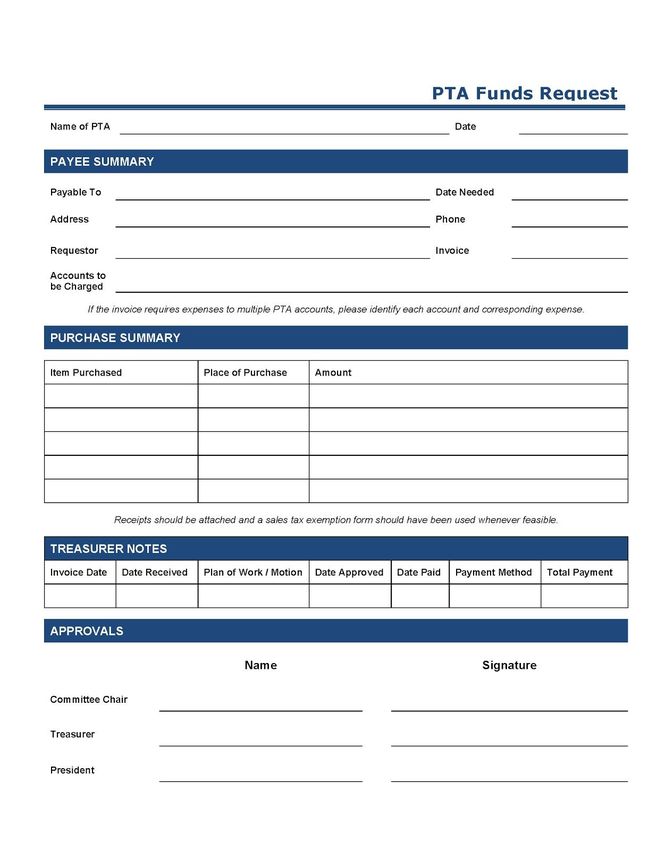
Sample PTA Funds Request              14

Reporting                             15

Sample Financial Report               16

When to Collect Sales Tax             22

Financial Reconciliation              24

Keeping Records                       26

Standards of Continuing Affiliation   27

Resources                             28

FAQs                                  29

Notes                                 32

                                       1
About PTA
VISION Every child’s potential is a reality.
MISSION To make every child’s potential a reality by engaging and empowering families and communities to
advocate for all children.
PURPOSES
● To promote the welfare of children and youth in home, school, places of worship, and throughout the
community;
● To raise the standards of home life;
● To advocate for laws that further the education, physical and mental health, welfare, and safety of children
and youth;
● To promote the collaboration and engagement of families and educators in the education of children and
youth;
● To engage the public in united efforts to secure the physical, mental, emotional, spiritual, and social
well-being of all children and youth; and
● To advocate for fiscal responsibility regarding public tax dollars in public education funding.
VALUES
● Collaboration: We will work in partnership with a wide array of individuals and organizations to broaden and
enhance our ability to serve and advocate for all children and families.
● Commitment: We are dedicated to children’s educational success, health, and well-being through strong
family and community engagement, while remaining accountable to the principles upon which our association
was founded.
● Diversity: We acknowledge the potential of everyone without regard, including but not limited to: age, culture,
economic status, educational background, ethnicity, gender, geographic location, legal status, marital status,
mental ability, national origin, organizational position, parental status, physical ability, political philosophy,
race, religion, sexual orientation, and work experience.
● Respect: We value the individual contributions of members, employees, volunteers, and partners as we work
collaboratively to achieve our association’s goals.
● Accountability: All members, employees, volunteers, and partners have a shared responsibility to align their
efforts toward the achievement of our association’s strategic initiatives.
PTA NATIONAL STANDARDS FOR FAMILY-SCHOOL PARTNERSHIPS
● Standard 1: Welcoming All Families into the School Community Families are active participants in the life
of the school, and feel welcomed, valued, and connected to each other, to school staff, and to what students
are learning and doing in class.
● Standard 2: Communicating Effectively Families and school staff engage in regular, two-way, meaningful
communication about student learning.
● Standard 3: Supporting Student Success Families and school staff continuously collaborate to support
students’ learning and healthy development both at home and at school, and have regular opportunities to
strengthen their knowledge and skills to do so effectively.
● Standard 4: Speaking Up for Every Child Families are empowered to be advocates for their own and other
children, to ensure that students are treated fairly and have access to learning opportunities that will support
their success.
● Standard 5: Sharing Power Families and school staff are equal partners in decisions that affect children and
families and together inform, influence, and create policies, practices, and programs.
● Standard 6: Collaborating with Community Families and school staff collaborate with community members
to connect students, families, and staff to expanded learning opportunities, community services, and civic
participation.
2Getting Started
QUICK-START ACTIONS
● Work with the outgoing Treasurer to review your responsibilities and become familiar with your Local PTA’s
financial practices.
○ Does our Local PTA file sales tax quarterly or annually?
■ Does the PTA have collected sales tax to remit?
○ What Form 990 will our Local PTA file this year?
○ Are there any outstanding or recurring bills of which I should be aware?
○ What software or ledger system does our Local PTA use?
● Become familiar with the approved budget and work with other officers to determine any needed
amendments before the new year begins.
● Develop a Plan of Work and submit it to the executive board for approval.
● Become an authorized signer on all bank accounts and ensure access to bank accounts and financial
records transition to the executive board.
● Provide guidance to incoming board members on best practices for your PTA.
● Sign the Texas PTA Confidentiality, Ethics and Conflict of Interest Agreement and submit to the secretary.
DUTIES AT A GLANCE
The treasurer is the authorized custodian of the funds of the association and should serve as chair of the Budget and
Finance Committee. A general overview of responsibilities may be found below.
● Study all references to duties and finances in the PTA bylaws, policies and standing rules.
● Ensure your Local PTA meets all requirements of the Standards of Continuing Affiliation.
● Keep an accurate and detailed account of all monies received and disbursed.
● Ensure all cash funds are counted by multiple individuals and documented with a Deposit Form. (Triplicate
Deposit Forms may be purchased from Texas PTA.)
● Keep on permanent file the PTA Employer Identification Number (EIN), as assigned by the IRS, and the
sales tax permit, as assigned by the Texas Comptroller.
● Present a financial report at all membership and executive board meetings.
● Make timely deposits to the PTA bank account.
● Reconcile monthly bank statements as soon as received from the assigned non-signer reviewer.
○ Statement Review by Non-Signer at txpta.org/treasurer
● Make disbursements in accordance with the budget, as adopted by the membership, and verify that each
transaction is accompanied by a PTA Funds Request Form and necessary documentation.
● Electronically file the appropriate Form 990 within 60 days of the end of the fiscal year.
● File sales tax returns to Texas Comptroller as required (annually, quarterly or monthly).
● Maintain a list of assets owned by the PTA.
● Submit all required items to the Financial Reconciliation Committee in a timely manner.
REQUIRED MONTHLY DUTIES
● Reconcile the checkbook to the bank statement.
● Reconcile any credit card or merchant accounts to the bank statement.
● Generate financial reports for executive board and/or membership meetings.
● Propose any budget amendments as needed.
● Deposit and expend funds as needed and record in accounting software/ledger.
● Record sales tax and state/national dues in escrow/liability accounts
● Coordinate with membership chair to report members/dues to Texas PTA
3Plan of Work
Officer/Chairman
Name:
Position: Treasurer Year: 2020-2021
Reproduce as needed for the appropriate number of goals.
Responsibilities Fill funds requests, make bank deposits, balance accounts, maintain Committee
/Duties: financial records and budget, file tax returns when applicable, make Members:
regular financial reports, and various support duties. Chair the Budget
and Finance Committee
Goal: To maintain the PTA financial records in such a manner that the Evaluation End of year
financial reconciliation committee finds the reconciliation process to be Process: review by financial
one of ease and organization. reconciliation
committee
Specific Action Steps Start Date Completion Date Budget
Regularly check the treasurer file and vault, process PTA funds Ongoing
request forms and make deposits quickly after receipt of funds.
Present financial reports at all regular membership and
executive board meetings.
Maintain (ledger or digital) financial records, update hard-copy Ongoing $100-$179 for
files, balance all accounts to bank statement monthly cloud based
financial
software
File returns (sales tax and Form 990) within published deadline Electronically file the
appropriate Form 990
within 60 days of fiscal
year end
Sales tax is due Jan 20
for annual returns and on
the 20th day of the
month following the end
of the quarter, if
quarterly.
Monitor committees expenditures and report to committee Ongoing
chairs monthly on budget status and provide documentation of
expenses.
Resources:
4PTA Budgets
A Budget and Finance Committee has the responsibility for developing a proposed budget for the PTA, and works to
ensure that all association funds are expended accordingly. This committee shall be appointed by the President
subject to the approval of the executive board, unless the PTA’s Standing Rules designate who may serve on the
committee. The treasurer shall serve as the Chair of the Budget and Finance Committee.
The budget is a financial representation of the activities and operations a PTA expects to conduct during the
association’s fiscal year, as determined in the PTA’s bylaws.
The association is obligated to use its funds for the purpose for which they are raised, and this purpose is to finance
PTA programs and service. PTAs may not raise funds for other organizations or individuals, no matter how worthy
the cause.
It is essential to have a budget in place at all times. A budget for the next fiscal year should be developed so that it
may be adopted at the final membership meeting of the current fiscal year. Without an approved budget, there is no
authorization to conduct business transactions of any kind until the first membership meeting is held, typically in
September.
It’s understandable that not all PTA plans will be finalized this far in advance, so the budget need only include those
income and expense items that have been planned at the time it is developed. At the first membership meeting of
the new school year, the treasurer presents an amendment to the budget to reflect any planned income or expense
that have been submitted to the executive board since the budget was first adopted. An amendment to the estimated
beginning balance may be necessary to reflect the actual beginning balance.
DEVELOPING THE BUDGET
The Budget and Finance Committee studies the current year’s budget vs actual report to determine how well that
the budget met the association’s needs, and considers requests for new programs or fundraisers. From this
information, the committee proceeds to develop the proposed budget for the next fiscal year.
The budget includes anticipated income, such as dues, donations, fundraisers and other merchandise sales.
Income and expenses should be categorized in detail so members have a clear understanding of how association
dollars are being spent. The following are some functions for which funds should be budgeted: leadership
training, insurance, advocacy, programs and parent education.
APPROVING THE BUDGET
After the budget has been drafted, it is presented by the committee chair to the PTA executive board for
consideration and then to the PTA membership for approval. The budget is presented, item by item, to allow for
discussion and amendment of each section. The approved budget must be recorded in the minutes of the
membership meeting. A majority vote of the members present and voting is required for approval.
AMENDING THE BUDGET
The approved budget serves as the financial guide for the fiscal year. Since the budget is only an estimate of the
planned expenditures and income for the year, adjustments (also known as amendments) may become
necessary from time to time.
Any time budgeted expenditures do not have sufficient funds in the line item to cover actual costs, the budget
must be amended and approved at a membership meeting before a check is issued for those expenses. The
same is true of the income items.
When income varies from the expected amount, be it more or less, the budget should also be amended to reflect the
correct revenue. If income is lower than projected, this amendment may necessitate a reduction in some expense
items to maintain a balanced budget. Amendments require a two-thirds vote by the membership for approval.
5Sample Budget
Terrific PTA
2020-2021 Proposed Budget
Beginning Balance $ 2,000.00
(Carry Over)
Income Membership: Local Dues Portion (250 members x 5.50) $ 1,375.00
Donation $ 250.00
Fundraisers
Fall Festival $ 4,000.00
Jean Bucks $ 1,000.00
Recycling Income $ 300.00
School Supplies $ 8,000.00
T-Shirts $ 2,000.00
Income Subtotal $ 16,925.00
Total Income $ 18,925.00
Expenses Bank Fees $ 72.00
Council Dues $ 75.00
Clothes Closet Donation $ 100.00
Credit Card Fees $ 80.00
Fall Festival $ 1,000.00
Hospitality (PTA Meetings) $ 200.00
Jean Bucks-Printing $ 50.00
Insurance $ 400.00
Leadership Training $ 1,200.00
Legislative Action (Rally Day) $ 400.00
Life Membership $ 125.00
Membership (Flyers, envelopes) $ 150.00
Newsletter $ 700.00
Parent Education $ 100.00
PTA Administrator (paper, supplies) $ 150.00
Reflections Awards $ 300.00
School Supplies (fundraiser) $ 6,000.00
Scholarships $ 500.00
Student Programs $ 2,500.00
T-Shirts (fundraiser) $ 1,800.00
Teacher Appreciation $ 900.00
Website $ 125.00
Total Expenses $ 16,927.00
Balance to Carry Forward to 2020-2021 $ 1,998.00
Total $ 18,925.00
* This is a sample report. The PTA’s budget report may look different depending on the accounting software the PTA uses.
6Handling Money
SAFEGUARDING CASH
● For the protection of both the PTA and its volunteers, PTA funds should always be counted and verified by
the signature of two individuals prior to deposit. Triplicate deposit forms are available on Texas PTA’s
online store. All signers should retain a copy of the completed deposit form. One of the counters may be
the PTA treasurer.
● Deposits should be processed as soon as possible, following receipt. If same-day or night deposits are not
possible, all monies should be kept in a secure location and never at a volunteer’s home. A safe or vault at
the school is an option for temporary security.
● Texas PTA recommends the adoption of standing rules or a policy to determine the cash handling
procedures for your PTA. If a separate policy, it must be reviewed and adopted annually by the
membership.
● It is strongly recommended the PTA purchase a fidelity bond to insure the treasurer and all other persons
authorized to handle funds of the association. The bond should be in an amount based upon the PTA’s
annual income and determined by the executive board.
● If the PTA suspects theft/fraud has occurred, a financial reconciliation must be conducted, and the PTA
must follow the Texas PTA Theft and Fraud Policy. https://www.txpta.org/policies
BANKING
● PTA money cannot be mingled with other funds. It must be kept in a PTA bank account at a financial
institution approved by the executive board, and in an account in the PTA’s name. The money of another
group or organization is never deposited into a PTA account. Any request to use a PTA bank account,
even if it costs the PTA no money, is unacceptable and possibly illegal.
● PTAs should adopt a check-signing policy or include in the standing rules to determine the number of
signatures required, amount thresholds and other stipulations as needed.
● The treasurer is an authorized signer on all bank accounts. Many school districts do not permit employees
to be signers on the bank account even if they are officers of the association. Check with your school
district about their specific volunteer policies.
● Individuals authorized to sign on the bank account cannot be related by blood or marriage or
reside in the same household.
● PTAs are authorized to remit payment electronically to Texas PTA and via WebFile to the Texas
State Comptroller, even if the PTA has not adopted electronic banking policies
E-COMMERCE: ELECTRONIC BANKING AND MERCHANT SERVICES
Visit txpta.org/policies for detailed information on the following:
● Online Statement Review
● Use of Credit/Debit Cards
● Electronic Banking
A PTA’s membership must vote to authorize e-commerce transactions by amending their standing rules or, in the
absence of standing rules, adopting a separate policy. PTAs should note that all adopted policies must be
reviewed and adopted annually by the membership.
PTA’s who vote to authorize one or more of the e-commerce options must include the corresponding language in
the standing rules or policy.
7Deposit Form
8Protecting Your PTA with Insurance
Texas PTA strongly encourages PTAs to obtain adequate insurance protection against liability and financial loss due
to fraud, embezzlement, or dishonest acts.
Texas PTA negotiated a group discount with association Insurance Management (AIM) (800-876-4044) to obtain
insurance coverage at affordable prices. Similar coverage may be obtained from any insurance company, locally or
otherwise.
AIM offers the several types of coverage listed below and PTAs may secure any combination of coverage at any
time during the year. Additional information may be found on the website https://www.txpta.org/pta-insurance
EVENT/GENERAL LIABILITY COVERAGE
● $1,000,000 OR $2,000,000 liability coverage per occurrence.
● $5,000 per person medical payment (no deductible)
● Option for increased medical payments: $10,000, $ 25,000, and $ 50,000
Event/General Liability covers fall carnivals, bounce houses, dunking booths, fun runs, skating parties, auctions, and
more.
DIRECTORS & OFFICERS LIABILITY COVERAGE
● $1,000,000 liability limit
● $1,500 deductible
If someone sued the officers of your PTA for mismanagement, misrepresentations, dissemination of false or
misleading information, or inappropriate actions, this coverage would pay to defend them against those actions.
EMBEZZLEMENT COVERAGE (FIDELITY BOND)
● Coverage available $10,000, $25,000 and $50,000
● $250 deductible
Embezzlement Insurance (bond) covers monetary losses sustained by a PTA through any fraudulent or dishonest
act(s) or embezzlement committed by any of the elected officers, members and volunteers.
PROPERTY COVERAGE
● $10,000, $ 20,000 and $ 50,000 Property Insurance Limit
● $250 deductible
Property Insurance covers items such as raffle merchandise, auction items, and fundraising supplies while in your
PTA's care, as well as your PTA’s personal property like popcorn machines, school store supplies, emergency relief
supplies, and more.
9Raising Money
Most PTAs need to raise funds to provide programs and services throughout the year; however, fundraising efforts
should not be the primary emphasis for PTAs. Fundraising efforts should be in response to supporting approved
PTA work rather than driving the goals of the PTA. To help ensure proper alignment with our Purposes, Texas PTA
recommends that PTAs engage in three programs or service projects for each fundraiser activity hosted.
There are many different methods to raise funds and PTAs will be approached by numerous external groups that
offer their products and services to assist the PTA in raising money. It’s important that PTA Leaders evaluate these
opportunities carefully and consider all legal and community-related implications.
When using a fundraising company, protect the PTA by having all information in writing. A contract protects you, the
association and the fundraising company. With a contractual agreement, all parties assume responsibility for
complying with the terms, but the PTA also begins with a clear understanding of who handles what. Make sure the
contract is clearly an agreement between two organizations, not two individuals. Contracts are only signed by the
President with board approval and the signer adds their title after their name to show they are signing for the PTA.
Here are some things to look for when reviewing the contract: Double check all the numbers (cost and profit
percentages), approved promotional materials listed, desired services included, what is the procedure for handling
damaged, unsold or returned merchandise, and dates for delivery, payment due consistent with verbal agreements.
NONCOMMERCIAL POLICY & CO-VENTURING
PTA bylaws include the requirement to be noncommercial.
● The name “PTA” is not to be used in conjunction with the commercial activities of other organizations,
including the promotion of their goods or services.
● A PTA does not raise money for other organizations or individuals, no matter how worthy their cause.
Commercial Co-Venturing is becoming a popular form of fundraising for PTAs. Commonly, a business will
advertise a cooperative fundraising effort in which a portion of their sales will be forwarded to the PTA as a
gift. The size of the gift is determined by how successful the business is in selling its product or service.
● Given PTA’s noncommercial policy, the only appropriate role in such a venture is a passive one. The PTA
must refrain from active promotion or marketing of the business’s products or services and do no more than
inform members of the agreement.
● Structure agreements in such a way as not to appear as an endorsement of a product or company. If this is
not possible, the PTA should not enter into the agreement.
BINGO
PTAs must consider all the regulations before committing to a Bingo event and should avoid participation unless
they can assure complete compliance. Detailed rules may be obtained from the Texas Lottery Commission (TLC) by
requesting a copy of the Bingo Enabling Act, the Charitable Bingo Administrative Rules and the Bingo Operations
Manual. You will also need to request a Texas Application for a Temporary License to Conduct Bingo in the event
you decide to go ahead with the process. Even if the games are just for fun, where no entry fees are collected, a
license is still required.
The TLC must receive the application and all attachments at least 30 days prior to your first event. To obtain forms
call the Charitable Bingo Division of the Texas Lottery Commission at 800 - BINGO77 (800-246-4677). You may not
advertise a Charitable Bingo prior to actually receiving your license.
10RAFFLES
Chapter 2002 of the Occupations Code, the Charitable Raffle Enabling Act, permits and regulates “raffles,” which it
defines as “the award of one or more prizes by chance at a single occasion among a single pool or group of persons
who have paid or promised to pay a thing of value for a ticket that represents a chance to win a prize.”
Raffles do not require a license. Local or Council PTAs must be in existence for at least three years before they can
conduct a raffle. According to a Texas Attorney General, they are a legal activity for a PTA provided each of the
following regulations is followed:
● Each ticket must have printed on it the name and address of the PTA, name of an officer, the price of the
ticket and a description of each prize valued at $10 or more. No prize may be valued in excess of $50,000.
● A PTA may hold no more than two raffles per year and only one at a time.
● Tickets may not be advertised statewide or through paid advertisements.
● A raffle prize may not be cash.
● The PTA must have the prizes in its possession or post a bond for the full value with the county clerk.
● Only members of the sponsoring PTA may sell tickets or an authorized representative.
● The PTA must complete a W2-G form to turn into the IRS if the prize exceeds $600. A W-9 must be
completed by the winner or backup withholding at the rate of 31% must be collected by the PTA. Provided
the prize value is less than $5,000 and a W-9 is completed by the recipient, the PTA is under no obligation to
collect tax.
● No one may be compensated directly or indirectly for organizing or conducting a raffle or for selling raffle
tickets.
DONORS AND CHARITABLE CONTRIBUTIONS
PTAs must be prepared to issue receipts for contributions made, regardless of the amount or value. Canceled
checks are no longer sufficient. There is no required format for the receipt and Social Security Numbers are not
required. At a minimum, the receipt must reflect the donor's name, date, cash amount received or a description of
the property received (but not the value), a statement that no goods or services were provided by the organization in
return for the contribution and has the PTA’s name on the receipt. If a donor receives value of goods or services for
the donation, only the portion in excess of the value is deemed a donation. A description and good faith estimate of
the value of goods or services, if any, that an organization provided in return for the contribution must be included in
the written acknowledgement. A donor cannot claim a deduction of $250 or more unless the donor obtains a written
acknowledgement of the contribution. Sample donation receipt/acknowledgement may be found at
www.txpta.org/treasurer
PTAs are required by IRS disclosure rules to inform prospective donors about the extent to which their contributions
are legally tax deductible.
If a PTA holds a fundraising event that provides a meal or some tangible item in return for the purchase of a ticket,
then the portion of the ticket that is tax deductible is the ticket price less the fair market value of the meal or item
received. For example, if a spaghetti supper ticket sells for $20 and the value of the meal is determined to be $5, the
purchaser is entitled to a $15 charitable contribution deduction. The $5 is not the cost to the PTA, but the value of a
prepared and served meal allowing for a reasonable profit.
RECORD KEEPING AND REPORTING
To comply with IRS reporting requirements, complete records must be kept on all monies received and all
expenditures for seven years after the date the PTA’s return is filed.
11Spending Money
● The PTA membership must authorize the expenditure of all funds by approving and amending the budget
throughout the year.
● Purchases should never be paid with cash.
● Check signers should never sign a blank check or issue disbursement without receipts or sufficient written
documentation.
● Checks should never be made payable to “cash”. If cash is needed for a specific event, the event chair
should complete a PTA Funds Request for cash. The check should be made payable to the volunteer who
will be responsible for the till.
● Authorized signers on the bank account(s) may not sign a check where he or she is also the payee.
MAKING DONATIONS
While a PTA may never donate money to any individual person or family, we may work cooperatively in coalitions if
the purpose is within the Purposes of PTA.
PTA policy concerning nonpartisan, nonsectarian and noncommercial activity must be followed.
Small token donations may be made to another group provided all of the following criteria are met:
● The PTA membership votes to make the donation.
● The group has 501(c)(3) status and PTA has documentation to prove that.
● The group shares at least one common purpose with PTA (i.e. to promote the health, education or welfare of
children, provide parent education or raise the standards of home life).
GIFT CARDS/GIFT CERTIFICATES
Any gift cards purchased by a PTA should not exceed $25 in value and must be retail-specific (i.e. branded cards of
restaurants, stores, etc). Generic cards (MasterCard, Visa, etc) are not permitted.
Gift cards are cash equivalents, so PTAs should exercise the same care when storing and distributing gift cards.
If a gift card is donated to the PTA for the purpose of subsidizing association expenses, complete a PTA Funds
Request Form with receipts attached for the Financial Reconciliation Committee to verify that funds were spent
appropriately.
DONATIONS TO SCHOOLS
Texas PTA has a policy that PTAs never turn funds over to the school to be spent at their discretion. There are times
when the best decision is to give funds to the school for a designated purpose. Oftentimes, schools can purchase
items at a significant discount where, if the PTA writes the check, they will have to pay full retail price. Other times,
PTA may decide to fund a portion of a purchase the school is making. When the best fiscal decision is to have the
school make the purchase, there are certain guidelines that must be followed:
1. The membership approves the gift to be made and its purpose.
2. Funds are only given for a specific, designated purpose agreed to in writing between the PTA president and
the appropriate school official. Some district policies require that gifts be made to the district and not a local
campus. Some school districts will not allow a gift to be made for a certain purpose. Local school district
procedures and policies may require that these forms be modified.
123. The written agreement specifically states the nature of the item to be purchased, the manner in which it is to
be used, the timeframe within which it to be procured, the agreement to provide PTA with a copy of the
invoice, the agreement that any excess funds will be returned to the PTA, and the agreement that all funds
will be returned to PTA if any of these terms are not met. It also includes the agreement as to who is
responsible for installation (if applicable), maintenance, and insurance.
Sample donation to school/district agreement may be found at www.txpta.com/treasurer
PLAYGROUND EQUIPMENT
If a PTA purchases and installs the playground equipment, the liability remains with the PTA regardless of any
exemption statements made by the campus principal or school. It is important to note that Texas schools may not be
sued.
Texas PTA advises all Local PTAs interested in purchasing playground equipment for their campuses to obtain
membership approval for the purchase.
If funds are approved, the PTA should forward a check to the school and indicate that the funds are earmarked for
playground equipment. The school will then choose the company for which to purchase the equipment and the
contractor to install the equipment.
FIELD TRIPS
Field trips are a great way to give back to your school community. However, whether the field trip is the PTA’s event
or the PTA gifts money to the school for a field trip, you could face liability. Gifting money to the school significantly
reduces liability but is no guarantee the PTA will not be held liable. Please review the information provided by AIM
Insurance by clicking the link Field Trips: What You Should Know or by visiting https://www.txpta.org/pta-insurance
MOVIE LICENSING
All movies that are shown in public require a license to be shown. If you are sponsoring a family movie night,
admission free, you must pay for a license to show the movie in public. Even if you own the DVD, you must have a
license to show the movie in public.
Some schools already have a license which would cover your showing, you should check with school administration
when planning to show a movie.
Many organizations that host public showings of movies, get their license and even rent the movie from Swank.
www.swank.com
There are serious fines and penalties for not having a license, so check before you schedule a showing.
13Sample PTA Funds Request
14Reporting
PTA FINANCIAL REPORT
The bylaws require that the treasurer present the financial report at membership meetings, executive board
meetings, and other times when requested by the executive board or the members. Reports must be given at every
meeting for all accounts; not just the general account. This written report indicates the period of the fiscal year the
report covers, the date it was prepared, and by whom. Separate reports are prepared for executive board meetings
and membership meetings, so the reports will have different reporting periods.
● Start with the balance on hand at the beginning of the year or the balance from the last meeting date.
● List all receipts in detail and total; itemize all disbursements and total.
● End with the balance on hand as of the date of the report.
Copies of the report are distributed to the members in attendance, when possible. This report is not adopted but
filed. The reports are provided to the financial reconciliation committee during the financial reconciliation process and
are maintained permanently. A copy is retained by the treasurer and another copy retained by the secretary, to be
placed with the minutes.
BUDGET VS ACTUAL REPORT
The budget vs actual year to date report should be printed or electronically displayed at each meeting, along with the
financial report, to provide members with a clear understanding of how the PTA is performing financially in
comparison with the approved budget. The executive board will use the budget report to determine if any budget
amendments may be required. The budget vs actual report does not have to be verbally presented at each meeting,
but it should be available for members to view.
Preliminary and Final Annual Report
The treasurer makes a preliminary annual report to the membership at the annual meeting, which is the final meeting
of the year. However, this report is for information only and is not officially adopted. The report looks just like the
annual budget, but with year-end actual figures. It is presented in a format comparing actual figures to the approved
budget as amended. At the close of the local PTA’s fiscal year, this report is finalized and provided to the financial
reconciliation committee.
The incoming treasurer presents the finalized annual report at the first membership meeting of the new year. The
financial reconciliation committee presents the financial reconciliation at the same meeting. The annual report and
the financial reconciliation report are filed after the association has formally adopted the financial reconciliation
report.
15Sample Financial Report
Terrific PTA
Financial Report- July 1, 2020 to September 19, 2020
Beginning Cash Balance: 7-1-20 $ 2,701.76
Income
Membership: Local Dues Portion (156 x 5.50) $ 858.00
Donations $ 75.00
School Supplies $ 7,986.00
T-shirts $ 1,460.00
Total Income: $ 10,379.00
Total Available Funds $ 13,080.76
Expenses
Bank Fees $ (12.00)
Council Dues $ (75.00)
Clothes Closet Donation $ (100.00)
Credit Card Fees $ (56.32)
Leadership Training $ (1018.34)
Membership Promotion - flyers, envelopes $ (26.51)
PTA Administration – Paper, supplies $ (16.78)
School Supplies (fundraiser) $ (5986.25)
T-shirts (fundraiser) $ (1678.00)
Teacher Appreciation $ (87.69)
Total Expenses $ (9,056.89)
Ending Balance September 19, 2020 $ 4023.87 ***
Receipts not belonging to PTA:
State and National Dues Escrow/Liability $ 702.00
received
State and National Dues Escrow/Liability $ (702.00)
payments
Ending Balance State and National Dues $ 0.00
Sales Tax Escrow/Liability received $ 27.88
Sales Tax Escrow/Liability payments $ 0.00
Ending Balance Sales Tax Escrow/Liability $ 27.88 ***
* This is a sample report. The PTA’s financial report may look different depending on the accounting software the PTA uses.
***Remember the balance in the bank is $4023.87 + 27.88 = $ 4,051.75 according to this report.
16IRS GROUP EXEMPTION
In a ruling dated September 14, 1967, the Internal Revenue Service held that Texas PTA and its PTAs are
exempt from federal income tax under the provision of Section 501(c)(3) of the Internal Revenue Code of 1954. As a
result of this ruling, Local and Council PTAs are not required to file Form 1023 to obtain this status. This ruling
further holds that contributions to Texas PTA and its Local or Council PTAs are deductible to the donor as charitable
contributions for federal income tax purposes.
Texas PTA is required by law to report annually to the Internal Revenue Service a list of all PTAs in good standing
with the state PTA. The PTAs listed are covered by our group exemption. In order for a PTA to be considered in
good standing, they must be in compliance with the Standards for Continuing Affiliation as published on the Texas
PTA website. Any PTAs not listed would be subject to income tax on all earnings.
For requests for a copy of the IRS Determination Letter and a Letter of Good Standing, please contact
finance@txpta.org and include your contact information, and your Local PTA name, city, and Local PTA ID number.
FEDERAL EIN
Each PTA will be issued a nine-digit tax identification number, known as an Employer Identification Number (EIN), or
federal ID number. Texas PTA provides this number at the time a Local PTA is organized. A PTA’s EIN is a part of
the permanent records of the PTA and is kept on file with Texas PTA. The PTA Bylaws will list the EIN assigned to
the PTA. All EINs are reported to IRS annually to identify those PTAs covered by the Texas PTA group exemption.
The EIN is used for all bank account(s), and certificates of deposit(s) of the PTA. The number is also required when
filing the appropriate 990 form or applying for a State of Texas sales tax permit. Please be sure to use the PTA’s
EIN, not Texas PTA’s EIN, when filing your 990.
FORM 990
A PTA’s gross receipts in a given fiscal year determine the appropriate Form 990 that should be filed. Gross receipts
are defined as the total amount the association receives from all sources during its annual accounting period without
subtracting any costs or expenses. Sales tax collected, state and national dues, and any carryover from the
previous year are not a source of revenue to the Local PTA and are not included in the calculation.
The Form 990 is an informational return only. No tax will be due if filed timely and accurately. The last three years
returns are required to be available for public inspection upon request or copies will be mailed for a nominal copying
and postage fee. If you are assessed penalties for failure to file, contact the Texas PTA office for assistance prior to
paying.
Failure to file the Form 990 for three consecutive years will result in the PTA’s tax-exemption being revoked. While
the IRS provides a filing deadline no later than four and a half months after the end of the fiscal year, Texas PTA
requires that PTAs file their 990 electronically within 60 days of the end of the fiscal year. The Taxpayer First
Act, signed into law July 1, 2019 requires all form 990s to be filed electronically
PTAs must file one of three Form 990s annually:
● 990-N: Gross receipts are normally $50,000 or less per year;
● 990-EZ: Gross receipts greater than $50,000 but less than $200,000 per year; or
● 990: Gross receipts more than $200,000 per year.
PTAs with gross receipts normally less than $50,000 will need to file the 990-N electronically directly with the IRS. If
the PTA is at least 3 years old and averaged $50,000 or less in gross receipts for the immediately preceding 3 tax
years (including the year for which calculations are being made), the PTA may file the 990N.This notice asks for a
17few basic pieces of information:
● the organization’s taxpayer identification number (EIN)
● its tax period (fiscal year)
● legal name (PTA Texas Congress), mailing address and DBA (Local PTA Name)
● a website address if one exists
● the name and address of a principal officer (president’s name and school’s address) and
● a statement confirming that the organization’s annual gross receipts are normally $50,000 or less.
● The 990-N filing guide and a youtube video on how to file are located on the Treasurer’s page of our
website at www.txpta.org/treasurer.
● Filing on the IRS website is free of charge.
990-EZ / 990
PTAs with gross receipts more than $50,000 but less than $200,000 will be required to file the 990-EZ. PTAs with
gross receipts more than $200,000 will be required to file the 990.
The Taxpayer First Act, signed into law July 1, 2019 requires all form 990s to be filed electronically. Texas PTA
recommends using a service such as efile.form990.org to file your 990EZ. This service is free if your gross receipts
are $100,000 or less and $38 for gross receipts from $100,001 to $500,000. Filing electronically will also help ensure
your PTA meets the filing requirement of the Standards of Affiliation in a timely manner.
PTAs filing Form 990-EZ should be able to do so electronically, without the assistance of a paid preparer. If filing a
full Form 990, PTAs should engage the services of a licensed tax preparer and file electronically.
When completing the Form 990-EZ / 990, two numbers must appear on page one in the appropriate place. The first
number is the Texas PTA group exemption number (GEN) 1889. The second number is the Local or Council PTA’s
Employer Identification Number (EIN). Do not use Texas PTA’s EIN when completing the return.
Schedule A must be completed and attached to the Form 990/990-EZ. Due to the group nature of our exemption, all
PTAs are considered nonprofit for the same reason. Therefore, all PTAs must check the box (currently Box 10) in
Part I of Schedule A indicating the reason for public charity status.
Some Local and Council PTAs may be required to file a Schedule B if they meet the requirements. To determine
whether your PTA is required to file Schedule B, first complete your PTA’s form 990/990-EZ. Organizations that
received $5,000 (in money or property) from any one contributor will be required to file Schedule B. Refer to the IRS
instruction booklet for Schedule B for line-by-line instructions on how to complete Schedule B. If your PTA does not
meet these requirements check the box (currently Box H) on the 990/990-EZ.
If the Local or Council PTA reported more than $15,000 from total gaming on line 6 a, and/or $15,000 or more from
fundraising and special events line 6 b, then Schedule G, Parts II and III must be attached to Form 990- EZ/990.
In addition, all PTAs are required to complete Supplemental Schedule O. This schedule lists other expenses not
included in Part 1, Lines 10-15 with a total that agrees to Part 1, Line 16 of the 990-EZ/990.
CHANGE IN ACCOUNTING PERIOD
A PTA may change its year-end by adopting a bylaws change. Until the bylaws change has been adopted by the
membership and approved by Texas PTA, the IRS cannot be notified of this change in year-end.
When changing a fiscal year, the PTA will need to file two Form 990s. One reflecting the old fiscal year, and a
second one for the month(s) between the previous fiscal year end and the new fiscal year end. For example: If a
PTA wishes to change from a May 31 to a June 30 year-end, a Form 990/990-EZ would be filed for the 12 months
18ending May 31 as usual. Additionally, a Form 990/990-EZ would be filed for the short year of one month ending June
30. Thereafter, returns would be filed for years ending June 30. On the other hand, if a PTA wishes to change its
year-end from June 30 to May 31, the returns would have been filed for the previous year-end as of June 30.
Another return would be submitted for the short year ending May 31 for 11 months, and thereafter every 12 months
ending May 31. The returns for the short year have the notation “Change in Accounting Period,” noted at the top of
the return.
If a PTA has changed its year-end previously within the last 10 years and was required to file a 990, it must now file
Form 1128 to request IRS approval to change its year-end. Additionally, Form 990/990-EZ is filed for the short year,
and a bylaws amendment to reflect the change is adopted.
If the PTA is required to file a 990-N, the treasurer observes that the fiscal year does not match with the fiscal year
designated in the local bylaws, contact the Texas PTA Finance Department and Texas PTA will notify the IRS. This
correspondence will correct the error and have the appropriate year-end on file with the IRS. The fiscal year cannot
be changed on the 990-N.
FORM 1099-MISC
All PTAs are required to file Form 1099-MISC with the IRS if they pay an individual or unincorporated business $600
or more during a calendar year for services rendered. An example where this would apply is for paid guest speakers.
A 1099 is not required when payments are for the purchase of merchandise. The Form 1099- MISC must be sent by
the PTA to the payee on or before January 31 of each year and filed with the IRS along with Form 1096 by February
28 of each year. The Form 1099 includes the name and address of the payee, his or her social security number or
EIN, and the total amount paid during the calendar year. Form 1096 is a summary of all 1099-MISC issued by the
PTA during a calendar year. Even if only one 1099-MISC was issued by the PTA, a 1096 must still be completed.
To obtain the above forms, visit the IRS website, www.irs.gov or call the toll-free Customer Account Services at
877-829-5500.
State Taxes
EXEMPTION FROM PAYING SALES TAX
PTAs are not required to pay the Texas sales tax on items purchased for use in presenting programs or carrying on
the work of the PTA. This exemption was granted to Texas PTA and covers all PTAs in good standing.
All PTAs in Good Standing should be individually listed with the Texas Comptroller’s office. You can verify if your
PTA is listed at https://comptroller.texas.gov/taxes/exempt/search.php If your PTA is not listed and wants to be listed
individually, complete the the Form AP-207 with the Texas Comptroller’s Office.
When PTA members purchase items for the PTA, they present an exemption certificate to the retailer to remove the
sales tax. Some retailers have their own certificates and will request the purchaser to sign it. The state of Texas
does not issue exemption numbers, and, therefore, your exemption certificate requires no number to be valid.
However, retailers will often ask for a tax exemption number. The information that the
retailer needs is the eleven-digit Texas Taxpayers Identification Number issued by the Texas Comptroller. This
allows the Texas Comptroller’s office to verify that any tax-free sales were legitimately sold to a tax-exempt entity.
You do not have to have a sales and use tax permit, which is needed to collect and remit sales tax on sales of
taxable goods and services, in order to have a Texas Taxpayer Identification Number.
EXEMPTION FROM PAYING STATE HOTEL OCCUPANCY TAX
Texas PTA and its affiliates are exempt from the state hotel occupancy tax, but are required to pay the local hotel
occupancy tax. To avoid paying the state tax, provide the hotel with a completed hotel occupancy exemption
certificate and a copy of the letter from the Texas Comptroller’s office granting this exemption.
https://comptroller.texas.gov/taxes/exempt/search.php
19COLLECTING AND REPORTING SALES TAX
A Local or Council PTA is required to have a sales and use tax permit if the PTA sells tangible items, such as
handicrafts, candles, t-shirts, cups, books and school supplies other than on the designated tax-free days. Before
submitting an application for a sales and use tax permit, the PTA must be listed as a tax-exempt entity on the Texas
Comptroller’s website. If the PTA is not listed, complete and submit Form AP-207.
The permit is issued from the Texas Comptroller’s office. The form requires the Local PTA’s EIN to complete the
application. It is recommended that the school address be used for the application, returns and correspondence.
Once a PTA has received a sales and use tax permit, the PTA must file the required reports, either quarterly or
annually, even if the amount of sales tax collected is zero.
Make at least two copies of the permit. File one copy with the treasurer’s permanent records, and give the other
copy to the fundraising chair or coordinator to display during the activity. There is no fee for the permit, and it
remains valid until a request to cancel it is made by the PTA or cancelled by the Texas Comptroller. When your
permit is issued, you will be assigned a reporting period. This could be monthly, quarterly or annually, depending on
your sales volume. Most PTAs are on an annual filing basis; therefore, their returns are due on January 20 for the
previous calendar (January-December) year. If the due date falls on Saturday, Sunday, or a legal holiday, the return
may be postmarked on the next business day and still be considered timely. The return must be filed if you have a
permit, even if you have no sales tax due during the reporting period.
● Total sales will equal the amount of PTA receipts as a result of the sale of tangible property. PTA
membership dues, an admission price to an event or donations are not considered sales. Total sales will
be the accumulation of the income from items such as spirit wear, school supplies, cookie dough sales
and school store merchandise.
● Taxable sales are the total receipts of goods on which sales tax should be collected.. In the bullet above,
the cookie dough fundraiser sales would not be included as taxable sales because cookie dough is
non-taxable. . Any taxable sales that occurred during the two tax-free days would not be included in this
calculation as well.
● Because the Texas Comptroller requests computation on income in whole dollars only, there will be a
difference in the amount collected and what is remitted to the Texas Comptroller. In addition, there is a
.05% deduction for paying timely. Once sales tax is paid, there is always a small amount left in sales tax
escrow that remains as a part of the PTA’s income. The PTA should zero out the balance in the sales tax
escrow/liability account and increase the donations income by that same amount.
A PTA purchasing taxable items for resale must first obtain a sales tax permit and issue a resale certificate to the
seller in lieu of paying sales tax. A PTA does not have the option of paying the sales tax when the merchandise is
purchased in order to avoid collecting the sales tax as merchandise is sold. When the items are resold, the PTA
must collect and remit the sales tax to the Texas Comptroller unless the taxable items are sold only during a tax-free
day. If taxable items are sold only on the tax-free day, an exemption certificate is given to the seller rather than the
resale certificate.
The following items are not subject to sales tax:
● PTA food sales made at a PTA fundraising event are exempt from sales tax unless the PTA is in direct
competition with a retailer required to collect sales tax. In this circumstance, the PTA would be required to
collect sales tax as well.
● There is no tax on admission tickets (including those at carnivals); fees or raffle tickets provided all the
proceeds go directly to the PTA.
● Student directories, yearbooks, cookbooks, and any other publications of the PTA are exempt from sales tax.
A PTA may participate in the annual State Sales Tax Holidays if they are selling items included in this event.. In
addition to clothes,footwear and some backpacks, Texas families also get a sales tax break on most school supplies
20priced at less than one hundred dollars ($100.00) purchased for use by a student in an elementary or secondary
school. These days would not count as one of your two tax-free days.
For more information, visit the Texas Comptroller’s website. Generally, profit is not a factor in determining if sales tax
must be collected and remitted to the state on the sale of an item. The exception to this general rule is when a PTA
purchases food from a for-profit business and turns around and sells it at no markup to its members. In this
circumstance, the sales are not exempt from the collection of sales tax. PTA cannot act as a conduit to circumvent
the collection of sales tax on a sale that in no way is benefiting the PTA.
An example would be if PTA purchases pizza from a restaurant and sells it to members at a meeting as a
convenience to provide dinner.
● If the PTA purchases the pizza from the restaurant and sells it to their members for the exact same price the
restaurant sells it for, tax must be collected. A resale certificate is given to the restaurant because PTA is
going to resell the pizza.
● If the PTA were purchasing the pizza to provide dinner at the expense of the PTA (the membership would not
pay for the pizza), the PTA would be exempt from paying the sales tax.
● If the PTA purchases the pizza from the restaurant and sells the pizza for a profit, then no tax would be
collected.
Any of the above taxable items could be deemed not taxable if sold on one of the PTA’s two tax-free days. Every
PTA is entitled to sell taxable items as nontaxable on two days (or 24-hour periods) per calendar year. These days
are determined and designated in the PTA’s minutes, prior to the beginning of the sale.
Most PTAs file returns annually or quarterly. Annual returns are due on the 20th of January and quarterly returns on
the 20th of the month following the end of the quarter. There are penalties for late filing.
PTAs are authorized to submit sales tax electronically to the Comptroller via WebFile, even if the PTA has not
adopted electronic banking policies.
Note: If you are selling items that the collection price includes sales tax, you must inform the purchaser that sales tax
has been included in the price. All information must state, “Sales tax included in price.”
21When to Collect Sales Tax
Taxable Nontaxable
Cookie Dough X
Popcorn, popped * X
Spaghetti supper X
Concession sales* X
Raffle tickets X
Cookbooks produced by the PTA X
Cookbooks purchased for resale X
Student directories produced by the PTA X
Other writing and publications of the PTA X
Gift wrap X
School supplies X
T-shirts X
Admission ticket (if the PTA is the provider of the amusement) X
Admission ticket (if the PTA is not the provider of the amusement) X
Discount Coupons X
Horticultural products such as flower arrangements, roses, carnations, X
holiday greenery and poinsettias
Agricultural products (plants and seeds), the products of which ordinarily X
constitute food for human consumption
Pumpkins from the pumpkin patch X
Pumpkins that have been carved, painted or decorated X
Books (not written by the PTA) X
Silent Auction items - DEPENDS ON THE ITEM AUCTIONED X X
Garage sale items X
Pictures with Santa X
Booth rental fee X
Confetti eggs at carnivals X
Face painting X
Educational activities such as coloring, painting, crafts X
Gift items sold at Santa’s Workshop X
Sales of magazine subscriptions sold for a semiannual or longer period (six X
months or greater) and entered as second class
Sales of magazine subscriptions sold for a shorter subscription period (less X
than six months) and sales of individual issues
* - These items would be taxable if the PTA is not the determined seller by both purchasing inventory AND
determining the sales price.
Additional information from the Texas Comptroller’s Office regarding sales tax and fundraisers may be
found under Resources at txpta.org/treasurer
22TAX-FREE DAYS
PTAs may hold two, one-day (24-consecutive hour), tax-free sales (for which the PTA is the determined seller) or
auctions each calendar year. These sales or auctions are designated in the executive board or membership meeting
minutes. Sales of otherwise taxable items made during the 24-hour period designated as the tax-free sale or auction
need not be taxed.
The Texas Comptroller’s office has ruled that brochure/catalog sales are not eligible for tax-free declaration by the
PTA because, for these sales, the PTA is acting as an agent for the vendor, who is the seller. The PTA collects sales
tax on the sales price and remits it to the vendor to remit to the Texas Comptroller’s office.
The PTA is the seller when a for-profit fundraising company does not coordinate the fundraising; the PTA is not
using the marketing materials of a fundraising company, such as brochures and order forms; the PTA purchases
inventory from a vendor for a certain price; the PTA resells those items at its own profit or loss and assumes all
responsibility and risk. When the PTA is the seller and not acting as a representative of a for-profit fundraising
company, the PTA is responsible for the proper collection and remittance of any tax due. The PTA may take
advantage of the one-day, tax-free sale provision if appropriate.
The Texas Comptroller’s office has ruled that PTAs may consider advance-order sales fundraisers as one of their
tax-free days, provided the following criteria are met:
● All orders must be submitted by the PTA to the supplier prior to the delivery of the merchandise.
● All merchandise must be delivered to the PTA by the supplier on one day (need not be the same day as
indicated above).
● The merchandise must be delivered to the purchaser over a reasonable period of time. Texas PTA
recommends this period of delivery not to exceed three weeks.
● The tax-free day is the day of delivery to the PTA, or the day of delivery to the customer if the delivery occurs
on one day and not over a multi-day event. The PTA may decide which of the two options they prefer.
A tax-free sale must not be a year-long activity, such as a school store.
23Financial Reconciliation
A financial reconciliation reviews all financial transactions to ensure that expenditures are properly documented
and conform with the approved budget and the PTA’s governing documents. Each PTA bank account should have
its own reconciliation report.
Remember, the treasurer is legally responsible for all the funds of the association. However, the officers of the
association are elected by the membership and have a fiscal responsibility to keep the affairs of the association on a
sound financial basis.
Committee information and discussions are confidential; therefore, meetings should be conducted in a private
location and only include appointed committee members. The committee may contact the outgoing treasurer and
outgoing president for any clarification required, all findings should remain confidential until the report is delivered.
All members of the committee should sign a confidentiality agreement.
A financial reconciliation is required, at least annually, at the end of the fiscal year. The review should also be
performed:
● when any authorized check signer is added or deleted on any bank account;
● at any time deemed necessary by the president or three or more members.
FINANCIAL RECONCILIATION COMMITTEES
● The president shall appoint, subject to the approval of the executive board, a financial reconciliation
committee consisting of not less than three members, who are not authorized signers.
● Members of the financial reconciliation committee shall not be the current secretary, incoming treasurer or be
related by blood or marriage and shall not reside in the same household as the authorized signers.
● For the financial reconciliation required at the end of the fiscal year, the president shall appoint the
financial reconciliation committee at the last membership meeting of the year.
PREPARING FOR THE FINANCIAL RECONCILIATION
The outgoing treasurer presents the following financial records to be reviewed by the committee:
● most recent financial reconciliation report
● all checks for all accounts, cleared, voided and unused
○ Images of cleared checks on bank statement are sufficient
● bank statements for all accounts
● all receipts and deposit records
● current year annual financial report (budget vs actual)
● general ledger (all transactions for the entire year)
● all receipts for expenditures
● adopted budget as amended
● sales tax returns filed
● 990N confirmation of acceptance or a draft of the appropriate Form 990 (990 EZ or 990)
● all correspondence with any taxing authority
● all financial reports for the period to be evaluated
● report of all fundraising events since the last sales tax return was filed. Include dates held, tax-free day
○ designations, total sales, taxable sales and sales tax collected.
● Electronic banking documentation
○ Reports from electronic systems used to collect funds online or in person
● any other information requested by the financial reconciliation committee
The outgoing secretary presents the following records to be reviewed by the committee:
24You can also read


