Academic Honesty Policy - Montessori International College International Baccalaureate Career-related Programme - Montessori ...
←
→
Page content transcription
If your browser does not render page correctly, please read the page content below
Montessori International College

   International Baccalaureate
   Career-related Programme

Academic Honesty
     Policy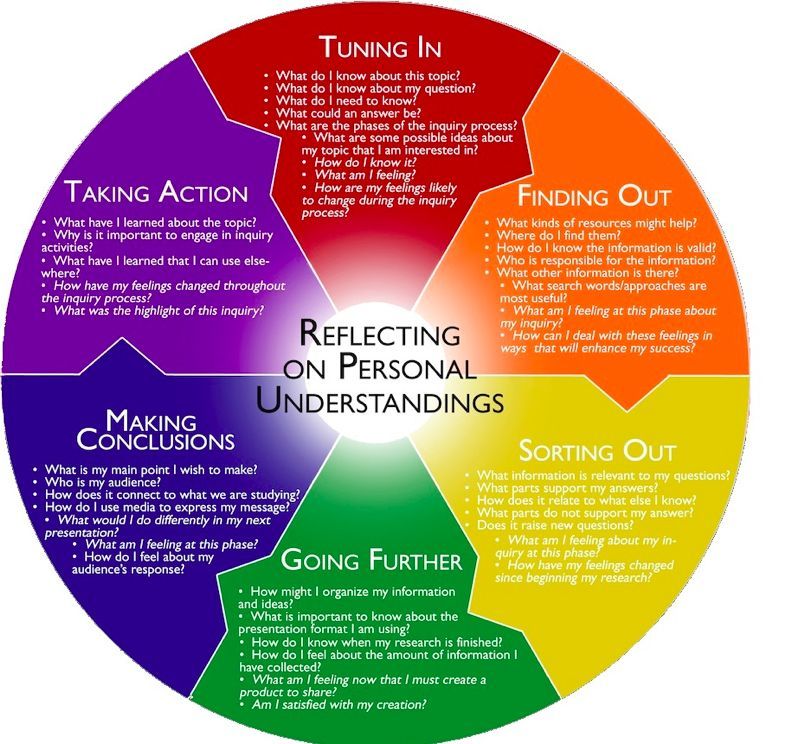
IBCP MIC Academic Honesty Policy - 2018 Edition

Table of Contents
1. Purpose                                                                       4
   What is Academic Honesty?                                                      4
   What is Academic Misconduct?                                                   5
   How is Academic Honesty Fostered at MIC?                                       6
   College Values                                                                 6
   Montessori International College Values                                        6
   Learner Profile                                                                7
   The Teaching and Learning Programme                                           8

2. Student Responsibilities                                                       8
   What does it mean to behave ethically?                                         8
   What does this look like in practice?                                         9
   Collaboration versus Collusion                                                9
   What happens if a student breaches the agreement?                              9
   Academic Honesty Agreement                                                    10
   Breaches of Academic Honesty - Flow Chart (School-based assessment)           11

3. Teacher Responsibilities                                                      14
   Authentication of Student Coursework                                          15
   Turnitin                                                                      15

5. Parent Responsibilities                                                       16
   Academic Honesty Agreement                                                    16

6. Evaluation and Review                                                         16

7. Appendices                                                                    17
   Appendix 1. IB Student Resource - Academic Honesty in the Diploma Program     18
   Appendix 2 - Academic Honesty Agreement                                       20
   Appendix 2.1 - IB Examples of Misconduct and Appropriate Follow-up            21
   Appendix 2.2 - Guideline for cases of academic misconduct for IB Assessment   26
   Appendix 3 - Teaching and Learning Programme                                  28
   Appendix 4. Turnitin                                                          39

                                             2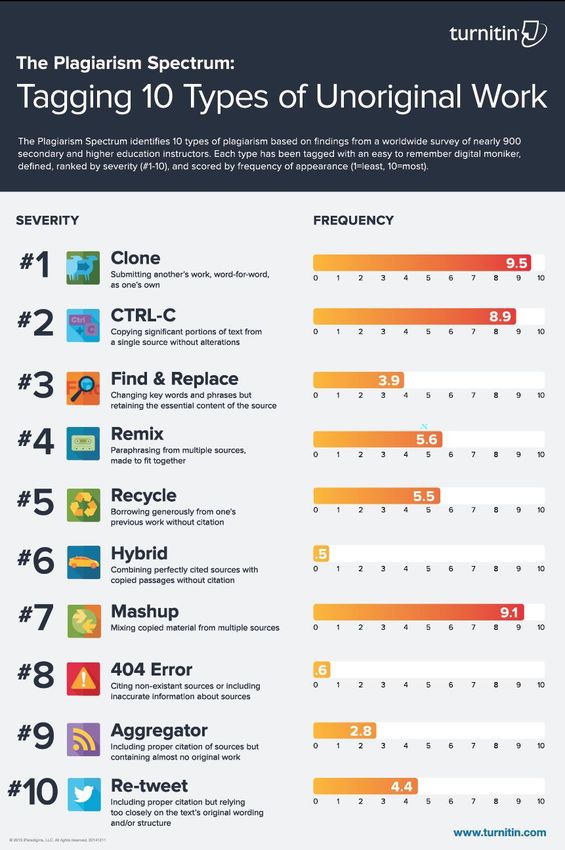
IBCP MIC Academic Honesty Policy - 2018 Edition
1. Purpose
The purpose of this policy is to ensure that Montessori International College has processes
and procedures in place to effectively implement an approach to academic honesty which is
transparent, fair and consistent. It explains the role of different members of the College
community and describes the rights and responsibilities of students, teachers, parents and
other members of the school community. It clearly explains the school’s approach to
developing assisting students develop the skills and understanding so that they present work
and undertake internal and external assessment tasks and examinations ethically - with
integrity and honesty - and demonstrate the Learner Profile attribute ‘Principled’. The policy
also make it clear what is considered academic misconduct and what action the College will
take when there are cases of malpractice. This policy is considered to be a working
document that is used by students, teachers and parents, and will be reviewed regularly.
What is Academic Honesty?
Academic honesty is a principal or approach to producing academic work or performing
academic tasks without plagiarism - the use or reproduction of ideas or words or statements
of another person without acknowledgment. It is an undertaking that a student's work is
original and authentic and completed only with the assistance allowed according College
and IB rules, policies and guidelines. Academic honesty includes the appropriate
acknowledgement of the use of words, ideas, scholarship and intellectual property of others.
From the IB Student Resource: Academic Honesty in the Diploma Program
International Baccalaureate (IB) programmes encourage students to inquire and to think
critically and creatively, and to present their thinking in a variety of ways. They should be
able to make their thoughts and their learning visible and explicit, show how they have
constructed their ideas, and demonstrate the views they have followed or rejected. This is
essentially what scholarship and academic honesty are: making knowledge,
understanding and thinking transparent.
Students need to understand how knowledge is constructed and, consequently, their own
role in furthering knowledge construction and building understanding. An essential aspect
of this is an understanding of the technical aspects of academic honesty, of citing and
referencing.
Academic honesty is an essential principle of the IB’s academic programmes that
enhances the organization’s credibility and position as a leader in international education.
As stated in the IB learner profile, all members of the IB community strive to be
“principled”, acting with “integrity and honesty, with a strong sense of fairness, justice and
respect for the dignity of the individual, groups and communities”
3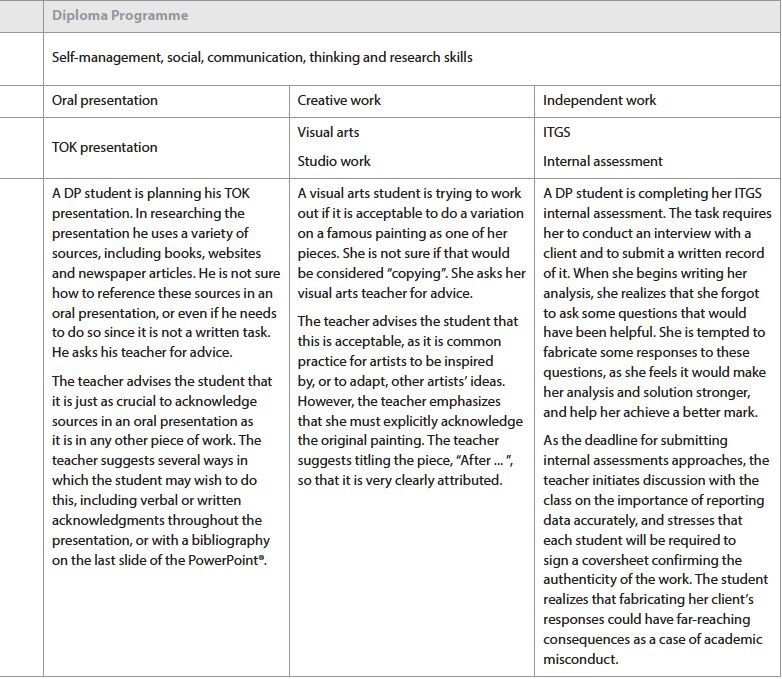
IBCP MIC Academic Honesty Policy - 2018 Edition
What is Academic Misconduct?
Academic misconduct is a breaches of academic integrity which includes plagiarism,
collusion, the fabrication or deliberate misrepresentation of data and any non-adherence to
the rules regarding examinations. Generally the motivation for such dishonesty is to gain
unfair academic advantage, however, ever if the act was inadvertent, it is still considered
misconduct.
The IB organization defines academic misconduct as any behaviour (deliberate or
inadvertent) that leads to a candidate gaining an unfair advantage over others.
Misconduct includes:
● Plagiarism ● Disruptive behaviour during
● Collusion examination
● Taking unauthorized material into ● Disclosure of information about the
an examination room content of an examination paper
● Stealing examination materials within 24 hours after a written
examination
From the IB General Regulations: Diploma Programme:
The IB defines academic misconduct as behaviour (whether deliberate or inadvertent) that
results in, or may result in, the candidate or any other candidate gaining an unfair
advantage in one or more components of assessment. Behaviour that may disadvantage
another candidate is also regarded as academic misconduct.
Academic misconduct is a breach of these regulations and includes, but is not restricted to:
a. plagiarism—this is defined as the representation, intentionally or unintentionally, of the
ideas, words or work of another person without proper, clear and explicit acknowledgment
b. collusion—this is defined as supporting academic misconduct by another candidate, for
example, allowing one’s work to be copied or submitted for assessment by another
c. duplication of work—this is defined as the presentation of the same work for different
assessment components and/or DP core requirements
d. misconduct during an IB examination (for example, taking unauthorized material into
an examination, behaviour that disrupts the examination or distracts other candidates, or
communicating with another candidate)
e. unethical behaviour such as the inclusion of inappropriate material in any assessment
materials or the breach of ethical guidelines when conducting research
f. any other behaviour that gains an unfair advantage for a candidate or that affects the
results of another candidate (for example, falsifying a CAS record, disclosure of information
to and receipt of information from candidates about the content of an examination paper
within 24 hours after a written examination via any form of communication/media).
4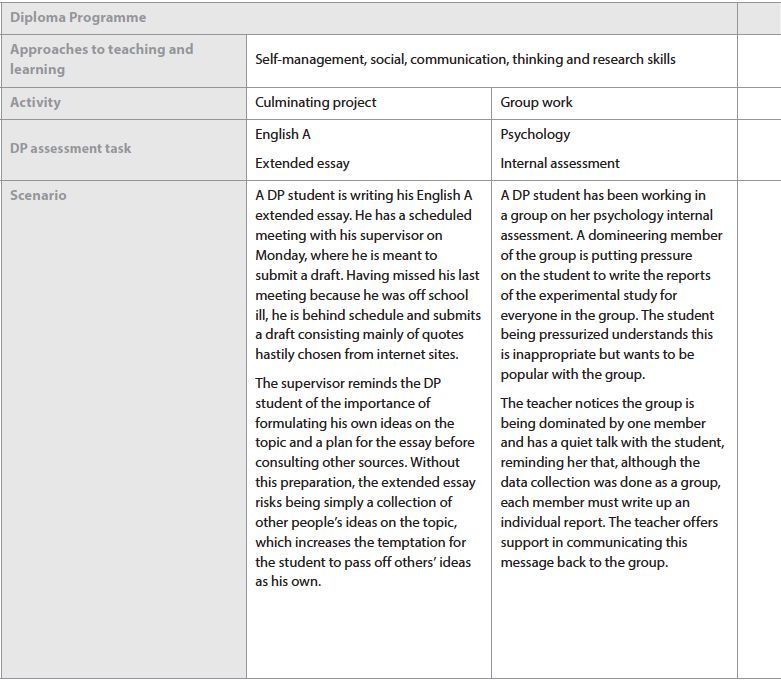
IBCP MIC Academic Honesty Policy - 2018 Edition
How is Academic Honesty Fostered at MIC?
At Montessori International College, academic honesty is a fundamental aspect of teaching
and learning and helping students develop effective skills to conduct research and
communicate findings and ideas. Academic honesty is promoted, supported, encouraged
and developed through:
● The College Values
● Development of the qualities of the Learner Profile
● Clear roles and responsibilities
● The pedagogical approach to teaching and learning
● Explicit teaching of research skills and effective communication skills
● Clear policy - processes and procedures
College Values
Honesty is an underlying value at the College and is implicit in many of our values:
Montessori International College Values
We have developed a set of values (2017) which are fundamental to the operations of the
school and, more importantly, progress our culture of learning. These values, support,
and reflect universally shared human values which are conducive to creating a Culture of
Peace. Our individual behaviours and actions throughout the college affirm these values.
Interdependence is recognising that we are shaped by our relationships, and that our
potential as human beings and as a society is dependent on the quality of our
relationships with one another. People learn from each other, find support, create
solutions, and gradually discover new capabilities from this web of trusting relationships.
We are all ‘bundles of potentiality’ that only manifest in relationship. Meg Wheatley
Deep Collaboration enables us to draw upon a knowledge base that would otherwise be
inaccessible by taking advantage of strengths, interests, and capacities unique to each
individual.
If you want to go fast, go alone. If you want to go far, go together. African proverb
Autonomy empowers and provides agency for individuals. It is the ability to make
informed decisions within a framework of responsibility and accountability.
Control leads to compliance, autonomy leads to engagement. Daniel H. Pink
Continuous Transformation is recognising and responding to change, remaining open to
new perspectives and enabling ideas to emerge. Continuous transformation requires
creativity, humility and self-awareness.
5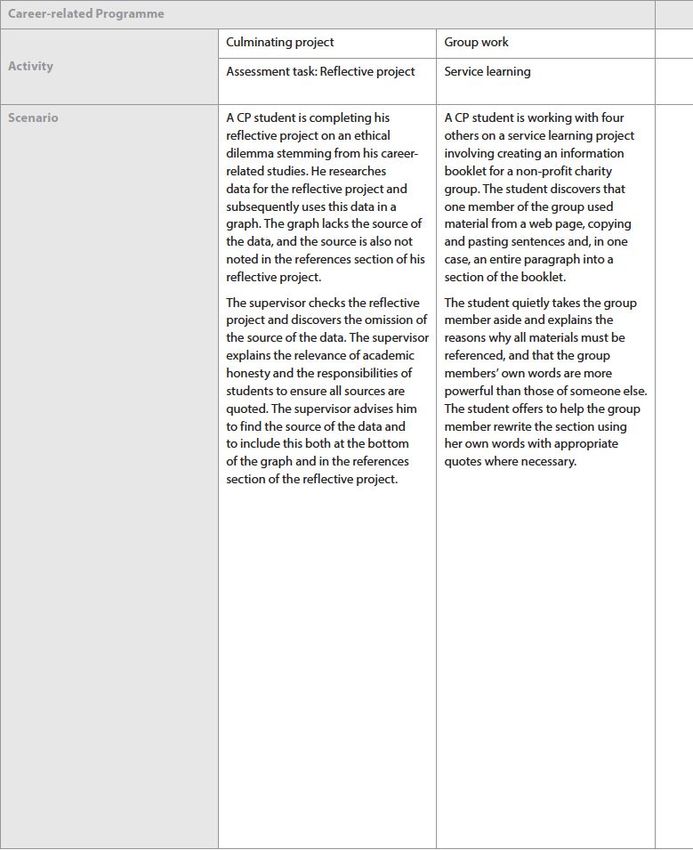
IBCP MIC Academic Honesty Policy - 2018 Edition
The illiterate of the 21st century will not be those who cannot read and write, but those
who cannot learn, unlearn, and relearn. Alvin Toffler
Creativity invites new ways of thinking and working.
Creativity involves breaking out of established patterns in order to look at things in a
different way. Edward de Bono
Learner Profile
Academic honesty is also evident in the Learner Profile, qualities which all IBCP MIC
students will be developing throughout their schooling in the Senior Phase Programme.
Of the IB Learner Profile capacities and responsibilities, the attributes: Inquirers,
Knowledgeable, Thinkers, Communicators and Principled are particularly relevant to the
development of academic honesty.
Inquirers
Through the development of skills for inquiry and research, students will learn about effective
research practices, and the importance of academic honesty and referencing of the work of
others or sources of information.
Knowledgeable
As students develop and use conceptual understanding across disciplines and learning
areas, they will be encouraged to engage with issues such as intellectual property and the
reasons it is important to acknowledge sources of information.
Thinkers
By engaging in critical and creative thinking students will be encouraged to analyse and
consider complex problems. They will be developing the capacity to make reasoned and
ethical decisions in the context of academic honesty.
Communicators
Academic honesty will also be ensured by promoting and developing student capacity to
better communicate their own ideas. Students will be assisted with the development of the
skills to communicate their ideas and findings effectively.
Principled
This quality is clearly the most obviously connected to the value of academic honesty.
Students will be supported and encouraged to act with integrity and honesty. They will
consider and explore the consequences of not acting this way - both the impact on
themselves, but more importantly, the effect or impact of behaving unethically on others.
They will also learn to take responsibility for their actions and see value in this through the
College’s approach to behaviour management using Restorative Practices.
6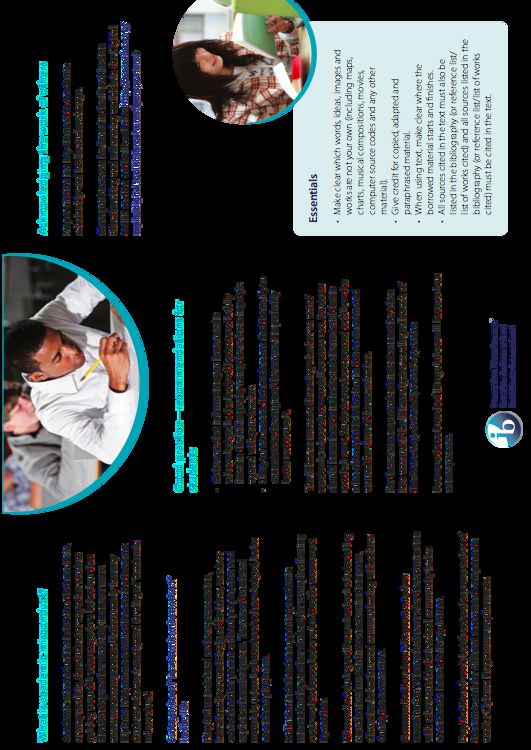
IBCP MIC Academic Honesty Policy - 2018 Edition
The Teaching and Learning Programme
Both the pedagogical approach to teaching and learning at MIC and the explicit teaching of
research skills and effective communication skills (particularly writing skills) underpins our
approach to academic honesty. The role students, teachers and parents play and their
responsibilities in regard to academic honesty is vital to students developing a genuine
understanding of the how and why.
From Academic Honesty in the IB:
“In order to fully master the technical aspects of academic honesty, such as accurately citing
and referencing, students need to understand how knowledge is constructed and,
consequently, their own role in furthering knowledge construction and building
understanding.”
“A safe and encouraging learning environment in which students can explore ideas and
make visible the development of their own thinking will support academically honest
behaviours and help to instill the values and principles that lie behind such behaviours. The
attributes of the learner profile are important in nurturing such an environment. This guide
will support schools, teachers and parents in providing such a learning environment and in
helping students of all ages be academically honest in all their studies.”
2. Student Responsibilities
Students need to understand what academic honesty is and how to effectively research and
construct knowledge, meaning and understanding, how to acknowledge the work and ideas
of others why this is important.
In the Senior Phase at MIC, it is expected that all students read this policy and a summary of
their responsibilities - in the MIC Senior Phase Student Handbook. Students will need to sign
an agreement to indicate they have read, understood and agree to abide by the schools
expectations regarding academic honesty.
What does it mean to behave ethically?
From IB Ethical Practice poster, “Students will exercise academic honesty in all aspects of
their work. They will acknowledge the work of others, including material taken from other
sources. They will not claim as their own the work of others. They will not give their work to
others to pass off as their own. They will observe the integrity of the examination room.”
7
IBCP MIC Academic Honesty Policy - 2018 Edition
What does this look like in practice?
From the IB Student Resource: Academic Honesty in the Diploma Program
Good practice—recommendations for students
● Make sure that information you have used is acknowledged in the body of the text
and is fully listed in the bibliography using the referencing style agreed with your
teacher.
● Cite your sources so that readers can find them; if you cannot state the origin of
the source it is probably better not to use it.
The IB has no means of knowing whether an act of academic misconduct was deliberate
or not. Students should know how to indicate and cite material that is not their own.
Students are also expected to follow the rules of acceptable behaviour in the exam room
and around the time of the examination.
For these reasons, a student’s intent cannot be taken into account if the IB investigates an
alleged breach of the General regulations: Diploma Programme.
Be aware that a breach of IB regulations will have serious consequences.
See Appendix 1 - Academic Honesty in the Diploma Program
Collaboration versus Collusion
Collusion is when two or more people work secretly for the purpose of deliberately deceiving
or misleading others. Understanding the difference between collaboration and collusion can
be confusing, particularly when work in groups. Submitting a piece of work done together in
a group as if it has been done individually (even if unintentional) is considered collusion.
Collusion is a form of plagiarism that can occur as a result of inappropriate collaboration
during group work. It involves working with someone with the deliberate intention to mislead.
This could involve working with someone else to produce work which is presented as your
own when, in fact, it was the result of secretly working with someone else. Collusion is
treated as a form of academic misconduct.
What happens if a student breaches the agreement?
The College follows a restorative approach to dealing with most behavioural issues,
including academic misconduct. Restorative Practices (RP) is a philosophy and continuum of
processes that is based on the premise that repairing harm done to people and relationships
(in this case to the intellectual property of the owner of the work appropriated or the other
students who the offender gains an advantage over) is a very effective way to resolve
issues, influence positive behaviour and build a safe, productive and caring community.
A core belief is that the wrongdoings and misbehaviours are primarily not just “breaking
rules”, but actually result in harm to individuals, groups and the whole school community.
8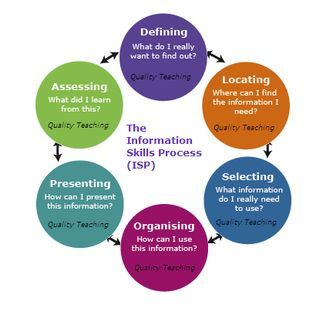
IBCP MIC Academic Honesty Policy - 2018 Edition
In practice, this involves a ‘restorative chat’ with a student the first time they behave
academically unethically. The flowchart below outlines the process followed when dealing
with academic misconduct.
Academic Honesty Agreement
All IBCP students and parents will be required to read the IB Academic Honesty Policy and
the College’s Academic Honesty Policy. Students will then be asked to sign an agreement
stating that they have read and understood the policy, and the consequences of academic
misconduct. See Appendix 2.
9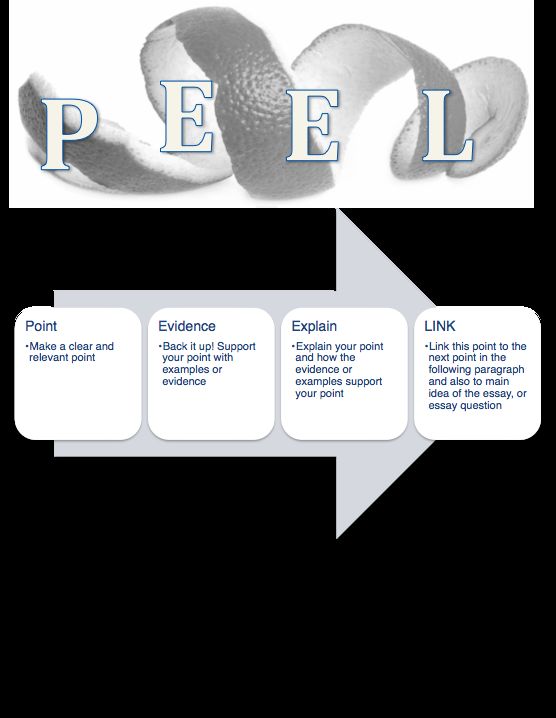
IBCP MIC Academic Honesty Policy - 2018 Edition

Breaches of Academic Honesty - Flow Chart (School-based
assessment)
Low level example:
 A student submits work without correctly citing or has not acknowledged the work
           of others appropriately, or duplicates work between 2 subjects

  Teacher has a ‘restorative chat’ with the student regarding the issue, and explains
      what they should have done. The student is asked to resubmit the work.

   The student submits the work, this time appropriately referencing and citing the
    work of others, and has gained a better understanding of academic honesty.
Note: if a student continues with the behaviour, the College will generally treat this as a
medium level incident.

Medium level example:
 A student submits work that is not their own, for example, plagiarised from another
                           student or an online source.

    Teacher has a ‘restorative meeting’ with the student (and in some cases their
 parents) regarding the issue, and explains what they should have done. The student
  is asked to resubmit the work. The misconduct is noted on the student’s file and
                    other staff and the child’s parents are notified.

 The student submits the work, this time appropriately researching, producing their
  own work and referencing and citing the work of others. They have also gained a
                   better understanding of academic honesty.
Note: if a student continues with the behaviour, the College will generally treat this as a high
level incident.

                                               10
IBCP MIC Academic Honesty Policy - 2018 Edition
High level example:
A student engages in academic malpractice repeatedly or ‘cheats’ in an
examination setting - including taking unauthorized material into the exam, stealing
or sharing exam materials or Communicating about the content of an examination.
Teacher and Senior Phase Coordinator meet with the student and their parents
regarding the issue. The student is will be asked to explain why they should be
given an opportunity to resit the examination or submit the work. Whether the
student will be given this opportunity is up to the school’s discretion. If not, they
will not receive any marks or credit for the task.
In some cases the student will given an opportunity to resit the examination or
submit the work. If not, they will not receive any marks or credit for the task.
Note: If this type of incident occurs again, the student may be asked to withdraw from the
IBCP.
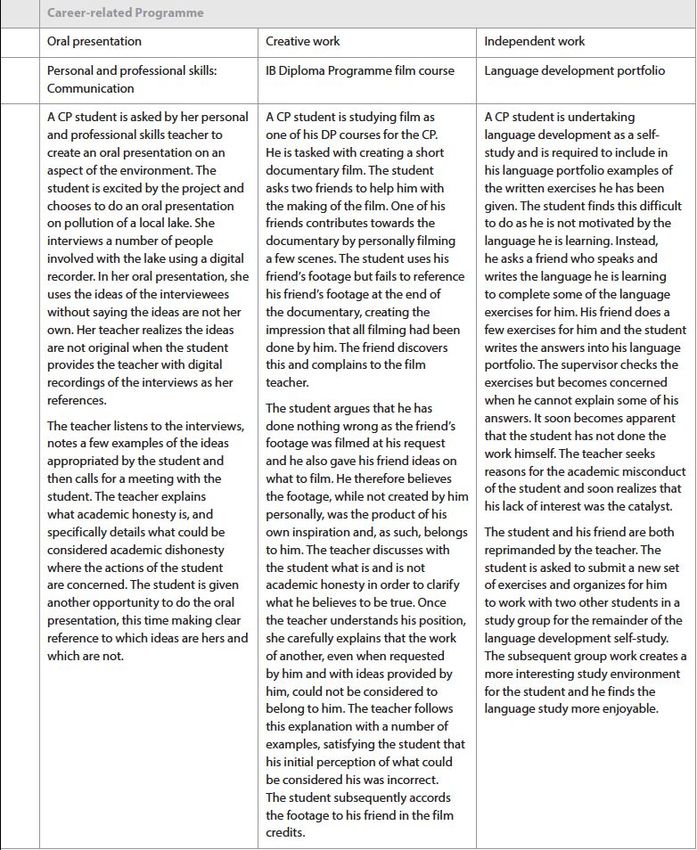
More examples of malpractice, and appropriate follow-up are included in Appendix 2.1
(taken from Academic Honesty in the IB).
In the case of suspected academic misconduct in IB Internal or External Assessment, the
case will be dealt with according to the guidelines in the General regulations: Diploma
Programme - Appendix 2.2 and the CP Assessment Procedures (Section A4):
A4.4 Action that the IB may take in cases of alleged academic
misconduct
A4.4.1 Circumstances that will trigger an investigation
These are some of the most common circumstances that will trigger an investigation.
● A coordinator informs the Assessment Division, IB Global Centre, Cardiff, that
academic misconduct may have taken place during an examination.
● An examiner suspects plagiarism or collusion and provides evidence to justify his or
her suspicion.
● A random check of assessment material at the Assessment Division, IB Global
Centre, Cardiff, using web-based plagiarism detection software, reveals that the work
of a candidate may not be entirely authentic.
Before the IB will investigate a case of suspected academic misconduct, there must be clear
evidence to justify a suspicion of wrongdoing.
11IBCP MIC Academic Honesty Policy - 2018 Edition
● In the case of plagiarism, the evidence must be in the form of a source that appears
to have been copied by a candidate.
● In cases of collusion, an investigation will only be pursued if the candidates’ work
shows clear similarities.
A4.4.2 The investigation process
When the IB starts an investigation into academic misconduct, the coordinator is informed by
email. The IB requires the coordinator immediately to inform the head of school of the
investigation.
The IB will include full instructions for the investigation, including the steps to be taken by the
coordinator, statement templates, etc, with the email.
The evidence is then considered by the academic honesty sub-committee of the final award
committee and the outcome is decided. The final award committee, or its sub-committee,
has full discretion to make these decisions.
In all cases where the final award committee has established a breach of regulations, the
head of school will be informed by email of the decision reached by the committee. The
correspondence will be copied to the school’s Career-related Programme coordinator,
appropriate IB staff and the chair of the examining board.
If the allegation is established, a penalty will be applied. If it is decided that no breach has
occurred, the subject result will be released in the normal way.
The process is illustrated in diagram below:
12IBCP MIC Academic Honesty Policy - 2018 Edition
3. Teacher Responsibilities
The IB teaching team at MIC are ultimately responsible for the teaching and learning
programme, and consequently are responsible for fostering the development of academic
honesty, integrity and ethical behaviour. Teaching and learning in the programme must help
students develop the positive behaviours they will need to complete work thoughtfully,
honestly and authentically. In the CP in particular, the teachers will need to ensure that
students clearly understand that all tasks and assessments must be distinct from, and may
not be included or used in, other areas of the student’s programme.
All teachers must:
● Give clear guidance about ethical practice and academic honesty to students in the
programme
● Put strategies in place to ultimately prevent students from undertaking any unethical
practice for any work that is going to be assessed (for example, for internal
assessment, the reflective project or a PPS presentation)
● Ensure that no work containing any unethical practice is presented for assessment.
Responsibilities of IB teachers (From: The Integrity of IB Assessments)
Adherence to the principle of academic integrity
● Acknowledge and support academic integrity as a core IB principle.
● Act with honesty and in a responsible and ethical manner.
● Fully comply with IB policies, procedures and subject guidelines.
● Encourage student responsibility for academic integrity.
● Respond to academic misconduct when it occurs.
● Help define and support school-wide academic integrity standards.
● Identify, declare and avoid any apparent or actual conflict of interest.
Support to students
● Support students to become actively responsible for their own learning.
● Support students to develop the IB learner profile attributes.
● Ensure that students receive guidance on how to produce genuine and authentic
work.
● Analyze all IB subject guidelines to support students’ understanding of the IB’s
assessment criteria.
● Ensure that students are appropriately prepared for the demands of the tasks
necessary to fulfill the requirements of IB assessment.
● Read and give advice to students only on the number of drafts as specified in the
relevant subject guide, providing oral or written advice on how the work could be
improved, but not editing the draft.
● Encourage students to take a responsible and conscientious attitude to their own
work and study.
● Give students regular feedback and encourage them to respond to the feedback.
13IBCP MIC Academic Honesty Policy - 2018 Edition
The teaching and learning programme, including and inquiry based constructivist approach,
explicit teaching of the research process, teaching of referencing skills, and also teaching
students clear and effective written communication skills all assist the development of
students skills and understanding in regards to academic honesty and malpractice. These
aspects of the program are explained in more detail in Appendix 3.
Authentication of Student Coursework
Teachers must ensure that all coursework produced by students, including work submitted
for assessment, is authentic, drawing on the student’s own original ideas and with the ideas
and work of others appropriately acknowledged. Assessment tasks that require teachers to
provide guidance, such as drafts, or tasks that require students to work collaboratively must
be follow the guidelines in the appropriate IB syllabi or guides. The College IB work
programs also include details regarding such guidelines. Teachers and other members of
the College community are also expected to practice academic honesty and behave with
integrity.
Turnitin
The College will subscribe to and utilise ‘Turnitin’ as a way of authenticating student work
that is submitted for assessment. Turnitin also has high quality resources to help students
understand what is acceptable practice and what is not. These resources will be used by
teachers to help students develop a clear understanding of the distinction between
plagiarism and acceptable practices. An example of a Turnitin resource is included in
Appendix 4.
14IBCP MIC Academic Honesty Policy - 2018 Edition
5. Parent Responsibilities
Parents play an important role in supporting academic honesty at the College. Like students,
they will also need to understand what academic honesty is and how support their child.
They will also be expected to read this policy and a summary of their responsibilities - in the
MIC Senior Phase Parent Handbook. Parents will need to co-sign the student agreement
that all students will be required to sign (students will need to sign an agreement to indicate
they have read, understood and agree to abide by the schools expectations regarding
academic honesty).
From the IB Student Resource: Academic Honesty in the Diploma Program
As the legal guardian of a Diploma Programme student, how can we support our
children?
● Encourage them to plan each assignment.
● Provide support with the scheduling of their work, as they may have many
assignments to complete.
● Establish a good level of communication with the school so that you understand
the requirements of the Diploma Programme and what is expected of students.
● Encourage them to ask their teacher for advice if they are having difficulty with
their work.
Academic Honesty Agreement
All IBCP students and parents will be required to read the IB Academic Honesty Policy and
the College’s Academic Honesty Policy. Students will then be asked to sign an agreement
stating that they have read and understood the policy, and the consequences of academic
misconduct.
6. Evaluation and Review
The College policy will be reviewed at least every 2 years to ensure currency, particularly
with such rapid developments in communication and ease of access to information.
Students, parents, teachers and other members of the College community will be involved in
this process.
15IBCP MIC Academic Honesty Policy - 2018 Edition
7. Appendices
Appendix 1.
IB Student Resource - Academic Honesty in the Diploma
Program
Appendix 2.
Academic Honesty Agreement
Appendix 2.1
IB Examples of Misconduct and Appropriate Follow-up
Appendix 2.2
Guideline for cases of academic misconduct for IB Assessment
Appendix 3
Teaching and Learning Programme
Appendix 4.
Turnitin
16IBCP MIC Academic Honesty Policy - 2018 Edition
Appendix 1. IB Student Resource - Academic Honesty in the
Diploma Program
17IBCP MIC Academic Honesty Policy - 2018 Edition
18IBCP MIC Academic Honesty Policy - 2018 Edition
Appendix 2 - Academic Honesty Agreement
Academic Honesty Agreement
All IBCP students and parents will be required to read the IB Academic Honesty Policy and
the College’s Academic Honesty Policy. Students will then be asked to sign an agreement
stating that they have read and understood the policy, and the consequences of academic
misconduct.
Student Declaration:
I hereby declare that I have read and understood the Montessori International College
Academic Honesty Policy. I also agree to undertake appropriate academic procedures when
completing my work and I understand the consequences in the event of malpractice.
Name: __________________________________
Signed: _________________________________ Date: _____________
Parent Declaration:
I hereby declare that I have read and understood the Montessori International College
Academic Honesty Policy and will support my child fulfill this agreement.
Name: __________________________________
Signed: _________________________________ Date: _____________
19IBCP MIC Academic Honesty Policy - 2018 Edition
Appendix 2.1 - IB Examples of Misconduct and Appropriate
Follow-up
From Academic honesty in the IB educational context
As young adults preparing for university studies or entry into the workforce, Diploma
Programme students both enjoy the freedom and bear the responsibility of studying a
course that emphasizes independence and self-reliance. DP students are, appropriately,
less dependent than their PYP and MYP counterparts on the steady intervention of
teachers and parents checking to make sure that lessons are understood and
assignments are completed on time. On the other hand, DP students experience a set of
emotional pressures—the pressure to perform on summative assessments, the stress of
the university admission process and time pressures—exerted by a system that can be
seen to reward the individual’s end result over the work (individual or collective) required
to get there. For academic honesty, this can mean that the idea of shared responsibility in
the PYP and MYP for ensuring a piece of work is the student’s own risks becoming the
sole responsibility of the DP student, should a case of academic misconduct arise (Carroll
2012). Thus, teaching and learning in the DP must develop the positive behaviours that
students will need to demonstrate clearly that they complete their work carefully, honestly
and authentically.
In their academic work, DP students develop research skills and study habits that are
needed to demonstrate academic honesty in more formal ways than would be appropriate
to expect of younger learners. DP students investigate and evaluate the usefulness of a
greater variety of resources, and incorporate and reference them within oral and written
presentations of increasingly complex formats. This level of rigour can present a challenge
to students who certainly know right from wrong, but who may not possess the
organizational and self-management skills to demonstrate clearly that their work meets a
formal standard of academic honesty. All IB students understand the importance of
acknowledging others because it is a central feature of the constructivist, inquiry-based
approach promoted in all IB programmes; yet, in the DP, this requires the explicit teaching
and learning of specific conventions accepted in a community of learners for being
transparent about the use of ideas and work of others—note making, in-text citation and
the preparation of a bibliography, to name but a few examples (Carroll 2012: 5–6).
20IBCP MIC Academic Honesty Policy - 2018 Edition
21IBCP MIC Academic Honesty Policy - 2018 Edition
IBCC students engage with IB Diploma Programme subjects, the four elements of the
IBCC core and a career-related study. All elements of the IBCC are interlinked and
connected to form an educational framework. Student work in the IBCC can be inspired
and informed by the student’s range of subjects. It is possible that data or information may
be used in more than one area of a student’s studies and that expertise can be transferred
where students utilize the skills developed in one area of the IBCC in another area.
However, all tasks and assessments must be distinct from, and may not be included or
used in, other areas of the student’s IBCC. IBCC teachers should support students to be
fully aware of their responsibilities in respect of academic honesty.
The approaches to learning (ATL) course, which all students undertake as a component of
the IBCC core, is ideal for the development of students’ understanding of academic
honesty. This understanding should include how to reference their work, cite sources and
acknowledge others’ ideas and concepts.
22IBCP MIC Academic Honesty Policy - 2018 Edition
23IBCP MIC Academic Honesty Policy - 2018 Edition
24IBCP MIC Academic Honesty Policy - 2018 Edition
Appendix 2.2 - Guideline for cases of academic misconduct for
IB Assessment
From General regulations: Diploma Programme pages 12-14
Article 20: Candidates suspected of academic misconduct
The IB defines academic misconduct as behaviour (whether deliberate or inadvertent) that
results in, or may result in, the candidate or any other candidate gaining an unfair advantage
in one or more components of assessment. Behaviour that may disadvantage another
candidate is also regarded as academic misconduct. Academic misconduct is a breach of
these regulations and includes, but is not restricted to:
a. plagiarism—this is defined as the representation, intentionally or unintentionally, of the
ideas, words or work of another person without proper, clear and explicit acknowledgment
b. collusion—this is defined as supporting academic misconduct by another candidate, for
example, allowing one’s work to be copied or submitted for assessment by another
c. duplication of work—this is defined as the presentation of the same work for different
assessment components and/or DP core requirements
d. misconduct during an IB examination (for example, taking unauthorized material into an
examination, behaviour that disrupts the examination or distracts other candidates, or
communicating with another candidate)
e. unethical behaviour such as the inclusion of inappropriate material in any assessment
materials or the breach of ethical guidelines when conducting research
f. any other behaviour that gains an unfair advantage for a candidate or that affects the
results of another candidate (for example, falsifying a CAS record, disclosure of information
to and receipt of information from candidates about the content of an examination paper
within 24 hours after a written examination via any form of communication/media).
Article 21: Investigating cases of suspected academic misconduct
21.1 If questions arise about the authenticity of a candidate’s work before submission for
assessment, the situation must be resolved within the school. If possible academic
misconduct (for example, plagiarism, collusion) is identified after a candidate’s work has
been submitted to the IB for assessment, the school’s DP coordinator must inform the IB as
soon as possible.
21.2 When a school, an examiner or the IB establishes evidence to suspect academic
misconduct by a candidate, the school will be required to conduct an investigation and
provide the IB with statements and other relevant documentation concerning the case. If a
school fails to support the investigation into possible academic misconduct, no grade will be
awarded to the candidate in the subject(s) concerned.
25IBCP MIC Academic Honesty Policy - 2018 Edition
21.3 If the IB notifies a school that a candidate is suspected of academic misconduct and
that the IB has the intention of initiating an investigation, at the discretion of the head of
school it is permissible for the candidate to be withdrawn from the session or from the
subject(s) in which academic misconduct may have occurred. However, at the discretion of
the IB the investigation into the suspected academic misconduct by the candidate may still
proceed and a decision be reached on whether to uphold or dismiss academic misconduct. If
a candidate is withdrawn from a subject no mark for that subject may contribute to the award
of a grade in a future examination session.
21.4 Candidates suspected of academic misconduct must be invited, through the school’s
DP coordinator, to present a written statement that addresses the suspicion of academic
misconduct. If a candidate declines to present a statement, the investigation and decision on
whether the candidate is in breach of regulations will still proceed.
21.5 The majority of cases of suspected academic misconduct will be presented to a
sub-committee of the Final Award Committee. The sub-committee will normally comprise IB
staff, school representatives, and chief/deputy chief examiners, but any group or
combination of these persons may make decisions on cases subject to the approval of the
Final Award Committee. The sub-committee will be chaired by the chair or vice-chair of the
Final Award Committee, or a chief examiner nominated by the vice-chair.
21.6 Decisions of the sub-committee are made on behalf of and under the supervision of the
Final Award Committee. After reviewing all statements and evidence collected during the
investigation, the subcommittee will decide whether to dismiss the suspicion of academic
misconduct, uphold it, or ask for further investigations to be made. If the sub-committee is
unable to reach a decision, then the case will be referred to the Final Award Committee.
21.7 If the sub-committee decides that a case of academic misconduct has been
established, a penalty will be applied in the subject(s) concerned. The penalty will, in the
judgment of the sub-committee, be proportionate with the severity of the misconduct.
21.8 If no grade is issued for a subject that contributes to a candidate’s IB Diploma, no IB
Diploma will be awarded to the candidate. DP Course Results will be awarded for other
subjects in which no academic misconduct has occurred. Except in cases of serious or
repeated misconduct, the candidate will be permitted to register for future examination
sessions, which may include the session that follows six months later, if the relevant
registration deadlines are met. In the case of an IB Diploma Candidate, if the session in
which the academic misconduct has been established is the candidate’s third examination
session towards achieving the award of the IB Diploma, no further IB examination sessions
will be permitted.
21.9 If the candidate has already been found in breach of regulations in any previous
session, this will normally lead to disqualification from participation in any future examination
session.
21.10 If there is substantive evidence, the IB is entitled to conduct an investigation into
academic misconduct after a candidate’s results have been issued. If academic misconduct
is subsequently established by the Final Award Committee, or its sub-committee, the
candidate’s grade for the subject(s) concerned may be withdrawn from the candidate which
will also result in the withdrawal of his or her IB Diploma where applicable.
26IBCP MIC Academic Honesty Policy - 2018 Edition
Appendix 3 - Teaching and Learning Programme
Inquiry Approach
Our pedagogical approach to teaching and learning will also promote a culture of academic
honesty, as students develop inquiry skills and effective research skills. The inquiry process
followed by the college is outlined below:
At Montessori International College we believe students should be encouraged to take
responsibility for their own learning and follow a constructivist approach (Piaget), where
students construct knowledge and meaning through their experiences. In the classroom,
this is evident in the inquiry approach that teachers follow to lead students through
appropriate experiences to allow this ‘construction’ of learning. The experiences students
are exposed to are timed appropriately to push students into their ‘zone of proximal
development’ (Vygotsky). This may include open ended experiences, direct and explicit
instruction or working alongside students and providing critical feedback.
Teachers use the Inquiry Model (Murdoch) to plan appropriate sequences of learning and
assessment. This approach is known as the ‘Three Period Approach’ in Montessori
programs.
The inquiry process followed in the Senior Phase at MIC is outlined in the graphic on the
next page.
27IBCP MIC Academic Honesty Policy - 2018 Edition
The Inquiry Based Learning model
Credit: Kath Murdoch
28IBCP MIC Academic Honesty Policy - 2018 Edition
Research Process
The College has also adopted an approach to research which draws on work of the
Australian Librarians. It is a research process that students are explicitly taught to follow
throughout secondary school, in both the Adolescent Community (Years 7-9) and the Senior
Phase. The research process is outlined in detail in the student handbook:
Research Process
The following process should be followed for all assignments and tasks that involve research.
DEFINE the task - Preparing
What do I really need to find out?
Strategies to use / what to do now:
· Brainstorm key words;
· Develop questions to help you gather information
LOCATE Information - Finding
Where can I find the information I need?
· What do you already know?
· What would be appropriate and effective resources and how do I research this task?
· How will I know my information is good?
SELECT Information - Sifting
What information do I really need to use?
As you go through the information consider these points:
29IBCP MIC Academic Honesty Policy - 2018 Edition
· What information do I need to include
· What information you already know and what new things you find out
· Is the information good information (current, accurate and credible with a clear purpose)
ORGANISE Information - Sorting and recording
How can I best use this information?
Your teacher will often ask you to fill out a ‘Note-Taking Template’ as evidence of this step.
PRESENT - Synthesising and Communicating
What is the best way to present this information?
Plan your assignment
The plan should cover the following:
· Are you going to use a poster or a PowerPoint to present this information?
· Does it make sense?
· Have I answered all of the questions?
· Have I included everything I need?
EVALUATE - Reflecting and assessing
Assess your work
Self Evaluation – You should always use the rubric given to you by your teacher to self assess
and evaluate your work. This should then be handed in with the completed task.
The research process utilised by the College is adapted from the Information Skills Process
(ISP) developed by the Australian School Library Association Inc. (ASLA) and NSW
Department of Education. The process is summarised in the diagram below:
30IBCP MIC Academic Honesty Policy - 2018 Edition
Referencing
Students are also explicitly taught how to reference appropriately, and why this is important.
Teachers use the same system throughout the secondary school to ensure students develop
effective referencing skills, and also to help students understand the importance of
referencing sources of information when presenting and communicating their ideas and
findings in the form of essays, reports, research articles, posters, multimodal presentations
and short films, etc. The Referencing Guide used by the College is detailed in the Student
Handbook. The guide is included below:
Referencing Guidelines (The Harvard System)
What is referencing?
Referencing is a system used in the academic community to indicate where ideas, theories, quotes,
facts and any other evidence and information used to undertake an assignment, can be found.
Why do I need to reference my work?
● To avoid plagiarism, a form of academic theft. Plagiarism is the act of copying work
without admitting it. For example, if you were to copy a sentence or two out of a book into
your assignment, without changing a word, then you would be committing plagiarism
unless you referenced the source of the material. Plagiarism is theft of intellectual property,
it is dishonest, and it is against the law as well as morally wrong. In order to avoid
plagiarism, you must correctly reference your assignment.
● Referencing your work correctly ensures that you give appropriate credit to the sources and
authors that you have used to complete your assignment.
What do I need to reference?
All the information that you have used in your assignment will need to be acknowledged. Your
teachers will ask you to complete a note-taking template to keep a record of all the details of the
sources that you use for your assignment as you go along.
Referencing consists of two parts – in-text references, and a bibliography (a list of sources at the
end of an assignment).
In-text Reference
For a direct quote: “Referencing is essential for clear and honest assignments” (Smith, 1996)”
would indicate a direct quote from a book by Smith, printed in 1996.
For an idea: Smith (1996, p23) states that referencing is essential for clear assignments.
Your teacher may also ask you to include the page number.
Bibliography
At the end of the assignment complete details of the source are listed. This is done in a separate
section titled “REFERENCES”. Each book or article referred to in your assignment must be listed in
this section. A very strict format must be followed (In alphabetical order of author). The use of the
full stops, commas, italics or normal type are all compulsory and follow certain rules.
31IBCP MIC Academic Honesty Policy - 2018 Edition
Examples
Books
Cochrane, A 2007, Understanding urban policy: a critical approach, Blackwell Publishing, Malden,
MA.
e-Book
Niemann, S, Greenstein, D, & David, D 2004, Helping children who are deaf: family and community
support for children who do not hear well, Hesperian Foundation, Berkley, CA, viewed 11 June
2007, http://www.hesperian.org/publications_download_deaf.php
Brochure
TransACT n.d., Guide to equipment and service, brochure, TransACT, Canberra.
No author/editor
Macroeconomics, prices and quantities: essays in memory of Arthur M. Okun 1983, Blackwell,
Oxford.
Journal
Jackson, A 2007, ‘New approaches to drug therapy’, Psychology Today and Tomorrow, vol. 27, no.
1, pp. 54-9.
Online journal
Noor, A 2008, ‘Ethics, religion and good governance’, JOAAG: Journal of Administration &
Governance, vol. 3, no. 2, pp. 62-77, viewed 17 November 2009,
http://www.joaag.com/Home_Page.php
Newspaper
Waterford, J 2007, ‘Bill of Rights gets it wrong’, Canberra Times, 30 May, p. 11.
Other Sources
Blog post
Keim, B 2009, ‘ID error leaves fish at edge of extinction’, Wired Science blog, web log post, 18
November, viewed 20 November 2009,
http://www.wired.com/wiredscience/2009/11/extinction-error/
CD recording - music
‘From little things big things grow’ 1997, on Songs from the south: Paul Kelly’s greatest hits, CD,
Mushroom Records, Melbourne. Written and performed by Paul Kelly.
DVD / Video recording
Sense and sensibility 1995, DVD, Columbia TriStar Home Video, Australia. Directed by Ang Lee.
Interview (TV or radio)
Mornings with Neil Mitchell 2009, radio broadcast, Radio 3AW, Melbourne, 16 October. Interview
with the Prime Minister, Kevin Rudd.
Motion picture (movie)
The lord of the rings: the return of the king 2003, motion picture, Imagine Films, Auckland, NZ.
Produced by Steve Pyke; directed by Peter Jackson.
This guide was developed from a number of university guides on referencing and plagiarism.
Communication and Presentation - Writing Strategies
Students are also taught clear and effective strategies to communicate and presented their
ideas and findings. The following summary, from the Student Handbook outlines some of the
strategies taught to better help students develop effective information literacy skills:
32IBCP MIC Academic Honesty Policy - 2018 Edition
Writing Strategies
The writing process includes planning, reading and making notes, constructing an outline,
drafting and editing. Your Teacher will give you the task requirements:
● Due date for submission
● Word limit – the length for the assignment
● Structure and style – whether a report, essay or review
● Marking criteria – how the assignment will be assessed
● Referencing requirements – referencing style is usually Harvard
● Presentation - format, font, point size, cover sheet.
Ask your Teacher if you are unsure about how to complete the task.
Analysing the task
To understand the question, look for:
● Direction words - evaluate, discuss, explain
● Content words - the topic focus for your essay
● Limiting words - the scope of the essay
At the same time, read the marking criteria for the task.
Planning the writing
Firstly, from the due date for your task, plan a starting date. Allow at least 3 weeks for an
assignment.
Stages
The writing process has stages that are interconnected and overlap.
Stages in assignment writing:
Stage 1 Analyse the question, brainstorm to explore the topic and make a draft plan. For read
begin with the textbook and set readings, then search using the library databases. Re
make notes from several sources.
Stage 2 Continue reading and note making as you decide a response to the task and a revise
Construct an outline and begin typing introduction, body paragraphs and conclusion.
your sources and include ideas from your reading as quotations and paraphrases as
write.
Stage 3 Expand and refine this first draft by further thinking, reading and writing. As you write,
and compare the views of different writers and comment on what they have to say. R
your drafts for relevance to the task, structure and organisation of ideas. Edit your wri
spelling, punctuation and grammar.
Stage 4 Complete your reference list, proofread the whole assignment, attach the cover sheet
marking criteria, and hand in by the due date. Keep a copy of the assignment for your
records.
33IBCP MIC Academic Honesty Policy - 2018 Edition
PEEL
When writing, use PEEL to help write well structured paragraphs.
34IBCP MIC Academic Honesty Policy - 2018 Edition
Essay Structure
The skill of good essay writing is to be able to critically discuss and evaluate ideas within a set word
limit. Essays focus on developing an argument or analysing ideas rather than on description. The
essay has three parts.
Introduction
The introduction sets the scene for the whole essay. For a 1500 word essay, this could be a 150
word paragraph. The purpose of the introduction is to identify the topic, your point of view and the
main reasons for your response.
Often this paragraph includes:
● An introductory sentence or two related directly to the question.
● A definition or explanation of a key term, cited from your discipline.
● A clear statement of the focus of the essay or the position being argued, your thesis
statement.
● Sentences that give a clear idea of what the essay will be about (content) and the direction
(scope) the essay will take.
Body
Paragraphs in the body of the essay show your discussion of the main ideas supporting your
position or response to the question. Ideas from the scholarly literature give credibility and weight to
your argument.
Each paragraph should link with the previous paragraph and may include:
● A topic sentence: a statement of the main idea of the paragraph.
● Explanation or supporting evidence from the scholarly readings.
● Further evidence from your reading to deepen your discussion.
● Application of ideas to a scenario or through the use of an example.
● Your discussion of, comment on and evaluation of these ideas.
● A concluding sentence that brings the paragraph to a close.
Conclusion
The purpose of the conclusion is to summarise and make final evaluative comments. It is important
to refer back to the essay question.
This paragraph includes:
● A brief summary of the main ideas presented in the essay.
● Confirmation of the thesis included in the introduction.
● Final evaluative comments on the relative importance of the arguments.
● Comments on the ongoing significance of the topic as an issue that needs further
discussion or investigation.
Source: Australian Catholic University - http://students.acu.edu.au/
35IBCP MIC Academic Honesty Policy - 2018 Edition
36IBCP MIC Academic Honesty Policy - 2018 Edition
Proofreading for Errors
What is proofreading?
Proofreading is the process of reading over your work to identify errors in the structure, grammar
and punctuation. Before proofreading for grammatical errors, check that you have answered the
question with a well-structured argument and have cited all your sources as quotations or
paraphrases.
To develop your skills, keep a record of the grammatical errors that you commonly make and
strategies to avoid them. Review your list before you begin. Also, use a dictionary and Word's
grammar and spelling check.
To proofread your work effectively, read your assignment several times.
First reading
Read each sentence aloud as if reading to a friend. Ask yourself:
● Is the meaning of each sentence clear?
● It is much better to write simple, clear sentences than complex, confusing ones.
● Is each sentence complete?
● Every sentence needs a main verb to be complete. Check that each sentence has a
subject and a verb. If a sentence is over 3 lines long check that the meaning is still clear.
Subsequent reading
Read your work again, looking for grammatical mistakes. Ask yourself:
● Have I used a, an and the when they were needed?
● Do all the sentences have subject - verb agreement?
● Have I used the passive voice when it is needed?
● Have I used suitable verb tenses?
● Do all the plural nouns have plural endings?
● Is the punctuation correct?
Finally, check citations in text, list of references, and the format of the assignment before submitting
your work.
37IBCP MIC Academic Honesty Policy - 2018 Edition
Appendix 4. Turnitin
http://turnitin.com/
38You can also read


