American Literary
Translators Association
←
→
Page content transcription
If your browser does not render page correctly, please read the page content below
American Literary Translators Association
ALTA42 | Rochester, NY
Thursday, November 7 – Sunday, November 10, 2019
  Joseph A. Floreano Riverside Convention Center

        ALTA43 | Tucson, AZ
                 November 2020

  More information at www.literarytranslators.org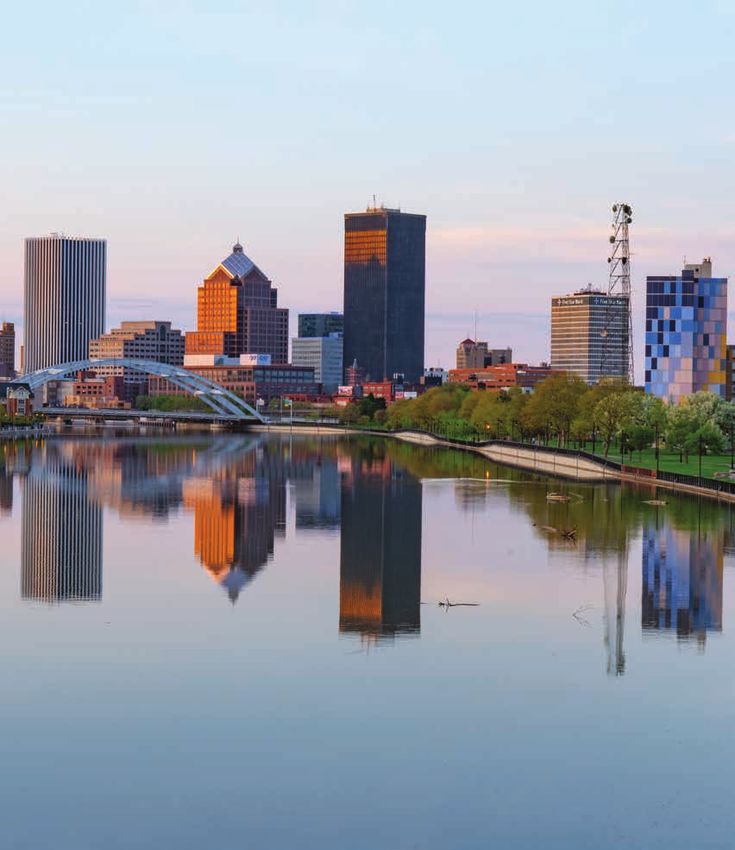
welcome
Dear Friends and Colleagues:

W
               elcome to Bloomington for our annual gathering. ALTA41 promises to be another outstanding
               conference, with an almost around-the-clock series of panels, readings, and special events
               that underscore this year’s themes: Performance, Props, and Platforms. This year’s conference
               features 67 panels, 229 presenters, and 91 bilingual readers, not to mention the yet-to be-
               discovered talent among us that will shine at the always-amazing Declamación!

Let me draw special attention to the theater events we have planned, and to the cross-disciplinary nature of
the conference. We welcome renowned playwright, translator, and educator Caridad Svich, recipient of an Obie
Award for Lifetime Achievement, as our keynote speaker.

Two staged readings are planned, one cosponsored by IU’s renowned Department of Theatre, Drama, and
Contemporary Dance, and another in collaboration with Cardinal Stage. Of particular note as well are the
sessions “Translanguaging in ASL Embodied Poetry Performance: A Marriage of Words and Hands” (featuring
the Flying Words Project, Deaf American Sign Language poet Peter Cook and collaborator Kenny Lerner), and
the Translation Centre Stage Workshop. Endless thanks are due to this year’s conference planning committee.

2018 has been another busy year for our organization. Earlier in the spring, we signed an affiliation agreement
with the University of Arizona, and effective January 1, 2019, ALTA will have its central office on the UA campus
in Tucson. With the move, our professional staff will expand to an unprecedented size. Our extraordinary team
of Elisabeth Jaquette (Executive Director), Kelsi Vanada (new Program Manager), and Rachael Daum (Assistant
Managing Director, wired in Serbia) will be supported by an administrative assistant (half-time), a graduate
assistant, and interns provided by UA.

Our affiliation with the College of Humanities at the University of Arizona will provide us with a sense of physical
belonging, a space where our amazingly creative professional staff can think, plan, and operate, and where they
can also draw intellectual and creative sustenance from the larger conversations taking place at UA. Naturally,
this physical and operational stability will enable us to focus more effectively on other organizational needs,
such as advancement and outreach.

We are equally excited about the creative synergies that both ALTA and UA have so far only imagined. As we
move forward, we will keep asking ourselves: How can our collaboration expand the reach, energy, and renown of
our organizations? Creative arts organizations and academic institutions—by the nature of our communities—
seldom, if ever, experience a deficit of ideas; we never lack vision. Often, though, the ideas that engender
transformative action depend on active collaboration built on mutual trust and shared purpose.

As ALTA members, we are literary translators, academics, editors, publishers, and advocates for international
literature in translation. Our art/craft intersects with scholarship, teaching, and outreach—making the College of
Humanities at the University of Arizona an ideal community with kindred goals and aspirations.

Finally, the Center for the Art of Translation and ALTA board members are challenging you to raise $30,000 to
help usher in ALTA’s move to Tucson at this exciting juncture. With your support, we will start the affiliation in
strength. Watch your mailboxes for more information about this important challenge.

Enjoy our conference!
Aron Aji, ALTA President

                                                                                                                          1
acknowledgments

                  W      e are very pleased to acknowledge the generous support for this year’s annual
                         gathering, provided by the following individuals and organizations:

                  The National Endowment for the Arts | The Spain-USA Foundation | AmazonCrossing

                  At Indiana University:
                  The Arts and Humanities Council | The Office of the Provost & Executive Vice President | The Office
                  of International Affairs in the College of Arts and Sciences | The Lilly Library | The Dorit and Gerald
                  Paul Fund for the Arts, Robert A. and Sandra S. Borns Jewish Studies Program | The Center for Latin
                  American and Caribbean Studies | The Center for Research on Concepts and Cognition, College of
                  Arts and Sciences | The Department of Comparative Literature | The Department of Slavic and East
                  European Languages & Cultures | The Department of Spanish & Portuguese | The Department of
                  Theatre, Drama & Contemporary Dance

                  Additionally:
                  Academic Studies Press | Bread Loaf Translators’ Conference | Columbia University School of the Arts |
                  Edinburgh University Press | Lavender Ink / Diálogos | Vermont College of Fine Arts International MFA in
                  Creative Writing and Literary Translation

                  We are also grateful for Elisabeth Jaquette, our Executive Director; Rachael Daum, our Assistant
                  Managing Director; and Kelsi Vanada, our Program Manager, whose professionalism, passion, and
                  dedication make them outstanding colleagues. Also, thanks for the planning expertise of Michelle
                  Boulden and her colleagues at IU Conferences, and the efforts of a large number of passionate
                  volunteers.

                  A special note of thanks is due to Alexis Levitin for his assistance with the ever-popular Bilingual
                  Readings Series, now in its 30th year. Once again, we are also pleased to thank Barbara Paschke for
                  her efforts in organizing Declamación, one of the most cherished traditions at the ALTA Conference.

                  We are indebted to the generous sponsors of ALTA’s 2018-19 Emerging Translator Mentorship
                  Program: AmazonCrossing, the Polish Cultural Institute New York, and the Russian Federation
                  Institute of Literary Translation. We are grateful to ALTA’s Past Presidents Council, the Peter K.
                  Jansen Memorial Travel Fund, and the Literature Translation Institute of Korea for their generous
                  support of the 2018 ALTA Travel Fellows.

                  We are also grateful to Elizabeth Harris, who is serving as mentor to the 2018 ALTA Travel Fellows.

                  We would be remiss in not thanking the 2018 ALTA Conference Organizing Committee, who worked
                  throughout the year to make the conference come together: Amanda Sarasien, Anne O. Fisher,
                  Catherine Nelson, Chad Post, Corine Tachtiris, Ellen Elias-Bursac, Jeremy Tiang, Keyne Cheshire,
                  Neil Blackadder, Nancy Naomi Carlson, Orlando Menes, Russell Valentino, Sean Bye, and Sebastian
                  Schulman, and Committee Chair Patrick Blaine.

    2
Join Us!

                                                                                                    join us!
          Sign up or renew your ALTA membership in 2019!
As a non-profit arts membership association,       Membership with ALTA is for the calendar year.
ALTA supports the work of literary translators     Join online: www.literarytranslators.org/join
and advances the art of literary translation.      Or mail to:
                                                      American Literary Translators Association
r Translator: $125                                    The University of Arizona
r Student: $30                                        Esquire Building #205
                                                      1230 N. Park Avenue
r Friend (non-translator): $75
                                                      Tucson, AZ 85721
r Organization: $250
Name                                               I can support ALTA with an additional donation
Street                                             r $50       r $100
City                        State                  r $150      r $1,000
Postal Code             Country                    r $2,500 r $5,000
Phone		                                            r Other Amount:
Email                                              r Check Enclosed r Please charge my card
                                                   Card #
Language(s)
                                                   Expiration Date         Security Code
                                                   Signature

                                                   r Keep donation anonymous

                                          Donations to ALTA are fully tax-deductible.
                                 Feel free to call or write to Kelsi Vanada, Program Manager:
                                        (520) 775-1766 | kelsi@literarytranslators.org

Include Us in Your Long-Term

                                                                                                    include us
Plans:

Have you ever wished you could do more
to support the art of literary translation?
You can make a life-changing gift without
changing your life by including ALTA in your
estate plans. ALTA now has the expertise to
work with individuals interested in learning
more about planned giving. Even donors of
modest means can make a real contribution
to ALTA’s future. Supporters can designate
ALTA in their will or make ALTA a beneficiary
of a portion of their IRA, at no tax cost to
them. Donors are also eligible for additional
tax benefits beyond those of a one-time
donation. And, of course, ALTA can fulfill
specific gift wishes and recognize a donor’s
significant contribution to ensuring the      For more information, please contact Vice President
organization’s future.                              Ellen Elias-Bursac at (857) 928-2039.
                                                                                                        3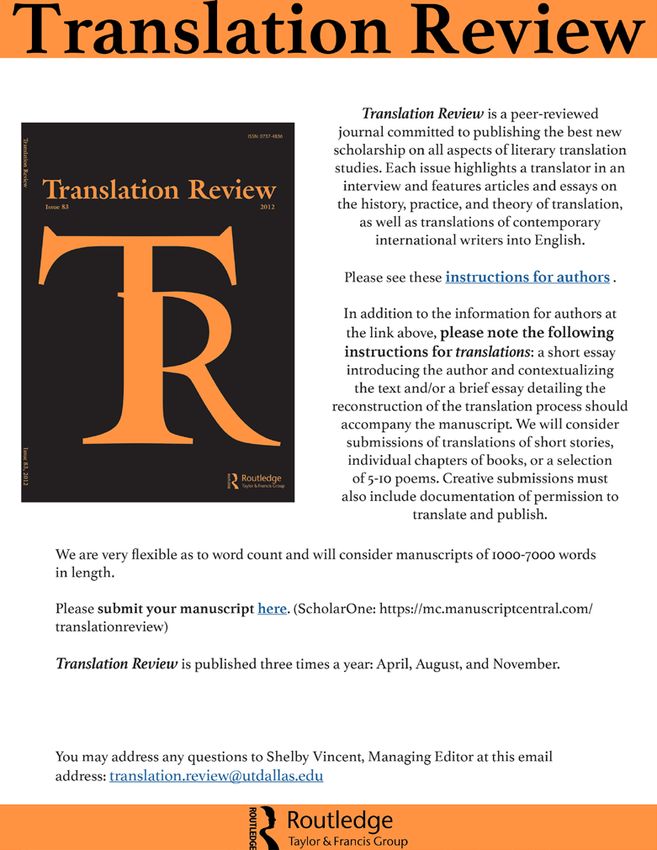
BREAD LOAF
                TRANSLATORS’
                CONFERENCE

specializing in the            MAY 31-JUNE 6, 2019
                               Rolling admissions.
Literary translation of        Oct. 1 to Feb. 15.

poetry and proseBREAD
                    LOAF ORION Enrollment is limited.

                               AWARD-WINNING

              ENVIRONMENTAL
                               FACULTY
with                           John Balcom

Introductory and               Edward Gauvin

              WRITERS’ CONFERENC
                               Elisabeth Jaquette

advanced workshops             Suzanne Jill Levine
                               Emily Wilson

                               go.middlebury.edu/bltc
and an
Inspiring schedule of
readings and lectures

All in Vermont’sBREAD      LOAF
                Green Mountains.
                WRITERS’
                CONFERENCE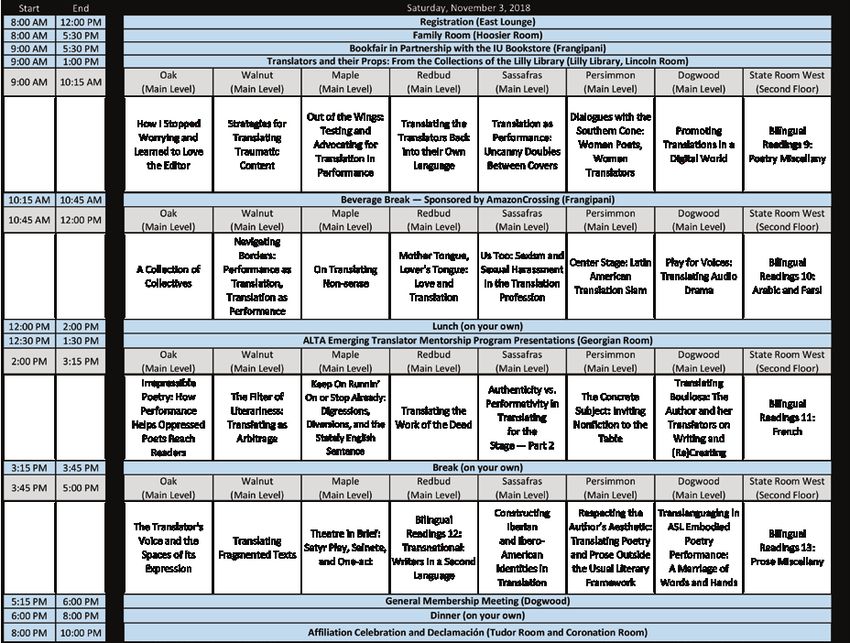
ALTA TRAVEL FELLOWSHIPS

                                                                                                                                           fellowships
Each year, between four and six $1,000 fellowships are awarded to emerging (unpublished or minimally published)
translators to help them pay for hotel and travel expenses to the annual ALTA conference. The ALTA Travel Fellowships are
funded by a combination of private and organizational donations, often generously given by established translators and other
devoted supporters of the craft and art of literary translation. 2018 marks the third year of the Peter K. Jansen Memorial
Travel Fellowship, preferentially awarded to an emerging translator of color or a translator working from an underrepresented
diaspora or stateless language.

This year’s winners were selected by judges Marguerite Feitlowitz, Margarit Ordukhanyan, Emma Ramadan, and Haider
Shahbaz. The 2018 ALTA Travel Fellowships are made possible thanks to the generous support of ALTA’s Past Presidents
Council, the Peter K. Jansen Memorial Travel Fund, and the Literature Translation Institute of Korea. Congratulations to these
exceptional emerging translators, chosen from more than 100 applicants:

Mariam Rahmani, 2018 Peter K. Jansen Memorial Travel Fellow (Persian)
                               Mariam Rahmani is a writer, translator, and emerging scholar. Her current projects include a novel-
                               in-progress and a translation from Persian into English of Mahsa Mohebali’s Don’t Worry (2008), for
                               which she was recently awarded a 2018 PEN/Heim Translation Fund Grant. In 2017, Mariam served
                               as one of five inaugural writers-in-residence with The Mastheads in Pittsfield, Massachusetts for
                               her novel, and has participated in VONA/Voices, a workshop dedicated to writers of color, as well as
                               the Bread Loaf Translators’ Conference. Her articles have appeared in The Rumpus, the Los Angeles
                               Review of Books, and BOMB Magazine. She graduated summa cum laude from Princeton University
                               with a BA in Comparative Literature, earned an MSt in Islamic Art with distinction from the University
                               of Oxford, and completed a Fulbright research grant in the UAE. Currently, she is a candidate for
                               the PhD in Comparative Literature at UCLA, writing a dissertation on gender in translation and the
                               violence of subject-formation.
       Serving as Mariam’s first book-length translation project, Don’t Worry by Mahsa Mohebali follows Shadi, a rich,
disillusioned junkie, on an apocalyptic day of earthquakes as she roams through a quickly crumbling Tehran in search of her next
fix. This tightly crafted, arguably queer, narrative eloquently interweaves a gritty vernacular with poetic prose, moving between
dialogue that is almost cinematic in its naturalism and the narrator’s lyrical first-person reflections. The novel has been widely
celebrated in Iran, winning the Golshiri Prize (the equivalent of a Pulitzer), among other accolades. It has already been published
in Italian and Swedish translations.

Elina Alter, 2018 ALTA Travel Fellow (Russian/German)
                                A few years ago, while living in Abu Dhabi, Elina decided to translate a story. She wanted to practice
                                Spanish, and also to find a way to link her writing and the daily practice of life in the UAE, where the
                                national language is Arabic, the lingua franca is English, and the population speaks dozens of other
                                languages, from Albanian to Urdu. Conversations can be full of confusion and infelicities of language,
                                as well as new coinages, nonce-words, and, if you’re lucky and paying attention, poetry.
                                     Aptly, a friend recommended that Elina’s adventures in literary translation start with Borges’
                                “La forma de la espada,” a story in which an Irishman called The Englishman gives an account of
                                his failure as a revolutionary, from the perspective of the man he betrayed. The story is narrated
                                by a character called Borges. The surreal experience of reading, translating, and “being” Borges
                                felt appropriate to the strangeness of living in the UAE, and translation itself proved to be a deeply
                                necessary corollary to Elina’s writing. If the work of the writer can seem solitary, the work of the
                                translator is a collaboration among many; the translator listens not just to the voice of one particular
writer, but to the voices around that writer, everything that informs the text. She must also know intuitively the rhythms of her
own time and place, in order to offer a translation that’s both intelligible and inventive; that despite being incommensurate to the
original, is original in its new language.
      To continue developing as a writer and a translator, Elina enrolled in the MFA Writing Program at Columbia, where she
studied with Susan Bernofsky, Natasha Wimmer, Mónica de la Torre, and Rowan Ricardo Phillips. While a student, she was an
Emerging Writer at the Festival des ecrivains du monde, traveling to Paris to meet with young writers from India and discuss
writing, translation, and the politics of writing in English. Her translation thesis was a collection of the young Chekhov’s vibrant
early humor pieces, originally published in St. Petersburg and Moscow magazines. Supported by a Katharine Bakeless Nason
scholarship, she revised the thesis with Idra Novey at the Bread Loaf Translators’ Conference, and published selections in The
Paris Review Daily. She is currently translating the St. Petersburg poet Alla Gorbunova’s acclaimed 2017 collection of short
fiction, Ings & Oughts, described by critics as “visionary, thrilling, and smart.” Selections appear in the Summer 2018 issue of the
New England Review. She writes about work in translation for Publishers Weekly, BOMB, and other publications.
      Elina was born in St. Petersburg. She earned her B.A. at the Gallatin School at New York University and earned an MFA in
Fiction and Translation at the School of the Arts at Columbia University, where she was a Teaching Fellow. She is the incoming
editor of Circumference: Poetry in Translation. Circumference was founded in 2003 by Jennifer Kronovet and Stefania Heim; it

                                                                                                         continued on the next page...

                                                                                                                                               5
has published new translations from Basque, Galician, Estonian, Milanese, K’iche, and Telugu, as well as translations and poems
fellowships
              by Paul Celan, Charles Simic, Jennifer Grotz, Maureen N. McLane, Li Po, Kim Hyesoon, and Roberto Bolaño. New issues of
              Circumference will include poetry in translation, as well as journalism, art, and thoughtful, in-depth criticism. Excited and grateful
              to be an ALTA Fellow, in the meantime Elina is studying German and continuing to work on her Spanish.

              Lizzie Buehler, 2018 ALTA Travel Fellow (Korean)
                                                    Lizzie Buehler grew up in Austin, Texas. She began to learn Korean during a gap year before
                                                    college, when she attended high school in Seoul and Jeollabuk-do. Lizzie continued her study
                                                    of Korean—alongside Japanese, Chinese, and Spanish—at Princeton University, where she
                                                    was a Comparative Literature major and a Creative Writing minor. At Princeton, she found that
                                                    translation provided an opportunity to meld her passions for foreign languages and creative
                                                    expression. For her senior thesis, she translated part of the short story collection Table for One
                                                    by Yun Ko Eun, and won the Edmund Keeley Translation Prize.
                                                         After graduating, Lizzie spent a year in New York working at a literary agency and freelance
                                                    translating. She also served as Assistant Editor at Asymptote, where she helped curate the
                                                    journal’s first Korean literature feature. Over the past year, several of her short translations have
                                                    been published and can be found in Asymptote, The Massachusetts Review, Korean Literature
                                                    Now, Azalea, and Litro. Lizzie recently received a Daesan Grant to complete her translation of
                                                    Table for One, which is forthcoming from Columbia University Press.
                    Lizzie’s work has been guided by notions of literary value, inspired by a publisher’s feedback on one of her early
              translations: “I very much enjoyed this piece, but it’s not literary enough to translate.” Considering this statement has helped
              Lizzie form an understanding of the question that motivates her as a translator: what constitutes “literary”? The writing of Yun
              Ko Eun, whom Lizzie has been translating for the past four years, is comedic and oftentimes odd. It diverges from mournful
              Korean classics and the introspective novels for which Korean literature has become known in the 21st century. Lizzie hopes her
              translations of Yun will broaden conceptions of Korean literature and of literary worth.
                    This fall, Lizzie will join the MFA program in Literary Translation at the University of Iowa, where she is an Iowa Arts Fellow.
              In Iowa, she looks forward to immersing herself in a cross-lingual community of translators and writers and to working with
              languages beyond Korean.
                    Lizzie is thrilled to meet other translators at her first ALTA conference.

              Aaron Robertson, 2018 ALTA Travel Fellow (Italian)
                                                 Aaron Robertson is a Detroit native currently living in New York City. A journalist and translator,
                                                 his interests lie between North African and European culture and history. Aaron’s aim as a
                                                 translator is to bring stories of the African diaspora in Italy—and Italians in Africa—into English.
                                                      As an undergraduate at Princeton University, Aaron began studying Italian language
                                                 and literature. Though the traditional contemporary canon of Italian literature appealed to
                                                 him—Italo Calvino, Elsa Morante, Natalia Ginzburg, and Alberto Moravia loom large—he sought
                                                 to merge this line of study with his interest in African-American literary traditions. Surely James
                                                 Baldwin or Toni Morrison could offer him a different way of thinking about racial politics abroad.
                                                 And they did.
                                                      In 2015, he traveled throughout Scotland, England, and Italy to visit sites associated with
                                                 medieval Christian saints, while also writing fiction that synthesized Black literary practices and
                                                 the genres of autobiography, confessional, and the vita (life of a saint). The following year, he
                                                 studied for a semester at the University of Bologna, Italy. That summer, his journalism career
              began at the Detroit Metro Times, where he wrote on the intersection of activist art and politics in the city.
                    While at Princeton, he was fortunate to receive instruction and guidance from authors and translators like Jeffrey
              Eugenides, David Bellos, John McPhee, and Jhumpa Lahiri. Lahiri’s course in literary translation alerted Aaron to the ways in
              which various writers have come to appreciate translation as a worthy art and challenge.
                    Aaron was Editor-in-Chief of The Nassau Literary Review, Princeton’s oldest student publication. During his tenure, he
              helped organize intercollegiate literary conferences and a symposium that featured magazine editors, publishers, designers,
              and authors. Highlights from his time with the Review include his interview with Angela Flournoy, the National Book Award-
              nominated author of The Turner House, and a panel he co-curated featuring journalist Nikole Hannah-Jones, n+1 Editor Marco
              Roth, and Pulitzer Prize-winning poet Tracy K. Smith.
                    On a proposal to study Afro-Italian women’s literature, Aaron received a Rhodes Scholarship to attend the University of
              Oxford. He wrote his master’s thesis on generic innovations in Martha Nasibù’s Memorie di una principessa etiope (Memories
              of an Ethiopian Princess). He has written on Italian literature and politics for publications including Foreign Policy, n+1, and The
              Point Magazine.
                    In 2018, Aaron received a PEN/Heim Translation Fund Grant for his translation of Igiaba Scego’s Beyond Babylon (Oltre
              Babilonia), which will be published by Two Lines Press in 2019. He is currently working on translations of Giulia Caminito’s The
              Big A (La Grande A) and Martha Nasibù’s Memories of an Ethiopian Princess (Memorie di una principessa etiope). Earlier this
              summer, he joined The New York Times as a James Reston Reporting Fellow, where he wrote for the Metro section.

   6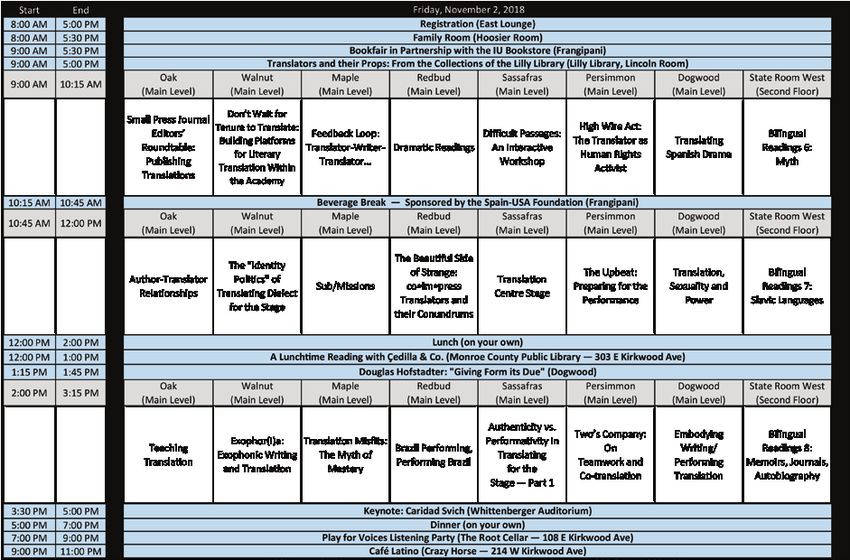
Brian Sneeden, 2018 ALTA Travel Fellow (Modern Greek)

                                                                                                                                        fellowshipss
                                      While completing his MFA in Creative Writing at the University of Virginia, Brian was given
                                      a book by a friend that contained poems by George Seferis in translation, which opened
                                      him to the world of Modern Greek poetry and authors such as C.P. Cavafy, Odysseas Elytis,
                                      and Rhea Galanaki. Wanting to experience the works behind the translations, he enrolled
                                      in courses in Modern Greek, and in 2015 he began a PhD in English at the University of
                                      Connecticut, where he studies literary translation.
                                          In 2016 he had the opportunity to meet contemporary Greek poet and performance
                                      artist Phoebe Giannisi, and began working on translating her poetry. His first attempts were
                                      experimental: playing and replaying audio recordings of the poet’s readings to help restage
                                      the poems’ internal rhyme, alliteration, and metrical variation in English. The struggle—and
                                      pleasure—was learning from the poems themselves how to convey their inventiveness
                                      of sound and spell-cadences. Working closely with the poet, Brian translated Giannisi’s
                                      collection of poems, Homerica, which was published in December by World Poetry Books
                                      and selected by Anne Carson as a favorite book of 2017.
     As a translator, Brian’s primary goal is to create translations that recreate the poem’s sense of rhythm and music. His work
stems from a belief that a translation of a poem must, first, be a viable poem in the target language. In addition to translation,
Brian also writes poetry, and his first book of poems, Last City, was published in February by Carnegie Mellon University Press.
His current projects include a second collection of poems by Phoebe Giannisi titled Cicada, which received a 2018 PEN/Heim
Translation Fund Grant, and translations of work by Athens-based poet George Prevedourakis

Maggie Zebracka, 2018 ALTA Travel Fellow (Polish)
                                        Originally from a small town in the Polish Carpathian Mountains, Maggie Zebracka
                                        immigrated to Chicago at the age of five. Soon after, her parents enrolled her in after-
                                        school Polish classes (popular in Chicago among its sizeable Polish-American population).
                                        Despite doing her best to resist attending—perhaps out of a desire to call herself American
                                        as quickly as possible—she’s grateful for all those Friday evenings spent in the company of
                                        Polish literature, history, and grammar.
                                             Those early experiences informed not only her sense of identity, but her creative
                                        work as well. Her MFA thesis at Vanderbilt—a novel still in-progress—explored how first-
                                        generation communities reconciled their newly hyphenated identities. The novel was, in
                                        many ways, a bilingual one. Much of the dialogue in Polish was left untranslated, and the
                                        characters often talked past one another, in Polish and in English. Maggie tried to examine
                                        how the worlds that characters construct out of language allow them to create space for
                                        themselves in their new homes, their new countries.
                                             Maggie has since been drawn to translation. She finds it a dynamic place where
                                        two languages can meet, interact, and, ultimately, transform one another, creating a
shared history that enriches both cultures through the text. But it also exposes the differences between those cultures—the
ways in which they signal agency or handle miscommunication. Joanna Bator, whose novels Maggie is currently translating, is
interested in situating her novels within the tension between two languages and histories. Many of them are set near the Polish-
German border, where decades-old rifts persist and linger, manifesting anew in each generation.
      She was introduced to Bator through her novel, Dark, Almost Night, which won Poland’s prestigious Nike Literary Award
in 2014. However, she was surprised to learn that none of Bator’s books had yet been translated into English. Dark, Almost
Night follows Alicja Tabor, a journalist who has returned to her childhood home in a small Silesian mining town to report on
the disappearance of three local children. When the investigation leads her into the darkness that lurks beneath Wałbrzych’s
surface, Alicja must confront not only the town’s traumas and secrets but those of her own past as well. Maggie’s excerpted
translations of the book appear in Asymptote, Hayden’s Ferry Review, and Drunken Boat.
      While working on Dark, Almost Night, she completed a Graduate Certificate in Linguistics, which helped to illuminate the
logical relationships of sentence structure and sound between and within languages. The study of extracting meaning from
decisions about tense or aspect, for example, has helped her to consider interpretations with more nuance.
      She is very excited to study literary translation as an MFA student at the University of Iowa this fall, and she is grateful to
ALTA for the opportunity to attend the conference and to meet all the translators whose work she has long admired.

                                                                                                                                             7
ALTA EMERGING TRANSLATOR MENTORSHIPS
mentorships
              For the fourth year, ALTA is proud to present our year-long mentorship program for emerging translators working on a book-
              length project. The ALTA Emerging Translator Mentorship Program was founded by former ALTA Board Member Allison M.
              Charette, and is designed to facilitate and establish a close working relationship between an experienced translator and an
              emerging translator on a project selected by the emerging translator. This year, ALTA again offered mentorships in Polish and
              Russian prose, as well as two non-language-specific mentorships, one in prose and the other in poetry. Congratulations to the
              2018-2019 emerging translators:

              Fiona Bell (Russian Prose)
                                                          Fiona Bell grew up in the United States, South Korea, and France. After reading
                                                          Turgenev’s novel Fathers and Sons in high school, she became intensely curious about
                                                          Russian culture and began learning the language in university. Fiona spent one summer
                                                          in St. Petersburg, Russia at the Derzhavin Institute. In 2017 she received a Critical
                                                          Language Scholarship to study Russian in Nizhni Novgorod, where she learned, among
                                                          other things, to garnish all food with a generous amount of sour cream.
                                                              In 2017 Fiona received a grant to visit the apartment-museums of two female
                                                          Russian poets: Anna Akhmatova and Marina Tsvetaeva. The poets wrote letters to each
                                                          other for years, diverging on most issues of poetry and politics, but ultimately forming
                                                          a friendship. In 2017 Fiona wrote Letters and Dreams, a play that imagines the only
                                                          meeting between these two poets, which occurred in 1941 but had no witnesses. Fiona
                                                          translated the poets’ work and incorporated it into the script, attempting to adapt the
                                                          Russian tradition of poetry recitation for the American stage. The play was staged at
                                                          Princeton’s Lewis Center for the Arts in 2018. Fiona is eager to continue exploring the
                                                          possibilities of poetry on stage at this year’s performance-themed ALTA conference.
                    Fiona took two translation courses during her junior year, translating excerpts of Tolstoy, Lermontov, Bulgakov, and others.
              For her thesis in translation, she translated a collection of poems by Elena Isaeva, a contemporary Moscow poet. In her poems,
              Isaeva resurrects people through memory, making her former schoolmates, family members, and lovers as present as those
              who are physically near. By conjuring figures from her past, Isaeva revives her own past selves: child, student, lover. One of the
              joys of translating her poetry was discovering the many experiences and identities of a contemporary Russian woman. The
              American understanding of Russia is so heavily based on male figures, whether Putin on the news or Tolstoy in literature classes.
              These pictures are incongruous with Fiona’s own experiences in Russia, which have been quite female-centered. As a scholar
              and translator, she is wholeheartedly devoted to translating female voices from Russia.
                    Fiona is pursuing an MPhil degree in Modern Languages at Oxford University, where she continues to study Russian drama,
              poetry, and translation. She is currently writing a play that adapts Valentin Rasputin’s 1976 novel Farewell to Matyora into a
              dramatic exploration of family, grief, and climate change in contemporary Florida. In general, Fiona is interested in the exchanges
              between Russian and other cultures. She has written about how 17th-century French dramas were “translated” on stage for
              19th-century Russian audiences. She researched the hybrid architecture of Japanese Russian Orthodox churches, focusing on
              Tokyo’s Nikolai-do cathedral. She also studied Journey Beyond Three Seas, a 1957 film in Hindi and Russian that celebrates the
              friendship between the Indian and Soviet governments. Fiona is excited to learn more about various languages and cultures by
              connecting with other translators at this year’s ALTA conference.

              Lauren Dubowski (Polish Prose)
                                            Lauren Dubowski comes to translation from a lifelong passion for the arts and a fascination with
                                            communication across cultures. Born in New York, she grew up in the culturally, linguistically,
                                            and politically diverse town of Chapel Hill, North Carolina. From an early age, she took classes
                                            in French, along with art, music, and theatre, in the public school system. She later worked in
                                            technical theatre, and interned at the American School for the Deaf, learning American Sign
                                            Language.
                                                  Lauren received a BA/MA in French Literature at Bryn Mawr College. There, she also studied
                                            Italian, as well as theatre at Swarthmore College. The subject of her thesis was Renée Vivien, a
                                            British writer in French active in Belle Époque Paris. Lauren went on to work in the Philadelphia
                                            arts community, where she helped launch the Headlong Performance Institute. Additionally, she
                                            studied Polish at Jagiellonian University in Kraków, through scholarships from the Kosciuszko
                                            Foundation.
                                              Lauren’s interests led her to Yale School of Drama, where she has trained as a dramaturg,
                                            researcher, teacher, translator, and writer in the Dramaturgy and Dramatic Criticism department.
              As an MFA student, she collaborated on many productions in a variety of creative roles; participated in a theatre for social
              change workshop in Dar es Salaam, Tanzania; and served as an artistic associate and artistic director of the Yale Cabaret. Lauren
              then spent a year in Yogyakarta, Indonesia as a Luce Scholar. While drawn to explore puppetry there and in other countries in
              Asia, she also developed an interest in film, newly aware of its global impact. She began to produce film and new media projects
              with Ado Ato Pictures, a production company she now continues to work with in Amsterdam, the Netherlands.

   8
Lauren’s DFA dissertation at Yale School of Drama is focused on the “Young Poland” theatre and visual artist Stanisław
mentorships
Wyspiański, and includes her English-language translations of several of his dramas. She has been fortunate to see many of his
plays performed in Poland, thanks to the support of the Fulbright Program and the MacMillan Center for International and Area
Studies at Yale. With this project, she hopes to encourage greater awareness of Wyspiański’s work internationally.
Lauren has contributed translation and writing to publications such as European Stages, The Theatre Times, and Words
Without Borders. She was also recently commissioned by the Adam Mickiewicz Institute to translate Stanisław Ignacy
Witkiewicz’s 1925 novel Farewell to Autumn into English. Lauren is thrilled for the opportunity to dive into and share the timely,
unique prose drama of Maria Pawlikowska-Jasnorzewska (1891-1945) as an Emerging Translator mentee.
Jennifer Kellogg (Non-Language-Specific Poetry)
Jennifer R. Kellogg is a scholar of modern and ancient Greece who resides in Rochester, NY.
Ardent about the ancient world from a young age, Jennifer earned a BA in Classical Philology
from Beloit College and spent her junior year abroad at College Year in Athens, Greece. While
in Athens, Jennifer began a journey to fluency in modern Greek by helping her friends buy
cigarettes and ask for directions in a sprawling metropolis. After college, Jennifer earned an MA
in West European Studies from Indiana University and completed her training in Modern Greek.
From 2000 until 2009, Jennifer worked at Harvard University’s Center for Hellenic Studies
in Washington, D.C. There she gained a lifelong appreciation for Homeric Greek, organized many
scholarly conferences and projects, and led the charge to open a research and teaching center
for Harvard University in Nafplion, Greece. The CHS Greece facility recently celebrated its tenth
anniversary and continues to be a hub of innovative cross-cultural education and research.
In 2013, Jennifer earned her PhD in Modern Languages and Literatures from the Université
Libre de Bruxelles (ULB) in Belgium. Her dissertation was entitled George Seferis’ Poetics: Loss
and the Language of Topos and was a study of 20th-century modern Greek poet George Seferis,
who won the Nobel Prize for Literature in 1963. The focus of her dissertation was how George Seferis’ poetry articulates ideas
and images of homeland. Jennifer translated all of the Greek texts cited, including re-translating dozens of Seferis’ poems. This
experience introduced Jennifer to the world of literary translation beyond academic or philological translation.
Jennifer is very lucky to reside in Rochester, NY, a town with a vibrant literary translation scene, thanks to Open Letter
Books at the University of Rochester. With the encouragement of many translator friends, Jennifer decided to work on a
manuscript of her poetry translations. Her work-in-progress is of George Seferis’ Book of Exercises II, published posthumously
in 1976. Most of the poems in this volume have not yet appeared in English. Book of Exercises II is a collection of drafts,
experiments, and final poems drawn from the poet’s diaries spanning 1931 to 1971.
Jennifer is looking forward to tackling the variety of poetic forms in Book of Exercises II—haiku, aphorisms, rhyming
limericks, short verses, and free verse poems—with the support of the ALTA Emerging Translator Mentorship Program.
Mirgul Kali (Non-Language-Specific Prose)
Mirgul Kali is a native of Kazakhstan. She has a background in engineering and spent
fifteen years working in the oil and gas industry. She first became involved with
literary translation a couple of years ago while volunteering at the Silk Road House, an
organization based in San Francisco Bay Area. At this non-profit, dedicated to promoting
and supporting diverse ethnic cultural traditions, she translated Kazakh folk tales and
songs for storytelling events and singing workshops. Since then, she has translated
several short stories by Kazakh writers, some of which have appeared or are forthcoming
in Tupelo Quarterly and Asymptote.
For the ALTA mentorship program, Mirgul chose to translate Kokbalaq, a novella
by a prominent Kazakh writer Mukhtar Magauin, whose works are highly regarded and
widely read in Kazakhstan. The novella follows a gifted musician through transformative
and tumultuous events of the 20th-century (the expansion of the Russian Empire into
Kazakhstan, the Soviet rule, and World War II) which cause disruption in the traditional
nomadic lifestyle of Kazakh people. The book explores the role and meaning of art in
the life of a man who witnesses not only obliteration of his family and wealth, but also
disintegration of the very environment that allows him to practice his ancient art.
Very little Kazakh literature has been translated into English, and most of the existing translations have been made on
the basis of Russian translations. By translating directly from Kazakh to English, Mirgul hopes to offer another, possibly a more
nuanced and informed interpretation, of the national literature and share its rich and unique voices with the rest of the world.
She is confident that participation in the ALTA Emerging Translator Mentorship Program will help her become a better translator
and support her in her mission to promote Kazakh literature abroad.
Mentors for the 2018-2019 mentorships are Bill Johnston (Polish prose), Marian Schwartz (Russian prose), Madhu Kaza
(non-language-specific prose), and Kareem James Abu-Zeid (non-language-specific poetry). These mentorships are offered
by ALTA in partnership with the Polish Cultural Institute New York, the Russian Federation Institute of Literary Translation, and
AmazingCrossing. Details about the program are available at www.literarytranslators.org/awards/mentorships.
9LITERARY TRANSLATION
ALUMNI ACCOMPLISHMENTS:
Joshua Daniel Edwin ’14, kummerang (gloomerang), the first book by
AT COLUMBIA
young German poet Dagmara Kraus (from German). (Image above.)
Cold Moons by Magnús Sigurðsson translated from Icelandic by
Meg Matich ’15 (Phoneme Media, 2017)
An encounter with literary translation is beneficial to many The Last Country by Svenja Leiber, translated from German by
writers’ development and imagination, enhancing their Nika Knight ’15 (Seagull Books, 2018)
understanding of voice and style while challenging them to
Third-Millennium Heart by Ursula Andkjaer Olsen translated from
write in a plurality of modes (including cross-genre projects).
Danish by Katrine Øgaard Jensen ’17 (Action Books / Broken
The MFA Writing Program at Columbia University School Dimanche Press, 2017), and a finalist for the Best Translated Book
of the Arts offers students in its Fiction, Nonfiction, and Award 2018
Poetry concentrations the opportunity to study Literary Pioneers: The First Breach by S. An-sky translated from Yiddish by
Translation through LTAC (Literary Translation at Rose Waldman ’14 (Syracuse University Press, 2017)
Columbia). All LTAC workshops, seminars, and master
Voices in the Dark by Marcel Beyer (words) and Ulli Lust (images)
classes are open to any interested student in the Writing
adapted from the translation from German of John Brownjohn by
Program, and no prior experience in literary translation
Nika Knight ’15 (New York Review Comics, 2017)
or fluency in a language other than English is required.
Old Demons, New Deities: Twenty-One Short Stories from Tibet
Recent faculty include Susan Bernofsky (LTAC Director), edited and with translations from Tibetan by Tenzin Dickie ’14
Edith Grossman, Natasha Wimmer, John Keene, (OR Books, 2017)
David Hinton, Mónica de la Torre,
The Secret Book of Kings: A Novel by Yochi Brandes translated from
Matvei Yankelevich, Rowan Ricardo Phillips,
Hebrew by Yardenne Greenspan ’12 (St. Martin’s Press, 2016)
Madhu Kaza, and Jennifer Hayashida.
The Clouds by Juan José Saer translated from Spanish by
MFA IN WRITING
Hilary Vaughn Dobel ’12 (Open Letter Books, 2016)
Extracting the Stone of Madness by Alejandra Pizarnik translated
FICTION • NONFICTION • POETRY from Spanish by Yvette Siegert ’07 (New Directions, 2016)
Interested students and advisors are invited to contact Susan Bernofsky at the ALTA conference or
by email at sb3270@columbia.edu. For more information, visit arts.columbia.edu/ALTA.Celebrating 10 years
thanks to ALTA members.
See you in our hometown in 2019!
25% oo all orders to ALTA members. Use ALTA2019. Valid until 12/31/18.
www.openletterbooks.orgTranslation Review is a peer-reviewed journal
committed to publishing the best new
scholarship on all aspects of literary translation
studies. Each issue highlights a translator in an
interview and features articles and essays on
the history, practice, and theory of translation,
as well as translations of contemporary
international
int writers into English
Please find author instructions on the
Translation Review pages of the Taylor &
Francis website.
In addition, please note the following
instructions for translations: a short essay
introducing the author and contextualizing the
text and/or a brief essay detailing the
reconstruction of the translation process
should accompany the manuscript. We will
consider submissions of translations of short
stories,
st individual chapters of books, or a
selection of 5-10 poems. Creative submissions
must also include documentation of
permission to translate and publish.
Please submit your manuscript on the ScholarOne submissions management
site. You will find a link on the Translation Review pages of the Taylor & Francis
,All That Is Evident
Is Suspect Readings from
the Oulipo 1963–2018
The first collection in any language to feature
writing from all forty-one members of the beloved
international literary group the Oulipo.
Available at store.mcsweeneys.net
Mexico_ad-literal.qxp 1/16/2007 12:22 PM Page 1
Mexico
A Traveler’s
L i t e r a r y
Companion
edited by C. M. Mayo
author of Miraculous Air
Not a guidebook but a dazzling
collection of contemporary
Mexican fiction and literary
prose—many translated into
English for the first time.
$14.95 / 256 pages / ISBN 1-883513-15-4
“This is how Mexico looks, tastes and feels, and
how its writers write about it. . . .This is a book
to throw in a suitcase or mochila (backpack) on
the way to Mexico or just settling into a favorite
patio chair. It will open your eyes, fill you with
pleasure and render our perennial vecinos a little
less distante.” —Los Angeles Times
Whereabouts Press
1111 8th Street, Suite D, Berkeley, CA 94710 / (510) 527-8280 /
www.whereaboutspress.com & www.cmmayo.comNorthwestern University’s
Global Humanities Initiative
$5,000 Translation Prize
The annual Global Humanities Translation Prize is
awarded by a rotating committee of distinguished
international scholars, writers, and public intellectuals.
The winning translators receive a $5,000 cash prize,
and the winning work is published by Northwestern
University Press. The prize recognizes works that strike
a nuanced balance between scholarly rigor, aesthetic
grace, and general readability, especially literature that
introduces a wider audience to underrepresented and
experimental voices from marginalized communities,
humanistic scholarship in infrequently translated
languages, and important classical texts in non-Western
traditions and languages.
For submission instructions, applicants may visit the
Global Humanities Initiative website at bit.ly/2C2JXOn or
write ghi@northwestern.edu.
www.nupress.northwestern.edu
T IN F IS H
TRANSLATION COLLECTION ce)
2016-2017, $54 (25% off cover pri
THE LAST LYRIC
Selected Poems
by Yu Xinqiao ON LOST SHEEP
Edited & Translated By Shiro Murano
by Yunte Huang Edited & Translated
By Goro Takano
ZERO DISTANCE
PEI PEI THE New Poetry from China
MONKEY KING Edited & Translated
by Wawa By Liang Yujing
Translated by
Henry Wei Leung
www.tinfishpress.comStart End Wednesday, October 31, 2018
9:00 AM 6:00 PM Translators and their Props: From the Collections of the Lilly Library (Lilly Library, Lincoln Room)
1:30 PM 4:30 PM Board Meeting (Charter Room)
10
5:00 PM 8:00 PM Registration (East Lounge)
Opening Reception (IMU Garden / Rain Location: Georgian Room)
5:00 PM 7:00 PM
Sponsored by the IU Office of the Provost and the Office of International Affairs in the IU College of Arts & Sciences
7:30 PM 9:30 PM Translation Trivia Night (Nick's English Hut — 423 E Kirkwood Ave)
Start End Thursday, November 1, 2018
8:00 AM 5:00 PM Registration (East Lounge)
8:00 AM 5:30 PM Family Room (Hoosier Room)
8:00 AM 8:45 AM First-time ALTA Participants Meeting (Whittenberger Auditorium)
9:00 AM 5:30 PM Bookfair in Partnership with the IU Bookstore (Frangipani)
9:00 AM 6:00 PM Translators and their Props: From the Collections of the Lilly Library (Lilly Library, Lincoln Room)
Oak Walnut Maple Redbud Sassafras Persimmon Dogwood State Room West
9:00 AM 10:15 AM
(Main Level) (Main Level) (Main Level) (Main Level) (Main Level) (Main Level) (Main Level) (Second Floor)
An Echo Within: Performing
Up Your Game: Idiomatic Surgery,
Creating Coalitions: Bilingual Listening for the Bilingual
Mistakes in Translating Poetry Reading and Implementing Props
The Politics of Readings 1: Translator's Voice Readings 2:
Translation into Performance Performing Russian of Culture, and
Collaboration Politics in the Securing Platform of Spain
Translations
Translated Text Locale
10:15 AM 10:45 AM Beverage Break (Frangipani)
Oak Walnut Maple Redbud Sassafras Persimmon Dogwood State Room West
10:45 AM 12:00 PM
(Main Level) (Main Level) (Main Level) (Main Level) (Main Level) (Main Level) (Main Level) (Second Floor)
My First Time:
Tools and
Translating and How the Sausage Bilingual
Natural Selection: Bilingual Translating Techniques for
Performing Writers is Made: Theater Approaches to Readings 4:
What Translation Readings 3: Hyphenated Translating “Low-
Who Have Never Translation from Translating Oralcy Romance
Editors Look For Asian Languages Latin America Resourced”
Been Translated Nose to Tail Languages
Languages
Before
12:00 PM 2:00 PM Lunch (on your own)
Special Programming: God of Vengeance Reading and Panel Discussion in Partnership with Cardinal Stage
12:30 PM 1:45 PM
(Ivy Tech John Waldron Arts Center — 122 S Walnut St)
Oak Walnut Maple Redbud Sassafras Persimmon Dogwood State Room West
2:00 PM 3:15 PM
(Main Level) (Main Level) (Main Level) (Main Level) (Main Level) (Main Level) (Main Level) (Second Floor)
Here Comes the Practical
Generative
Dot Dot Dot. . . Performance: Getting Basque
Judge: Perspectives Sensitivities: How
Transcreating WiT Hosts Bilingual
on Grants, Punctuation, and Catalan Translation Emotional and
Lorca's "Duende" Wikipedia Readings 5:
Residencies, and Pacing, and Parsing Literature Centre Stage Cultural Empathy
and Workshopping Edit-a-thon Mexico
Prizes in Literary in Poetry and Prose Out There Impacts Author-
Arbuthnot/Le's
schedule-at-a-glance
Translation Translator Relations
"Wings"
3:30 PM 4:30 PM ALTA Travel Fellows Reading (Whittenberger Auditorium)
4:45 PM 6:45 PM ALTA Awards Reception (Alumni Hall)
6:30 PM 8:15 PM Sonhando em Português: Portuguese Language Reading (Irish Lion Restaurant and Pub — 212 W Kirkwood Ave)
6:45 PM 8:30 PM Dinner (on your own)
Special Programming: Staged Reading of Deserts in Partnership with the IU Department of Theatre, Drama, and Contemporary Dance
8:30 PM 10:30 PM
and Sponsored by the Arts and Humanities Council (Wells-Metz Theatre, Lee Norvelle Theatre and Drama Center — 275 N Jordan Ave)schedule-at-a-glance
11schedule-at-a-glance
wednesday
                   ALTA41: EXPANDED PROGRAM
                            American Literary Translators Association
                           ALTA41: Performance, Props, and Platforms
                                October 31 – November 3, 2018

Wednesday, October 31, 2018
9:00am – 6:00pm   Translators and their Props: From the Collections of the Lilly Library (Lilly Library, Lincoln Room)
                  To welcome guests at ALTA41, the Lilly Library is offering a display of materials related to translators
                  and their props. The exhibition will include notebooks, correspondence, word lists, special reference
                  works, and other aids translators employ in their work. Examples have been selected from four
                  archives: Joel Agee, revising his translation of Rilke’s Letters on Cézanne; Max Eastman, translating
                  Trotsky’s The History of the Russian Revolution; Peter Theroux, working with the Iraqi author Alia
                  Mamdouh’s novel Habbāt al-Naftālīn (Mothballs); and Barbara Wright, translating such leading
                  French authors as Raymond Queneau. Organized by Breon Mitchell, this exhibit will be on display in
                  the Lincoln Room from October 29-December 14 during normal library hours.

                  The Lilly Library
                  1200 E 7th Street, Bloomington, IN 47405
                  (812) 855-2452 | http://www.indiana.edu/~liblilly/

1:30pm – 4:30pm   ALTA Board Meeting (Charter Room, Main Level)

3:30pm – 4:30pm   Volunteer Orientation (State Room West, Second Floor)

5:00pm – 8:00pm   Registration (East Lounge, Main Level)

5:00pm – 7:00pm   Opening Reception (IMU Garden, Main Level/Rain Location: Georgian Room, First Floor)
                  Sponsored by the IU Office of the Provost and the Office of International Affairs in the College of
‘                 Arts and Sciences
                  Light appetizers and cash bar available.

7:30pm – 9:30pm   Offsite: Translation Trivia Night
                  Hosted by Bill Johnston
                  How much do you REALLY know about translation? Join us for a light-hearted quiz on all things
                  translational! Teams of two to four players will be organized at the start of the event and will compete
                  for prizes and bragging rights. Libations will be available to stimulate your memory!

                  Nick’s English Hut
                  423 E Kirkwood Ave, Bloomington, IN 47408
                  (812) 332-4040 | http://www.nicksenglishhut.com/
                  Food and beverages available for purchase.

                                                                                                                                19
Thursday, November 1, 2018
thursday
6:00am – 9:00am Breakfast (on your own)
7:00am – 7:30am Volunteer Orientation (State Room West, Second Floor)
8:00am – 5:00pm Registration (East Lounge, Main Level)
8:00am – 5:30pm Family Room (Hoosier Room, Main Level)
8:00am – 8:45am First-time ALTA Participants Meeting (Whittenberger Auditorium, First Floor)
Hosted by Marian Schwartz and Bill Johnston
New to the conference? Join us for some tips on how to make the most of your experience.
9:00am – 5:30pm Bookfair (Frangipani, Main Level)
In partnership with the Indiana University Bookstore
9:00am – 6:00pm Translators and their Props: From the Collections of the Lilly Library (Lilly Library, Lincoln Room)
To welcome guests at ALTA41, the Lilly Library is offering a display of materials related to translators
and their props. The exhibition will include notebooks, correspondence, word lists, special reference
works, and other aids translators employ in their work. Examples have been selected from four
archives: Joel Agee, revising his translation of Rilke’s Letters on Cézanne; Max Eastman, translating
Trotsky’s The History of the Russian Revolution; Peter Theroux, working with the Iraqi author Alia
Mamdouh’s novel Habbāt al-Naftālīn (Mothballs); and Barbara Wright, translating such leading
French authors as Raymond Queneau. Organized by Breon Mitchell, this exhibit will be on display in
the Lincoln Room from October 29-December 14 during normal library hours.
The Lilly Library
1200 E 7th Street, Bloomington, IN 47405
(812) 855-2452 | http://www.indiana.edu/~liblilly/
9:00am – 10:15am Sessions
Creating Coalitions: The Politics of Collaboration
9:00am – 10:15am
Oak (Main Level)
While conversations on collaboration in literary translation tend to focus on questions of logistics
and practicalities, this panel addresses the political and economic implications of working
collaboratively. We will explore the politics of collaboration from a variety of perspectives, including
those of editors and unconventional configurations of co-translators. Panelists consider how the
act of translating in collaboration creates a platform for revealing the often-hidden hierarchies that
are an integral part of how art and artists are defined, based on the myths of singular authorship,
originality, and inspiration. We aim, too, to discuss how the defamiliarization of the fundamental
relationships of all creative work can form creative coalitions and strengthen artistic solidarity.
Moderator: Katherine Hedeen
Participants: Alexis Almeida
Megan Berkobien
Ignacio Infante
Olivia Lott
Mistakes in Translation
9:00am – 10:15am
Walnut (Main Level)
The panel will explore the ideas, significance, ramifications, understandings, and misunderstandings
resulting from mistakes in translation. We’ll consider what constitutes a mistake, how we define and
identify the various sorts, and the ways differences in re-translations and adaptations are identified
as mistakes.
Moderator: Ellen Elias-Bursac
Participants: Benjamin Paloff
Deborah Smith
20Translating Poetry into Performance
9:00am – 10:15am
thursday
Maple (Main Level)
Four poet/translators discuss and debate the challenges and rewards of transporting poetry from
Persian, Urdu, and Greek into performable structures of dramatic arts and music of English. How
do cultural differences expand the English language? What sorts of departures from the original
text does the translator have to make in order to make the new text a believable performance? How
does the diasporic experience become a third cultural experience?
Moderator: Sholeh Wolpé
Participants: Aliki Barnstone
Tony Barnstone
Bilal Shah
9:00am – 10:15am Bilingual Readings 1: Politics
Redbud (Main Level) Moderator: Katherine Young
Time Translator | Author | Country | Language | Genre
9:00am Susan Kalter | Justin Lhérisson | Haiti | French | Fiction
9:12am Robert Shoemaker | Giuseppe Gioachino Belli | Italy | Italian | Poetry
9:24am Abigail Wender | Iris Hanika | Germany | German | Fiction
9:36am Katherine Young | Akram Aylisli | Azerbaijan | Azerbaijani/Russian | Fiction
9:48am Dmitri Manin | Alexander Galich | Russia | Russian | Poetry
10:00am Lívia Lakomy | Manoel Carlos Karam | Brazil | Portuguese | Fiction
Up Your Game: Reading and Performing Russian Translations
9:00am – 10:15am
Sassafras
This Russian translation workshop will focus on how translators perform texts, quite literally.
(Main Level)
Translators are often called upon to read from our work, and our skill in doing so—delivering a
performance fluently, with emotional resonance and good pacing, for example—inevitably and
immediately affects how our work, and therefore the author’s work, is received by audiences.
Translators of Russian and other Slavic-language poetry and prose will gather to demonstrate
their best techniques for oral presentation of their work, and receive constructive feedback from
colleagues. Those who wish to actively participate are asked to come prepared with a text to
perform. Anyone with an interest in the topic is welcome to attend, and we encourage translators of
all experience levels to participate.
Moderators: Shelley Fairweather-Vega
Mary Jane White
An Echo Within: Listening for the Translator’s Voice in the Translated Text
9:00am – 10:15am
Persimmon
Public recognition and acceptance of the translator’s voice have evolved from utter erasure to
(Main Level)
frequent acknowledgment on the title page. Meanwhile, translators, knowing their voice was
inevitably embedded in the translated text, have always had to come to terms with the question
of their own voice: its place, its role, and its relationship with the voice of the author. This panel will
contribute to that ongoing discussion by exploring ways in which translators find their own voice
within the voice of their authors. How do they see their own voice inflected by factors such as
authorial style and literary genre?
Moderator: Lynn E. Palermo
Participants: Mira Rosenthal
Marci Vogel
Orlando R. Menes
Performing Idiomatic Surgery, Implementing Props of Culture, and Securing Platform of Locale
9:00am – 10:15am
Dogwood
Tricks of the translation trade, well, traded. When or how does one stitch idioms together, avoid
(Main Level)
creating monstrous scars, excise or breathe life into idioms? Do we prop up cultural references via
footnotes, remarks, re-phrasings? Or let them stand (and hope the readers’ props are not knocked
out from under them)? And, whenever our source text is clearly based in a certain geographical
place, how do we convey location, location, location with finesse and grace? Panel members will
describe their experience translating to and from English, French—Francophone and continental—
German, Gujarati, Polish, Portuguese, and Spanish, and will engage in what promises to be a lively
and insightful discussion with audience members.
Moderator: Marilya Veteto Reese
Participants: Grażyna Drabik
Patricia Frederick
Astrid Klocke
Iva Patel
Michael Rulon
Heath Wing
Elitza Kotzeva
21You can also read


