Astronomy Physics & Postgraduate Opportunities 2021 - The ...
←
→
Page content transcription
If your browser does not render page correctly, please read the page content below
Postgraduate Opportunities
2021

Physics &
Astronomy

www.ph.ed.ac.uk
www.ph.ed.ac.uk

Top                                   We’re consistently
                                      ranked one of the top

50
                                      50 universities in the
                                      world. We’re 20th in
                                      the 2021 QS World
                                      University Rankings.

19 4
  TH TH
We're ranked 19th                            We’re ranked
in the world's                               fourth in the UK
most international                           for research power,
universities‡. Since                         based on the 2014
2010, we have taught                         Research Excellence
students from 160                            Framework.†
countries.

Top                                   We’re ranked in the top
                                      10 in the UK and in the

100
                                      top 100 in the world for
                                      the employability of our
                                      graduates.§

7 19
 TH
Edinburgh is ranked                          There are 19 Nobel
the seventh best                             Prize winners who
student city in Europe                       are alumni of the
and 15th in the world.*                      University or who
                                             have been members
                                             of academic staff here.

Online leader
Edinburgh is one of the largest providers of online
postgraduate programmes in the UK.

‡ Times Higher Education, The World's Most International Universities 2020
† Times Higher Education, Overall Ranking of Institutions
§ Times Higher Education, Global Employability University Ranking 2019
* QS Best Student Cities 2019
Physics & Astronomy Postgraduate Opportunities 2021                            The University of Edinburgh   01

Open to the world
We’re open to the world today so we can influence the world tomorrow.
The University brings people with new ideas and perspectives together in
a spirit of interdisciplinary innovation and collaboration. This has already
shaped the world in so many ways, from the great thinkers of the Scottish
Enlightenment, to the discovery of the Higgs boson particle and the
development of a genetically engineered vaccine for Hepatitis B. Our 21
Schools, across three academic Colleges, embody our approach.

02 02 www.ph.ed.ac.uk

Physics & Astronomy Postgraduate Opportunities 2021                             The University of Edinburgh          03

                                                      About the School of
                                                      Physics & Astronomy
                                                      As the birthplace of the Higgs mechanism and
                                                      the prediction of the Higgs boson, the University
                                                      of Edinburgh’s School of Physics & Astronomy
                                                      has a strong track record of innovation and
                                                      research excellence.

                                                      Our research – 96 per cent of which was rated 4* world leading
                                                      or 3* internationally excellent on the overall quality profile of the
                                                      Research Excellence Framework (REF) 2014 – pushes the frontiers
                                                      of scientific thinking.

                                                      From the smallest to largest scales, the School’s pioneering work
                                                      regularly attracts global attention. Not only have we played a vital role
                                                      in the world’s largest scientific experiment – to find the Higgs boson
                                                      – but we have also carried out the biggest exercise yet to map dark
                                                      matter, spanning billions of light years across the universe.

                                                      New discoveries, and more to come
                                                      The discovery of the Higgs boson at CERN prompted the creation of
                                                      a new centre at the School – where Peter Higgs remains an Emeritus
                                                      Professor – to support research in theoretical physics. The Higgs
                                                      Centre for Theoretical Physics brings together scientists from
                                                      around the world to seek deeper understanding of the workings
                                                      of the universe and its contents, through its extensive visitor and
                                                      workshop programmes.

                                                      Our researchers work in three institutes:

                                                      The Institute for Astronomy
                                                      The Institute for Astronomy is one of the UK’s major centres of
                                                      astronomical research, with particular strengths in survey astronomy,
                                                      cosmology, active galaxies and the formation of stars and planets.

                                                      The Institute for Condensed Matter and Complex Systems
                                                      At the Institute for Condensed Matter and Complex Systems we explore
                                                      everything from the motion of microorganisms to the behaviour of
                                                      matter under the extreme pressures found at the centres of stars.

                                                      The Institute for Particle and Nuclear Physics
                                                      The work of the Institute for Particle and Nuclear Physics includes the
                                                      giant experiments of the Large Hadron Collider at CERN, Switzerland,
                                                      which are revealing the secrets of the building blocks of the universe.

                                                                       The Institute of
                                                                     Physics awarded us
                                                                  Juno Champion status for
                                                                    our work to promote
                                                                      gender equality.
04      www.ph.ed.ac.uk

Our
community
As you would expect from one
of the largest physics research
centres in the UK, our academic
community spans a broad range
of subject areas.

Our staff includes a number of Fellows
of both the Royal Society and the Royal
Society of Edinburgh, and you’ll have access
to experts from other institutions through
our membership of the Scottish Universities
Physics Alliance (SUPA).

This means you’ll be undertaking your
research in an environment that encourages
discovery through collaboration. You’ll be
part of a vibrant and motivated group of
researchers, and will be able to participate
in events aimed at developing strong
collaborative links.

Social networking
You’ll have plenty of opportunities to leave
your office or lab to enjoy the company
of your peers from across the University.
Edinburgh University Students’ Association
has a host of societies, sporting activities
and social events waiting for you. It is one
of the oldest students’ associations in the
UK and is an excellent way of getting to
know other students.

SUPA connections
Our membership of SUPA – the Scottish
Universities Physics Alliance – helps ensure
exposure to as broad a range of thinking
as possible. SUPA features courses, guest
lecturers and online events aimed at bringing
together the expertise of Scotland’s
physicists and astronomers. You’ll have the
opportunity to connect with your peers from
other Scottish universities and establish your
place within the wider scientific community.

Physics & Astronomy Postgraduate Opportunities 2021                                                      The University of Edinburgh         05

Employability and
graduate attributes
As well as the specific skills you will gain throughout your studies,
you will also develop techniques and abilities that will give you a
head start in any career. We offer outstanding services to enhance
your employability and make the most of your time here.

Institute for Academic Development                    Careers Service                                    Open to new ideas
All postgraduate students can benefit from            Our Careers Service plays an essential             If you consider yourself something of an
our Institute for Academic Development (IAD),         part in your wider student experience at the       entrepreneur, you'll be interested to know
which provides information, events and                University, offering a range of tailored careers   that Edinburgh is an entrepreneurial city,
courses to develop the skills you will need           and personal development guidance and              home to two of the UK's $1 billion-valued
throughout your studies and in the future.            support. We support you to recognise the           unicorn companies. We boast one of the
IAD events also offer the perfect opportunity         wealth of possibilities ahead, while at            most entrepreneurial student bodies in the
to meet and network with other postgraduates          university and after graduation, helping you       UK and have helped students launch nearly
from across the University.                           explore new avenues, tap into your talents         100 startups in the last two years. One in five
                                                      and build your employability with confidence       of those startups was a social enterprise.
Further information is available online:              and enthusiasm.                                    Edinburgh Innovations, the University’s
www.ed.ac.uk/iad/postgraduates                                                                           commercialisation service, offers free support
                                                      From exploring career options to making            to student entrepreneurs including
For taught postgraduates, the IAD provides            decisions, from CV writing to interview            one-to-one business advice and a range
a popular study-related and transferable              practice, from Employ.ed internships to            of workshops, bootcamps, competitions
skills support programme. It is designed              graduate posts and from careers fairs to           and networking events. Successful recent
to help you settle into postgraduate life,            postgraduate alumni events, we will help           clients include Orfeas Boteas, creator of the
succeed during your studies and move                  you prepare for the future.                        Dehumaniser sound effects software used
confidently to the next stage of your career.                                                            by Hollywood movies and blockbuster video
It offers on-campus and online workshops              We sustain and continually develop links           games; Douglas Martin, whose company
and one-to-one study skills consultations,            with employers from all industries and             MiAlgae aims to revolutionise the global
as well as online advice and learning                 employment sectors, from the world’s top           aquaculture and pet food industries; and
resources in the Study Hub (www.ed.ac.uk/             recruiters to small enterprises based here         Aayush Goyal and Karis Gill, whose gift box
iad/studyhub). The programme and learning             in Edinburgh. Our employer team provides           enterprise Social Stories Club brings ethical
resources cover key study skills tailored             a programme of opportunities for you to            products to a wider market: www.ed.ac.uk/
to different academic stages, including               meet employers on campus and virtually,            edinburgh-innovations/for-students
prearrival sessions; getting started with your        and advertises a wide range of part-time
studies; critical reading, writing and thinking;      and graduate jobs.                                 Equality recognition
managing your exams; and planning for and                                                                The School has been awarded Athena SWAN
writing up your dissertation.                         More information:                                  Silver status and Juno Champion status in
                                                      www.ed.ac.uk/careers/postgrad                      recognition of our ongoing commitment to
IAD also provides a comprehensive                                                                        advancing women’s careers in education
programme of transferable-skills training,            Platform One                                       and research.
resources and support for researchers                 We provide opportunities for students
completing a doctorate. The programme                 to draw on the knowledge and experience            More information:
consists of workshops that are designed to            of our worldwide alumni network through            www.ecu.ac.uk/athena-swan
help you successfully prepare for the various         lectures, workshops and panel discussions,         www.iop.org/juno
milestones of your PhD, from getting started          and online via Platform One. This supportive
with your research, to writing up and                 environment allows students, alumni, staff
preparing for the viva, as well as developing         and volunteers to gather to share their
personal and professional skills that can             knowledge and experiences and discuss
be transferred to your future employment.             ideas, plans and possibilities.
Workshops cover topics such as writing skills,
reference management tools, statistics,               More information:
preparing for conferences, delivering                 www.ed.ac.uk/platform-one
presentations, time and project management,
and personal development. IAD also offers
online resources and planning tools to help
get your research started, as well as support
for tutoring and demonstrating, and public
engagement and communication.
06    www.ph.ed.ac.uk

Open to                           Speeding up
the world                         identification of viruses
                                  and bacteria
                                  The Coronavirus pandemic highlighted the need for fast,
                                  reliable disease detection and Professor Rosalind Allen’s
                                  research is suggesting a new way to achieve this.
                                  The Professor of Biological Physics worked with a multinational team of researchers
                                  in Cambridge, China, London and Slovenia, using computer simulations to show
                                  molecular probes that bind weakly to disease DNA may be more effective than
                                  standard detection methods.

                                  Both viral and bacterial infections are currently detected by screening for disease
                                  DNA in patient samples – a challenging proposition because the amount of detectable
                                  disease DNA is so small. Scientists typically conduct this screening using molecular
                                  probes designed to bind strongly to disease DNA but not to non-disease DNA.

                                  However, Professor Allen’s study, which will be published in the USA in the
                                  Proceedings of the National Academy of Sciences, reveals the potential of probes
                                  designed to bind weakly all over the target DNA.

                                  Further experiments will be required to test how well this works in practice but
                                  it is promising work, with particular potential for countries with weak health
                                  infrastructure.

The University of Edinburgh
has been influencing the world
since 1583. Our Schools have
a long history of making a
difference but it isn’t one we
take for granted. To this day,
we strive to deliver excellence
and help address tomorrow’s
greatest challenges.

Here’s a snapshot of what your
School’s community has been
up to recently.
Physics & Astronomy Postgraduate Opportunities 2021                                             The University of Edinburgh              07

                                                        Possible light flare
                                                        from black hole
                                                        merger detected
                                                        An international team of scientists, including physicists
                                                        from the School of Physics & Astronomy, has seen what
                                                        could be the first ever light flare from a black hole merger.
                                                        The flash of light, pinpointed to the same area of space as gravitational waves

Edinburgh
                                                        resulting from a black hole merger, is significant and may herald a new chapter
                                                        in astrophysics. It was previously believed that the gravity associated with
                                                        a black hole was so strong that nothing – not even light – could escape it.

CERN                                                    Supermassive black holes lurk at the centre of most galaxies, including our own
                                                        Milky Way. They can be surrounded by a disc of flowing gas, containing swarms
                                                        of stars and smaller black holes. In close proximity, two black holes will spiral

team make                                               around each other before they ultimately collide and merge, generating ripples
                                                        in space and time known as gravitational waves.

subatomic
                                                        The latest study, published in Physical Review Letters, looks at a black hole
                                                        merger spotted by the National Science Foundation’s Laser Interferometer
                                                        Gravitational-wave Observatory (LIGO) and the European Virgo detector in

particle
                                                        May 2019. Shortly after the collision an unexpected flare of light was detected by
                                                        the Palomar Observatory, San Diego, and pinpointed to the same area of space.

                                                        Experts believe the merger created ‘a kick’ – a reaction of the gas to the new

discoveries                                             black hole – which generated a bright light flare.

                                                        “This result, the optical flash resulting from two black holes colliding and
                                                          crushing the gas around them, is so exciting. As a wee kid, I was hooked
                                                          by the idea of black holes and now, as a big kid, the fact that we have ‘seen’
Particle physicists from the                              as well as ‘heard’ these black hole mergers, is an amazing discovery that
School of Physics & Astronomy                             has deep implications for astrophysics.”
have discovered three new                                Dr Nicholas Ross
                                                         Project collaborator and STFC Ernest Rutherford Fellow at the Institute for Astronomy
excited states of the Xic0 baryon,
a type of subatomic particle.
The team has been working on the Large
Hadron Collider beauty (LHCb) particle
detector at CERN – the European Organization
for Nuclear Research. The LHCb experiment
investigates the differences between matter
and antimatter by studying a type of particle
called a beauty quark or b-quark.

The Xic0 state is a baryon composed of three
different types of quarks. Like electrons in
atoms, the quarks can be rearranged into
excited states with different values of angular
momentum and quark spin orientation.
Three new excited states of the Xic0 baryon,
named Ξc(2923)0, Ξc(2939)0 and Ξc(2965)0,
have been observed.

“This discovery probes the internal structure of
  the baryons and helps us to understand how
  quarks bind together inside the hadrons.”
 Dr Marco Pappagallo
 LHCb research assistant, Particle Physics Experiment
 Research Group
08       www.ph.ed.ac.uk

Building the                                    Future
world’s most                                    leaders in
advanced                                        physics and
neutrino                                        astronomy
observatory                                     Dr James Aird and
                                                Dr Maxwell T. Hansen have
                                                been awarded Future Leaders
The School of Physics &
                                                Fellowships by UK Research
Astronomy is to construct
                                                and Innovation (UKRI).
the computing and software
infrastructure of a flagship                    The UKRI fellowships are intended to secure
global science project, following               a strong supply of talented individuals
                                                needed for a vibrant research and innovation
a £650,000 award from the                       environment in the UK. Each awards £400,000
UK Research and Innovations’                    to £1.5 million in funding, initially over four
Science and Technology                          years, to support novel projects, equipment
Facilities Council.                             and personal development.

Physicists and software engineers will          Dr Aird will join the Institute for Astronomy,
work on a complex, globally-distributed         using his fellowship to probe the lifecycles
data management system to catalogue and         of supermassive black holes over timescales
deliver multi-petabyte datasets generated       from millions to billions of years. He intends
by the Deep Underground Neutrino                to determine their impact on the growth
Experiment (DUNE).                              and evolution of the galaxies they lie in,
                                                developing new statistical tools that combine
The world’s most advanced neutrino              data from a range of large astronomical
observatory, DUNE is bringing together more     surveys spanning X-ray, optical and radio
than 1,000 physicists in 31 countries across    wavelengths.
Asia, Europe and the Americas. It will study
the behaviour of neutrinos, fired 1,300km       Dr Hansen will join the Institute for Particle
through the earth at a liquid argon detector,   & Nuclear Physics. A theorist seeking
and their antimatter counterparts,              evidence for phenomena that go beyond
antineutrinos, as well as watch for neutrinos   the Standard Model of physics, he is focused
from supernovae and investigate whether         on understanding the role of the strong force
protons decay.                                  in uncovering new physics signatures. He will
                                                combine cutting-edge high-performance
“It is particularly exciting to know that       computing with an advanced theoretical
 we will become part of an experiment that      framework to inform experiments
 may discover matter antimatter asymmetry       challenging the Standard Model.
 in neutrino interactions, as well as become
 part of the global supernova-watching
 community.”
Professor Peter Clarke
DUNE lead, School of Physics & Astronomy
Physics & Astronomy Postgraduate Opportunities 2021 The University of Edinburgh 09
New array to shed
light on dark energy
Scientists from the Institute of Astronomy are
taking part in the most detailed survey of the
Universe ever undertaken.
For more than a decade, they have contributed to an international
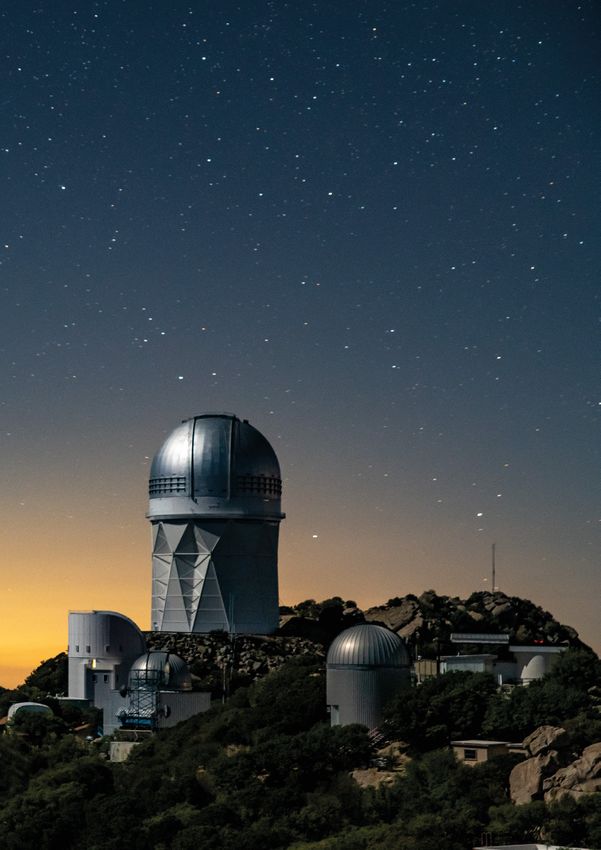
project to design and build the Dark Energy Spectroscopic Instrument
(DESI) on top of the Mayall Telescope in Arizona.
DESI is an array of 5,000 robotic fibre-optic eyes that swivel in a
choreographed dance, each focusing on a distant galaxy. In perfect
sky conditions they will enable the instrument to measure the light
of 5,000 galaxies in around 20 minutes.
The project has been designed to shed light on dark energy – the
mysterious force thought to be pushing galaxies apart and causing the
expansion of the Universe to accelerate. DESI will point automatically
at preselected galaxies, gather their light and split it into various
bands of colour, precisely mapping those galaxies’ distance from
Earth and gauging how quickly they are moving away from us.
When formal observations begin, DESI will peer deeply into the
Universe’s infancy and early development – up to 11 billion years ago
– to create the most detailed 3D map of the Universe ever produced.
Over its five-year run, DESI will repeatedly map the distance to
35 million galaxies and 2.4 million star-like quasars. This will provide
precise measurements of the Universe’s expansion rate and tell
scientists exactly how this rate has varied over time, helping establish
the mechanism for the acceleration of the expansion.
“DESI will define a new state of the art for studying the large-scale
structure of the Universe. This has always been a scientific area
in which the UK has been strong, and we’re very happy to be part
of this wonderful project.”
Professor John Peacock
Institute for Astronomy10 www.ph.ed.ac.uk Our teaching The School of Physics & Astronomy offers taught master of science (MSc) degrees in particle and nuclear physics, mathematical physics and theoretical physics. At the time of printing, our planned taught degrees for 2021 are: • Mathematical Physics (MSc) • Particle & Nuclear Physics (MSc) • Theoretical Physics (MSc) Our degree in particle and nuclear physics will give you the opportunity to develop advanced experimental techniques, computational techniques and theoretical understanding of the discipline. You will develop research and problem-solving skills, preparing you for employment in research, science-based industry, medical physics and education. Our mathematical and theoretical physics degrees jointly mark a new era in physics, one which follows the discovery of a Higgs boson at CERN and our establishment of the Higgs Centre, which provides training in the application of theoretical physics to solve problems at the forefront of academic and industry research. Please check our online degree finder for the most up-to-date information available on our taught postgraduate opportunities and to make an application: www.ed.ac.uk/ postgraduate/degrees “I’m very pleased to support the two MSc programmes in theoretical and mathematical physics. This initiative will greatly help the University of Edinburgh to play a major role in training the next generation of theoretical physicists.” Peter Higgs, Emeritus Professor of Theoretical Physics University of Edinburgh
Physics & Astronomy Postgraduate Opportunities 2021                                                    The University of Edinburgh         11

                                                      Facilities and resources
                                                      Our School, home to around 100 academics devoted to research
                                                      and teaching, offers the breadth of expertise and world-class
                                                      facilities that will inspire you to produce groundbreaking work.

                                                      You’ll be encouraged to explore the best         The Higgs Centre for Theoretical Physics
                                                      the world can offer in your field of interest.   has been established by the University to
                                                      Our connections with organisations such as       seek answers to some of these questions,
                                                      CERN can widen your horizons, as can visits      by creating opportunities to formulate new
                                                      to international conferences and events.         theoretical concepts to take us beyond the
                                                      Thanks to our reputation as a centre for         limitations of current paradigms.
                                                      research excellence, we regularly play
                                                      host to specialist conferences, and you can      The Higgs Centre of Innovation
                                                      expect to have access to some of the most        The new Higgs Centre of Innovation, located
                                                      respected names in the field.                    on the Royal Observatory Edinburgh site,
                                                                                                       opened in July 2018. This new centre brings
                                                      World-leading facilities                         together the innovation and technology
                                                      World-leading research requires exceptional      developed in astronomy, particle and nuclear
                                                      facilities to help fulfil your academic          physics with a start-up company incubator
                                                      ambitions. While we have established strong      facility to exploit technologies such as in
                                                      connections with many prestigious global         imaging, medical applications and satellite
                                                      research centres, a number of internationally    development. The Centre aims to form
                                                      recognised facilities are based here at          a link between research and industry to the
                                                      Edinburgh. They include:                         benefit of all, and especially to PhD students
                                                                                                       working in these areas.
                                                      The Higgs Centre for
                                                      Theoretical Physics                              UK Centre for Astrobiology
                                                      The discovery in July 2012 of the Higgs boson    We are affiliated with the NASA Astrobiology
                                                      at CERN, almost half a century after Peter       Institute and have a mission to advance
                                                      Higgs’ prediction in 1964, is a milestone in     our understanding of molecules and life in
                                                      the history of theoretical physics. Rarely has   extreme environments on Earth and beyond.
                                                      a theoretical prediction been confirmed          We do this with a combination of theoretical,
                                                      so spectacularly, so long after it was made.     laboratory, field and mission approaches.
                                                      The theoretical ideas put forward by Peter       We apply this knowledge to improving the
                                                      Higgs, Francois Englert and Robert Brout,        quality of life on Earth and developing space
                                                      inspiring thousands of physicists and putting    exploration as two mutually enhancing
                                                      in motion the experimental searches for the      objectives. Our work is underpinned by
                                                      Higgs boson, were celebrated with the Nobel      broad and compelling questions: How did
                                                      Prize in Physics awarded in October 2013.        life originate? Is there life elsewhere in the
                                                                                                       Universe? What are the limits of the Earth’s
                                                      The discovery marks the start of a new era       biosphere? Can we establish a permanent
                                                      in theoretical physics. While the Standard       human presence beyond the Earth?
                                                      Model of elementary particle physics is now      We study the responses of molecules to
                                                      complete, many fundamental questions             extreme environments, including the space
                                                      remain unanswered. We still don’t                environment, simulate extra-terrestrial
                                                      understand the intricate structure of charges    environments, and maintain a 1.5km-deep
                                                      and flavours in the Standard Model, or what      subsurface biology laboratory at the Boulby
                                                      determines the values of its parameters. We      Mine in Yorkshire, England.
                                                      are still struggling to build a compelling
                                                      theory of quantum gravity, and understand        The Centre for Science at
                                                      the role played by the vacuum in the             Extreme Conditions (CSEC)
                                                      formation of the early universe. We have no      At this highly specialised laboratory,
                                                      idea what dark matter and dark energy are,       the physical properties of materials can
                                                      and we have difficulty understanding             be measured at extremely high pressures.
                                                      structure formation and complexity.              CSEC, which has risen to international
                                                                                                       prominence over the past 20 years, provides
                                                                                                       the infrastructure needed to explore the
                                                                                                       effects of pressure on structure at
                                                                                                       interatomic distances.
12 www.ph.ed.ac.uk
Research opportunities
and support
We offer a diverse range of doctor of philosophy (PhD) degrees across
all of our areas of research. You will be supported by courses designed
for PhD students, in addition to those offered by the Scottish Universities
Physics Alliance (SUPA) Graduate School and the Institute for Academic
Development (see pages 4 and 5).
The Postgraduates in Physics & Astronomy Research opportunities
(PPA) Society provides an interface between At the time of printing, our planned
students and the Graduate School where postgraduate research opportunities
issues concerning students can be discussed for 2021 are:
and resolved.
• Astrophysics (PhD)
We have an active student group that • Condensed Matter & Complex Systems (PhD)
organises student-led seminars and • Nuclear Physics (PhD)
workshops in specific and general areas. • Particle Physics (PhD)
They also organise social activities, typically
a welcome BBQ, a residential trip to the Please check our online degree finder for
Firbush Point Field Centre on the shores of the most up-to-date information available
Loch Tay in the Scottish Highlands, Christmas on our postgraduate research opportunities
Ceilidh with Scottish dancing, and day bicycle and to make an application.
rides to the East Lothian beaches.
Research degree index: www.ed.ac.uk/
For further information on our PhD research studying/postgraduate/degrees/research
see: www.ph.ed.ac.uk/studying/
postgraduate-research PhD research projects:
www.ed.ac.uk/studying/
You can ‘meet’ current students and find out phd-research-projects
what they think about their programmes at:
edin.ac/phd-student-interviews Advice on finding a research supervisor:
www.ed.ac.uk/studying/postgraduate/
research
Career opportunities
Recent graduates have gone on to
postdoctoral research posts at universities
internationally or are now working for
employers such as BAE, EY, HMRC and
Moody’s Analytics.
See also…
You may be interested in postgraduate opportunities elsewhere within the University,
in particular degrees offered by the schools of Biological Sciences, Chemistry,
Informatics or Mathematics, or the Continuing Professional Development offered by the
Moray House School of Education: www.ed.ac.uk/studying/prospectus-requestPhysics & Astronomy Postgraduate Opportunities 2021 The University of Edinburgh 13
Case study
Edinburgh’s research with impact
Formulation physics
From the moment we awake each morning, we interact with
complex fluids throughout the day – whenever we wash, eat,
read on liquid crystal displays (LCDs) or touch a variety of
coatings from topical creams to decorative paints. Other complex
fluids may be less obvious to us, such as the dispersions used
in pesticides and the pastes used to make catalytic exhausts,
yet they are still vital to the quality of our lives. Given such ubiquity,
what are complex fluids?
Complex fluids
Unlike simple liquids, made of molecules with equal freedom
to move, complex fluids often contain nano- to micro-sized
components in the form of dispersed polymers, particles, droplets
or bubbles. Such materials can be highly concentrated dispersions
such as toothpastes, polymeric and particulate composites such
as the dough that forms bread, or emulsions such as decorative
paints. To the general consumer these kinds of products are
considered ‘gooey’ and have properties somewhere in between
the classic models of liquids, which flow easily, and solids,
which do not flow at all.
The Edinburgh Complex Fluids Partnership (ECFP) was set up
in 2012 as a knowledge exchange unit to develop collaborations
between industry and the Soft Matter and Biological Physics
Group within the School of Physics & Astronomy.
Collaboration
During the first five years ECFP collaborated with more than
30 companies of all scales from start-ups to multinationals,
working across numerous sectors including personal care,
decorative paints, food and drink, agrochemicals and ceramics.
The breadth of work illustrates the importance of developing
generic physical principles through research, the results
of which are relevant to a number of different systems with
similar microstructure.
Through working with industry, ECFP has been able to help
companies improve their formulations and processes and in doing
so reduce wastage. Furthermore, exciting new research themes
have arisen, inspired by fundamental challenges faced by industry.
www.edinburghcomplexfluids.com
Working with industry, ECFP has been able
to help companies improve their formulations
and processes.
See more online: www.ed.ac.uk/research/impact14 www.ph.ed.ac.uk
Funding
A large number of scholarships, loans and other funding schemes are available
for your postgraduate studies. It is only possible to show a small selection in print.
To see the full range, please visit: www.ed.ac.uk/student-funding/postgraduate
Awards are offered by the School of Scholarships at the Research council awards
Physics & Astronomy, the College of Science University of Edinburgh Research councils offer awards to eligible
& Engineering, the University of Edinburgh, masters and PhD students in most of the
the Scottish, UK and international • Centre for Doctoral Training in Schools within the University of Edinburgh.
governments and many funding bodies. Mathematical Modelling, Analysis All studentship applications from the
and Computation (MAC-MIGS) research councils must be made through the
Here we list a selection of potential sources This PhD is run jointly by the University University, through your School or College
of financial support for postgraduate of Edinburgh and Heriot Watt University. office. Please check the eligibility criteria for
students applying to the School of Physics It typically offers 15 PhD studentships per each opportunity online: www.ed.ac.uk/
& Astronomy. This list was correct at the year and is based in the new Bayes Centre. student-funding/research-councils
time of printing but please check the full Entry to this CDT is via the School
and up-to-date range online (see above). of Mathematics, with typically two Loans available for study at
studentships per year in the School the University of Edinburgh
University of Edinburgh of Physics & Astronomy: The University of Edinburgh is a participating
Alumni Scholarships www.mac-migs.ac.uk institution in the following loans programmes,
We offer a 10 per cent scholarship towards meaning we certify your student status and
• Centre for Doctoral Training in
postgraduate fees to all alumni who graduated can help with the application process.
Soft Matter and Industrial Innovation
from the University as an undergraduate,
(SOFI2)
and to all students who spent at least one • The Canada Student Loans
This is a tri-institutional collaboration
semester studying at the University on Program
between the universities of Durham,
a visiting programme: www.ed.ac.uk/ The University is eligible to certify
Edinburgh and Leeds. Recently renewed
student-funding/alumni-scholarships Canadian student loan applications:
for 2019-24 entry, it typically offers
12 studentships a year, with two placed www.ed.ac.uk/student-funding/
in the School of Physics & Astronomy: canadian-loans
Key
www.dur.ac.uk/soft.matter/soficdt • Postgraduate Doctoral
Taught masters degrees
Masters by Research degrees • Higgs Scholarship Loans England
Research degrees The School offers six MSc scholarships, Student Finance England offers
each worth £5,000. These will be awarded postgraduate loans for doctoral study,
on the basis of academic merit to students payable to eligible students and divided
of all nationalities who are accepted for equally across each year of the doctoral
admission to MSc Theoretical Physics, programme: www.gov.uk/doctoral-loan
Mathematical Physics or Particle & Nuclear • Postgraduate Doctoral Loans Wales
Physics: www.ph.ed.ac.uk/ Student Finance Wales offers loans for
higgs-centre-scholarships postgraduate doctoral study, payable to
• Principal’s Career Development eligible students, divided equally across
PhD Scholarships each year of the doctoral programme:
These prestigious scholarships give access www.studentfinancewales.co.uk/
to any applicant from around the world postgraduate-students/
to undertake discipline training and postgraduate-doctoral-loan
additional skills development. Students are • Postgraduate Loans (PGL)
encouraged to engage with entrepreneurial England
training, teaching, outreach and industrial Student Finance England offers
engagement. Each award covers the tuition postgraduate loans for taught and research
fee and full stipend: www.ed.ac.uk/ masters programmes, payable to eligible
student-funding/development students: www.gov.uk/postgraduate-loan
• School-funded places • Postgraduate Loans (PGL)
We have School-funded PhD places Northern Ireland
and PhD places covering a stipend Student Finance Northern Ireland offers
and the Home/EU tuition fee available eligible students a tuition fee loan for
across all our subjects: taught and research programmes, at
edin.ac/physics-funding-studentships certificate, diploma, and masters level,
which will be paid directly to the University:
www.studentfinanceni.co.ukPhysics & Astronomy Postgraduate Opportunities 2021 The University of Edinburgh 15 • Postgraduate Loans (SAAS) The Student Awards Agency Scotland offers eligible students tuition fee loans for taught and research programmes at diploma and masters level, which will be paid directly to the University. Eligible students can also apply for a non-income assessed living cost loan: www.saas.gov.uk • Postgraduate Master’s Finance Wales Student Finance Wales offers eligible students postgraduate finance for taught and research masters programmes: www.studentfinancewales.co.uk • US Student Loans The University is eligible to certify loan applications for US loan students. Full details on eligibility and how to apply can be found online: www.ed.ac.uk/ student-funding/us-loans Other sources of funding The following are examples of the many scholarships and support schemes available to students from particular countries who meet certain eligibility criteria. • Chevening Scholarships A number of partial and full funding scholarships are available to one-year masters students: www.chevening.org • Commonwealth Scholarships Scholarships available to students who are resident in any Commonwealth country, other than the UK: www.dfid.gov.uk/cscuk • Marshall Scholarships (USA) Scholarships available to outstanding US students wishing to study at any UK university for at least two years: www.marshallscholarship.org
16       www.ph.ed.ac.uk

Where we are
The School of Physics & Astronomy’s teaching and administration centre           Detailed maps
                                                                                can be found at:
is in the James Clerk Maxwell Building, on the University’s King’s Buildings
                                                                               www.ed.ac.uk/maps
campus, about two miles south of the city centre. The Institute for
Astronomy is based at the Royal Observatory, also in the south of the city.

                                        We are here!
                                          The School
                                          of Physics &
                                          Astronomy

   A702 SOUTH

                                   …and here
                                    Institute of
                                    Astronomy

    University building
Physics & Astronomy Postgraduate Opportunities 2021 The University of Edinburgh 17
What’s next?
Contact us For any other enquiries, contact:
For more information about applying
for an MSc, contact: School of Physics & Astronomy
The University of Edinburgh
MSc Administrator James Clerk Maxwell Building
Tel +44 (0)131 651 3448 King’s Buildings
Email msc.tpmp@ph.ed.ac.uk Peter Guthrie Tait Road
or msc.pnp@ph.ed.ac.uk Edinburgh EH9 3FD, UK
Tel +44 (0)131 651 7067
For more information about the application Email enquiries@ph.ed.ac.uk
and admissions process for taught MSc
degrees, contact: Institute for Astronomy
The University of Edinburgh
College of Science & Engineering Royal Observatory
Recruitment and Admissions Team Blackford Hill
Tel: +44 (0)131 650 5737 Edinburgh EH9 3HJ, UK
www.ed.ac.uk/science-engineering/ Tel +44 (0)131 668 8403
contact/ug-pgt-enquiries
Visit us
For more information about applying for We offer many opportunities for you to join
our doctorates, contact: us in Edinburgh and find out more about the
University – including Online Information
Graduate School Administrator Sessions to access from the comfort of your
Tel +44 (0)131 651 7837 own home and Open Days you can attend in
Email gradschool@ph.ed.ac.uk person or online. Find out what event we're
hosting next: www.ed.ac.uk/visit/open-days
Virtual Visit
Can’t visit Edinburgh in person? Our Virtual
Visit allows you to virtually explore the
University and the city. View a range of
videos, 360° photos and image galleries to
find out what it is like to live and study here:
www.virtual-visit.ed.ac.uk
Chat online
Wherever you are in the world, we offer
you opportunities to get in touch and speak
directly to us about studying here.
We offer all postgraduate students online
information sessions. To find out more and
see when the next session will be:
www.ed.ac.uk/postgraduate/online-events
Our visits to you
If you are unable to visit the University, we
attend events worldwide whenever possible
during the year. Find out about your next
opportunity to speak to us in person:
www.ed.ac.uk/postgraduate/meet-usWe know these are uncertain times
but at the University of Edinburgh
your safety is our priority. We hope Physics &
Astronomy
to welcome you on campus and are
committed to ensuring you're taught
as safely as possible during the
pandemic. To find out about the
steps we’re taking, in line with
Scottish Government guidance, visit:
www.ed.ac.uk/news/covid-19
Published by:
Communications and Marketing, The University of Edinburgh
Designed by:
Parkhouse
Photography by:
Paul Dodds
Shutterstock
Nick Callaghan
Marilyn Chung, Berkeley Lab
Chris Robson “The attraction was the diversity
Getty Images
of the courses available. I could tailor
This publication is available online my programme and select courses
at www.ed.ac.uk/postgraduate and that were mathematical, theoretical
can be made available in alternative
formats on request. Please contact or experimental. The staff were
communications.office@ed.ac.uk extremely approachable and caring.”
or call +44 (0)131 650 2252.
Vasiliy Demchenko
Physics graduate
We have made every effort to ensure the accuracy of
the information in this prospectus before going to print.
However please check online for the most up-to-date
information: www.ed.ac.uk
The UK formally left the European Union (EU) on
31st January 2020. UK and Scottish Governments have
confirmed that most non-UK EU students commencing
study in 2021/22 will no longer be treated as 'home'
students in relation to fee status or access to funding.
Final fee regulations are not yet available but are expected
to clarify fee status for those with settled status and for Irish
citizens (under the Common Travel Agreement). For the
latest information for students and applicants from the EU,
please visit our website: www.ed.ac.uk/news/eu
The University’s standard terms and conditions will form
an essential part of any contract between the University
of Edinburgh and any student offered a place here. Our full
terms and conditions are available online:
www.ed.ac.uk/student-recruitment/terms-conditions
© The University of Edinburgh 2020.
No part of this publication may be reproduced without
written permission of the University. The University of
Edinburgh is a charitable body registered in Scotland,
with registration number SC005336.You can also read


