Bougainville : Tax Revenue Challenges - Nelson Atip Nema - Economics Division , University of Papua New Guinea. August 8 , 2019.
←
→
Page content transcription
If your browser does not render page correctly, please read the page content below
Bougainville :
Tax Revenue
Challenges

                 Nelson Atip Nema - Economics
                 Division , University of Papua New
                 Guinea.
                 August 8 , 2019.
Introduction Current & potential challenges of tax revenue collection in AROB. If vote for independence (October ,2019) – decision to adopt PNG’s current tax code or not & if not whether to review existing legislation or not. Assumption : Tax base constant & discussions on current tax rate , policy & effects . Researches prove that one of factors that affect patterns of tax in countries are influenced by structures in neighbouring countries - so PNG & AROB.
Chand (2018) mentioned a budget estimate of K300 m is needed to effectively run AROB. 2017: however, ceiling at K162 m falling short of 138 m. 2018 : increase but ceiling at 226 m falling short of K74 m. Increase mainly due to increase in grants for lead up to referendum : K31.5 m (2017) to K78 m (2018). Objective : fill the revenue gap thru increase tax revenue collection.
Methodology Desk top research – supported with evidence of information mainly from internet. Discussions done in 2 parts: (1) policy perspective (2) Administrative perspective – emphasis placed here. Historical cross sectional qualitative data used . Most data from the ABG website , especially AROB 2017 tax summit presentations.
PART 1: Challenges Relating to the
Tax Policy
Good tax policy influences economic development .
Potential future Bougainville gov’t or AROB needs
more revenue for economic development.
ABG - Fiscal Self-Reliance & not Fiscal Autonomy .
BPA Paragraph 137 – deemed to achieve in the first
year when revenues from company tax (100%) ,
customs duties (100%)& 70% GST equal to value of
recurrent grant on sustainable basis.Revenue Sharing Issue Compelling Issue - BPA Paragraph 137 – only accounts for 3 specific types of taxes. Need proper definition of self-reliance to include “all revenues” generated in the AROB. Eg in 2016 company taxes – K727,850 , GST K1,532,118 & customs duties K2,379,009 – self reliance – 5.66% first definition. All revenues – K23,233,617- self reliance- 56.27% second definition. Even 70% GST has limiting factor ,why not 100%?
Policy Legislation Issue Lack of clarity on application of grant formula. Funds disbursed to ABG over the last few years has been on adhoc basis. Evidence can be seen on total value of grants to the ABG by the PNG Government in the years 2014 (K155m), 2015 (K60m) and 2016 (K57m) where there was no steady formula used.
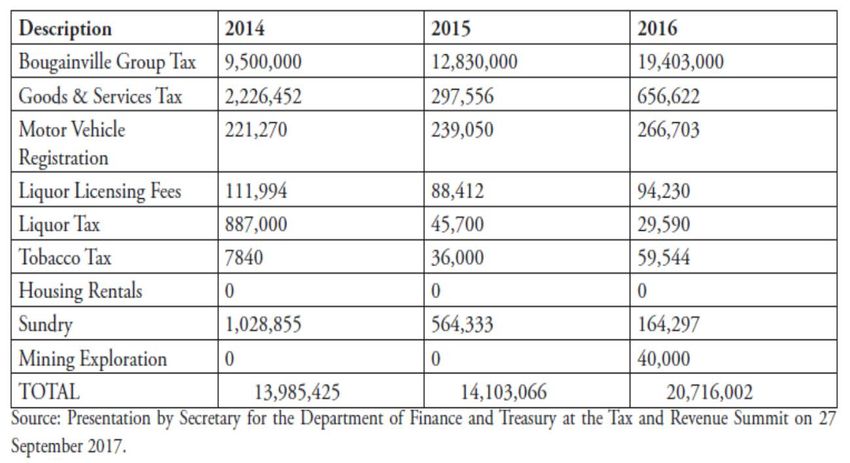
PART II – Tax Revenue Collection Challenges Challenges to Collecting Income & Consumption taxes Income Tax – a major source of tax revenue in AROB. In 2016, of K20, 716,002 total revenue collected K19, 403,000 (94%) came from Group Tax. Challenge - unsustainable since employers & employees may change , switch jobs, die etc.
Value of revenues generated within Bougainville , 2014- 16
Consumption Tax Make up the mainstay of revenue base for most countries – over 150 countries have a VAT regime. Sustainable and a good indicator for economic performance . GST - second largest tax revenue collected by ABG. Major challenge to promote growth of SME and turning the informal businesses into formal businesses.
Challenge to Collection of
Resources Taxes
Mineral Resources tax –
Estimated that the reopening of Panguna mine would
generate significant tax revenue of US 560 million
per year - more than 6 times revenue needed to
run the AROB economy.
Major challenge – Bouginville Mining Act (2015) not
comprehensive of tax regime – PNG to legislate or
new tax Act needed for AROB.
Also other mines apart from Panguna – Tore , Isina ,
Jaba & Manetai. ABG sets rates for land taxes – flexible to collect-
revenue collected from board fees.
Challenge – ABG to validate property register on
current properties not formally documented.
2,375 properties at current - would increase when
property register is validated.
Fisheries - at least 30% of the PNG catch is taken in
waters associated with Bougainville which would put
the value at over USD 333 million – over K1 billion.
Challenge – set out fisheries tax rates – making more
transparent & efficient than current auction basis
trading.Challenges to collection of Export
& Import Taxes
Export taxes levied mostly on agricultural & mineral products
in the primary producing countries.
Levy export taxes when currency depreciates & import
taxes when currency appreciates.
Bougainville Cocoa provided 33% of overall PNG production
from 2006 – 2016.
Challenge would be to levy on an agreed rate, either
between the ranges of 1% to 5 %.
AROB Copra – also an important commodity for export
taxes.
Import tax common challenges – revenue leakages when
currency depreciates , fraud & corruption , weakness in
policies , manpower shortage, skills shortages, best practice
international etc.Costs of Taxation A new Bougainville government needs the following for its tax office: - New tax regime - New technology such as PNG’s Standard Integrated Government Tax Administration System (SIGTAS) program. - Recruit more staff & train. - A new Revenue Building .
CONCLUSION
Estimated budget of K300 million is needed by the ABG .
2017 budget gap of K138 million & 2018 budget gap of K74 million.
Appropriate options currently available to increase in the collection
of tax revenue to fill the gap.
Tax Policy Challenge - Definitions of Self-Reliance according to
legislation.
No clear evidence that the PNG government is using the recurrent
grant formula to calculate its annual grants towards the Bougainville
Government.
Consumption tax such as GST is sustainable to grow economy
than Income Tax - so grow SMEs.
BTO needs sufficient highly skilled human resources , new
infrastructure & new technology to efficiently collect tax revenue. .
Possible to manage self-government on the conditions that the
revenue challenges are met or will be able to meet in the transition
period for a while before being stabilized.End of Presentation ! Thankyou
You can also read


