Bryant & Stratton College
   Online RN to BSN

    Nursing Program

   Student Handbook

          2021
←
→
Page content transcription
If your browser does not render page correctly, please read the page content below
Bryant & Stratton College
Online RN to BSN
Nursing Program
Student Handbook
2021Bryant & Stratton College
ONLINE RN to BSN Handbook 2021
Table of Contents Page
Nursing Program 3
College Mission Statement 3
College Vision Statement 3
Nursing Program (Mission, Philosophy) 3
Nursing Program Conceptual Framework 6
Nursing Program Student Learning Outcomes 9
RN-BSN Program Entry and Non-Academic Requirements 9
BSN Program Entry Requirements 9
Disclosure 10
Federal Law 10
Professional Appearance 11
Academic Policies and Procedures 11
Transfer Credit and Proficiency Credit 12
RN-BSN Completion Option Students 12
Notification of policy change 12
Course Grading Scale 12
Academic Advisors 12
Progression through the Nursing Program 13
Acceptable Achievement in Nursing Courses 13
Grade Appeal 13
Non-Grade Related Grievance Process 13
Program Jeopardy Status 13
Release from the Nursing Program 13
Re-entry into the Nursing Program 14
Completion of the Nursing Program 14
Safe Nursing Practice Definition 15
Professional Student Conduct 15
Student Conduct 17
Statement of Confidentiality 18
Student Illness or Injury Policy 18
Accidental Exposure 19
Student Health and Counseling Services 19
Fees and Expenses 19
Student Complaints 19
RN-BSN Curriculum Plan 21
Student Acknowledgement of Handbook 23
Original 3/2018, revised 7/26/18, 10/10/18, 4/17/19; 8/19/19, 1/6/2020; 8/28/2020; 4/30/2021; 8/1/2021; 9/2/2021 2Bryant & Stratton College
ONLINE RN to BSN Handbook 2021
The information in this handbook is NOT A CONTRACT with students and is subject to change at
any time without notice. Students will be notified via e-mail of policy changes to specific nursing policy
and procedures. Questions regarding updates may be directed to the Program Director. If any
information in this handbook conflicts with the State or Federal Statute, Rules, or Regulations, the
State or Federal Statutes, Rules, or Regulations will control.
I. About the Nursing Program
This handbook was developed to provide faculty and students in the RN to BSN Online Nursing Program
with information and answers to questions concerning the Nursing Program at Bryant & Stratton College.
Included in this handbook:
a. Program-specific information
b. Academic policies and procedures relating to the RN to BSN Online Nursing Program
Students who deviate from the requirements and obligations set forth in this Handbook and in the
Official Catalog are subject to appropriate action including suspension or dismissal from the
College and release from the Nursing Program.
College Mission Statement
Bryant & Stratton College offers a personalized career education and experience leading to high-
demand professions so graduates are prepared for their career and life pursuits.
College Vision Statement
Bryant & Stratton College will offer a personalized and customized career education and experience
leading to high-demand professions so graduates adapt to 21st century career and life pursuits.
BSN Program Mission Statement
The mission of the baccalaureate nursing program is to provide quality nursing education and to facilitate
the provision of quality healthcare in the region. The mission espouses a commitment to prepare graduates
to provide safe, quality, humanistic, and holistic healthcare as professional nurses and lifelong learners.
BSN Program Philosophy
The baccalaureate nursing program subscribes to and functions within the mission of Bryant & Stratton
College to deliver outcome-based nursing education and training through a flexible, contemporary,
curriculum in a personalized environment with emphasis on authentic and experiential education.
Additionally, the philosophy of the baccalaureate nursing program is in accordance with the mission of
the nursing program. The philosophy reflects standards of professional nursing guidelines for reform and
innovation in nursing education and the collective beliefs and values of the nursing faculty. Beliefs and
values related to professional nursing, person, health, environment, society, professional nursing
education and professional role development, and teaching-learning practices, are interrelated and
constitute the philosophy of the nursing Program.
Original 3/2018, revised 7/26/18, 10/10/18, 4/17/19; 8/19/19, 1/6/2020; 8/28/2020; 4/30/2021; 8/1/2021; 9/2/2021 3Bryant & Stratton College
ONLINE RN to BSN Handbook 2021
Professional Nursing: The faculty embraces the American Nurses Association (2016) contemporary
definition of nursing. The definition includes the full range of the client’s potential responses to health
and illness that are of concern and highly valued when providing exceptional healthcare:
Nursing is the protection, promotion, and optimization of health and abilities, prevention of illness and
injury, facilitation of healing, alleviation of suffering through the diagnosis and treatment of human
response, and advocacy in the care of individuals, families, groups, communities, and population. (ANA,
2016)
As both an art and science, professional nursing incorporates patient/client advocacy, caring, cultural
sensitivity, evidence-based outcome-oriented actions, and professional values, to assist the patient/client
toward adaptation, self-care, and equilibrium. The faculty affirms that altruism, autonomy, human
dignity, integrity, mercy, and social justice exemplify the caring component of professional nursing and
guide the nurse’s ethical behavior in patient/client care.
Professional nursing also encompasses the application of knowledge from both the arts and sciences in
the care for diverse populations across the life-span and health-illness continuum. Professional nurses
facilitate health and healing and provide safe, quality, and exceptional healthcare through critical
thinking, clinical judgment, and clinical reasoning processes.
Person: As members of the global society, people are endowed with intellects and capabilities which
direct them toward uniqueness, inherent worth, autonomy, and self-fulfillment. Striving toward
equilibrium in ever-changing internal and external environments, the person is an open, adaptive, goal-
oriented, and interpersonal system incorporating physical, psychological, interdependence, social,
developmental, role, and spiritual spheres. People have rights, privileges, and responsibilities as members
of a family, a community, and the global society. Influences such as urban and rural settings, economics,
and cultural, ethnic, spiritual, family, and religious influences affect people.
People are holistic and worthy of compassionate, patient/client-centered nursing care that is based on
respect for patient/client preferences, values, and needs. Consistent with the faculty’s definition of
professional nursing, the person in patient/client-centered nursing may be an individual, family, group,
community, or population, across the life span, and across healthcare environments. When providing
patient/client-centered healthcare, the nurse facilitates nurse-patient/client partnerships whereby the
patient/client and nurse collaborate and share responsibility for healthcare decision making, as
appropriate.
The person (patient/client; consumer; resident) is the recipient of nursing care and may be an individual,
family, group, aggregate, community, or population. The person may “function in independent,
interdependent, or dependent roles, and may seek or receive nursing interventions related to disease
prevention, health promotion, or health maintenance, as well as illness and end-of-life” (AACN, 2008, p.
38) while maintaining the locus of control.
Health is a vibrant, dynamic state which fluctuates within a health-illness continuum with the individual’s
optimal level of health as the goal and in which the potential of a person is realized to the fullest extent
possible. Health is a human experience that is often expressed in terms of wellness and illness and may
occur in the presence or absence of disease or injury. Each person perceives health in a unique manner,
according to developmental stage, cultural context, spirituality, preferences, and health literacy.
Original 3/2018, revised 7/26/18, 10/10/18, 4/17/19; 8/19/19, 1/6/2020; 8/28/2020; 4/30/2021; 8/1/2021; 9/2/2021 4Bryant & Stratton College
ONLINE RN to BSN Handbook 2021
The professional nurse focuses on the following constructs of health, across the life span, at the individual
and population levels including vulnerable populations: health promotion; prevention; acute and chronic
health needs; elimination of health disparities; disease management; injury prevention; risk reduction; the
relationship of genetics and genomics to health and illness; health determinants including environmental
assessments of health and illness parameters; and educating patient/clients and caregivers about these
same constructs of health.
Students must be prepared to assume new roles in health education, wellness, prevention, and disease
management as the capability of predicting future health problems becomes more of a reality with
advances in science and technology.
Environment: Unique responses by the person to constant interaction with their internal and external
environments result in varying degrees of health. The nurse practices from a holistic perspective related
to assessment of the person’s responses to the environments. The environment reflects two, interrelated
dimensions: the internal and external environment. The internal environment comprises all dimensions
of the person including the person’s mind, body, spirit, and emotions. The external environment is
everything outside the person and comprises multiple dimensions that affect the person including the
complex, ever-changing, healthcare environment. “Because professional nurses are the human link
between the patient/client and the complex healthcare environment, they must provide compassionate
care informed by a scientific base of knowledge, including current evidence from research” (AACN,
2008, p. 29). The patient/client must continually adapt to changes in the internal and/or external
environments.
The practice of nursing in a global, diverse society mandates that nursing education programs prepare the
student to develop the knowledge, skills, and attitudes to practice professional nursing in a multicultural
environment with the ability to collaborate with members of interdisciplinary healthcare teams from
diverse backgrounds. An ongoing goal for professional nursing and the benchmark for quality healthcare
is the provision of safe, quality, and culturally-sensitive nursing care for patient/clients across the lifespan,
during all transitions of care and across the continuum of healthcare environments.
Society is a system that provides the framework for human behavior and expectations and includes all
physical, psychological, cultural, ethical, and spiritual elements that provide a framework for interactions
to address the person’s needs and goals. The person is an integral part of society and also a member of a
family, group, community, and population. Society’s structure and diverse cultures influence a person’s
behavior. The person’s socialization and response to health and illness reflects the learned behaviors
from their culture, exposures, and learned responses. The professional nurse must understand cultural
impacts and be prepared to individualize care provided to diverse populations.
The faculty affirms the beliefs and tenets related to the value-added dimension that the nursing profession
offers to society as presented in Nursing’s Social Policy Statement: The Essence of the Profession (ANA,
2010).
Professional Nursing Education builds upon and integrates the arts, sciences, and humanities with
nursing science to facilitate acquisition and refinement of knowledge, beliefs, values, attitudes, and skills
reflected in cognitive, affective, and psychomotor domains. Based on a philosophical foundation of
valuing student success and supporting professional role development, the concepts and theories from
nursing and related disciplines form the structure of the nursing curriculum.
Original 3/2018, revised 7/26/18, 10/10/18, 4/17/19; 8/19/19, 1/6/2020; 8/28/2020; 4/30/2021; 8/1/2021; 9/2/2021 5Bryant & Stratton College
ONLINE RN to BSN Handbook 2021
To fulfill the mission of providing quality healthcare, the faculty believes that it is imperative for the
nursing curriculum to be in alignment with on-going changes in science and technology, shifting
population demographics, emerging healthcare needs of contemporary society, and changes in
professional nursing practice and practice environments.
Professional Roles: Professional nursing education prepares the student to practice as a professional
nurse in diverse roles and practice settings. Consistent with The Essentials for Baccalaureate Education
for Professional Nursing Practice (AACN, 2008, p. 35), the faculty believes that the following roles are
relevant for the baccalaureate-prepared generalist nurse:
Provider of care (evaluate client changes and progress over time; develop a beginning proficiency
and efficiency in delivering safe care)
Designer/manager/coordinator of care (manage care transitions; be an active participant on the
interprofessional team; identify system issues; develop working skills in delegation, prioritization,
and oversight of care
Member of a profession (evaluate one’s practice; assume responsibility for supporting the
profession)
Professionalism encompasses the values, formation of professional roles, and images of the nurse.
Values have their basis in understanding the ethical, legal, and regulatory guidelines defined by the
profession and society as a whole. The expectation of the nurse is to contribute to both the profession
and professional development of self by using critically reviewed research to define evidence-based
practice and to practice lifelong learning.
Teaching-Learning Practices: Teaching is a reciprocal exchange of knowledge, beliefs, values,
attitudes, and skills that promotes lifelong learning. Teaching is the facilitation of mutual learning that
requires collaboration, sharing experiences, and creating a stimulating and dynamic educational
environment that fosters critical thinking. Learning is the outcome of teaching that is a reflection of
cognitive, affective, and psychomotor domains.
Effective teaching/learning practices consider the needs of the learner, builds\ on prior learning and
predetermined standards of academic rigor, and seek to advance growth through experiences that promote
a sense of excitement, curiosity, creativity, and discovery. These practices further the learner’s sense of
valuing their own accountabilities and responsibilities for learning, and partner with and support the
learner’s individual efforts to achieve expected learning outcomes.
CONCEPTUAL FRAMEWORK
The nursing faculty designed the BSN program with a philosophy and conceptual framework which
support contemporary evidence-based nursing practice focused on quality and safety. The conceptual
framework of the BSN program at Bryant & Stratton College is derived from three major components:
1. The Essentials of Baccalaureate Education for Professional Nursing Practice (American
Association of Colleges of Nursing, 2008).
2. Quality and Safety Education for Nurses (QSEN)
3. NLN Competencies for Baccalaureate Programs in Nursing (NLN, 2010)
Original 3/2018, revised 7/26/18, 10/10/18, 4/17/19; 8/19/19, 1/6/2020; 8/28/2020; 4/30/2021; 8/1/2021; 9/2/2021 6Bryant & Stratton College
ONLINE RN to BSN Handbook 2021
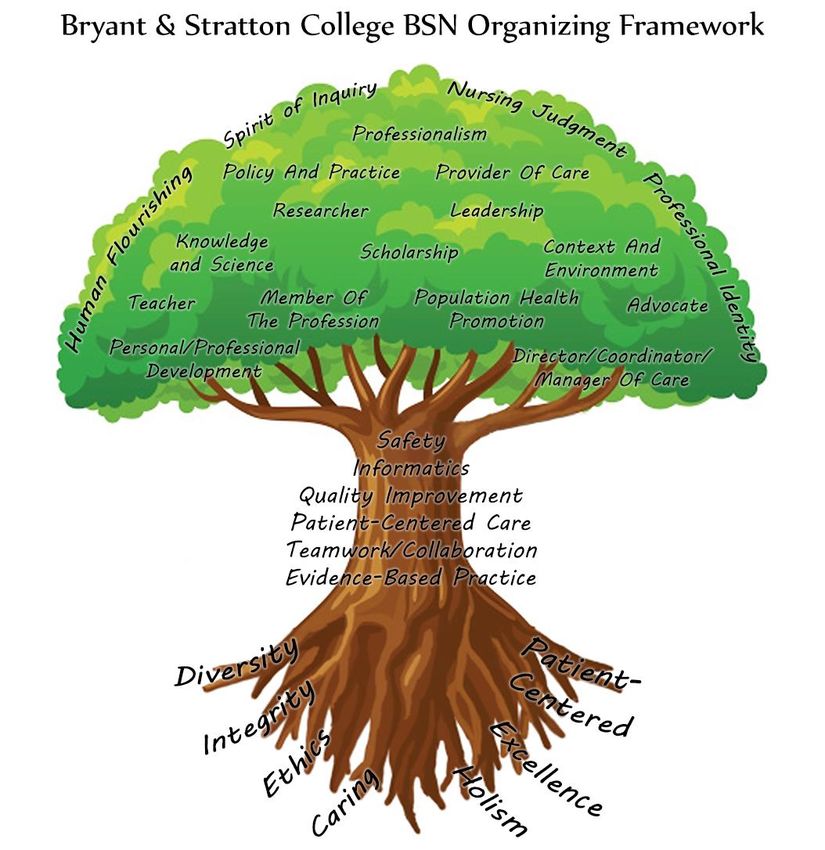
To serve as a visual guide, the BSN Organizing Framework has been developed to illustrate the integrative
process of the conceptual framework at Bryant & Stratton College.
At the root of nursing practice lies the core values of nursing (NLN, 2010) which include diversity, integrity,
ethics, caring, holism, excellence, and patient-centeredness. These core values embody the work of the
profession of nursing in all areas of practice.
Quality and Safety Education for Nurses includes six competencies essential to creating a safe and effective
health care environment. These competencies form the stem, support the framework, and also provide for
the reciprocal nature of the incorporation of the core values and the baccalaureate essentials. The
competencies of QSEN include safety, informatics, quality improvement, patient-centered care, teamwork
and collaboration, and evidence-based practice. The QSEN competencies are reflected in the core values
and they provide support for the NLN integrating concepts and the baccalaureate essentials.
The BSN organizing framework depicts a tree encompassing the conceptual framework components. The
leaves of a tree individually accomplish their function of providing nutrients and energy, while collectively,
Original 3/2018, revised 7/26/18, 10/10/18, 4/17/19; 8/19/19, 1/6/2020; 8/28/2020; 4/30/2021; 8/1/2021; 9/2/2021 7Bryant & Stratton College
ONLINE RN to BSN Handbook 2021
the branches and leaves create a rich environment for survival, relationships with each other, and growth of
the entire tree.
Similarly, the Essentials of Baccalaureate Education (AACN, 2008) and the NLN integrating concepts
(NLN, 2010) provide the fruitful energy of nursing practice, are harmonious, and create the extension of the
core values which are essential to safe and effective nursing practice. The NLN integrating concepts
include context and environment, knowledge and science, personal/professional development, quality and
safety, relationship centered care, and teamwork. These concepts are congruent with the QSEN
competencies and the core values of nursing practice. The Essentials of Baccalaureate Education reinforce
concepts such as patient-centered care, interprofessional teams, evidence-based practice, quality
improvement, patient safety, informatics, clinical reasoning/critical thinking, genetics/genomics, cultural
sensitivity, professionalism, and nursing practice across the lifespan in providing quality patient care
(American Association of Colleges of Nursing, 2008).
Three main roles of the baccalaureate nurse include the member of profession, provider of care, and the
director/coordinator/manager of care. Expected outcomes for graduates of Bryant & Stratton BSN Program
contain the following nine “Essentials:”
Essential I: Liberal Education for Baccalaureate Generalist Nursing Practice
Essential II: Basic Organizational and Systems Leadership for Quality Care and Patient Safety
Essential III: Scholarship for Evidence Based Practice
Essential IV: Information Management and Application of Patient Care Technology
Essential V: Health Care Policy, Finance, and Regulatory Environments
Essential VI: Interprofessional Communication and Collaboration for Improving Patient Health
Outcomes
Essential VII: Clinical Prevention and Population Health
Essential VIII: Professionalism and Professional Values
Essential IX: Baccalaureate Generalist Nursing Practice (American Association of Colleges of Nursing,
2008).
The BSN curriculum was designed with three contemporary, relevant, and thorough representations of
strong student preparation for the profession of nursing, the provision of high quality nursing care, and the
anticipation of the future evolution of nursing roles. The ultimate goal is the achievement of the
competencies Human Flourishing, Spirit of Inquiry, Nursing Judgment, and Professional Identity (NLN,
2010) which are embedded within and congruent with the BSN program student learning outcomes.
Original 3/2018, revised 7/26/18, 10/10/18, 4/17/19; 8/19/19, 1/6/2020; 8/28/2020; 4/30/2021; 8/1/2021; 9/2/2021 8Bryant & Stratton College
ONLINE RN to BSN Handbook 2021
Program Student Learning Outcomes
1. Employ the nursing process to implement comprehensive, safe, diverse, culturally effective
patient-centered care across the lifespan in all health care settings.
2. Demonstrate integration of knowledge, skills, professional attitude, through the use of critical
thinking, best current evidence, and clinical judgment in providing care to individuals, groups,
and communities with a variety of healthcare needs.
3. Practice within the ethical, legal, and regulatory frameworks of nursing, health care, and its
related agencies assuming they have no past conduct or convictions which prevent such
practice.
4. Fulfill the roles of the baccalaureate nurse generalist as provider of direct and indirect care,
advocate, collaborator designer/manager/coordinator of care, and member of the profession.
5. Construct a framework which promotes lifelong learning essential to continuous professional
development and tolerance for the unpredictable and ambiguous nature of the healthcare system.
6. Employ information literacy skills through the effective use of informatics to communicate,
manage knowledge, mitigate errors, and support decision-making.
7. Utilize appropriate current technology and resources to locate and evaluate information needed to
accomplish a goal, and then communicate findings in visual, written and/or oral formats. *
8. Transfer knowledge, skills and behaviors acquired through formal and informal learning and life
experiences to new situations. *
9. Employ strategies for reflection on learning and practice in order to adjust learning processes for
continual improvement. *
10. Follow established methods of inquiry and mathematical reasoning to form conclusions and make
decisions. *
11. Participate in social, academic, and professional communities for individual growth and to
function as a citizen of a multicultural world. *
* Institutional Outcome
II. RN to BSN Program Entry and Non-Academic Requirements
1. Complete and submit to the nursing program director for consideration:
o Eapplication
o Acceptance of RN-BSN program disclosure
o Transcripts of post-secondary educational experience. If transcripts are necessary to evaluate
credit, applicants must provide the transcripts confirming earned credit from a regionally or
nationally accredited college. These documents must be a part of the applicant’s application
packet before consideration of a candidate’s application is made. Official transcript(s) must
be received by the end of the first semester.
o HS transcripts or GED will be required.
o A copy of legal picture ID
2. An interview with a bachelor program administrator may be scheduled as part of acceptance and
prior to acceptance.
Original 3/2018, revised 7/26/18, 10/10/18, 4/17/19; 8/19/19, 1/6/2020; 8/28/2020; 4/30/2021; 8/1/2021; 9/2/2021 9Bryant & Stratton College
ONLINE RN to BSN Handbook 2021
3. Applicants interested in taking courses through Online Education must meet certain technology
requirements, including hardware and software, in order to be successful. Applicants must read and
accept the technology agreement which outlines the necessary requirements for acceptance into the
online course. The minimal requirements can be found on the College website.
4. Student must have an active unencumbered RN license from the state they practice for the duration
of the program and reviewed by the Nursing Program Director;
5. Student must come from a Board of Nursing approved program;
6. Diploma hospital nursing courses will be considered if they meet 80% content match to our syllabi;
7. Diploma hospital non-nursing courses will not be considered because they are not credit bearing;
8. Additional requirements for the Nursing Program can include:
a. Health history and examination by a physician with proof of vaccinations and Tuberculin Skin
tests.
b. CPR Certification that is valid throughout the term of the Nursing Program.
c. Current health care insurance coverage.
d. Background Record Checks
e. Fingerprints submitted to the Federal Bureau of Investigation (FBI) and/or Ohio State Bureau of
Criminal Identification and Investigation (BCII)
f. Drug screening
Disclosure:
The RN-BSN Program is designed for RN graduates who have passed the RN-N.C.L.E.X. and earned
licensure. Admission requirements for the RN-BSN program are provided in the Official
Catalog. Applicants must provide proof of an unencumbered and active RN license in the state in
which they practice during the application process, and any time renewal of such license is obtained
during their enrollment in the program. Applicants are advised that this program includes a practice
experience component that may be completed in a live healthcare environment. Compliance with the
requirements of any agencies/healthcare facilities utilized for completion of this component will be
necessary and such compliance may include, but not be limited to, health history and examination by a
physician with proof of vaccinations and Tuberculin skin tests, valid CPR certification, proof of current
health care insurance coverage, background checks, fingerprint screening(s) and/or drug testing.
Any student whose background check generates an unfavorable report is required to sign the Bryant &
Stratton College Background Check Acknowledgement.
The purpose of these requirements is to:
1. Comply with State law.
2. Comply with clinical affiliates who require a student background check as a condition of their
contract.
3. Promote and protect patient/client safety.
FEDERAL LAW
In addition to state laws, federal law mandates criminal record checks with respect to work in certain
facilities or settings that receive federal funding. For example, the 2010 Patient Protection and Affordable
Care Act (42 U.S.C. § 1320a-7l) requires the Secretary of Health and Human Services to carry out a
Original 3/2018, revised 7/26/18, 10/10/18, 4/17/19; 8/19/19, 1/6/2020; 8/28/2020; 4/30/2021; 8/1/2021; 9/2/2021
10Bryant & Stratton College
ONLINE RN to BSN Handbook 2021
nationwide program for states to conduct national and statewide criminal background checks for direct
patient access employees of nursing facilities and other providers.
Professional Appearance
The student must be clean, neat, and in compliance with the agency dress code for practice experiences.
Business casual may be appropriate for most practice experiences.
III. Academic Policies and Procedures
Transfer Credit and Proficiency Credit
General Transfer Credit Policy
Bryant & Stratton College accepts credits from other accredited colleges, universities, post-secondary
institutions, and American Council on Education (ACE) recommended programs for college credit, if the
following criteria are met:
a. The transfer course content must meet or exceed the educational outcomes of the course in the Bryant
& Stratton College curriculum.
b. Official college transcripts or training program/certification documentation for the transfer courses
must be received along with the completed transfer request by the end of the student’s first semester
of enrollment at Bryant & Stratton College.
c. The applicant earned a grade of C or better in the course. [See additional information in Nursing
Program below.]
d. The length of time elapsed since the transfer course credit has not rendered the course obsolete as to
the utility of the knowledge in the field of study or the application of technology. [See additional
information in Nursing Program below.]
General Credit by Examination Policy
a. Credit by examination is a process that employs rigorous assessments that require students to meet
all of the established competencies and outcomes for the award of credit for a select group of courses
at Bryant & Stratton College.
b. Prior Learning Assessments (PLAs) are available to all campus-based students for select courses in
the degree plan, or liberal arts course series.
c. It is recommended that PLAs be completed by the end of the first term of enrollment.
d. Students must earn a grade of 70% or better on any Bryant & Stratton College PLA in order to earn
credit for the related course. [See additional information in Nursing Program below.]
e. PLAs may be taken only once in a subject and must be taken before the student enrolls in the related
course. [See additional information in Nursing Program below.]
f. Students who receive the grade W in a course may not complete the related PLA, nor may students
complete a PLA while they are enrolled in the related course or after they have failed the related
course.
g. For individuals with experience in the armed forces of the United States, or in the National Guard or
in a reserve component, refer to the Official Catalog for the SOCNAV/SOCAD opportunities for
earning transfer credit.
Original 3/2018, revised 7/26/18, 10/10/18, 4/17/19; 8/19/19, 1/6/2020; 8/28/2020; 4/30/2021; 8/1/2021; 9/2/2021
11Bryant & Stratton College
ONLINE RN to BSN Handbook 2021
Nursing Program Transfer and Credit by Examination Policy:
Non-clinical nursing and biology courses will transfer into the Nursing Program as long as they meet the
requirements in the Bryant & Stratton College transfer policy, stated above, and additionally meet the
following conditions:
o The grade for the course is a “C” or better
RN-BSN Completion Option Students
Upon admission, RN-BSN option students' transcripts are evaluated for maximum transfer credit and are
advised on an individual basis. Students must satisfy all requirements of the BSN Generalist degree plan
in order to receive the Bachelor of Science in Nursing Degree. Students may transfer up to 32 lower
division nursing credits. Liberal arts and Biology courses may transfer into the BSN program as long as
the courses meet the transfer credit policy requirements for Bryant & Stratton College.
Students may be awarded up to 91 credits (75% of the degree plan).
In Virginia, students may be awarded up to 85 credits (70% of the degree plan) as per the State Council
of Higher Education in Virginia.
The process by which policies are changed and communicated to students
Students will be notified of new policies or changes to present specific nursing policy and procedures via
e-mail by the Nursing Program Director. These will also be included in the Student Handbook during
annual revision of the catalog and handbooks.
Course Grading Scale
The grading scale for the nursing courses is not consistent with all other Bryant & Stratton College
programs (A=90%-100%; %; B+=85%-89%; B=80%-84%; C+=75%-79%; C=70%-74%; F=69% or less;
I=Incomplete; W=Withdrawal). ). The D+ grade is not used in the nursing program with the exception of
all liberal arts courses that are not major requirements. Student learning will be evaluated using multiple
assessment measures: written work or research papers, individual and group projects, etc. Refer to the
instructor’s supplemental syllabus for further explanation of assessment measures for individual courses.
Syllabi may be revised as needed throughout the term.
Academic Advisors
a. Faculty advisors may be assigned to nursing students on an as-needed basis.
b. The Program Director and Nursing Administrative team are available to discuss grades, academic
plans or problems, course changes, etc. Students are encouraged to confer with all the resources
available as academic problems, conflicts, or concerns arise.
c. All faculty are available to discuss academic plans or problems, course changes etc. for their specific
course (s)
d. The Dean of Instruction and the Dean of Student Services are also available to advise students as
issues arise.
Original 3/2018, revised 7/26/18, 10/10/18, 4/17/19; 8/19/19, 1/6/2020; 8/28/2020; 4/30/2021; 8/1/2021; 9/2/2021
12Bryant & Stratton College
ONLINE RN to BSN Handbook 2021
Academic Progression through the Nursing Program
Acceptable Achievement in Nursing Courses
Students must achieve a grade of C or better. A minimum grade point average (GPA) of 2.0 must be
maintained to progress through the nursing courses.
Grade Appeal
The instructor for the course is responsible for assigning grades. If there is disparity between the
opinions of the instructor and the student regarding an assigned grade, the student may challenge the
grade by following the grade appeal procedures as outlined in the Official Catalog. A student receiving
a failing grade for unethical or unsafe conduct who nonetheless otherwise meets satisfactory academic
progress requirements may be released from the Nursing Program yet may continue within the College
in a different program at the discretion of the College. Such a student, however, may be subject to the
College’s disciplinary process for violation of the Code of Conduct as described in the Official Catalog.
Non-Grade-Related Grievance Process
For matters not related to grade challenges, students should follow the established Bryant & Stratton
College Grievance Procedures, found in the Official Catalog.
Program Jeopardy Status
A student who earns one non-passing grade (F) or a withdrawal (W) from a NURS or BIOL course is
placed on program jeopardy status and remains in such status until the student completes the program.
Students who fall below a 2.0 grade point average (CGPA) will be placed on program jeopardy status for
one semester with the opportunity to get back in good standing.
Program Jeopardy Status is distinct from academic probation as set forth in the College Official Catalog’s
description of the College’s satisfactory academic progress policy. A student may be in Program
Jeopardy Status in the Nursing Program yet may be maintaining satisfactory academic progress at the
College. Such a student will be in jeopardy of being released from the Nursing Program but may not
necessarily be on academic probation.
Release from the Nursing Program
Students will be released from the Nursing Program for any one of the following reasons with no
eligibility to re-enter the Nursing Program:
a. Student earns a total of two non-passing grades (F) or withdrawal (W) in any NURS course,
whether the non-passing grades are earned in the same course or two different courses and
regardless of the semester in which the two non-passing grades are earned;
b. Students earns a total of two non-passing grades (F) or withdrawal (W) in any BIOL course,
whether the non-passing grades are earned in the same course or two different courses and
regardless of the semester in which the two non-passing grades are earned;
c. Student falls below the minimum 2.0 (CGPA) and does not get back in good standing in the
subsequent semester; or
d. Student engages in unethical or unsafe conduct while providing patient care.
Original 3/2018, revised 7/26/18, 10/10/18, 4/17/19; 8/19/19, 1/6/2020; 8/28/2020; 4/30/2021; 8/1/2021; 9/2/2021
13Bryant & Stratton College
ONLINE RN to BSN Handbook 2021
Students who earn the two non-passing grades or engaged in unethical or unsafe conduct as described
in paragraphs a., b, or d. in one semester will be released from the Nursing Program and will not be
provided the benefit of program jeopardy status.
Students must also maintain the quantitative component of the College’s satisfactory academic progress
toward completion of their studies in order to remain in good academic standing and remain enrolled at
the College. The academic standards for the Nursing Program have different levels of performance that,
augment and supersede the measuring points and requirements outlined in the Official Catalog, and are
used to evaluate a student’s ability to progress in the Nursing Program.
Re-Entry to the Nursing Program
Students may petition for re-entry to the Nursing Program if they have voluntarily withdrawn from the
Nursing Program.
Re-entry is considered on a space-available basis. Students must apply for re-entry in writing to the
Program Director prior to the start of the semester. The application letter must include:
a. The last semester attended
b. The reason for dismissal or withdrawal
c. The semester in which the student wishes to return
d. The course(s) he or she intends to take
e. Transcripts and grades for any courses taken while out of the Nursing Program
f. What plans or changes the student has made to ensure retention and success if re-admitted
The request will be reviewed by the Program Director within 7 days of receipt. The student’s prior
academic and clinical performance and any other pertinent information will be reviewed. If approval for
re-entry to the Nursing Program is granted, the student will resume the Nursing Program at a point of
entry determined by the Program Director on a space available basis. The student will follow the current
catalog courses to complete his/her degree.
Completion of the Nursing Programs
Nursing students must:
a. Pass all courses with the minimum grade required.
b. Earn 122 credits for the BSN and meet all other applicable Bryant & Stratton College requirements.
See the Official Catalog for details.
c. Meet the stated criteria found in this Handbook.
d. Complete graduation petitions during the final semester of study. An administrative graduation fee is
assessed for each student and covers the cost of caps and gowns.
e. Take part in a Graduate Transitional Interview.
Supervision of a Student in Practice Experiences
Preceptors may be used for specialized practice experiences and are approved by the nursing program to
meet particular course objectives and enhance the variety of practice experiences for the student.
Original 3/2018, revised 7/26/18, 10/10/18, 4/17/19; 8/19/19, 1/6/2020; 8/28/2020; 4/30/2021; 8/1/2021; 9/2/2021
14Bryant & Stratton College
ONLINE RN to BSN Handbook 2021
Safe Nursing Practice Definition
Safe nursing practice is essential to all clinical courses. Safe nursing practice is defined as the application
of scientific principles and nursing theory in performing nursing care. Care is provided in a reasonable
and prudent manner providing for the welfare and protecting the well-being of the client. Safe practice
implies that the student can demonstrate awareness of the potential effect of actions and decisions. Such
actions and decisions shall not endanger the integrity of the client.
Unsafe Practice Procedures
Safe practice is an essential requirement for progression to the next course and will be judged by the
clinical support personnel. A student who engages in unsafe practice will receive an unsatisfactory grade
for the clinical portion of the course, resulting in a grade of “F” for the course. Documentation of unsafe
practice will be formulated by faculty and discussed with and signed by students. Faculty will determine
if the student is to be dismissed for the day or the remaining portion of the course. In addition, unsafe
practice may result in release of the student from the Nursing Program.
Professional Student Conduct
The Nursing Program Director and faculty will implement policies related to student conduct that
incorporate the standards for safe nursing care, including but not limited to the following:
a. A student shall, in a complete, accurate, and timely manner, report and document nursing assessments
or observations, the care provided by the student for the client, and the client's response to that care.
b. A student shall, in an accurate and timely manner, report to the appropriate practitioner errors in or
deviations from the current valid order.
c. A student shall not falsify any client record or any other document prepared or utilized in the course
of, or in conjunction with, nursing practice. This includes, but is not limited to, case management
documents or reports or time records, reports, and other documents related to billing for nursing
services.
d. A student shall implement measures to promote a safe environment for each client.
e. A student shall delineate, establish, and maintain professional boundaries with each client.
f. At all times when a student is providing direct nursing care to a client the student shall:
i. Provide privacy during examination or treatment and in the care of personal or bodily
needs; and
ii. Treat each client with courtesy, respect, and with full recognition of dignity and
individuality.
g. A student shall practice within the appropriate scope of practice as set forth in the Board of Nursing
standards.
h. A student shall use universal blood and body fluid precautions
i. A student shall not:
i. Engage in behavior that causes or may cause physical, verbal, mental, or emotional
abuse to a client;
ii. Engage in behavior toward a client that may reasonably be interpreted as physical,
verbal, mental, or emotional abuse.
j. A student shall not misappropriate a client's property or:
i. Engage in behavior to seek or obtain personal gain at the client's expense;
ii. Engage in behavior that may reasonably be interpreted as behavior to seek or obtain
personal gain at the client's expense;
Original 3/2018, revised 7/26/18, 10/10/18, 4/17/19; 8/19/19, 1/6/2020; 8/28/2020; 4/30/2021; 8/1/2021; 9/2/2021
15Bryant & Stratton College
ONLINE RN to BSN Handbook 2021
iii. Engage in behavior that constitutes inappropriate involvement in the client's personal
relationships; or
iv. Engage in behavior that may reasonably be interpreted as inappropriate involvement in
the client's personal relationships.
v. Accept any gifts from patients or clients.
For the purpose of this paragraph, the client is always presumed incapable of giving free, full, or informed
consent to the behaviors by the student set forth in this paragraph.
k. A student shall not:
i. Engage in sexual conduct with a client;
ii. Engage in conduct in the course of practice that may reasonably be interpreted as
sexual;
iii. Engage in any verbal behavior that is seductive or sexually demeaning to a client;
iv. Engage in verbal behavior that may reasonably be interpreted as seductive, or sexually
demeaning to a client.
For the purpose of this paragraph, the client is always presumed incapable of giving free, full, or informed
consent to sexual activity with the student.
l. A student shall not, regardless of whether the contact or verbal behavior is consensual, engage with a
patient of the student in any of the following:
i. Sexual contact
ii. Verbal behavior that is sexually demeaning to the patient or may be reasonably
interpreted by the patient as sexually demeaning.
m. A student shall not self-administer or otherwise take into the body any dangerous drug, in any way not
in accordance with a legal, valid prescription issued for the student.
n. A student shall not habitually indulge in the use of controlled substances, other habit-forming drugs,
or alcohol or other chemical substances to an extent that impairs ability to practice.
o. A student shall not have impairment of the ability to practice according to acceptable and prevailing
standards of safe nursing care because of habitual or excessive use of drugs, alcohol, or other chemical
substances that impair the ability to practice.
p. A student shall not have impairment of the ability to practice according to acceptable and prevailing
standards of safe nursing care because of a physical or mental disability. As required by Federal and
State law, appropriate and reasonable accommodations will be made to students with qualifying
disabilities if requested according to Bryant & Stratton College procedures set forth in the Official
Catalog;
q. A student shall not assault or cause harm to a patient or deprive a patient of the means to summon
assistance;
r. A student shall not obtain or attempt to obtain money or anything of value from a patient;
s. A student shall not have been adjudicated by a probate court of being mentally ill or mentally
incompetent, unless restored to competency by the court.
t. A student shall not aid and abet a person in that person’s practice of nursing without a license, practice
as a dialysis technician without a certificate issued by the Board, or administration of medications as
a medication aide without a certificate issued by the Board.
u. A student shall not prescribe any drug or device to perform or induce an abortion, or otherwise perform
or induce an abortion;
v. A student shall not assist suicide
Original 3/2018, revised 7/26/18, 10/10/18, 4/17/19; 8/19/19, 1/6/2020; 8/28/2020; 4/30/2021; 8/1/2021; 9/2/2021
16Bryant & Stratton College
ONLINE RN to BSN Handbook 2021
A student shall not submit or cause to be submitted any false, misleading or deceptive statements,
information, or document to Bryant & Stratton College, its faculty or preceptors, or to the Board.
Substance Abuse
Bryant & Stratton College requires that nursing students at all times be capable of providing safe and
effective patient care. To that end, the College is committed to a substance-free workplace and
environment. This means that nursing students must not be impaired by any substances during any part of
the Nursing Program, including classroom work, laboratory assignments, and clinical settings in which
the nursing students participate. Therefore, any situation where a student’s ability or performance is
impaired by drugs or alcohol will be dealt with in the following manner:
a. Suspicion of substance use will warrant drug testing; all associated fees will be at the expense of the
student. Drug testing results will be due within 24 hours to the Nursing Program Director or designee.
b. The campus director or academic manager may warn, suspend, or dismissed from school any student
for violation of the Code of Conduct as detailed in the Official Catalog. Such students will be ineligible
to receive any refund of tuition.
c. The action taken against any student will be based upon the severity of the infraction.
d. Each case will be handled and determined on an individual basis and will be completely documented
and filed in the student’s academic file.
e. All accused students will be afforded the right of challenge the action under the procedures set forth
in the Official Catalog. However, clinical facilities may, without a hearing, bar the participation of a
student who has tested positive in a drug screen or manifested impairment at a clinical facility.
Student Conduct hearings at Bryant & Stratton College are bound by the published guidelines in the
Official Catalog.
Reasons to Suspect Impairment Include, But Are Not Limited To:
a. Alcohol on the breath or order of alcohol
b. Flushed face and/or bloodshot eyes
c. Tremors of the hands
d. Unsteady gait
e. Patterned absenteeism
f. Frequent breaks or disappearance
g. Repeated tardiness
h. Memory lapses, difficulty concentrating, confusion
i. Lack of coordination/dexterity
j. Slurred or incoherent speech
k. Deterioration of appearance
l. Dilation or constricted pupils
m. Anger, hostility, irritability, mood swings, agitation
n. Presence of drug paraphernalia
o. Drowsiness and sleepiness
Student Conduct
Students should conduct themselves in a manner consistent with the College’s educational mission.
College disciplinary proceedings may be instituted against a student charged with conduct that
Original 3/2018, revised 7/26/18, 10/10/18, 4/17/19; 8/19/19, 1/6/2020; 8/28/2020; 4/30/2021; 8/1/2021; 9/2/2021
17Bryant & Stratton College
ONLINE RN to BSN Handbook 2021
potentially violates either criminal law and/or the Student Code of Conduct. Students should refer to the
Official Catalog for a detail description of the Student Code of Conduct and disciplinary hearings. Students
should be respectful and professional at all times in any communication including social media.
Statement of Confidentiality
All information that a student learns about a patient/client while providing care is private and confidential.
This information is not to be shared with anyone except an instructor and those members of the health
team directly involved with the care of the patient/client. The right of privacy is paramount; therefore,
confidential information about the patient acquired from any source is to be safeguarded.
The student shall access patient information only for purposes of patient care or for otherwise
fulfilling the student's assigned clinical responsibilities, and shall not disseminate patient
information for purposes other than patient care or for otherwise fulfilling the student's assigned
clinical responsibilities through social media, texting, emailing or any other form of
communication.
To the maximum extent feasible, identifiable patient health care information shall not be disclosed
by a student unless the patient has consented to the disclosure of identifiable patient health care
information. A student shall report individually identifiable patient information without written
consent in limited circumstances only and in accordance with an authorized law, rule, or other
recognized legal authority.
The student shall not use social media, texting, emailing, or other forms of communication with,
or about a patient, for non-health care purposes or for purposes other than fulfilling the student’s
assigned clinical responsibilities.
With the nurse-patient relationship based on trust, the client’s welfare and reputation can be jeopardized
by inappropriate disclosure and the nurse-client relationship destroyed. Students are expected without
exception to observe the patient/client’s right to privacy. Serious consequences such as release from the
Nursing Program may result if the student fails to maintain this privacy. Students are reminded that
confidentiality has legal and ethical implications and that an inappropriate break of confidentiality may
expose the student to liability.
Student Illness or Injury Policy
For the protection of students, patients, clinical personnel and faculty, the following policies must be
adhered to:
1. Any student with an injury or illness involving a potential communicable disease which will impact the
student’s ability to safely provide patient care will be required to furnish a clearance statement from a
health care provider. The letter must be reviewed by the program director prior to the student’s return to
the clinical setting.
2. Any student being treated by a doctor with any other injury, illness, or condition (including a student in
late pregnancy) will be required to furnish a clearance statement from a health care provider. Letters from
health care providers must include specific limitations or restrictions as well as a statement defining
classroom and clinical activities allowed. Students are not permitted to attend clinical with restrictions
that could impede the student’s ability to safely provide patient care. Any such restrictions or limitations
must be followed up by a written release from the physician before returning to full activity.
Original 3/2018, revised 7/26/18, 10/10/18, 4/17/19; 8/19/19, 1/6/2020; 8/28/2020; 4/30/2021; 8/1/2021; 9/2/2021
18Bryant & Stratton College
ONLINE RN to BSN Handbook 2021
3. In all circumstances, students must be able to meet the learning objectives, with consideration of the
restrictions stipulated by the health care provider, to remain in good standing in the Nursing Program.
PLEASE NOTE: The faculty of the nursing education department may require an additional
written medical clearance to ensure student and patient safety.
Accidental Exposure
Bryant & Stratton College nursing students may participate in practice experiences in health care facilities.
Therefore, in the event of accidental exposure injuries, the faculty and students will follow the policy of
the facility where the incident occurs. Bryant & Stratton College/Clinical Facility assumes no
responsibility for the cost of testing in accidental exposure injury.
Student Health and Counseling Services
Bryant & Stratton College does not provide Student Health Services or Counseling Services.
Students who need these services may meet with student services personnel to review available community
resources.
Bryant & Stratton College provides career counseling for all current students and graduates of all Bryant
& Stratton College programs. Students needing career counseling should contact the Career Services
Department on campus to schedule an appointment. Bryant & Stratton College does not provide student
health insurance.
Fees and Expenses
The tuition charges and associated fees for the Nursing Program are established for the system of Bryant
& Stratton College and are consistent for programs at all campuses conferring the degree. The tuition
and fees are published in the Official Catalog.
Student Complaints
Bryant & Stratton College prides itself in providing a positive experience for all students. In the event
you become dissatisfied with any aspect of your educational experience, you have the right to post a
formal complaint. To register a formal complaint you should adhere to the following procedure.
1. Prepare a written complaint describing the nature of the problem, the date of occurrence. and
your student identification number. You can mail, e-mail, or submit a paper copy of your
complaint. Send this formal complaint to the program director or manager of the appropriate
department. If your concern does not relate to a specific department, address your complaint to
the Dean of Instruction or the Grievance Coordinator.
2. You will receive a return message within 5 business days, confirming that your complaint has
been received.
3. Within 10 business days of receipt of the complaint, you will receive an official response from
the program director, manager, or campus designate. The response may include a scheduled
meeting, resolution action, or referral to a committee
4. All formal complaints are retained as part of the student files.
5. If you are dissatisfied with the response or resolution, you may submit your concern to the
Campus Director.
Original 3/2018, revised 7/26/18, 10/10/18, 4/17/19; 8/19/19, 1/6/2020; 8/28/2020; 4/30/2021; 8/1/2021; 9/2/2021
19Bryant & Stratton College
ONLINE RN to BSN Handbook 2021
Student Acknowledgement of Handbook
Students must sign the form on the following page acknowledging that they read the handbook. Please
scan and submit the signed acknowledgement to the course instructor by the third week of the semester.
Original 3/2018, revised 7/26/18, 10/10/18, 4/17/19; 8/19/19, 1/6/2020; 8/28/2020; 4/30/2021; 8/1/2021; 9/2/2021
20Bryant & Stratton College
ONLINE RN to BSN Handbook 2021
RN-BSN Curriculum Plan
SEMESTER Course Course Name Prerequisites/ Theory Laboratory Clinical Total
1 Number Co-requisites Clock Clock Clock Course
Hours Hours hours Hours
NURS Health BIOL 113; BIOL 30 45 0 75
3 300 Assessment and 213
Interpersonal
Communication
NURS Transition to 45 0 0 45
3 306 Professional
Nursing
MATH Lower Division 45 0 0 45
3 309 Statistics MATH course
PSYC Lower Division 45 0 0 45
3 310 Organizational PSYCH course
Psychology &
Communication
Upper 45 0 0 45
3 Liberal
Arts
Elective
SEMESTER Course Course Name Prerequisites/ Co- Theory Lab Clock Clinical Total
2 Number requisites Clock Hours Clock Course
Hours hours Hours
3 NURS Gerontological 30 0 45 75
302 Nursing
3 NURS Transcultural 45 0 0 45
310 Nursing
3 NURS Nursing Research 45 0 0 45
407
3 SOSC 45 0 0 45
301 Interpersonal
Relationships and
Group Dynamics
3 PHIL 45 0 0 45
310 Logic and
Reasoning
SEMESTER Course Course Name Prerequisites/ Co- Theory Lab Clock Clinical Total
3 Number requisites Clock Hours Clock Course
Hours hours Hours
NURS Nursing 45 0 0 45
3 403 Management and
Leadership
NURS 45 0 45 90
4 404 Nursing in the
Community
NURS Final term 45 0 90 165
5 471 Practicum and
Capstone Project
Original 3/2018, revised 7/26/18, 10/10/18, 4/17/19; 8/19/19, 1/6/2020; 8/28/2020; 4/30/2021; 8/1/2021; 9/2/2021
21Bryant & Stratton College
ONLINE RN to BSN Handbook 2021
3 Nursing 45 0 0 45
Elective
Total Clock 600 45 180
Hours
825
Total
Program
Clock Hours
Original 3/2018, revised 7/26/18, 10/10/18, 4/17/19; 8/19/19, 1/6/2020; 8/28/2020; 4/30/2021; 8/1/2021; 9/2/2021
22Bryant & Stratton College
ONLINE RN to BSN Handbook 2021
Student Acknowledgement of Handbook
I, _____________________, acknowledge that I have entered the College website and read the Nursing
Program Student Handbook for 2021 and the current Bryant & Stratton College Catalog.
I understand that it is my responsibility to know the contents of the Student Handbook and the Catalog and
that it is my responsibility to refer to these publications as the need arises. I also understand that it is my
obligation to periodically review the Student Handbook and the Catalog and to look for changes. I also
understand that it is my obligation to view updates to the Student Handbook and Catalog upon notice of
amendments.
I agree to be bound by the requirements, standards, policies, and procedures set out in the Student
Handbook and the Catalog and any amendments to them.
I understand that I will be held accountable for deviation from the requirements and obligations set
forth in the Student Handbook and Catalog and that such deviation may result in disciplinary action
taken against me including suspension, release from the Nursing Program, or dismissal from Bryant
& Stratton College.
I understand that neither the Nursing Program Student Handbook nor the Catalog is a contract or an
offer of a contract and that I should not consider them as such. I also understand that the Student
Handbook and the Catalog are subject to change at any time without notice. Questions regarding
updates may be directed to the Nursing Program Director. If any information in the Student Handbook
or Catalog conflicts with the State or Federal Statute, Rules, or Regulations, the State or Federal
Statutes, Rules, or Regulations will control.
Student’s Name Printed ______________________________________
Signature _______________________________________________
Date _________________________________________________
Original 3/2018, revised 7/26/18, 10/10/18, 4/17/19; 8/19/19, 1/6/2020; 8/28/2020; 4/30/2021; 8/1/2021; 9/2/2021
23You can also read


