CLINICAL STUDIES IN MYELODYSPLASIA - DR. MITCHELL SABLOFF DIRECTOR OF THE OTTAWA HOSPITAL LEUKEMIA PROGRAM
←
→
Page content transcription
If your browser does not render page correctly, please read the page content below
CLINICAL STUDIES IN MYELODYSPLASIA

                     DR. MITCHELL SABLOFF

                     DIRECTOR OF THE OTTAWA HOSPITAL LEUKEMIA PROGRAM

                     FEB 2ND 2021

                             www.ohri.ca | Affiliated with • Affilié à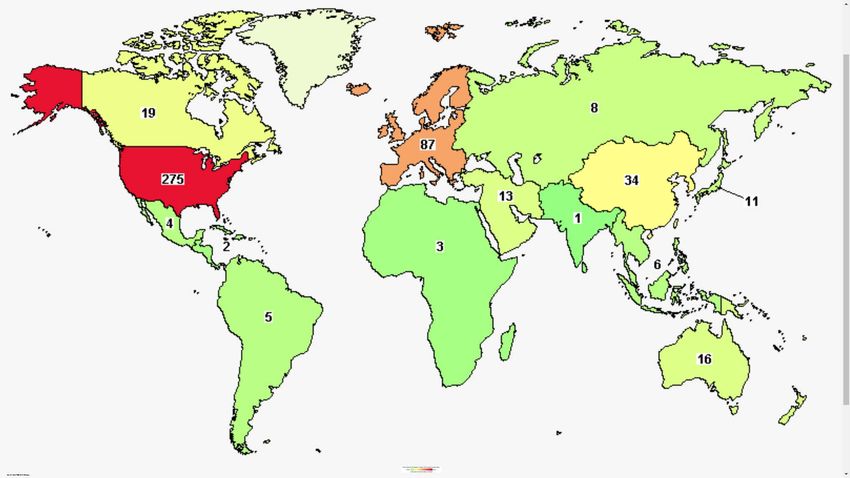
OBJECTIVES   ▶   What is a clinical trial?

             ▶   What is involved in participating in a clinical trial?

             ▶   How to find the most up-to-date information about
                 clinical trials.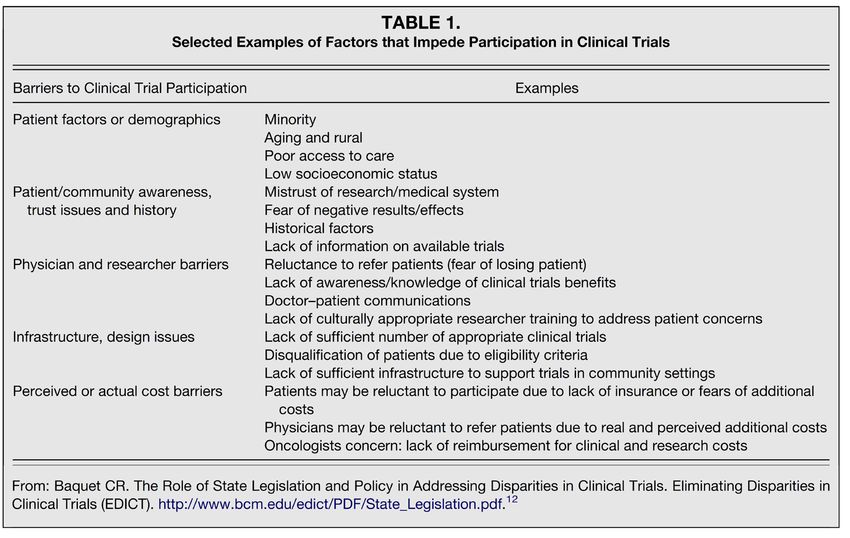
WHAT ARE CLINICAL TRIALS AND WHY DO WE PERFORM THEM?
▶   What is a clinical trial?                                   • Diagnostic trials
    • tests how a drug, medical device, or treatment approach          - test new ways to diagnose a disease
      works in people
                                                                • Screening trials

▶   Why do we engage in clinical trials?                               - test the best way to detect a disease or health
                                                                         problem.
    • Answer scientific questions
                                                                • Quality of life (supportive care) trials
    • Test new ways to
                                                                       - study ways to improve the comfort of people with
           - prevent
                                                                         chronic illness
           - detect
           - diagnose                                           • Prevention trials
           - treat                                                     - look for better ways to prevent disease in people
                                                                         who have never had the disease.
    • Treatment trials
           - test new treatment options

                                                                                       Affiliated with • Affilié à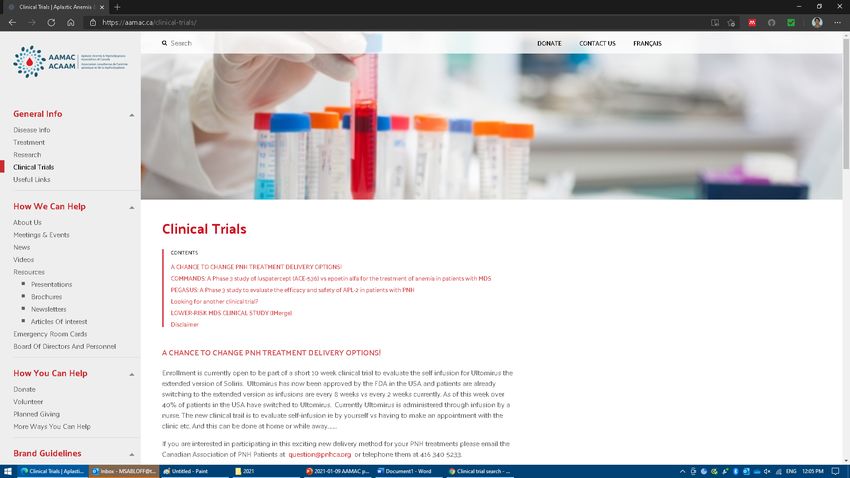
▶ Phase I:
• Tests a new drug or treatment in a small group to see if it is safe.
▶ Phase II:
• Expands the study to a larger group of people to find out if it works.
PHASES OF DRUG ▶ Phase III:
CLINICAL TRIALS • Expands the study to an even larger group of people to compare it to the standard
treatment for the disease.
- Randomized
- Placebo controlled
- Blinded
Single vs double blinded
▶ Phase IV
• Takes place after the drug or treatment has been licensed and marketed to find out
the long-term impact of the new treatment.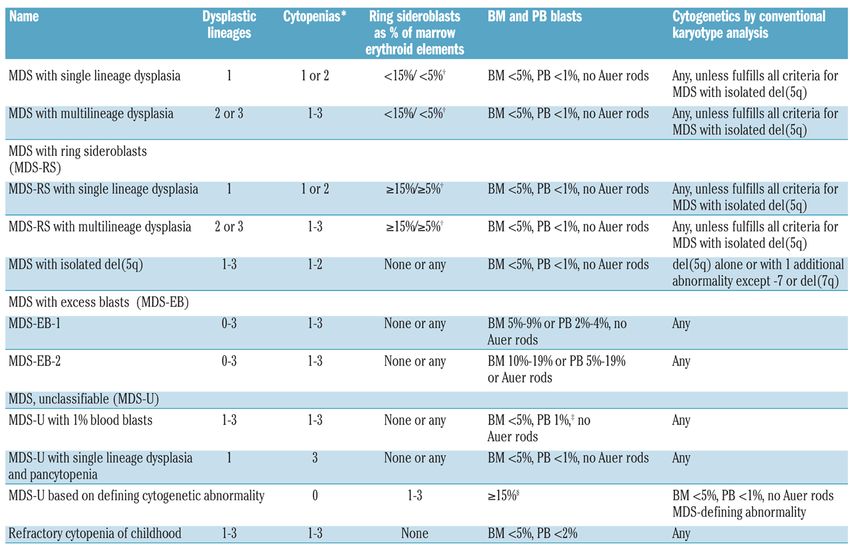
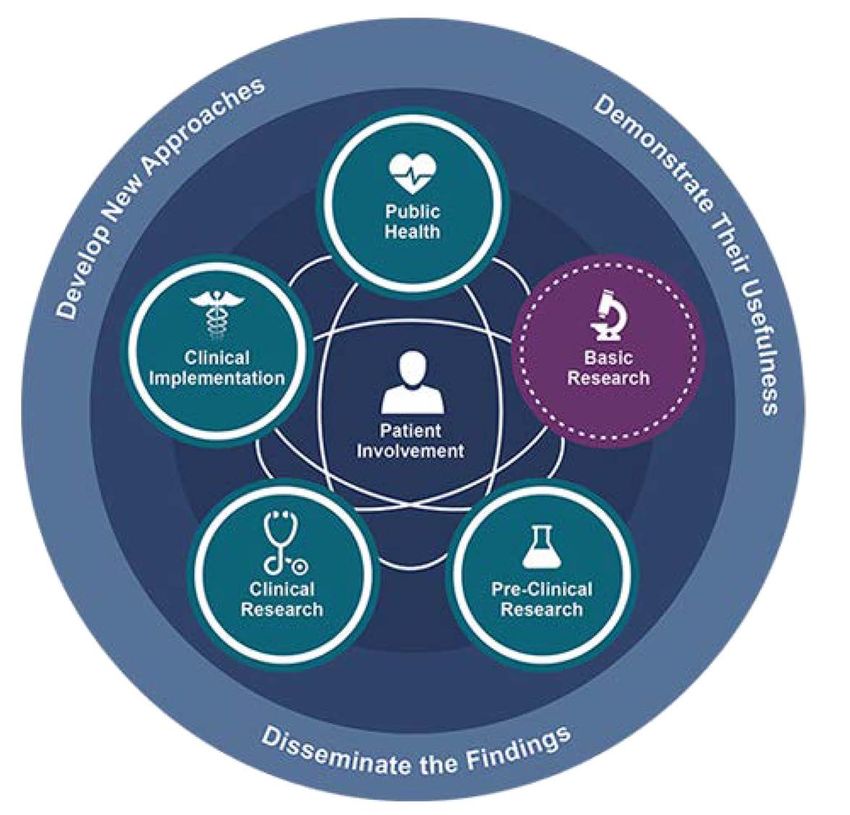
NIH - TRANSLATIONAL ROADMAP

                              5
TRANSLATIONAL
SCIENCE SPECTRUM
• biological basis of health and
  disease to interventions that
  improve the health of individuals
  and the public

•   not linear or unidirectional

•    Patient involvement is a critical
    feature of all stages in translation

                                           6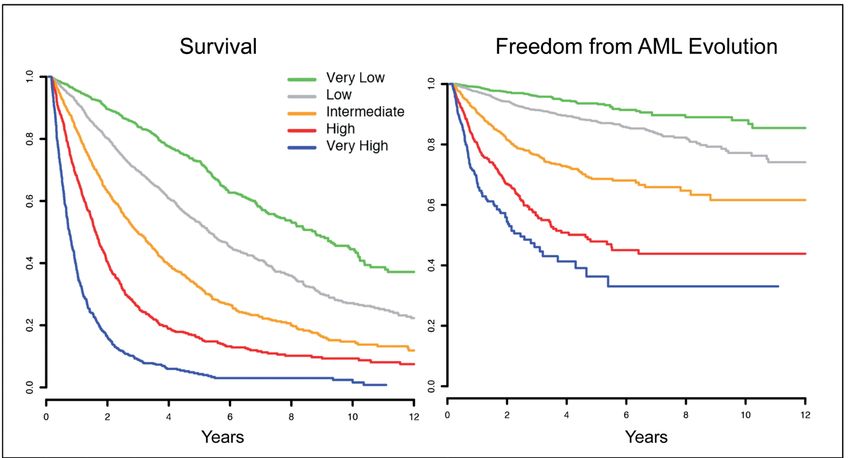
▶   Benefits
RISKS AND BENEFITS   •   access to promising new procedures or treatments that are generally
                         not available outside of a clinical trial.

                     •   The new procedure or treatment being studied may be more
                         effective than the current usual approach.

                     •   Trial participants receive high-quality medical care from a research
                         team that includes doctors, nurses, and other health professionals.

                     •   The results of the trial may help other people who need medical
                         care in the future.

                     •   Trial participants are helping scientists learn more about cancer and
                         other medical conditions, which will lead to more advances.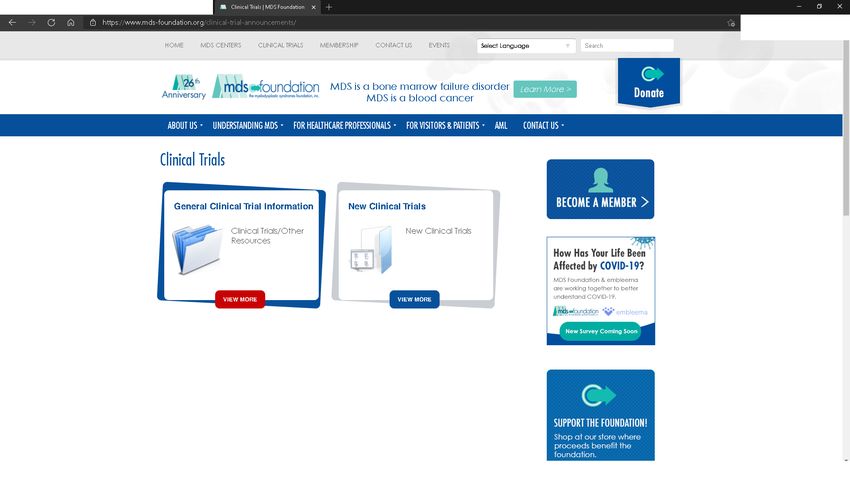
▶   Risks
RISKS AND BENEFITS   •   The new procedure or drug may not be better than what is currently
                         available, or it may have side effects that doctors do not expect or
                         that are worse than the side effects of the current usual approach.

                     •   Trial participants may be required to make more visits to the doctor
                         than they would if they were not in a clinical trial and/or need to
                         travel farther for those visits.

                     •   Some of the costs of participating in a trial may not be covered by
                         health insurance.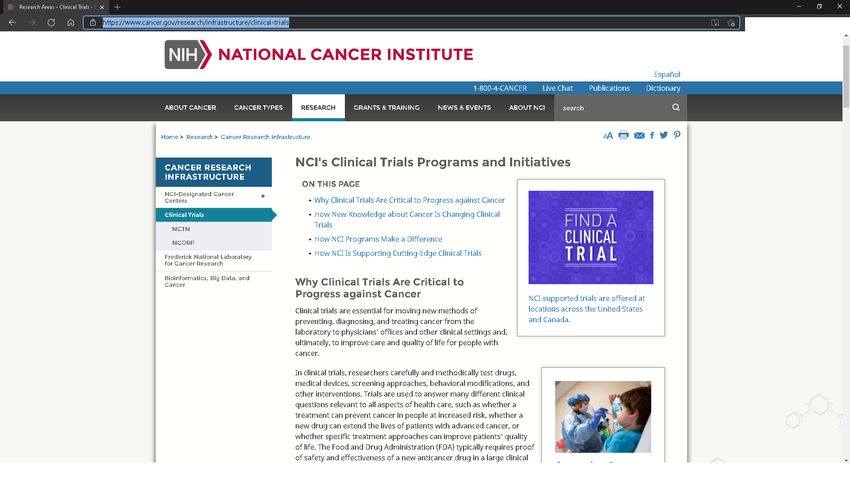
▶   Clinical trials follow a protocol which is written to meet strict, scientific
                                standards to produce reliable results while at the same time protecting the
                                participants
                                • Very specific goals
                                • Strict eligibility criteria
                                • Specific duration of the study
                                • specific information to be gathered is specified
WHAT IS A CLINICAL TRIAL?
                                • Protections against risks to participants and their privacy
                                • Informed consent
                                        • Details about tests, procedures, and treatments

                            ▶   Evaluates:
                                • Safety & efficacy of new treatments
                                • It may compare new treatments to standard treatments
                                • It may assess an individual’s Quality of life with a type of disease and/or during a
                                  specific treatment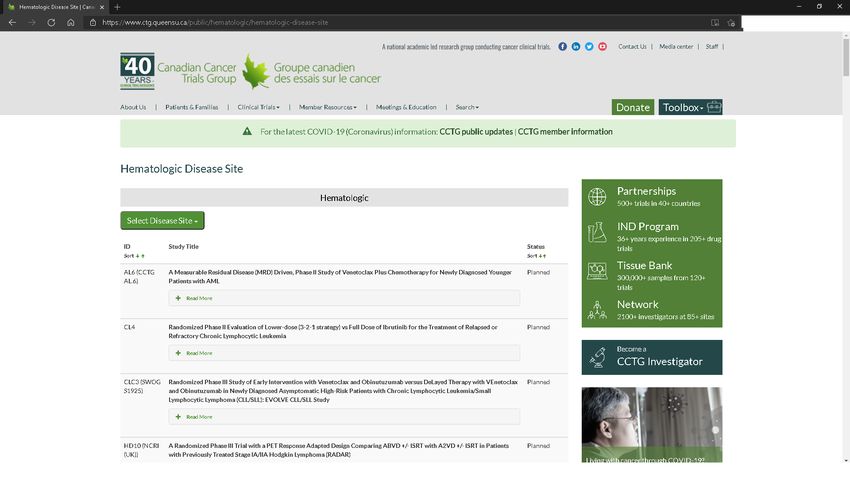
1.   Lead physician, scientist, or nurse researcher–primary
MEMBERS OF THE        investigator (PI)
RESEARCH TEAM

                 2.   Other clinicians: physicians, nurse practitioners, or
                      scientists (Sub-Investigators)

                 3.   Statisticians

                 4.   Research staff (nurses, coordinators, Data Managers)
▶ Institutional Review Boards (IRB): A group of experts from the
institution conducting the trial or representing a cooperative group
HOW ARE CLINICAL of institutions who review each trial for patient safety and scientific
TRIALS MONITORED? merit. The IRB will continue to monitor the conduct of the trial
until it is completed along with the Primary Investigator and the
research team.
▶ Data and Safety Monitoring Boards: An independent committee of
physicians, researchers, statisticians, and other experts.ABOUT THE STUDY
• What is the purpose of the study?
• Why do researchers think the approach may be effective?
QUESTIONS TO ASK • Who will fund the study?
ABOUT PARTICIPATING • Who has reviewed and approved the study?
IN A CLINICAL TRIAL
• How are study results and safety of participants being monitored?
• How long will the study last?
• What will my responsibilities be if I take part?
• Who will tell me about the results of the study and how will I be
informed?
https://www.nih.gov/health-information/nih-clinical-research-trials-you/basicsRISKS AND POSSIBLE BENEFITS
• What are my possible short-term benefits?
QUESTIONS TO ASK • What are my possible long-term benefits?
ABOUT PARTICIPATING
IN A CLINICAL TRIAL
• What are my short-term risks, and side effects?
• What are my long-term risks?
• What other options are available?
• How do the risks and possible benefits of this trial compare with those
options?
https://www.nih.gov/health-information/nih-clinical-research-trials-you/basicsPERSONAL
• What kinds of therapies, procedures and/or tests will I have during the
trial?
• Will they hurt, and if so, for how long?
QUESTIONS TO ASK
ABOUT PARTICIPATING • How do the tests in the study compare with those I would have outside
IN A CLINICAL TRIAL of the trial?
• Will I be able to take my regular medications while taking part in the
clinical trial?
• Where will I have my medical care?
• Who will be in charge of my care?
• How could being in this study affect my daily life?
• Can I talk to other people in the study?
https://www.nih.gov/health-information/nih-clinical-research-trials-you/basicsCOST ISSUES
• Will I have to pay for any part of the trial such as tests or the study
drug?
QUESTIONS TO ASK
ABOUT PARTICIPATING • If so, what will the charges likely be?
IN A CLINICAL TRIAL
• What is my health insurance likely to cover?
• Who can help answer any questions from my insurance company or
health plan?
• Will there be any travel or child care costs that I need to consider
while I am in the trial?
https://www.nih.gov/health-information/nih-clinical-research-trials-you/basicsPROBLEMS WITH CLINICAL TRIALS
▶ Currently 96 million have been infected with SARS-CoV2
▶ Only 4% have been enrolled in randomized clinical trials
▶ Similar to cancer trials - 5-9% enrollment
▶ This results in
• Underrepresented communities (African Americans, rural, and underserved cancer patients)
• Missed opportunities of (Scientific knowledge and Therapeutic strategies)
▶ Non-systematic enrolment of people in less powerful types of studies expose thousands of patients to the potential risks of untested
interventions with no reliable way of drawing conclusions about efficacy and safety.
• Off-label use of medications
- Hydroxychloroquine
- Statins
- Tocilizumab
- …
North, C. M., Dougan, M. L. & Sacks, C. A. Improving Clinical Trial Enrollment — In the
Covid-19 Era and Beyond. N. Engl. J. Med. 383, 1406–1408 (2020).
Baquet, C. R., Henderson, K., Commiskey, P. & Morrow, J. N. Clinical Trials: The Art of
Enrollment. Semin. Oncol. Nurs. 24, 262–269 (2008)
Affiliated with • Affilié àBaquet, C. R., Henderson, K., Commiskey, P. & Morrow, J. N. Clinical Trials: The Art of Enrollment. Semin. Oncol. Nurs. 24, Affiliated with • Affilié à 262–269 (2008).
▶   86% of clinical trials do not reach their recruitment targets, and approximately 20% close early
    because of recruitment failure, with important scientific, ethical, financial, and policy implications

▶   Even large centres have low recruitment
    • 23% of patients with MDS enrolled in interventional trials at any point in their disease course.
    • narrow eligibility criteria

                                                   Brierley, C. K., Zabor, E. C., Komrokji, R. S., DeZern, A. E., Roboz, G. J., Brunner, A. M.,
                                                          et al. Low participation rates and disparities in participation in interventional clinical
                                                          trials for myelodysplastic syndromes. Cancer 126, 4735–4743 (2020).

                                                                                                     Affiliated with • Affilié à
WHAT DOES THE CLINICAL TRIAL
LANDSCAPE LOOK LIKE?
www.ohri.ca | Affiliated with • Affilié àDISTRIBUTION OF CLINICAL TRIALS FOR MYELODYSPLASTIC SYNDROME
AROUND THE WORLD
Affiliated with • Affilié àHOW DO I FIND THE ONE THAT IS
RIGHT FOR ME?
1. TALK TO YOUR DOCTOR
2. UNDERSTAND YOUR DISEASE
www.ohri.ca | Affiliated with • Affilié àWORLD HEALTH ORGANIZATION CLASSIFICATION OF MYELODYSPLASTIC SYNDROMES CLASSIFICATION OF MYELODYSPLASTIC SYNDROMES
▶ Research questions being studied
• Treatment by RISK group
- LOW
CLINICAL TRIALS IN Untreated
MYELODYSPLSIAS
After failed treatment
How are they grouped or divided?
- HIGH
Initial treatment
Relapsed
• Targeted therapy
• Iron overloadINTERNATIONAL PROGNOSTIC SCORING SYSTEM
Standard IPSS score
Prognostic variable 0 0.5 1.0 1.5 2.0
Bone marrow blastsINTERNATIONAL PROGNOSTIC SCORING SYSTEM
IPSS Score Risk grouping
0 Low risk
0.5 – 1.0 Intermediate-1 Risk
1.5 – 2.0 Intermediate-2 Risk
≥ 2.5 High risk
Affiliated with • Affilié à 25
Greenberg P, et al. Blood. 1997;89:2079-2088.TRANSFUSION DEPENDENCE, SURVIVAL AND
TRANSFORMATION TO AML BY IPSS SCORE
Parameter Low Int-1 Int-2 High
Score 0 0.5-1.0 1.5-2.0 ≥2.5
Transfusion dependence 39% 50% 63% 79%
Median AML transformation, Years 9.4 3.3 1.1 0.2
Median survival, Years 5.7 3.5 1.2 0.4
Greenberg P, et al. Blood. 1997;89:2079-2088. Affiliated with • Affilié à 26
Balducci L. Cancer. 2006;106(10):2087-2094REVISED INTERNATIONAL PROGNOSTIC SCORING SYSTEM CLINICAL TRIALS IN MYELODYSPLSIAS • Risk Group
REVISED INTERNATIONAL PROGNOSTIC SCORING SYSTEM

                     Hellström-Lindberg, E., Tobiasson, M. & Greenberg, P. Myelodysplastic syndromes: Moving towards personalized
                     management. Haematologica 105, 1765–1779 (2020).

                                                                            Affiliated with • Affilié à
APPROACH TO THE TREATMENT OF MDS Cazzola, M. Myelodysplastic Syndromes. N. Engl. J. Med. 383, 1358–1374 (2020)
WHERE TO FIND A CLINICAL
TRIAL?

                           www.ohri.ca | Affiliated with • Affilié à
HTTPS://WWW.CLINICALTRIALS.GOV/
Affiliated with • Affilié àHTTPS://WWW.CANCER.GOV/RESEARCH/INFRASTRUCTURE/CLINICAL-TRIALS
Affiliated with • Affilié àHTTPS://WWW.CANADA.CA/EN/HEALTH-CANADA/SERVICES/DRUGS-HEALTH-
PRODUCTS/DRUG-PRODUCTS/HEALTH-CANADA-CLINICAL-TRIALS-
DATABASE.HTML
Affiliated with • Affilié àHTTPS://TRIAL-FINDER.CTONTARIO.CA/
Affiliated with • Affilié àHTTPS://WWW.CTG.QUEENSU.CA/PUBLIC/HEMATOLOGIC/HEMATOLOGIC-
DISEASE-SITE
Affiliated with • Affilié àHTTPS://WWW.MDS-FOUNDATION.ORG/CLINICAL-TRIAL-
ANNOUNCEMENTS/
Affiliated with • Affilié àHTTPS://AAMAC.CA/CLINICAL-TRIALS/
Affiliated with • Affilié àAffiliated with • Affilié à
LOCAL TRIALS - OTTAWA
▶   Lower risk
    • COMMANDS
          - Luspatercept (Ace-536) Versus Epoetin Alfa For The Treatment Of Anemia Due To Ipss-r Very Low, Low Or
            Intermediate Risk Myelodysplastic Syndromes (Mds) In Esa Naïve Subject Who Require Red Blood Cell Transfusions

    • IMERGE
          - Imetelstat (GRN163L) in Transfusion-Dependent Subjects with IPSS Low or Intermediate-1 Risk MDS that is
            Relapsed/Refractory to erythropoietic stimulating agent Treatment

▶   Higher risk

▶   Canadian Myelodysplastic Syndromes Priority Setting Partnership

                                                                                        Affiliated with • Affilié à
LOCAL TRIALS – TORONTO [HTTPS://PM.CTRIALFINDER.COM/LIST-VIEW]
▶ A phase I/II study to investigate the safety and clinical activity of GSK3326595 and other agents in
subjects with myelodysplastic syndrome and acute myeloid leukaemia
▶ A phase 3b open-label, single arm, rollover study to evaluate long-term safety in subjects who have
participated in other luspatercept (ACE-536) clinical trials (NCT04064060)
▶ An open-label, dose escalation, safety and pharmacokinetic study of CFI-400945 fumarate
administered orally in patients with relapsed or refractory acute myeloid leukemia (AML) or
myelodysplastic syndrome (MDS)
▶ Phase Ib/II study of IDH2 inhibitor enasidenib in combination with BCL2 inhibitor venetoclax in
patients with IDH2-mutated myeloid malignancies
▶ A phase 1/2, multicenter, open-label study of FT-2102 as a single agent and in combination with
azacitidine in patients with acute myeloid leukemia or myelodysplastic syndrome with an IDH1
mutation
Affiliated with • Affilié àOTHER TRIALS
▶ Safety And Efficacy Study Of Venetoclax Tablet With Intravenous or Subcutaneous
Azacitidine to Assess Change in Complete Remission and Overall Survival In Adult
Participants With Newly Diagnosed Higher-Risk Myelodysplastic Syndrome
▶ A Phase III Study Evaluating The Efficacy And Safety Of Crovalimab Versus Eculizumab In
Participants With Paroxysmal Nocturnal Hemoglobinuria (PNH) Not Previously Treated With
Complement Inhibitors.
▶ Magrolimab + Azacitidine Versus Azacitidine + Placebo in Untreated Participants With
Myelodysplastic Syndrome (MDS)
▶ Comparing Two Diets in Patients Undergoing HSCT or Remission Induction Chemo for
Acute Leukemia and MDS (UF-BMT-LDND-101)
▶ Study of Efficacy and Safety of MBG453 in Combination With Azacitidine in Subjects With
Intermediate, High or Very High Risk Myelodysplastic Syndrome (MDS) as Per IPSS-R, or
Chronic Myelomonocytic Leukemia-2 (CMML-2)
Affiliated with • Affilié àAffiliated with • Affilié à
You can also read


