New Grade Coding Rules - It's a Good Thing! 2018 - Jennifer Ruhl, Jim Hofferkamp and the SSDI/Grade Taskforce!
←
→
Page content transcription
If your browser does not render page correctly, please read the page content below
2018
New Grade Coding Rules
It’s a Good Thing!
Presented by
Donna M. Hansen, CTR
California Cancer Registry
NAACCR Webinar
May 1, 2018
&
May 2, 2018
1
Acknowledgement
Special Thanks To:
Jennifer Ruhl, Jim Hofferkamp
and the SSDI/Grade Taskforce!
2Outline
• New Grade Data Items 2018+
• 2018 Grade Major Changes
• Grade Tables
• Coding Instructions
• 2018 Grade Manual
• Practice Quizzes
3
Grade 2018 – Major Changes
Previous single Grade/differentiation data item and coding
instructions discontinued for cases diagnosed 2018+
• Retained for cases diagnosed prior to 1/1/2018
Former SSFs which collected chapter specific grades (e.g.,
Breast, Prostate, Soft Tissue, etc.) discontinued for 2018+
• Retained for cases 2004-2017
4Grade 2018 – Major Changes
Beginning with 2018+ cases
• Grade definitions have expanded
• Classification of grade now varies by tumor site and/or histology
• Grading systems for a cancer type may use a two, three, or four
grade system
• No longer will all grades be converted to a four-grade system
5
Grade 2018 – Major Changes
3 New Grade Data Items
– Grade Clinical
• Collects grade during clinical time frame – usually from a biopsy or FNA
• Before any treatment such as surgical resection or neoadjuvant therapy, etc.
– Grade Pathological
• Collects grade from the primary tumor which has been resected (unless
microscopic clinical grade is higher or surgical resection grade is unknown),
and neoadjuvant therapy was NOT administered
– Grade Post-therapy
• Collects grade from a tumor resection AFTER completion of neoadjuvant
therapy
6Grade 2018 – Major Changes
Grade captured at different points of patient care
• Similar to AJCC TNM “time frames”
– Clinical Grade from diagnostic workup prior to treatment
– Pathological Grade from surgical resection specimen of primary tumor or organ; OR
grade from clinical workup if higher than surgical resection grade, since all information
from DX workup through surgical resection is used for Pathological Grade
– Post-therapy Grade from surgical resection of primary tumor or organ after
neoadjuvant therapy. Note; clinical grade would never be used for post-therapy grade
• If AJCC TNM stage is being assigned, the “surgical resection” must meet
AJCC criteria for cancer site, for:
• Pathological Grade Whichever is applicable for case
• Post-therapy Grade 7
Grade 2018 – Major Changes
• AJCC Chapter specific grading systems incorporated into 2018 Grade
• Site specific grades harmonized with CAP cancer protocol checklists
• Based on site and/or chapter, the generic cancer registry grade
categories or another definition of grade may be used
• Historical grade definitions still apply when specific grading systems not
applicable for site, or preferred grade not available
8Grade 2018 – Major Changes
Tables for Grade Restructured
• Combination of numeric & alphabetic
codes within the same table
• Codes 1-5 reserved for 8th edition site-specific
grade definitions
• May include additional applicable CAP
surgical checklist grade definitions
• May include generic (historical) grade
definitions
9
Grade Tables
Overview
10Grade Table - Ovary/Primary Peritoneal/Fallopian Tube
• Grade based on
Grade Table in AJCC 8th edition 2018 Grade Table histology
G Grade Definition Code Grade Description • Codes 1-3 priority if
GX Grade cannot be assessed 1 G1: Well differentiated nuclear grade
GB Borderline tumor 2 G2: Moderately differentiated documented
G1 Well differentiated 3 G3: Poorly differentiated or • Code B avail If your
G2 Moderately differentiate undifferentiated Hosp or State
G3 Poorly differentiated or B GB: Borderline Tumor collects borderline
undifferentiated L Low Grade tumors
H High Grade
• Immature
• Tables include recommended AJCC 9 Grade cannot be assessed teratomas or serous
definitions combined with CAP (GX);Unknown carcinoma use
and/or generic terms when needed
• Code 9 still used for unknown codes L & H
11
Grade Table - Breast
Code Grade Definition
1 G1: Low combined histologic grade (favorable), SBR score of 3-5 points Priority
codes
2 G2: Intermediate combined histologic grade (moderately favorable); SBR score of 6-7 points for
3 G3: High combined histologic grade (unfavorable);SBR score of 8-9 points invasive
L Nuclear Grade I (Low) (in situ only)
M Nuclear Grade II (interMedidate) (in situ only) Used when tumor is only in situ
H Nuclear Grade III (High) (in situ only)
A Well differentiated
B Moderately differentiated Used when a more specific grade above was not
determined and path report used these terms
C Poorly differentiated for grade
D Undifferentiated, anaplastic
9 Grade cannot be assessed (GX); Unknown
12Generic Grade
Applies when:
• No applicable AJCC Chapter for Site (e.g. trachea), OR
• No recommended grading system for site (e.g. melanoma of skin)
• Historical generic grade categories will still apply and be used for all
three grade fields
– However, “codes” have changed….
13
Generic Grade Table
• Generic Grade Table Example
2018 Code Grade/Cell Type Description
A Well differentiated
Historically
B Moderately differentiated codes were
C Poorly differentiated 1-4
D Undifferentiated, anaplastic
9 Grade cannot be assessed; Unknown
• Codes 1, 2, 3, 4 now reserved for the preferred AJCC grade
– Code 9 retained for Unknown definitions
• A, B, C & D now used for standard historical grade
– In all grade tables where applicable
14• Cervical Lymph Nodes and Unknown Primary
Generic Grade •
•
Major Salivary Glands
Nasopharynx
• Oropharynx HPV-Mediated (p16+)
Example: •
•
Mucosal Melanoma of Head & Neck
Thymus
• Merkel Cell Carcinoma
• These Sites still use the generic • Melanoma of Skin
historical definitions •
•
Placenta
Testis
• Melanoma Conjunctiva
• Thyroid
• Thyroid-Medullary
NET Adrenal Gland
• There is no AJCC preferred or •
recommended Grade Code Grade Description
for these sites A Well differentiated
B Moderately differentiated
C Poorly differentiated
D Undifferentiated, anaplastic
9 Grade cannot be assessed; Unknown
15
Quick Quiz 1 - Breast
Path Report: Bx L-breast, PD infiltrating Duct Ca, unable to classify further
Code Grade Definition (Grade Table 12)
1 G1: Low combined histologic grade (favorable), SBR score of 3-5 points Codes 1-3
Priority
2 G2: Intermediate combined histologic grade (moderately favorable); SBR score of 6-7 points (AJCC Grades)
3 G3: High combined histologic grade (unfavorable);SBR score of 8-9 points If documented
L Nuclear Grade I (Low) (in situ only)
M Nuclear Grade II (interMedidate) (in situ only)
H Nuclear Grade III (High) (in situ only) What is the
A Well differentiated Clinical
B Moderately differentiated
If the documented grade is not from the Grade?
recommended AJCC grade system, record the
C Poorly differentiated highest [specified/documented] grade
D Undifferentiated, anaplastic
9 Grade cannot be assessed (GX); Unknown
162018 Grade Table
Individual Grade Tables
include:
– Schema ID & Name
– AJCC ID & Chapter Name
– Coding Notes
– Codes/Descriptions
17
Grade Tables
• 29 Grade Tables
• ~118 primary site and/or histology combinations incorporated
‒ 14 Grade tables represent a single site
‒ 15 Grade tables incorporate multiple primary sites
‒ Tables include appropriate grading system for site(s)
• AJCC recommended
• Generic
• Other
• Or Combinations of
18Grade Tables
How do you chose the correct grade table?
• Registrar Codes:
‒ Primary site
‒ Histology/behavior Schema ID is Derived
‒ Schema discriminator (if needed)
Software selects applicable grade table for coding
‒ Grade table notes will be included as well
19
Coding Instructions
20Grade – General Coding Instructions
What’s the Same? What’s Different?
Basic core coding concepts unchanged: • 2018 Grade items apply only when DX Date 2018+
• Code grade from the primary tumor- not • Priority goes to the recommended AJCC grade
metastatic site listed in the applicable AJCC chapter
• If more than one grade available from same • If none of the specified grades documented are
time period code the higher from the recommended AJCC grade system, record
the highest [documented] grade
• If grade given for an in situ tumor, code it
• Do NOT code grade for dysplasia or high • If there is no recommended AJCC grade [for that
grade dysplasia site], code the highest [documented] grade
• If both in situ and invasive components, • Grade for hematopoietic and lymphoid neoplasms
code grade of invasive component NO LONGER COLLECTED for DX Date 2018+ *
* See complete coding instructions in the 2018 Grade manual 21
Grade Clinical
CLINICAL GRADE Coding Guidelines
Note 1: Clinical grade is recorded for cases where a histological (microscopic) exam is done and tissue is available
and grade is recorded. This includes FNA, biopsy, needle core biopsy, etc.
Note 2: Clinical grade must not be blank.
Note 3: Assign the highest grade from the primary tumor assessed during the clinical time frame.
Note 4: Code 9 (unknown) when
• Grade is not documented
• Clinical staging is not applicable (for example, cancer is an incidental finding during surgery for another condition)
• Grade checked “not applicable” on CAP Protocol (if available) and no other grade information is available
• If there is only one grade available and it cannot be determined if it is clinical or pathological, assign it as a clinical
grade and code unknown (9) for pathological grade, and blank for post-therapy grade.
See individual site-specific Grade tables for additional notes
22Grade Pathological
PATHOLOGICAL Coding Guidelines
Note 1: Pathological grade is recorded for cases where a surgical resection has been done.
Note 2: Pathological grade must not be blank.
Note 3: Assign the highest grade from the primary tumor. If the clinical grade is the highest grade identified, use the
grade that was identified during the clinical time frame for both the clinical grade and pathological grade.
Note 4: Code 9 (unknown) when
• Grade not documented
• No resection of the primary site
• Neoadjuvant therapy followed by a resection (see post-therapy grade)
• Clinical case only (see clinical grade)
• There is only one grade available and it cannot be determined if it is clinical or pathological
• Grade checked “not applicable” on CAP Protocol (if available) and no other grade information is available
See individual site-specific Grade tables for additional notes 23
Grade Post-therapy
POST-THERAPY Coding Guidelines
Note 1: Leave post-therapy grade blank when:
• No neoadjuvant therapy
• Clinical or pathological case only
• There is only one grade available and it cannot be determined if it is clinical, pathological or post-
therapy
Note 2: Assign the highest grade from the resected primary tumor assessed after the completion of neoadjuvant
therapy.
Note 3: Code 9 when
• Surgical resection is done after neoadjuvant therapy and grade from the primary site is not
documented
• Grade checked “not applicable” on CAP Protocol (if available) and no other grade information is
available
See individual site-specific Grade tables for additional notes
24Coding Instructions
Example Grade ID 01 (3 grade system)
• 23 sites use these grade tables
• See actual grade table for complete list of coding instructions
Clinical Pathological Post-therapy
Code Grade Description Code Grade Description Code Grade Description
1 G1: Well differentiated 1 G1: Well differentiated 1 G1: Well differentiated
2 G2: Moderately differentiated 2 G2: Moderately differentiated 2 G2: Moderately differentiated
3 G3: Poorly differentiated 3 G3: Poorly differentiated 3 G3: Poorly differentiated
9 Grade cannot be assessed 9 Grade cannot be assessed (GX); 9 Grade cannot be assessed (GX);
(GX); Unknown Unknown Unknown
• Clinical grade cannot be blank • Pathological grade cannot be blank Blank See Note 1
• Code 9 when: • Code 9 when:
Note 1: Leave post-therapy grade blank
• No grade documented • No resection of primary tumor
when:
• Cancer incidental finding • Neoadjuvant therapy given
• No neoadjuvant therapy
during surgery prior to surgical resection (see
• Clinical or Pathological case only
post-therapy grade)
25
Coding Instructions
3 Grade Data Items
• TWO (2) GRADES usually defined per case, sometimes 1, never 3
• Clinical Grade (most of the time - unless no Dx until surgery)
• If Pathological grade recorded, Post-
• Pathological Grade therapy grade will always be BLANK
or
• If Post-therapy grade is recorded,
• Post-therapy Grade Pathological grade will always be code 9
26Quick Quiz 2 - Colon
• Colonoscopy revealed a right colon lesion. Biopsy taken. Final DX: Moderately
differentiated adenocarcinoma. Patient underwent hemicolectomy: Final pathologic
diagnosis: PD adenocarcinoma with invasion through serosa. Pt is a candidate for
adjuvant chemotherapy
• Code the 3 grade data items:
Code Grade Description Grade Clinical
1 G1: Well differentiated
2 G2: Moderately differentiated Grade Pathological
3 G3: Poorly differentiated
4 G4: Undifferentiated
Grade Post-therapy
9 Grade cannot be assessed (GX);Unknown
Blank No neoadjuvant therapy
Clinical or Pathological case only
27
Coding Instructions - Grade Required for TNM stage
• Some AJCC Chapters require Grade to assign TNM Stage Group
• Chapter 16: Esophagus and Esophagogastric Junction
• Chapter 19: Appendix
• Chapter 38: Bone
• Chapter 41: Soft Tissue Sarcoma of the Trunk and Extremities
• Chapter 44: Soft Tissue Sarcoma of the Retroperitoneum
• Chapter 43: Gastrointestinal Stromal Tumor
• Chapter 48: Breast
• Chapter 58: Prostate
• If AJCC priority grade not stated, code applicable generic grade or other grade
indicated
• If AJCC grade not available, it may not be possible to assign TNM stage group
28Coding
Instructions
Grade required for TNM
• Notes Include:
− General notes
− Directions if specific term
used
− Directions if grade required
for stage
• 3 Grade System
− Plus additional grade
definition
29
Coding instructions
Hematopoietic & Lymphoid Neoplasms
Cell lineage indicator/grade for hematopoietic and lymphoid neoplasms NO
LONGER COLLECTED for DX Date 2018+
– Histology range 9590-9992
– Historically cell lineage indicator (B-cell, T-cell, Null cell, NK-cell collected)
Exception: Ocular Adnexa Lymphoma AJCC 8th Ed Chapter 71
– AJCC has a defined grading system for the follicular histologies
– Applicable primary sites: C441, C690, C695, C696
– Applicable histologies 9690/3, 9691/3, 9698/3
– Grade for all other histologies collected in AJCC Chapter 71 coded as 9
30Coding
Instructions
Example:
• Hematopoietic
& Lymphoid
Neoplasms
‒ Clinical Grade 8
‒ Pathological Grade 8
‒ Post-therapy Grade (blank)
31
Coding
Instructions
Example:
• No AJCC Chapter
• No preferred grade
Grade is still coded
– Generic Grade used
– Code for each grade
data item
32Coding instructions
• If documented grade terminology does not fit grade table definitions, or
grade is unknown
– Assign code 9
• Exception:
– If site uses a 4-grade system with generic grade codes A-D included
in table
– An applicable Mapping Term for grade may apply
33
Mapping/Crosswalk terms for generic grade in a 4-grade system
Description Grade Assigned Grade Code
• Terms which can be “mapped” to describe Differentiated,NOS
Well differentiated
I
I
A
A
one of the generic grade categories for 2018 Only stated as ‘Grade I’
Fairly well differentiated
I
II
A
B
Intermediate differentiation II B
Low grade I-II B
Mid differentiated II B
• Applies ONLY to cancers using 4-grade system Moderately differentiated
Moderately well differentiated
II
II
B
B
Partially differentiated II B
Partially well differentiated I-II B
Relatively or generally well differentiated II B
• Only use when code table includes generic Only stated as ‘Grade II’
Medium grade, intermediate grade
II
II-III
B
C
categories with alphabetic codes A-D Moderately poorly undifferentiated III C
Moderately undifferentiated III C
Poorly differentiated III C
Relatively poorly differentiated III C
Relatively undifferentiated III C
• Do not use for 4-grade generic table where Slightly differentiated III C
code options are designated 1-4 Dedifferentiated
Only stated as ‘Grade III’
III
III
C
C
High grade III-IV D
– Never use to code terms for 2 or 3 grade system Undifferentiated, anaplastic, not differentiated IV D
Only stated as ‘Grade IV’ IV D
Non-high grade 9
• ~Pages 32-33 in Grade Manual 34Example
When mapping terms CAN be crosswalked
- to generic 4-grade system
Table uses Description Grade Assigned Grade Code
Differentiated,NOS I A
4- grade Well differentiated I A
system Only stated as ‘Grade I’
Fairly well differentiated
I
II
A
B
Intermediate differentiation II B
Includes Low grade
Mid differentiated
I-II
II
B
B
AJCC grade Moderately differentiated II B
Moderately well differentiated II B
G1-G4 & Partially differentiated II B
generic Partially well differentiated I-II B
Relatively or generally well differentiated II B
A-D Only stated as ‘Grade II’ II B
Medium grade, intermediate grade II-III C
Moderately poorly undifferentiated III C
If G1-G4 Moderately undifferentiated III C
(codes 1-4) Poorly differentiated III C
Relatively poorly differentiated III C
not stated… Relatively undifferentiated III C
Slightly differentiated III C
Dedifferentiated III C
These Only stated as ‘Grade III’ III C
terms may High grade III-IV D
Undifferentiated, anaplastic, not differentiated IV D
be used to Only stated as ‘Grade IV’ IV D
code Non-high grade 9
A-D 35
Example
When mapping terms CAN be crosswalked to generic 4-grade system
Description Grade Assigned Grade Code
Differentiated,NOS I A
Well differentiated I A
Site uses Only stated as ‘Grade I’ I A
generic Fairly well differentiated
Intermediate differentiation
II
II
B
B
4 grade Low grade I-II B
Mid differentiated II B
system Moderately differentiated II B
only - with Moderately well differentiated II B
Partially differentiated II B
codes A-D Partially well differentiated I-II B
Relatively or generally well differentiated II B
Only stated as ‘Grade II’ II B
Terms Medium grade, intermediate grade II-III C
can be Moderately poorly undifferentiated III C
Moderately undifferentiated III C
used to Poorly differentiated III C
assign Relatively poorly differentiated III C
Relatively undifferentiated III C
codes Slightly differentiated III C
A-D Dedifferentiated III C
Only stated as ‘Grade III’ III C
High grade III-IV D
Undifferentiated, anaplastic, not differentiated IV D
Only stated as ‘Grade IV’ IV D
Non-high grade 9
36Example
When mapping terms CANNOT be crosswalked to generic 4-grade system
Description Grade Assigned Grade Code
Site uses Differentiated,NOS I A
4-grade Well differentiated I A
Only stated as ‘Grade I’ I A
generic Fairly well differentiated II B
categories Intermediate differentiation
Low grade
II
I-II
B
B
Mid differentiated II B
However, Moderately differentiated
Moderately well differentiated
II
II
B
B
codes Partially differentiated II B
are Partially well differentiated
Relatively or generally well differentiated
I-II
II
B
B
Numeric Only stated as ‘Grade II’ II B
Medium grade, intermediate grade II-III C
Moderately poorly undifferentiated III C
And Moderately undifferentiated III C
Poorly differentiated III C
table does Relatively poorly differentiated III C
not Relatively undifferentiated III C
Slightly differentiated III C
include Dedifferentiated III C
generic Only stated as ‘Grade III’ III C
High grade III-IV D
codes Undifferentiated, anaplastic, not differentiated IV D
A-D Only stated as ‘Grade IV’ IV D
Non-high grade 9
37
Quick Quiz 3 - Kidney
Path Report: Right kidney nephrectomy; renal parenchyma tumor c/w low grade
renal cell carcinoma, papillary type
Code Grade Description (Grade table 18) • What is the
1 G1: Nuceloli absent or inconspicuous and basophilic at 400x magnification Pathological Grade?
2 G2: Nucleoli conspicuous and eosinophilic at 400x magnification, visible but
not prominent at 100x magnification
B
3 G3: Nucleoli conspicuous and eosinophilic at 100x magnification
4 G4: Marked nuclear pleomorphism and/or multinucleate giant cells and/or
rhabdoid and/or sarcomatoid differentiation • “low grade” coded
A Well differentiated
to B in generic A-D
B Moderately differentiated
options per mapping
C Poorly differentiated terms list
D Undifferentiated, anaplastic
9 Grade cannot be assessed (GX); Unknown
382018 Grade Manual
Organization
Demo
39
2018 Grade Manual
• Primary resource for documentation and coding instructions
• Important to review introductory information:
‒ Organization & Suggestions on how to use
• Carefully review pages ~18-34
‒ General Instructions
‒ General Rules • Reflects info NOT in software
‒ Background and additional information notes
• Grade Tables
‒ Each Grade table set includes a clinical, pathological and post-therapy table
along with their respective coding “notes”
‒ Coding “notes” will differ for each grade data item
402018 Grade Manual
• Grade Schema ID [Master] Table includes:
• Grade tables available in both:
• Schema ID Order (pgs 8-12)
• Alphabetical Order (pgs 13-17)
• Navigation hyperlinks
41
2018 Grade Manual
DEMO
Navigation of 2018 Grade Manual
– https://www.naaccr.org/SSDI/Grade-Manual.pdf
42Let’s Practice Coding Grade
43
Quick Quiz 4 – Lung
Use Grade table set 02 to code each data item:
• CT Chest 4cm mass right upper lobe of the lung with extensive hilar &
mediastinal LAD. Lung mass Bx confirms anaplastic small cell carcinoma.
Patient not a surgical candidate. RX plan Chemo/Radiation.
Grade Clinical
Grade Pathological
Grade Post-Therapy
44Quick Quiz 5 – Prostate
Use Grade table set 17 to code each data item:
• Patient with history of elevated PSA presents for a biopsy of the prostate.
Final pathologic diagnosis: Prostatic Adenocarcinoma, Gleason Score 3+3=6.
Treatment was discussed and patient elects active surveillance
Grade Clinical
Grade Pathological
Grade Post-Therapy
45
Quick Quiz 6 – Bladder
Use Grade table set 19 to code each data item:
• Hx hematuria. Cystoscopy revealed tumor in bladder trigone. Bx confirms high
grade papillary urothelial ca with focus of muscle invasion. Pt received neoadjuvant
chemo followed by radical cystectomy. Final pathological dx: High grade papillary
urothelial ca.
Grade Clinical
Grade Pathological
Grade Post-Therapy
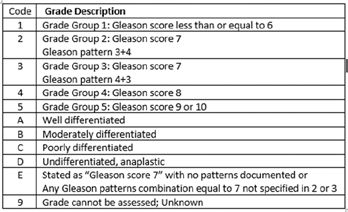
46Quick Quiz 7 – Prostate
Use Grade table set 17 to code each data item:
• Patient with biopsy proven prostatic adenocarcinoma Gleason score 7 (3+4)
presented for a robotic assisted prostatectomy. Final Dx from prostatectomy:
Moderately differentiated adenocarcinoma, Gleason 6 (3+3)
Grade Clinical
Grade Pathological
Grade Post-Therapy
• Pathological Grade Note 2: If clinical grade higher than path grade, use clinical grade for
both 47
Quick Quiz 8 – Ovary
Use Grade table set 15 table to code each data item:
• Patient with abdominal distension and pain. CT reveals liver mass with
abdominal and pelvic ascites. Liver biopsy positive for high grade serous
carcinoma c/w ovarian origin.
Grade Clinical
Grade Pathological
Grade Post-Therapy
• 1st basic coding rule- Code grade from the primary site, not a metastatic site
48Quick Quiz 9 – Colon
Use Grade table set 02 to code each data item:
• Patient had routine colonoscopy revealing a mass in ascending colon. Bx positive
for invasive Mod-diff Adenocarcinoma. Subsequent hemicolectomy final
pathologic diagnosis: High grade adenocarcinoma.
Grade Clinical
Grade Pathological
Grade Post-Therapy
49
Quick Quiz 10A – Breast
Use Grade table set 12 to code each data item:
• Patient with left UOQ breast mass 1.0cm; Breast bx positive for invasive Ductal ca
Nottingham Grade 1:3-5 points (Tubule formation 2, Nuclear pleomorphism 2,
mitotic activity 1). Patient underwent lumpectomy. Final Pathology: Residual DCIS
0.3 cm, intermediate grade. No remaining invasive tumor. 0/1 sentinel LN pos(+).
Margins clear.
Grade Clinical
Grade Pathological
Grade Post-Therapy
50Quick Quiz 10B – Breast
Use Grade table set 12 to code each data item:
• Mammogram: UOQ breast mass 1.3cm. Breast bx: DCIS, high grade. Patient
underwent definitive lumpectomy. Final Pathology: Invasive ductal carcinoma
0.8cm, Nottingham Grade 1:3-5 points; residual DCIS 0.2cm high grade. 0/1 sentinel
LN pos(+). Margins clear.
Grade Clinical
Grade Pathological
Grade Post-Therapy
•
51
Wrap Up
52Grade 2018
• Grade assigned for every reportable case
– Even if grade is unknown
• Registrar codes recommended AJCC Grade if used, even when case not
eligible for TNM Staging
• If recommended grading system not used, generic grade categories may
apply
53
Grade 2018
• Grade codes and/or coding instructions vary for each grade data item:
• Clinical
• Pathological Based on type of cancer
• Post-therapy
– Always read the grade table “notes”
• Included in software
Also read background and additional instructions in Grade manual
• These will not be in your software notes
54Grade 2018 = Harmonization
Breast Grade Table- AJCC 8th edition Breast Grade- CAP Protocol Checklist
G G Definition
GX Grade cannot be assessed
G1 Low combined histologic grade (favorable), SBR score
of 3-5 points
G2 Intermediate combined histologic grade (moderately
favorable); SBR score of 6-7 points
G3 High combined histologic grade (unfavorable); BSR
score of 8-9 points
2018 Breast Grade Table- excerpt of first 3 codes
55
Grade 2018
• AJCC recommended Grade categories
• CAP protocol checklist Grade categories
Harmonized (whenever possible)
• Generic Grade definition categories
• 2018 Grade Coding Tables
• Goals: Improve ease of collecting grade and coding accuracy overall
A It’s a Good Thing!
56Where can I ask Grade Questions?
• Post your questions
to CAnswer Forum
• Answers will be from
subject matter experts
57
Questions? Thank You
Donna M. Hansen, CTR
Auditor/Education Training Coordinator
California Cancer Registry
916-731-2543
Email: dhansen@ccr.ca.gov
58 59You can also read


