Commissioning guide: Paediatric Emergency Appendicectomy - Royal College of Surgeons
←
→
Page content transcription
If your browser does not render page correctly, please read the page content below
2014

       Commissioning guide:
       Paediatric Emergency Appendicectomy

                                                                      Commissioned and facilitated by

Sponsoring Organisation: British Association of Paediatric Surgeons
Date of evidence search: February 2014
Date of publication: January 2015
Date of Review: January 2018
Commissioning guide 2014
Paediatric Emergency Appendicectomy

CONTENTS

Introduction................................................................................................................................................. 2
1. High Value Care Pathway for acute appendicitis .......................................................................................... 2
1.1 Primary care                             ..................................................................................................................................... 2
1.2 Secondary and Tertiary Care .................................................................................................................................... 3
1.3 Flow diagram for children requiring surgical intervention ....................................................................................... 4
2. Procedures explorer for acute appendicitis ................................................................................................. 5
3. Quality dashboard for acute appendicitis .................................................................................................... 5
4. Levers for implementation ........................................................................................................................ 6
4.1 Audit and peer review measures .............................................................................................................................. 6
4.2 Quality Specification/CQUIN .................................................................................................................................... 6
5. Directory ................................................................................................................................................. 7
5.1 Patient Information                      ..................................................................................................................................... 7
5.2 Clinician information                    ..................................................................................................................................... 7
6. Benefits and risks of implementing this guide ............................................................................................. 8
7. Further information .................................................................................................................................. 8
7.1 Research recommendations .................................................................................................................................... 8
7.2 Other recommendations                    ..................................................................................................................................... 8
7.3 Evidence base                            ..................................................................................................................................... 9
7.4 Guide development group ................................................................................................................................... 10
7.5 Funding statement                        ................................................................................................................................... 11
7.6 Conflict of interest statement ................................................................................................................................ 11
Appendix 1:                                  ................................................................................................................................... 12

The Royal College of Surgeons of England, 35-43 Lincoln’s Inn Fields, London WC2A 3PE

                                                                                                                                                                                  1
Commissioning guide 2014
Paediatric Emergency Appendicectomy
Introduction
Annually in England around 12,000 emergency appendicectomies are performed1 in children under 18 years of age.
The majority, 80%, are admitted and managed at DGH’s the remaining 20% being admitted to Specialised Paediatric
Units1.
Many other children present acutely with non-specific abdominal pain requiring in-patient assessment,
outnumbering those with acute appendicitis by a ratio of 4:12, 3.
This is not intended as a comprehensive guide for the management of paediatric patients presenting with
abdominal pain.
1. High Value Care Pathway for acute appendicitis
1.1 Primary care
Acute pain of recent onset associated with localised peritonism is a good predictor for secondary referral 4,5
Children under 5 years of age often present with peritonitis6 and should be referred to a specialised Paediatric
Surgical Unit
If there is abdominal pain associated with diarrhoea persisting longer than 5 days consider referral for assessment
to exclude a pelvic collection secondary to appendicitis
The differentiation of appendicitis from non-specific abdominal pain can be challenging 2,3,5,7, the table below
summarises the differences, but if there is uncertainty the patient should be referred to secondary care for
assessment8.
Rectal examination should not be carried out in primary care
Appendicitis Non-specific abdominal pain
Presentation Acute Often recurrent
Symptoms Central to RIF pain/anorexia/vomiting Vague localisation of abdominal pain
Dysuria & diarrhoea may mimic UTI or No associated symptoms
gastroenteritis
Examination Flushed/pyrexial/avoids moving Exaggerated responses/apyrexial
2Commissioning guide 2014
Paediatric Emergency Appendicectomy
Raised respiratory rate, tachycardia Findings non-focal/not reproducible
Tender RIF with peritonism
Referral To local hospital Observe & refer to local hospital for
assessment if ongoing concerns
1.2 Secondary and Tertiary Care
Care should be provided within a managed clinical network of secondary and tertiary care providers9,10,12,20
Triage and measurement of vital signs should be completed on arrival in an appropriate setting 10, 11
The senior surgical decision maker should assess all children on admission to agree and action appropriate
management with the on call consultant surgeon12,13,17
There must be 24 hour access to a named consultant paediatrician 19
An unwell child under 5 years, with suspected peritonism should be referred urgently to a specialised Paediatric
Surgical Unit
Appropriate radiology14 and laboratory services must be available.
Children must be cared for in an appropriate child friendly environment
Children undergoing surgery must have a pain management plan which includes post-operative and discharge
analgesia 12,13,18
Trusts must ensure they have protocols and procedures in place to identify a deteriorating child and alert
appropriately trained personnel 12,15,17
All staff who come into contact with children and young people are trained in safeguarding to an appropriate
level as defined in the intercollegiate framework: Safeguarding Children and Young people: roles and
competences for health care staff 16,18
There should be defined arrangements for emergency transfer if required 12,15
The decision on whether the appendicectomy should be done via an open or laparoscopic route is dependent on
the individual patient and should be decided by the operating surgeon.
Appropriate information in a range of formats and support must be available to parents/children to enable
them to fully participate in decisions about the care of their child.
3Commissioning guide 2014
Paediatric Emergency Appendicectomy
1.3 Flow diagram for children requiring surgical intervention
CHILD PRESENTING AS
AN EMERGENCY WITH
SUSPECTED
APPENDICITIS
Triage within 15 minutes
of arrival in appropriate
environment
Resuscitate
Is the child seriously ill?
Do they requires extensive
resuscitation?
Are they under 5 years of age?
NO YES
Are there Consultant review
appropriate local
facilities?
Appropriate ward Theatre staff competent
An anaesthetist
A surgeon competent to facilities and nursing staff to undertake the
competent to
undertake surgery? with paediatric procedure with the
anaesthetise?
competencies? appropriate equipment?
Consider URGENT
transfer to tertiary
YES NO
paediatric surgical
unit
Arrange surgery
locally
4Commissioning guide 2014
Paediatric Emergency Appendicectomy
2. Procedures explorer for acute appendicitis
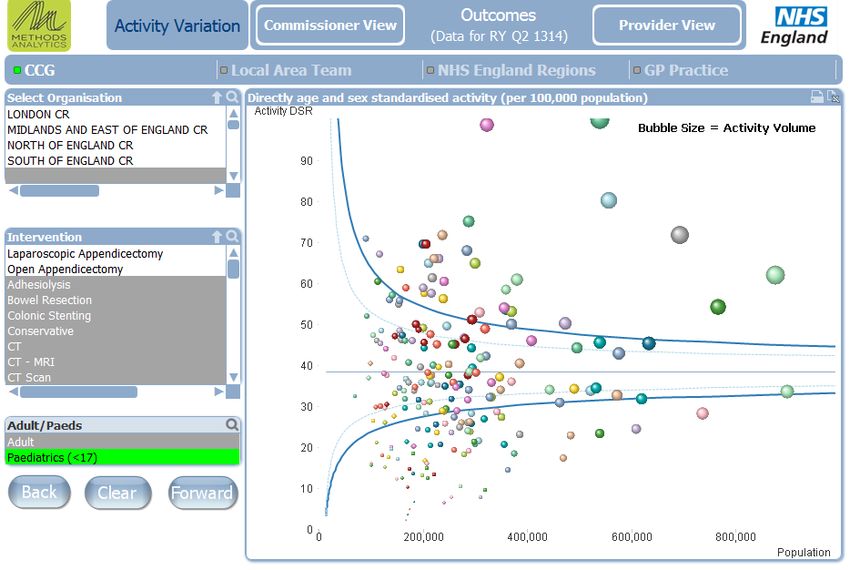
Users can access further procedure information based on the data available in the quality dashboard to see how
individual providers are performing against the indicators. This will enable CCG’s to start a conversation with
providers who appear to be ‘outliers’ from the indicators of quality that have been selected.
The Procedures Explorer Tool is available via the Royal College of Surgeons website.
The screenshot above shows the activity in CCGs for operative treatment of right iliac fossa pain, for the year ending
September 2013, in patients under 17 years.
See Appendix 1 for the OPCS and ICD-10 codes used to capture data on management of right iliac fossa pain
3. Quality dashboard for acute appendicitis
The quality dashboard provides an overview of activity commissioned by CCGs from the relevant pathways, and
indicators of the quality of care provided by surgical units.
The quality dashboard is available via the Royal College of Surgeons website.
5Commissioning guide 2014
Paediatric Emergency Appendicectomy
4. Levers for implementation
4.1 Audit and peer review measures
The following measures and standards are those expected. Evidence should be available to commissioners if
requested.
Measure Standard
Member of local GPS Network Provider can demonstrate participation in the Network
Compliance with network audits Involvement and provision of audit data to the Network
Appraisal General paediatric surgery activity/training should be
included in annual appraisal and revalidation
4.2 Quality Specification/CQUIN
Commissioners may wish to include the following measures in the Quality Schedule with providers. Improvements
could be included in a discussion about a local CQUIN.
Measure Description Data specification
(if required)
Timely intervention Percentage of appendicectomies >90%
within 12 hours of decision to operate
Diagnostic accuracy Percentage of negativeCommissioning guide 2014
Paediatric Emergency Appendicectomy
5. Directory
5.1 Patient Information
Name Publisher Link
Information for parents/carers on British Association of Paediatric www.baps.org.uk/resources/docu
appendicectomy Surgeons (BAPS) ments/appendicectomy/
Acute appendicitis in children Patient.co.uk www.patient.co.uk/doctor/Acute-
Appendicitis.htm
Parent/carer information on Royal College of Anaesthetists http://www.rcoa.ac.uk/childrensinf
anaesthetia (RCoA) o
Parent/carer information on NHS Choices www.nhs.uk/conditions/Appendicit
appendicitis is/Pages/Introduction.aspx
Local trust patient/carer Local trust or network Should be available via local trust
information website and in hard copy
5.2 Clinician information
Name Publisher Link
Standards for Children’s Surgery, Children’s Surgical Forum www.rcseng.ac.uk/publications/docs/
2013 (RCSEng) standards-in-childrens-surgery
Surgery for Children: Delivering a Children’s Surgical Forum www.rcseng.ac.uk/publications/docs/
First Class Service (RCSEng) CSF.html
Guidance for Provision of Paediatric Royal College of Anaesthetists www.rcoa.ac.uk/gpas2013
Anaesthesia (RCoA)
Standards of care for critically ill The Paediatric Intensive Care www.ukpics.org.uk/documents/PICS_
children Society (PICS) standards.pdf
Are we there yet? A review of NCEPOD www.ncepod.org.uk/2011report1/do
organisational and clinical aspects wnloads/SIC_summary.pdf
of children’s surgery
7Commissioning guide 2014
Paediatric Emergency Appendicectomy
6. Benefits and risks of implementing this guide
Consideration Benefit Risk
Patient outcome Ensure access to the best
quality and timely clinical
management
Patient safety Reduce delayed recognition of
acute appendicitis & improve
management of children
Reduce risk of complications
Patient experience Improve access to patient
information
Equity of access Support access to effective Selected patients and
local care carers required to travel
greater distances to
receive care
Resource impact Reduce unnecessary referral Resource required to
and intervention maintain and establish
operational delivery
Reduce length of stay
networks
Failure of repatriation to
secondary care
7. Further information
7.1 Research recommendations
Management of the appendix mass
7.2 Other recommendations
Maintenance and establishment of managed clinical networks
Standards for engagement with and transfer to tertiary paediatric services
8Commissioning guide 2014
Paediatric Emergency Appendicectomy
7.3 Evidence base
1. Trends in Children’s Surgery 1994-2005.Evidence from Hospital Episodes Statistics Data. 2007.
Hugh Cochrane & Stuart Tanner, DOH
2. Brekke M., Eilersten RK. Acute abdominal pain in general practice: tentative diagnoses and handling. A
descriptive study. 2009. Scandinavian Journal of Primary Health Care; 27(3):137-40
3. Buddinggh KT, Wieselmann E, Heineman E, Broens PM. 2012. Constipation and nonspecific abdominal pain in
teenage girls referred for emergency surgical consultation. Journal of Pediatric Gastroenterology & Nutrition;
54(5):672-6
4. Kulik DM, Uleryk EM, Maguire JL. Does this child have appendicitis? A systematic review of clinical prediction
rules for children with acute abdominal pain. 2013. Journal of Clinical Epidemiology; 66(1):95-104
5. Blundy DG, Byerley JS, Liles EA, Perrin EM, Katznelson J, Rice HE. 2007. Does this child have appendicitis?
JAMA ;298(4):438-51
6. Bansal S, Banever GT, Karrer FM, Partick DA. Appendicitis in children less than 5 years old: influence of age
on presentation and outcome. 2012. American Journal of Surgery ;204(6):1031-5; discussion 1035
7. Chitkara DK, Rawat DJ, Talley NJ. The epidemiology of childhood recurrent abdominal pain in western
countries: a systemic review. 2005. American journal of Gastroenterology ; 100(8):1868-75
8. Evans C, van Woerden HC. J .The effect of surgical training and hospital characteristics on patient outcomes
after paediatric surgery: a systematic review. 2011.Pediatr Surg ;46(11):2119-27
9. Ensuring the provision of General Paediatric surgery in the district General Hospital: Guide to commissioners
and service planners, Children’s Surgical Forum. 2010. Royal College of Surgeons of England
10. Standards for Children’s surgery: Children’s Surgical Forum. 2013. Royal College of Surgeons of England
11. National Service framework for Children Young People and Maternity services: Core Standards. 2004.
Department of Health
12. Surgery in Children: Are we there yet? A review of organisational and clinical aspects of children’s surgery.
2011. National Confidential Enquiry into Patient Outcome and Death.
13. Surgery for Children: Delivering a First Class Service. Children’s Surgical Forum. 2007.Royal College of
Surgeons of England
14. Delivering Quality Imaging Services for Children: A report from the National Imaging Board 2010
15. Guidance on the provision of paediatric anaesthetic services’ – Chapter 8 in Guidelines for the provision of
Anaesthetic Services. April 2010. London RCA
16. Safeguarding children and Young People: Roles and competencies for healthcare staff. Intercollegiate
document, third edition, March 2014. Royal College of Paediatric and Child Health
9Commissioning guide 2014
Paediatric Emergency Appendicectomy
17. Getting the right start: National Service Framework for Children: Standard for Hospital Services -Surgery 4.34.
2004. Department of Health
18. Improving services for children in hospital. 2009. Healthcare Commission
19. Facing the Future: Standards for Paediatric Services. 2011. Royal College for Paediatrics and Child Health
20. The way forward: Strategic Clinical Networks. 2012. NHS Commissioning Board
7.4 Guide development group for appendicitis
A commissioning guide development group was established to review and advise on the content.
Name Job Title/Role Affiliation
Mr Salem Al-Hamali Consultant General Surgeon Royal College of Surgeons
Ms Nicole Barnes Patient representative
Dr Polly Davies Consultant Anaesthetist Royal College of Anaesthetists
Dr Emma Fernandez Clinical and Training Standards Manager Royal College of Surgeons
Mr Robin Gupta Consultant General Surgeon Royal College of Surgeons
Dr Puran Khandewal Consultant Anaesthetist Royal College of Anaesthetists
Dr Suganthi Joachim Consultant Anaesthetist Royal College of Anaesthetists
Dr Julian Law GP Royal College of General Practitioners
Samantha Little Lead Commissioner Children & Families West Leicestershire CCG
Dr Paul Martin Consultant Anaesthetist Royal College of Anaesthetists
Association of Paediatric Anaesthetists of
Great Britain and Ireland
Donna Mason Paediatric Ward Matron Royal College of Nursing
Mr Feilim Murphy Consultant Paediatric Urologist British Association of Paediatric Surgeons
Mr Nitin Patwardhan Consultant Paediatric Surgeon Royal College of Surgeons
British Association of Paediatric Surgeons
Miss Jane Patterson Consultant General Surgeon Royal College of Surgeons
Mr John Quarmby Consultant General Surgeon Royal College of Surgeons
Mr Ashok Rajimwale Consultant General Surgeon Royal College of Surgeons
Dr William Russell Consultant Anaesthetist Royal College of Anaesthetists
Mr Manoj Shenoy Consultant Paediatric Urologist British Association of Paediatric Surgeons
10Commissioning guide 2014
Paediatric Emergency Appendicectomy
Dr John Somers Consultant Paediatric Radiologist Royal College of Radiologists
Mr Richard Stewart Consultant Surgeon Royal College of Surgeons
British Association of Paediatric Surgeons
Mr Haradikar Varadaraj Consultant urologist Royal College of Surgeons
Sharon Verne Senior quality improvement Lead East Midlands Strategic Clinical Network
Dr Neil Williams Consultant Anaesthetist Royal College of Anaesthetists
7.5 Funding statement
The development of this commissioning guidance has been funded by the following sources:
East Midlands Strategic Clinical Network funded the cost of the guideline development group, literature
searches and contributed towards administrative costs.
The Royal College of Surgeons of England and the British Association of Paediatric Surgeons provided staff to
support the guideline development.
7.6 Conflict of interest statement
Individuals involved in the development and formal peer review of commissioning guides are asked to complete a
conflict of interest declaration. It is noted that declaring a conflict of interest does not imply that the individual has
been influenced by his or her secondary interest. It is intended to make interests (financial or otherwise) more
transparent and to allow others to have knowledge of the interest.
The following interests were declared by group members: None noted
11Commissioning guide 2014
Paediatric Emergency Appendicectomy
Appendix 1: The OPCS and ICD-10 codes used to collect data on management of right iliac fossa pain
12Commissioning guide 2014
Paediatric Emergency Appendicectomy
13You can also read


