Conservation of breeding colonies of the bank myna, Acridotheres ginginianus (Latham 1790), in Chapai Nawabganj, Bangladesh
←
→
Page content transcription
If your browser does not render page correctly, please read the page content below
Univ. j. zool. Rajshahi Univ. Vol. 30, 2011 pp. 49-53                                         ISSN 1023-6104
   http://journals.sfu.ca/bd/index.php/UJZRU                              © Rajshahi University Zoological Society

Conservation of breeding colonies of the bank myna, Acridotheres
ginginianus (Latham 1790), in Chapai Nawabganj, Bangladesh
M Farid Ahsan and M Tarik Kabir
Department of Zoology, University of Chittagong, Chittagong, Bangladesh

    Abstact: A study on the conservation on breeding colonies of bank myna, Acridotheres ginginianus (Latham
    1790), was conducted in Chapai Nawabganj district of Bangladesh during a period from June 2007 to
    October 2009. The total population in the breeding colonies was estimated as 4,452. The preferable
    breeding habitats of bird are bank of the river, soil heap/ditches of brickfield and holes of culvert.
    Environmental calamities such as bank erosion and flooding, drought and rain affect the breeding colonies.
    Human settlement near breeding habitats, hunting, collecting eggs and nestlings by children, and use of
    nets to prevent nesting at bank of the river are the main human impacts on the breeding colonies. Major
    threats are flood, children-fun, predators and human for its meat. Conservation awareness for this species
    have depicted in this paper.
    Key words: Conservation, breeding colonies, bank myna, Acridotheres ginginianus, Chapai Nawabganj,
    Bangladesh.

                                                           example, Grimmett et al. (1998), Inskipp et al.
Introduction
                                                           (1996), Sibley & Monroe (1993, 1990), Sibley &
Conservation biology is the new multidisciplinary          Ahlquist (1990), Ripley (1982), Husain (2003,
science that has developed to deal with disaster           1979), Harvey (1990), Sarkar & Sarker (1988),
of biological diversity (Primack, 2006). To                Khan (1982), Rashid (1970), Rashid (1967)]. An
investigate human impact on biological diversity           attempt was taken in this study to know the
and develop practical approaches to prevent the            interaction between local people and bank myna,
extinction of species are the main goal of                 threats, demark environmental and human impact
conservation biology (Soule, 1985; Wilson,                 on the breeding habitat of the species, and create
1992). It also creates link between conservation           conservation awareness for the species in Chapai
priorities and human needs.                                Nawabganj of Bangladesh.
Acridotheres ginginianus (Latham, 1790) is a               Study area and Methods
grayish-blue passerine bird with orange orbital
                                                           Chapai      Nawabganj     (formerly   known     as
skin. It has blackish cap with tufted forehead.
                                                           Nawabganj) is one of the Districts of Rajshahi
Wing patch, under-wing-coverts, and tail-tip are
                                                           Division in the northern Bangladesh. Originally it
orange buff; bills and legs are orange-yellow. Its
                                                           was a Thana of Maldaha District of the British
call is a ringing tone like, kew, kew, kew, krew,
                                                           India. After 1947 it was upgraded to a Subdivision
krew, chake-chake.
                                                           of Rajshahi District of East Pakistan (after 1971
There are 148 species of sturnids throughout the           became Bangladesh) and eventually in 1984 all
world of which Bangladesh supports 12 species              Subdivisions of Bangladesh were upgraded as
(Siddiqui et al., 2008). The bank myna is not              Districts.
considered a threatened species in Bangladesh
                                                           Chapai Nawabganj District (24º44´00´´ North
or world, although three sturnids (Asian glossy
                                                           latitude and 88º12´00´´ East longitude), an area of
starling [Aplonis panayensis], braminy myna
                                                           1,744.33 km², is bounded by West Bengal of India
[Sturnus pagodarum] and pale-bellied myna
                                                           on the north, south and west. Rajshahi and
[Acridotheres cinereus]) have data deficient,
                                                           Naogaon Districts cover the east side. The District
three    (spot-winged     starling   [Saroglossa
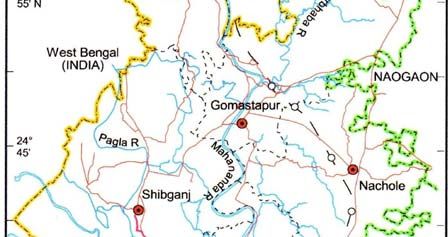
                                                           comprises five Upazillas (Fig. 1): Chapai
spiloptera], rosy starling [Sturnus roseus] and
                                                           Nawabganj, Shibganj, Bholahat, Gomastapur and
common starling [Sturnus vulgaris]) vagrant, and
                                                           Nachole. Part of the District lies under Barind Tract
others are common in the country. According to
                                                           and consists of diaras and charland (sandbars
IUCN (2009) Red List Category: bank myna is
                                                           develop in river bed). Main Rivers of the area are
Least Concern species of the world.
                                                           the Ganges, Mahananda, Pagla, Maraganga and
Literature review reveals that no published                the Punarbhaba (Baby, 2003; Chowdhury, 2003a,
paper is available on record on the conservation           b; Taru, 2003). There are about 30 depressions
of the bank myna, but there are some works                 (beels) are present in this area and the larger
mainly on the distribution and taxonomy [for               important ones are Vaeoa, Chatra, Kaubari,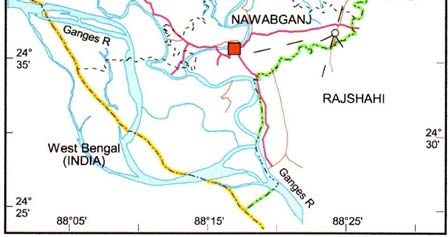
Amgachi, Baro, Charal, Kolar, Hazardighi,            Results and Discussion
Damas, Bhatia, Singra, Sukrabari Damos,              Population: Twenty breeding sites of the bank
Maricha Dara, Putimari and Kumiradaha.               myna were spotted in the study area, where 45
The present study was carried out during a           colonies were found. In total 4,452 birds were
period from June 2007 to October 2009 in             counted in 2,226 active nests or holes according
Chapai Nawabganj District of Bangladesh.             to two birds per nest/hole (Table 1). There might
Engine boats were used to spot the breeding          be some other members (about 548) of the
colonies of the bird. Later on microbus and/or       species whose nests were not found out presents
local transport were used to reach to the spots.     a round figure of 5,000 individuals in the study
Local assistants were engaged to collect some        area. It breeds in colonies of a dozen to forty pairs
information also.                                    (Baker, 1926).

Breeding colonies of bank myna was searched          Breeding habitat of bank myna: Bank mynas
along the rivers of Chapai Nawabganj,                prefer bank of the river, brickfield and culvert hole
brickfields and culverts. Searching was also         as nesting habitat. After maturity of the gonad
done by interviewing local people. Breeding          they come to breeding places and become
colonies visited in every month at different parts   distributed throughout the nesting sites. There are
of Chapai Nawabganj District of Bangladesh.          different nesting sites of bank myna in Chapai
People’s interaction and threats of bank myna        Nawabganj. These do not only vary for their
were assessed by prepared questionnaires and         nature but also differ for their height, shape, size
field visits. Randomly selected 100 persons          and steepness (Table 2).
were interviewed through questionnaires
                                                     Table 1. Breeding population of bank myna during
                                                              July 2008
                                                     Sl.no.   Breeding site Colony no.    No. of nest   Population
                                                     01       Kalupur           2        500            1,000
                                                     02       Chowdala          2        50             100
                                                              Ranibari
                                                     03                         3        60             120
                                                              Chandpur
                                                     04       Nayadiari)        2        450            900
                                                     05       Fatepur           5        300            600
                                                     06       Mohipur           3        80             160
                                                     07       Sarjan            1        15             30
                                                     08       Poladanga         1        10             20
                                                     09       Raninagar         1        60             120
                                                     10       Nakkatitala       4        150            300
                                                     11       Moheshpur         1        60             120
                                                     12       Boliharpur        1        50             100
                                                     13       Baliadanga        1        150            300
                                                              Baroghoria
                                                     14                         4        150            300
                                                              brickfields
                                                              Palsha
                                                     15                         1        15             30
                                                              brickfields
                                                              Other
                                                     16                         2        40             80
                                                              brickfields
                                                     17       Mokarampur        1        10             20
                                                              Ramdasghat,
                                                     18                         1        20             40
                                                              Kazigram
                                                     19       Diyar             5        40             80
                                                              Pond banks
                                                     20       (Ranibari,        4        16             32
                                                              Nayadiary)
                                                              Total             45       2,226          4,452
                                                                                                        548 =
                                                              Other                      274
                                                                                                        5,000
Source: National Encyclopedia of Bangladesh
Fig.1. Map of Chapai Nawabganj                       Usually they select nesting places near the human
                                                     inhabitants where foods are available, although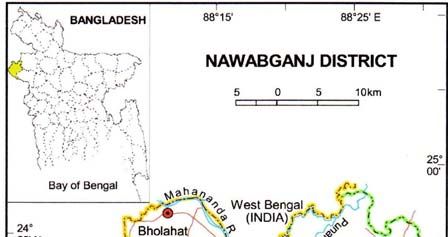
sometimes they also select breeding habitats far            Threats to bank myna: The following threats
away from human inhabitants. They collect food              were recognized during this study in the area: (1)
both from cultivated fields and homestead                   flood, (2) children, (3) human for its meat, and (4)
gardens.                                                    animals as predator.
Table 2. Broken bank height of the breeding                 (1) Flood: During June-July, heavy rainfall causes
         sites of bank myna                                 flood to the nesting site. First rain in 2009
 Sl. No.   Breeding site        Minimum (m)   Maximum (m)   damaged 18 nests at Barogharia brickfield. Rain
 01        Noyadiary            0.91           2.44         also damaged several nests at Nakkatitala in June
 02        Fatepur              1.22          2.74          2008.
 03        Mohipur              0.76          2.44
 04        Sarjan               0.91          1.22          (2) Children: Major threat of bank myna by
 05        Poladanga            1.22          4.57          human interferes through children. Children
 06        Raninagar            0.91          2.13          damage nests, eggs and nestlings for making fun
 07        Nakkatitola          1.22          4.27          and funny game by its nestlings. Based on
 08        Moeshpur             3.66          4.88          questionnaire, 34% peoples opined that children
 09        Boliharpur           1.22          3.66          damage eggs and nestlings (occasionally collect
 10        Baliadanga           1.52          3.05          for meat) of the bank myna.
 11        Brickfield           2.13          4.57
 12        Brickfield ditches   1.22          2.13          (3) For meat: Some peoples also capture adults
           Mean                 1.41          3.18          and nestlings for meat, but the snake charmer
                                                            (bede) community frequently does it. Some
Along with bank myna some other species of                  students of Ranibari Alia Madrasha at Ranibari
breeding birds also select the broken bank of the           Chandpur caught some adults for meat in 2008.
rivers as breeding ground, of which white-                  Questionnaire based interviews reveal that only
throated kingfisher (Halcyon symrnensis) and
                                                            13% local peoples were in favour of collecting
pied kingfisher (Ceryle rudis) are common.
                                                            bank myna for meat.
Bank myna chose the following different types of
                                                            (4) Animals as predator: Snakes, ants and
breeding habitat: (1) broken/steep river bank; (2)
                                                            mongooses were identified as predators of bank
soil heap or ditch-wall of brickfield;
                                                            myna. Snakes were found to be the most effective
(3) holes of the culvert; (4) walls of the man-             predators of the bank myna and 5% people
made ditches; (5) water seeping holes of the                opined that snakes eat bank myna (eggs,
wall along the rivers; (6) man-made soil steep              nestlings and adults). Snake caste was found
ground due to collected soil from other                     outside the brood chamber and also seen to nest
purposes; and (7) hay-heaps (per. com. Prof. M.             inside the brood chamber at Fatepur nesting site.
A. Mannan).                                                 Ants may also kill nestlings and red ants (Formica
Bank myna showed regular local movement or                  spp,) killed two nestlings at Nakkatitala nesting
migration. In non-breeding season, no birds                 site. One villager reported that he saw mongoose
were found around breeding sites. They moved                to eat nestlings of bank myna.
to the feeding ground at Godagari of Rajshahi               Environmental impact on breeding colonies of
District, which is about 20 km north from nesting           bank myna: The bird is associated with the
sites. At night, they roost in tall substrates such         following impacts to its breeding colonies:
as bamboo, mango trees, etc. assumed with
common myna and pied myna.                                  1. Erosion of the nesting bank due to heavy rains,
                                                            which also damage some of the nests, eggs and
Interaction between man and bank myna:
                                                            nestlings. For instance, in 2008 some nests were
Bank myna is a very common bird in the Chapai
                                                            damaged at Nakkatitala site and Baroghoria
Nawabganj area. Based on questionnaire, 94%
                                                            brickfield breeding site due to bank erosion in
people are well known about it while 6% are not
                                                            June and July;
familiar. Local people have to some extent
knowledge/idea about its life cycle, food and               2. Flood and water current inundate and erode
feeding habits, and its usefulness in biological            some breeding habitat/nesting bank leading to
control. About 79% people think that the bank               destruction of many nests resulting the birds
myna is useful to control insect pests and 12%              leaving the sites. For instance, Baroghoria
have no idea about its usefulness in nature and             brickfield was inundated in July 2008, which led
the rest 9% have no comments.                               abandonment of the site;
3. Occasional excessive drought and sunshine 6. Most of the people know that bank mynas are
make the breeding site hot causing the birds fail not harmful rather helpful friend of the farmers.
to make nests associated with declined insect They eat a lot of insects from mango orchards,
populations needed by brooding birds during vegetable gardens and crop fields protecting the
nestlings; crop from destruction, hence, increase their crop
production.
4. Predators like snakes, crows, raptors and
pariah dogs eat some eggs and nestlings; Future plan- Conservation awareness: The
following steps can be taken for the conservation
5. Use of insecticides in the mango orchards, awareness of the species in the breeding area:
crop fields and vegetable gardens may affect the 1. Making colour poster(s) that will illustrate the
birds through poisoning by eating insects from positive roles played by the species in nature
these fields. Long term study is, therefore and distributing to all schools, colleges and
needed to understand the effects of these local government offices (Union Parishad
chemicals; and Chairmen Offices and Upazila Offices) in the
area will help to create awareness and
6. Rains after May and June make the protection of the species;
vegetations luxury with leaves and fruit and the
increase of insects’ populations help bank 2. Making the small size of colour poster in one
side a class routine table in other side of the
mynas feeding nestlings.
paper for school students and that will be
Human impact on breeding colonies of bank distributing in all schools in the breeding area
myna: The following human impacts were of the species, small sticker may be made for
observed on the breeding colonies of the birds: the same purpose;
3. Arranging seminars in major schools and
1. Human settlements are very close to the
colleges about the positive roles of the
breeding sites of bank myna and their different
species;
activities have negative influence on the
breeding colony; 4. Farmers are fully aware that insects damage
their crops and bank myna eats those insects
2. Usually local inhabitants do not eat the meat and thus save their crops;
of bank myna, but peoples from other places,
5. This bird is our national property, so we have
who visit the area occasionally, eat the meat of
to save it for the ecological balance in nature
nestling/adults. Three times people found of the area and future generations;
catching bank myna for meat in 2008. Similarly,
the same incidence was occurred at Ranibari 6. Hosting few signboards at major breeding
Chanpur area. Likewise, ‘Bede’ community sites mentioning the importance of the
(snake charmers) are known to eat the meat of species in nature in the area for the protection
of the breeding sites;
bank myna;
Further research can be carried out on its
3. Children collect eggs and nestlings for fun
ecology, behaviour, effects of pesticides on the
and sometimes they use sticks to poke the nests species and conservation.
killing the nestlings;
Acknowledgement
4. People living on the eroded banks think that
The study was carried out with financial supports
bird holes initiate bank erosion when floodwaters
of the personal research grants of Professor Farid
enter into the holes. So some peoples set up Ahsan of the NUFU Project associated with the
nets on the eroded bank close to their houses to Department of Zoology, University of Chittagong,
prevent the birds from making holes in the Chittagong. Professor Eivin Roskaft, Dr E. Gereta,
banks; Dr B. G. Stokke and Dr. I. M. Mfunda of NTNU
5. Breeding habitats of the species are being (The Norwegian University of Science and
Technology) Trondheim, Norway, and Dr David J.
disturbed and destroyed due to human
Chivers of Cambridge University, UK made some
settlement close to breeding sites through
comments on the first draft of the manuscript. We
cutting down trees and bamboos. The species thank them all. We have sincere thanks to Mr.
prefers to take rest and socialize on the plants; Masud and Mr. Ashraful Islam for their help during
and the fieldwork.References Rashid, A. 1970. The breeding biology of the jungle
Baby, S.N. 2003. Mahananda River. In: Banglapedia: myna, Acridotheres fuscus. Unpublished M. Sc.
national encyclopedia of Bangladesh, volume 6, thesis. University of Dhaka, Dhaka
(ed. S. Islam). Asiatic Society of Bangladesh, Rashid, H. 1967. Systematic list of the birds of East
Dhaka, Bangladesh. 345 p. Pakistant. The Asiatic Society of Pakistan, Dacca.
Baker, E.C.S. 1926. The fauna of British India, 144 pp.
nd
including Ceylon and Burma. Vol. III (2 ed.) Ripley, S.D. 1982. A synopsis of the birds of India and
Taylor and Francis, London, UK. 489 pp. Pakistan together with those of Nepal, Bhutan,
Chowdhury, M.H. 2003a. Punarbhaba River. In: Bangladesh, and Sri Lanka. Bombay: Bombay
Banglapedia: national encyclopedia of Bangladesh, Natural History Society, Bombay, India.
volume 8, (ed. S. Islam). Asiatic Society of Sarker, M.S.U. & Sarker, N.J. 1988. Wildlife of
Bangladesh, Dhaka, Bangladesh. 249 p. Bangladesh (a systematic list with status,
Chowdhury, M.H. 2003b. Padma River. In: Banglapedia: distribution and habitat). The Rico Printers, Dhaka,
national encyclopedia of Bangladesh, volume 7, Bangladesh. 69 pp.
(ed. S. Islam). Asiatic Society of Bangladesh, Sibley, C.G. & Ahlquist, J. 1990. Phylogeny and
Dhaka, Bangladesh. 384 p. classification of birds. Yale University Press, New
Grimmett, R., Inskipp, C. & Inskipp, T. 1998. Birds of Heaven and London, UK. 706 pp.
the Indian Subcontinent. Oxford University Press, Sibley, C.G. & Monroe, B.L. 1990. Distribution and
New Delhi, India. 884 pp. taxonomy of birds of the world. Yale University
Harvey, W.G. 1990. Birds in Bangladesh. The Press, New Heaven and London, UK. 1111 pp.
University press Limited, Dhaka. 188 pp. Sibley, C.G. & Monroe, B.L. 1993. A world checklist of
Husain, K.Z. 2003. Birds of Bangladesh: an annotated birds. Yale University Press, New Heaven and
comparative checklist (for the 20th century). Majid London, UK. 393 pp.
Publication, Dhaka, Bangladesh. 95 pp. Siddiqui, K.U., Islam, M.A., Kabir, S.M.H., Ahmad, M.,
Husain, K.Z. 1979. Birds of Bangladesh. Department Ahmed, A.T.A., Rahman, A.K. A., Haque, E.U.,
of Films and Publications, Government of the Ahmed, Z.U., Begum, Z.N.T., Hassan, M.A.,
People’s Republic of Bangladesh, Dhaka, Khondker, M. & Rahman, M.M. (eds.) 2008.
Bangladesh. 64 pp. Encyclopedia of flora and fauna of Bangladesh, vol.
26. Birds. Asiatic Society of Bangladesh. Asiatic
Inskipp, T., Lindsey, N. & Duckworth, W. 1996. An Society of Bangladesh, Dhaka, Bangladesh. 662 pp.
annotated list of the birds of the Oriental Region.
Oriental Bird Club, UK. 294 pp. Soule, M.E. 1985. What is conservation biology? Bio-
Science. 35: 727-734.
Khan M.A.R. 1982. Wildlife of Bangladesh: a
checklist. The Dhaka University Press, Dhaka, Taru, M.I. 2003. Punarbhaba River. In: Banglapedia:
Bangladesh, 172 pp. national encyclopedia of Bangladesh, volume 7,
(ed. Islam, S.). 277-278. Asiatic Society of
Primack, R.B. 2006. Essentials of conservation biology, Bangladesh, Dhaka, Bangladesh.
6th edn. Sinauer Associates, Inc, Publisher
Sunderland, Massachusetts, USA. 564 pp. Wilson, E.O. 1992. The diversity of life. The Penguin
Press, London. 421 pp.
Manuscript received on 17.07.2011, accepted on 04.12.2011You can also read


