Environmental Impact Assessment Screening Report universally accessible entrance Killiney Hill - for proposed at - Dún ...
←
→
Page content transcription
If your browser does not render page correctly, please read the page content below
Environmental Impact Assessment
                 Screening Report

                           for proposed

             universally accessible entrance
                                 at

                           Killiney Hill

for:   Dún Laoghaire–Rathdown County Council

by:    CAAS Ltd.
       1st Floor
       24-26 Ormond Quay Upper
       D07 DAV9

                             AUGUST 2021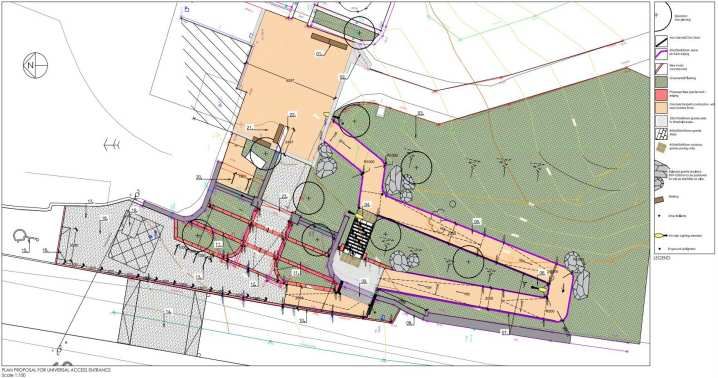
EIA Screening for proposed universally accessible entrance at Killiney Hill                August 2021

                                          Document Control

                                    Author/Reviewer                             Date

                                                                                Various dates to 18
 prepared by                        Paul Fingleton
                                                                                August 2021

 checked by                         Conor Skehan                                19 August 2021

 status                             Final, subject to any comments from DLRCC

by CAAS Ltd. for Dún Laoghaire–Rathdown County Council                                                i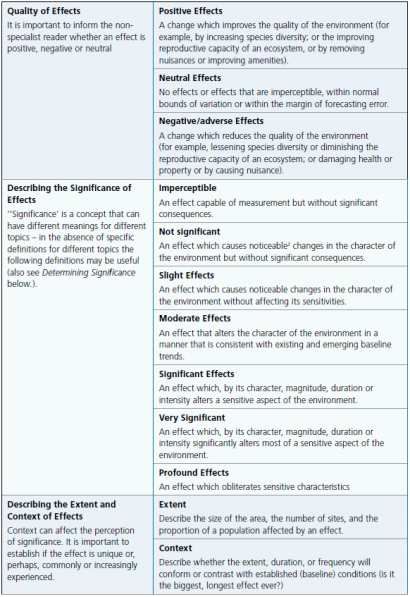
EIA Screening for proposed universally accessible entrance at Killiney Hill                                                              August 2021

                                                           Table of Contents
1.     Introduction..................................................................................................................................... 1
2.     The proposed development ............................................................................................................ 2
     2.1      Overview of the development................................................................................................. 2
     2.2      Project details .......................................................................................................................... 2
3.     Legislative basis for EIA ................................................................................................................... 6
4.     Screening considerations ................................................................................................................ 7
     4.1      Project type ............................................................................................................................. 7
     4.1      Subthreshold development ..................................................................................................... 8
     4.2       Review against Schedule 7 criteria ......................................................................................... 9
5.     Conclusions.................................................................................................................................... 13

                                                                     Figures
Figure 2.1 Location map .......................................................................................................................... 3
Figure 2.2 Extent of works area............................................................................................................... 4
Figure 2.3 Site plan .................................................................................................................................. 5

                                                                 Appendices

Appendix I – Standard Descriptions of Effects
Appendix II – Competency of Author

by CAAS Ltd. for Dún Laoghaire–Rathdown County Council                                                                                                  ii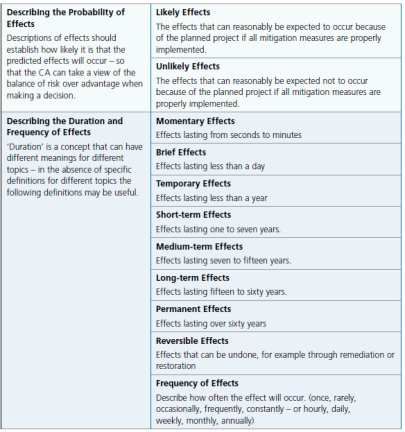
EIA Screening for proposed universally accessible entrance at Killiney Hill                August 2021

1. Introduction

CAAS has been appointed by Dún Laoghaire-Rathdown County Council to prepare this Environmental
Impact Assessment Screening Report for the proposed universally accessible entrance at Killiney Hill,
Killiney Hill Road, Killiney, Co. Dublin (the proposed development). This report has been prepared to
form an opinion as to whether or not the proposed development should be subject to
Environmental Impact Assessment (EIA) and if so, whether an Environmental Impact Assessment
Report (EIAR) should be prepared in respect of it.

The screening assesses the proposed development with reference to the EIA legislation1 including
the EIA Directive, and Planning and Development legislation. It also has regard to relevant parts of
EIA Guidance for Consent Authorities regarding sub-threshold development, 2003, Department of the
Environment, Heritage and Local Government, OPR Practice Note PN02 Environmental Impact
Assessment Screening, 2021, OPR and Guidelines for Planning Authorities and An Bord Pleanála on
carrying out Environmental Impact Assessment, 2018, Department of Housing, Planning and Local
Government and relevant EU Guidance including Interpretation of definitions of project categories of
annex I and II of the EIA Directive, 2015, EU and Environmental Impact Assessment of Projects -
Guidance on Screening, 2017, EU.

The consideration of potential impacts covers all significant direct, indirect and secondary impacts as
relevant, with reference to the guidance and in compliance with the legislation, including the criteria
for determining whether certain development types should be subject to EIA, and which are
grouped into these categories in the Directive:
       (i) Characteristics of the proposal
       (ii) Location of the proposal
       (iii) Characteristics of potential impacts

Where used, descriptions of impacts follow the statutory EPA (draft) Guidelines on the information
to be contained in Environmental Impact Assessment Reports (2017). For ease of reference, these
standardised descriptions are reproduced in Appendix I of this report.

Information on the development has been obtained from Dún Laoghaire-Rathdown County Council,
including a written description and drawings.

The following sections of this report cover:
    • The proposed development (s2)
    • The legislative basis for EIA (s3)
    • Screening considerations (s4)
    • Conclusion (s5)

An overview of the author’s competency is provided in Appendix II.

1
    see section 3 for details

by CAAS Ltd. for Dún Laoghaire–Rathdown County Council                                                1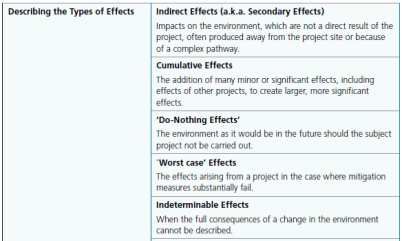
EIA Screening for proposed universally accessible entrance at Killiney Hill                  August 2021

2. The proposed development

2.1      Overview of the development
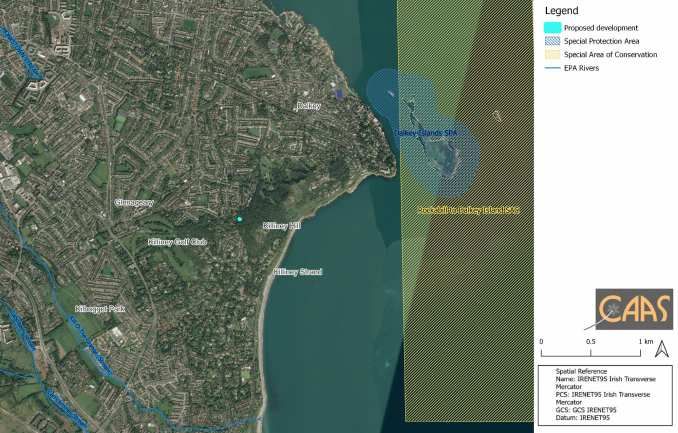
The site is located along the western boundary to Killiney Hill Park, adjacent to Killiney Hill Road. The
entrance is approximately 1.4km south of Dalkey Village, on the west boundary of Killiney Hill, and is
the primary entrance to access the park tearooms and associated facilities (see Figure 0.1 and Figure
0.2 for site location). The entrance is known locally as the Victorian or Tearooms entrance. The total
area of the proposed development is 0.096ha.

The aim of the project is to create a universally accessible entrance. Although the topography of the
park does not allow universal access throughout, the proposed project will enable universal access
to the tearooms and the seating area and toilet facilities associated with it. The proposed project will
also enhance the overall appearance of the existing entrance, improve on movement circulation and
define a legible and structured arrival space. Terraced planters will flank the entrance, preventing
unauthorised vehicle parking and framing the original gates.

2.2      Project details
The project consists of:
    • A 2m wide footpath will link the park arrival area to the proposed entrance. A bespoke
        guardrail positioned along the Killiney Hill Road will provide a protective barrier between the
        pedestrian and vehicular movement.
    • A reconstituted stone gateway structure will mark the entrance to the universal accessible
        path and ambulant accessible steps.
    • Minor earth form manipulation of the sloped embankment to accept the proposed steps
        and accessible path. The embankment will be planted with suitable native / pollinator
        friendly species.
    • The upper seating space associated with the Tearooms will be resurfaced and additional
        seating introduced.
    • The installation of cycle racks will provide for short stay cycle parking and help prevent
        unauthorised parking within the pedestrian arrival space.
    • A planting scheme will supplement the existing native woodland environment and create
        interest with selected specimen species.

The universally accessible entrance will be constructed south of and adjacent to the Victorian
entrance. This new entrance will be contemporary in design and off-set from the original entrance to
avoid detracting from the historic setting (see Figure 0.3 for the site plan).

The general upgrade works will include new paving and kerbs, seating, public lighting, soft
landscaping, cycle parking, fabrication & installation of new entrance gateway, construction of steps
and accessible pathway and minor earth works (Figure 0.3).

by CAAS Ltd. for Dún Laoghaire–Rathdown County Council                                                  2
EIA Screening for proposed universally accessible entrance at Killiney Hill August 2021 Figure 0.1 Location map by CAAS Ltd. for Dún Laoghaire–Rathdown County Council 3
EIA Screening for proposed universally accessible entrance at Killiney Hill   August 2021

Figure 0.2 Extent of works area

by CAAS Ltd. for Dún Laoghaire–Rathdown County Council                                 4
EIA Screening for proposed universally accessible entrance at Killiney Hill   August 2021

Figure 0.3 Site plan2

2
Dún Laoghaire-Rathdown County Council Drawing ref. DLR-KH-2445-003

by CAAS Ltd. for Dún Laoghaire–Rathdown County Council                                 5
EIA Screening for proposed universally accessible entrance at Killiney Hill                   August 2021

3. Legislative basis for EIA

EIA requirements derive from EU Directive 2011/92/EU (as amended by Directive 2014/52/EU) on
the assessment of the effects of certain public and private projects on the environment. The
Directive has been transposed into various Irish legislation of which the following are the most
relevant to this development.

    •    The Planning and Development Acts 2000-2020 (Part X), as amended by, inter alia, the:
         o    Planning and Development Regulations 2001 (S.I. 600/2001)
         o    European Union (Planning and Development) (Environmental Impact Assessment)
              Regulations 2018) (S.I. 296/2018)
         Part 1 of Schedule 5 of these regulations lists projects included in Annex I of the Directive
         which automatically require EIA.
         For projects included in Annex II of the Directive, Part 2 of Schedule 5 provides thresholds
         above which EIA is required.

by CAAS Ltd. for Dún Laoghaire–Rathdown County Council                                                   6
EIA Screening for proposed universally accessible entrance at Killiney Hill August 2021
4. Screening considerations
4.1 Project type
In the first instance it is necessary to determine whether the project is of a type that requires EIA.
Potentially relevant project types prescribed for EIA purposes in the Planning and Development
legislation are listed in the table below, with commentaries of their applicability to the proposed
development. Criteria prescribed in the legislation for changes or extensions are included.
The proposed development does not correspond to any specific project type listed under the
regulations. However, for the purpose of providing a robust assessment, the proposed development
has been considered under classes which it may correspond to most.
Project type / criteria Comment Is EIA
required
on this
basis?
Planning and Development
legislation
S.I. 600/2001, Schedule 5, Pt 2
Project type 10. Infrastructure
projects (b) (iv)
Urban development which would Commission guidance3 lists a range of projects, No
involve an area greater than 2 stating that these or other projects with similar
hectares in the case of a business characteristics can be considered to be ‘urban
district, 10 hectares in the case of development’. These include:
other parts of a built-up area and
• Shopping centres
20 hectares elsewhere.
• Bus garages
(In this paragraph, “business • Train depots
district” means a district within a • Hospitals
city or town in which the • Universities
predominant land use is retail or • Sports stadiums
commercial use.) • Cinemas
• Theatres
• Concert halls
• Other cultural centres
• Sewerage or water supply networks
The proposed project does not correspond to or
have similar characteristics to any of the above
listed project types.
On the basis of case law it is arguable that the
‘urban development’ project type can be considered
to apply to a wider range of developments in an
urban areas than stated in the Commission
3
Interpretation of definitions of project categories of annex I and II of the EIA Directive, 2015, EU
by CAAS Ltd. for Dún Laoghaire–Rathdown County Council 7EIA Screening for proposed universally accessible entrance at Killiney Hill August 2021
Project type / criteria Comment Is EIA
required
on this
basis?
guidance. (ref Carvill & Anor v Dublin City Council &
Ors [2021 No. 111 JR])
Notwithstanding, at 0.096 ha the size of the subject
proposal is far less than either of the thresholds for
this project which could be considered to apply here
(10 hectares in the case of other parts of a built-up
area and 20 hectares elsewhere).
Project type 13. Changes,
extensions, development and
testing
(a) Any change or extension of The changes covered by the proposed development No
development which would:- will not result in:
(i) result in the development (i) the development being of a listed class
being of a class listed in Part 1 or
N.B. While (subject to interpretation and
paragraphs 1 to 12 of Part 2 of
case law as discussed above) it could be
this Schedule, and
deemed to be urban development, it is
(ii) result in an increase in size below threshold.
greater than-
or
- 25 per cent, or
- an amount equal to 50 (ii) the development corresponding to either of
per cent of the appropriate the expansion scales given in (ii)
threshold, whichever is the N.B. The perimeter wall of the Park,
greater including gateways, is some hundreds of
metres long. The length of this perimeter
within the area of the proposed works is
approximately 20 m long. Similarly, the
length of pathways created by or affected
by the works is much less than the length of
pathways in the Park. The development is
well below both of the scales of expansion
given in 13(a)(ii) (25% and 50%).
4.1 Subthreshold development
Article 92 of the Regulations of 2001, as amended define: ‘sub-threshold development’ as:
development of a type set out in Part 2 of Schedule 5 which does not equal or exceed, as the
case may be, a quantity, area or other limit specified in that Schedule in respect of the
relevant class of development.
Annex III of the EIA Directive (2011/92/EU, as amended) as transposed into Schedule 7 of the
Planning and Development Regulations - sets out criteria for review of sub-threshold projects to
by CAAS Ltd. for Dún Laoghaire–Rathdown County Council 8EIA Screening for proposed universally accessible entrance at Killiney Hill August 2021
determine if they should be subject to EIA. These criteria include characteristics, location and
potential impacts.
The proposed development does not clearly fall into a project type prescribed in Part 2 of Schedule 5
and can be considered, on the one hand, not to be ‘sub-threshold development’. On the other hand,
taking project type 10(b)(iv) to have a wider meaning, per the case law referred to above, it may be
considered that the development does correspond to this project type. For the avoidance of any
doubt the next section of this report contains a review of the characteristics, location and potential
impacts of the proposal against the Schedule 7 criteria to determine if it should be subject to EIA.
4.2 Review against Schedule 7 criteria
These criteria cover:
1. Characteristics of the proposed development
2. Location of the proposed development
3. Types and characteristics of potential impacts
The criteria are listed in the table below. The comments provided in relation to the category 1 and 2
criteria are factual and do not comment on the types or characteristics of impacts. In keeping with
the intent of Schedule 7, commentary on impacts is provided in response to the items covered by
category 3 (the third part of the table below). All comments, particularly regarding ‘significance’, are
made in the context of the Directive and guidance. The review against the Schedule 7 criteria takes
account of the environmental factors set out in of Schedule 6 (2(d)), as relevant.
Schedule 7A of the Planning and Development Regulations sets out ‘Information to be provided by
the Applicant or Developer for the Purposes of Screening Sub-threshold Development for
Environmental Impact Assessment’. This information includes:
1. A description of the proposed development
2. A description of the aspects of the environment likely to be significantly affected by the
proposed development.
3. A description of any likely significant effects, to the extent of the information available on
such effects, of the proposed development on the environment
4. The compilation of the information at paragraphs 1 to 3 shall take into account, where
relevant, the criteria set out in Schedule 7.
This screening report includes the relevant Schedule 7A information. This is contained in s2 above
and in the commentary provided in and below the table which follows.
by CAAS Ltd. for Dún Laoghaire–Rathdown County Council 9EIA Screening for proposed universally accessible entrance at Killiney Hill August 2021
Schedule 7 Criteria Commentary
1. Characteristics of Proposed Development
The characteristics of proposed development, in
particular:
(a) the size and design of the whole of the The site covers approx. 0.096 ha. It will affect
proposed development approximately 20 m of park perimeter.
(b) cumulation with other existing development The context of the site is largely in amenity
and/or development the subject of a consent for usage with protected structures and extensive
proposed development for the purposes of amenity woodland. The lands on the opposite
section 172(1A)(b) of the Act and/or side of Killiney Hill Road are largely in
development the subject of any development residential use. A review of planning files for
consent for the purposes of the Environmental the surrounding area found that permissions
Impact Assessment Directive by or under any have been granted for a number of small to
other enactment medium scale residential developments in the
last 5 years.
(c) the nature of any associated demolition works Approximately 3 m of existing wall will be
removed to allow creation of the new
universally accessible entrance..
(d) the use of natural resources, in particular No significant natural resources will be used.
land, soil, water and biodiversity
(e) the production of waste, Waste generated during construction and
operation can be anticipated to be typical for
a small scale works project. No significant
waste streams will be generated.
(f) pollution and nuisances, During construction, the proposal is likely to
generate localised and short-term noise and
dust. It will also generate minor traffic. Post-
construction, it can be anticipated to have
negligible potential to cause any pollution or
nuisance.
(g) the risk of major accidents, and/or disasters There are no significant risks associated with
which are relevant to the project concerned, the proposal.
including those caused by climate change, in
accordance with scientific knowledge
2.Location of proposed development
The environmental sensitivity of geographical
areas likely to be affected by the proposed
development, with particular regard to—
(a) the existing and approved land use The site is largely in amenity usage with
protected structures and extensive amenity
woodland. The lands on the opposite side of
Killiney Hill Road are largely residential.
by CAAS Ltd. for Dún Laoghaire–Rathdown County Council 10EIA Screening for proposed universally accessible entrance at Killiney Hill August 2021
(b) the relative abundance, availability, quality Due to the scale of the proposed
and regenerative capacity of natural resources development and its location in a developed
(including soil, land, water and biodiversity) in residential and suburban context, the impact
the area and its underground on natural resources in the area will be
minimal.
(c) the absorption capacity of the natural
environment, paying particular attention to the
following areas:
(i) wetlands, riparian areas, river mouths -
(ii) coastal zones and the marine environment -
(iii) mountain and forest areas -
(iv) nature reserves and parks The development is on the perimeter of
Killiney Hill Park.
(v) areas classified or protected under -
legislation, including Natura 2000 areas
designated pursuant to the Habitats Directive
and the Birds Directive
(vi) areas in which there has already been a -
failure to meet the environmental quality
standards laid down in legislation of the
European Union and relevant to the project,
or in which it is considered that there is such
a failure.
(vii) densely populated areas The environs of the Park are predominantly
low-density suburban residential.
(viii) landscapes and sites of historical, cultural The existing Victorian gates and piers are
or archaeological significance protected structures as is the adjacent
tearooms building.
3. Types and characteristics of potential impacts
The likely significant effects on the environment
of proposed development in relation to criteria
set out under paragraphs 1 and 2, with regard to
the impact of the project on the factors specified
in paragraph (b)(i)(I) to (V) of the definition of
‘environmental impact assessment report’ in
section 171A of the Act, taking into account—
(a) the magnitude and spatial extent of the The site covers 0.096 ha. No significant
impact (for example, geographical area and size effects are likely to extend beyond the site
of the population likely to be affected) boundary.
(b) the nature of the impact Temporary to short term localised
construction phase impacts are likely. These
are likely to be small scale and localised.
Permanent effects on the setting of adjacent
protected structures are likely. These are not
likely to be significant within the meaning of
the Directive.
by CAAS Ltd. for Dún Laoghaire–Rathdown County Council 11EIA Screening for proposed universally accessible entrance at Killiney Hill August 2021
(c) the transboundary nature of the impact -
(d) the intensity and complexity of the impact The effects outlined at (b) above are likely to
be low in intensity and complexity.
(e) the probability of the impact The effects outlined at (b) above are likely to
occur.
(f) the expected onset, duration, frequency and Construction phase impacts will commence at
reversibility of the impact start of construction, be of varying frequency
and can be anticipated to be insignificant to
slight and temporary to short term. Once
completed, effects will be insignificant and
permanent.
(g) the cumulation of the impact with the impact On the basis of their nature and scale, when
of other existing and/or development the subject considered in-combination with the proposed
of a consent for proposed development for the development, potential for other existing
purposes of section 172(1A)(b) of the Act and/or and/or permitted development to cause
development the subject of any development significant cumulative impacts can be
consent for the purposes of the Environmental considered to be negligible.
Impact Assessment Directive by or under any
other enactment
(h) the possibility of effectively reducing the Not relevant as significant effects are
impact considered unlikely to occur.
Based on review against the Schedule 7 criteria, the environmental impacts of the proposal can be
anticipated to be unlikely to be significant within the meaning of the Directive.
Article 120 of the Regulations of 2001, as amended, require the Schedule 7A information to be
accompanied by:
(a) ‘shall be accompanied by any further relevant information on the characteristics of the
proposed development and its likely significant effects on the environment, including, where
relevant, information on how the available results of other relevant assessments of the
effects on the environment carried out pursuant to European Union legislation other than
the Environmental Impact Assessment Directive have been taken into account’ and
(b) ‘may be accompanied by a description of the features, if any, of the proposed development
and the measures, if any, envisaged to avoid or prevent what might otherwise have been
significant adverse effects on the environment of the development.’
In relation to (a), an Appropriate Assessment screening report forms part of the Part 8
documentation. This finds that a stage two Appropriate Assessment is not required. There is no
further relevant information arising from other assessments as described at (a) that needs to be
taken into account.
In relation to (b) as no significant adverse effects are likely to occur on the environment, no
measures are envisaged or proposed to avoid or prevent such effects.
by CAAS Ltd. for Dún Laoghaire–Rathdown County Council 12EIA Screening for proposed universally accessible entrance at Killiney Hill August 2021 5. Conclusions It is considered that the proposed universally accessible entrance at Killiney Hill, Killiney Hill Road, Killiney, Co. Dublin does not need to be subject to Environmental Impact Assessment and no Environmental Impact Assessment Report is required for it. This conclusion is based on an objective review of the proposed development, including its characteristics, location and the likelihood of it causing significant environmental impacts. The screening has followed the relevant legislation and has had regard to the relevant guidance. by CAAS Ltd. for Dún Laoghaire–Rathdown County Council 13
EIA Screening for proposed universally accessible entrance at Killiney Hill            August 2021

Appendix I – Standard Descriptions of Effects

(from Guidelines on the information to be contained in Environmental Impact Assessment Reports,
2018 draft, EPA)

by CAAS Ltd. for Dún Laoghaire–Rathdown County Council                                Appendix I-1
EIA Screening for proposed universally accessible entrance at Killiney Hill   August 2021

by CAAS Ltd. for Dún Laoghaire–Rathdown County Council                        Appendix I-2
EIA Screening for proposed universally accessible entrance at Killiney Hill   August 2021

by CAAS Ltd. for Dún Laoghaire–Rathdown County Council                        Appendix I-3
EIA Screening for proposed universally accessible entrance at Killiney Hill                        August 2021

Appendix II - Competency of Authors

Paul Fingleton, the lead author, has an MSc in Rural and Regional Resources Planning (with
specialisation in EIA) from the University of Aberdeen. Paul is a member of the International
Association for Impact Assessment as well as the Institute of Environmental Management and
Assessment. He has over twenty-five years’ experience working in the area of Environmental
Assessment. Over this period, he has been involved in a diverse range of projects including
contributions to, and co-ordination of, numerous complex EIARs and EIA screening reports. He has
also contributed to and supervised the preparation of numerous AAs and AA screenings.

Paul is the lead author of the current EPA Guidelines4 and accompanying Advice Notes5 on EIARs. He
has been involved in all previous editions of these statutory guidelines. He also provides a range of
other EIA related consultancy services to the EPA. Paul is regularly engaged by various planning
authorities and other consent authorities to provide specialised EIA advice.

Clare O’Doherty, Environmental Assistant has a BSc in Environmental Management, Dublin Institute
of Technology, 2019. Clare has experience working as part of team projects and in the preparation of
EIA and AA documents on behalf of multi-nationals and infrastructural providers. She also liaises
with various government agencies and local authorities in order to assimilate the environmental
baseline information that is used in EIAs and AAs and assists in the preparation of the various EIA
and AA related documentation.

4
    Guidelines on the information to be contained in Environmental Impact Assessment Reports, EPA, 2017 (Draft)
5
    Advice notes on current practice in the preparation of Environmental Impact Assessment Reports, EPA, 2003

by CAAS Ltd. for Dún Laoghaire–Rathdown County Council                                            Appendix II-1
You can also read


