Controlling giant hogweed: the scope of a concerted regional intervention - NCCEH
←
→
Page content transcription
If your browser does not render page correctly, please read the page content below
May 2018

Controlling giant hogweed: the scope of a concerted
regional intervention
                                                                                                                                       Authors:
                               Dre Joanne Aubé-Maurice, M.D., M. Sc., FRCPC, Medical Health Officer, Public Health Authority of the Bas-Saint-
                                                              Laurent Integrated Health and Social Services Centre (CISSS du Bas-Saint-Laurent)
                               Geneviève Fontaine, B. Sc., Environmental Health Professional, Public Health Authority of the Bas-Saint-Laurent
                                                                                                   Integrated Health and Social Services Centre
                                  Guylaine Morrier, B. Sc., Environmental Health Professional, Public Health Authority of the Bas-Saint-Laurent
                                                                                                   Integrated Health and Social Services Centre

Summary

 Giant hogweed is an invasive alien plant that can severely burn the skin. The plant is not yet very prevalent in Bas-Saint-
 Laurent, and intervention in the region to date has focused on eradicating it during the first stage of its invasion. To that
 end, a consultation process was undertaken in 2015 under the leadership of the public health authority and the regional
 development collective (CRD), in collaboration with several partners. Significant mobilization around this common objective
 has helped establish the credibility of the process and facilitate its funding and significant progress on the ground.

Introduction                                                                  Photo 1 – Giant hogweed
Giant hogweed (Photo 1) is an alien plant considered to be
invasive, in particular because of the large number of seeds it can
produce when the plants reach maturity (1). Since the seeds can
float on water, they are able to travel and can be dispersed over
distances of up to 10 km, thereby colonizing riparian areas (1).

From an environmental standpoint, the proliferation of giant
hogweed poses a risk to biodiversity. From a public health
standpoint, giant hogweed is a concern because it can cause
severe skin burns. When in contact with the skin and activated
by ultraviolet rays, the toxins in its sap can cause second-degree
burns (2). A number of burns have been reported in recent
years in Bas-Saint-Laurent, including a few that received media
coverage but were not confirmed by health professionals.

                                                                              Source : CISSS du Bas-Saint-Laurent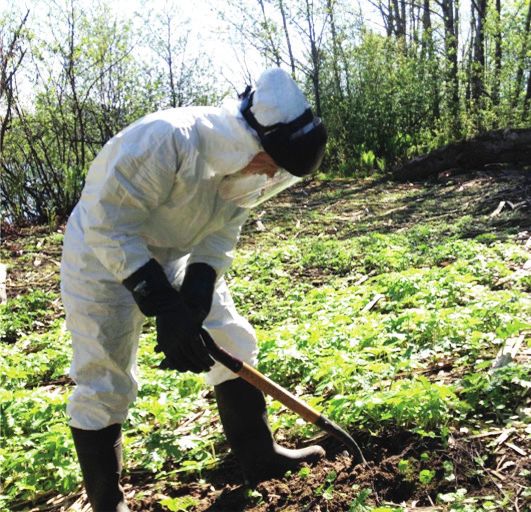
BISE - Aubé-Maurice, J. et al. (2018)

The intervention ongoing in Bas-Saint-Laurent since 2015       awareness of the possibility of eradicating the plant as
aims to eradicate giant hogweed while it is still possible—    well as providing an opportunity for the various partners
during the first stage of its invasion. This approach, which   to share their concerns. A working group coordinated by
arose out of a context that favoured the mobilization of       the DSPublique was quickly set up. Figure 1 shows the
partners and the sustainability of the project, has already    main partners involved in this working group.
had an obvious impact. The characteristics and factors
that contributed to the success of the intervention will be    Deployment of multi-faceted interventions
discussed below.
                                                               The action plan to control giant hogweed in Bas-Saint-
The emergence of a concerted                                   Laurent is structured around four major steps of
                                                               intervention: the continuation of awareness-raising and
approach to controlling giant                                  mobilization efforts with partners, the production of a
                                                               description of the problem, the deployment of eradication
hogweed in Bas-Saint-Laurent                                   actions in the field and follow-up of the previous steps.
                                                               Although this sequence has made it possible to structure
Establishing a structure for regional                          the interventions chronologically, it is an iterative
collaboration                                                  approach requiring constant back and forth between the
Structured interventions to control giant hogweed in           different steps named above, which are being refined as
Bas-Saint-Laurent began in 2015, following a training          the interventions evolve. In addition, three major levels
session organized by the regional public health authority      of intervention describe the chosen approach: individual,
(DSPublique) in collaboration with a subject-matter            community and regional interventions. Table 1 presents
expert. Many partners potentially affected by the giant        examples to illustrate the levels and steps of intervention
hogweed issue were invited to this event, which gave           recommended in the context of the approach to control
rise to a better understanding of the problem and raised       giant hogweed in Bas-Saint-Laurent.

Figure 1 – Partners affected by the issue of giant hogweed in Bas-Saint-Laurent

    Source : CISSS du Bas-Saint-Laurent

2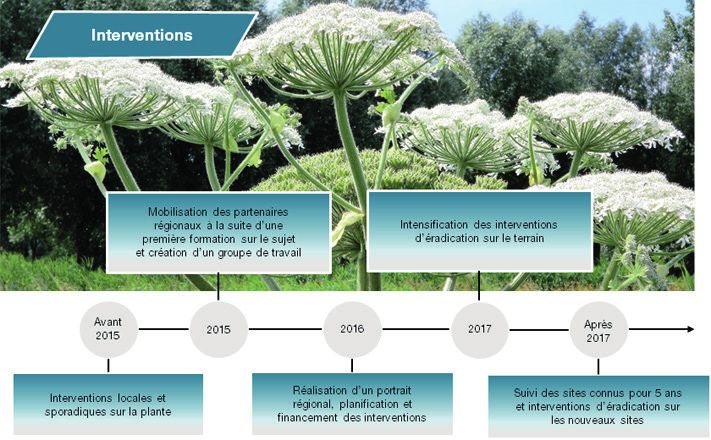
BISE - Aubé-Maurice, J. et al. (2018)

Table 1 – Examples of interventions in the action plan according to the different levels and steps of intervention

                                                                      LEVELS
 STEPS
                               Individual                           Community                             Regional
                    • Informing the public and           • Raising awareness among en-        • Leading a regional consultation
 Awareness and        raising awareness about the          trepreneurs and other partners       for the control of giant ho-
 mobilization         problem                              (agriculture, excavation, etc.)      gweed
                                                           about the problem

                    • Raising awareness among the        • Connecting partners and OBVs       • Establishing lines of communi-
                      public to encourage the identi-      to report plants to be mapped        cation between MTMDET and
 Description          fication and reporting of plants                                          OBVs concerning the location
                      to watershed organizations                                                of plants
                      (OBVs) and municipalities
                    • Providing information to land      • Identifying plants using in situ   • Proposing a model municipal
                      owners when a giant hogweed          panels to prevent burns              by-law on giant hogweed
 Actions              intervention is planned on         • Removing plants by
                      their land                           OBVs

                                                         • Visiting invaded sites several     • Publishing an annual report via
                                                           times Follow-up a year for           local and regional media
 Follow-up
                                                           three to five years

Challenges associated with field                                  summer, for example when a colony is spotted late in the
                                                                  season. However, this method simply prevents the spread
intervention                                                      of seeds without eliminating the plant. Moreover, as giant
                                                                  hogweed does not die until the seeds have spread, usually
Interventions aimed at eliminating giant hogweed plants           after its fourth year of life, cutting the umbel prolongs its
can be laborious, particularly because of the frequent            survival (6).
confusion with cow-parsnip, a highly common native
species in Bas-Saint-Laurent (see box at the end of this          Photo 2        Non-absorbent protective garment worn
article). The work is further complicated by the risk of                         during an intervention on giant hogweed
burns associated with handling the plant and by the
plant’s highly invasive nature, given that each specimen
can produce about 15,000 seeds (3).

Persons working with giant hogweed should therefore
be able to accurately recognize the plant and should
wear non-absorbent protective clothing (synthetic and
waterproof material) when handling it (Photo 2) (4). In
addition, colonized sites must be monitored annually until
the seed bank is depleted (5), as the seeds usually take
five to six years to germinate (1).

Two types of methods can be used to control giant
hogweed: mechanical methods and chemical methods.
The former consists mainly of uprooting the plant at the
root and the umbel section before the seeds are released.
Uprooting is the recommended method in early summer
when plants are recognizable but still small, to limit the
physical effort required for extraction. On the other
hand, cutting the umbel is more useful at the end of the          Source : OBV du fleuve Saint-Jean
                                                                                                                                    3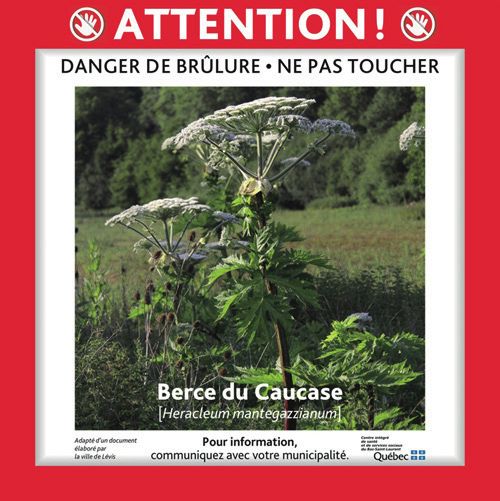
BISE - Aubé-Maurice, J. et al. (2018)

Chemical methods involve using “an herbicide to kill the                   Funding of interventions for sustainability
plant in the very short term” (4). This strategy must be
repeated over time, as a single treatment usually fails                    Given the significant mobilization around the issue,
to kill the plant. This method is generally used when the                  the structured approach that was advocated by the
size of the colony exceeds the capacity of mechanical                      working group and the challenges of implementing these
intervention. Sometimes both methods are combined to                       interventions without dedicated additional resources,
eliminate a colony (5).                                                    the Forum de concertation bas-laurentien and the Bas-
                                                                           Saint-Laurent Integrated Health and Social Services
                                                                           Centre (CISSS) agreed as of 2016 to allocate an initial
                                                                           sum of $60,000 to the project over two years. The CRD,
                                                                           a structure aimed at supporting the Forum in managing
                                                                           the projects it finances, then joined forces with the
                                                                           DSPublique in coordinating the regional dialogue and
                                                                           reached agreements with the four local OBVs to fund their
                                                                           interventions to control and eradicate giant hogweed in
                                                                           the area. Figure 2 illustrates in more detail the actions
                                                                           surrounding the control of giant hogweed in Bas-Saint-
                                                                           Laurent since 2015.

Figure 2       Actions surrounding the control of giant hogweed in Bas-Saint-Laurent since 2015

Source : CISSS du Bas-Saint-Laurent

i.   Le Forum de concertation bas-laurentien réunit les préfets de chaque municipalité régionale de comté (MRC), les maires de plus grandes agglo-
     mérations du territoire ainsi que quelques acteurs de la société civile, dont le CISSS du Bas-Saint-Laurent.

4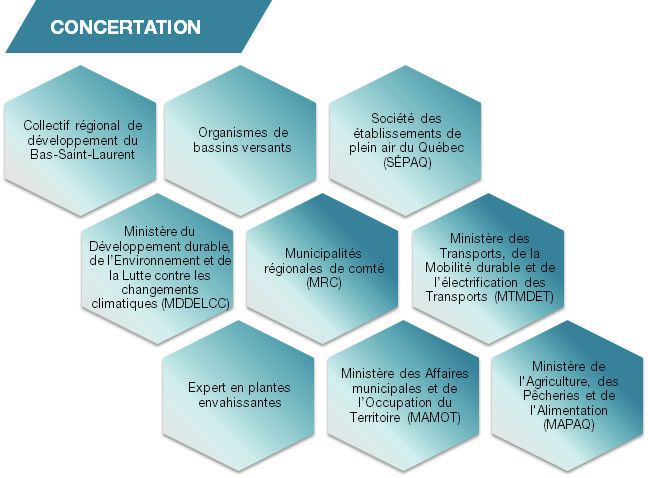
BISE - Aubé-Maurice, J. et al. (2018)

Project discussion and outcomes                             Moreover, in addition to public health risks, the
                                                            anticipated ill effects of the plant on the environment
Several factors have informed the approach to controlling   have led to the involvement of a number of partner
giant hogweed in Bas-Saint-Laurent, starting with the       organizations whose mission focuses on biodiversity,
fact that the plant was not widely known in the area,       rather than health. The training offered regionally on
leading to a dearth of information and resources to         the issue, followed by the implementation of a regional
effectively address the issue. Even at the community        and intersectoral structure for joint action, co-led by
level, the multiple challenges associated with giant        DSPublique and the CRD, has made it much easier for
hogweed eradication interventions, coupled with the         partners to get involved and for structured actions to be
limited resources available, have hindered the ability      planned. Finally, the choice by elected officials to split the
of communities to adequately intervene. In addition,        resources and costs associated with future interventions
media coverage of a number of burn cases suspected of       between RCMs and municipalities has made it possible
being caused by exposure to giant hogweed has drawn         to bolster, better structure and dovetail the interventions
increasing attention to the issue, raising concerns among   already in progress. Figure 3 illustrates a range of factors
the public, elected officials and partners.                 that spurred the involvement of partners.

Figure 3    Factors that have spurred mobilization around giant hogweed

           Source : CISSS du Bas-Saint-Laurent

                                                                                                                              5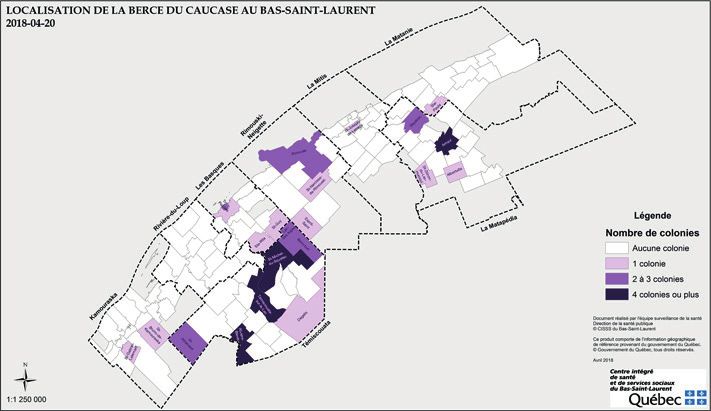
BISE - Aubé-Maurice, J. et al. (2018)

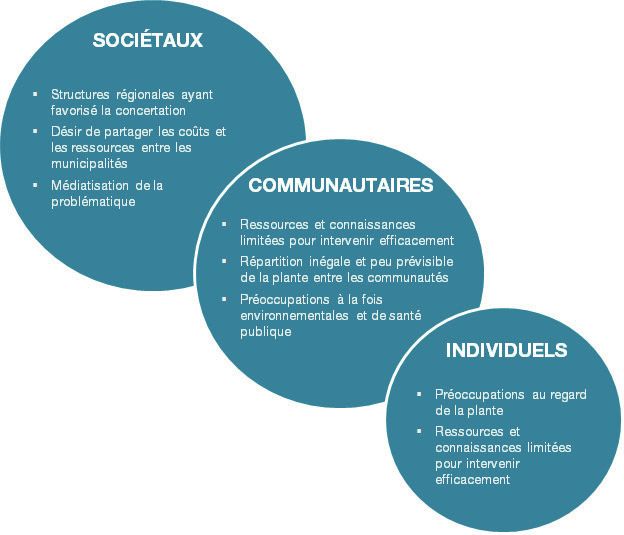
The concerted efforts have led to a better understanding      This process has contributed to more clearly outlining
of giant hogweed’s geographical distribution in Bas-Saint-    the roles of each individual partner, all while fostering a
Laurent (Map 1), in addition to better equipping local        shared sense of collective success and motivating partners
stakeholders to intervene effectively and prevent the plant   to collaborate on other issues. Finally, splitting the cost of
from spreading. They have promoted public awareness           tackling the issue, which respects no borders, has made it
of the plant’s health effects and the importance of redu-     possible not to leave the public and municipalities dealing
cing the risk of exposure. They were also an invaluable       with this invasive species to their own devices, while also
opportunity to partner with various local actors, including   promoting interventions that are sustainable in the long
stakeholders from the municipal and health sectors, in line   term.
with the Démarche Prendre soin de notre monde [Taking
care of our world approach] (7).

Map 1       Giant hogweed distribution in Bas-Saint-Laurent

Source : CISSS du Bas-Saint-Laurent

6
BISE - Aubé-Maurice, J. et al. (2018)

Conclusion                                                     A word about cow-parsnip and common hogweed

The approach deployed in Bas-Saint-Laurent stands out          +     Two other species of hogweed are found in Bas-
                                                                     Saint-Laurent: cow-parsnip (Heracleum maximum)
for its proactive, voluntary, concerted and collaborative       and common hogweed (Heracleum sphondylium).
nature. The choice to raise partner awareness through
local training sessions seems to have led to voluntary          Cow-parsnip, a native species, can also cause burns, albeit
mobilization around a working group before the issue            less severe than those caused by giant hogweed (8).
becomes out of hand in the area. The intervention to
control giant hogweed in Bas-Saint-Laurent has been             The lesser-known common hogweed is mainly found
bolstered by a sharing of responsibilities between the          in the Matapédia Valley. Unlike giant hogweed, this
partners, including funding from elected officials and the      species is well established in the environment. It seems
CISSS, the leading of on-the-ground actions by the OBVs         impossible to envision its eradication at this point (9).
and the facilitation of the consultation process by regional    The favoured approach in the intervention regarding
organizations such as the CRD and DSPublique. The               this species has been to reduce the risk of burns by
project also gained great credibility thanks to the support     controlling its presence in areas that attract the public
of a Université Laval expert, whose in-depth knowledge          (walking trails, children’s parks, etc.) and to prevent it
of the subject and experience in comparable contexts            from spreading.
informed the choice of efficient strategies and made it
possible to sidestep certain mistakes in managing the
issue and promoting the involvement of the partners.           Acknowledgements
It appears to us that the essential foundations for the        We would like to thank everyone who has contributed
success of such an intervention are: 1) the involvement        to the implementation of this regional intervention for
of elected officials and regional and local partners; 2) a     eradicating giant hogweed: watershed organizations
regional consultation structure to take into account the       (OBVs), the regional development collective (CRD),
concerns of all partners; 3) complete coverage of the Bas-     regional county municipalities (RMCs), municipalities,
Saint-Laurent territory to zero in on the problem and take     the Société des établissements de plein air du Québec
action; 4) a financial investment shared among regional        (SÉPAQ), the ministère du Développement durable, de
partners; and 5) medium- and long-term monitoring of           l’Environnement et de la Lutte contre les changements
the interventions and their progress.                          climatiques (MDDELCC), the ministère des Transports, de
                                                               la Mobilité durable et de l’Électrification des transports
For all correspondence                                         (MTMDET), the ministère de l’Agriculture, des Pêcheries
                                                               et de l’Alimentation du Québec (MAPAQ), the ministère
Guylaine Morrier
                                                               des Affaires municipales et de l’Occupation du territoire
Public health authority
                                                               (MAMOT) and Claude Lavoie, full professor and director
Centre intégré de santé et des services sociaux du Bas-
                                                               at Université Laval’s École supérieure d’aménagement du
Saint-Laurent
                                                               territoire et de développement régional.
288 Pierre-Saindon Street
Rimouski, Quebec G5L 9A8
                                                               Photo credit: OBV du fleuve Saint-Jean, pixabay.com.
Email: guylaine.morrier.cisssbsl@ssss.gouv.qc.ca (link to
send an email)

                                                                                                                                7
BISE - Aubé-Maurice, J. et al. (2018)
References 6. Trottier N., E. Groeneveld, C. Lavoie dans
J. Piette. Étude génétique de l’invasion
1. Page NA, Wall RE, Darbyshire SJ, Mulligan GA. de la berce du Caucase (Heracleum
The Biology of Invasive Alien Plants in Canada. mantegazzianum) au Québec, Mémoire [En
4. Heracleum mantegazzianum Sommier ligne]. Université Laval; 2017. Disponible :
& Levier. Can. J. Plant Sci [En ligne]. 2006; https://www.queberce.crad.ulaval.ca/files/
(86) : 569-589. Disponible : http://www. queberce/Jeanne-Piette-111-043-678.pdf
nrcresearchpress.com/doi/pdf/10.4141/P05- (lien externe s’ouvrant dans une nouvelle
158 (lien externe s’ouvrant dans une nouvelle fenêtre)
fenêtre) 7. Prendre soin de notre monde – Québec
2. Lavoie C, Lelong B, Blanchette-Forget N, en Forme. Prende soin de notre monde.
Royer H. La berce du Caucase : à l’aube d’une [En ligne]. Gouvernement du Québec;
invasion au Québec?. Le Naturaliste canadien 2015-2018. Accueil. Disponible : http://
[En ligne]. 2003; 137(2) : 5-11. Disponible : prendresoindenotremonde.com/ (lien
https://www.queberce.crad.ulaval.ca/files/ externe s’ouvrant dans une nouvelle fenêtre)
queberce/LAVOIE_ET_AL_2013.pdf (lien 8. Groupe de recherche QuéBERCE. Groupe
externe s’ouvrant dans une nouvelle fenêtre) de recherche QuéBERCE [En ligne]. 2015.
3. Trottier N., E. Groeneveld, C. Lavoie dans Identification. Disponible : https://www.
J. Piette. Étude génétique de l’invasion queberce.crad.ulaval.ca/identification.html
de la berce du Caucase (Heracleum (lien externe s’ouvrant dans une nouvelle
mantegazzianum) au Québec – Mémoire [En fenêtre)
ligne]. Université Laval; 2017. Disponible : 9. Groupe de recherche QuéBERCE. Groupe de
https://www.queberce.crad.ulaval.ca/files/ recherche QuéBERCE [En ligne]. 2015. Une
queberce/Jeanne-Piette-111-043-678.pdf autre espèce de berce toxique au Québec.
(lien externe s’ouvrant dans une nouvelle Disponible : https://www.queberce.crad.
fenêtre) ulaval.ca/nouvelles/une-autre-espece-de-
4. Lavoie C. et B. Lelong. Méthodes de lutte berce-toxique-au-quebec.html (lien externe
contre l’herbe à puce – Recension de la s’ouvrant dans une nouvelle fenêtre)
littérature scientifique et recommandations
[En ligne]. Université Laval; 2017. Disponible :
https://www.plantesenvahissantes.ulaval.ca/ Translation of this document has been made possible
files/form-plantes/HERBE_A_PUCE2.pdf (lien through a financial contribution from the Public Health
externe s’ouvrant dans une nouvelle fenêtre) Agency of Canada
through the National
5. Kraus N. Giant Hogweed program – 2015 Collaborating Centre
annual report [en ligne]. New York State for Environmental
Health.
Department of Environmental Conservation,
Division of Lands & Forests, Forest Health;
2015. Disponible : http://adkinvasives.com/
wp-content/uploads/2016/03/2015-DEC-
Giant-Hogweed-Report.pdf (lien externe
s’ouvrant dans une nouvelle fenêtre)
8You can also read


