Cost-effectiveness analysis regarding postoperative administration of vitamin-D and calcium after thyroidectomy to prevent hypocalcaemia
←
→
Page content transcription
If your browser does not render page correctly, please read the page content below
Rev. salud pública. 13 (5): 804-813, 2011
804        REVISTA DE SALUD PÚBLICA · Volumen 13 (5), Octubre 2011

   Cost-effectiveness analysis regarding
 postoperative administration of vitamin-D
    and calcium after thyroidectomy to
          prevent hypocalcaemia
 Análisis de costo-efectividad de la administración postoperatoria de
Vitamina D y calcio después de tiroidectomía para la prevención de la
                            hipo calcemia

                   Álvaro Sanabria, Luis C. Domínguez, Valentín Vega,
                             Camilo Osorio y Daniel Duarte
Department of Surgery. School of Medicine. Universidad de La Sabana. Chia, Colombia.
alva rosa nabria@gmail.com,l ucardo6 1@gmail .com,neil va lentin@ya hoo.com,
camilo.osorio@unisabana.edu.co, danielduarteca@gmail.com

      Received 24th April 2011/Sent for Modification 5th October 2011/Accepted 25th October 2011

ABSTRACT

Objective Hypocalcaemia is a frequently arising complication following total
thyroidectomy. Routine postoperative prophylactic administration of vitamin D or
metabolites and calcium reduce the incidence of symptomatic hypocalcaemia; this
article reports evaluating its cost-effectiveness in Colombia.
Methods Meta-analysis was used for comparing the administration of vitamin D or
metabolites to oral calcium or no treatment at all in patients following total thyroidectomy
and a cost-effectiveness analysis was designed based on a decision-tree model with
local costs.
Results The OR value for the comparison between calcitriol and calcium compared to
no treatment and to exclusive calcium treatment groups was 0.32 (0.13-0.79 95 %CI)
and 0.31 (0.14-0.70 95 %CI), respectively. The most cost-effective strategy was vitamin
D or metabolites and calcium administration, having a US $0.05 incremental cost-
effectiveness ratio.
Conclusion Prophylactic treatment of hypocalcaemia with vitamin D or metabolites +
calcium or calcium alone is a cost-effective strategy.

Key Words: Thyroid neoplasm, thyroidectomy, hypocalcaemia, cost-benefit (source:
MeSH, NLM).

RESUMEN

Objetivos La hipo calcemia es la complicación más frecuente después de
tiroidectomía. La administración profiláctica de vitamina D o metabolitos y calcio reduce

                                                804
Torres - -Perfil
Sanabria lipídico y vértigoanalysis
Cost-effectiveness periférico 805
la incidencia de hipocalcémia sintomática. Se evalúa su costo-efectividad en
Colombia.
Materiales y métodos Utilizamos la información de un meta-análisis que comparó la
administración de vitamina D o metabolitos contra calcio no tratamiento en pacientes
llevados a tiroidectomía total y diseñamos un análisis de costo-efectividad basados
en un modelos de decisiones con costos locales.
Resultados El valor del OR para la comparación entre calcitriol y calcio comparado
con no tratamiento o calcio exclusivo fue de 0.32 (95 % IC, 0.13- 0.79) y 0.31 (95 % IC,
0.14-0.70), respectivamente. La estrategia más costo-efectiva fue la administración
de vitamina D o metabolitos y calcio, con una relación de costo-efectividad incremental
de US $0.05.
Conclusiones El tratamiento profiláctico de la hipo calcemia con vitamina D o
metabolitos y calcio o calcio exclusivo después de tiroidectomía total es una estrategia
costo-efectiva.
Palabras Clave: Neoplasias de tiroides, tiroidectomía, hipo calcemia, costo-beneficio
(fuente: DeCS, BIREME).
T
hyroidectomy is the most common endocrine procedure performed
by surgeons. Hypocalcaemia is a frequently occurring complication
following total thyroidectomy and leads to prolonged hospital stay. (1-3)
The rate of symptomatic postoperative hypocalcaemia ranges from 5 % to 50 %
(4), but only 1-3 % of cases are permanent and require a calcium and vitamin D
supplement. Hypocalcaemia treatment depends on its severity; oral vitamin D or
metabolites and calcium supplements are enough to relieve symptoms in mild
cases and return serum calcium values to normal levels. Emergency admission
to hospital is necessary in cases of severe hypocalcaemia, involving periodic
serum calcium measurement, administration of intravenous calcium gluconate
and high supplementary doses of oral vitamin D or metabolites and calcium.
It has been demonstrated that routine oral vitamin D or metabolites and
calcium prophylactic administration during the postoperative period reduces
symptomatic hypocalcaemia rate (5). However, the economic impact of this
intervention must be assessed. Vitamin D or metabolites and calcium
administration increase treatment costs because they must be used in all
patients for at least one or two weeks after thyroidectomy. Such intervention's
cost-effectiveness has not been assessed previously, so this therapy cannot
be recommended for universal use due to health system differences.
This study was aimed at evaluating this treatment regime's cost-
effectiveness in a developing country's health system.806 REVISTA DE SALUD PÚBLICA · Volumen 13 (5), Octubre 2011
MATERIALS AND METHODS
Data from a previous systematic review which assessed vitamin D or
metabolites and calcium administration's effectiveness in patients who had
undergone total thyroidectomy was used here (5).
The cost-effectiveness economic analysis was based on a deterministic
and probabilistic decision-making model, selected on the premise that different
therapeutic strategies have different costs and different outcomes. The
reference case in the current analysis was a patient who underwent total
thyroidectomy, considering thyroidectomy as a therapy for goitre and well-
differentiated thyroid carcinoma without lateral neck metastases.
Decision alternatives. Pursuant to what has been accepted in the literature,
two mutually-exclusive decision alternatives were chosen as measures for
preventing postoperative hypocalcaemia: postoperative supplementation with
oral vitamin D or metabolites and calcium, exclusive oral calcium
supplementation, both compared to no supplementation. These decision
alternatives were used for assessing the following criteria: better effectiveness
(using data from a previous systematic review), study design (only randomised
controlled trials were included in the systematic review) and intervention and
outcome costs (data was directly obtained from a first-level (highly specialised)
institution and from the of the Social Security Institute of Colombia price
manual).
Figure 1. Standard decision treeTorres - -Perfil
Sanabria lipídico y vértigoanalysis
Cost-effectiveness periférico 807
Sequences and outcome pathways. The primary outcome was the presence
or absence of symptomatic postoperative hypocalcaemia, regardless of
diagnostic test findings, and effectiveness was defined as the percentage of
patients without symptomatic postoperative hypocalcaemia. The tree was
built using TreeAge Inc DATA 4.0 software (Figure 1).
The likelihood of presenting postoperative hypocalcaemia, the probability
of having a severe crisis in the patients presenting hypocalcaemia and final
treatment cost were calculated for each pathway.
Analytical perspective. Health management organisations' (HMO) analytical
perspective was adopted; it was chosen because such organisations ultimately
pay for a particular therapeutic approach and therefore HMOs need well-
documented suggestions concerning the implementation of protocols that may
be included as part of an integrated healthcare approach.
Costs. The data were obtained from a cohort of 13 patients who had presented
postoperative hypocalcaemia after total thyroidectomy in a first-level institution.
Such data was complemented with data obtained from the literature. HMOs
are mostly concerned with direct and indirect medical costs determining the
amount to be paid. The costs for the model were obtained from the Colombian
Social Security Institute's billing manual for integrated care (adjusted to 2008
prices) and the Colombian Manual of Pharmaceutical Products. The
diagnostic and therapeutic procedures were selected in accordance with the
Social Security Institute's procedures manual. Prices were converted to US
dollars using the December 2008 conversion rate (1 dollar=2,204 Colombian
pesos). The disease was divided into two phases for estimating average
costs. The acute phase included emergency department evaluation, serum
calcium measurement, acute treatment with calcium gluconate and length of
stay which extended until symptoms were controlled. The chronic phase
included the value of administering each strategy (vitamin D or metabolites +
calcium, calcium), the value of treating the hypocalcaemia episode (divided
into an intensive period involving higher doses for severe hypocalcaemia
(carpopedal spasm) and a maintenance period with lower doses for mild
hypocalcaemia (perioral tingling) and diagnostic tests and medical evaluation
used during follow-up.808 REVISTA DE SALUD PÚBLICA · Volumen 13 (5), Octubre 2011
Time period. Postoperative hypocalcaemia is a condition that can be
considered a short-course acute event. As the supplement was designed to
alleviate the appearance of symptoms during the postoperative period, one
month was considered to be sufficient time for identifying risks and benefits.
Moreover, no discount adjustments were required.
Sensitivity analysis. The critical issues requiring one-way sensitivity analysis
were changes in the probability of postoperative hypocalcaemia and strategy
costs. A probabilistic sensitivity analysis was also designed including random
distributions for probabilities of hypocalcaemia (beta), length of stay and costs
(lognormal). A Monte Carlo simulation was made (10,000 trials were run). A
mean and incremental cost-effectiveness plane and acceptability curve were
designed.
RESULTS
The systematic review included 706 patients: 346 in the vitamin D or metabolites
group, 288 in the oral calcium group and 72 in the control group. The
hypocalcaemia symptom rate was 13/346 (4 %, 1-23 % range) patients in
the vitamin D or metabolites group, 28/288 (19 %, 7-35 % range) in the oral
calcium group and 22/72 (31 %, 24-41 % range) in the control group. The
OR value for the comparison between calcitriol and calcium as compared to
no treatment was 0.32 (0.13-0.79 95 %CI) and 0.31 (0.14-0.70 95 %CI) for
the comparison between the vitamin D or metabolites and exclusive calcium
treatment groups.
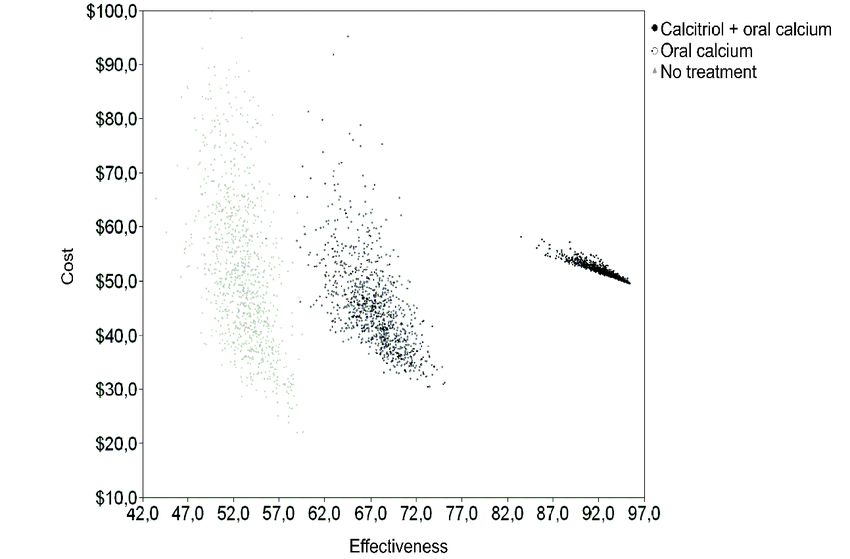
Probability, cost and resource use values for each strategy are shown in
Tables 1, 2 and 3, respectively. Table 4 gives the deterministic model's strategy
analysis results. The most cost-effective strategy was administering vitamin
D or metabolites and calcium, having a US$0.56 mean cost-effectiveness
ratio, followed by calcium exclusively, having US$0.65 mean cost-
effectiveness ratio. The no treatment branch was always dominated by the
other strategies. Increased cost-effectiveness ratio for oral calcium compared
to no treatment was negative and that for vitamin D or metabolites and calcium
branch was almost 0. The incremental cost-effectiveness ratio for vitamin D
or metabolites and calcium compared to exclusive calcium was US$0.32,
meaning that US$0.32 had to be provided over the cost paid for the exclusive
calcium strategy to avoid a hypocalcaemia episode.Torres - -Perfil
Sanabria lipídico y vértigoanalysis
Cost-effectiveness periférico 809
Table 1. Probability of presenting postoperative hypocalcaemia and having a
severe crisis in patients who presented hypocalcaemia and the cost of resources
included in the decision tree
Variable Probability
Description Branch
name value
Vitamin D + oral calcium
Probability of having p_vitD 0.04
branch
symptomatic
Oral calcium branch p_calc 0.19
hypocalcaemia
No treatment branch p_notret 0.31
Vitamin D + oral calcium
Probability of having 0.25
branch p_sevvitD
severe symptomatic
Oral calcium branch p_sevcalc 0.5
hypocalcaemia
No treatment branch p_sevno 0.68
Table 2. Cost of resources used in the decision tree for each strategy
Item Value (US dollars)
Medication
Calcitriol (Cap, 0.5 mcg) 0.92
Calcium carbonate (Tab, 600 mg) 0.24
Calcium gluconate (Sol 10 %, 10 ml) 0.91
Medical services
Emergency evaluation 7.62
Serum calcium measurement 3.86
Hospitalisation per day 33.12
The most relevant variables for assessing sensitivity were vitamin D or
metabolite cost, hospitalisation days and the probability of having
hypocalcaemia. A one-way sensitivity analysis showed that only a cost below
US$0.58 made the vitamin D or metabolites and calcium strategy dominant.
For hospitalisation, only stays longer than 4.98 days in the calcium branch
modified the dominance of the exclusive calcium strategy. Regarding the
probability of having hypocalcaemia, the dominance of the exclusive calcium
strategy was never surpassed in typical clinical circumstances. The cost-
effectiveness plane is shown in Figure 2. The most cost-effective alternative
was vitamin D or metabolites and calcium. Figure 3a and 3b show the
incremental cost-effectiveness plane for comparing vitamin D or metabolites
and calcium to no treatment and vitamin D or metabolites and calcium to
calcium. 43.4 % and 16.9 % of the probabilistic trials were located in quadrant
IV for the vitamin D or metabolites and calcium compared to no treatment
and vitamin D or metabolites and calcium compared to calcium comparisons,
respectively. The other trials were located in quadrant I. The acceptability
curve showed that the vitamin D or metabolites and calcium strategy was
100 % acceptable with US $2 willingness to pay.810 REVISTA DE SALUD PÚBLICA · Volumen 13 (5), Octubre 2011
Table 3. Decision tree regarding the pattern of resources used for each strategy
Number Total value
Resource Quantity
of days (US dollars)
Vitamin D or metabolites + oral calcium strategy
No tetany arm
Calcium carbonate 3 600 mg/day 15 21.54
Calcitriol 0.5 mcg/day 15 27.46
Total 49.00
Mild tetany arm
Emergency evaluation 1 7.62
Serum calcium measurement 1 2 7.71
Calcium carbonate 3 600 mg/day 2 2.87
Calcitriol 0.5 mcg/day 2 3.66
Calcium carbonate 4 800 mg/day 13 24.89
Calcitriol 1 mcg/day 13 47.59
Total 94.35
Severe tetany arm
Emergency evaluation 1 7.62
Serum calcium measurement 2 2 15.43
Calcium gluconate 2 2 3.64
Calcium carbonate 3 600 mg/day 2 2.87
Calcitriol 0.5 mcg/day 2 3.66
Calcium carbonate 4 800 mg/day 13 24.89
Calcitriol 1 mcg/day 13 47.59
Hospitalization day 1 2 66.24
Total 171.95
Oral calcium strategy
No tetany arm
Calcium carbonate 3 600 mg/day 15 21.54
Total 21.54
Mild tetany arm
Emergency evaluation 1 7.62
Serum calcium measurement 1 2 7.71
Calcium carbonate 3 600 mg/day 2 2.87
Calcium carbonate 4 800 mg/day 13 24.89
Calcitriol 0.5 mcg/day 13 23.80
Total 66.89
Severe tetany arm
Emergency evaluation 1 7.62
Serum calcium measurement 2 3 23.14
Calcium gluconate 2 3 5.46
Calcium carbonate 3 600 mg/day 2 2.87
Calcium carbonate 4 800 mg/day 13 24.89
Calcitriol 1 mcg/day 13 47.59
Hospitalization day 1 3 99.36
Total 210.94
No supplement arm
No tetany arm
Total 0
Mild tetany arm
Emergency evaluation 1 7.62
Serum calcium measurement 1 2 7.71
Calcium carbonate 3 600 mg/day 13 18.67
Calcitriol 0.5 mcg/day 13 23.80
Total 57.80
Severe tetany arm
Emergency evaluation 1 7.62
Serum calcium measurement 2 3 23.14
Calcium gluconate 2 3 5.46
Calcium carbonate 4 800 mg/day 13 24.89
Calcitriol 1 mcg/day 13 47.59
Hospitalization day 1 3 99.36
Total 208.07Torres - -Perfil
Sanabria lipídico y vértigoanalysis
Cost-effectiveness periférico 811
Table 4. Results of cost-effectiveness analysis and incremental cost-
effectiveness ratio as compared to no treatment and oral calcium strategies
Incremental
Cost
Incremental Incremental cost-
Strategy Cost Effectiveness effectiveness
cost effectiveness effectiveness
ratio
ratio
Deterministic model
No treatment 49.68 53 0.94
Oral calcium 43.94 7.86 67.4 24.9 0.65 0.32
Vitamin D+oral
calcium 51.8 2.12 92.3 39.3 0.56 0.05
Probabilistic model
No treatment 52.2 53.0 0.98 Dominated
Oral calcium 45.1 -7.13 67.4 14.4 0.67
Vitamin D+oral
51.8 -0.40 92.2 39.2 0.56 0.27
calcium
Figure 2. Cost-effectiveness plane812 REVISTA DE SALUD PÚBLICA · Volumen 13 (5), Octubre 2011
Figure 3. Incremental cost-effectiveness plane
A. Vitamin D or metabolites + B. Vitamin D or metabolites +
DISCUSSION
Postoperative hypocalcaemia is a common problem following thyroidectomy due
to its high frequency and the decrease in quality of life for patients who suffer from
severe symptoms (1,2). It has been previously demonstrated that using routine
prophylactic vitamin D or metabolites and calcium or exclusive calcium decreases
hypocalcaemia rate. This approach would avoid the measurement of serum calcium
before leaving the hospital and any crisis would be less severe and easy to treat (6-
10). No cost-effectiveness studies in other countries assessing this strategy in patients
who underwent thyroidectomy could be found; existing randomised controlled trials
(RCT) do not offer information about this outcome. As the results of a cost-
effectiveness study cannot be readily extrapolated, it was thus decided to make
such analysis considering cost differences in different health systems related to the
local setting (11,12).
Regarding costs, some surgeons have suggested that adopting routine prophylaxis
with vitamin D or metabolites and calcium will increase treatment cost. The current
study assessed these therapeutic strategies' cost-effectiveness by means of a
decision-making analysis model. The strategies based on prophylactic administration
of vitamin D or metabolites and calcium or exclusive calcium were more cost-
effective than the no treatment branch. The most cost-effective treatment was the
routine use of exclusive calcium, and the vitamin D or metabolites and calcium
branch showed a US $ 0.32 increase in cost-effectiveness ratio compared to the
exclusive calcium treatment group. The sensitivity analysis showed that only a
decrease in the amount of vitamin D or metabolites or a significant increase in
hospital stay could modify exclusive calcium branch dominance. Probabilistic analysis
also confirmed this strategy's cost-effectiveness. This study did not include utilitySanabria
Torres - -Perfil
Cost-effectiveness
lipídico y vértigoanalysis
periférico 813
values representing the quality of life experienced by patients. Therefore, the cost-
effectiveness analysis did not consider all important intervention outcomes.
Considering that patients judge symptoms of hypocalcaemia to be very unpleasant,
it can be assumed that the slight increase in cost-effectiveness found means a
better quality of life, providing the intervention with a good cost-utility rate. One
probable advantage not included in this economic analysis of the routine prophylaxis
strategy was the avoidance of routine serum calcium measurements and the
possibility of offering thyroidectomy as an outpatient procedure, because the risk of
hypocalcaemia decreases to very low levels leading to more reliable out-patient
control. The potential adverse events arising from using vitamin D or metabolites
and calcium could not be measured in all patients (i.e. gastric symptoms or
constipation) because they had not been suitably assessed in the systematic review
and could represent an increase in costs which was not considered in the analysis.
However, such events are believed to be rare and their presentation probably did
not affect the final results. Thus using prophylaxis for hypocalcaemia comprising
vitamin D or metabolites and calcium or exclusive calcium must be recommended
as a cost-effective strategy and should be introduced into clinical practice to support
the wider use of out-patient thyroidectomy
REFERENCES
1. Falk SA, Birken EA, Baran DT. Temporary postthyroidectomy hypocalcemia. Arch Otolaryngol
Head Neck Surg. 1988;114:168-74.
2. Rao RS, Jog VB, Baluja CA, Damle SR. Risk of hypoparathyroidism after surgery for carcinoma of
the thyroid. Head Neck. 1990;12:321-5.
3. Chia SH, Weisman RA, Tieu D, Kelly C, Dillmann WH, Orloff LA. Prospective study of perioperative
factors predicting hypocalcemia after thyroid and parathyroid surgery. Arch Otolaryngol
Head Neck Surg. 2006;132:41-5.
4. Pisaniello D, Parmeggiani D, Piatto A, Avenia N, d'Ajello M, Monacelli M et al. Which therapy to
prevent post-thyroidectomy hypocalcemia? G Chir. 2005;26:357-61.
5. Sanabria A, Dominguez LC, Vega V, Osorio C, Duarte D. Routine Postoperative Administration Of
Vitamin D And Calcium After Total Thyroidectomy: A Meta-Analysis. Int J Surg. 2010; 9:46-51.
6. Bellantone R, Lombardi CP, Raffaelli M, Boscherini M, Alesina PF, De CC, et al. Is routine
supplementation therapy (calcium and vitamin D) useful after total thyroidectomy? Surgery.
2002;132:1109-12.
7. Moore FD, Jr. Oral calcium supplements to enhance early hospital discharge after bilateral surgical
treatment of the thyroid gland or exploration of the parathyroid glands. J Am Coll Surg.
1994;178:11-6.
8. Roh JL, Park CI. Routine oral calcium and vitamin D supplements for prevention of hypocalcemia
after total thyroidectomy. Am J Surg. 2006;192:675-8.
9. Testa A, Fant V, De RA, Fiore GF, Grieco V, Castaldi P et al. Calcitriol plus hydrochlorothiazide
prevents transient post-thyroidectomy hypocalcemia. Horm Metab Res. 2006;38:821-6.
10. Uruno T, Miyauchi A, Shimizu K, Tomoda C, Takamura Y, Ito Y et al. A prophylactic infusion of
calcium solution reduces the risk of symptomatic hypocalcemia in patients after total
thyroidectomy. World J Surg. 2006;30:304-8.
11. Bryan S, Brown J. Extrapolation of cost-effectiveness information to local settings. J Health Serv
Res Policy. 1998;3:108-12.
12. Drummond MF, Bloom BS, Carrin G, Hillman AL, Hutchings HC, Knill-Jones RP et al. Issues in the
cross-national assessment of health technology. Int J Technol Assess Health Care.
1992;8:671-82.You can also read


