COVID-19 AFTERSHOCKS SECONDARY IMPACTS THREATEN MORE CHILDREN'S LIVES THAN DISEASE ITSELF - World Vision International
←
→
Page content transcription
If your browser does not render page correctly, please read the page content below
COVID-19                    SECONDARY IMPACTS
                                THREATEN MORE
                                CHILDREN’S LIVES THAN
AFTERSHOCKS                     DISEASE ITSELF

      W O R L D V I S I O N I N T E R N AT I O N A L
COVID-19 Aftershocks | World Vision International

Summary

COVID-19 is not currently perceived as a major threat to children, particularly because of the relatively low
number of girls and boys believed to have contracted the diseasei. Severe infections are rare and, according
to the University of Oxford, child deaths have, to date, been relatively fewii. But such positive statistics mask
a much bigger threat to the world’s youngest citizens. Based on evidence from the 2014-16 Ebola outbreak
in West Africa, millions of girls and boys in the world’s poorest and most fragile places are facing disastrous
“secondary” impacts from the pandemic that will put their lives and their futures at risk.

Too many children, especially those living in fragile contexts, already face unacceptable threats to their
wellbeing and futures. World Vision’s experience in Ebola has shown us that beyond COVID-19 itself, children
will inevitably face heightened food insecurity; increased risk of violence, neglect, abuse and exploitation; and
the interruption or total breakdown of essential services including formal and informal education. While
children may not suffer the worst symptoms of COVID-19, millions of young lives will be put at risk as weak
health systems become overwhelmed by the pandemic and precious resources are diverted.

                                                         2
COVID-19 Aftershocks | World Vision International

Key findings of this report
As the UN recently wrote in its Global Humanitarian                             The lives of millions of children in fragile contexts affected
Response Plan COVID-19, while all countries need                                by conflict, instability and displacement, are already at
to respond to this pandemic, those with existing                                unprecedented risk. According to the World Health
humanitarian crises are particularly vulnerable, and less                       Organisation (WHO), the global COVID-19 response
equipped and able to do so. Our analysis examines the 24                        may leave these children and their communities behind if
countries prioritised by the UN in their plan1. It does not                     adequate efforts are not made to mitigate these risks. As
include refugees or migrants covered by the latest UN                           countries’ health systems are overwhelmed by COVID-19,
regional response plans. After considering the secondary                        children and other vulnerable groups will have less or
impacts of the 2014-2016 Ebola outbreak in three                                sometimes no access to other routine but critical primary
countries and considering the existing needs in each of                         and tertiary health care services.
the 24 countries we concluded the following:
                                                                                Our findings highlight potentially devastating impacts
Increased threats from COVID-19:                                                which could reverberate through these communities
        • As many as 30 million children’s lives are at risk 		                 and countries for years to come, compounding what
        from secondary health impacts2:                                         are already extremely difficult situations, and threatening
             • Over 26 million children are at greater                          to undermine hard-fought gains in strengthening health
                  risk of being exposed to potentially                          services and other areas of development.
                  fatal infectious diseases due to a 30%
                  reduction in Diphtheria-tetanus-pertussis
                  (DTP3) immunisation coverage.
             • More than 5 million additional children
                  could suffer from malnutrition, including
                  severe wasting, an increase of almost
                  40% from current numbers
             • 100,000 additional children, an increase
                  of 50% from current levels, could die
                  from malaria.

These are shocking figures that compound the already
awful situation for many millions of men, women and
children in these countries:

          • 149.5 million people, including 76.5 million
          children, are already in need of humanitarian
          assistance
          • 95.5 million people, including 41.5 million
          children, are already in need of health assistance
          • 100 million people, including 42 million children,
         are already in need of basic water, sanitation and
         hygiene (WASH) services, including handwashing
         facilities, which are so critical in preventing the
         spread of disease.

1 The 24 countries are: Afghanistan, Burkina Faso, Burundi, Cameroon,
Central African Republic, Chad, Colombia, DRC, Ethiopia, Haiti, Iraq,
Libya, Mali, Myanmar, Niger, Nigeria, Occupied Palestinian Territory, So-
malia, South Sudan, Sudan, Syria, Ukraine, Venezuela and Yemen. These
had pre-existing Humanitarian Response Plans.
2 The approximate total of the individual health impacts noted below. It
does not account for possible double-counting of children when tally-
ing the different impacts – e.g. the same child could both be affected by
decreased immunisations and malnutrition. In addition to the secondary
health impacts we have included here, there are many more potential
risks that could result from COVID-19, including psychosocial trauma
and mental health needs.

                                                                            3
COVID-19 Aftershocks | World Vision International

Background                                                        High-risk countries
World Vision was on the frontline of the Ebola epidemic           Well before COVID-19, these 24 countries were already
in Guinea, Liberia and Sierra Leone between 2014 and              experiencing humanitarian crises due to a range of issues
2016. While it was adults who bore the brunt of this              such as conflict or extreme climate events. Such crises
disease, we guessed then what data now shows: that                take a significant toll on the women, girls, men and boys
secondary impacts put many more children’s lives and              living in these contexts; they have left health systems
futures at risk. Secondary impacts can include increased          ill-prepared, and they have created inherent challenges in
food insecurity; a greater risk of violence, neglect, abuse       reaching those most in need.
and exploitation; and the interruption or total breakdown
of essential services including formal and informal               Significant numbers of people in these countries reside in
education and health services.                                    precarious and insecure conditions including large over-
                                                                  crowded refugee/internally displaced persons (IDP) camps
Based on research and evidence from the 2014-16 Ebola             or densely populated urban settings. Girls and boys in such
Outbreak in West Africa, this report has estimated some           hazardous settings are particularly vulnerable to a number
of the very real secondary health impacts of COVID-19             of threats including malnutrition, disease, physical and
which could be felt by children in 24 of the world’s              sexual exploitation and abuse, gender-based violence and
poorest and most fragile countries. Their effects will            child marriage, child labour, absence from education, and
reverberate through these communities and countries for           significant mental and psycho-social health challenges and
years to come, compounding what are already extremely             trauma.
difficult situations and threatening to undermine progress
made towards increasing health, wellbeing, and prosperity.        Children and their families in these contexts often live
                                                                  in poor quality and cramped housing that do not allow
As a result of the 2014-16 Ebola epidemic, Guinea, Liberia,       for physical distancing. Also, they have limited prospects
and Sierra Leone lost an estimated $2.2billion of their           for livelihoods or must work despite very difficult
gross domestic product due to health costs, lives lost,           circumstances.
lower agricultural production, and reduced investmentsiii.
The world is only beginning to understand the impacts             Many people in these countries have limited or no access
of pandemics like COVID-19 on the least-developed                 to basic services and supports, including basic healthcare.
countries as a whole and over the long term.
                                                                  Weak health system capacities

                                                                  To date, the COVID-19 pandemic has largely affected
                                                                  developed countries with strong health systems—yet even
                                                                  in those countries, governments are struggling to contain
                                                                  it. Even the best-equipped countries are experiencing
                                                                  high mortality rates, medical supply shortages, and
                                                                  overburdening of health care providers and facilities.

                                                                  Many health systems were underprepared and
                                                                  underdeveloped prior to the COVID-19 pandemic.
                                                                  A World Health Organisation analysis of 182 Member
                                                                  States found that 18% were not ready to respond to an
                                                                  infectious disease outbreakiv. The countries identified in
                                                                  the UN’s Global Humanitarian Response Plan are prime
                                                                  examples.

                                                                  Many of these countries also experience the double
                                                                  burden of high infectious disease rates alongside non-
                                                                  communicable diseases such as cancer, and injuries. For
                                                                  pandemic response, capacity is limited. Critical care
                                                                  capacity in Africa, for example, is the lowest in the world.

                                                              4
COVID-19 Aftershocks | World Vision International

In 23 of the 24 countries identified as humanitarian              The Global Health Security Index, led by Johns Hopkins
priorities in the UN’s Global Humanitarian Response               University, assessed the readiness of 195 countries to
Planv, an average of 1.28 hospital beds are available per         respond to infectious disease threats. Analysing capacity
1,000 people. Contrasting that with the G20 country               for prevention, detection, response, health services, norms,
average of 5.1 and the G7 country average of 5.4, it is           and risk, they compiled a readiness grade out of 100.
clear that increased needs for intensive care would quickly       Collectively, the 195 countries had an average score of
overwhelm these fragile health systems. Requirements              40.2 out of 100 – not particularly high already. For the
for ventilators, electricity, and oxygen are not achievable       UN’s 24 priority countries, however, the average score is
in many of these contexts, and intensive care beds and            29.4 – a significant capacity gap, and a concerning sign of
the skilled staff required to operate them are nearly             the likelihood for these health systems to be completely
non-existent. Across 22 of the 24 countries3, there are           overwhelmed. The table below, shows the comparative
only 0.65 doctors per 1,000 people. Across 23 of the 24           scores between these 24 countries and global averages.
countries4, there are only 1.33 nurses per 1,000 people.

With the emergence of COVID-19, these already limited
resources risk being diverted solely to pandemic response,
leaving other health needs completely ignored and putting
children at increased risk.

Table 1 Comparative GHSI     score between the UN’s 24 countries and global averages

3 No data for Palestine, South Sudan
4 No data for south sudan

                                                              5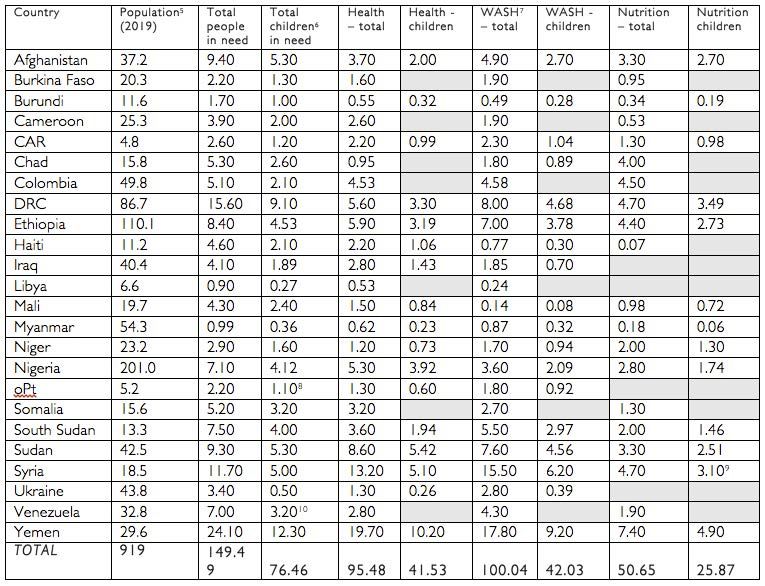
COVID-19 Aftershocks | World Vision International

Quantifying current health-related needs
                                                                   While not all of these countries’ populations (nor all
Our review of the most recent Humanitarian Response                the people identified in pre-COVID-19 response plans)
Plans and/or Humanitarian Needs Overview for each                  represent the most affected and at-risk due to the pan-
of the 24 priority countries highlights already staggering         demic, the existence of significant humanitarian crises and
levels of need that will make it challenging – if not impos-       their relatively weak health systems makes them highly
sible – to simultaneously respond to COVID-19 and other            vulnerable to both the primary and secondary impacts of
pressing health challenges.                                        COVID-19. Essential services and programmes are likely
                                                                   to be suspended or interrupted as efforts and resources
Identified humanitarian needs (in millions) (grey boxes            are redirected to COVID-19 responses.
indicate data not available)5678910

                                                                   The UN has identified children as a group of priority
                                                                   concern, highlighting their increased risk of experiencing
                                                                   violence; suffering mental health and psychosocial impacts;
                                                                   lack of access to health services; and malnutrition. Girls
                                                                   (and women) are often at further increased risk of not
                                                                   being able to access health services – including for gen-
                                                                   der-based violence – as a result of gender normsvi.

5 Source: United Nationas Population Division                      Our analysis demonstrates that the combination of
6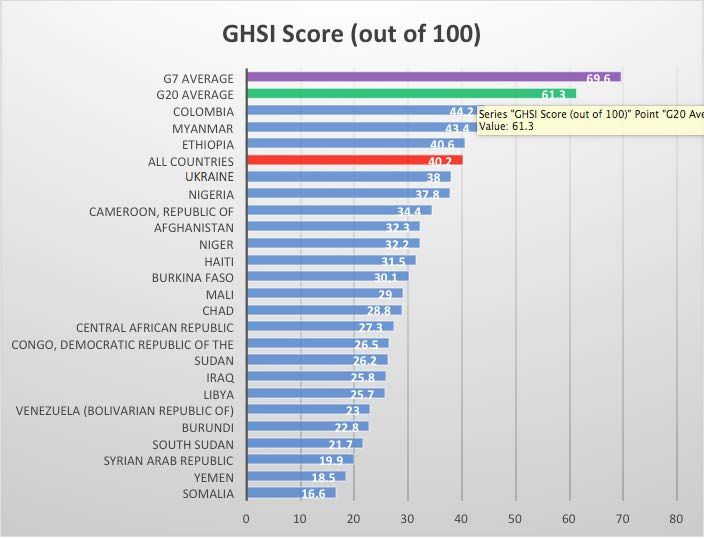
COVID-19 Aftershocks | World Vision International

Estimating secondary                                                  Increase in malaria deaths

health impacts of                                                     Malaria is the fourth highest killer of children under 5
                                                                      among all infectious diseases, surpassed only by pneu-

COVID-19
                                                                      monia, diarrhoea, and sepsisviii. Although global mortality
                                                                      rates for children under five have fallen 34% in the past 10
                                                                      years, the toll on children and their families is still signifi-
2014-16 Ebola outbreak in West Africa’s secondary impacts             cant.
on children
                                                                      During the Ebola outbreak of 2014-2016, the region saw a
Although key differences exist, the 2014-16 Ebola out-                50% reduction in access to healthcare services, which led
break in West Africa provides valuable insights into the              to increased deaths from malaria by an average of 50.5%
secondary health impacts children can experience during               across Guinea, Sierra Leone, and Liberia.
an infectious disease outbreak where weak health systems
are already stretched to their limit, people’s routines are           Part of this was due to fear – outpatient visits dropped
disrupted, and fear takes hold.                                       to as low as 10%, as people were afraid to visit health
                                                                      facilities in case they caught the virus themselves. Similar
The World Health Organisation (WHO) described the                     fears are being seen with COVID-19. Also, lockdowns are
outbreak as the “largest, most severe and most complex                initiated globally and people are encouraged to stay home.
Ebola epidemic” in history. More than 28,000 people were
infected, and over 11,000 people died before the interna-             For 23 of the 24 UN countries with Humanitarian
tional public health emergency ended in June 2016. Most               Response Plansix, a similar 50% increase in malaria deaths
of the cases occurred in three countries: Guinea, Sierra              would lead to more than 100,000 additional children
Leone, and Liberia. The virus spread rapidly within the               dying from malaria – an increase from 203,218 to 305,844.
region, revealing the failures of disjointed and under-re-
sourced healthcare systems.                                           Malnutrition

Though the full impact of COVID-19 on girls and boys                  In Sierra Leone, the Ebola outbreak reduced opportunities
is still being determined by the WHO and leading health               to screen for malnutrition, contributing to a 2% increase
authoritiesvii, initial analysis indicates that children do not       in severe acute malnutrition by the end of the outbreak.
appear to be at higher risk of infection or mortality than            Although community screening eventually returned to
adults. During the Ebola outbreak of 2014-16, children                normal, only one quarter of children were able to access
also represented a smaller proportion of the total cases,             treatment for malnutrition, leading to prolonged health
due in part to social and cultural practices as they were             impactsx. According to UNICEF, malnutrition causes nearly
less often involved in the gatherings or religious practices          half of all deaths in children under 5, either directly from
that contributed to the virus‘ spread. However, the sec-              acute forms or from increased vulnerability to infections
ondary impacts on girls and boys were profound.                       and other illnessesxi.

Applying Ebola’s secondary impacts to COVID-19                                  As a result of the current pandemic, children and
                                                                      their families are also experiencing reduced access to
While there is much we do not yet understand about                    nutritious food. Children previously fed through schools or
COVID-19, we do know that in a large scale outbreak                   other support programmes may no longer have
situation local health systems will be overwhelmed.                   access to these services, not least because of government
World Vision applied evidence of the secondary health                 restrictions on movement and social gatherings. Markets
impacts on children experienced during the 2014-16 Eb-                are closed, limiting opportunities to buy or sell produce
ola outbreak in West Africa (described above) to estimate             and other food items. Price hikes are becoming common,
the potential consequences of COVID-19 in 24 of the                   forcing families to make difficult decisions about when to
world’s poorest and most fragile countries.                           eat, and who to prioritisexii.

These issues are always context-specific, dependent on                Across 22 of the 24 UN countriesxiii, more than 13.1
a country’s health system capacity, infrastructure, demo-             million children are estimated to be experiencing
graphics, culture and other factors. Estimates present a              moderate or severe malnutrition. Children under five with
potential scenario of the secondary health impacts that               severe acute malnutrition are 9 times more likely to die
children could face as a result of COVID-19 outbreak in               from preventable diseases than well-nourished children. If
their contexts.                                                       each of these countries saw the same 2% jump in overall
                                                                      prevalence that was seen during the Ebola epidemic, the
                                                                  7
COVID-19 Aftershocks | World Vision International
total number of children experiencing moderate or severe Given this impact, it is critical that children experi-
malnutrition would reach more than 18.1 million11 – more encing acute respiratory infections or diarrhoea are treat-
than 5,000,000 additional children experiencing moderate ed quickly and comprehensively. Epidemics and pandemics,
to severe malnutrition. however, put this treatment at risk.
Malnutrition is an underlying cause of 45% of all preventa- Researchers identified a 58% drop in hospital
ble child deaths under five, but the risks do not end there. visits for under-five acute respiratory infections, and a 23%
For those children who don’t die because of malnutrition, decrease in visits to community health facilities in Guineaxvi.
their health and growth will still be stunted as will their For diarrhoeal infections, the drops were 60% and 25%
future educational and economic attainment. for hospital visits and community facility visits respectively.
These findings reinforce the earlier statement that parents
Decreased immunisations may have been reluctant to bring children to health facili-
ties out of fear of contracting Ebola, putting them at great
The Ebola outbreak also led to a 30% decrease in risk of untreated killer diseases.
childhood immunisation rates in Sierra Leone, Guinea, and
Liberia, as health resources were redirected, social gather- For the 24 UN countries, impacts could be
ings were limited and physical distancing reduced the significant. In 2018,14 across the countries, 206,543 children
ability to provide vaccines to childrenxiv. In the long-term, have died from diarrhoeal infections, while 373,618
this put children at heightened risk of otherwise prevent- children died from acute respiratory infections. If treat-
able infectious diseases, and put communities at risk of ment drops by 23-25% at a minimum, child deaths will
further outbreaks and strains on the health system. increase significantly. If the drops are as high as 58-60%,
these countries could face massive increases in child
In the UN’s 24 countries, coverage rates for three deaths due to acute respiratory infections. Either way, the
doses of the diphtheria-tetanus-pertussis (DTP3) vaccine impacts to families, communities and countries will be
meant that more than 88.6 million infants under one catastrophic.
year of age12 were protected from infectious disease. A
30% decrease in childhood immunisation screening rates
could put 26.6 million children13 at risk of being under- or
unvaccinated, exposing them to potential fatal infectious
diseases.
And that is just the tip of the iceberg – DTP3
vaccine coverage rates are commonly used as a proxy for
childhood immunisation rates, which means that if DTP3
coverage suffers, childhood vaccine coverage for other
dangerous infectious diseases, such as polio, could be simi-
larly compromised.
Impacts of reduced access to Reproductive,
Maternal, Newborn, and Child Health (RMNCH)
services
Pneumonia is currently the most dangerous infectious
disease for children, killing more than 800,000 children
under five globally every year. Progress in reducing these
deaths has also been slower than hoped, declining by
about 54% since 2000, with much progress left to be
madexv. Diarrhoeal infections are the second most danger-
ous infectious disease for children, causing 437,000 deaths
in children under five each year.
11 13,106,283 to 18,107,325 children
12 88,676,229
13 26,602,689 14 The last year with complete data.
8COVID-19 Aftershocks | World Vision International
Recommendations • Governments should make child pro-
tection and mental health and psycho-
social support core components of
World Visionxvii calls on Governments, the UN, civil society their COVID-19 response. They should
organisations and donors to: develop an MHPSS strategy for reaching
those directly and indirectly impacted,
• Urgently scale up global COVID-19 prevention especially those most vulnerable. This
and response measures for children and their support should address fear, stigma, neg-
families to strengthen health systems, maintain ative coping strategies, and other needs
essential health service delivery, equip frontline identified through assessments and build
health workers, engage and communicate effec- on positive, community-proposed coping
tively with communities including children, and strategies, promoting close collaboration
provide critical child protection interventions and between communities, inclusive of faith
mental health and psychosocial support (MHPSS). actors, and health, education, and social
In particular: welfare services.
• Governments should expand access • Donors should urgently commit emer-
to essential health services, especially gency funding for health system strength-
for those most vulnerable and at risk, ening, provide technical resources for
by rapidly mobilising community health support, and ensure equitable distribu-
workers, providing response training tion of supply chains. They should also
and ensuring appropriate supply chains finance risk communication/community
(e.g., for personal protective equipment) engagement and provide any necessary
for front-line workers, scaling digital online MHPSS training.
platforms for surveillance and case
monitoring, and providing free primary • Adopt policies and fund COVID-19 response
health care and COVID-19 diagnosis and plans that holistically address the secondary
treatment. impacts of the pandemic on children and families,
• Governments should work with rele- particularly with respect to child protection, gen-
vant in-country stakeholders at all levels der-based violence, education, water and sanita-
to develop, implement, and monitor an tion, food security, and livelihoods.
action plan for communicating effec-
tively with the public, and engaging with • Protect ongoing investments in humanitarian
communities, local partners, faith leaders, and development assistance for the most vulnera-
and other stakeholders to help prepare ble, adapt programmes to be COVID-19 sensitive
and protect individuals, families, and the in existing humanitarian response contexts, ensure
public’s health, in line with the WHO’s and where possible maximise humanitarian access
COVID-19 Preparedness and Response including creation of exceptions for humanitarian
guidance. workers’ and supply chain movements, and find
alternatives to humanitarian programme suspen-
sions where COVID-19 prevention policies are
required.
9COVID-19 Aftershocks | World Vision International
Appendix 1:
Priority countries for UN Global Humanitarian
Response Plan for COVID-19
Due to the characteristics and impact of the COVID-19 pandemic described previously, all countries with an ongoing
humanitarian response are prioritised in the Global Humanitarian Response Plan (HRP). This includes countries with an
HRP or a Regional Refugee Plan (RRP), the Refugee and Migrant Response Plan for Venezuela (RMRP), and countries
covered by the Regional Refugee and Resilience Plan (3RP) for the Syria crisis, and the Joint Response Plan for Rohingya
Humanitarian Crisis (JRP). Iran is also included due to the particularly severe impact of the pandemic and call for
international assistance.
10i https://www.thelancet.com/journals/lanres/article/PIIS2213-2600(20)30152-1/fulltext
ii https://www.cebm.net/covid-19/global-covid-19-case-fatality-rates/
iii https://www.cdc.gov/vhf/ebola/history/2014-2016-outbreak/cost-of-ebola.html
iv https://www.thelancet.com/journals/lancet/article/PIIS0140-6736(20)30553-5/fulltext
v Hospital bed numbers not available for the occupied Palestinian Territories
vi https://www.unocha.org/sites/unocha/files/Global-Humanitarian-Response-Plan-COVID-19.pdf p.16
vii https://www.cdc.gov/coronavirus/2019-ncov/faq.html?CDC_AA_refVal=https%3A%2F%2Fwww.cdc.gov%2Fcoronavi
rus%2F2019-ncov%2Fprepare%2Fchildren-faq.html#anchor_1584387482747
viii https://data.unicef.org/topic/child-health/pneumonia/
ix Data on the occupied Palestinian Territories not available
x https://www.ncbi.nlm.nih.gov/pmc/articles/PMC5515560/
xi https://data.unicef.org/topic/child-health/pneumonia/
xii For a summary of probable impacts of COVID-19 on food systems see https://www.gainhealth.org/sites/default/files/news/
documents/covid-19-crisis-and-food-systems-probable-impacts-and-potential-mitigation-and-adaptation-responses.pdf
xiii Data on the Central African Republic and Venezuela were not available
xiv UNDP. 2014. “Assessing the socio-economic impacts of Ebola Virus Disease in Guinea, Liberia and Sierra Leone: The Road to
Recovery.” http://www.africa.undp.org/content/dam/rba/docs/Reports/EVD%20Synthesis%20Report%2023Dec2014.pdf
xv https://data.unicef.org/topic/child-health/pneumonia/
xvi Rapid Assessment of Ebola-Related Implications for Reproductive, Maternal, Newborn and Child Health Service Delivery
and Utilization in Guinea. https://www.ncbi.nlm.nih.gov/pmc/articles/PMC4542265/
xvii This report has focused on the 24 countries with existing Humanitarian Response Plan (HRP) listed in the UN’s Global HRP.
In its own response plan https://www.wvi.org/publications/coronavirus-health-crisis/covid-19-emergency-response-plan
World Vision has prioritised the 17 countries where it believes it can have the biggest impact: Afghanistan, Bangladesh, Brazil,
Democratic Republic of Congo, Haiti, India, Indonesia, Iraq, Kenya, Lebanon, mainland China, Mongolia, Philippines, Senegal,
South Africa, Syria, and Thailand.World Vision is a Christian relief, development and advocacy organisation dedicated to working with children,
families and communities to overcome poverty and injustice. Inspired by our Christian values, we are dedicated
to working with the world’s most vulnerable people. We serve all people regardless of religion, race, ethnicity or
gender.
www.wvi.orgYou can also read


