Earlston High School Prospectus 2020-2021 - Respect, Responsibility, Honesty, Commitment, Excellence & Positivity
←
→
Page content transcription
If your browser does not render page correctly, please read the page content below
Earlston High School
Respect, Responsibility, Honesty, Commitment, Excellence
                          & Positivity

              Prospectus 2020-2021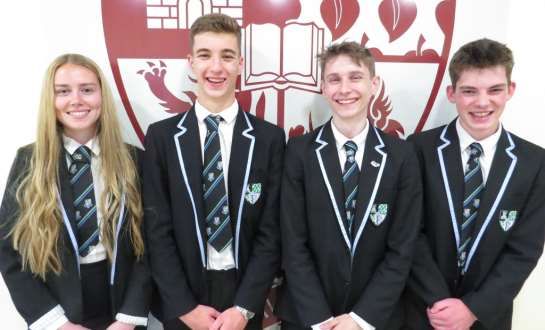
Address: East End, Earlston, TD4 6JP
                                          Telephone No: 01896 849282

                                       Email: earlstonhs@scotborders.gov.uk
                                       Website: www.earlstonhighschool.org.uk
                 Facebook @EarlstonHighSchool / Twitter @EarlstonHighSch / Instagram @EarlstonHigh

                                          Headteacher: Mr Justin Sinclair

                                              School Roll April 2020:
                                                  S1:       196
                                                  S2:       192
                                                  S3:       169
                                                  S4:       219
                                                  S5:       158
                                                  S6:       123
                                                  Total: 1057

Earlston High School is a non-denominational, co-educational, comprehensive secondary school. The school is linked
with 8 partner primary schools – Earlston, Gordon, Westruther, Channelkirk, Newton, St Boswells, Melrose and Lauder.

                                                         1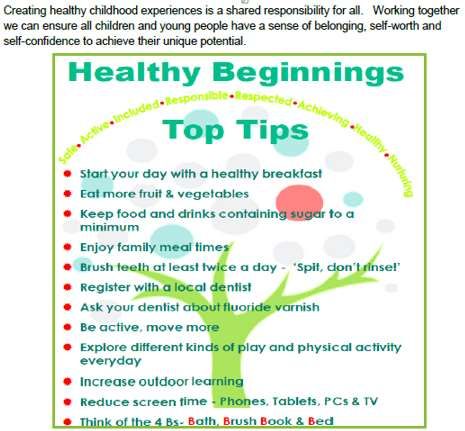
CONTENTS
                                                       Page                                                                               Page

Welcome                                                   1                      Our Senior Management Team                                 16
Aims and Values                                           2                      Our Pupil Support Staff                                    17 – 18
Moving from Primary to Secondary                          3                      Our Teaching Staff                                         19
Pupil Responsibilities                                    4                      Our Support Staff                                          20
Rights Respecting Charter                                 5                      Absence and Lateness                                        21
School Day, School Year                                   6                      Pupil Wellbeing                                            22 – 27
School Survival Kit                                       7                      Financial Support                                          28
Kit for PE and Craft & Design                             8                      Pupil Leadership                                            29 – 30
School Dress Code                                         9                      Parent Council                                             31
Broad General Education                                   10 – 11                Mobile Technology                                          32
The Senior Phase                                          12 – 13                Transferring Educational Data/GDPR                         33 – 34
Homework                                                  14                     Extra-Curricular Activities                                35 – 36
Dates for Parents’ Evenings and Reports                   15

School show photographs courtesy of Sheila Scott Photography.
Thank you to staff and pupils for allowing their photographs to be included.
Thank you to parents, pupils and partners for their contributions to the prospectus.

                                                                                       Whilst information provided in the prospectus is considered to be
                                                                                       correct at the time of printing, it is possible that there may be
                                                                                       some minor inaccuracy by the time the document reaches the
                                                                                       parent/carer.

                                                                             2
WELCOME FROM THE S6 HEAD TEAM

Welcome to Earlston High School! We hope you find the information in the prospectus helpful and that you have rewarding and
enjoyable time as EHS students and parents.

We all remember that starting a new school is often very daunting, but there really is no need to worry. Staff and pupils are very willing
to help you settle in and will help you with anything you may be worried about. When you first come to the school you will be introduced
to your Pastoral teacher (or Guidance teacher as we sometimes call them), who will get to know you well during your time here. They
will always be there to speak to and are the first point of contact for parents too.

All first year pupils are teamed with a member of sixth year, who will be their ‘buddy’. They will have a chance to meet their buddy in
Learner Journey classes and their role is to support them as they settle into EHS. However, all sixth years are willing to help new
pupils. You’ll recognise us from our blue braided jackets. Please do not hesitate to speak to us as we are all very friendly and happy
to help you with any queries.

We hope you have a very successful and enjoyable time
at Earlston High School.

Good luck.

     Finlay, William, Molly & Jamie
     Head Team for Session 2019-20

                                                                     Molly             Finlay            William            Jamie
                                                                      1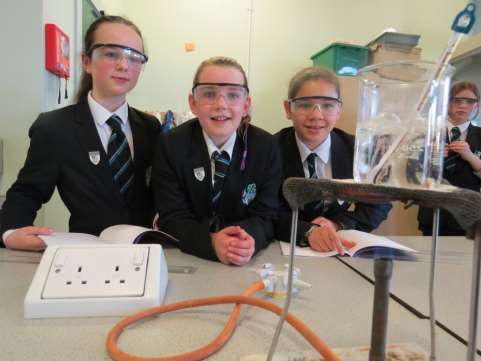
THE AIMS AND VALUES OF EARLSTON HIGH SCHOOL
Earlston High School aims to educate young people to the highest standards of excellence and to become full and active members of
the community.
We achieve this by:
Encouraging achievement.
Rewarding success.
Promoting high quality teaching and learning for all.
Providing a caring environment.
Promoting loyalty and pride in the school.
Developing responsibility.
Promoting respect.
Encouraging participation.
We are committed to a positive learning environment where achieving our potential
is central all we do.
Academic attainment is obviously important but we also pride ourselves on creating
opportunities for participation in a full range of extra curricular activities. High
standards of behaviour, including respect for self and others, are at the heart of our
work.
Our core values are:
Respect, Commitment, Responsibility, Honesty & Excellence
For 2019-20 Positivity (as chosen by S1 pupils)
We have yet to decide on the 6th value for session 2020 - 2021
2
MOVING FROM PRIMARY TO SECONDARY

CATCHMENT AREA
The school serves a largely rural catchment area taking pupils from the
following primary schools:

        Earlston         Lauder              Melrose          Channelkirk
        Newtown          St Boswells         Gordon           Westruther

A number of pupils also choose to attend our school from outwith the
catchment area. This is done by applying to Scottish Borders Council for a
placing request. Parents are invited to contact the school to arrange a visit prior
to submitting the placing request form.

We have an excellent relationship with our cluster primaries and together we aim to develop a strong partnership in three main groups:

1. YOUNG PEOPLE
The move from primary to secondary school is an important event for our pupils. We at Earlston High School wish to make this move
as untroubled and smooth as we can. The Primary 7 pupils spend 2 days visiting the school in June and following their S1 timetable.

2. PARENTS AND CARERS
Information evenings for parents/carers of Primary 7 pupils are held in September and June. These evenings provide a general
introduction to the school and a chance to meet your child’s Pastoral teacher. We fully encourage parents to become partners with
Earlston High School in the education of our young people. We also encourage parents to join our active and successful Parent
Council.

3. TEACHERS
The Headteacher and the Depute Headteachers meet regularly with our cluster primary colleagues to discuss projects involving
Primary and Secondary. Teachers exchange details of the courses taught and the materials used in order to smooth the ‘change over’
from primary to secondary. The Pupil Support team (Pastoral and Support for Learning teachers) visit the primaries and information
about individual strengths, weaknesses, attainments and skills is also transferred. We thus have a clear picture of pupils’ strengths,
any difficulties, aptitudes, special talents and so on. In this way we are more likely to help each young person to settle and to provide
continuity with the work done in primary school.

                                                                         3
PUPIL RESPONSIBILITIES
We ask our students to demonstrate our core values in their day to day life at school and in the community.

The main responsibilities carried by each pupil are:

1.   To try your best at classwork and homework.

2.   To ask for help whenever you need it.

3.   To have respect for yourself and others.
       i.e. pupils, teachers, office staff, librarian, cleaners, canteen staff, janitors, visitors etc.

4.   To come properly equipped for lessons.

5.   To let a teacher know of any other pupil who needs help.

6.   To support the school guidelines on dress.

7.   To support school sports, clubs, excursions, concerts etc.

8.   Realise your potential.

9.   Show pride in your school.

                                                                           4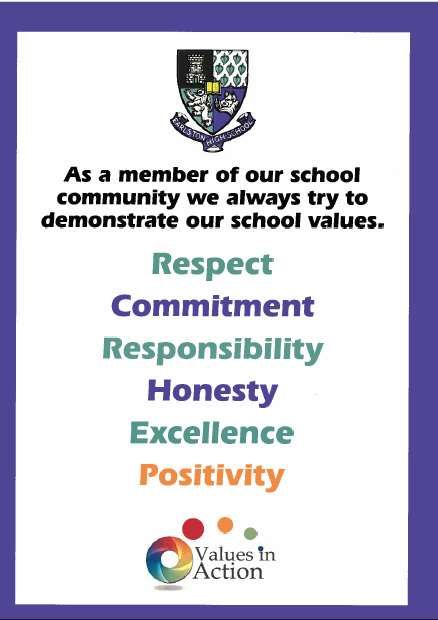
RIGHTS RESPECTING CHARTER
After a consultation involving staff, pupils and parents a Rights Respecting Charter was drawn up to outline the agreed rights and
responsibilities of pupils across the school. Alongside staff, prefects have been given the responsibility to help uphold and monitor
the use of the charter.

     COMMITMENT                                                                RESPONSIBILITY

     I have the right to belong to the school community AND                    I have the right to benefit from the opportunities given in the school
     the responsibility to come to school on time, wearing                     AND the responsibility to uphold the good reputation of the school.
     appropriate uniform and with the correct equipment.
                                                                               I have the right to raise issues that I may have with my homework
     I have the right to attend extra-curricular clubs that                    AND the responsibility to do my homework to the best of my ability
     interest me AND the responsibility to participate fully and               and to hand it in on time.
     attend regularly.

                                             EXCELLENCE

                                             I have the right to have my achievements recognised AND the responsibility to
                                             do my best at all times.

                                             I have the right to a good education AND the responsibility to make the most
                                             of this.
     RESPECT
                                                                                          HONESTY
     I have the right to a clean environment AND the responsibility
     to keep it clean.                                                                    I have the right to fully explain my actions AND the
                                                                                          responsibility to be honest at all times and to accept the
     I have the right to have my opinions heard and to be treated                         consequences of my actions.
     fairly AND the responsibility to listen to and respect the
     opinions of others.                                                                  I have the right to report actions that are disrespectful AND
                                                                                          the responsibility to do so.
     I have the right to use school property AND the responsibility to
     use it with respect.

                                                                           5
THE SCHOOL DAY
The school starts at 8.50 am and the day is divided as follows:

                     Mon to Thurs                     Friday
Period 1             08.50 – 09.40                    Period 1    08.50 – 09.40
Period 2             09.40 – 10.30                    Period 2    09.40 – 10.30
Break                10.30 – 10.45                    Break       10.30 – 10.50
Period 3             10.45 – 11.35                    Period 3    10:50 – 11.40
Period 4             11.35 – 12.25                    Period 4    11.40 – 12.30
Period 5             12.25 – 13.15                    Period 5    12.30 – 13.20
Lunch                13.15 – 14.05
Period 6             14.05 – 14.55
Period 7             14.55 – 15.45

THE SCHOOL YEAR
HOLIDAY ARRANGEMENTS                                                  IN-SERVICE

Start for students   Tuesday 18th August 2020                         Monday 17th August 2020
                                                                      Thursday 12th November 2020
October Holiday      School closes Friday 9th October 2020            Friday 13th November 2020
                     Opens Monday 19th October 2020                   Friday 12th February 2021
                                                                      Friday 30th April 2021
St Andrew’s Day      Monday 30th November 2020

Christmas Holiday    School closes Friday 18th December 2020
                     Opens Tuesday 5th January 2021                   CASUAL HOLIDAYS
                                                                      Wednesday 17th February 2021
Mid Term Holiday     School closes Thursday 14th February 2021        Monday 7th June 2021
                     Opens Thursday 18th February 2021
Easter Holiday       School closes Thursday April 1st 2021
                     Opens Monday 19th April 2021

May Holiday          Monday 3rd May 2021
Close                Wednesday 30th June 2021

                                                                  6
SCHOOL SURVIVAL KIT

What should you bring with you?

It is important to come to school each day fully prepared.

    1.      You should be following the school dress code (unsuitable clothing such as jeans, tracksuits, scarves will mean that you
            cannot take part in some practical lessons for safety reasons)

    2.      You should have a bag to carry all you need for the day

    3.      You should have your Inspire Learning iPad ready for every lesson and with a reasonable amount of charge

    4.      You should have all the books and jotters you need for the day, including a pocket dictionary for Modern Languages, if
            possible

    5.      You should have a supply of pens, pencils, ruler, rubber and sharpener. For some subjects you may need coloured
            pencils

    6.      You should have any special requirements for practical subjects such as Home Economics or P.E.

    7.      All pupils will be issued with a locker, supplied with a padlock and key. Pupils will be required to pay for replacement
            padlocks and keys.

                                                                      7
KIT FOR P.E.
The emphasis at Earlston High School is on participation and so there is no specific kit required for PE. However, pupils should have
clothing which is appropriate to the activity and no clothing which promotes cigarettes, alcohol or gambling can be worn. We also ask
that pupils wear a top with a high neckline and either short/long sleeves. The list below is the required kit for pupils when they represent
the school at rugby or hockey.
Hockey Rugby
Emerald green hockey top Black Adidas shorts
Navy blue skirt/shorts Adidas royal blue/black rugby
Navy/emerald green knee length socks shirt
Astro Trainers, trainers or studded boots Black rugby socks
Training shoes or rugby boots
Hockey kit can be ordered from the PE
department – these orders are sent away Rugby kit can be ordered from
each year. In May each year, order forms are the PE Department. Please
sent to our cluster primaries. contact Mr Alston for more information.
Please contact Miss Pate for more information.
KIT FOR CRAFT DESIGN AND TECHNOLOGY
Safety is paramount in the CD&T department and pupils will be provided with safety glasses for practical work in the workshop. Loose
clothing, hoodies, scarves and tracksuits will not be permitted for health and safety reasons. It is also advisable to wear school shoes
which cover the foot for some additional protection.
8SCHOOL DRESS CODE
Scottish Borders Council and Earlston High School believe there are many advantages in having a clear dress code. We are very
encouraged by the smart appearance of our pupils and feel that a dress code encourages a sense of belonging. As you will see from
the photographs, the pupils look very smart and are proud to show they attend Earlston High School. The dress code for 2020 is
detailed below. It was proposed and voted for by the pupils in 2009 and jackets added in 2016.
S1- S5 Pupils
Plain white shirt or blouse (with collar)
School tie (worn at the collar)
Black jacket with EHS badge
Plain black v-neck jumper or
Plain black cardigan
Black trousers or skirt
Black shoes (not trainers)
S6 Pupils
Plain white shirt or blouse (with collar)
Senior school tie (worn at the collar)
S6 jacket with blue braiding and EHS badge
Black trousers or skirt
Black shoes (not trainers)
Any parent who has difficulty in supporting the school guidelines on
dress should write to the school. If a pupil has difficulty meeting the
guidelines on any day he/she must hand in a note or explain the
difficulty.
Black jumpers, cardigans, tank tops and school ties are on sale from the school office. Jackets are available to order direct from
Border Embroideries through their website.
9BROAD GENERAL EDUCATION (S1 - S3)
In these years we develop and build on the work done in the later stages of primary and as students
progress we prepare them for the senior phase (S4 to S6) and National qualifications. The emphasis is
very much on pupils as individuals – each moving at a suitable pace to master content and skills. We
focus on skills for Senior phase and our Golden Skills :
Communication, Problem Solving, Organisation, Independent Working, Critical Thinking.
Our aim is to provide a supportive learning environment which encourages pupils to do their best and
make progress.
Pupils are divided into teaching classes, which have a mix of children from a variety of primary schools.
These pupils will also be together for non-practical subjects, such as Modern Languages, Geography,
History, R.M.E. and Modern Studies.
For practical subjects, such as Home Economics, Science, Craft Design &Technology, Music, Drama and
Art & Design, the class will divide into practical sets, which have a maximum of twenty pupils.
Throughout S1, S2 and S3 all pupils follow a broad general education as shown below, although the allocation of periods may vary
in each year.
Art & Design Leadership
Craft, Design & Technology Learner Journey
Drama Mathematics
English Modern Languages
Geography Modern Studies
History Music
Home Economics Physical Education
Health and Well Being Religious & Moral Education
ICT Science
10CHOICES AND SPECIALISMS AT THE END OF S2
S3 is the final year of the Broad General Education. It should continue to lay solid foundations
before moving on to the Senior Phase and national qualifications.
At Earlston High School we recognise that choice is motivating for young people. At the end of
S2 students will select specialisms to study in S3. Specialisms are our way of keeping a broad
curriculum whilst allowing young people the opportunity to explore discrete subjects in more depth.
As well as 10 specialisms, pupils will study English, Maths, Core PE, Core RME, Health &
Wellbeing and Learner Journey.
RELIGIOUS AND MORAL EDUCATION
Religious and Moral Education (RME) is required by law to be part of the school’s curriculum and national guidelines are set regarding
its content and time allocation. Two periods a week are allocated to RME in first year. One period a week is allocated for years 2, 3,
4 and 5. Courses cover the study of the main Religions of the World. If a family has a religion which does not allow children to have
Religious Education, the parent should write to ask for his/her child to be excused from these classes.
WORK EXPERIENCE
It is hoped that every pupil in S3 will have the opportunity of Work Experience lasting one week. Pupils are able
to experience a continuous spell in a working atmosphere and can gain first-hand knowledge of what any
particular job entails. Work Experience can therefore assist in personal development, as well as being an aid
in the choice of a suitable career.
Extended placements are available for senior students to allow them to use their timetabled study time for work
experience. All placements must be Health and Safety checked by Scottish Borders Council. Mr D Ferguson
co-coordinates the work experience programme.
INSTRUMENTAL INSTRUCTION
We offer instruction in a variety of musical instruments: strings, woodwind, guitar, percussion and brass. Lessons take place weekly as
part of the school day. Pupils attending instrumental lessons will miss their normal class. However, timetables are planned to make
sure pupils don't always miss the same lesson every week. There may also be the opportunity to join bands and other instrumental
groups within our school. For the first year of instruction the charge is £85 and subsequent years cost £140. This can be paid annually
in full or 6 monthly instalments. Pupils do not need to pay if they get free schools meals or school clothing / footwear allowance or if
they are in S4 to S6 studying SQA Music, including free standing units.
11THE SENIOR PHASE (S4 – S6)
S4-S6 students will choose subjects from a Senior Phase Choice sheet. Students in S4 will
study 6 subjects: English, Maths and four others. The choice process starts in February and
students are supported by the Guidance teachers when choosing their courses.
STUDENTS CONSIDER
Their own interests – what they enjoy or do best.
Their future intentions – what is necessary for their career aspirations.
Their abilities – what is realistic in terms of subject recommendations.
Their educational needs – what is considered broad/balanced education?
S4-S6 students can choose a blend of courses offered by school and Borders College. Every year the Borders College Academies
Programme offers courses such as Motor Vehicle Maintenance, Early Child Care and Education, Software Development, Psychology,
Journalism etc. Foundation Apprenticeships in Business, Civil Engineering, Food and Drink Technologies and Children and Young
People are also on offer. The link between school and college is an excellent experience for many students, allowing them to build
confidence and prepare for life beyond school.
NOTES ON CHOICES
A college course counts as one subject/choice.
Courses may not run if numbers selecting them are small.
The number of places on some courses is limited.
It is not possible to offer all combinations of options.
The school website gives information on each course.
12THE SENIOR PHASE (S5 and S6)
Almost all students returning to S5/S6 are choosing to return to school to continue their education. This may result in more mature and
relaxed relationships with staff, greater responsibility for their curriculum and more negotiations over the use of their time. The experience
of the senior school can be a very rewarding one and we hope students will look back on this time as worthwhile and successful in terms
of academic achievement and in personal development as young adults.
S5/6 CURRICULUM
Students are able to choose from a menu of courses at Levels 1 – 4 and Levels 5 (National 5), 6 (Higher) and 7(Advanced Higher).
S5
Students will study a five subjects.
Of the five subjects some will study all Level 4/5 courses, some will study all Level 6 courses and some will
study a mixture of levels.
Students will have one period of core PE, RME and Learner Journey each week.
S6
In S6 students will study either three Level 7 courses (Advanced Highers) or four courses at Levels (1 – 6).
Some S6 are able to fit in work experience into their timetable.
S6 students are expected to offer school/community service as part of their timetable.
Students are expected to use their study time wisely.
SENIOR SCHOOL COMMITMENT
All senior pupils must follow the school dress code and show commitment to their studies.
We actively encourage parents of students in senior school to remain involved in all aspects of their
child’s education.
UNIVERSITY/COLLEGE APPLICATIONS / REFERENCES
Advice and assistance for applications to university, college or employment is provided by the pastoral
staff. References are compiled using comments from subject teachers.
LEAVERS’ EVENING
In June we hold our Leavers’ Evening ceremony. Students leaving school are presented with their
Record of Achievement and each receives a Souvenir Programme listing the destinations of all those
leaving school. The evening is a lovely celebration of their time at Earlston High School.
13HOMEWORK - Why have homework?
When done well and consistently – homework is proved to boost grades and give extra learning power!
Homework might be:
Reading a book, article or newspaper Researching a particular topic
Preparing a talk for a class or group Practising skills learnt at school, e.g.
Further questions which reinforce learning in class musical or sporting skills.
Working towards a major project Learning by rote key information
Revision for an assessment Completing work started in class
Watching a particular TV programme Creative writing
Visiting a relevant website Anything else!
Homework helps pupils:
to consolidate and extend the work done in class
to develop wider information and research skills
to develop good study and organisation skills
to work with their parents to support your learning
to revise and prepare for tests and exams
Pupils are expected to: Parents might help by:
use Satchel: One to plan homework looking at Satchel: One on a regular basis
complete and hand in homework on time providing a suitable place for their child to study
supplement work in school with research and self-study at encouraging their child to find interest in school work and to
home try hard
Teachers will:
Use the Satchel: One app to issue homework instructions
give adequate notice of homework and make sure pupils always know when the homework is due
on the rare occasion that homework is due the next day, it should not take more than 15 minutes to complete
avoid issuing routine homework tasks within 2 weeks of exams
give feedback on homework
14TIMETABLE OF PARENTS’ EVENINGS AND REPORTS
S1
October settling-in report issued
February parents’ evening
May report issued
S2
November report issued
January parents’ evening
S3
November parents’ evening
January report issued
S4
October report issued
December parents’ evening
February report issued
S5 and S6
October reports issued
December parents’ evening
February report issued
For specific dates, please refer to the updated school calendar on the website at: www.earlstonhighschool.org.uk
15OUR SENIOR LEADERSHIP TEAM
Mr J Sinclair
Headteacher
Mrs J McDonald Miss B Clark
Depute Headteacher Depute Headteacher
Year Head S5 & S6 Year Head S1 & S2
Mrs J Weston Mr D Hayes Mrs M Colvine
Depute Headteacher Depute Headteacher Business Manager
Year Head S3 Year Head S4
16OUR PUPIL SUPPORT STAFF
PRINCIPAL TEACHERS (PASTORAL/GUIDANCE)
Miss M Allison Mr A Christensen Miss C Fleming Mr A McKenzie Mr S Watson Mr D Ferguson
Principal Teacher Principal Teacher Principal Teacher Principal Teacher Principal Teacher PT DYW
Turfford House Teviot House Tweed House Leader House Eden House (Developing Young Workforce)
Pastoral care is very high priority and each pupil is supported by a Principal Teacher (PT) Pastoral for their House. Pupils often refer to these as
their Guidance teachers. A pupil will normally remain in the same House and in the care of the same teacher throughout their school career. The
PT Pastoral for your child’s House is your first point of contact if there are any problems or questions. Pupils can contact their teacher directly or
via the school office.
Mr McKenzie: Leader House Mr Christensen: Teviot House Miss Fleming: Tweed House
Miss Allison: Turfford House Mr Watson: Eden House
CAREERS SUPPORT
Pastoral Principal Teachers support pupils with their choice of course and career decisions. The school is fortunate to have excellent links with
Skills Development Scotland and the support of a career adviser. Once a week, at key stages in the year, there are lunchtime ‘drop-in’ sessions
for any pupil wanting careers information. At other times, pupils can make a careers appointment by speaking to Mr Ferguson. The Careers
Adviser attends Parents’ Evenings for S2, S4, S5 and S6 and is available for consultation. Mr Ferguson, Principal Teacher Developing Young
Workforce, liaises with the school’s partners to provide opportunities for pupils to develop their work-related and career planning skills.
17PUPIL SUPPORT
Mrs S Lawrence Mrs L Fairbairn Mrs H Monks Mrs A Tiemessen
Principal Teacher Teacher Teacher Teacher
Pupils of all abilities may experience difficulties with their learning at one time or another in their school career so support is available to all who
need it. The support can be given in a number of ways. For example, a member of the support team may go into a subject class to work
cooperatively with the class teacher to support pupils in their day to day work. Another instance might be to offer small group tuition to some pupils.
Pupil Support Assistants work closely with students on a one-to-one basis and may also support individuals within mainstream classrooms. The
policy of the department is to maintain the learning of all students, as far as possible, within mainstream classes. We do, however, run a support
base where pupils can go for a short period of time to get particular help.
The school aims to provide appropriate education for all its pupils. Pupils with additional needs attend usual classes as far as possible.
Occasionally, a modified or reduced curriculum is arranged. Support staff liaise with the primary school staff in order to provide a smooth transition
to Earlston High School for pupils whose additional needs have already been identified.
For further information please refer to Scottish Borders Council’s website:
https://www.scotborders.gov.uk/info/20041/support_for_pupils/456/additional_support
ACCOMMODATION: The Pupil Support faculty is situated in the front wing of the school. As well as a number of small teaching rooms, it has
shower rooms, a laundry, a kitchen, interview and meeting rooms. The medical room is also in this wing.
In all our work to support pupils, we hope to work together with you, the parents, and we encourage you to contact us regularly to help us set targets,
review progress or to voice your concerns and share your ideas. We enjoy positive links with external support agencies, the school health service
and our school police liaison officer. Our aim is to work in partnership to support the needs of our pupils.
18OUR TEACHING STAFF
EXPRESSIVE ARTS
MUSIC AND DRAMA ART & DESIGN HEALTH & WELLBEING
Mr J Thomson (PT) Ms L Lees (PT) (Mat) HOME ECONOMICS PHYSICAL EDUCATION
Mrs A Brown Mr J Adam Mrs L Ballantyne Miss E Pate (PT)
Miss A Dickson Ms K Macbeth Miss T Reilly Mr N Alston
Ms E Flanagan Mr A Kidd
Mr M Haywood Miss L Miller
Mr R Paterson
SCIENCE & ENVIRONMENT
CHEMISTRY BIOLOGY MODERN LANGUAGES & CITIZENSHIP
Mr N Westgarth (PT) Mrs D Cadden MODERN LANGUAGES
Mr A Foggin Ms I Rutherford Ms H Feeney (PT)
Miss J Walker Mr J Towill Mrs K Falconer
Miss K Williamson Mr J-F Marchand
PHYSICS Mr C Paus
Dr J Morton
Mr R Simson NUMERACY & ICT ENGLISH & LITERACY
Mr G Meikle (PT) Miss L McDougal (PT)
Ms J Arrol Mrs L Dorricott (Mat)
HUMANITIES Mr K Bender Mrs H Dalyrymple
HISTORY GEOGRAPHY Mrs K Higgin Mrs S Haywood
Miss H Thores (PT) Mrs G McGinlay Miss K Hogg Mr S Kinahan
Mrs J Maciver Mrs K Renwick Mr J Pritchard Mr C Mitchell
Mrs S Cunningham Miss L Wilkie Mrs C Smart Mrs N Robertson (Mat)
Mr D Hayes (DHT) Mrs F Sutherland
Mrs J Weston (DHT)
MODERN STUDIES RELIGIOUS EDUCATION
Miss J Cook Mr A Simpson
Miss L Johnston Ms J Thomson PUPIL SUPPORT PUPIL SUPPORT- Pastoral
Mrs S Lawrence (PT) Miss M Allison (PT) Turfford
TECHNOLOGIES & ENTERPRISE Mrs L Fairbairn Mr A Christensen (PT) Teviot
CRAFT, DESIGN & TECHNOLOGY BUSINESS STUDIES Mrs H Monks Miss C Fleming (PT) Tweed
Mr N Woodcock (PT) Mrs S Thomson Mrs A Tiemessen Mr A McKenzie (PT) Leader
Mr C Anderson Mrs Z Wright Mr S Watson (PT) Eden
Mr J Callaghan
Mr K Dodds Mr D Ferguson (PT DSYW)
Mr G Scott
19OUR SUPPORT STAFF
OFFICE CANTEEN
Mrs L Bouache (Catering Supervisor)
Full-Time
Mrs M Colvine (Business Support Manager)
LIBRARIAN
Mrs K Brydon (Administrative Assistant)
Miss N Laing (Administrative Assistant) Miss J Slack
Mrs K Whyte (School Assistant – School Office)
PUPIL SUPPORT ASSISTANTS
Part-Time (Term Time Only)
Mrs P Clark
Mrs A Eaton Turner (School Assistant – School Office)
Mrs S Craig
Mrs J McLoughlin (School Assistant(Temp) – School Office)
Mr A Dunlop
Miss S Jackson (School Assistant – Home Economics)
Miss L Grant
Mrs M Hogg
TECHNICIANS Mrs N Jarvie
Mrs E Johnston
Mr G Chisholm (IT) – (Term Time)
Miss D Kwasek
Mr B Hislop (Science)
Mrs R Lumsden
Mr G Wilson (Technical/Whole School) – (Term-Time)
Ms A McPherson
Ms T Dickson
JANITORS
Mrs L Sinclair
Mr R Lynch (Head Janitor) Ms A Sztando-Sroda
Mr A Cockburn (Janitor)
Mr G Foster (Janitor)
PT = Principal Teacher, Mat = Maternity Leave
In addition to those listed here, we have a team of canteen staff, who look after the nourishment of a large proportion of our pupils. We
also have the services of a number of cleaners who do their work after the pupils go home each day. They have the important task of
ensuring that pupils arrive to a school which is clean the following day.
20ABSENCE AND LATENESS
The school’s aim is to promote good habits and routines which show a sense of commitment, reliability and responsibility. Good
attendance is vital if a young person is to achieve their potential in school and beyond. If parents and teachers work together
on this, good habits will be developed by all pupils.
GROUPCALL : Our Groupcall system will automatically send a text message to a parent or carer’s mobile if no explanation has been received
for a pupil’s absence by 9am on any given day. This message will ask for the absence to be explained. Please make sure that the school
always has an up-to-date mobile telephone number.
ABSENCES : Absences must be explained by a phone call (answerphone message facility available), email or Xpressions message from a
parent or carer. Pupils who need to sign out of school early can only do so if prior notification has been from a parent to the school office and
they must go to the school office to sign out (and in again should they return).
LEAVE OF ABSENCE : If a parent wishes to ask for leave of absence for a pupil this must be done in advance and in writing, by email or
Xpressions message. The Scottish Government is trying to discourage parents from taking pupils on holiday during term time. Schools can
no longer authorise absence for this reason and so it is recorded as ‘unauthorised’. Parents are asked to help minimise any interruptions to
teaching.
SIXTH YEAR STUDENTS: Sixth years have the privilege of explaining their own absence or lateness. This must be in writing and passed to
the office. If they wish leave of absence, they must apply to a member of the Senior Leadership Team prior to the event.
LEAVING SCHOOL GROUNDS: No pupil may leave school grounds during class hours or at the morning interval without permission. First
year pupils should remain in the school grounds at lunchtime in the first term. They will have the privilege of going into Earlston at lunchtime
after the October holidays.
LATENESS: Pupils who arrive late for school must report to the school office. The school office requires advance notification (phone
call/email/Xpressions message) of the late arrival. If no explanation is received, the pupil is requested to explain the reason for their late arrival
to Senior Management at breaktime.
21PUPIL WELLBEING
RESPECTFUL RELATIONSHIPS – ANTI BULLYING
As a school, we promote respectful relationships and encourage the use of restorative practice to ensure
every young person feels safe and secure within our school environment. When a young person's time at
school is being made difficult by others, it is very serious and when brought to the attention of a member of
staff is given the highest priority. Usually, in the first instance, Pastoral teachers will see the pupils involved
and do their best to help resolve the problems. If the offence is repeated, the problem is referred to Senior
Leadership and parents are informed. We encourage everyone to report instances of bullying behaviour.
The school's Anti-bullying policy was produced in consultation with pupils via the Pupil Parliament. Scotland's Anti-Bullying service - Respect
Me - gives general advice as well as information on cyberbullying on their website: www.respectme.org.uk The SBC Respectful Relationships
Policy can be downloaded from the website: www.scotborders.gov.uk/antibullying
YOUNG CARERS
A Young Carer is someone who is under 18 years of age or who has reached 18 and still a pupil at school and provides care for another
individual. A number of young carers do not always identify themselves or wish to be identified.
Young carers undertake a number of tasks for the people they live with and look after. This caring role means they might not have as much
time to complete work at home which has an ongoing effect on progress and learning or attend clubs and after school activities, therefore
missing out on the social aspects of school.
Within Earlston High School we want our young carers to enjoy school, make progress and feel they are included. Please let us know if there
are difficulties meeting deadlines with work, arriving on time or any other issues which affect a young person who has a caring role at home.
QUARRIERS WELLBEING SERVICE
Quarriers Resilience for Wellbeing Service is an early intervention and prevention service that
works with young people to improve their emotional wellbeing. At EHS, our Quarriers Resilience
Practitioner works with students Monday to Thursday in school. The practitioner encourages and
supports students to develop the coping strategies that give them the confidence and resilience
needed to achieve their goals. The aim is for the young person to be able to manage life's ups and downs more effectively when feeling
anxious, stressed, worried, overwhelmed, or low and prevent their getting drawn into damaging risk-taking behaviours. Interventions are
time limited, enabling the young people to put their learned coping strategies into practice, promoting resilience and not building reliance.
Access to the service: Quarriers accepts referrals from school Pastoral Staff as well as operating a self-referral and a supported self-
referral system via attending the drop in sessions held in school.
22KEEPING OUR CHILDREN AND YOUNG PEOPLE SAFE
CHILD PROTECTION
• At EHS we work hard to keep our students safe - all children and young people have a right to feel
safe within the setting, home and community.
• We strive to provide a safe, secure and nurturing environment for our children and young people,
which promote inclusion and achievement.
• All staff in Education have a statutory and professional responsibility to take action if we have reason to believe a child is suffering,
or is at risk of abuse.
• Our Scottish Borders Child Protection procedures set out what we will do if we have reason to believe a child is being abused or is
at risk of abuse, either within the home or the community. These procedures are designed to ensure that children and young people
get the help they need when they need it.
• All staff are aware of their child protection responsibilities and every year all staff at EHS attend a child protection update.
• Many of our staff undertake additional multi-agency child protection training.
• Every setting has a Child Protection co-ordinator who has the responsibility for overseeing child protection concerns as well as
those young people who are care experienced within the setting.
• The Child Protection Co-ordinator for EHS is Mrs Jill McDonald (DHT)
Protecting Children & Young What to do if you have a child protection concern?
People is Everybody’s If you have any concerns that a child is being harmed or is at risk of harm, please call without
delay. You can call:
Responsibility 01896 662787 (Duty Children and Families Social Work Team)
01896 752111 (Out of office hours that covers all areas)
Emergency contact
If you consider a child or young person is in immediate danger, call the Police on 999
immediately
Need more information about keeping our children and young people safe?
The Scottish Borders Child Protection Committee online website offers some suggested links to websites to better inform
you about safety issues such as Internet safety and Child Sexual Exploitation as well as letting you know about
opportunities for training in Child Protection. You can also find the Scottish Borders Child Protection Procedures on this
website: http://onlineborders.org.uk/community/cpc
23GETTING IT RIGHT FOR EVERY CHILD (GIRFEC)
Getting It Right For Every Child (GIRFEC) is the national approach in Scotland to improving outcomes
and supporting the wellbeing of our children and young people by offering the right help at the right time
from the right people.
The GIRFEC approach aims to make it easier for parents, children, young people and the services that support them – such as early
years services, schools and the NHS – to work together to get it right. Practitioners work together to support you and your child, working
across organisational boundaries and putting your child and you at the heart of decision making, ensuring we give all our children and
young people the best possible start in life.
GIRFEC means that everyone working with Scottish Borders children, young people and their families are encouraged to:
Ensure children, young people, and their families get the help they need when they need it and are central to the process of finding
solutions.
Use one consistent and equitable approach, actively share information to agreed protocols and work more effectively together to
improve outcomes for children and young people.
Be clear about personal responsibility to do the right thing for each child/young person.
Work with children, young people and their families, using a collaborative approach with fewer meetings. This should ensure
children, young people and their families give information only once, and enables the development of one plan to meet all their
needs.
Respond to children and young people and take appropriate, proportionate and timely action with the minimum of paperwork,
bureaucracy and duplication.
GIRFEC is part of the Children and Young People (Scotland) Act 2014 and the GIRFEC provisions are planned to be fully implemented by
August 2017. If you would like any further information please ask your child’s Headteacher.
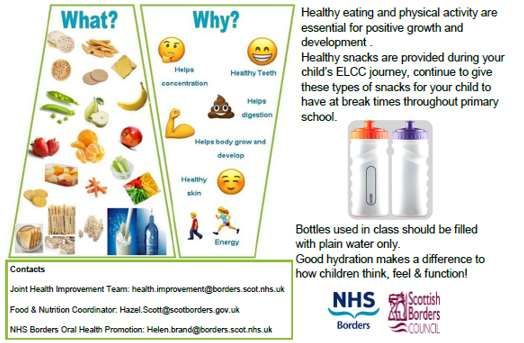
24HEALTHY CHOICES
25MEDICAL CARE
We do not have a full time nurse, but we do have qualified first aiders. Pupils who are feeling unwell during the day must report to the school
office. In cases where the pupil feels unable to continue with lessons, the office staff will contact a parent with a view to having the pupil taken
home. No pupil is allowed to go home without first reporting to the school office. The school is unable to administer treatments or medicine
(including aspirin and paracetamol) without a written request by a parent. Parents must let the office staff know if their child is taking medication
at school. School follows the guidelines for the administration of medication set up by the Health & Safety Section of Scottish Borders Council
in conjunction with the Education department.
The school doctor and nurse provide an advisory service to pupils. The school nurse, Mary Carryer, runs a weekly drop-in session during
lunchtime. It is important to point out that this is just like going to a Health Centre. The usual levels of medical confidentiality apply and teachers
are not informed about these consultations. Pupils will not be given prescriptions, but might receive information on contraceptives etc and
could receive condoms. These arrangements were approved by the Parent Council.
EDUCATIONAL PSYCHOLOGY SERVICE
The Educational Psychology Service (EPS) works with all SBC schools to support children’s learning and wellbeing. They provide advice and
training to school staff on how children learn, and advise on ways to help children who require support.
If requested by the school, we can arrange follow-up for individual children and young people, together with their families and teachers, to
help support their learning, or with social or emotional issues. This is generally achieved by meeting the children, their families and school
staff, to review the support they have already received and agree ways in which we can all help your child in school. In some cases, we may
agree that a psychologist will work on a one-to-one basis with a child to obtain a clearer picture of how they can best be supported.
If you have any worries about your child, please contact the school, in the first instance, to arrange a meeting to discuss your concerns. All
schools have access to a range of support Services and your child’s Pastoral Teacher will be able to advise you about when the EPS may be
able to help.
Further information about the EPS is available on the Scottish Borders Council website. Here you can access a downloadable leaflet for
parents and carers, which explains in more detail how the EPS may be able to work with you to support your child in school.
Please see www.scotborders.gov.uk/EPS
26COUNCIL’S IMPLEMENTATION OF BRITISH SIGN LANGUAGE PLAN
The Council’s BSL Plan 2018-24 has seven holistic actions. These actions are consistent with the ten long term goals of the National BSL
Plan in Scotland, which are, early years and education; training and work; health, mental health and wellbeing; transport; culture and the
arts; justice and democracy.
These goals represent the Scottish Government’s aim “to make Scotland the best place in the world for BSL users to live, work and visit.”
The Council will implement measures to promote awareness of BSL and the use of BSL, with the long term goal being that across
Scotland information and services will be accessible to all BSL users*.
Contact Scotland –BSL is an online British Sign Language interpreting service that allows deaf people across Scotland to access services
free and available 24 hours a day throughout the year: https://contactscotland-bsl.org/
If a BSL user requests a face to face meeting then the School is required to provide a face to face interpreter.
*Whenever we refer to ‘BSL users’ we mean D/deaf and /or Deafblind people (those who receive the language in a tactile form due to
sight loss) whose first of preferred language is British Sign Language
EMPLOYMENT OF CHILDREN
Children under the statutory school leaving age can only be employed within the terms of the bye-laws on the Employment of children.
These regulations allow anyone to be employed at 14 years but under certain circumstances children under 13 years of age can be
employed, and for those over the age of 13 there are limits on the hours and type of employment which are allowed. Parents and
employers must both complete an application form for an employment permit before the employment begins. Forms and application forms
are available from the school office. Further details can be obtained from HQ Operations, Children & Young People Services, Scottish
Borders Council, Newtown St Boswells, TD6 0SA
Further information can be found at:
https://www.scotborders.gov.uk/info/20025/licensing/670/employment_byelaws_for_children_and_young_people/1
27FINANCIAL SUPPORT
SCHOOL CLOTHING ALLOWANCE
Some families may qualify for financial assistance for school clothing. Application forms are available from Scottish Borders Council
Headquarters in Newtown St Boswells and from their website: www.scotborders.gov.uk
FREE SCHOOL MEALS
To qualify for this assistance the requirements and application forms are the same as for the School
Clothing Allowance. Parents who qualify are encouraged to apply. Pupils who receive free school
meals will have their National Entitlement Card credited to use this in the refectory as part of the
cashless payment scheme for all pupils.
EDUCATIONAL MAINTENANCE ALLOWANCE (EMA)
An EMA has been available to eligible young people remaining in full time education beyond the statutory leaving age of 16. It is a weekly
payment made directly to the young person from a family whose annual household income is £22,403 or less. Payments will only be made if
the pupil has satisfied attendance requirements. Pupils must complete a learning agreement. Information and application forms are available
from the school office.
SCHOOL TRANSPORT
Pupils in our catchment area are eligible for free travel provided their home is more than three miles from the school. They may travel on
special buses or they may be given a pass to use on public transport. Parents moving into the area may contact School Transport Office at
SBC Headquarters if transport arrangements have to be made for their children. New S1 pupils receive their bus passes by post during the
summer holiday. Where provided, seat belts should be worn on school transport.
Pupils can ONLY travel on the service number they are allocated to, due to capacity and insurance implications.
They should carry their bus pass at all times. If it is lost or damaged, a new one should be purchased via Parentpay and a temporary pass
applied for at the office during break or lunchtime to cover their journeys until their new pass arrives.
28PUPIL LEADERSHIP
At Earlston High School, Leadership is not just about the few leading the many, it is about leadership for all. By
developing leadership we create opportunities that allow our young people to take charge in their lives and
helping shape school life and their education to the benefit of all.
Currently we have 500 formal leadership roles for our young people who complement the excellent work of the
S6 Leadership Team. Every pupil at Earlston High School has the opportunity to develop their leadership skills
through departments, extra-curricular clubs and lessons.
Pupil Parliament
Young people can be a catalyst for change at Earlston High School by bringing issues and ideas to the Pupil
Parliament through their Pupil Voice representatives of which there are ten in every year. We look at ‘How Good
is our School’ documents to find areas we can work on together to make positive change.
School Ambassadors
In addition to the Student Council each year group has 10-12 School Ambassadors who help shape and run day
to day activities and larger events in the school. These roles carry a lot of responsibility and the pupils selected
went through a formal application process.
S1 Leadership Course
All S1 pupils take part in the S1 Leadership course that teaches them basic leadership skills, styles how core values shape us as leaders.
Literacy Ambassadors
These Ambassadors work hard throughout the year to assist pupils from Earlston High School and the local primary in literacy work across
the school and monitor the Literacy Café at break and lunch.
Roles and Responsibilites
Our pupil leaders are expeceted to uphold Earlston High School’s core values in their everyday
approach to learning and school life. They are role models for all pupils and are requested to
assist and attend school events where possilbe, such as ‘World of work evening’ and parents’
evenings.
There is an ever increasing list of opportunities and leadership roles available, including faculty,
sports and extra curricular roles. Keep an eye at EHS on the Leadership notice boards and daily
bulletin for new exciting opportunities!
29HOUSE SYSTEM
The school has five houses: Eden, Leader, Teviot, Turfford and Tweed of which every student is a member of one. We have two Senior House
captains in S6 who motivate and lead the whole House. We also have two Sports Captains for each House in S6. They are supported by the
Junior House and Sports Captains in S3 who provide Leadership to the junior students in the school.
House Captains House Points
-Two sixth years are chosen to lead each - Earning House points is a whole school event
House with the support of two Sports - participation is not compulsory but highly
Captains encouraged
- They are elected by members of their - Pupils can receive points for their given
House – staff and pupils. House for a variety of reasons: out of school
achievements, academic improvement, extra
- They represent their House at curricular achievements and upholding the
assemblies, campaigning and encouraging ethos of the school.
their House to participate in events and win
House points. -These points all add up to determine the
winning House at the end of the year.
The House System was introduced in 2012. The names of the Houses
were chosen by first year pupils after the rivers in the Borders.
Leader Tweed Eden Turfford Teviot
30THE PARENT COUNCIL
All parents are members of the Council which aims to create a valuable, welcoming, inclusive working partnership between the school,
young people and the parents.
The Council aims to represent the views of all parents on the education provided and the welfare of the young people, as well as supporting
and developing activities for young people. All parents are invited to bring issues to the attention of the Parent Council and to attend meetings.
Parents can also expect to receive information about the school and be asked for their views on issues relating to the school and the education
it provides.
The Council also support the school by organising events and fundraising which supports school activities, leadership programmes and
equipment.
Dr Annabel Howell is the chairperson of the Parent Council. Further information on the Parent Council is available on the school website.
The Parent Council can be contacted via email: parentcouncil@earlstonhigh.scotborders.sch.uk
The Council would love you to get involved in whatever way you feel you can - either being on the council which meets monthly during term
time, or supporting fundraising activities or by supporting individual projects. It is a great way to meet other parents and get an insight into
what happens at school.
If you want any information, please email Annabel Howell (Chair) on annabel@howell5.com
EHS Burns Supper
31MOBILE TECHNOLOGY IN SCHOOL
As part of Scottish Borders Council’s Inspire Learning program all secondary pupils are issued with iPad to assist their learning. Teachers will
make use of the technology when they feel it will enhance the learning experience our pupils receive. Homework may also me issued digitally
and parents and pupils will be notified of this through the Satchel One app (previously known as Show My Homework).
RESPONSIBILITIES
Pupils are expected to have their iPad in every lesson, and the device should have reasonable charge.
They must carry the iPad responsibly, taking sensible precautions to protect the device from damage.
Pupils are trusted not to misuse the iPad in any way, including taking video/photographs without express
permission or using an Apple ID other than the one issued by the council.
RESTRICTIONS OF USE
The iPad should only be used in class when given permission by the teacher.
Misuse of iPads may result in the device being confiscated for a period of time.
Any other mobile devices should be switched off and out of sight during lessons unless instructed otherwise. Their use may result in the
member of staff confiscating the device. The school office will hold personal devices until the end of the school day.
TRANSFERRING EDUCATIONAL DATA ABOUT PUPILS
Education authorities and Scottish Government have collected data about pupils on paper forms for many years. We now work together with
schools to transfer data electronically through the ScotXed programme. Thus Scottish Government has two functions: acting as a ‘hub’ for
supporting data exchange within the education system in Scotland and the analysis of data for statistical purposes within Scottish Government
itself.
Why do we need your data? In order to make the best decisions about how to improve our education service, Scottish Government, education
authorities and other partners such as the SQA and Careers Scotland need accurate, up-to-date data about our pupils. We are keen to help
all our pupils do well in all aspects of school life and achieve better examination results.
Accurate and up-to-date data allows us to:
plan and deliver better policies for the benefit of all pupils,
plan and deliver better policies for the benefit of specific groups of pupils,
better understand some of the factors which influence pupil attainment and achievement,
share good practice,
target resources better.
32GENERAL DATA PROTECTION REGULATION
Scottish Borders Council is a local authority established under the Local Government etc. (Scotland) Act 1994 and its headquarters is based
at Newtown St Boswells, Melrose TD6 0SA. You can contact the Information Management Team by post at this address, or by email at:
dataprotection@scotborders.gov.uk , or by telephone – 0300 100 1800.
Why we need your information
Every child of school age has the right to be educated. A child is of school age if he/she has attained the age of 5 but has not attained the
age of 16 years. The term “young person” applies to a pupil over school age, but who has not attained 18 years. The education authority
has a duty to provide education to any young person who is still a school pupil.
We need to collect, use and store personal information about you and your child/ren to enable us to provide your child/ren with an appropriate
education. We provide these services to you as part of our statutory function as your local authority under:
The Education (Scotland) Act 1980, Education (Scotland) Act 1980
The Education (Placing in Schools etc. Deemed Decisions) (Scotland) Regulations 1982
The Standard in Scotland’s Schools Act 2000
Education (Scotland) Act 2016
We also use your information to verify your identity where required, contact you by post, email or telephone to maintain our records.
Who we will share information with
We will share information with health and wellbeing services and may share information with other external agencies and organisations who
provide or assist with educational provision and with online payment solution providers.
The Scottish Government for examination, career guidance and monitoring purposes.
ParentPay, ESP Systems and CRB to allow the school to offer cashless catering and to receive payment for school trips and
events;
Groupcall to allow the school to communicate with you;
The NHS for health monitoring;
Netmedia to enable the online arrangement of parents evenings;
Internal Scottish Borders Council departments to allow the provision of catering and transport.
On each occasion, the recipients are bound to the terms of a Data Sharing Agreement and accordingly will only use your child’s data for the
specified purpose. This data sharing is in accordance with our Information Use and Privacy Policy and covered in our full privacy statement
on our website.
We are also legally obliged to share certain data with other public and regulatory bodies such as Education Scotland, Police and NHS will
do so where the law requires this.
Your information may also be shared and analysed internally in order to provide management information, inform service delivery reform
and similar purposes to meet our duty to achieve best value and continuous service improvement.
We are legally obliged to safeguard public funds so we are required to verify and check your details internally for fraud prevention. We may
share (and also receive) this information with other public bodies fraud checking purposes.
33How long do we keep your information for?
We only keep your personal information for the minimum period amount of time necessary. Sometimes this time period is set out in the law,
but in most cases it is based on the business need. We will retain a copy of your child/ren’s educational record up until they reach the age
of 25.
Photographs/videos
Photographs and videos may be taken by staff in the school, media and other parents for a variety of reasons for example Sports Day,
celebrations of achievement, charity events, excursions etc. EHS may wish to display or show photographs or videos taken by themselves,
in print, in various locations or by electronic means such as a website. Likewise the media or other parents may wish to use the images of
pupils in various ways. We ask you at the time your child enrols if you are happy for images of your child to be used in this way and we try
to ensure you are aware of, and understand, such possible use of your child’s image and that you have consented.
Any permission given will remain in force during your child’s primary and secondary schooling until you indicate that you wish to withdraw
your consent. You can do this by contacting the head teacher as soon as possible.
Your Rights
You have the right to request access to any personal data held about you by the Council. You can also request that we restrict the use of
your information or even object to any further processing. You can do this by contacting the Data Protection Officer using the contact details
provided above. We will respond to your request within thirty calendar days.
For more information on your rights please visit our website http://www.scotborders.gov.uk/DPYourRights or if you would like a hard copy
of this information, please contact us using the contact details provided above.
Complaints
We aim to directly resolve all complaints about how we handle personal information. If your complaint is about how we have handled your
personal information, you can contact our Data Protection Officer by email at dataprotection@scotborders.gov.uk or by telephone on 0300
100 1800.
However, you also have the right to lodge a complaint about data protection matters with the Information Commissioner's Office, who can
be contacted by post at:
Information Commissioner's Office, Wycliffe House, Water Lane, Wilmslow, Cheshire, SK9 5AF
You can visit their website for more information https://ico.org.uk/make-a-complaint/ .
If your complaint is not about a data protection matter you can find details on how to make a complaint on the SBC website:
https://www.scotborders.gov.uk/info/20016/have_your_say/155/make_a_complaint/1
34You can also read


