Netherlands Economy Profile - Doing Business 2019
←
→
Page content transcription
If your browser does not render page correctly, please read the page content below
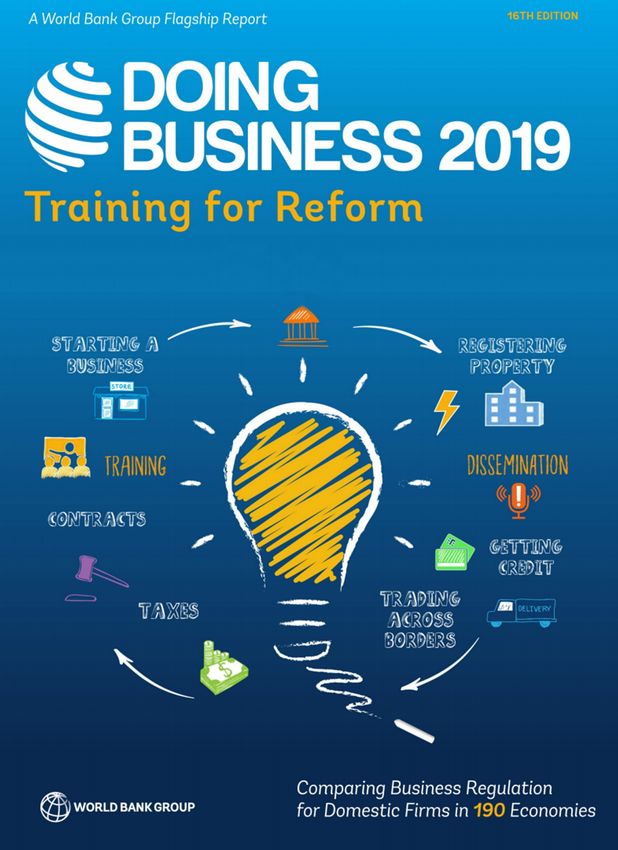
Doing Business 2019   Netherlands

                                      Economy Profile

                                    Netherlands

                                                        Page 1
Doing Business 2019       Netherlands

                                           Economy Profile of Netherlands

                                             Doing Business 2019 Indicators
                                        (in order of appearance in the document)

Starting a business                 Procedures, time, cost and paid-in minimum capital to start a limited liability company

Dealing with construction permits   Procedures, time and cost to complete all formalities to build a warehouse and the quality
                                    control and safety mechanisms in the construction permitting system

Getting electricity                 Procedures, time and cost to get connected to the electrical grid, and the reliability of the
                                    electricity supply and the transparency of tariffs

Registering property                Procedures, time and cost to transfer a property and the quality of the land administration
                                    system

Getting credit                      Movable collateral laws and credit information systems

Protecting minority investors       Minority shareholders’ rights in related-party transactions and in corporate governance

Paying taxes                        Payments, time, total tax and contribution rate for a firm to comply with all tax regulations as
                                    well as post-filing processes

Trading across borders              Time and cost to export the product of comparative advantage and import auto parts

Enforcing contracts                 Time and cost to resolve a commercial dispute and the quality of judicial processes

Resolving insolvency                Time, cost, outcome and recovery rate for a commercial insolvency and the strength of the
                                    legal framework for insolvency

Labor market regulation             Flexibility in employment regulation and aspects of job quality

                                                                                                                                       Page 2
Doing Business 2019 Netherlands
About Doing Business
The Doing Business project provides objective measures of business regulations and their enforcement across 190 economies and selected
cities at the subnational and regional level.
The Doing Business project, launched in 2002, looks at domestic small and medium-size companies and measures the regulations applying
to them through their life cycle.
Doing Business captures several important dimensions of the regulatory environment as it applies to local firms. It provides quantitative
indicators on regulation for starting a business, dealing with construction permits, getting electricity, registering property, getting credit,
protecting minority investors, paying taxes, trading across borders, enforcing contracts and resolving insolvency. Doing Business also
measures features of labor market regulation. Although Doing Business does not present rankings of economies on the labor market
regulation indicators or include the topic in the aggregate ease of doing business score or ranking on the ease of doing business, it does
present the data for these indicators.
By gathering and analyzing comprehensive quantitative data to compare business regulation environments across economies and over time,
Doing Business encourages economies to compete towards more efficient regulation; offers measurable benchmarks for reform; and serves
as a resource for academics, journalists, private sector researchers and others interested in the business climate of each economy.
In addition, Doing Business offers detailed subnational reports, which exhaustively cover business regulation and reform in different cities and
regions within a nation. These reports provide data on the ease of doing business, rank each location, and recommend reforms to improve
performance in each of the indicator areas. Selected cities can compare their business regulations with other cities in the economy or region
and with the 190 economies that Doing Business has ranked.
The first Doing Business report, published in 2003, covered 5 indicator sets and 133 economies. This year’s report covers 11 indicator sets
and 190 economies. Most indicator sets refer to a case scenario in the largest business city of each economy, except for 11 economies that
have a population of more than 100 million as of 2013 (Bangladesh, Brazil, China, India, Indonesia, Japan, Mexico, Nigeria, Pakistan, the
Russian Federation and the United States) where Doing Business also collected data for the second largest business city. The data for these
11 economies are a population-weighted average for the 2 largest business cities. The project has benefited from feedback from
governments, academics, practitioners and reviewers. The initial goal remains: to provide an objective basis for understanding and improving
the regulatory environment for business around the world.
More about Doing Business (PDF, 5MB)
Page 3Doing Business 2019 Netherlands
Ease of Doing Business in DB 2019 Rank
Region OECD high income
190 1
Netherlands
Income Category High income 36
DB 2019 Ease of doing business score
Population 17,132,854
0 100
City Covered Amsterdam 76.04
DB 2019 Ease of Doing Business Score
0 100
84.64: Denmark (Rank: 3)
80.35: Finland (Rank: 17)
77.80: Regional Average (OECD high income)
77.29: France (Rank: 32)
76.04: Netherlands (Rank: 36)
73.95: Belgium (Rank: 45)
Note: The ease of doing business score captures the gap of each economy from the best regulatory performance observed on each of the indicators across all economies
in the Doing Business sample since 2005. An economy’s ease of doing business score is reflected on a scale from 0 to 100, where 0 represents the lowest and 100
represents the best performance. The ease of doing business ranking ranges from 1 to 190.
Rankings on Doing Business topics - Netherlands
1
1 7
22 21
31
28
56
55
72 74
84
82
Rank
112
109
136
163
190
Starting Dealing Getting Registering Getting Protecting Paying Trading Enforcing Resolving
a with Electricity Property Credit Minority Taxes across Contracts Insolvency
Business Construction Investors Borders
Permits
Ease of Doing Business Score on Doing Business topics - Netherlands
100.00
100 94.31
87.58
84.28
81.58 80.05
80
69.36
58.33 59.94
Score
60
45.00
40
20
0
Starting Dealing Getting Registering Getting Protecting Paying Trading Enforcing Resolving
a with Electricity Property Credit Minority Taxes across Contracts Insolvency
Business Construction Investors Borders
Permits
Page 4Doing Business 2019 Netherlands
Starting a Business
This topic measures the number of procedures, time, cost and paid-in minimum capital requirement for a small- to medium-sized limited
liability company to start up and formally operate in each economy’s largest business city.
To make the data comparable across 190 economies, Doing Business uses a standardized business that is 100% domestically owned, has
start-up capital equivalent to 10 times the income per capita, engages in general industrial or commercial activities and employs between 10
and 50 people one month after the commencement of operations, all of whom are domestic nationals. Starting a Business considers two
types of local limited liability companies that are identical in all aspects, except that one company is owned by 5 married women and the
other by 5 married men. The ranking of economies on the ease of starting a business is determined by sorting their scores for starting a
business. These scores are the simple average of the scores for each of the component indicators.
The most recent round of data collection for the project was completed in May 2018. See the methodology for more information.
What the indicators measure Case study assumptions
Procedures to legally start and formally operate To make the data comparable across economies, several assumptions about the
a company (number) business and the procedures are used. It is assumed that any required information is
readily available and that the entrepreneur will pay no bribes.
• Preregistration (for example, name verification or
reservation, notarization)
The business:
• Registration in the economy’s largest business - Is a limited liability company (or its legal equivalent). If there is more than one type
city
of limited liability company in the economy, the most common among domestic firms
• Postregistration (for example, social security is chosen. Information on the most common form is obtained from incorporation
registration, company seal) lawyers or the statistical office.
- Operates in the economy’s largest business city. For 11 economies the data are
• Obtaining approval from spouse to start a
business or to leave the home to register the also collected for the second largest business city.
company - The entire office space is approximately 929 square meters (10,000 square feet).
- Is 100% domestically owned and has five owners, none of whom is a legal entity;
• Obtaining any gender specific document for has a start-up capital of 10 times income per capita and has a turnover of at least
company registration and operation or national 100 times income per capita.
identification card
- Performs general industrial or commercial activities, such as the production or sale
of goods or services to the public. The business does not perform foreign trade
Time required to complete each procedure
activities and does not handle products subject to a special tax regime, for example,
(calendar days)
liquor or tobacco. It does not use heavily polluting production processes.
• Does not include time spent gathering - Leases the commercial plant or offices and is not a proprietor of real estate and the
information amount of the annual lease for the office space is equivalent to the income per
capita.
• Each procedure starts on a separate day (2
procedures cannot start on the same day) - Does not qualify for investment incentives or any special benefits.
- Has at least 10 and up to 50 employees one month after the commencement of
• Procedures fully completed online are recorded operations, all of whom are domestic nationals.
as ½ day - Has a company deed that is 10 pages long.
• Procedure is considered completed once final
document is received The owners:
• No prior contact with officials - Have reached the legal age of majority. If there is no legal age of majority, they are
assumed to be 30 years old.
Cost required to complete each procedure (% of - Are sane, competent, in good health and have no criminal record.
income per capita) - Are married and the marriage is monogamous and registered with the authorities.
- Where the answer differs according to the legal system applicable to the woman or
• Official costs only, no bribes man in question (as may be the case in economies where there is legal plurality), the
• No professional fees unless services required by answer used will be the one that applies to the majority of the population.
law or commonly used in practice
Paid-in minimum capital (% of income per
capita)
• Funds deposited in a bank or with third party
before registration or up to 3 months after
incorporation
Page 5Doing Business 2019 Netherlands
Starting a Business - Netherlands
Standardized Company
Legal form Besloten Vennootschap (BV)
Paid-in minimum capital requirement EUR 0
City Covered Amsterdam
Indicator Netherlands OECD high Best Regulatory
income Performance
Procedure – Men (number) 4 4.9 1 (New Zealand)
Time – Men (days) 3.5 9.3 0.5 (New Zealand)
Cost – Men (% of income per capita) 4.2 3.1 0.0 (Slovenia)
Procedure – Women (number) 4 4.9 1 (New Zealand)
Time – Women (days) 3.5 9.3 0.5 (New Zealand)
Cost – Women (% of income per capita) 4.2 3.1 0.0 (Slovenia)
Paid-in min. capital (% of income per capita) 0.0 8.6 0.0 (117 Economies)
Figure – Starting a Business in Netherlands and comparator economies – Ranking and Score
DB 2019 Starting a Business Score
0 100
94.31: Netherlands (Rank: 22)
93.27: France (Rank: 30)
93.03: Belgium (Rank: 33)
92.52: Denmark (Rank: 42)
92.43: Finland (Rank: 43)
91.19: Regional Average (OECD high income)
Note: The ranking of economies on the ease of starting a business is determined by sorting their scores for starting a business. These scores
are the simple average of the scores for each of the component indicators.
Page 6Doing Business 2019 Netherlands
Figure – Starting a Business in Netherlands – Procedure, Time and Cost
Time (days) Cost (% of income per capita)
3.5 4.5
4
3
Cost (% of income per capita)
3.5
2.5
3
Time (days)
2 2.5
1.5 2
1.5
1
1
0.5
0.5
0 0
1 2 3 4
Procedures (number)
* This symbol is shown beside procedure numbers that take place simultaneously with the previous procedure.
Note: Online procedures account for 0.5 days in the total time calculation. For economies that have a different procedure list for men and
women, the graph shows the time for women. For more information on methodology, see the Doing Business website
(http://doingbusiness.org/en/methodology ). For details on the procedures reflected here, see the summary below.
Page 7Doing Business 2019 Netherlands
Details – Starting a Business in Netherlands – Procedure, Time and Cost
No. Procedures Time to Complete Associated Costs
1 Check the company name for appropriateness and validity Less than one day no charge
Agency : Chamber of Commerce (online procedure)
As of July 2011, the Chamber of Commerce no longer carries out trade names
searches. However, parties themselves can carry out a check on trade names
online on the Chamber of Commerce website for free.
2 Draft and sign the company’s deed of incorporation that is executed by a 1 day EUR 1,750
civil law notary
Agency : Civil Notary
Notary rates are negotiable and can be billed on the basis of an hourly rate, or a
fixed fee. This varies between notaries. The deed can be signed in presence of
the notary or by way of a written (private) power of attorney.
3 Register the company at the local Chamber of Commerce and obtain a 1 day EUR 50
registration number
Agency : Chamber of Commerce
The registration at the Chamber of Commerce can be done online or in person. If
it is done online, it takes several hours to receive the registration number, and if
the documents are filed in person, it takes 1 to 5 working days. Registration at
the local Chamber of Commerce is mandatory. There is a registration fee of EUR
50. The payment of the fee can be done in cash, wire transfer and bank draft.
Usually an invoice arrives by mail from the Chamber, and the preferred method
of payment is by wire transfer.
The registration process can be completed online if it is done through a notary;
however, for registration applications completed through the Chamber of
Commerce, the business owner will submit the required documents online and
then physically go to the Chamber of Commerce in person for identification
purposes.
After incorporation of the company, the founders of the company are jointly and
severally liable for each legal act performed during their management and which
binds the company in the period between execution of the deed of incorporation
and the registration at the Chamber of Commerce has been affected. Publication
in the Netherlands Official Gazette (Staatscourant) of the first registration and
certain subsequent registrations is required and will be made by the Chamber.
Companies with more than 50 employees must have a properly constituted
workers council. The workers council representatives are entitled to participate in
discussions and give advice on important company matters.
The government is in the process of implementing a UBO-register; a register
containing the details of the individuals that are the ‘ultimate beneficial owners’ of
legal entities in the Netherlands.
4 Register with the local tax authorities and social security authorities 1 day no charge
Agency : Local Tax Authority
The registration form can be filed in a day but it will take 2 to 6 weeks for the tax
office to provide the required tax numbers. For income tax, a separate
registration form must be filed, which can also take 4 weeks.
Takes place simultaneously with previous procedure.
Page 8Doing Business 2019 Netherlands
Dealing with Construction Permits
This topic tracks the procedures, time and cost to build a warehouse—including obtaining necessary the licenses and permits, submitting all
required notifications, requesting and receiving all necessary inspections and obtaining utility connections. In addition, the Dealing with
Construction Permits indicator measures the building quality control index, evaluating the quality of building regulations, the strength of
quality control and safety mechanisms, liability and insurance regimes, and professional certification requirements. The most recent round of
data collection was completed in May 2018. See the methodology for more information
What the indicators measure Case study assumptions
Procedures to legally build a warehouse To make the data comparable across economies, several assumptions about the
(number) construction company, the warehouse project and the utility connections are used.
• Submitting all relevant documents and obtaining The construction company (BuildCo):
all necessary clearances, licenses, permits and
certificates - Is a limited liability company (or its legal equivalent) and operates in the economy’s
largest business city. For 11 economies the data are also collected for the second
• Submitting all required notifications and receiving largest business city.
all necessary inspections
- Is 100% domestically and privately owned; has five owners, none of whom is a
• Obtaining utility connections for water and legal entity. Has a licensed architect and a licensed engineer, both registered with
sewerage the local association of architects or engineers. BuildCo is not assumed to have any
• Registering and selling the warehouse after its other employees who are technical or licensed experts, such as geological or
completion topographical experts.
- Owns the land on which the warehouse will be built and will sell the warehouse
Time required to complete each procedure upon its completion.
(calendar days)
The warehouse:
• Does not include time spent gathering
information - Will be used for general storage activities, such as storage of books or stationery.
- Will have two stories, both above ground, with a total constructed area of
• Each procedure starts on a separate day— approximately 1,300.6 square meters (14,000 square feet). Each floor will be 3
though procedures that can be fully completed
meters (9 feet, 10 inches) high and will be located on a land plot of approximately
online are an exception to this rule
929 square meters (10,000 square feet) that is 100% owned by BuildCo, and the
• Procedure is considered completed once final warehouse is valued at 50 times income per capita.
document is received - Will have complete architectural and technical plans prepared by a licensed
architect. If preparation of the plans requires such steps as obtaining further
• No prior contact with officials
documentation or getting prior approvals from external agencies, these are counted
Cost required to complete each procedure (% of as procedures.
income per capita) - Will take 30 weeks to construct (excluding all delays due to administrative and
regulatory requirements).
• Official costs only, no bribes
The water and sewerage connections:
Building quality control index (0-15)
- Will be 150 meters (492 feet) from the existing water source and sewer tap. If there
• Quality of building regulations (0-2) is no water delivery infrastructure in the economy, a borehole will be dug. If there is
• Quality control before construction (0-1) no sewerage infrastructure, a septic tank in the smallest size available will be
installed or built.
• Quality control during construction (0-3) - Will have an average water use of 662 liters (175 gallons) a day and an average
• Quality control after construction (0-3) wastewater flow of 568 liters (150 gallons) a day. Will have a peak water use of
1,325 liters (350 gallons) a day and a peak wastewater flow of 1,136 liters (300
• Liability and insurance regimes (0-2) gallons) a day.
• Professional certifications (0-4) - Will have a constant level of water demand and wastewater flow throughout the
year; will be 1 inch in diameter for the water connection and 4 inches in diameter for
the sewerage connection.
Page 9Doing Business 2019 Netherlands
Dealing with Construction Permits - Netherlands
Standardized Warehouse
Estimated value of warehouse EUR 2,127,274.50
City Covered Amsterdam
Indicator Netherlands OECD high Best Regulatory
income Performance
Procedures (number) 13 12.7 None in 2017/18
Time (days) 161 153.1 None in 2017/18
Cost (% of warehouse value) 3.7 1.5 None in 2017/18
Building quality control index (0-15) 10.0 11.5 15.0 (3 Economies)
Figure – Dealing with Construction Permits in Netherlands and comparator economies – Ranking and Score
DB 2019 Dealing with Construction Permits Score
0 100
86.94: Denmark (Rank: 4)
79.30: France (Rank: 19)
75.79: Finland (Rank: 34)
75.42: Belgium (Rank: 38)
75.41: Regional Average (OECD high income)
69.36: Netherlands (Rank: 84)
Note: The ranking of economies on the ease of dealing with construction permits is determined by sorting their scores for dealing with
construction permits. These scores are the simple average of the scores for each of the component indicators.
Figure – Dealing with Construction Permits in Netherlands – Procedure, Time and Cost
Time (days) Cost (% of warehouse value)
160 3.5
140 3
Cost (% of warehouse value)
120
2.5
Time (days)
100
2
80
1.5
60
1
40
20 0.5
0 0
1 *2 3 4 5 6 7 8 9 10 11 12 13
Procedures (number)
* This symbol is shown beside procedure numbers that take place simultaneously with the previous procedure.
Note: Online procedures account for 0.5 days in the total time calculation. For economies that have a different procedure list for men and
women, the graph shows the time for women. For more information on methodology, see the Doing Business website
(http://doingbusiness.org/en/methodology ). For details on the procedures reflected here, see the summary below.
Page 10Doing Business 2019 Netherlands
Figure – Dealing with Construction Permits in Netherlands and comparator economies – Measure of Quality
15 14.0
12.0 11.5
11.0
Index score 10.0 10.0
10
5
0
Netherlands Belgium Denmark Finland France OECD high income
Details – Dealing with Construction Permits in Netherlands – Procedure, Time and Cost
No. Procedures Time to Complete Associated Costs
1 Obtain report on the soil conditions from soil researching company 30 days EUR 9,650
Agency : Soil Researching Company
The soil on which a building is to be constructed should not be contaminated. If a
soil report is not available, soil testing must be conducted. The soil testing should
be performed before requesting a building permit.
2 Hold a consultation with the municipal authorities 15 days no charge
Agency : Municipality
An appointment request is made online to meet with one of the building
inspectors. The consultation is free of charge. While this appointment is not
mandatory, it is advisable to check that all the requirements for the permit are
met. They will also check whether the zoning plan allows for the construction of a
warehouse in the proposed location.
3 Submit a request for a building permit to the Municipal Executive (Mayor 98 days EUR 67,860
and Aldermen)
Agency : Municipal Executive (Mayor and Aldermen)
As of October 1, 2010 an online system www.eherkenning.nl/ was implemented
which allows uploading of all documents to request a building permit, as well as
following up on the request.
At the same time, several types of permits were combined into one General
Environmental Law (Wet algemene bepalingen omgevingsrecht- Wabo). All
different types of building permits (e.g., building permit, demolition permit, a
permit to cut down trees, etc) are now combined into one environmental permit.
The Municipality has 8 weeks to decide on the permit and another 6 weeks to
finalize the permit. If the building does not fit into the zoning scheme, the
procedure to obtain the permit will take 26 weeks.
There are exceptions in particular cases for which the procedure takes 26 weeks:
• Application for a specific fire-safe utilization of a building
• Application for a building in which an enterprise is going to start with production
processes that are harmful for the environment
• Application for a building that does not fit into the zoning scheme
• Application for a building permit concerning a renovation of a cultural heritage
building
4 Notify Municipality if there is a heating installation 0.5 days no charge
Agency : Municipality
The notification is pursuant to the municipal heating regulations (Verordening
Stookinstallaties). The regulations establish technical and environmental rules
with which the installation should comply.
5 Notify building inspector two days before construction work begins 0.5 days no charge
Agency : Building Inspection Department
For each of the following activities, an independent notification is required:
• The start of construction work, including excavations
• The start of foundation activities
• The start of soil consolidation activities
Furthermore, the building inspection office should be notified at least one day
before the start of concrete pouring. This inspection can be carried out on site.
6 Request and receive inspection at foundation stage 1 day no charge
Agency : Building Inspection Department
There are one or two inspections at the foundation stage.
7 Request and receive inspection at roof stage 1 day no charge
Agency : Building Inspection Department
There are one or two inspections at the roofing stage.
Page 11Doing Business 2019 Netherlands
8 Notify building inspector upon completion of work 0.5 days no charge
Agency : Building Inspection Department
If a permit is required for the use the building, the building inspector must be
notified when part of the construction has been completed, such as when the
connection to the sewer system has been made, or when all the work has been
completed. Notification must be given upon completion of construction work in
order to be granted a permit to use the property. If inspections show that the
building has not been constructed in accordance with the building permit, an
occupancy permit cannot be issued.
9 Notify Fire Department upon completion of work 0.5 days no charge
Agency : Fire Department
BuildCo must notify the Fire Department about the completion of construction
works in order to receive the final inspection.
10 Receive final inspection 1 day no charge
Agency : Municipality
11 Request water connection 6 days no charge
Agency : Vitens N.V.
In order to request a new water connection, an account needs to be set up on
www..mijnaansluiting.nl, with the following information:
- Address details and contact details
- Required connection and the required capacity of the connections.
- A map of the building showing the location of the meter (s). On the map, enter
the distances in meters or the scale of the map.
- The week in which customer prefer to have the work carried out. The network
operator determines the final schedule. This depends, among other things, on
the type of work and the necessary preparations.
12 Receive inspection for water services 1 day no charge
Agency : Vitens N.V.
13 Pay and obtain water connection 21 days EUR 370
Agency : Vitens N.V.
Takes place simultaneously with previous procedure.
Page 12Doing Business 2019 Netherlands
Details – Dealing with Construction Permits in Netherlands – Measure of Quality
Answer Score
Building quality control index (0-15) 10.0
Quality of building regulations index (0-2) 2.0
How accessible are building laws and regulations in your economy? (0-1) Available online; 1.0
Free of charge.
Which requirements for obtaining a building permit are clearly specified in the building List of required 1.0
regulations or on any accessible website, brochure or pamphlet? (0-1) documents; Fees
to be paid;
Required
preapprovals.
Quality control before construction index (0-1) 1.0
Which third-party entities are required by law to verify that the building plans are in Licensed 1.0
compliance with existing building regulations? (0-1) architect;
Licensed
engineer.
Quality control during construction index (0-3) 3.0
What types of inspections (if any) are required by law to be carried out during construction? Inspections at 2.0
(0-2) various phases;
Risk-based
inspections.
Do legally mandated inspections occur in practice during construction? (0-1) Mandatory 1.0
inspections are
always done in
practice.
Quality control after construction index (0-3) 3.0
Is there a final inspection required by law to verify that the building was built in accordance Yes, final 2.0
with the approved plans and regulations? (0-2) inspection is
done by
government
agency.
Do legally mandated final inspections occur in practice? (0-1) Final inspection 1.0
always occurs in
practice.
Liability and insurance regimes index (0-2) 1.0
Which parties (if any) are held liable by law for structural flaws or problems in the building Architect or 1.0
once it is in use (Latent Defect Liability or Decennial Liability)? (0-1) engineer;
Professional in
charge of the
supervision;
Construction
company.
Which parties (if any) are required by law to obtain an insurance policy to cover possible No party is 0.0
structural flaws or problems in the building once it is in use (Latent Defect Liability Insurance required by law
or Decennial Insurance)? (0-1) to obtain
insurance .
Professional certifications index (0-4) 0.0
What are the qualification requirements for the professional responsible for verifying that the There are no 0.0
architectural plans or drawings are in compliance with existing building regulations? (0-2) specific
requirements.
What are the qualification requirements for the professional who supervises the construction There are no 0.0
on the ground? (0-2) specific
requirements.
Page 13Doing Business 2019 Netherlands
Getting Electricity
This topic measures the procedures, time and cost required for a business to obtain a permanent electricity connection for a newly
constructed warehouse. Additionally, the reliability of supply and transparency of tariffs index measures reliability of supply, transparency of
tariffs and the price of electricity. The most recent round of data collection for the project was completed in May 2018. See the methodology
for more information.
What the indicators measure Case study assumptions
Procedures to obtain an electricity connection To make the data comparable across economies, several assumptions about the
(number) warehouse, the electricity connection and the monthly consumption are used.
• Submitting all relevant documents and obtaining The warehouse:
all necessary clearances and permits
- Is owned by a local entrepreneur and is used for storage of goods.
• Completing all required notifications and - Is located in the economy’s largest business city. For 11 economies the data are
receiving all necessary inspections
also collected for the second largest business city.
• Obtaining external installation works and possibly - Is located in an area where similar warehouses are typically located and is in an
purchasing material for these works area with no physical constraints. For example, the property is not near a railway.
- Is a new construction and is being connected to electricity for the first time.
• Concluding any necessary supply contract and
- Has two stories with a total surface area of approximately 1,300.6 square meters
obtaining final supply
(14,000 square feet). The plot of land on which it is built is 929 square meters
Time required to complete each procedure (10,000 square feet).
(calendar days)
The electricity connection:
• Is at least 1 calendar day
- Is a permanent one with a three-phase, four-wire Y connection with a subscribed
• Each procedure starts on a separate day capacity of 140-kilo-volt-ampere (kVA) with a power factor of 1, when 1 kVA = 1
• Does not include time spent gathering kilowatt (kW).
information - Has a length of 150 meters. The connection is to either the low- or medium-voltage
distribution network and is either overhead or underground, whichever is more
• Reflects the time spent in practice, with little common in the area where the warehouse is located and requires works that involve
follow-up and no prior contact with officials
the crossing of a 10-meter road (such as by excavation or overhead lines) but are all
carried out on public land. There is no crossing of other owners’ private property
Cost required to complete each procedure (% of
income per capita) because the warehouse has access to a road.
- Does not require work to install the internal wiring of the warehouse. This has
• Official costs only, no bribes already been completed up to and including the customer’s service panel or
• Value added tax excluded switchboard and the meter base.
The reliability of supply and transparency of The monthly consumption:
tariffs index (0-8)
- It is assumed that the warehouse operates 30 days a month from 9:00 a.m. to 5:00
• Duration and frequency of power outages (0–3) p.m. (8 hours a day), with equipment utilized at 80% of capacity on average and that
• Tools to monitor power outages (0–1) there are no electricity cuts (assumed for simplicity reasons) and the monthly energy
consumption is 26,880 kilowatt-hours (kWh); hourly consumption is 112 kWh.
• Tools to restore power supply (0–1) - If multiple electricity suppliers exist, the warehouse is served by the cheapest
• Regulatory monitoring of utilities’ performance supplier.
(0–1) - Tariffs effective in January of the current year are used for calculation of the price of
electricity for the warehouse. Although January has 31 days, for calculation
• Financial deterrents limiting outages (0–1) purposes only 30 days are used.
• Transparency and accessibility of tariffs (0–1)
Price of electricity (cents per kilowatt-hour)*
• Price based on monthly bill for commercial
warehouse in case study
*Note: Doing Business measures the price of
electricity, but it is not included in the ease of doing
business score nor the ranking on the ease of
getting electricity.
Page 14Doing Business 2019 Netherlands
Getting Electricity - Netherlands
Standardized Connection
Price of electricity (US cents per kWh) 10.6
Name of utility Liander
City Covered Amsterdam
Indicator Netherlands OECD high Best Regulatory
income Performance
Procedures (number) 5 4.5 3 (25 Economies)
Time (days) 110 77.2 18 (3 Economies)
Cost (% of income per capita) 28.1 64.2 0.0 (3 Economies)
Reliability of supply and transparency of tariff index (0-8) 8 7.5 8.0 (27 Economies)
Figure – Getting Electricity in Netherlands and comparator economies – Ranking and Score
DB 2019 Getting Electricity Score
0 100
92.01: France (Rank: 14)
90.22: Denmark (Rank: 21)
88.98: Finland (Rank: 25)
85.47: Regional Average (OECD high income)
81.58: Netherlands (Rank: 56)
67.31: Belgium (Rank: 112)
Note: The ranking of economies on the ease of getting electricity is determined by sorting their scores for getting electricity. These scores are
the simple average of the scores for all the component indicators except the price of electricity.
Page 15Doing Business 2019 Netherlands
Figure – Getting Electricity in Netherlands – Procedure, Time and Cost
Time (days) Cost (% of income per capita)
30
100
Cost (% of income per capita)
25
80
20
Time (days)
60
15
40
10
20 5
0 0
1 *2 3 *4 *5
Procedures (number)
* This symbol is shown beside procedure numbers that take place simultaneously with the previous procedure.
Note: Online procedures account for 0.5 days in the total time calculation. For economies that have a different procedure list for men and
women, the graph shows the time for women. For more information on methodology, see the Doing Business website
(http://doingbusiness.org/en/methodology ). For details on the procedures reflected here, see the summary below.
Figure – Getting Electricity in Netherlands and comparator economies – Measure of Quality
8 8 8 8
8 7.5
7
7
6
Index score
5
4
3
2
1
0
Netherlands Belgium Denmark Finland France OECD high income
Page 16Doing Business 2019 Netherlands
Details – Getting Electricity in Netherlands – Procedure, Time and Cost
No. Procedures Time to Complete Associated Costs
1 Submit application to Liander and receive quote 20 calendar days EUR 0
Agency : Liander
The customer can apply for an electricity connection with the utility, Liander,
online at www.aansluitingen.nl, in person, by phone, mail or fax.
The customer will need to attach the following documents to their application:
location of building to public road and the exact location of the building.
The utility then prepares and calculate the connection fees.
No inspection of the entire internal wiring is carried out during the process, but
the electrician/electrical contractor, in charge of the internal wiring, will need to
submit a notification to Liander stating the installation has been carried out
according to the regulations.
2 Obtain external inspection by Liander 1 calendar day EUR 0
Agency : Liander
If there are no maps for the area where the building is located and thus a site
inspection is necessary, Liander will inspect the site to determine the specifics of
the connection. The client does not need to be present during the inspection.
3 Obtain external works from Liander’s contractor 90 calendar days EUR 11,961
Agency : Liander
Liander will sub-contract the works to a private firm. In this case, the works
consist of laying out a cable from the warehouse to the closest supply source.
A standard connection is a connection for a house or a small company with a
length up to 25 meters. Connection fees are fixed and set by the ACM (Autoriteit
Concument & Markt) and include the physical works for a connection up to 25
meters. Beyond the 25 meters additional costs apply, depending on the distance.
Liander distinguishes between 3 categories of connections: households and
small businesses (loads of up to 3 x 80 Ampere); large businesses and small
industrial (between 3 x 80 Ampere and 2 MVA); large industrial (over 2 MVA).
The assumed case fits into the second categor.
Before the electricity can be turned on, the client will need to show the relevant
agency (Liander) a copy of the supply contract. (Nowadays this is carried out by
using electronic communication.) This is done during the execution of the works
and therefore gives no additional delay of the process.
4 Sign contract with electricity supplier 7 calendar days EUR 0
Agency : Supplier
In the Netherlands, the electricity market is free. Liander is a distributor of
electricity, but not a provider. Therefore, in order to obtain electricity, the client
will need to choose and sign a contract with one of many suppliers.
5 Obtain meter installation by meter company or Liander 7 calendar days EUR 0
Agency : Liander or meter company
The customer can choose a meter company to install the meter for them,
as for example Liander’s own meter department.
Before the electricity can be turned on, the client will need to show the relevant
agency (Liander) a copy of the supply contract. (Nowadays this is carried out by
using electronic communication.) This is done during the execution of the works
(procedure 3) and therefore gives no additional delay of the process
Takes place simultaneously with previous procedure.
Page 17Doing Business 2019 Netherlands
Details – Getting Electricity in Netherlands – Measure of Quality
Answer
Reliability of supply and transparency of tariff index (0-8) 8
Total duration and frequency of outages per customer a year (0-3) 3
System average interruption duration index (SAIDI) 0.6
System average interruption frequency index (SAIFI) 0.3
What is the minimum outage time (in minutes) that the utility considers for the calculation of SAIDI/SAIFI 0.3
Mechanisms for monitoring outages (0-1) 1
Does the distribution utility use automated tools to monitor outages? Yes
Mechanisms for restoring service (0-1) 1
Does the distribution utility use automated tools to restore service? Yes
Regulatory monitoring (0-1) 1
Does a regulator—that is, an entity separate from the utility—monitor the utility’s performance on reliability of Yes
supply?
Financial deterrents aimed at limiting outages (0-1) 1
Does the utility either pay compensation to customers or face fines by the regulator (or both) if outages Yes
exceed a certain cap?
Communication of tariffs and tariff changes (0-1) 1
Are effective tariffs available online? Yes
Link to the website, if available online https://www.liander.nl
/tarieven2018 or
mijnliander.nl
https://www.consuwij
zer.nl/energie
Are customers notified of a change in tariff ahead of the billing cycle? Yes
Note:
If the duration and frequency of outages is 100 or less, the economy is eligible to score on the Reliability of supply and transparency of tariff
index.
If the duration and frequency of outages is not available, or is over 100, the economy is not eligible to score on the index.
If the minimum outage time considered for SAIDI/SAIFI is over 5 minutes, the economy is not eligible to score on the index.
Page 18Doing Business 2019 Netherlands
Registering Property
This topic examines the steps, time and cost involved in registering property, assuming a standardized case of an entrepreneur who wants to
purchase land and a building that is already registered and free of title dispute. In addition, the topic also measures the quality of the land
administration system in each economy. The quality of land administration index has five dimensions: reliability of infrastructure, transparency
of information, geographic coverage, land dispute resolution, and equal access to property rights. The most recent round of data collection for
the project was completed in May 2018. See the methodology for more information.
What the indicators measure Case study assumptions
Procedures to legally transfer title on To make the data comparable across economies, several assumptions about the
immovable property (number) parties to the transaction, the property and the procedures are used.
• Preregistration procedures (for example, The parties (buyer and seller):
checking for liens, notarizing sales agreement,
paying property transfer taxes) - Are limited liability companies (or the legal equivalent).
- Are located in the periurban area of the economy’s largest business city. For 11
• Registration procedures in the economy's largest economies the data are also collected for the second largest business city.
business city.
- Are 100% domestically and privately owned.
• Postregistration procedures (for example, filling - Have 50 employees each, all of whom are nationals.
title with municipality) - Perform general commercial activities.
Time required to complete each procedure The property (fully owned by the seller):
(calendar days)
- Has a value of 50 times income per capita, which equals the sale price.
• Does not include time spent gathering - Is fully owned by the seller.
information - Has no mortgages attached and has been under the same ownership for the past
• Each procedure starts on a separate day - 10 years.
though procedures that can be fully completed - Is registered in the land registry or cadastre, or both, and is free of title disputes.
online are an exception to this rule - Is located in a periurban commercial zone, and no rezoning is required.
- Consists of land and a building. The land area is 557.4 square meters (6,000
• Procedure is considered completed once final square feet). A two-story warehouse of 929 square meters (10,000 square feet) is
document is received
located on the land. The warehouse is 10 years old, is in good condition, has no
• No prior contact with officials heating system and complies with all safety standards, building codes and legal
requirements. The property, consisting of land and building, will be transferred in its
Cost required to complete each procedure (% of entirety.
property value) - Will not be subject to renovations or additional construction following the purchase.
• Official costs only (such as administrative fees, - Has no trees, natural water sources, natural reserves or historical monuments of
duties and taxes). any kind.
- Will not be used for special purposes, and no special permits, such as for
• Value Added Tax, Capital Gains Tax and illicit residential use, industrial plants, waste storage or certain types of agricultural
payments are excluded activities, are required.
- Has no occupants, and no other party holds a legal interest in it.
Quality of land administration index (0-30)
• Reliability of infrastructure index (0-8)
• Transparency of information index (0–6)
• Geographic coverage index (0–8)
• Land dispute resolution index (0–8)
• Equal access to property rights index (-2–0)
Page 19Doing Business 2019 Netherlands
Registering Property - Netherlands
Indicator Netherlands OECD high Best Regulatory
income Performance
Procedures (number) 5 4.7 1 (4 Economies)
Time (days) 2.5 20.1 1 (New Zealand)
Cost (% of property value) 6.1 4.2 0.0 (Saudi Arabia)
Quality of the land administration index (0-30) 28.5 23.0 None in 2017/18
Figure – Registering Property in Netherlands and comparator economies – Ranking and Score
DB 2019 Registering Property Score
0 100
89.88: Denmark (Rank: 11)
80.73: Finland (Rank: 28)
80.05: Netherlands (Rank: 31)
77.17: Regional Average (OECD high income)
63.33: France (Rank: 96)
51.41: Belgium (Rank: 143)
Note: The ranking of economies on the ease of registering property is determined by sorting their scores for registering property. These
scores are the simple average of the scores for each of the component indicators.
Figure – Registering Property in Netherlands – Procedure, Time and Cost
Time (days) Cost (% of property value)
2.5 7
6
Cost (% of property value)
2
5
Time (days)
1.5
4
3
1
2
0.5
1
0 0
1 *2 3 4 5
Procedures (number)
* This symbol is shown beside procedure numbers that take place simultaneously with the previous procedure.
Note: Online procedures account for 0.5 days in the total time calculation. For economies that have a different procedure list for men and
women, the graph shows the time for women. For more information on methodology, see the Doing Business website
(http://doingbusiness.org/en/methodology ). For details on the procedures reflected here, see the summary below.
Page 20Doing Business 2019 Netherlands
Figure – Registering Property in Netherlands and comparator economies – Measure of Quality
30 28.5
26.5
24.5 24.0
25 22.5 23.0
Index score
20
15
10
5
0
Netherlands Belgium Denmark Finland France OECD high income
Details – Registering Property in Netherlands – Procedure, Time and Cost
No. Procedures Time to Complete Associated Costs
1 Notary conducts a title search at the Land Registry Less than one day, EUR 2,259.6; (1. Title
Agency : Cadastre, Land Registry and Mapping Agency online search:
According to Dutch Civil Code it is mandatory to hire a civil law notary to perform (disbursements,
the registration process of property in the Netherlands. The civil law notary will
charged by the Land
conduct a title search at the Land Registry to check for ownership and
Registry):
encumbrances before executing the deed. Art 84 Book 3 Civil Code states that
- EUR 2.4 per
for a legally valid transaction the seller should have the right to dispose, which is
one of the major elements of a property right. For such transactions a notarial registered title;
deed is compulsory ('authentic deed'); therefore, the notary checks whether the - EUR 2.4 per
seller is indeed the owner. It is mandatory in the professional rules of the cadastral map;
National Association of Notaries. Notaries can consult the land register by an on- - EUR 2.4 per
line system, called the Automatic Cadastral Registration (AKR), but only cadastral extract (x2)
regarding some aspects. (per cadastral parcel
two extracts are
The deeds and other registered documents from 1998 onward are online required, one
accessible. Since December 2009 all deeds are digitally available (first deeds
regarding the
1832). Extracts from the cadastral map showing the relevant properties are also
ownership and one
available online. To obtain all relevant information takes a few minutes. A notary
regarding the
can ask the Land Registry Office to find out the history and identifiers of a parcel.
mortgages and
If a cadastral parcel has been changed (e.g. a parcel is divided into 2 new
parcels), the parcel will be given a new, unique parcel number. The civil law attachments – even if
notary then drafts the deed of transfer. Preemption rights ('Voorkeursrecht') only the property has no
apply in exceptional cases, for properties located in the Municipalities mortgages).
Preferential Rights Act ('Wet voorkeursrecht gemeenten') or for ground leases
(as opposed to freehold). 2. Notarial fee (inter
alia including the
work mentioned
above under
procedure 1):
EUR 1,000-3,500
Final check: no cost)
Page 21Doing Business 2019 Netherlands
2 Notary conducts a search on the representation of the parties Less than one day, EUR 19.8; (Research
Agency : Trade Register ('Kamer van Koophandel' - www.kvk.nl) online of the buyer and
For companies the notary must conduct an on-line research with the Trade purchaser charged by
Register with respect to specific information of the company (such as address,
the Chamber of
managing directors). From July 1, 2012 all notaries are obliged to check
Commerce
addresses in the Dutch national online address database 'Basisadministratie
Adressen en Gebouwen (BAG)'. The central database was designed to prevent
1. Excerpts providing
individuals from using fake addresses.
an overview of
The articles of association cannot be checked on-line. The civil law notary can registered data of a
have these sent to him by mail or fax. It is to identify who is authorized to legally company, such as
bind the company. This procedure is mandated by the Manual that was adopted name, address, date
in May 2009 by the Association of Notaries (internal rules). The May 2009 of incorporation and
Manual explains how to apply the "August 2008 Law against Whitewashing and in most cases
Financing of Terrorism" (referred to as the "WWFT" law). Article 11 of the law is officials, &
related to identifying and verifying the identity of people. In Section B of the information about the
Annex (page 3), the text refers to "article 4, para 2 of the Executive Decree to the
legal person,
Law", which states that "to identify companies registered in the Netherlands, an
company and location
extract from the trade registrar is a sufficient document."
(s)
The notary will also check the Insolvency Registry, which is a public register held - EUR 15 (hard copy);
by the courts, in which everybody (including companies) who has been declared EUR 7.50 (digitally
bankrupt can be found. He checks both buyer and seller at the time of signing the certified extract) and
deed and the registration with the Land Registry. This is not mandatory but EUR 2.30 (online
necessary to know whether seller or buyer do not have the right to dispose and review).
to bind, because of registration in the register. It is described in the professional
rules of the National Association of Notaries. 2. Company Profile to
This checking is done online at www.faillisementen.com. Only subscribers can check the check the
access this site and the annual membership fees are 175 Euro. Online checking
financial position: €
of insolvencies can be done as well on http://insolventies.rechtspraak.nl which is
2.65)
part of the website of the Dutch courts and checking this register is free of
charge.
3 Execution of the transfer deed Less than one day, EUR 127,636.47;
Agency : Civil law notary online (Transfer Tax: 6% of
The notarial deed of transfer must be drawn up by a notary and signed by the property value for
latter and both parties. Before signing, a notary is required to investigate the title
non-residential; 2%
to the property and the seller’s power to dispose of it in the public registers. The
for residential use)
notary must provide for a transfer free of mortgages and attachments, this
requires the cooperation of third parties and the retrieval of information other than
that provided by the Land Registry. The authorized persons will either have to
appear before the notary or must have granted power of attorney. After the deed
has been registered with the Land Registry Office, a civil law notary must carry
out the post registration check in order to detect any potential change between
the execution and the registration of the deed. As the evidence of the registration
is sent by internet, just after the electronic submission following execution of the
transfer deed, this check can be done immediately.
4 Registration of deed Less than one day, EUR 77; (- EUR 126
Agency : Cadastre, Land Registry and Mapping Agency online for regular
Every notary deed must be registered with the Land Registry ('ingeschreven'). registration; EUR 77
This can be done through the internet (the notary does not need to go to the land
for fully automatic
registry or 'kadaster').
registration)
The registration fee of the Land Registry depends on the way the deed is
submitted to the Land Registry: Land Registry EUR 150.- for regular registration
(= sending paper version of deed by mail), EUR 126 for semi automatic
registration (= sending pdf-file of deed by email) and EUR 77.- for fully automatic
registration (= sending data file with essentials of transfer only).
5 Registration with Tax authority, Department Registration Less than one day, Already paid in
Agency : The Ministry of Finance, Tax authority, Department Registration online Procedures 3
(www.belastingdienst.nl)
Registration with the Ministry of Finance, Tax Authority, Department Registration
is done online: www.belastingdienst.nl This is the official register of the
Department Registration. Each notarial deed has to be registered within 10 days
with the Tax Authority who checks the deed for taxable aspects. The transfer tax
is paid to the civil law notary, who will pay this tax to the Tax Authorities after
registration. The transfer tax is 6% or 2% of the total purchase price or the
market value, whichever is higher. Also, or instead of transfer tax, sometimes
VAT is applicable. It is 21% regarding property. This depends, inter alia, on the
status of the property and the fact if the seller is a VAT-entrepreneur. They do not
keep a copy but give a statement that the deed involved is checked on a certain
date. The deed itself is then returned with that statement to the civil law notary.
Takes place simultaneously with previous procedure.
Page 22Doing Business 2019 Netherlands
Details – Registering Property in Netherlands – Measure of Quality
Answer Score
Reliability of infrastructure index (0-8) 7.0
What is the institution in charge of immovable property registration? Kadaster
In what format are the majority of title or deed records kept in the largest business city—in a Computer/Scann 1.0
paper format or in a computerized format (scanned or fully digital)? ed
Is there an electronic database for checking for encumbrances (liens, mortgages, restrictions Yes 1.0
and the like)?
Institution in charge of the plans showing legal boundaries in the largest business city: Kadaster
In what format are the majority of maps of land plots kept in the largest business city—in a Computer/Fully 2.0
paper format or in a computerized format (scanned or fully digital)? digital
Is there an electronic database for recording boundaries, checking plans and providing Yes 1.0
cadastral information (geographic information system)?
Is the information recorded by the immovable property registration agency and the cadastral Single database 1.0
or mapping agency kept in a single database, in different but linked databases or in separate
databases?
Do the immovable property registration agency and cadastral or mapping agency use the Yes 1.0
same identification number for properties?
Transparency of information index (0–6) 6.0
Who is able to obtain information on land ownership at the agency in charge of immovable Anyone who 1.0
property registration in the largest business city? pays the official
fee
Is the list of documents that are required to complete any type of property transaction made Yes, online 0.5
publicly available–and if so, how?
Link for online access: www.kadaster.nl
Is the applicable fee schedule for any property transaction at the agency in charge of Yes, online 0.5
immovable property registration in the largest business city made publicly available–and if
so, how?
Link for online access: https://www.kada
ster.nl/tarieven
Does the agency in charge of immovable property registration commit to delivering a legally Yes, online 0.5
binding document that proves property ownership within a specific time frame–and if so, how
does it communicate the service standard?
Link for online access: https://www.kada
ster.nl/kwaliteitsh
andvest
Is there a specific and separate mechanism for filing complaints about a problem that Yes 1.0
occurred at the agency in charge of immovable property registration?
Contact information: https://www.kada
ster.nl/klachten-
en-bezwaren
Are there publicly available official statistics tracking the number of transactions at the Yes 0.5
immovable property registration agency?
Number of property transfers in the largest business city in 2017: For the Noord-
Holland province
(of which
Amsterdam is the
largest city) the
total number of
property transfers
in 2017 was
39849
Who is able to consult maps of land plots in the largest business city? Anyone who 0.5
pays the official
fee
Page 23You can also read


