Effects of restoration habitats on snake species of Dghoumes National Park (Tunisia)
←
→
Page content transcription
If your browser does not render page correctly, please read the page content below
Biodiversity Journal, 2019, 10 (3): 213–220                 https://doi.org/10.31396/Biodiv.Jour.2019.10.3.213.220

Effects of restoration habitats on snake species of Dghoumes
National Park (Tunisia)

Ernesto Filippi

Via Aurelia 18, 00040 Ariccia (Rome) Italy; e-mail: ernesto.flp@gmail.com

ABSTRACT               Dghoumes National Park (DNP) is an important protected area located in South Tunisia. This
                       region is characterized by desertification and habitat degradation, mainly caused by climate
                       changes and overgrazing by domestic and semi-domestic livestock. Habitat regeneration, pro-
                       tection of native wildlife and reintroduction of some animal species are at the centre of the
                       activity of this protected area. This article summarizes the results of the first study carried
                       out on the snakes inhabiting this National Park. The study aimed at working out the first
                       checklist of the species and at making a preliminary analysis of the consequences of habitat
                       restoration on the snake species inside the National Park.

KEY WORDS               Desertification; habitat alteration; habitat restoration; Snakes; Tunisia.
Received 19.05.2019; accepted 02.07.2019; published online 20.08.2019.

INTRODUCTION                                                 close to Tozeur (Fig. 1), in a territory affected by
                                                             desertification and habitat degradation, mainly
    Desertification, the process of semiarid ecosys-         caused by climate changes and overgrazing by do-
tem deterioration, including drought, soil degrada-          mestic and semi-domestic livestock (goats, sheep
tion and vegetation loss in arid environments,               and dromedaries in a semi-wild state) (Woodfine et
covers a wide variety of interactive phenomena,              al., 2009). DNP protects a small (7,000 ha), but re-
both natural and anthropogenic (Hillel & Rosen-              markably diverse, remnant of sub-desertic continen-
zweig, 2002). This process is widespread and ex-             tal steppe in a transition zone between the central
panding, also in North Africa (Geist & Lambin,               steppe region and the desert in the South (Le
2004). Past studies, in areas affected by this process,      Houérou, 2001; Olsen et al., 2001; El Ghaib, 2004).
have demonstrated that fauna abundance and diver-            DNP comprises two distinct topographical areas:
sity decline are a result of vegetation loss (see, for       (1) an intermediate plain marked by a series of
example for birds Bowen & Kruse, 1993, and for               ephemeral water courses (wadis) running North to
lizards Martin & Lopez, 2002). In these degraded             South (~4,000 ha); and (2) a mountain chain to the
areas, measures for habitat protection or the reha-          north that rises steeply from the plain to an average
bilitation of cover plant can help gradually restore         altitude of around 370m above sea level (~3,000 ha)
wildlife populations (see, for example, Attum et al.,        (El Ghaib, 2004; Woodfine et al., 2009). Basically
2006 for lizards).                                           the intermediate plan of DNP is a subrectangular
    Dghoumes National Park (DNP) is located in               and fenced flat area, bordering north the mountain
South Tunisia (N 34o03’00.09”, E 8o33’37.30”),               chain and south the salt lake “chott El Jerid”. In
214                                             ERNESTO FILIPPI

DNP some activities are in progress to contrast de-          To measure snakes frequency, I divided the
sertification, to remove the problems that are caus-     total number of snakes observed by the effort in
ing the habitat degradation and to protect wildlife.     the field (numbers of hours spent in searching for
The activities carried out in the intermediate plan      snakes). Since effort in the field inside DNP in-
of DNP can briefly be summarized as follows: i)          termediate plain and effort in the field outside
intervention of vegetation regeneration (Figs. 2, 3);    DNP intermediate plain was different, for any
ii) interdiction of grazing by domestic and semi-do-     comparisons between the numbers of snakes ob-
mestic livestock which in the past caused extensive      served and expected inside and outside DNP, dur-
overgrazing; iii) creation of two small storage          ing the field study, I used the same method
ponds; iv) reintroduction of some mammal and bird        described in Seigel (1992) which permits the cal-
species, e.g. scimitar-horned oryx, Oryx dammah          culation of the expected numbers of snakes in re-
(Cretzschmar, 1827) Mammalia Bovidae, an ante-           lation to capture effort (see also Filippi, 2003). I
lope extinct in nature.                                  first determined the relative sampling effort per
     Some studies were realized in DNP to evaluate       area by dividing the number of hours spent in
the consequences of these activities of wildlife and     each area by the total number of hours spent in
habitat conservation. In this paper I report the re-     the field during the entire research period. Using
sults of the first study on snake species that was       a null hypothesis of equal activity among the
aimed to deliver a check list of snake species and a     areas, I then generated the expected number of
preliminary assessment on the effect of the meas-        snakes active inside and outside DNP by multi-
ures of habitat restoration on snake species. This       plying the total number of snakes found active
study was part of a wider monitoring survey on rep-      during the study by the relative sampling effort
tiles and amphibians (see also Filippi et al., 2011;     for each area. Finally, observed and expected val-
Filippi & Petretto, 2013), carried out from 2010 to      ues were compared by using a χ2 -test.
2014.                                                        Snake species diversity and dominance inside
                                                         and outside DNP were calculated using Margalef’s
                                                         Diversity Index and the Berger-Parker index
MATERIAL AND METHODS                                     (Magurran, 1988):

    With the assistance of National Park rangers I            Div. = (S – 1) /lnN (Margalef’s Diversity Index)
searched for snakes along randomized routes inside            Dom. = Nmax/N (Berger - Parker index)
DNP in intermediate plain (~4,000 ha) and in adja-
cent areas, located to the East (~2,000 ha) and West         where S is the total number of species, N is the
(~2,000 ha) outside DNP, immediately close to the        total number of individuals and Nmax is the total
fence delimiting DNP. On some occasion I also car-       number of the individuals of the most abundant
ried out the survey in the mountain chain inside         species.
DNP. Capture was made by hand and/or with the                I also set up diurnal randomized transects in-
help of professional tools (sticks and hooks). Data      side and outside the intermediate plain of DNP to
were gathered within 233 hours (28 days in total,        evaluate potential quantitative differences in num-
divided in 7 surveys: October 2010, April and Sep-       ber of Acanthodactylus boskianus (Daudin, 1803).
tember 2011, September 2012, May and September           This lizard, which is ubiquitary and very common
2013, May 2014), and I made any effort to maintain       in DNP intermediate plain, is reported to be a part
the same standards throughout the different days (7-     of the diet of all snake species inhabitants in DNP
9 hour/day).                                             (Chpakowsky & Chnéour, 1953; Scheich et al.,
    In order to estimate the completeness of the in-     1996). I realized these diurnal standardized tran-
ventory of the snakes I calculated the estimated         sects (individuals per km) in four areas (~ 600 ha
species using the program EstimateS ver. 9.1.0 (see      each) of the intermediate plain: two areas within
Colwell e al., 2004). Since the analysis was per-        DNP and two adjacent areas outside, one on the
formed by using abundance of the species, I used         West and the other on the East side. Line-transect
the non-parametric estimators ACE and Chao 1             relied on the following critical assumptions
(Luja et al., 2017).                                     (Buckland et al., 2001): each transect in each area,
Effects of restoration habitats on snake species of Dghoumes National Park (Tunisia)             215

was randomly selected, sampled only once and in                 rately, with no observer bias; twenty one replicate
only one direction, at a constant rate of approxi-              transects, 1 km each, were surveyed on foot in
mately 2-2.5 km per hour; lizards were detected                 each area. The perpendicular distance from tran-
prior to responsive movement and detections were                sects to lizards was calculated for each animal
independent; measurements were recorded accu-                   sighted.

    Figure 1. Localization of the Dghoumes National Park (DNP), S-Tunisia. Figures 2, 3. Differences in vegetation
            cover between the inside (Fig. 2) and the outside (Fig. 3) of DNP. For more details, see the text.

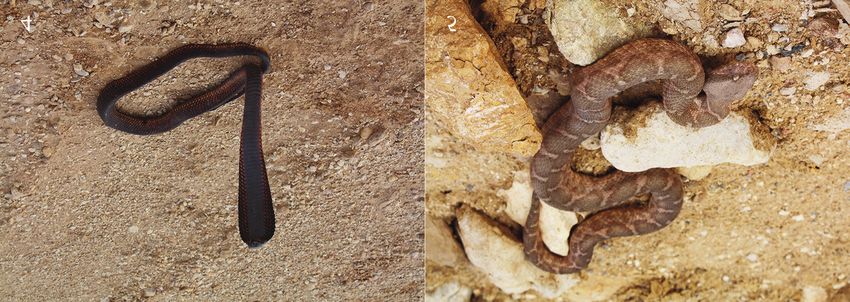
                              Figures 4, 5. Two of the snake species observed at DNP:
                  Naja haje (Linnaeus, 1758) (Fig. 4) and Daboia deserti (Anderson, 1892) (Fig. 5)
216 ERNESTO FILIPPI Table 1. Reptiles list of the Dghoumes National Park (DNP). *T. fascicularis is a new subspecies of T. mauritanica, en- demic to Central Tunisa from Gafsa (Djebel Orbata) in the West to Bou Hedma in the East, south to Degache and Tozeur at the northern banks of Chott al Djérid (Joger & Bshaenia, 2010). **Daboia deserti is included in Daboia following Lenk et al. (2001). It is uncertain that Daboia deserti and D. mauritanica (Gray, 1849) are separate species.
Effects of restoration habitats on snake species of Dghoumes National Park (Tunisia)              217

Table 2. Values of Margalef’s, Berger-Parker, and Seigel’s (1992) index, and numbers of snakes (all species are cumulated;
diversity index comprises the individuals found dead, which are reported in brackets) observed and expected in the study
area. For more details, see the text.

Table 3. Probability (Poisson probability for obtaining the observed value, assuming a Poisson distribution with a mean rate
parameter λinside = 1.05 and λoutside = 0.43 ), expected (Poisson) and observed frequencies of lizard individual/ transect
km inside or outside Dghoumes National Park.

RESULTS                                                            equality, binomial test, p > 0.05) and the fre-
                                                                   quency of observation was 0.05 individuals x
    Snakes composition of DNP is 7 species in total                hour -1). In terms of total length (TL) (males x =
(Figs. 4, 5). The ACE and Chao1 estimator pre-                     60.2 ± 5.8 cm, n = 4; females x = 57.1 ± 6.8 cm ,
dicted seven species each. I summarized, in Table                  n = 6) and snouth vent length (SVL) (males x =
1, the snake species and other reptiles recorded. I                54.3 ± 5.3 cm, n = 4; females x = 52.7 ± 6.2 cm,
captured 23 snakes as a whole: 19 inside and 4 out-                n = 6) no inter-sexual differences was observed
side the National Park. The overall frequency of ob-               in TL (Student t- test, p > 0.05, df = 8) and SVL
servation was 0.099 snakes x hour -1, the inside                   (p = 0.68) with the males attaining a slightly
frequency of observation was 0.14 snakes x hour -1                 longer size than females (p > 0.05). A significant
and the outside frequency of observation was 0.04                  difference was noticed between males and fe-
snakes x hour -1.                                                  males in terms of tail length with the males at-
    Cerastes cerastes (Linnaeus, 1758) is the most                 taining a larger size (p < 0.05).
common snake in this area (n = 12, individuals cap-                    As far as the number of snakes observed in-
tured, n= 6 females, n= 4 males and n = 2 juve-                    side and outside DNP, with the same field effort,
niles). The adult sex ratio (1.5 : 1) was close to                 the number of snakes observed exceeded signifi-
218 ERNESTO FILIPPI
cantly the one expected inside the National Park (χ2 (Moldryk, 2003) and in Djebil NP, which is located
-test Yates correction = 7.50, p < 0.01, df = 1) and 100 km south from DNP and is characterized by de-
was significantly fewer than that expected inside sertic ecosystem, where 4 snakes species were
DNP (χ2 -test Yates correction = 5.65, p < 0.05, df recorded (Joger, 2003).
= 1) (see Table 2). Inside DNP I observed more snake species than
Five individuals, Naja haje (Linnaeus, 1758) (n outside, the frequency of observations and the di-
= 1), C. cerastes (n = 2), Daboia deserti (Anderson, versity index increased, the dominance index de-
1892) (n =1), Hemorrois algirus (Jan, 1863) (n =1) creased and the difference between individual
were found dead by the author or collected by observed and expected was significantly higher.
rangers. The causes of death were different: two There is also a significant difference in A.
were killed by man (N. haje and D. deserti), two boskianus observed, one of the most common prey
were road killed outside the National Park (H. al- of all the snakes in this area.
girus and C. cerastes) and one was killed by N. haje The quantitative analysis and the diversity index
(n = 1) (see Filippi & Petretto, 2013). (though it is necessary to always consider the theo-
The comparison between Berger-Parker, Mar- retical limitations of these index when applied to a
galef’s and Seigel’s index, calculated by using both low number of species as in the study case, see
snakes captured and those found dead, inside and Hubalek, 2000) suggest that the snakes are not in-
outside DNP, is reported in Table 2. dependently and randomly distributed inside and
There is a significant difference in the number outside DNP. Therefore the collected data indicate,
of individuals lacertids observed between all areas though preliminarily, that the actions to restore the
taken as samples (χ2 -test = 13.226, p < 0.01, df = habitat inside DNP have produced positive effects
3), particularly between the areas located inside the on snake species presence and species richness. The
National Park and those located outside the Na- increased availability of food, as seen for lizards,
tional Park (χ2 -test = 10.903, Yates correction, p < refuges, microhabitats and/or thermoregulatory
0.001, df = 1), while there is no significant differ- patches result of the vegetation regeneration could
ence between the two areas outside (χ2 -test = 2, have contributed to this higher snakes species rich-
Yates correction, p > 0.05, df = 1,) and the two areas ness. This is more evident if we consider that the
inside the National Park (χ2 -test = 0.818, Yates cor- analysis of the snakes inside the protected areas
rection, p > 0.05, df = 1). could be partially underestimated since the search
The comparison between the frequency of lizard for snakes is more difficult in some parts of the pro-
individuals observed per km, the expected fre- tected areas which are characterized by a higher
quency and the possibility to obtain the different vegetation density, following the vegetation restora-
frequencies observed are reported in Table 3. tion interventions and lack of overgrazing by do-
mestic livestock.
The results achieved are consistent with previ-
RESULTS ous studies in desertic areas which showed that the
number of invertebrates and lizards is higher in the
The data gathered have allowed to outline a first areas with more vegetation. All this could result in
check list of DNP snakes, an important area in a higher food availability for their predators in the
Southern Tunisia which had not been studied be- different steps of the trophic chain (Sanchez & Par-
fore. The estimators calculated show that this study menter, 2002; Attum et al., 2006).
has probably allowed a total completeness of DNP snakes are subject to a series of threats,
species richness of this area. The number of snake among which car accidents and intentional killing
species of DNP, located in a transition zone between by man. Considering that there is a touristic project
the central steppe region and the desert in the South, in order to develop this protected area and that
is quite consistent with those reported in the two some species are declining in other areas (i.e. cobras
nearest national parks: Bou Hedma National Park, in the National park Bou Hedma see Joger, 2003),
which is located 70 km north from DNP and is char- a particular attention shall be devoted to snakes
acterized by Mediterranean and semi-arid ecosys- safeguard and the correct information campaign on
tem, where 10 snakes species were recorded the importance of these vertebrates.Effects of restoration habitats on snake species of Dghoumes National Park (Tunisia) 219
In conclusion, the present study provides a first species accumulation curves. Ecology, 85: 2717–
check-list of snake species in DNP and represents 2727.
the first attempt to evaluate the effects on snakes of El Ghaïb, 2004. Le Parc National de Dghoumes. In:
habitat restoration in subdesertic areas of Tunisia. IRSNB. 2004. Redéploiement et conservation des
Antilopes Sahélo-Sahariennes en Tunisie Compte-
However, in order to better quantify the effects of
rendu de l’Atelier Technique. Douz, Tunisie 18 et 19
this important phenomenon in subdesertic areas of
avril 2004 version provisoire. Institut royal des Sci-
North Africa it is necessary to carry out further stud- ences naturelles de Belgique, 63 pp.
ies both in the same area and in other places with Filippi E., 2003. The effects of timbering on the commu-
comparable conditions. nity structure of snakes at a Mediterranean area of
central Italy. Amphibia-Reptilia, 24: 75–79. https://
doi.org/10.1163/156853803763806966
ACKNOLEDGMENTS Filippi E. & Petretto M., 2013. Naja haje (Egyptian
Cobra) Diet/Ophiophagy. Herpetological Review, 44:
This research study was funded and supported by 155–156.
Marwell Wildlife (UK). Researches were realized Filippi E., Chetoui A., D’Alterio G.L., Parker G. &
Woodfine T., 2011. Bufo boulengeri: field observa-
under authorization of Direction Generales des
tions on breeding phenology at a new Saharan site in
Forets (Ministere de l’Agriculture et des Ressources Southern Tunisia. Herpetology Notes, 4: 215–217.
Hydrauliques) and the Commissariat Regional de Geist H.J. & Lambin E.F., 2004. Dynamic causal patterns
Developpement Agricole (CRDA) Tozeur, Tunisia. of desertification. BioScience, 54: 817–829. https://
In particular, I would like to thank Gian Lorenzo doi.org/10.1641/0006-3568(2004)054[0817:
D’Alterio, Abdelkader Chetoui, Tim Woodfine, DCPOD]2.0.CO;2
Marie Petretto, Chokri Essaoui, Guy Parker, and all Hillel D. & Rosenzweig C., 2002. Desertification in Re-
the staff of Dghoumes National Park, the Commis- lation to Climate Variability and Change. Advances
sariat Regional de Developpement Agricole in Agronomy, 77: 1–38. https://doi.org/10.1016/S0
(CRDA) Tozeur and the Direction Generales des 065-2113(02)77012-0
Forets (Ministere de l’Agriculture et des Ressources Joger U., 2003. Reptiles and Amphibians of Southern
Tunisia. Kaupia, 12: 71–81.
Hydrauliques) for their precious support and assis-
Joger U. & Bshaenia I., 2010. A new Tarentola (Reptilia:
tance. Let me also thank Maria Luce Del Vecchio Gekkonidae) subspecies endemic to the Tunisia.
(Roma, Italy) for her precious help in writing the Bonn zoological Bulletin, 57: 267–274.
English version. Karem A., Ksantini M., Schoenenberger A. & Waibel T.,
1993. Contribution a la Régénération de la Végéta-
tion dans le Parcs Nationaux en Tunisie Aride. Im-
REFERENCES primerie Arabe de Tunisie.
Hubalek Z., 2000. Measures of species diversity in ecol-
Attum O., Eason P., Cobbs G. & Baha El Din S., 2006. ogy: an evaluation. Folia Zoologica, 49: 241–260.
Response of a desert lizard community to habitat Le Houérou H.N., 2001. Biogeography of the arid step-
degradation: Do ideas about habitat specialists/gen- peland north of the Sahara. Journal of Arid Environ-
eralists hold? Biological Conservation, 133: 52–62. ments. 48: 103–128. https://doi.org/10.1006/jare.
https://doi.org/10.1016/j.biocon.2006.05.017 2000.0679
Bowen B.S. & Kruse A.D., 1993. Effects of grazing on Lenk P., Kalyabina S., Wink M. & Joger U., 2001. Evo-
nesting by upland sandpipers in southcentral North lutionary relationships among the true vipers (Rep-
Dakota. Journal of Wildlife Management, 57: 291– tilia: Viperidae) inferred from mitochondrial DNA
301. sequences. Molecular Phylogenetics and Evolution,
Buckland S.T., Anderson D.R., Burnham K.P., Laake 19: 94–104. https://doi.org/10.1006/mpev.2001.0912
J.L., Borchers D.L. & Thomas L., 2001. Introduction Luja V.H., López J.A., Cruz-Elizalde R. & Ramírez-
to distance sampling. Oxford University Press, Ox- Bautista A., 2017. Herpetofauna inside and outside
ford, 448 pp. from a natural protected area: the case of Reserva Es-
Chpakowsky N. & Chnéour A., 1953. Les serpents de tatal de la Biósfera Sierra San Juan, Nayarit, Mexico.
Tunisie. Bulletin de la Société des sciences naturelles Nature Conservation, 21: 15–38. https://doi.org/10.
de Tunisie, 6: 125–146. 3897/natureconservation.21.12875
Colwell R.K., Mao C.X. & Chang J., 2004. Interpolating, Magurran A.E., 1988. Ecological diversity and its meas-
extrapolating, and comparing incidence-based urement. Princeton University Press, 192 pp.220 ERNESTO FILIPPI Martin J. & Lopez P., 2002. The effect of Mediterranean land-grassland ecotone: a test of island biogeographic dehesa management on lizard distribution and con- theory. Journal of Arid Environments, 50: 247–265. servation. Biological Conservation, 108: 213–219. https://doi.org/10.1006/jare.2001.0920 https://doi.org/10.1016/S0006-3207(02)00107-6 Schleich H.H., Kästle W. & Kabisch K., 1996. Amphib- Olsen D.M., Dinerstein E., Wikramanayake E.D., Burgess ians and Reptiles of North Africa. Koeltz, Koenig- N.D., Powell G.V.N., Underwood E.C., D’Amico stein, 627 pp. J.A., Itoua I., Strand H.E., Morrison J.C., Loucks C.J., Seigel R.A., 1992. Ecology of a specialized predator: Allnutt T.F., Ricketts T.H., Kura Y., Lamoreux J.F., Regina grahami in Missouri. Journal of Herpetology, Wettengel W.W., Hedao P. & Kassem K.R., 2001. Ter- 26: 32–37. restrial Ecoregions of the World: A New Map of Life on Woodfine T., Zahzah K., Chetoui A., Gilbert T. & D’Al- Earth. BioScience 51: 933–938. https://doi.org/10.1641/ terio G.L., 2009. Reintroduction of scimitar-horned 0006-3568(2001)051[0933: TEOTWA]2.0.CO;2 oryx to Dghoumes National Park, Tunisia. Report Sanchez B.C. & Parmenter R.R., 2002. Patterns of shrub prepared for Direction Générales des Forêts, Tunis, dwelling arthropods diversity across a desert shrub- 26 pp.
You can also read


