Enterovirus D68 Epidemic - Updated As of 11/5/14
←
→
Page content transcription
If your browser does not render page correctly, please read the page content below
Enterovirus D68 Epidemic

    Updated As of 11/5/14
Timeline of Events (1)
• August 2014 hospitals in Kansas City, MO and Chicago, IL
notified CDC of increase in severe respiratory illness among
children seen in ED
– Specimens tested positive for rhinovirus/enterovirus
– Enterovirus D68 (EV-D68) identified
– Symptoms included difficulty breathing hypoxemia, and
wheezing
– Age range 6 weeks through 16 yearsTimeline of Events (2)
• September 11, 2014 Bureau for Public Health (BPH) issued
HAN alert
– Reminder that clusters/outbreaks of respiratory illness
shall be reported immediately to local health department
– Standard and contact precautions are recommended for
hospitalized children for duration of illness
• September 12, 2014 CDC issued HAN alert
– Health care providers should consider EV-D68 as possible
cause of acute, unexplained severe respiratory illness
– CDC began accepting specimens from state public health
laboratories for molecular sequencingObjectives of CDC
• Situation is evolving quickly, CDC is trying to better
understand:
– EV-D68 and the illness caused by this virus
– How widespread EV-D68 infections may be and the
populations affected
– Whether other states are experiencing severe respiratory
illness, possibly due to EV-D68Background (1) • Enteroviruses are very common – +100 types – 10 to 15 million infections in the US each year • Enteroviruses can cause respiratory illness, febrile rash, and neurologic illnesses, such as aseptic meningitis and encephalitis • Most infected people have no symptoms or only mild symptoms, but some infections can be serious • Most enterovirus infections occur seasonally during the summer and fall
Background (2)
• EV-D68 infections are thought to occur less commonly than
  infections with other enteroviruses
• EV-D68 was first identified in California in 1962
• Compared with other enteroviruses, EV-D68 has been rarely
  reported in the US
United States (1)
• As of October 30, 2014
    – 1105 cases in 47 states
• Many states are investigating increases in severe respiratory
  illness in children
• Of the more than 2200 specimens tested 40% have been
  positive for EV-D68
• 9 deaths are currently being investigated who tested positive
  for EV-D68
    – The role that EV-D68 infection played in these deaths is
      unclear at this time
    – Investigations are ongoing, however 2 of the deaths were
      caused by EV-D68
United States (2)
• Starting October 14:
a new, faster lab test for detecting EV-D68, allowing
CDC to rapidly process specimens
• As a result, the number of confirmed EV-D68 cases has
increased substantially and will likely continue to increase in
the coming days
• These increases will not reflect actual changes or mean the
situation is getting worse.
Faster testing will help to better show the trends of this
outbreak since August and to monitor changes occurring in
real timeWest Virginia • WV is among one of the states with confirmed EV-D68 • A total of 62 specimens from the State Laboratory/WHO Lab have been sent to CDC from WV since 10/6/14 • 12 out of 62 were positive for EV-D68 • Other viruses identified include: rhinovirus A and C, and coxsackievirus A and B • No deaths have been reported in WV
Acute Neurologic Illness of
          Unknown Etiology
• Cluster of focal acute neurologic illness detected by the
  Colorado Department of Health
• Symptoms included: extremity weakness, cranial nerve
  dysfunction (e.g., diplopia, facial droop, dysphagia, or
  dysarthria), or both
• None of these children experienced altered mental status or
  seizure
• 4 out of 8 positive for EV-D68
• October 3, 2014 WV BPH Commissioner ordered reporting of
  any patient neurologic illness immediately to LHD
• It is unclear at this time if there is a direct association
  between the acute neurologic illness and EV-D68 or just a
  coincidence
County of Residence of Positive EV-D68 Cases in WV as of 11/5/14, n=12
HANCOCK
BROOKE
OHIO
MARSHALL
WETZEL MONONGALIA
MORGAN
MARION
TYLER PRESTON BERKELEY
PLEAS- MINERAL
ANTS TAYLOR
HARRISON HAMPSHIRE JEFFERSON
DODD-
WOOD RITCHIE RIDGE BARBOUR TUCKER GRANT
HARDY
WIRT LEWIS
GILMER
JACKSON CAL- UPSHUR
HOUN RANDOLPH
MASON ROANE BRAXTON
PENDLETON
WEBSTER
PUTNAM CLAY
CABELL
KANAWHA
NICHOLAS
POCAHONTAS
LINCOLN
WAYNE
BOONE FAYETTE
GREENBRIER
LOGAN RALEIGH
MINGO
WYOMING
SUMMERS MONROE
MCDOWELL MERCEREV-D68 Like-Illness Surveillance
EV-D68 Testing Criteria(1)
WV State Public Health Laboratory is accepting specimens for
testing:
1. Outbreaks and clusters of respiratory illness
2. Hospitalized patients with severe unexplained respiratory
     illness
3. Hospitalized patients with severe respiratory illness who test
     positive for enterovirus
4. Hospitalized patients < 21 years of age
   – Acute onset of focal limb weakness occurring on or after
         August 1st
   – MRI showing spinal cord lesion largely restricted to gray
         matter
EV-D68 Testing Criteria (2) • Hospitals must coordinate testing with their local health department • Patient summary form must be completed for all specimens submitted • EV-D68 can only be diagnosed by doing specific lab tests on specimens from a person’s nose and throat • Nasopharyngeal swabs are recommended for diagnosis • Many hospitals and some doctor’s offices can test sick patients to see if they have enterovirus infection • However, most cannot do specific testing to determine the type of enterovirus, like EV-D68
People At Risk
• Infants, children and teenagers are most likely to get infected
  with enteroviruses and become sick
• Adults can get infected with enteroviruses, but they are more
  likely to have no or mild symptoms
• Children with asthma may have a higher risk for severe
  respiratory illness caused by EV-D68
Transmission
• EV-D68 is a respiratory illness that can be found in respiratory
  secretions such as saliva, nasal mucus, or sputum
• Virus likely spreads from person to person when an infected
  person cough, sneezes, or touches a surface that is then
  touched by others
Treatment
• There is no specific treatment for people with respiratory
  illness caused by EV-D68 infection
    – For mild respiratory illness, you can help relieve symptoms
      by taking over-the-counter medications for pain and fever
    – Aspirin should not be given to children
    – Some people with severe respiratory illness caused by EV-
      D68 may need to be hospitalized and receive intensive
      supportive therapy
• There are no antiviral medications are currently available for
  people who become infected with EV-D68
Prevention • Persons should stay home if they are ill • Wash their hands often with soap and water • Avoid close contact (such as touching and shaking hands) with those who are ill • Cover your coughs and sneezes with a tissue or shirt sleeve, not your hands • Clean and disinfect frequently touched surfaces • Children are not recommended to be excluded from school unless they are febrile or generally does not feel well
What is WV Doing
• WV continues to collect information on hospitalized patients
  with severe unexplained respiratory illness
• WV is accepting specimens to the state public health
  laboratory for hospitalized patients and outbreaks for
  diagnostic and molecular typing for EV-D68
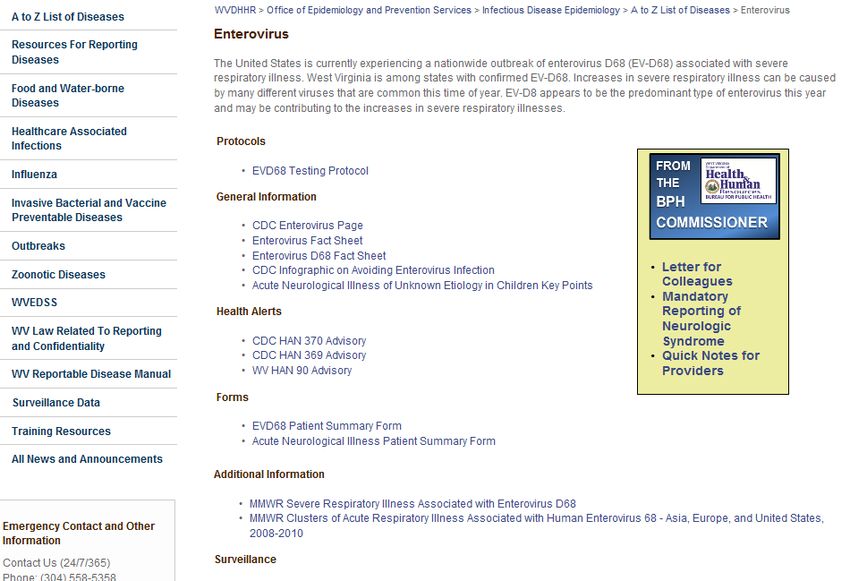
• We have posted information on EV-D68 on our website with
  resources at:
  http://www.dhhr.wv.gov/oeps/disease/atoz/pages/enteroviru
  s.aspx
Website
For Additional Information
     Please Contact
        304-558-5358
You can also read


