Training Session for Programs of All-Inclusive Care for the Elderly (PACE) Organizations - Part D Coordination of Benefits - CMS
←
→
Page content transcription
If your browser does not render page correctly, please read the page content below

Training Session for Programs of All-Inclusive Care for the Elderly
                       (PACE) Organizations

                                         Part D Coordination of
                                         Benefits

                                         Center for Medicare,
                                         Medicare Drug Benefit
                                         Group

                                         December 1, 2016
Presentation Topics

1. Introductions
2. What are the Part D Coordination of Benefits
   (COB) requirements?
3. 1/3 Audit, Common Findings for PACE
   Organizations (POs)
4. TrOOP Refresher
5. How do POs comply with Part D COB
  – Best Practices
  – Acceptable Alternatives
6. Other topics of Interest?
Introductions

•   Shelly Winston, CMS, Part D COB
•   Monique Irmen, RelayHealth
•   Joscelyn Lissone, CMS Part D COB
•   Stephanie Hammonds Ho, CMS Part D Policy
•   Jasmine Myers-Duncan, CMS Part D Division of
    Benefit Purchasing and Monitoring
What are the Part D Coordination of
Benefits (COB) Requirements?
• All Part D plans, including POs are
required to coordinate with other
payers of prescription drug coverage.
• Sponsors are required to transfer
TrOOP (true out-of-pocket) and gross
covered drug cost balances
whenever a beneficiary changes Part
D sponsors during the coverage year.
• These data are required for the new
sponsor to correctly position the
beneficiary in the benefit.
1860D-24(a) of the Social Security ActWhile CMS requires COB, it is only required if certain
conditions exist
Part D plans must coordinate benefits if the supplemental payer* follows the
CMS-approved industry defined electronic process
• Supplemental payer must have:
– Electronic eligibility submitted to CMS; and
– Electronic transactions that contain supplemental payer payment
information (batch is allowed)
• A Part D drug:
– meets the definition of a Part D Drug;
– is paid for by the Part D Plan (on the plans formulary, covered under
transition or via an appeal/grievance); and
– is purchased at a Part D Plan network pharmacy (Out-of-Network only in
special circumstances)
*such as State Pharmaceutical Assistance Programs, AIDS Drug Assistance Programs,
Medicaid, TRICARE, Veteran’s Administration (VA), group health plans, Workers’
Compensation, Auto/Life/Liability Insurance, Commercial group health plans, etcCOB Timeframes
(42 CFR 423.466)
Retroactive adjustments
Sponsors are required to make retroactive claims
adjustments and issue refunds or recovery notices within
45 days of the sponsor’s receipt of complete information.
COB time limit
Sponsors are required to coordinate benefits with other
entities providing drug coverage, and non-network payers
(such as beneficiaries and others paying on the
beneficiaries’ behalf) for a period not to exceed 36 months
from the date of fill for a covered Part D drug.1/3 Financial Audit, Common Findings
for PACE Organizations (POs)
• TrOOP miscalculations
• Failing to use CMS TrOOP calculator, or using
calculator for the incorrect year
• Lack of notice to departing beneficiaries
• Non-TrOOP eligible payments included in
TrOOP calculationsWhy do TrOOP Balance Transfers
Matter
• Sponsors are required to transfer TrOOP and
gross covered drug cost balances whenever a
beneficiary changes Part D sponsors during
the coverage year.
– These data are required for the new sponsor to
correctly position the beneficiary in the benefit.Standard Benefit 2017
Total Spending
Catastrophic Coverage
$400 ICL $3,700 OOPC $7,425
D
e CoverageManufacturer
Gap
d Discount
75% Plan Pays
50% (Brand)
u 75% Plan Pays 51%
c Coins 80% Reinsurance
t (Generic)
i
b 40%
l 49% Plan Coinsur.
e Pays (Brand)
(Generic)
25% Coinsurance
10% Plan Pays
(Brand)
$400 $4,950 TrOOP
15% Plan Pays 5% Coinsurance
Beneficiary Direct Subsidy/ Medicare Pays
Liability Beneficiary Premium ReinsuranceStandard Benefit Across Time
Year Deductible ICL OOPC TrOOP
2012 $320 $2,930 $6,657.50 $4,700
2013 $325 $2,970 $6,733.75 $4,750
2014 $310 $2,850 $6,455 $4,550
2015 $320 $2,960 $6,680 $4,700
2016 $360 $3,310 $7,062.50 $4,850
2017 $400 $3,700 $7,425 $4,950
Total Drug SpendTrOOP Refresher • What counts towards TrOOP? • Why does it matter? – Part D Requirements – Protects the Beneficiary from Additional Costs • Impact of Retroactivity
Which Payments Count Towards TrOOP
 Payments for covered prescription drugs paid for by:

TrOOP eligible:                  Non-TrOOP eligible
• Beneficiary, family, friends
                                 • What Part D plan pays
• SPAPs/ADAPs
• Medicare Extra Help (LIS)      • Premiums
• Indian Health services         • Drugs purchased
• Most charities                   abroad
• Manufacturer payments
  under Coverage Gap             • Over the counter drugs
  Discount Program               • Payments reimbursed
• Beneficiary payments             by other insurance
  from HSAs, FSAs, MSAs
                                   companies
How Does your Plan Pays for Drugs Covered under PACE?
• Real-time electronic transactions (NCPDP standard)
• Direct billing from the pharmacy to you
– Invoice
– Data file
• Does the plan have a copay?Basic TrOOP Requirements for POs • When a beneficiary enters a PACE plan, the plan should receive the beneficiary’s EOB • No TrOOP calculation when beneficiary is in PACE • When beneficiary leaves PACE, TrOOP must be calculated. Calculation must include: – supplemental payments, – costs for beneficiary before entering PO • Report values to beneficiary and new Part D plan • Non-qualified supplemental payments must reduce TrOOP • If supplemental payer has paid against the copay (such as SPAP/ADAP) and the copay amount changes retroactively (due to LICS level change), the PACE must reimburse the supplemental payer.
How does a PACE Organization receive
supplemental coverage information?
 • Other Health Insurance Eligibility File (COB
   File)
   – Separate file that must be uploaded to the Part D
     Enrollment information in the PACE and PBM
     system
 • From the beneficiary
   – PACE must update information, if other than
     SPAP/ADAP in Electronic Correspondence Referral
     System (ECRS)
How do PACE Organizations Comply?
• Communicating TrOOP amounts
• Coordinating with supplemental payers
• Identify and manage beneficiaries
• Business Associates Agreement (BAA)
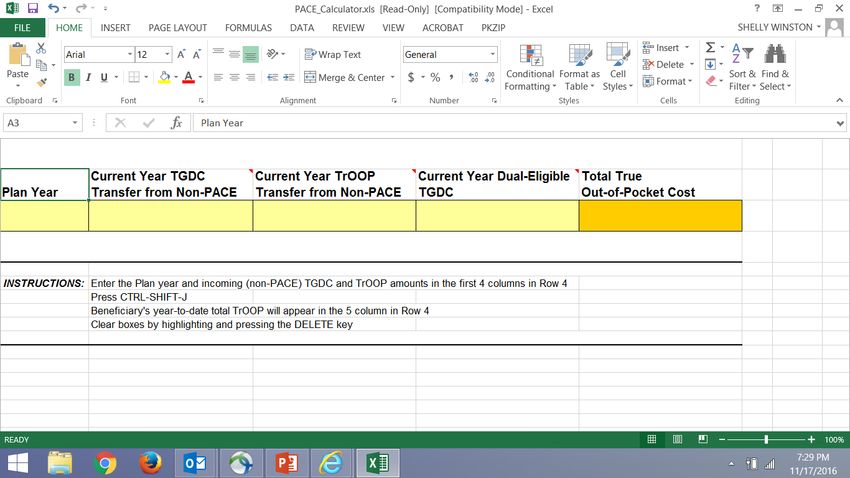
16PO Calculator on cms.gov
Communicating amounts to Beneficiary

Best Practice (s)                  Acceptable Alternative (s)
• Participate in ATBT              • Manually Coordinate
• Accept and Process “N”
  transactions
                                     payments with
• Automated Coordination of          supplemental payers and
  payments with supplemental         track amounts as needed
  payers and track amounts as
  needed
                                   • Give beneficiary sample
• Give beneficiary sample            “Notice of Benefit
  “Notice of Benefit Information     Information for Your New
  for Your New Medicare              Medicare Prescription
  Prescription Drug (Part D)
  Plan” form                         Drug (Part D) Plan” form

       18
Identify and Manage Beneficiary
Best Practice (s) Acceptable Alternative (s)
• Dedicated BIN/PCN • Communicate enrollee
• Communicate enrollee information to CMS
information to CMS • Ensure that beneficiary
• Ensure that beneficiary information includes
information includes any OHI
any OHI
19Business Associates Agreement (BAA)
Best Practice (s) Acceptable Alternative (s)
Active signed BAA with
TrOOP facilitator NONE
20Critical Players in Part D COB Part D Transaction Facilitator (formerly TrOOP Facilitator)- Responsible for transmitting supplemental claims payment to the Part D plan using an industry and CMS defined set of rules National Council for Prescription Drug Programs (NCPDP) - the organization that sets the standards for transactions used in Part D COB Contractor- Currently, Group Health Inc (GHI), an Emblem Company that receives health insurance and prescription insurance information from payers/plans/beneficiaries that offer coverage to Medicare Part D beneficiaries Part D plan sponsors – plans approved by the Centers for Medicare and Medicaid Services to offer Part D Prescription Drug coverage Supplemental Payers Pharmacies
Transaction Facilitation Services-
    RelayHealth as a CMS contractor
• Eligibility (E1) transactions
    – Part D
    – Other Health Insurance
•   TrOOP Balance Transfer (FIR) transactions
•   Supplemental Payer Payment (Nx) transactions
•   Reporting
•   Compliance Support
•   Industry Support
•   NCPDP Leadership/Participation
In what instances would a
supplemental payer pay after PACE?
• The drug is not on formulary,
• The drug is not a Part D drug,
• The PACE organization has a copay, or
• The drug was not billed to the PACE
organizationExample -
PACE Success Story
• Case Study:
– $0 copay PACE received an N transaction, but did
not have a Part D paid claim for the beneficiary
– Year prior, beneficiary was enrolled in an MAPD
and a SPAP
– Claim was billed to the old plan which rejected it.
– Claim then billed to supplemental payer when
claim should have been billed to PACE.
– PACE was tracking the N and intervened.Where to go for help with N and FIR
transactions
• Your PBM should be first resource
• Questions about N transactions (record of
supplemental payment) and reports or FIR
transactions (automated TrOOP balance Transfer)
are often answered in NCPDP task group calls
• Contact Kittye Krempin at kkrempin@ncpdp.org
and ask her to join the calls. You can also request
a mentor on the call.Resources for PACE Organizations
• Part D COB
– PartD_COB@cms.hhs.gov, or Chapter 14 of the Medicare Prescription Drug Manual
• PDE Submission Questions
– PDEJan2011@cms.hhs.gov
• HPMS Help Desk
– hpms@cms.hhs.gov
• DMAO Portal
― https://dmao.lmi.org
• PACE Regulation
– https://www.gpo.gov/fdsys/granule/CFR-2009-title42-vol4/CFR-2009-title42-vol4-
part460
• Proposed PACE Regulation
https://www.federalregister.gov/documents/2016/08/16/2016-19153/medicare-and-
medicaid-programs-programs-of-all-inclusive-care-for-the-elderly-pace
• PACE Manual
– https://www.cms.gov/Regulations-and-Guidance/Guidance/Manuals/Internet-
Only-Manuals-IOMs-Items/CMS019036.html
• PACE Information on CMS website
— https://www.cms.gov/Medicare/Health-Plans/PACE/Overview.htmlFeedback • Questions? • Other Topics of Concern?
You can also read


