Future Challenges for Smart Specialisation - Peter Berkowitz, Directorate General for Regional and Urban Policy, European Commission
←
→
Page content transcription
If your browser does not render page correctly, please read the page content below

Future Challenges for Smart Specialisation

Peter Berkowitz, Directorate General for Regional and Urban Policy,
European Commission

                                                              30 June 2021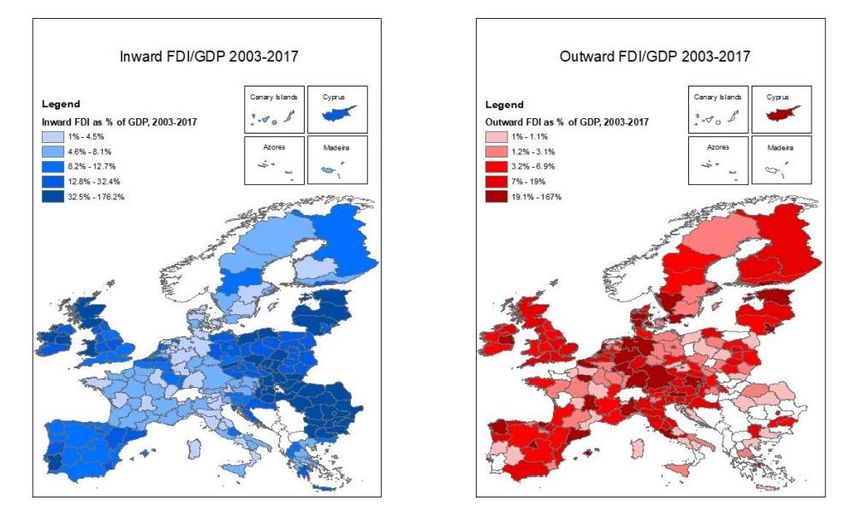
Why do we have smart specialisation in Cohesion Policy?

Europe’s innovation divide
Cohesion policy is the main source to address innovation divide

             DG REGIO Calculations
Designing transformative solutions

                                                                                                                      A time of transitions
                                               Transforming the                                                       •   Industrial
                                                                                                                      •   Digital
                                               EU’s economy for a
       Increasing the EU’s Climate             sustainable future             A zero pollution ambition
       ambition for 2030 and 2050                                            for a toxic-free environment
                                                                                                                      •   Demographic
  Supplying clean, affordable
      and secure energy
                                                        The                         Preserving and restoring
                                                                                  ecosystems and biodiversity
                                                                                                                      •   Climate
                                                     European
                                                      Green
                                                       Deal
                                                                                                                      •   Environment
        Mobilising industry                                                    From ‘Farm to Fork’: a fair, healthy
for a clean and circular economy                                               and environmentally friendly food      •   Educational
                                                                                            system

       Building and renovating in an                                         Accelerating the shift to
                                                And leaving
     energy and resource efficient way                                    sustainable and smart mobility
                                                no one behind

                                               Designing a set of
                                         deeply transformative policies
Enabling condition for smart specialisation

                 Policy objective                 Specific objective        Name of enabling condition

      1. A more competitive and smarter ERDF:
      Europe by promoting innovative and Specific objectives 1.1 and Good governance of national or regional
      smart economic transformation and 1.4    under this policy smart specialisation strategy
      regional ICT connectivity          objective

                                    Fulfilment criteria for the enabling condition

       Smart specialisation strategy(ies) shall be supported by:
      1. Up-to-date analysis of challenges for innovation diffusion and digitalisation
      2. Existence of competent regional / national institution or body, responsible for the
         management of the smart specialisation strategy
      3. Monitoring and evaluation tools to measure performance towards the objectives of the
         strategy
      4. Functioning of stakeholder cooperation (“entrepreneurial discovery process”)
      5. Actions necessary to improve national or regional research and innovation systems, where
         relevant
      6. Where relevant, actions to manage industrial transition
      7. Measures for enhancing cooperation with partners outside a given Member State in priority
         areas supported by the smart specialisation strategy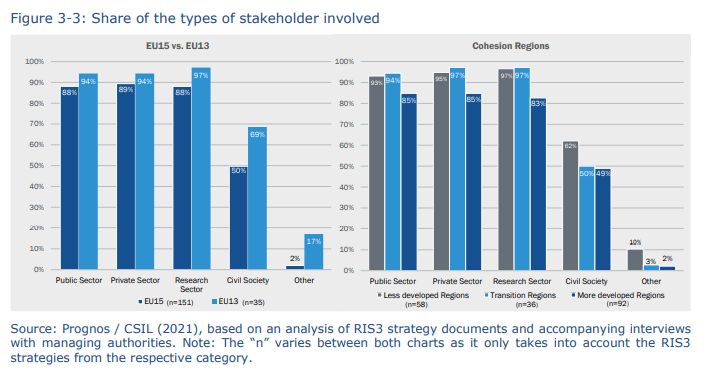
What needs to be done?
1. Involve a broader range of stakeholders

    Source: Study on prioritisation in S3 in the EU, Prognos/CSIL (2021)
2. Make the EDP more operational
Source: Study on prioritisation in S3 in the EU, Prognos/CSIL (2021)3. Improve Prioritisation
Prioritisation
All regions Less Transition More
developed developed
Total 1014 325 189 500
Average per region 5.5 5.6 5.4 5.4
Median 5.0 6 5 5
Range: MIN – MAX 2 -15 2 – 15 2–8 2 – 15 Directionality
Table 0-1 (ex. sum.): Number of priority areas of the RIS3 strategies in Member States/regions (latest RIS3 strategy year)
Source : Prognos / CSIL (2021). Note : n=185 regions. Mobility &
Logistics Social Innovation &
7% Welfare, 1%
Tourism, Cultural &
Materials & Energy & Other, Creative
Alignment of Project Selection Advanced Energy Storage
1%
Industries
9%
Manufacturing 7%
11%
84% Construc-
60% tion, 2% Agrofood &
Aerospace & Bioeconomy
Defense, 2%
50% 52% CleanTech &
21%
ICT & Industry 4.0 CE, 4% Blue
40% 15% Growth,
3%
Fashion,
30%
Media &
Creative Ind.
Health & Life
4%
20%
Sciences
18%
16% 15% Legend: Only single assignments. One priority
10% 14% area was assigned to one topic. n = 997
0%
S3 alignment as an eligibility condition - S3 alignment as a preferential criterion in S3 alignment as an eligibility condition - No specific alignment criteria
substantial the selection process formal
n=2324
Source: Prognos / CSIL (2021).4. Strengthen the research and innovation ecosystem: links with the European Semester Country Report 2020 • Poland is taking measures to enhance the economy’s innovative capacity, but a significant rise in innovative outputs is still to materialise. • Polish companies, particularly small ones, show a slow uptake of digital technologies. • Poland is introducing measures to improve its scientific performance. • The potential of cooperation between science and business remains underexploited. The role of technology transfer centres in the process of innovation diffusion remains limited.
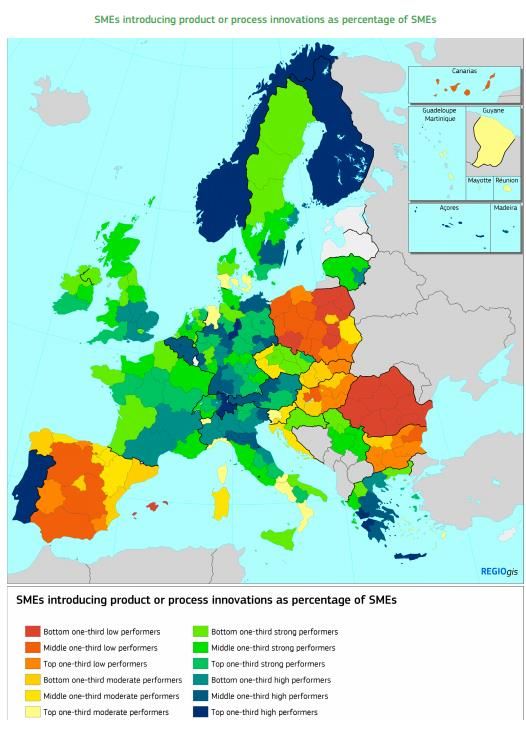
5. Increase focus on Innovation diffusion

                                        SMEs introducing
                                        product and process
                                        innovations

                                  Source: Regional Innovation Scoreboard 2019, EC (2019)
6. Improve FDI spillovers and GVC integration
Source: Study on FDI, GVC and regional economic development
for DGREGIO, Commotti/Crescenzi/Iammarino (2020)7. Build on complementary specialisation capabilities
Maps on relatedness
for 7 key technologies,
showing for each
region top 5 regional
matches. For example
for batteries for the
Dresden (DED2) region
Chemnitz, Stuttgart,
Arnsberg, Mittel-
franken and
Malopolskie are the 5
best regional matches.
https://paballand.github.io
/4-relatedness-top-
matches-nuts2-
Batteries.htm
Source: Balland/Boschma study `beyond patents´ for REGIO (2020)8. Prepare for Interregional Innovation Investments – 570m Euro Strand 1 - Financial and Advisory Support for Investments in Interregional Innovation projects • Supporting partnerships to connect demand and supply side to accelerate interregional innovation investments in shared Smart Specialisation priority areas. • Starting from concrete business cases, support to the development of portfolios of projects by selected partnerships. • It might include connecting, developing or making complementary use of testing and demonstration facilities to accelerate market uptake and scale up innovative solutions Strand 2 - Financial and Advisory Support for the development of value chains in less developed regions • Increasing the capacity of regional innovation eco-systems in less developed regions to participate in global value chains as well as the capacity to co-invest in partnerships with other regions. • Creating linkages between less developed regions with those in lead regions. • Focus on foreign direct investment, (FDI) driven value chains & other emerging sectors.
9. Strengthen policy synergies

                                                 Pillar 2                                                         Policy Objective 1
   Pillar 1                                                                           Pillar 3                    A more competitive and smarter Europe by
   Excellent Science                             Global Challenges and                Innovative Europe
                                                 European Industrial                                              promoting innovative and smart economic
                                                 Competitiveness                                                  transformation and regional ICT connectivity

                                                 • Health                                                          Developing and enhancing research and
  European Research Council                      • Culture, Creativity and          European Innovation Council
                                                                                                                   innovation capacities and the uptake of
                                                   Inclusive Society                                                       advanced technologies
                                                 • Civil Security for Society
   Marie Skłodowska-Curie             Clusters   • Digital, Industry and Space          European innovation
                                                                                                                    Reaping the benefits of digitisation for
                                                 • Climate, Energy and                      ecosystems
           Actions                                                                                                      citizens, companies, research
                                                   Mobility                                                          organisations and public authorities
                                                 • Food, Bioeconomy, Natural
                                                   Resources, Agriculture and           European Institute of
                                                                                                                      Enhancing sustainable growth and
                                                   Environment                              Innovation
   Research Infrastructures                                                                                       competitiveness of SMEs and job creation
                                                                                          and Technology
                                                                                                                   in SMEs, incl. by productive investments
                                                   Joint Research Centre
                                                                                                                  Developing skills for smart specialisation,
                                                                                                                  industrial transition and entrepreneurship
          Widening Participation and Strengthening the European Research Area
                                                                                                                        Enhancing digital connectivity
  Widening participation and spreading excellence              Reforming and Enhancing the European R&I system
10. Use smart specialisation as basis for synergies
• Partnership Agreements and programmes have to take into account relevant 2019
country specific recommendations when selecting policy objectives (Art. 8(a)
and 17(3)(a)(iii) Common Provisions Regulation (CPR))
• Partnership Agreements have to set out arrangements for using the CPR Funds in
an effective and efficient manner and complementarities between the shared
managed Funds and other Union instruments (Art. 8(b)(ii) CPR).
• Smart Specialisation Strategies are key to synergies with Horizon Europe,
Single Market Programme, Digital Europe Programme and other EU smart growth
related instruments.
• S3 "Entrepreneurial Discovery Process" should bring together the industry and research and
innovation "communities" (and other relevant stakeholders).
• S3 priority setting facilitates finding partners in other MS for cooperating on related topics and
value chains. (Annex IV to CPR)11. Develop new tools for smart specialisation
Strengthen Monitoring and evaluation
• Improve information collection systems
• Make data more available
• Make use of innovative methodologies – ex-ante and ex-post counterfactual impact
evaluation
Capitalisation of knowledge about governance and EDP
• Extensive knowledge has been generated, need to ensure transferability
• Link with effectiveness
Policy tools for industrial transition, innovation diffusion, value chains
• Need for new policy frameworks – green innovation, local industrial policy, socially
inclusive growth
• Anticipation of effects of disruptive technologies
Does smart specialisation work?
• Related versus unrelated diversification?
• Do strategies reflect scientific, economic or technology structures? Are they used?
• Have smart specialisation strategies made a difference? Does targeting work?Thank you! Regional and Urban
You can also read


