IRC Work Programme (D3.2) - Luca Montanarella (European Commission-JRC) This project has received funding from the European Union's Horizon 2020 ...
←
→
Page content transcription
If your browser does not render page correctly, please read the page content below
IRC Work Programme (D3.2)
     Luca Montanarella (European Commission-JRC)

This project has received funding from the European Union's Horizon 2020 research and innovation programme
                                      under grant agreement No 774378
                                                                                                        1
WP3. Facilitating the establishment of an
International Research Consortium (IRC)
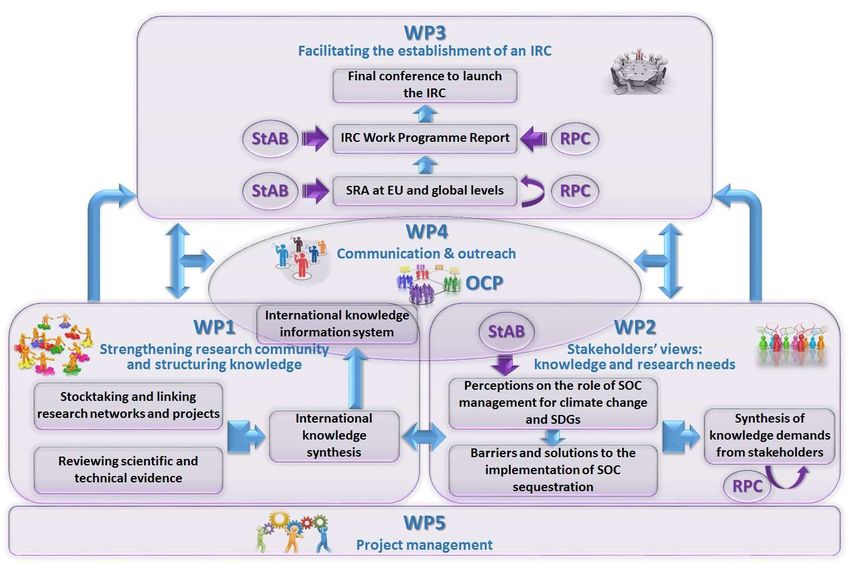
Building on the outcomes of WP1 and WP2
1. Co-design a 2020-2025 Strategic Research Agenda with
support of the Stakeholder Advisory Board and Research
Policy Committee.

2. Explore activities, resources and governance for an IRC
on agricultural soil carbon and draft a work plan.

3. Organize preparatory meetings for this IRC, prepare
the implementation plan and, if possible, the launch.

CIRCASA – Part B

3      I mplementation
 3.1     Work plan – Work packages and deliverables.
       3.1.1   Overall structure of the work plan

Figure 7. Overall structure of the CIRCASA work plan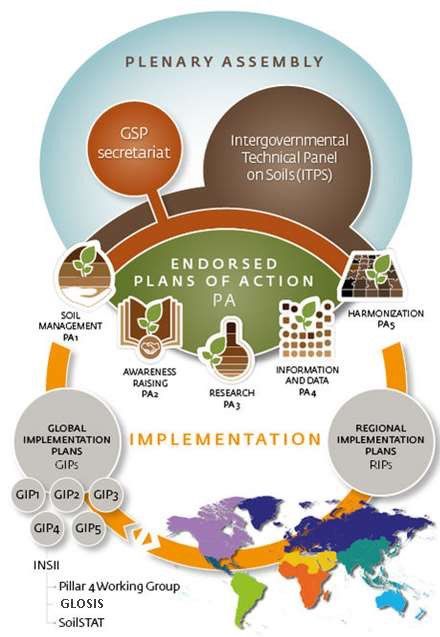
Create an International Research Consortium on SOC (WP3)

  • Belmont forum pre-program on ‘Soil Health’
  • European Joint Program, Agricultural Soils, with International calls
  • EC Horizon Europe Mission planned on Land degradation and Soil
    Health
   => CIRCASA Research Policy Committee: Explore activities,
   resources and governance for an International Research
   Consortium (IRC) on agricultural soil carbon and draft a work plan.
   The Global Soil Partnership (GSP), the GRA, FACCE-JPI and the 4 per 1000
   initiative will greatly facilitate this task, allowing the CIRCASA IRC to be
   embedded into a broader soil and agricultural research context.
Soil carbon as a cross-cutting theme between food security,
        climate change, desertification and biodiversity

Food Security                                 Climate Change

                                                   IPCC

                   CIRCASA      Global Research
                                Alliance on
                                Agricultural

                     IRC
                                Greenhouse Gases

     IPBES

                 CBD
                                   UNCCD
 Biodiversity
                                                   Desertification
Existing examples of IRCs

3 June 2019                    6
Pillar 4 - GIP
   The International
    Network of Soil
      Information
 Institutions (INSII) is
the backbone of Pillar
4 and is supported by
  a technical working
      group of soil
 information experts
        (P4WG).
Pillar 3: Promote targeted soil research and development
             focusing on identified gaps, priorities and synergies with
             related productive, environmental and social development
             actions
Chair: Ms. Natalia Rodríguez Eugenio (GSP Secretariat,
Natalia.RodriguezEugenio@fao.org )
Secretary: Mr. Ronald Vargas

                Africa: Mr. Martin Yemefack (Cameroon)

                Asia: Mr. Kazuyuki Yagi (Japan)

                Europe: Coen Ritsema (The Netherlands) / Gergely Tóth (Hungary)
                Eurasia: Svyatoslav Baliuk

                Central America, Caribbean and Mexico: Mr Carlos Henriquez (Costa Rica)

                Near East and North Africa: Mr. Bahram Taheri (Iran)

                North America: Mr. Jerry Hatfield

                South West Pacific: Mr. David J Hunter, Samoa
« 4 per 1000 » Africa Symposium
                                   Johannesburg, 24-26th October 2018

The 4°/oo Initiative
                         4 working axis organized in 2 parts
                         Action Plan
                         • A multi-stakeholder platform to facilitate
                           partnerships
                         • A tool to expertise and evaluate projects
                           based on a set of references and indicators
                         Scientific Program
                         • An international research and scientific
                           cooperation program
                         • A digital resources center on carbon in
                           soils

         With the support of
« 4 per 1000 » Africa Symposium
                                       Johannesburg, 24-26th October 2018

   Main deliverables since 2016
• Installation of the Executive Secretariat
• Adoption by the Consortium upon the STC proposal of:
    • a set of reference criteria for the evaluation of
      projects and actions
    • orientations of the international scientific
      research and cooperation program
• Opening of the website « 4 per 1000 »
• Opening of the collaborative platform
• Adoption of a communication plan
• Development of cooperation on SCS

             With the support of
« 4 per 1000 » Africa Symposium
Johannesburg, 24-26th October 2018
The Four pillars of the
International Research and Scientific Cooperation Program
1st Pillar: Estimating the potential of soil carbon
sequestration and associated benefits
2nd Pillar: Developing practices adapted to specific soil
and climate conditions
3rd Pillar: Define and strengthen the enabling
environment
4th Pillar: Monitoring, reporting and verification
of soil carbon
With the support ofWP3 Description of work (JRC) • T 3.1 Developing a Strategic Research Agenda at EU and global levels (INRA) • T 3.2 Mapping IRC activities, resources and governance (JRC) • T 3.3 Preparing for the establishment of an IRC (EI)
T 3.2 Mapping IRC activities,
    resources and governance (JRC)
• A survey will identify the views from major institutions
  potentially involved and the modes in which they would
  like to contribute to IRC activities, resources and
  governance. Based on this survey, and on consultations
  with potential partners, with the RPC and the StAB and
  on participating initiatives, including GSP, GRA, FACCE-
  JPI and the 4 per 1000, the Executive Committee
  (ExCom) will produce a report presenting
  recommendations for the set-up of an IRC on SOC
  sequestration in agriculture. This will lead to the
  formulation of a draft IRC work program that will be
  submitted for revision to the RPC.
Objectives and deliverables of the
STAR-IDAZ International Research
Consortium (IRC):
The overall objective of STAR-IDAZ IRC is
to coordinate research at international
level to contribute to new and improved
animal health strategies for at least 30
priority diseases/infections/issues
The deliverables include :
• candidate vaccines, and/or
• diagnostics, and/or
• therapeutics and other animal health
products, and/or
• procedures and/or
• key scientific information/tools to
support risk analysis and disease
controlEntry ticket
Individual STAR-IDAZ IRC Programme
Owners/Funding Bodies
• To be considered as a member of the STAR-IDAZ IRC
the programme owner/funding body, whether a
member of STAR-IDAZ or not, should commit a
minimum of $10 million over 5 years for future
funding of research projects/programmes contributing
towards STAR-IDAZ IRC objectives. Each funding
body can nominate one representative to the
Executive Committee.
15Partners who have joined, to date, the IRC include: 1. Danish National Veterinary Institute (DTU Vet), Denmark 2. National Institute of Agricultural Research (INRA), France 3. The French Agency for Food, Environmental and Occupational Health & Safety (ANSES), France 4. Ministry of Health, Italy 5. Ministry of Economic Affairs (MinEZ), The Netherlands 6. National Institute for Agriculture and Food Research and Technology (INIA), Spain 7. Department for the Environment, Food and Rural Affairs (Defra), UK 8. Biotechnology and Biological Science Research Council (BBSRC), UK 9. Regional Consortium; Universiteit Gent (Ghent University), Université de Liège, the Federal Public Service Health, Food Chain Safety and Environment (unit Contractual Research) and CODA-CERVA (Veterinary and Agrochemical Research Centre) 10. Kimron Veterinary Institute, Israel 11. International Livestock Research Institute (ILRI), Kenya 12. Tanzania Veterinary Laboratory Agency (TVLA), Tanzania 13. National Institute of Animal Health, National Agriculture and Food Research Organisation (NIAH), Japan 14. Agriculture Research Services, United States Department of Agriculture (USDA ARS), US 15. National Institute of Agriculture Technology (INTA), Argentina 16. Ministry of Science, Technology and Productive Innovation (MINCYT), Argentina 17. Canadian Food Inspection Agency (CFIA), Canada 18. World Organisation for Animal Health (OIE) 19. Zoetis 20. Bill and Melinda Gates Foundation (BMGF) 21. HealthforAnimals (Global Animal Medicines Association) 22. Diagnostics for Animals (Veterinary Diagnostics Manufacturers) (formerly EMVD) 23. European Commission 24. Regional Consortium; Nigerian Animal Health Research Network led by National Veterinary Research Institute Vom 25. National Advisory Council on Animal Health (CONASA) and the National Autonomous University of Mexico (UNAM), Faculty of Veterinary Medicine and Zootechnics (FVMZ)
LC-SFS-20-2019: European Joint Programme on agricultural soil management fostering understanding of soil management and its influence on climate mitigation and adaptation, sustainable agricultural production and environment; understanding how soil carbon sequestration can contribute to climate change mitigation at regional level including accounting for carbon; strengthening the scientific cooperation at European level including training of young scientists; development of agreed knowledge base and database for European contribution towards international reporting; contributing to the European Soil Data Centre with harmonized European soil information for international reporting.
Deliverables

• D 3.1 Strategic Agenda at EU and global levels
  (M30)
• D 3.2 IRC Work Programme report presenting
  recommendations for the set-up of an IRC on soil
  carbon sequestration in agriculture (M36)
• D 3.3 Final conference organized in Brussels and
  conference proceedings (M36)
Thank you for your attention!

Follow us on Twitter! @CIRCASAproject
Visit our website www.circasa-project.eu

                              This project has received funding
                                 from the European Union's
                                 Horizon 2020 research and
                                   innovation programme
                                 under grant agreement No
                                           774378

                                                             19
You can also read


