Global Education First Initiative
←
→
Page content transcription
If your browser does not render page correctly, please read the page content below
Global Education
First Initiative
AN INITIATIVE OF THE UNITED NATIONS SECRETARY-GENERAL
Global Education First Initiative
       The United Nations Secretary-General’s
initiative to ensure quality, relevant and transformative
                education for everyone.
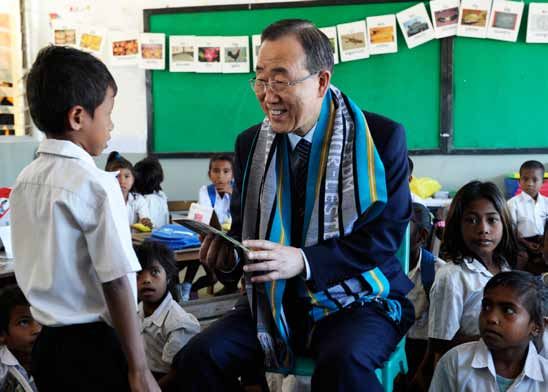
Secretary-General BAN Ki-moon with students
at Cassait School, in the Liquica District of
Timor-Leste. UNICEF constructed buildings
at the school, trained teachers and parents in
the child rights-led approach to education,
and provided learning materials. Children are
taught both about child rights and about the
responsibilities that come with those rights.

                       Global Education First Initiative   1
Introduction

               Education has shaped my life and the history of my country. I grew up in a
               society ravaged by war and mired in poverty. Schools had been destroyed.
               My classes were held in the open under a tree. We had no desks, chairs or
               other basic necessities. The Republic of Korea was on its knees, but education
               enabled the country to stand tall again. The United Nations Educational,
               Scientific and Cultural Organization (UNESCO), the United Nations
               Children’s Fund (UNICEF) and other international partners provided books
               and school supplies to help pave the road to recovery. I will never forget the
               hope that these basic tools gave us.

               Even in the worst circumstances, education helps to give children confidence
               to face the future. As Secretary-General of the United Nations, I want every
               child, without exception, to have the same oportunity that I had. The power
               of education to transform lives is universal. When you ask parents what they
               want for their children—even in war zones and disaster areas—they seek the
               same thing first: education. Parents want their children in school.

 2
Children have a fundamental right to free primary schooling of good quality.
Governments have pledged to uphold this right. I am deeply concerned that
education is slipping down the international priority list. The Global Education
First Initiative (GEFI) stems from my resolve to answer the call of parents
everywhere for the schooling their children deserve—from the earliest years
to adulthood. We must place education at the heart of our social, political and                           Tweetable
development agendas.
                                                                                                When we put
This is not a matter of choosing education over other issues of great importance.     #EducationFirst, we can
Our internationally agreed development goals are a complex tapestry, and
                                                                                    reduce poverty & hunger,
education is the indispensable thread. Educated mothers are more likely to have
healthy children who survive. Educated families are less vulnerable to extreme
                                                                                      end wasted potential, &
poverty and hunger. And educated nations are more likely to enjoy vibrant            look forward to stronger
economies, political stability and a respect for human rights.                       & better societies for all.

Education is not simply a moral imperative—it is the smart choice. Every
dollar invested generates US$ 10 to US$ 15 in returns. Yet worldwide, some
61 million children are still not in school. Our shared ideals are simple. We
want all children to attend primary school and to progress to secondary
school and relevant higher education. We want them to acquire the literacy,
numeracy and critical-thinking skills that will help them to succeed in life
and live as engaged and productive global citizens.

This is a pivotal moment for collective action. The 2015 deadline for achieving
the internationally agreed goals for education is approaching fast. The
achievements of the past decade have shown what it takes to succeed: political
will at the highest levels, sound policies, and resources to scale up proven
methods. But to achieve a breakthrough, we will need an unprecedented
mobilization of all traditional and new partners. The Initiative aims to rally
a broad spectrum of actors to spur a global movement to achieve quality,
relevant and transformative education.

We must not deny the promise of quality education to any child. The stakes are
too high. When we put education first, we can end wasted potential—and look
forward to stronger and better societies for all.

BAN Ki-moon
United Nations Secretary-General
New York, September 2012

                                                                                    Global Education First Initiative   3
The central role
 of education

             The basic building block

             Education is the basic building block of every society. It is a fundamental
             human right, not a privilege of the few. It is no coincidence that parents
             around the world demand education for their children as their first priority.
             Children themselves yearn for the opportunity to fulfill their dreams. Just
             ask them what they wish to be when they grow up. They want to be nurses,
             teachers, musicians, mathematicians, painters and farmers. Education
             is the gateway to learning the skills and values necessary to fulfill those
             aspirations.

             In our knowledge-based world, education is the single best investment
             countries can make towards building prosperous, healthy and equitable
             societies. It unleashes the optimal potential in people, improving individual
             livelihoods and those of future generations. If all students in low-income
             countries acquired basic reading skills, 171 million people could be lifted out
             of poverty, equivalent to a 12% cut in world poverty.

             Yet a good education is more than an entry point into the job market.
             Education has the power to transform people and bring shared values to life.
             People around the world are connected as never before. In the face of global
             pandemics, conflict, climate change and economic turmoil, it is clear we
             sink or swim together. We must forge a new way of relating to each other—
             as individuals, communities, and countries. Education can cultivate in us a
             vision that sees beyond one’s immediate interests to the world at large. It can
             give us a profound understanding that we are tied together as citizens of the
             global community, and that our challenges are interconnected.

             By expanding educational opportunities, we can open the door to more
             equitable, dynamic and resilient patterns of globalization. It will be difficult
             to achieve sustainable development or lasting peace without the knowledge,
             skills and values cultivated through education. Indeed, education is the
             critical thread tying together all our hopes for the achievement of the
             Millennium Development Goals (MDGs).

  4
The
 promise

 Universal right to basic education

 Twelve years ago, the dawn of the century renewed optimism that nations
 could unite to address pressing global challenges. The eight Millennium
 Development Goals—which range from halving extreme poverty and
 ensuring gender equality to halting the spread of HIV by the target date of
 2015—formed a blueprint to meet the needs of the world’s poorest.
                                                                                                      Tweetable
 World leaders recognized education as a critical component in that equation,
 agreeing that countries should guarantee primary education as a universal                     Education is the
 minimum for children everywhere. This promise is also enshrined in
                                                                                          basic building block
 the “Education for All” goals, which aim to fulfill the learning needs of all
                                                                                           of every society. It
 children, youth and adults by 2015.
                                                                                              is a fundamental
 The promise stands on the conviction that a decent education is the                       human right, not a
 birthright of every child in every country. Gender, ethnicity, and geography             privilege of the few.
 should not determine whether a child attends school. Nor should a family’s
                                                                                               #EducationFirst
 poverty deprive any child of a decent education.

 Youth and adults also have the right to a quality education. To further
 economic development, a country must have a well-functioning and wide-
 reaching secondary education system, with both formal and non-formal
 learning opportunities. It must also give the millions of out of school
 youth a second chance to gain the skills needed to earn a decent living and
 contribute to their societies.

 A nation’s human capital—the skills, knowledge and values that education
 makes possible—is the truest source of its wealth. More than at any time
 in history, the destiny of nations and the well-being of their people, now
 depend on their ability to expand this human capital.

                                                                                 Global Education First Initiative   5
The education
crisis
We stand on the verge of breaking the promise we made to children in 2000. It
is true that we have enrolled more children in primary school than ever before.
At the end of the 1990s, there were 108 million children of primary school
age not enrolled. That number has fallen to 61 million. We have also reduced
gender disparities. This is due in large part to national and international
resolve to act on shared goals for education. Yet this global expansion has
stalled, and some regions are now losing ground. If current trends continue, we
could have more children out of school in 2015 than today.
Getting children into school is a first step. Some drop out before receiving
the four years of schooling recommended for one to become fully literate and
Tweetable numerate. Many more stay in school but learn very little year after year. We
have a learning deficit that poses huge challenges for development. The failure
If we do not act to invest simultaneously in access and quality of education has created a world
swiftly, educational in which at least an estimated 250 million children are not able to read, write
disparities will or count well even for those who have spent at least four years in school. The
become greater poorest and the most marginalized are worst affected. When we fail to convey
those skills, we fail a generation of children whose prospects in life will depend
sources of division
on them.
both within &
between countries. Inequality is at the heart of the global education emergency. If we do not act
#EducationFirst swiftly, educational disparities will become an even greater source of division—
both within and between countries. In at least 63 countries around the world,
female youth from poor households are significantly less educated than other
sectors of society. And just as gender limits opportunities, so does disability,
ethnicity, language, displacement and rural residence. The inequality is
magnified for vulnerable children. Children in conflict-affected poor countries
account for 42% of those out of school. The deep and persistent disparities
in access to school are mirrored in learning achievement while at school.
Children orphaned by AIDS and other causes need focused care and protection,
as do those subjected to child labour and exploitation. We must not let them
fall through the cracks.
Continued neglect of education has disastrous human, social, economic and
political consequences. It is consigning millions of people to lives of poverty
and diminished opportunity. It is undermining our efforts to end poverty and
hunger, empower women, save children and mothers from unnecessary deaths
and our ability to live in harmony with the environment.
The crisis in education is also undermining a shared sense of global citizenship.
It is eroding the hopes and confidence of a whole generation. Yet, education can
still give wings to the aspirations, creativity and potential of this generation.
6Do girls or boys have a better
chance of graduating from
primary school?
91 countries
Girls and boys have an equal
chance to graduate
24 countries 47 countries
Girls more likely Girls less likely
to graduate to graduate
Data available from 162 countries, end 2009
Source: Global Education Digest 2011, UNESCO
Global Education First Initiative 7The state of education at a glance
1.8 billion
Number of children and young people between ages 5-19
691 million
Children enrolled in primary school
329 million girls
Girls enrolled in primary school (48%)
828 million 30 million
Primary school teachers Secondary school teachers
18 million women 15.6 million
teachers (62%) women teachers (52%)
531 million
Children enrolled
258 million girls in secondary school
Girls enrolled in
secondary school (49%)
149 million girls 313 million
Children enrolled
Girls enrolled in lower-
in lower secondary school
secondary school
(48%)
71 million
61 million Out-of-school lower secondary school children
Out-of-school primary school age children
32 million girls 34 million girls
Out-of-school primary school age girls (52%) Out-of-school lower secondary school age girls (48%)
Source: UNESCO, UN Population Division
Global Education First Initiative 9What the Initiative
will do
The Global Education First Initiative (GEFI) seeks to unleash human
potential by nurturing the unique gifts that every child brings to the
world. People everywhere embrace that vision, but public action has been
fragmented and inadequate. We must re-energize the global community to
deliver on the promise of universal education and create opportunities for
ordinary citizens to make a difference.
The convening power of the United Nations Secretary-General provides
a crucial link that could set us on track to 2015. GEFI will rally a broad
spectrum of actors for the final push. In addition, GEFI will lay the
groundwork for a bold vision for education post-2015. It also provides a
platform to generate open discussion on the purpose of education in today’s
context; we must put in place the foundation needed to prepare children for
life.
To provide the desperately needed “breakthrough in education”, GEFI will:
1 Rally together a broad spectrum of actors for the final push to 2015
and ensure we deliver on the promise of universal access to primary
education;
2 Spur a global movement to put quality, relevant and transformative
education right at the heart of the social, political and development
agendas; and
3 Generate additional and sufficient funding for education through
sustained global advocacy efforts.
10The smart choice
Education is the single best investment nations can make to
build prosperous, healthy and equitable societies. Education
unleashes potential in the individual and society to solve the
problems of today, address the challenges of tomorrow and live
in a world free of poverty.
Education = Economic
Education = Gender equality opportunity
Education empowers women Lifts people out of poverty
One additional school year can increase a Some 171 million people could be lifted out of
woman’s earnings by 10% to 20%. poverty—reducing the global rate by 12%—if
all students in low-income countries acquired
No education for girls = basic reading skills.
economic loss
Some countries lose more than US$ 1 billion a Boosts economic growth
year by failing to educate girls to the same Getting all children into basic
level as boys. education, while raising
learning standards, could
Education increases $ boost growth by 2%
awareness of rights € annually in low-income
¥
Educated women are more likely to countries.
have decent working conditions,
delay childbearing, resist
violence, denounce injustice
and participate in political education
processes.
=
development Education =
Environmental
Education = Health sustainability
Saves children’s lives Improves long term
Over the past four decades, environmental sustainability,
the global increase in women’s by promoting concern,
education has prevented more awareness and new attitudes.
than 4 million child deaths. In sub-
Saharan Africa, approximately 1.8 million Environmental skills education leads
children’s lives could have been saved in to environmental sustainability
2008 if all their mothers had at least secondary Understanding local environments,
education. designing greener technologies, changing
consumption and production patterns and
Social vaccine against AIDS, coping better with the impacts of economic
tuberculosis and malaria and natural shocks are all skills essential to
Women with secondary education are more environmental sustainability.
likely to know how to prevent mother-to-
child transmission of HIV, an infection that
contributed to 230,000 fatalities in 2011 alone.
Global Education First Initiative 11Three priority areas
The Initiative’s basic priorities are to expand access to education, improve
the quality of learning and foster global citizenship.
Put every child Improve the
In school quality of learning
12Tweetable
#EducationFirst:
everyone goes to school,
everyone learns,
& everyone contributes
to society.
Foster global
citizenship
Global Education First Initiative 13Priority area one
Put every child in school
Education is a great driver of social, economic and political progress.
As people learn to read, count and reason critically, their prospects
for health and prosperity expand exponentially. But our advances in
education have not benefited everyone equally—and primary school
enrollment rates tell only part of the regrettable story. Millions of
children who start primary school are unable to finish and still more
miss out on secondary school. Today, some 71 million adolescents—in
low-income countries—are receiving no post-primary education. We
can no longer afford the cost of excluding them.
Barriers to school enrollment and completion
Unaffordable costs. Poverty is the greatest barrier to high-quality
education. Even when primary school is technically free, additional charges
for uniforms, textbooks, teacher salaries and school maintenance create
financial barriers for many families. In surveys from countries with “free
education”, parents consistently say these indirect costs keep them from
sending their children to school. While some governments have withdrawn
formal fees for basic education, few have dropped fees for secondary
education. In sub-Saharan Africa, children from the richest 20% of
households reach ninth grade at 11 times the rate of those from the poorest
40% of households.
A shortage of classrooms. The poorest countries need almost 4 million
new classrooms by 2015, largely in rural and marginalized areas, to
accommodate those who are not in school. More classrooms will alleviate
overcrowding, cut class sizes and reduce the long travel distances.
Children in rural areas sometimes walk two to three hours to attend school.
Dilapidated classrooms also need refurbishing or upgrading to acceptable
minimum standards for learning.
Humanitarian emergencies, especially conflict. The need to fulfill the right
to education is greatest in humanitarian crises. More than 40% of out-of-
school children live in conflict-affected poor countries, and millions are
forced out of school by natural disasters each year. In emergency situations,
education can save and sustain lives. A safe school environment can
give children a sense of normalcy during a crisis. Schools can also aid in
post-conflict reconstruction. Yet only 2% of all humanitarian aid goes into
education. Schools should be a higher priority during humanitarian crises,
and national education plans should include contingencies for emergencies.
14Gender discrimination. Girls face a unique set of barriers to education, such
as child marriage, early pregnancy, and expectations related to domestic
labour, not to mention unsafe travel and a lack of sanitary facilities. Many
countries under-value girls’ education, with the result that fewer girls enroll
and those who do are more likely to drop out. Some 34 million adolescent
girls are out of school around the world, and women make up nearly two- Tweetable
thirds (almost 500 million) of the world’s illiterate adults. The gender gap
has significantly narrowed in primary education but there has been limited Today, some 71 mln
progress at the secondary level.
adolescents in low-income
Child labour. Poverty and vulnerability are pushing far too many young countries, are receiving no
children out of school and into the world of work. Some children remain post-primary education.
in school, but are disadvantaged doubling up studies with work. For
households living in poverty, children may be pulled out of school and into #EducationFirst
work in the face of external shocks such as natural disasters, rising costs, or
a parent’s sickness or unemployment. By leaving school to enter the labour
market prematurely, children miss a chance to lift themselves, their families,
and their communities out of a cycle of poverty. Sometimes children are
exposed to the worst forms of labour that is damaging to their physical,
mental and emotional well-being.
Global Education First Initiative 15Environment of the Global Education
First Initiative Teachers
well trained and
Every child should be happy to go to school every morning. Every compensated
teacher must be proud to teach and feel respected. All parents
should be able to send all their children to school.
Schools must be a place where everyone flourishes—students,
parents, teachers, communities and nations. Schools must become
the engines of growth and development.
NUMERACY
+−×÷
+4 years
in school
A DE
GR
H
5T
safe water and
sanitation
health
services
e
od
Timing to l c ct
oo du
suit the h
S c co
n
of
community
NO e
us
Ab nce
e
ol g
V i y in on
u l l
a ti
B in
m
ri
sc
Di
Optimal
student-
teacher
ratio
Girl friendly
Safe for policies
children
Access Parents send
to school all children Teachers
uniforms show respect
to school
to students
Free primary
education
Parents involved
in children’s
learning
16New
technologies
Second chance
learning
Curriculum
for GLOBAL
BASIC CITIZENSHIP
LITERACY
Ou
r va
Pe l u
a
Re ce
es
sp
Ju ec t
Hu s t i
c
Cu man e
lt r
G l ur al i gh t
o
E n b a di v s
v ir l c i e r s
on t iz i Easy access
me en t y
nt shi
co p to schools
ns
cio
u s
BOOKS AND
LEARNING
MATERIALS
Support for
disadvantaged
children
gOOD Environment
nutrition Support children Opportunities
friendly with disabilities for play and
sport
Global Education First Initiative 17Priority area two
Improve the quality of learning
School attendance should open pathways of learning and discovery, but
too often it does not. Millions of children go through school and come out
without basic literacy and numeracy skills. Education is ultimately judged
by what people learn. Many students around the world are banking their
futures on poorly trained, weakly motivated teachers without enough
books and other basics to facilitate their learning. This is a grave
disservice not only to the students themselves but also to the parents
who sacrifice to support them and the countries whose futures depend
on them. While we strive to boost school attendance, we must ensure that
our schools are engines of opportunity.
Barriers to quality learning
Shortage of qualified teachers. Education systems are complex and are
influenced by numerous actors. But no education system is better than
its teachers. Globally, we need an additional 2 million teachers to achieve
universal primary education by 2015. The shortage of teachers, combined
with absenteeism and the lack of qualifications, is a major barrier to
learning. We need a strong cohort of both female and male teachers who
are paid well and respected in their communities. This is not always the
case. Teachers should also have opportunities for continued professional
development and growth.
Lack of learning materials. Outdated and worn-out textbooks are often
shared by six or more students in many parts of the developing world.
Workbooks, exercise sheets, readers and other core materials to help
students learn their lessons are in short supply. Teachers also need materials
to help prepare their lessons, share with their students, and guide their
lessons. The persistent digital divide and uneven access to information and
communication technologies (ICTs) have severe implications for education.
ICTs can transform not only instruction but also the learning process. They
empower both teachers and learners.
Weak foundation for early learning. A significant proportion of young
children never benefit from early childhood education programs,
compromising their cognitive development and their preparedness for
school. Those who do not learn to read or write in their first few grades
carry a handicap as they try to progress to higher levels, where literacy and
numeracy become tools for learning rather than ends in themselves. They
struggle in school for many years and some simply quit. Around the world,
primary schools give more attention to later grades, in large part to prepare
students for high-stakes examinations. It would be more effective to deploy
the most qualified teachers in the first four years of school when students
establish the foundation for success in later years.
18Challenging family environments. Challenging living circumstances affect
a child’s learning in many ways. When families lack electricity at home,
particularly in rural areas, children have fewer hours available to study and
learn. When their homes lack books and other reading material, they practice
less and forget more during school breaks. And when parents themselves
lack literacy and numeracy skills, they are less able to reinforce what children
are learning in school. Other factors, such as a stressful or violent home
environment, can also highly impede a child’s learning. Tweetable
Mismatch of skills and today’s livelihoods. With more than 1.2 billion young While we strive to boost
people in the world today, our youth have the potential to alter our course in school attendance,
history. Yet, in many countries, education systems have not caught up to the
21st century knowledge-based economy. Teaching by rote curtails creative we must ensure that
or divergent thinking. It is rigid and is not tailored to individual needs or schools are engines
talents. This form of learning is widespread. There is a mismatch between of opportunity.
the competencies needed in today’s world and those acquired through the
current education system. Too often technical and vocational education is #EducationFirst
specific and narrow thus limiting job opportunities as skills become quickly
obsolete in a dynamic and rapidly changing world.
Language barriers. The language of instruction strongly influences the ability
of children to comprehend and learn. Yet an estimated 221 million children
are being taught in a language other than their mother tongue. Many of them
drop out or repeat grades—an experience that can damage self-esteem and
raise the cost that parents must shoulder. Studies suggest that children fare
better if they can acquire basic skills in their home language before trying to
master a second one.
Hunger and poor nutrition. The impact of hunger on education systems is
gravely underreported. Evidence from Latin America finds that being stunted
at age 6 was equivalent to losing four grades of schooling. Far too many
children are reaching school damaged by malnutrition. Around 171 million
children in developing countries are stunted by hunger by the time they
reach age 5. When children are hungry during lessons, they have trouble
concentrating. Providing school meals and social protection programs
focusing on the needs of children can insure that no child is hungry at school.
Ineffective systems to evaluate the performance of students. We cannot
readily improve students’ progress without measuring it. Education systems
need to closely monitor how well students are learning in order to offer
the correct support before it is too late. Additionally, testing is too often
inappropriately used to influence major financing decisions such as closing
schools or firing teachers or eliminating students who cannot progress to the
next level rather than as a means to identify ways to help students improve
their learning. We must have better ways to take stock of whether children
are learning and use the information to direct support and resources for
effective solutions.
Global Education First Initiative 19Priority area three
Foster global citizenship
The world faces global challenges, which require global solutions.
These interconnected global challenges call for far-reaching changes
in how we think and act for the dignity of fellow human beings. It is
not enough for education to produce individuals who can read, write
and count. Education must be transformative and bring shared values
to life. It must cultivate an active care for the world and for those with
whom we share it. Education must also be relevant in answering the
big questions of the day. Technological solutions, political regulation
or financial instruments alone cannot achieve sustainable development.
It requires transforming the way people think and act. Education
must fully assume its central role in helping people to forge more
just, peaceful, tolerant and inclusive societies. It must give people the
understanding, skills and values they need to cooperate in resolving
the interconnected challenges of the 21st century.
Barriers to global citizenship
Legacy of the current education system. Schools have traditionally prepared
people to pass exams, proceed to the next level and graduate into the
workplace. We now face the much greater challenge of raising global
citizens. Promoting respect and responsibility across cultures, countries
and regions has not been at the centre of education. Global citizenship is
just taking root and changing traditional ways of doing things always brings
about resistance. This entails changing the way education is organized—
making content more relevant to contemporary life and global challenges,
introducing innovative and participatory teaching and learning styles. We
must rethink the purpose of education and prepare students for life, not
exams alone.
Outmoded curricula and learning materials. Reviews from around the
world find that today’s curricula and textbooks often reinforce stereotypes,
exacerbate social divisions, and foster fear and resentment of other groups
or nationalities. Rarely are curricula developed through a participatory
process that embraces excluded and marginalized groups. But change
is possible when educators adopt a vision of ethical global citizenship.
Lessons from India and Ghana, for example, show that explicitly teaching
good citizenship as a subject can have powerful results with more
empowered and ethical students emerging. Deeply entrenched beliefs
take time to change. But young people are open to new perspectives, and
schools are ideally positioned to convey them.
20Lack of teacher capacity. Broad teacher development reforms are needed
to ensure the uptake of new citizenship skills. If we want to transform the
way students learn, we must also help teachers expand their own skills
and outlooks. Are they comfortable with a curriculum that dwells explicitly
on global citizenship? Can they teach traditional subjects in ways that
exemplify non-discrimination and positive support to the disadvantaged? Tweetable
Many teachers lack the training, confidence and classroom resources to
meet these challenges without support and instruction. We owe it to them, It is not enough for
and our children, to provide it. education to produce
Teachers must both be comfortable with the content of what they are individuals who can read,
teaching but also model it in their teaching practice. This means on-going write & count. Education
teacher development and participatory learning techniques are important
must be transformative.
to ensure teachers feel comfortable teaching about global citizenship
explicitly. Teachers can help build ideas and habits of non-discrimination #EducationFirst
and positive support to the disadvantaged through the way they conduct
their teaching of literacy, numeracy and other subjects.
Inadequate focus on values. The values of peace, human rights, respect,
cultural diversity and justice are often not embodied in the ethos of schools.
Instead of empowering students to learn and thrive, schools often replicate
social inequalities and reinforce social pathologies by tolerating bullying and
gender-based violence and subjecting children to physical and psychological
punishment. Young people learn much from schools, but what they learn is
not only in their lessons. Teachers and administrators must learn to model
the skills we want students to develop, such as good environmental practices,
participatory decision-making, and the control and prevention of violence
through reporting policies and clear codes of conduct.
Lack of leadership on global citizenship. To create a generation that values
the common good, we must understand how young people see the world
today—and our schools must find ways to foster a broader vision. Goals
and targets should be set around 21st century skills and regularly assessed
to measure progress.
Open discussion of tolerance and human rights can be politically sensitive,
but it is critical if we want to overcome divisions and expand the prospects
for peace and prosperity. Success will require support from a wide range of
stakeholders, including the highest levels of government.
Global Education First Initiative 21We all win! Barriers To School Enrollment and Completion
Barriers To Quality Learning
Start the journey to ensure that everyone goes to school, Barriers To Global Citizenship
everyone learns and everyone contributes to society. Key Actions
Education for All (EFA) and MDG goals
KEY ACTION 1
START
Access ENROLL ALL Humanitarian emergencies,
Unaffordable costs A shortage of classrooms
CHILDREN IN especially conflict
SCHOOL
Key Action 4
Lack of learning A shortage of
materials
Tr ain more qualified teachers
Improve teachers
Quality
Key Action 5
EQUIP
CLASSROOMS
WITH BOOKS
and LEARNING
MATERIALS
Weak foundation for Challenging family Mismatch of skills and
early learning environments today’s livelihoods
FOSTER
Global
citizenship
Key Action 8
Ineffective systems to
Legacy of current INSTILL
evaluate the performance
education system LIFELONG of students
LEARNING
Outmoded curricula
and learning
REWARD materials
UNLEASH
HUMAN
POTENTIAL
Lack of leadership on
Lack of teacher capacity Inadequate focus on values
Global Citizenship
22Key Action 2 EFA Goal 1
Sustain Expand and improve
education in comprehensive early childhood
Gender discrimination
humanitarian care and education, especially
crises, especially for the most vulnerable and EFA Goal 2
conflict disadvantaged children Ensure all children,
particularly girls, those
in difficult circumstances
and those belonging to
ethnic minorities, have
access to and complete,
free and compulsory
primary education of
Key Action 3 EFA Goal 3
good quality.
Ensure all Ensure that the learning needs
of all young people and adults
children are Child labour
are met through equitable
liter ate and
access to appropriate learning
numer ate and life-skills programmes.
EFA Goal 4
Key Action 6 Achieve a 50% improvement in
PREPARE adult literacy, especially among
Language barriers
STUDENTS FOR women. Secure equitable
LIVELIHOODS access to basic and continuing EFA Goal 5
education for all adults. Eliminate gender
disparities in primary and
secondary education by
2005, and achieve gender
equality in education
by 2015, with a focus on
ensuring girls’ full and
equal access to basic
EFA Goal 6 education of
Key Action 7 Improve the quality of education good quality.
so that measurable learning
IMPROVE CHILD Hunger and poor nutrition
outcomes are achieved by all,
NUTRITION
especially in literacy, numeracy
and essential life skills.
MDG 3: PROMOTE MDG 2: ACHIEVE
GENDER EQUALITY AND UNIVERSAL
Key Action 9 Key Action 10 EMPOWER WOMEN PRIMARY EDUCATION
FOSTER GLOBAL Close the Eliminate gender disparity in primary Ensure by 2015 that children
CITIZENSHIP financing gap and secondary education, preferably by everywhere, boys and girls alike,
2005, and in all levels of education will be able to complete a full
no later than 2015. course of primary schooling.
Global Education First Initiative 23Ten Key Actions
Despite the gains of the past dozen years, tens of millions of young people still miss
out on the benefits of basic education. Millions more attend schools that lack the staff,
facilities and resources to impart needed knowledge and skills—let alone nurture global
citizenship. There are no automatic blueprints for successful reform but the Initiative
identifies 10 actions that can help the nations of the world meet these challenges. This
guide shows briefly what each action entails and how it supports a broader global priority.
Eliminate cost barriers to attending and
completing basic education.
Eliminate access inequities to primary
and secondary education, especially for Enroll all children in school 1
marginalized children.
Close the gender gap at all education levels.
Enforce the protection of children, teachers
and schools during armed conflict.
Ensure national education policies are in place Sustain education in humanitarian
to secure the continuity of children’s education
during humanitarian emergencies. crises, especially conflict 2
Make education a central pillar of every
humanitarian response—ensuring education
is at least 4% (up from 2%) of the overall
humanitarian budget.
Ensure all children are fully literate and
numerate after four years in school.
Promote instruction in students’ local Ensure all children are literate
languages, especially during early grades.
and numerate
3
Track every student’s learning outcomes, and
use the information to help improve their
achievement.
Hire 2 million more teachers by 2015.
Ensure that all teachers receive basic training
and have opportunities for professional
development. Train more teachers 4
Improve teachers’ earnings, working conditions
and status in society.
Build 4 million more classrooms, especially in
marginalized areas.
Ensure that books and supplies are up to date
Equip classrooms with books
and in good condition.
and learning materials
5
Use information and communication
technology to expand access and improve the
quality of learning.
24Expand access to secondary school, halving
the number of adolescents out of lower
secondary school.
6 Prepare students for livelihoods Ensure education is relevant for local
economies and livelihoods.
Prepare young people with critical thinking
and 21st century skills.
Halve the number of children under five who
suffer from stunted growth (now at 171 million).
7 Improve child nutrition Provide food and health services through
school for poor children.
Develop systems to identify and help children
who need nutritional and social support.
Increase (from 15 to 45%) participation
in quality early childhood development
programs for marginalized children in low-
income countries.
8 Instill lifelong learning Provide alternative learning opportunities,
including life skills, to all young people who
have missed out on formal schooling.
Halve the number of illiterate adults by 2015,
especially women.
Develop the values, knowledge and skills
necessary for peace, tolerance, and respect
for diversity.
Cultivate a sense of community and active
9 Foster global citizenship
participation in giving back to society.
Ensure schools are free of all forms of discrimi-
nation, including gender inequality, bullying,
violence, xenophobia, and exploitation.
Invest at least 5% to 6% of national GDPs in
education.
Increase global investment in poor countries’
10 Close the financing gap school systems by an additional US$ 24 billion
per year to fill the financing gap for primary
and lower secondary education.
Ensure effective and accountable use of
resources aligned with national education plans.
Global Education First Initiative 25Raise your hand for the
Global Education First Initiative
Meeting the urgent needs of our children and communities will take more than good intentions. To
fulfill the promise of the Initiative, the United Nations Secretary-General will lend his convening power,
supported by his Special Envoy for Global Education and all the education-related UN agencies, to
leverage the expertise and experience of existing stakeholders, as well as find innovative ways to engage
new networks. Everyone has a critical role to play. When we act with unity of purpose and rise above self
interest, miracles will happen.
Tweetable
01
Governments
02
Donors
An additional There is no substitute for national Donor nations must uphold their
political leadership, policy and commitment to ensure that, “no
US$ 24 billion
resources. Governments must country seriously committed to
needed annually to remove the barriers that keep education for all will be thwarted
fill financing gap for disadvantaged children out of in their achievement of this goal
primary and lower school or prevent them from by lack of resources”. Donors must
learning well when in school. All increase their multilateral and
secondary education.
nations should accelerate the rate bilateral aid to protect the education
# EducationFirst of progress towards universal basic gains of the last decade. Education
education and identify ways for should be central to the G8, G20,
the international community to BRICS and other global agendas.
support them. Countries should Donors should also improve the
train, support and keep their effectiveness of their funding and
teachers motivated. They should target resources to countries most
also establish targets for reaching in need. Where possible, they
marginalized children and closing should pool resources to advance
all equity gaps. shared action plans. Foundations
and individual philanthropists
should devote more resources to
global education, with a focus on
reaching the most marginalized.
By coordinating their investments
with public authorities and other
partners, they can leverage resources
and advance best practices.
2603
Teachers
04
Families
05
Students
Teachers must serve as role models Families must share responsibility Students should actively demand
for good citizenship, promoting with the school for their children’s their right to education. Together
gender equality and supporting learning and success. Home with their families, teachers and
the disadvantaged. They must environments affect how prepared communities, they should amplify
live up to their important role by and ready children are to learn the call for equal access to quality
attending school regularly, not in school. Parents should create education. Students must hold
using corporal punishment, and a supportive environment. They their end of the deal by taking
reporting any exploitation or abuse should commit to supporting their full advantage of the educational
they encounter. They have a unique children in school and must not opportunities available to them.
opportunity to create a supportive pressure children to marry or work By studying hard, students have a
environment for children to thrive. when it will jeopardize their long- unique opportunity to fulfill the
School administrators must commit term educational prospects. Parents promise of education and go on to be
themselves to provide good quality should be involved and engaged at productive and thoughtful citizens
pre-service training systems for new the classroom and school level. They that can give back to their society.
and incoming teachers. must also know and claim their
children’s rights to education.
Global Education First Initiative 2706
Civil society
07
Multi-lateral organizations
Non-governmental organizations, Agencies of the United Nations, the
faith-based organizations, and Global Partnership for Education,
community organizations must regional intergovernmental bodies
play an important role as advocates and development banks must affirm
for education, including mounting the high priority of basic education,
media campaigns, mobilizing especially for the poorest, in their
networks and members and development strategies. They
engaging governments, donors should pursue the Millennium
and multilaterals. Where they are Development Goals and the specific
involved in service delivery, they targets of Education for All and the
should work, when feasible, in Global Education First Initiative.
collaboration with local authorities They should also help develop more
and in support of local plans. fit for purpose support mechanisms
They should also focus on taking for reaching out of school children,
successful innovations to national especially those in humanitarian
scale, monitoring progress and contexts. Such a mechanism should
holding governments and education also support innovative financing
stakeholders to account. The faith- arrangements to facilitate broader
based community should also work support for the three priorities of
to generate support among the GEFI.
communities where they practice
and among inter-faith networks.
2808
The business community
09
Academia
10
The media
The private sector must engage Academic institutions must The media has a pivotal platform
in education. It should use prioritize their colleges of for monitoring and explaining the
its technology, resources and education, supporting the crisis in education while harnessing
expertise to support national and highest quality intellectual the power of technology to make
international efforts in the ‘big leadership and evidence base to education a global priority. Media
push’ to education. In addition to drive sound policy reforms in outlets should track governments’
corporate philanthropy, the business education. Academic institutions progress, highlight effective
community should examine how its should redouble investments initiatives, share stories that
core business assets can accelerate in teacher training programs inspire commitment and follow
progress to 2015 and beyond. There to create the next generation of policy debates. With the help of
is genuine value for businesses to teachers and provide ongoing communities, media can also make
invest in education in the countries professional development. They excluded voices more audible.
where they operate. Businesses should demonstrate leadership Media can help bring all partners to
have potential for leadership and on the development of curricula account by making visible areas in
advocacy in collaboration with which integrate the values of which they are falling short.
other key stakeholders. Within their global citizenship. The academic
own companies, executives can community could scale up research
promote education by adopting pro- on what works in this budding
learning policies and by combating area, while working to devise
child labour in supply chains. strategies to achieve high-quality
education for everyone.
Global Education First Initiative 29M o re e q u
Mor
i es ity
p ro o c i et
e
sp e r s
o us a n d p e a c e fu l
e e c o n o m i c g ro w t h
Better sk ills
h e r e d uc a t i o n
Mor
ec onomi c g ro wth
e
Mor
M o re j
d h ig
ob s
an
oo l
ol
c ho
ry
o
nda
ec
s
h
c
ni s
n
in s
en i
me nt
r
M o re g ir ls
s t
M o re c h ild
M o re i n ve
du
lt s
s a sa
B ett e r h e a lt h o ut c o m e
Mo
re i i on
n ves c a t
t ment du
in p ri m a ry e
30Conclusion
It is time for the international
community to face the fact that we
have a crisis in education. We must
be clear that if children are forced
out of school, their governments
and communities are also failing.
As we approach 2015, we must have
unwavering support for achieving and
exceeding the global education goals
we have set for ourselves.
It will take relentless and
uncompromising focus on the most
marginalized children and countries
lagging furthest behind to finish
the job. But we cannot stop until
every child, youth and adult has the
opportunity to go to school, learn
and contribute to society. When we
put Education First, we see an end to
wasted potential--- we unleash the
human spirit.
Global Education First Initiative 31Millennium Development Goal 2
ACHIEVE UNIVERSAL PRIMARY EDUCATION
Ensure by 2015 that children everywhere, boys and
girls alike, will be able to complete a full course of
primary schooling.
Millennium Development Goal 3
PROMOTE GENDER EQUALITY AND
EMPOWER WOMEN
Eliminate gender disparity in primary and secondary
education, preferably by 2005, and in all levels of
education no later than 2015.
32Education for All goals by 2015 Goal 1 Expand and improve comprehensive early childhood care and education, especially for the most vulnerable and disadvantaged children. Goal 2 Ensure all children, particularly girls, those in difficult circumstances and those belonging to ethnic minorities, have access to and complete, free and compulsory primary education of good quality. Goal 3 Ensure that the learning needs of all young people and adults are met through equitable access to appropriate learning and life-skills programmes. Goal 4 Achieve a 50% improvement in adult literacy, especially among women. Secure equitable access to basic and continuing education for all adults. Goal 5 Eliminate gender disparities in primary and secondary education by 2005, and achieve gender equality in education by 2015, with a focus on ensuring girls’ full and equal access to basic education of good quality. Goal 6 Improve the quality of education so that measurable learning outcomes are achieved by all, especially in literacy, numeracy and essential life skills.
United Nations
              Secretary-General
            New York, NY 10017
                           USA

                       un.org/sg

                Designed by UNAIDS

       Twitter: @GlobalEduFirst
Facebook: @GlobalEducationFirst
        globaleducationfirst.org
You can also read


