Global Health Summit The Rome Declaration
←
→
Page content transcription
If your browser does not render page correctly, please read the page content below
1

              Global
              Health
              Summit
              Rome, 21 May 2021

The
Rome
Declaration
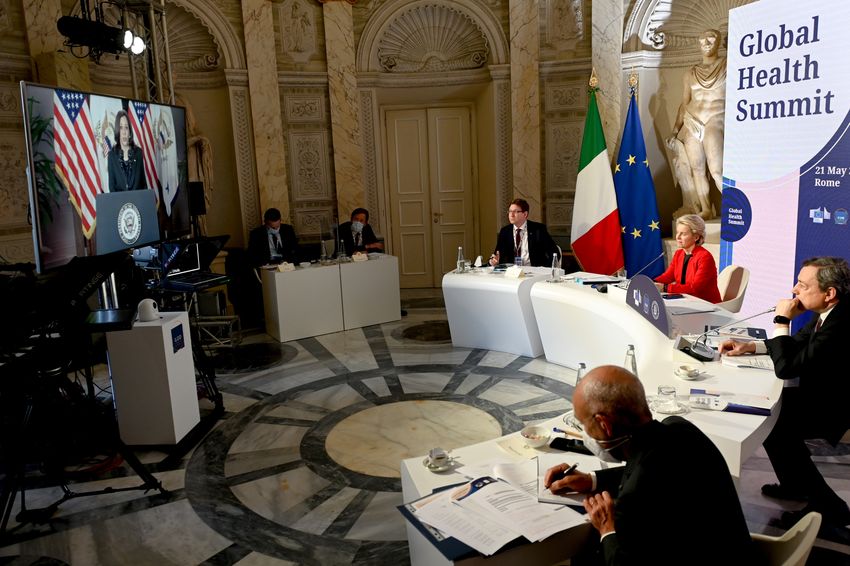
President of the European Commission Ursula von der Leyen, Prime Minister of Italy Mario Draghi and Vice-President of the United States Kamala Harris
4                                                                                                                                     5

    The Rome
    Declaration
    We, Leaders of G20 and other states, in the presence of the
    Heads of international and regional organisations meeting
    at the Global Health Summit in Rome, May 21, 2021, having
    shared our experience of the ongoing global COVID-19
    pandemic, and welcoming relevant work in this regard,
    including that presented during the pre-Summit, today:

    Reaffirm that the pandemic continues to be an unprecedented
    global health and socio-economic crisis, with disproportionate
    direct and indirect effects on the most vulnerable, on women,
    girls and children, as well as on frontline workers and the
    elderly. It will not be over until all countries are able to bring
    the disease under control and therefore, large-scale, global,
    safe, effective and equitable vaccination in combination with
    appropriate other public health measures remains our top
    priority, alongside a return to strong, sustainable, balanced
    and inclusive growth.

    Convey our condolences for lives lost and express our
    appreciation for healthcare and all frontline workers’ vital
    efforts in responding to the pandemic.

    Welcome the World Health Organization’s (WHO) designation
    of 2021 as the Year of Health and Care Workers, and reaffirm
    our full support for the leading and coordinating role of the
    WHO in the COVID-19 response and the broader global health
    agenda.

                                                                         President of the European Commission Ursula von der Leyen,
                                                                         Prime Minister of Italy Mario Draghi
6 7
Underline that sustained investments in global health, towards
achieving Universal Health Coverage with primary healthcare
at its centre, One Health, and preparedness and resilience, are
broad social and macro-economic investments in global public
goods, and that the cost of inaction is orders of magnitude
greater.
Recognise the very damaging impact of the pandemic on
progress towards achieving the Sustainable Development
Goals (SDG). We reaffirm our commitment to achieving them to
strengthen efforts to build back better (as in UNGA resolution,
11 September 2020), and to the International Health
th
Regulations 2005 (IHR), which together will improve resilience
and global health outcomes.
Strongly underline the urgent need to scale up efforts,
including through synergies between the public and private
sectors and multilateral efforts, to enhance timely, global and
equitable access to safe, effective and affordable COVID-19
tools (vaccines, therapeutics, diagnostics, and personal
protective equipment, henceforth ‘tools’). Recognise the
necessity to underpin these efforts with strengthened health
systems, recalling the G20 extraordinary Summit of 26 March
2020.
Recognising the role of extensive COVID-19 immunisation as a
global public good, we reaffirm our support for all collaborative
efforts in this respect, especially the Access to COVID-19
Tools Accelerator (ACT-A). We underline the importance of
addressing the ACT-A funding gap, in order to help it fulfil its
mandate. We note the intention to conduct a comprehensive
strategic review as basis for a possible adaptation and to strengthen supply chains and boost and diversify global
extension of its mandate to the end of 2022. We emphasise vaccine-manufacturing capacity, including for the materials
our support for global sharing of safe, effective, quality and needed to produce vaccines, including by sharing risks, and
affordable vaccine doses including working with the ACT-A welcome the vaccines technology transfer hub launched by
vaccines pillar (COVAX), when domestic situations permit. We the WHO. We ask the Working Group and Task Force to report
welcome the June 2021 COVID-19 Vaccines Advance Market on their progress to the G20 in time for the Leaders’ Summit
Commitment (COVAX AMC) Summit and we note the in October. This report will be informed by the WTO and other
Charter for Equitable Access to COVID-19 tools. international stakeholders and organisations, consistent with
their mandates and decision-making rules, on how to improve
Note the COVAX Vaccine Manufacturing Working equitable access in the current crisis.
Group, supporting the COVAX Manufacturing
Task Force, led by the WHO, the Coalition for Applaud the unprecedented achievement of safe and
Epidemic Preparedness Innovations (CEPI), GAVI effective COVID-19 vaccines within one year, and highlight
and UNICEF, that includes partners such as the the importance of continued investment in research and
World Trade Organisation (WTO) and Medicines innovation, including in multilateral and other collaborative
Patent Pool. We affirm our support for efforts efforts, to further accelerate the development of safe and
effective tools.8 9
Underline the importance of working with all relevant
public and private partners rapidly to increase the equitable
availability of tools and to enhance access to them. Short-
Principles of
term options include: sharing existing products, including of
vaccines through COVAX; Diversifying production capacity;
Identifying and addressing bottlenecks in production;
the Rome Declaration
Facilitating trade and transparency across the entire value
chain; Promoting increased efficiency in the use of capacities
We commit to promote and make tangible progress towards
and global distribution by cooperation and expansion of
these principles and the action they guide by the G20 Summit
existing capacities, including by working consistently within the
in Rome in October and beyond and invite their consideration
TRIPS agreement and the 2001 Doha Declaration on the TRIPS
in the forthcoming World Health Assembly (WHA) and other
agreement and Public Health; and Promoting the use of tools
relevant fora, and by all relevant stakeholders. We will:
such as voluntary licencing agreements of intellectual property,
voluntary technology and know-how transfers, and patent
pooling on mutually-agreed terms.
Welcome high-level political leadership for preparedness and
response in relation to health emergencies. Note proposals on
a possible international instrument or agreement with regards
1|
to pandemic prevention and preparedness, in the context of Support and enhance the existing multilateral health
the WHO, and efforts by the WHO, World Organisation for architecture for preparedness, prevention, detection and
Animal Health, Food and Agriculture Organisation, United response with an appropriately, sustainably and predictably
Nations Environment Programme and others in relation to funded, effective WHO at its centre, taking account of the
strengthening the implementation of the One Health approach forthcoming WHA and various recent and ongoing review
through their One Health High-Level Expert Panel. processes, including those resulting from the previous WHA.
Support the achievement of the SDG, their targets, and
Beyond these statements in view of the ongoing pandemic, specific initiatives such as the Global Action Plan for Healthy
we set out principles and guiding commitments below. These Lives and Wellbeing for all to better support countries to
serve as voluntary orientation for current and future action accelerate progress towards the health-related SDG including
for global health to support the financing, building, and towards Universal Health Coverage. Support the goal of a
sustaining of effective health system capabilities and capacities sustainable, inclusive and resilient recovery that promotes
and Universal Health Coverage to improve preparedness, the progressive realisation of the right for all people to the
early warning of, prevention, detection, coordinated response, enjoyment of the highest attainable standard of health.
and resilience to, and recovery from, the current pandemic
and future potential public health emergencies.
2|
These mutually reinforcing principles reconfirm
our commitment to global solidarity, equity,
and multilateral co-operation; to effective
governance; to put people at the centre of
preparedness and equip them to respond Work towards and better support the full implementation
effectively; to build on science and of, monitoring of and compliance with the IHR, and
evidence-based policies and create trust; enhanced implementation of the multi-sectoral, evidence
and to promote sustained financing for based One Health approach to address risks emerging from
global health. the human-animal-environment interface, the threat of anti-
microbial resistance, noting the role of relevant international
organisations in that regard and encourage new public health
guidance in consultation with relevant health organisations on
international travel by air or sea, including cruise ships.10 11
5|
Enable equitable, affordable, timely, global access to high-
quality, safe and effective prevention, detection and response
tools, leveraging and drawing on the experience of ACT-A,
as well as to non-pharmaceutical measures, clean water,
sanitation, hygiene and (adequate food) nutrition and to
strong, inclusive, and resilient health systems; and support
robust vaccine delivery systems, vaccine confidence and health
literacy.
6|
Support low- and middle-income countries to build
expertise, and develop local and regional manufacturing
capacities for tools, including by building on COVAX efforts,
with a view to developing improved global, regional and local
manufacturing, handling and distribution capacities. Further
enable increased use of health technologies and the digital
transformation of health systems.
3|
Foster all-of-society and health-in-all policies approaches,
with mutually reinforcing national and community elements,
7|
Leverage synergies and build on expertise of relevant
and promote responsibility at the highest levels of
organisations and platforms to facilitate data sharing,
government for the achievement of better preparedness,
capacity building, licensing agreements, and voluntary
prevention, detection and response.
technology and know-how transfers on mutually agreed
terms.
4|
Promote the multilateral trading system, noting the central
role of the WTO, and the importance of open, resilient,
8|
Enhance support for existing preparedness and prevention
diversified, secure, efficient and reliable global supply
structures for equitable immunisation against vaccine
chains across the whole value chain related to health
preventable diseases, and surveillance and health programmes
emergencies, including the raw materials to produce vaccines,
for these and other diseases, including HIV/AIDS, tuberculosis,
and for the manufacturing of and access to medicines,
malaria and others, and non-communicable diseases, as part
diagnostic, tools, medical equipment, non-pharmaceutical
of integrated service delivery and ensuring that no one is left
goods, and raw materials to address public health
behind.
emergencies.12 13
12|
Invest predictably, effectively and adequately, in line
with national capacities, in domestic, international and
9|
multilateral cooperation in research, development, and
innovation, for health systems tools and non-pharmaceutical
measures, considering issues of scalability, access, and
manufacturing from an early stage.
Invest in the worldwide health and care workforce, to
bring about the triple dividend of better health, acceleration
13|
of development, and advancements in social inclusion
and gender equality, by developing mutually recognised
competencies through education and training including
through relevant WHO initiatives including the WHO Academy.
Invest in community health and in health systems to Coordinate pharmaceutical and non-pharmaceutical
achieve strengthened, resilient, inclusive, high quality health measures and emergency response (including online
services, continuity of care, local and home care, and public coordination of crisis and operation centres), in the context
health capacities in all countries. Invest in multilateral WHO- of a sustainable and equitable recovery, with investment
led mechanisms to facilitate assistance and response in health, preparedness and response and policies informed
capacities for use in developing and crisis affected countries. by scientific advice. Policies should accelerate progress
Invest also in water sanitation and hygiene in health care towards achieving the SDG, combat the root causes of health
facilities to reduce infection risks and safeguard healthcare emergencies, including social determinants of health, poverty,
workers. structural inequality and environmental degradation, build
human capital, accelerate green and digital transitions, and
boost prosperity for all.
10|
Invest in adequate resourcing, training, and staffing of
diagnostic public and animal health laboratories, including
14|
genomic sequencing capacity, and rapidly and safely share Increase the effectiveness of preparedness and response
data and samples during emergencies domestically and measures by supporting and promoting meaningful and
internationally, consistent with applicable laws, relevant inclusive dialogue with local communities, civil society,
existing agreements, regulations and arrangements. frontline workers, vulnerable groups, women’s and other
organisations and all other relevant stakeholders and by
countering misinformation and disinformation. Underpin
11|
this with trust and transparency in relation to governance
and decision-making, arising from the timely and culturally
adapted communication of accurate information, of evidence
and of uncertainty, and of lessons learned from the COVID-19
Invest in further developing, enhancing and improving inter- pandemic response and previous public health emergencies.
operable early warning information, surveillance, and Undertake health promotion and work on the social
trigger systems in line with the One Health approach. Invest determinants of health to address other critical health issues
in new efforts to strengthen surveillance and analyse data on such as non-communicable diseases, mental health and food
potential outbreaks, including rapid and transparent cross- and nutrition, as part of efforts to enhance overall resilience to
sectoral and international information and data sharing, in future health crises and in addition ensure an age- and gender-
accordance with the IHR. sensitive response to future crises.14 15
15|
Address the need for enhanced, streamlined, sustainable
and predictable mechanisms to finance long-term
pandemic preparedness, prevention, detection and
response, as well as surge capacity, capable of rapidly
mobilising private and public funds and resources in a
coordinated, transparent and collaborative manner and with
robust accountability and oversight. In a spirit of solidarity, join
efforts to support in particular the manufacture and supply of
vaccines and other supplies and/or the provision of funding for
vaccine purchase, to low- and middle-income countries.
16|
Seek to ensure the effectiveness of such financing
mechanisms, including by leveraging blended finance,
innovative mechanisms, public, private, and philanthropic
sources, and international financial institution funds. Seek
to avoid duplication of efforts, and underline the need for
countries to finance their national IHR and R&D capacities,
primarily through domestic resources in line with their national
circumstances, and mustering support for those unable to do
so. Underline the importance of multilateral efforts to meet the
financing needs of low- and middle-income countries, including
the proposed new general allocation of Special Drawing Rights
by the IMF, an ambitious IDA20 replenishment and existing G20
endorsed measures. Welcome the ongoing work of Multilateral
Development Banks and International Organisations and call
for increase within their mandates and respective budgets
their efforts to better support the preparedness, prevention,
detection, response, and control of health threats and enhance
their coordination.You can also read


