HIGHLIGHTS OF UNION BUDGET - 2020-2021 An insight into the ne print by CA VINOD JAIN - Inmacs India
←
→
Page content transcription
If your browser does not render page correctly, please read the page content below

HIGHLIGHTS OF UNION BUDGET 2020-2021 An insight into the ne print by CA VINOD JAIN Restricted circula on
Contents
01 Prominent Themes of the Budget   03

02 Income Tax                       17

03 Goods & Service Tax (GST)        36

04 Custom Act                       39

05 Economic Announcements           46

06 Vivad se Vishwas Scheme          51

                                         02
Prominent Themes of the Budget

Governance               EASE OF LIVING      Financial
                                               sector

  Aspirational             Economic           Caring
     India                Development         Society

       Agriculture,           Industry,         Women &
  Irrigation and Rural      Commerce and       Child, Social
      Development            Investment          Welfare

   Wellness, Water                             Culture and
   and Sanitation           Infrastructure      Tourism

    Education and           New Economy      Environment and
        Skills                                Climate Change

                                                               03
GOVERNANCE
                     STRUCTURAL REFORMS

       IBC                                   GST

Honourable           Ÿ 20 per cent reduction in turn around time for
exit through           trucks.
IBC for companies.   Ÿ Benefit to MSMEs through enhanced threshold
                       and composition limits.
                     Ÿ Savings of about 4 per cent of monthly spending
                       for an average household.
                     Ÿ In last 2 years, 60 lakh new taxpayers added
                       and 105 crore e-way bills generated

                     DIGITAL REVOLUTION
   Shift to DBT                          Next wave

During 2018- 19,     Ÿ Digital Governance.
₹ 7 lakh crore       Ÿ Improve physical quality of life through National
transferred            Infrastructure Pipeline
through Direct       Ÿ Disaster Resilience.
Benefit Transfer      Ÿ Social Security through Pension and Insurance
                       penetration.

                     INCLUSIVE GROWTH
Governance guided by “Sabka Saath, Sabka Vikas, Sabka Vishwas”
with focus on:
   • Preventive Healthcare: Provision of sanitation and water
   • Healthcare: Ayushman Bharat
   • Clean energy: Ujjawala and Solar Power
   • Financial Inclusion, Credit support and Pension
   • Affordable Hosuing
   • Digital penetration

                                                                           04
FINANCIAL SECTOR
                      STRUCTURAL REFORMS
Ÿ Deposit Insurance Coverage to increase from Rs. 1 lakh to Rs. 5 Lakh per
    depositor.
Ÿ   Eligibility limit for NBFCs for debt recovery under SARFAESI Act
    proposed to be reduced to asset size of Rs. 100 crore or loan size of Rs.
    50 Lakh.
Ÿ   Proposal to sell balance holding of government in IDBI Bank.
Ÿ   Separation of NPS Trust for government employees from PFRDAI.
Ÿ   Specified categories of government securities would be opened for
    non resident investors
Ÿ   FPI Limit for corporate bonds to be increased to 15 per cent.
Ÿ   New debt ETF proposed mainly for government securities.

                                                                                05
                                                                                01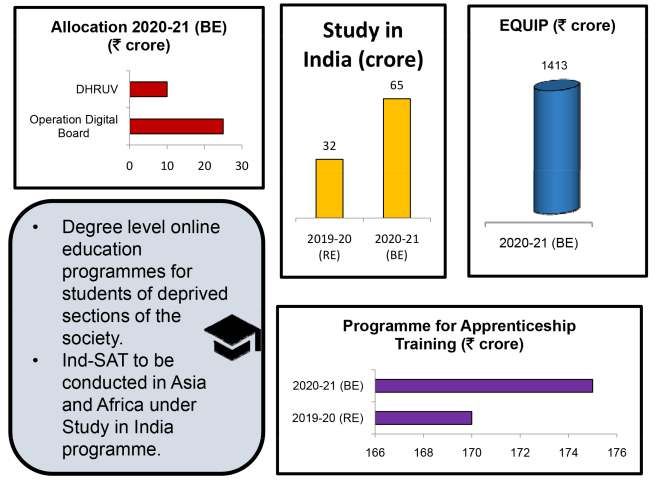
MACRO ECONOMIC INDICATORS
GDP Growth Rate (per cent) CPI and WPI (per cent)
8.5
8 6
7.5
7 4
6.5
6 2
5.5
5 0
4.5
4-15
5-16
6-17
7-18
April-
2018-19
4
er)
-2
Decembe
2014
2015
2016
2017
2019-20(A
-4
CPI-C WPI
9,000
Net FDI CAD/Forex (per cent)
8,000
7,000 35
6,000 30
US $ Million
25
5,000
20
4,000
15
3,000
10
2,000
5
1,000
0
0
Apr-17
Oct-17
Apr-18
Oct-18
Apr-19
Oct-19
Jan-17
Jul-17
Jan-18
Jul-18
Jan-19
Jul-19
-1,000
53 3.5
Trends in Deficits Debt
ent)
nt)
52 3
External Debt (per cen
Central Government Debt (per ce
4.1 4.2 51 2.5
1.1 50
3.9 4.0 2
3.8 49
Percent of GDP
Percent of GDP
0.9 1.5
3.8 48
0.7 0.9 3.5 3.5 3.5 47 1
3.4 3.6
46 0.5
0.5 0.7 0.7 3.4
45 0
0.3 3.2
0 4 0.4
0.4 0 4 0.4
04 0.4
0.1 3.0
Central Government Debt as per cent of GDP
External Debt as per cent of GDP at current
PD FD (RHS) exchange rate
06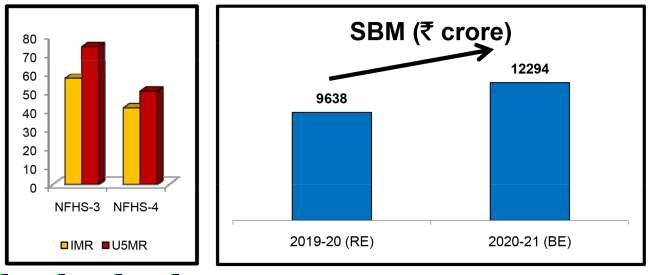
Tracking Progress in Numbers
Foreign Exchange Reserves (` crore) Gross Bank Credit (` Crore)
3320000 10000000
3270000 9000000
3220000 8000000
3170000 7000000
3120000 6000000
3070000 5000000
3020000 4000000
2970000 3000000
02-Aug-2019
16-Aug-2019
30-Aug-2019
13-Sep-2019
27-Sep-2019
08-Nov-2019
22-Nov-2019
06-Dec-2019
20-Dec-2019
03--Jan-2020
17--Jan-2020
11--Oct-2019
25--Oct-2019
2000000
1000000
0
Nov.24,Mar.
201730,Nov.23,
2018 Mar.29,
2018 Nov.22,
2019 2019
National Infrastructure Pipeline
Distribution of workers by status in
Employment (per cent) Rural Infrastructure
2011-12 2017-18 Irrigation
Renewable Power
60
Conventional Power
50
40 Railways
30 Urban and Housing
20
Roads
10
0 0 5 10 15 20
Self employed Regular wage/ Casual labour
Salaried Rs. Lakh Crores
India is the 5th largest economy in the world in terms of
GDP at current US $ Trillion.
USA CHINA
GERMANY 3.9
21.4
14.1 5.2
JAPAN
2.9
INDIA
All figures in US $
Trillion
4
07
Budget at a glance

                     08
Budget at a glance
Ÿ PM KUSUM to cover 20 lakh farmers for stand alone solar pumps and
further 15 Lakh for grid connected pumps.
Ÿ Viability gap funding for creation of
efficient warehouses on PPP mode.
Ÿ SHG Vill t h SHGs run Village storage
scheme to be launched.
Ÿ Integartion of e-NWR with e-NAM.
Ÿ “Kisan Rail” and “Krishi Udaan” to be Ÿ Fish Production target
launched by Indian Railways and of 200 lakh tonnes by
Ministry of Civil Aviation respectively 2022-23.
for a seamless national cold supply Ÿ Another 45000 acres of
chain for perishables. aqua culture to be
supported.
Ÿ Fishery extention
Ÿ Elimination of FMD and brucellosis in through 3477 Sagar
cattle and PPR in sheep and goat by Mitras and 500 fish
2025. FPOs.
Ÿ Increasing coverage of artificial Ÿ Raise fishery exports to
insemination to 70 per cent. Rs. 1 lakh crore by 2024-
Ÿ Doubling of milk processing capacity by 25.
2025.
Ÿ Agricultural credit target of Rs.15 lakh
crore for 2020-21.
09Wellness, Water and Sanitation
Ÿ More than 20 000 empanelled hospitals under PM
Jan Arogya Yojana.
Ÿ FIT India movement launched to fight NCDs.
Ÿ “TB Harega Desh Jeetega” campaign
Ÿ launched to end TB by 2025
Ÿ Viability gap funding proposed for setting up
hospitals in the PPP mode.
Ÿ Expansion of Jan Aushadhi Kendra Scheme to all
districts by 2024.
Ÿ Coverage under 35 under Nikshay Poshan Yojana(Rs. Lakh)
Ÿ ODF Plus to sustain ODF behaviour.
Ÿ Focus on liquid and grey water management along
with waste management.
Swach Bharat Mission ( Rs. Crore)
Mortality Rate
10Education and Skills
Ÿ About 150 higher educational institutions will start apprenticeship
embedded courses.
Ÿ Internship opportunities to fresh engineers urban local bodies.
Ÿ Special bridge courses to improve skill sets of those seeking
employment abroad.
Ÿ Degree level online
education
programmes for
students of deprived
sections of the society.
Ÿ Ind-SAT to be
conducted in Asia and
Africa under Study in
India programme
New Economy
Ÿ Knowledge Translation Clusters for emerging technology sectors
Ÿ Scaling up of Technology Clusters harbouring test beds and small
scale manufacturing facilities.
Ÿ National Mission on Quantum Technologies and applications with an
outlay of Rs.8000 crore proposed.
11Industry, Commerce and Investment
Ÿ Scheme to encourage
manufacturing of mobile phones,
electronic equipment and semi
conductor packaging.
Ÿ National Technical Textiles
Mission for a period of 4 years.
Ÿ NIRVIK Scheme for higher export
credit disbursement launched.
Ÿ S e t t i n g u p o f a n I n ve st m e n t
Clearance Cell to provide end to
end facilitation.
Ÿ Extension of invoice financing to
MSMEs through TReDs.
Ÿ A scheme to provide subordinate
debt for entrepreneurs of MSMEs
Ÿ Scheme anchored by EXIM Bank
and SIDBI to handhold MSMEs in
exports markets.
12Infrastructure
Ÿ National Logistics Policy to be launched soon
National Logistics Policy to be launched soon.
Ÿ Roads: Accelerated development of Highways.
Ÿ Railways: Four station redevelopment projects
Ÿ 150 passenger trains through 1PPP mode.
Ÿ More Tejas type trains for tourist destinations.
Ÿ Port: Corporatised and listing of at least one
major port.
Ÿ Air: 100 more airports to be developed under
UDAAN.
Ÿ Power: Efforts to replace conventional energy Efforts
to replace conventional energy meters by prepaid
smart meters.
Ÿ Gas Grid: Expand National Gas Grid to 27,000 km
Ÿ Infrastructure Financing: Rs. 103 lakh crore National
infrastructure Pipeline projects announced.
Ÿ An international bullion exchange to be set up at GIFT
City.
Accelerated road development
Bharat Net (` crore)
9000
8000
7000
6000
5000
4000
3000
2000
1000 0 4000 8000
0
2019-20 (RE) 2020-21 (BE) in km
13Caring Society
Women & child, social Welfare
Ÿ More than 6 lakh anganwadi workers equipped
with smart phones.
Ÿ A task force to be appointed to recommend
regarding lowering MMR and improving
nutrition levels.
Culture and Tourism
Ÿ Proposal to establish Indian Institute of Heritage
and conservation.
Ÿ 5 archaeological sites to be developed as iconic
sites.
Ÿ A museum on Numismatics and Trade to be
established
Ÿ Tribal museum in Ranchi .
Ÿ Maritime museum to be set up at Lothal.
Ÿ Environment and Climate Change• Coalition for
Disaster Resilient Infrastructure launched in
September 2019.
Ÿ Encouragement to states implementing plans
for cleaner air in cities above 1 million.
Tourism promotion
Nutrition related programmes (Rs. crore)
(Rs.crore) 2500
35600
2020-21 (BE)
2020-21 (BE)
14Budget Allocation to Major Schemes
Integrated Child
Development Services
15Expenditure of major items
In Rs. Crore
Rs. 50040 Ministry of Housing and Urban Affairs
Rs. 67112 Ministry of Health and Family Welfare
Rs. 72216 Ministry of Railways
Ministry of Road Transport and
Rs. 91823
Highways
Ministry of Human Resource
Rs. 99312 Ministry of Housing and Urban Affairs
Development
Rs. 122398 Ministry o Rural Development
Ministry of Consumer Affairs,
Rs. 124535
Food and Public Distribution
Ministry of Agriculture and Farmers’
Rs. 142762
Welfare
Rs. 167250 Ministry of Home Affairs
Rs. 471378 Ministry of Defence
16Income Tax
Top Highlights
New simplified income Dividend distribution tax Corporate tax cut to 15%
tax regime with low (DDT) abolished. Dividend for power generation
rates. New tax rate to be taxed in the hands of companies.
optional for those not recipient. To allow
availing any exemption. deduction of dividend
received by holding
companies from subsidiary.
Increase in safe harbour Exemption in filing income Tax dispute resolution
limit from 5% to 10% in tax return for non-residents scheme “Vivad se Vishwas”
case of immovable in case of Royalty & Fees for
property sale. technical services. launched for settlement of
tax disputes and reduce
litigation.
09
TCS to be collected on Due date of filing Income EPF, NPS & Superannuation
sale of goods by the Tax Return is now 31 st contribution deduction to
sellers whose turnover October for companies and be restricted to Rs. 750,000
exceeds 10 crore @ 0.1% other tax payers liable for cummulatively for perks
tax audit. Tax audit filing exemption
date continues to be 30 th
September.
17INCOME TAX PROPOSALS
1.CORPORATE TAX RATE
There is no change in tax rate of companies.
Description Existing Changes proposed
Rate*
Domestic Company Nil
Regular Tax 5%
Gross Receipts > 400 Crore in FY 2018-19 onwards 31.24% No Change
Ÿ Total income INR 10 crore
Gross Receipts < 400 Crore in FY 2018-19 onwards 26% No Change
Ÿ Total income INR 10 crore
New manufacturing companies set up and registered 17.16% a. Eligible Taxayers can claim
on or after 1 October 2019 not availing incentives deduction with respect to inter-
(Optional) - Section 115BAB coroprate dividends under Section
(FY 2019-20 onwards) 80M as introduced in Finance
Bill,2020.
b. Power Generation Companies also
covered in Section 115BAB
Other domestic companies not availing incentives 25.17 % a. Resident Co-operative societies
(Optional) - have an option to opt for this new tax
(FY 2019-20 onwards) regime under Section 115BAD of the
Act by foregoing exemptions and
deductions.
*includes applicable surcharge and cess
Taxrate
ANALYSIS OF GLOBAL CORPORATE TAX RATES IN THE WORLD
40.0% 38.0%
35.0%
35.0%
29.7% 30.0%
30.0% 28.0% 28.0%
25.0% 25.0% 25.0% 25.2%
25.0% 23.2%
21.4%
20.0% 20.0%
20.0% 17.9% 19.0%
17.0%
15.0% 15.8% 16.5%
15.0%
10.0%
5.0%
00.0%
ite ze e
re
en
th pan
Ca sh
sia
a
Ne ri L ia
at w Z nka
da
s
do s
la s
Vi om
Th am
ng g
ng any
Ki nd
Sw nd
el nd
iu
In and
ng ne
Un wit por
in
Si on
d
Ph awa
de
ed
na
ne
rit
Ch
In
d rla
la
- D ala
d
n
a
Ba ippi
Ne Ja
K
m
ng
et
a
au
ai
l
er
er
es e
il
M
G
S
Ho
S
St
d
ite
Un
18INCOME TAX PROPOSALS
02. NEW TAXTION REGIME FOR INDIVIDUAL TAXATION (OPTIONAL) –
SECTION 115BAC
A new section is proposed which provides an option to Individual and HUF to pay tax as per
the following slab rates:
Total Income (Rs.) Rate
Up to 2,50,000 Nil
From 2,50,001 to 5,00,000 5%
From 5,00,001 to 7,50,000 10 %
From 7,50,001 to 10,00,000 15 %
From 10,00,001 to 12,50,000 20 %
From 12,50,001 to 15,00,000 25 %
Above 15,00,000 30%
The income shall be computed as per the provisions laid below:
Taxrate
ANALYSIS OF HIGHEST TAX RATES OF INDIVIDUAL IN THE WORLD
60.0%
35.0%
50.0% 43.6% 45.0% 45.0% 45.0% 45.0%
40.0% 35.0% 35.0%
30.0% 30.0% 30.0%
30.0% 24.0%
22.0%
17.0%
20.0%
10.0%
00.0%
e
e
sh
n
ka
a
sia
a
s
s
m
ng
y
nd
ne
nd
or
ar
pa
di
in
an
do
de
an
Ko
ne
In
Ch
la
ap
aw
pi
la
Ja
m
ng
ai
la
iL
do
ilip
er
ng
er
ng
el
Th
ng
Ki
Sr
th
G
-D
In
Ph
Si
Ho
Ba
Ne
d
ite
es
Un
at
St
d
ite
Un
19INCOME TAX PROPOSALS
a. Deduction and exemptions as follows will not be available:
• Leave Travel concessions received by the employee from the employer as per the
conditions referred in the Section 10(5).
• House Rent Allowance as referred in the Section 10(13A).
• Special allowance not in the nature of perquisite incurred to meet the performance of
duties by officer. {Sec. 10(14)
• Daily allowance or any other allowance as mentioned in the section provided to the
members of Parliament. {Sec. 10(17)}
• Exemption of Rs. 1,500 granted to parent for clubbing income of minor. {Sec.10(32)}
• Special Rebates and Deductions for SEZ's. {Sec. 10AA}
• Deductions from salaries (including Entertainment Allowance, standard deduction of
Rs. 50,000 etc.) as per the Section 16.
• Deduction of Interest on Self occupied or vacant property under Section 24(b).
• Deductions with respect to depreciation on the block of assets of the entity as
mentioned in the Section 32(1)(iia).
• Additional Deduction of 15% of assets WDV to set up a unit in notified backward area
u/s 32AD.
• Deduction with respect to Tea , Coffee and Rubber units as prescribed under Section
33AB
• Deduction as provided to Mining and Exploration companies in contract with
government subject to conditions as specified in Section 33ABA
• Deductions as provided to Scientific Institutions on various expenditures as specified in
Section 35.
• Deductions with respect to expenditure of certain specified business as prescribe in the
Section 35AD.
• Deductions as provided for agricultural Extension Project according to the Section
35CCC
• Standard Deduction in relation to family pension u/s 57 (iia)
• Any other deductions and Exemptions under Chapter VI-A (like section 80C, 80CCC,
80CCD, 80D, 80DD, 80DDB, 80E, 80EE, 80EEA, 80EEB, 80G, 80GG, 80GGA, 80GGC,
80IA, 80-IAB, 80-IAC, 80-IB, 80-IBA, etc). However, deduction under sub-section (2)
of section 80CCD (employer contribution on account of employee in notified
pension scheme) and section 80JJAA (for new employment) can be claimed.
• b. The option shall be exercised for every previous year where the individual or the HUF
has no business income, and in other cases the option once exercised for a previous year
shall be valid for that previous year and all subsequent years.
• c. The option shall become invalid for a previous year or previous years, as the case may be,
if the Individual or HUF fails to satisfy the conditions and other provisions of the Act shall
apply.
20INCOME TAX PROPOSALS
d. The provisions relating to AMT shall not apply to such individual or HUF having business
income.
e. Set off loss of the following shall not be allowed:
(a) Carried forward of loses and deprecation of previous years only which had been
attributed due to any of the deductions mentioned in above clause
(b) Loss from house property from any other head of income
TAX COMPARISON OLD REGIME VS. NEW REGIME
Income of individual Tax as per old regime {deduction Tax as per new regime
u/s 80C (Rs. 1.5 Lakhs) & 80D (Rs. (no exemption & no deduction)
0.25 Lakhs) and standard deduction
(Rs. 0.5 Lakhs) considered}
₹ 5,00,000 ₹0 ₹0
₹ 6,00,000 ₹0 ₹ 22,500
₹ 7,00,000 ₹0 ₹ 32,500
₹ 7,50,000 ₹ 17,500 ₹ 37,500
₹ 8,00,000 ₹ 27,500 ₹ 45,000
₹ 9,00,000 ₹ 47,500 ₹ 60,000
₹ 10,00,000 ₹ 67,500 ₹ 75,000
₹ 11,00,000 ₹ 87,500 ₹ 95,000
₹ 12,00,000 ₹ 1,07,500 ₹ 1,15,000
₹ 12,50,000 ₹ 1,20,000 ₹ 1,25,000
₹ 13,00,000 ₹ 1,35,000 ₹ 1,37,500
₹ 14,00,000 ₹ 1,65,000 ₹ 1,62,500
₹ 15,00,000 ₹ 1,95,000 ₹ 1,87,500
₹ 20,00,000 ₹ 3,45,000 ₹ 3,37,500
3. RESIDENTIAL STATUS
• There are various individuals who arrange their affairs in such a manner that they are not
liable to tax in any country or jurisdiction during a year. This arrangement is typically
employed by high net worth individuals (HNWI) to avoid paying taxes to any country/
jurisdiction on income they earn. The current rules governing tax residence make it possible
for HNWIs and other individuals, who may be Indian citizen to not to be liable for tax
anywhere in the world.
21INCOME TAX PROPOSALS
Hence, it is proposed that-
• the exception provided in clause (b) of Explanation 1 of sub-section (1) to section 6 has been
changed:
• 182 days has been replaced with 120 days for determining residency of an Indian
citizen or Person of Indian Origin (PIO) who being outside India comes on a visit to India
(subject to satisfaction of other conditions).
• Conditions for Not Ordinarily Resident status is proposed to be modified wherein an
individual or an HUF shall be said to be “not ordinarily resident” in India in a previous year, if
the individual or the manager of the HUF has been a non-resident in India in 7 out of 10
previous years preceding that year as against 9 out of 10 previous years earlier.
This new condition to replace the existing conditions in clauses (a) and (b) of sub-section (6)
of section 6.
Thus in case of person who was non resident in last 3 year or more in last 10 years, he will be
resident but not ordinary resident
• An Indian citizen who is not liable to tax in any other country or territory by reason his
domicile or residency shall be deemed to be resident in India. A press release has further
clarified the matter
This amendment will take effect from 1st April, 2021 and will, accordingly, apply in relation to the
assessment year 2021-22 and subsequent assessment years.
4. CLARITY OVER THE SURCHARGE ON INCOME TAX OF ANY PERSON –
• Amendment was made via Taxation Law Amendment Act, 2019 by which enhanced surcharge
was rolled back from the any capital gain so computed under the provision of section-111A &
112A of the Act. The budget now provides for the detailed explanation of the said amendment
which has been summarised as following:
Total Income Surcharge at the rate
Exceeding ₹ 50Lakhs to ₹ 100 Lakhs* 10 per cent
Exceeding ₹ 100 Lakhs to ₹ 250 lakhs* 15 per cent
Exceeding ₹ 250 Lakhs to ₹ 500 Lakhs** 25 per cent
Exceeding ₹ 500 Lakhs and above** 37 per cent
Exceeding ₹ 250 Lakhs*** 15 per cent
* Including the income under the provision of Sec-111A & 112A
** Excluding the income under the provision of Sec-111A & 112A
*** Including the income under the provision of Sec-111A & 112A and does not covered in any above range
provided
22INCOME TAX PROPOSALS
Further rate of surcharge on amount of income-tax computed in respect of income chargeable
under section 111A and section 112A of the Income-tax Act of income shall not exceed fifteen per
cent in any case.
5. START- UPS - SECTION 80IAC OF THE INCOME TAX ACT
a. 100% profit-linked deduction is eligible for start-ups for income earned from eligible
business. The deduction is available at the option for accompanies which incorporated on or
after 1 April 2016 and before 1 April 2021.
b. With effect from assessment year 2021-22, an eligible start-up can claim deduction for any 3
consecutive assessment years out of 10 years (previously 7 year) from the date of its
incorporation provided that its total turnover from the eligible business in the year of
deduction does not exceed INR100 crore (previously INR25 crore).
6. EXTENSION OF TIME LIMIT FOR APPROVAL OF AFFORDABLE HOUSING
PROJECT FOR AVAILING DEDUCTION - SECTION 80-IBA OF THE ACT.
• The existing provisions of section 80-IBA of the Act, inter alia, provide that where the gross
total income of an assessee includes any profits and gains derived from the business of
developing and building affordable housing projects, there shall, subject to certain
conditions specified therein, be allowed a deduction of an amount equal to one hundred per
cent of the profits and gains derived from such business. The conditions contained in the
section, inter alia, prescribe that the project is approved by the competent authority during
the period from 1st June, 2016 to 31st March, 2020.
• In order to incentivise building affordable housing to boost the supply of such houses, the
period of approval of the project by the competent authority is proposed to be extended to
31st March, 2021.
7. DEDUCTION IN RESPECT OF INTEREST ON LOAN TAKEN FOR RESIDENTIAL
HOUSE:
An additional deduction up to INR1.5 lakh will be continued to be provided for purchase of first
residential house property, if the loan has been sanctioned between 01 April 2019 and 31 March
2021.
The time limit for loan sanction has been extended from 31 March 2020 to 31 March 2021.
23INCOME TAX PROPOSALS
08. MODIFICATION IN CONDITIONS FOR OFFSHORE FUNDS' EXEMPTION
FROM “BUSINESS CONNECTION”
The Act provides that in respect of an eligible investment fund wherein the fund management
activity, if carried out through an eligible fund manager located in India and acting on behalf
of such fund, shall not constitute a business connection in India (Section 9A). Further, an
eligible investment fund shall not be said to be resident in India merely because the eligible
fund manager undertaking fund management activities on its behalf is located in India. The
benefit criteria under section 9A are linked to residence of fund, corpus, size, investor broad
basing, investment diversification and payment of remuneration to fund manager at arm's
length.
The following changes will now be made to the prescribed conditions:
a. for the purpose of calculation of the aggregate participation or investment in the fund,
directly or indirectly, by Indian resident, contribution of the eligible fund manager during
first 3 years up to twenty-five crore rupees shall not be accounted for; and
b. The cut-off date to satisfy the “monthly average of corpus of fund” condition (i.e., INR 100
crore) for the funds established during the financial year shall be 12 months from the last
day of the month of its establishment or incorporation.
09. Section 194LC of the Act has been amended to extend the period of concessional rate of 5% of
withholding tax to 1st July, 2023 from 1st July, 2020 and also to provide that the rate of TDS shall
be four per cent on the interest payable to a non-resident, in respect of monies borrowed in
foreign currency from a source outside India, by way of issue of any long term bond or RDB on or
after 1st April, 2020 but before 1st July, 2023 and which is listed only on a recognised stock
exchange located in any IFSC.
10. Section 194LD deals with the TDS Liability of the Assessee who is paying Interest on Rupee
dominated bonds, Government Securities to a Foreign Institutional Investor or Qualified
Foreign Investor on or after 1st June 2013 but before 1st July 2023 (earlier 2020).
• The applicability of the section has been extended to investment in Municipal Debt
Securities (as per SEBI Act, 1992), where the interest has been paid on or after 1st April 2020
but before 1st July 2023.
• Rate of TDS remains same at 5%.
11. INCREASE IN SAFE HARBOUR LIMIT IN CASE OF IMMOVABLE PROPERTIES
FROM 5% TO 10% - SECTION 43CA, 50C & 56 OF THE ACT
As per the provision of the Income Tax Act, if consideration from transfer of land or building or
both, is less than the stamp duty value and the difference between the two is less than 5% of
actual consideration, then the actual sale consideration is deemed to be full value of
consideration for the purposes of computation of capital gains and business income. Further,
the buyer or recipient of such property is also taxed on the difference amount if the difference
is more than 5%
24INCOME TAX PROPOSALS
Thus, the present provisions of section 43CA, 50C and 56 of the Act provide for safe
harbour of five per cent
The above safe harbour of difference in stamp duty value and actual consideration is
increased to 10% in the hands of both transferor and transferee
This amendment will take effect from 1st April, 2021 and will, accordingly, apply in relation to
the assessment year 2021-22 and subsequent assessment years.
12. EXEMPTING NON-RESIDENT FROM FILING OF INCOME-TAX RETURN IN
CERTAIN CONDITIONS
Section 115A of the Act provides for the determination of tax for a non-resident whose total
income consists of:
(a) certain dividend or interest income;
(b) royalty or fees for technical services (FTS)
The section provides that a non-resident is not required to furnish its income tax return if its total
income, consists only of certain dividend or interest income and the TDS on such income has
been deducted.
The relief of non- filing of income tax return has now been extended where the total income
consists only of dividend or interest income or Royalty or Fees for Technical Services and TDS
on such income has been deducted under the provisions of Chapter XVII-B of the Act at the rates
which are not lower than the prescribed rates under sub-section (1) of section 115A.
13. TDS ON EMPLOYEE STOCK OPTION PLAN (ESOPs) OF START-UPS
ESOPs have been a significant component of the compensation for the employees of start-ups,
as it allows the founders and start-ups to employ highly talented employees at a relatively low
salary amount with balance being made up via ESOPs. Currently ESOPs are taxed as
perquisites under section 17(2) of the Act read with Rule 3(8)(iii) of the Rules.
The taxation of ESOPs is split into two components:
i. Tax on perquisite as income from salary at the time of exercise.
ii. Tax on income from capital gain at the time of sale.
It is proposed to introduce sub-section (1C) in section 192 which defers the liability of eligible
start-ups to deduct the tax at source on ESOPs and sweat equity shares. However, TDS has to be
deducted within 14 days from the earliest of following:
25INCOME TAX PROPOSALS
(a) after the expiry of forty-eight months from the end of the relevant assessment year; or
(b) from the date of the sale of such specified security or sweat equity share by the assesse; or
(c) from the date of the assesse ceasing to be employee of the employer who allotted or
transferred him such specified security or sweat equity share.
If the TDS is not deducted by the employer being eligible start-up in accordance with the above
provisions, then employee shall have to pay income tax directly within the time limit mentioned
above u/s. 191.
14. INCLUSION OF ATTRIBUTION OF PROFIT TO PERMANENT
ESTABLISHMENT IN SAFE HARBOUR RULES (SHR) UNDER SECTION 92CB
& IN ADVANCE PRICING AGREEMENT(APA) UNDER SECTION 92CC
The term “safe harbour” means circumstances in which the Income-tax Authority shall accept
the transfer price declared by the assessee.
APA provides tax certainty in determination of ALP for five future years as well as for four earlier
years (Rollback).
SHR provides tax certainty for relatively smaller cases for future years on general terms, while
APA provides tax certainty on case to case basis not only for future years but also Rollback
years. Both SHR and the APA have been successful in reducing litigation in determination of the
ALP.
The scope of APA and Safe Harbour provisions will be expanded to cover determination of
income deemed to accrue or arise in India.
This could include all income arising to an NR through or from a business connection and PE, or
through or from any property or asset or source of income in India, or through a transfer of a
capital asset situated in India as well as determining the manner in which income is to be
attributable to operations carried on in India.
The manner of determining the income may include the methods provided under the Income-
Tax Rules, 1962, including the prescribed TP method, with adjustments or variations as
appropriate.
The amendment will be effective for APAs entered on or after 1 April 2020, and for Safe Harbour
from AY 2020–21
26INCOME TAX PROPOSALS
15. ALLOWING DEDUCTION FOR AMOUNT DISALLOWED UNDER SECTION
43B, TO INSURANCE COMPANIES ON PAYMENT BASIS (AY 2021-22 &
onwards)
Rule 5 of the First Schedule provides for computation of profits and gains of insurance business
other than life insurance. In terms of said rules, any expenditure debited to the profit and loss
account which is not admissible under the provisions of sections 30 to 43B shall be added back.
It is now proposed to insert a proviso after clause (c) to clarify the allowability of deduction for
payment of certain expenses specified in section 43B, if they are paid in subsequent previous
year.
16. TDS ON E-COMMERCE TRANSACTIONS [SECTION 194-O]
It is proposed to insert a new section 194-O so as to provide for a levy of TDS at the rate of 1% to
be deducted by an e-commerce operator on the gross amount of sales or services of an e-
commerce participant with the following key points:
• The TDS is to be paid by e-commerce operator for sale of goods or provision of service
facilitated by it through its digital or electronic facility or platform.
• E-commerce operator is required to deduct tax at the time of credit of amount of sale or
service or both to the account of e-commerce participant or at the time of payment thereof
to such participant by any mode, whichever is earlier.
• 1% TDS is required to be deducted on the gross amount of such sales or service or both.
• Any payment made by a purchaser of goods or recipient of services directly to an e-
commerce participant shall be deemed to be amount credited or paid by the e-commerce
operator to the e-commerce participant and shall be included in the gross amount of such
sales or services for the purpose of deduction of income-tax.
• An e-commerce participant being an individual or Hindu Undivided Family is exempt from
TDS, if the following conditions are cumulatively satisfied.The exemption is only for sale of
goods or services and not for other transaction
• Where the gross amount of sales or services or both does not exceed 50 lakhs
• Upon furnishing of Permanent Account Number (PAN) or Aadhaar number to the e-
commerce operator.
• If no PAN or Aadhar is furnished by e-commerce participant then TDS @5%will be applicable
• This amendment will take effect from 1st April, 2020
27INCOME TAX PROPOSALS
17. TAX COLLECTION AT SOURCE (TCS)
The tax collection mechanism will now be extended to cover the following persons
TRANSCATION QUANTUM OF WHO TO DEDUCT TCS RATE RATE IN CASE OF
TYPE TRANSACTION TCS NO PAN AND
AADHAR
Sale of goods* >50 lakhs Seller of goods 0.1% 1%
whose turnover
exceeds 10crore
Sum paid by the - Tour Operator 5% 10%
buyer of overseas
tour package
Remittance outside Aggregate sum Authorized dealer 5% 10%
India under the LRS remitted is Rs. 7 lakh
scheme or more during FY
18. TAX TREATMENT OF EMPLOYER'S CONTRIBUTION TO RECOGNIZED
PROVIDENT FUNDS, SUPERANNUATION FUNDS AND NATIONAL PENSION
SCHEME
Under the existing provisions of section 17(2)(vii), contribution by employer to recognised
provident fund (RPF), approved superannuation fund and National Pension Scheme (NPS) is
taxable as under:
PARTICULARS TAXABLE PORTION
In case of RPF Amount in excess of 12% of (Basic salary + Dearness allowance)
In case of Superannuation Fund Amount in excess of ` 1,50,000/-
In case of NPS Amount in excess of 10% of (Basic salary + Dearness allowance)
From, AY 2021-2022, it is proposed that aggregate amount of exempted perquisite in respect of
above 3 items is restricted to a maximum of 7,50,000/- per annum.
Further, any dividend, interest or any other accretion earned on the abovementioned funds
shall also be treated as perquisites if the same relates to the amount which is included in the
total income under section 17(2)(vii) in any previous year.
28INCOME TAX PROPOSALS
19. WIDENING THE SCOPE OF COMMODITY TRANSACTION TAX (CTT)
The scope of taxable commodities transaction attracting levy of CTT widened to include new
derivative products i.e. option in goods and commodities futures based on prices or indices of
prices of commodity futures.
TRANSACTION CTT RATE
Sale of a commodity derivative based on prices or 0.01% payable by seller
indices of prices of commodity derivatives
Sale of an option in goods resulting in actual delivery 0.0001% payable by purchaser
of goods
Sale of an option in goods resulting in a settlement 0.125% payable by purchaser
otherwise than by the actual delivery of goods
This amendment will take effect from 1st April, 2020
20. REFERENCE TO DISPUTE RESOLUTION PANEL [SECTION 144C]
It is proposed that the provisions of section 144C of the Act may be suitably amended to:-
(A) include cases, where the AO proposes to make any variation which is prejudicial to the
interest of the assessee, within the ambit of section 144C;
(B) expand the scope of the said section by defining eligible assessee as a non-resident not
being a company, or a foreign company.
Amendment to Sec. 144C to cover any variation (as opposed to earlier variation only to ‘income
or loss’) that is prejudicial to assessee and expanding the scope of ‘eligible assessees’ to
foreign entities not being a company, or a foreign company - Impacts HC decision in [TS-164-
HC-2016(DEL)] and ITAT ruling in [TS-36-ITAT-2020(CHNY)]
21. CLARITY ON STAY BY THE INCOME TAX APPELLATE TRIBUNAL (ITAT)
• It is provided that ITAT may grant stay of demand of tax subject to the condition that the
assessee deposits not less than 20% of the amount of tax, interest, fee, penalty, or any other
sum payable under the provisions of this Act, or furnish security of equal amount in respect
thereof.
• It is also proposed that no extension of stay shall be granted by ITAT, where such appeal is not
so disposed of which the said period of stay as specified in the order of stay.
However, on an application made by the assessee, a further stay can be granted, if the delay
in not disposing of the appeal is not attributable to the assessee and the assessee has
deposited not less than 20% of the amount of tax, interest, fee, penalty, or any other sum
payable under the provisions of this Act, or furnish security of equal amount in respect
thereof.
The total stay granted by ITAT cannot exceed 365 days.
29INCOME TAX PROPOSALS
• The above amendment in Section 254(2A) of the Act making payment of 20% of the demand
as pre-condition before ITAT to consider a plea for stay impact Supreme court ruling in LG
Electronics India Pvt Ltd [TS-406-SC-2018]
• SC clarifies that CBDT's office memorandum ('OM') dated July 31, 2017 regarding stay
of demand does not interfere with AO's power to grant stay on deposit of a lesser
amount, pursuant to Revenue's appeal challenging Delhi HC judgment in LG
Electronics India Pvt. Ltd.'s ('assessee') case; SC gives credence to Additional Solicitor
General Vikramjit Banerjee's submission before it that the said administrative Circular
of the CBDT will not operate as a 'fetter' on the Commissioner, since it is a quasi judicial
authority; Disposing off Revenue's appeal, SC clarifies that “in all cases…it will be
open to the authorities, on the facts of individual cases, to grant deposit orders of a
lesser amount than 20%, pending appeal.”
22. ALIGNING PURPOSE OF ENTERING INTO DOUBLE TAXATION AVOIDANCE
AGREEMENTS (DTAA) WITH MULTILATERAL INSTRUMENT (MLI)
In order to align with the purpose of Article 6 (purpose of Covered Tax Agreement) of MLI to
which India is a signatory, it is proposed to amend clause (b) of sub-section (1) of section 90 to
provide that the Central Government may enter into said agreement for the avoidance of
double taxation without creating opportunities for non-taxation or reduced taxation through
tax evasion or avoidance (including through treaty-shopping arrangements aimed at
obtaining reliefs provided in the said agreement for the indirect benefit to residents of any
other country or territory).
It is also proposed to make similar amendment in clause (b) of sub-section (1) of section 90A.
23. INCOME DEEMED TO ACCRUE OR ARISE IN INDIA [SECTION 9]
a. Deferring of “Significant Economic Presence” (‘SEP’)
• The Finance Act, 2018, inserted new explanation to Section 9 to clarify that the SEP
of a non-resident in India shall constitute "business connection" in India although it
was a non-recommended option for countries to adopt.
• Discussions on the issue of taxation of digital/digitized businesses is undergoing in
G20-OECD BEPS project of which India is a participant. The report on the same is
expected by the end of December 2020 after consensus is development among
various countries.
• Hence, the SEP provisions will be deferred by one year. The provisions will now apply
from financial year starting 1 April 2021.
30INCOME TAX PROPOSALS
b. Extending “Source Rule”
The business connection rule and source rule has now been extended to include:
• Income from advertisement
• Income from sale of data collected from a person who resides in India or from a
person who uses internet protocol address located in India
• Income from sale of goods or services using data collected from a person who
resides in India or from a person who uses internet protocol address located in India.
c. Aligning exemption from taxability of Foreign Portfolio Investors (FPIs), on
account of indirect transfer of assets, with amended scheme of Securities and
Exchange Board of India (SEBI)
• The exemption from taxability of FPIs, on account of indirect transfer of assets is
aligned with the amended scheme of SEBI:
• Grandfathering of exception to capital asset held by nonresident by way of
investment in erstwhile Category I and II FPIs under the SEBI (FPI) Regulations, 2014
• Extension of similar exemption to investment in Category-I FPI under the SEBI (FPI)
Regulations, 2019
d. DEFINITION OF TERM ROYALTY
As per the provisions of Section 9(1)(vi) the term “royalty, means the transfer of all or
any rights (including the granting of a licence) in respect of any copyright, literary,
artistic or scientific work including films or video tapes for use in connection with
television or tapes for use in connection with radio broadcasting, but not including
consideration for the sale, distribution or exhibition of cinematographic films.
Due to exclusion of consideration for the sale, distribution or exhibition of
cinematographic films from the definition of royalty, such royalty is not taxable in
India even if the DTAA gives India the right to tax such royalty
Hence, it is proposed to amend the definition of royalty so as not to exclude
consideration for the sale, distribution or exhibition of cinematographic films from its
meaning.
Amendment to Sec. 9(1)(vi) expanding the scope of ‘royalty’ to include income from
sale, distribution, exhibition of cinematographic films - Overrules HC decision in
K.Bhagyalakshmi [TS-647-HC-2013(MAD)] and ITAT ruling in Warner Brother Pictures
Inc[TS-787-ITAT-2011(Mum)].
31INCOME TAX PROPOSALS
24. REMOVING DIVIDEND DISTRIBUTION TAX (DDT) AND MOVING TO
CLASSICAL SYSTEM OF TAXING DIVIDEND IN THE HANDS OF
SHAREHOLDERS/UNIT HOLDERS
Section 115-O provides for levy of additional income tax at the rate of 15% plus surcharge and
cess on any amount declared, distributed or paid by a domestic company by way of dividend,
whether out of current or accumulated profits.
It is proposed that no DDT shall be paid on the dividend declared, distributed or paid after 31st
March 2020. Hence, dividend or income from units are taxable in the hands of shareholders or
unit holders at the applicable rate and the domestic company or specified company or mutual
funds are not required to pay any DDT. It is also proposed to provide that the deduction for
expense under section 57 of the Act shall be maximum 20 per cent of the dividend or income
from units
It will have following impact:
• Exemption of Section 10(34) withdrawn
• Amend section 115R to provide that the income distributed on or before 31st March, 2020
shall only be covered under the provision of this section
• Amend Section 10(35) to provide that the provision of this clause shall not apply to any
income, in respect of units, received on or after 1st April, 2020.
• Amend section 10(23FC) so that all dividends received or receivable by business trust from
a special purpose vehicle is exempt income under this clause
• Amend section 10(23FD) to exclude dividend income received by a unit holder from
business trust from the exemption so that the dividend income is taxable in the hand of unit
holder of the business trust.
• insert new section 80M to remove the cascading affect, with a change that set off will be
allowed only for dividend distributed by the company one month prior to the due date of
filing of return, in place of due date of filing return earlier.
• Amend section 115BBDA which taxes dividend income in excess of ten lakh rupee in the
hands of shareholder at ten per cent., to only dividend declared, distributed or paid by a
domestic company on or before the 31st day of March, 2020.
• Amend section 57 to provide that no deduction shall be allowed from dividend income, or
income in respect of units of mutual fund or specified company, other than deduction on
account of interest expense and in any previous year such deduction shall not exceed
twenty per cent. of the dividend income or income from units included in the total income
for that year without deduction under section 57.
• Amend section 194 to include dividend for tax deduction. At the same time the rates of ten
per cent. is proposed to be prescribed and threshold is proposed to be increased from Rs
2,500/- to Rs 5,000/- for TDS on dividend paid other than cash. Further, at present the
mode of payment is given as “an account payee cheque or warrant”. It is proposed to
change this to any mode.
32INCOME TAX PROPOSALS
• Amend section 194LBA to provide for tax deduction by business trust on dividend income
paid to unit holder, at the rate of ten per cent. for resident. For non-resident, it would be 5
per cent for interest and ten per cent. for dividend.
• Amend section 195 to delete exemption provided to dividend referred to in section 115-O
etc.
25. TAX AUDIT
Threshold for tax audit will be increased to INR5 crore for taxpayers carrying on business,
provided cash transaction of the assessee is less than 5% in value for all receipts and 5% in
value for all payments.
It may be noted that tax payer for turnover upto 200 Lakhs will also have to meet the condition
of a minimum income declared of atleast 8% (6% in case of digital transactions) in terms of
section 44AD to be exempt from Audit requirement.
26. DUE DATE OF FILING RETURN OF INCOME
• The due date of filing return of income for companies and other taxpayers liable to tax audit
(other than taxpayers who are required to file a transfer pricing report) will be 31 October
(instead of 30 September) of the following financial year.
• The due date of filing return for a working and a non-working partner of a firm will also be
31st October.
27. VIVAD SE VISHWAS SCHEME
• In order to reduce the tax litigations considering the direct tax cases pending in various
Appellate forums i.e. Commissioner (Appeals), ITAT, High Court and Supreme Court, it is
proposed to introduce Vivad se Vishwas Scheme in line with the Sabka Vishwas Scheme
introduced under indirect taxes.
• Under the proposed 'Vivad Se Vishwas' scheme, a taxpayer would be required to pay only the
amount of the disputed taxes and will get a complete waiver of interest and penalty provided
he pays by 31st March, 2020. Those who avail this scheme after 31st March, 2020 will have to
pay some additional amount. The scheme will remain open till 30th June, 2020.
• A detailed note is enclosed on page no. 51
28. OTHER MISCELLANEOUS AMENDMENTS:
a. The definition of term “business trust” has been amended so as to include the units of
business trust that are not listed on recognised stock exchange.
b. TDS on fees for technical services as defined in terms of Act (other than professional
services) paid to residents, will be reduced from 10% to 2% under Section 194J with effect
from 1 April 2020.
c. TDS will be applicable in case of cooperative society making payment or credit of interest
(other than interest on securities) to any resident of India, provided:
33INCOME TAX PROPOSALS
I. The total sales, turnover or gross receipts of cooperative society exceeds 50 crore in the
financial year immediately preceding the year in which payment is made or interest is
credited.
ii. The aggregate amount of interest exceeds INR50,000 in case of senior citizen payee and
INR40,000 in any other case.
d. TDS on Payment to Contractors [Section 194C]:
It is proposed to amend the definition of “work” to provide that in a contract manufacturing,
the raw material provided by the assessee or its associate shall fall within the purview of the
'work' under section 194C.
Further, the term 'Associate' is now defined to mean a person who is placed similarly in
relation to the customer as is the person placed in relation to the assessee.
e. e-Appeals will be enabled in line with faceless assessment, reducing human intervention
and improving taxpayers' experience with the Commissioner (Appeals).
f. e-penalty will be enabled in line with faceless assessment, reducing human intervention
and improving taxpayers' experience
g. In cases of information received from the prescribed authority, the survey operations can
be conducted only with the prior approval of Joint Director or Joint Commissioner. In any
other case, the surveys are to be conducted with prior approval of Commissioner or
Director.
h. Filing of statement of donation by donee in their tax returns, to cross-check claim of
donation by donor
I. The prescribed income-tax authority or the person authorised by such authority to upload
in the registered account of the assessee a statement in such form and manner and setting
forth such information, which is in the possession of an income-tax authority (In terms of AIR
or other requirement). This information will be displayed in Form 26AS.
j. Penalty for fake invoice:
Levy of penalty on a person if it is found during any proceeding under the Act that in the
books of accounts maintained by him there is a
(i) false entry or (ii) any entry relevant for computation of total income of such person has
been omitted to evade tax liability.
The penalty payable by such person shall be equal to the aggregate amount of false
entries or omitted entry.
It is also propose to provide that any other person, who causes in any manner a person to
34INCOME TAX PROPOSALS
make or cause to make a false entry or omits or causes to omit any entry, shall also pay by
way of penalty a sum which is equal to the aggregate amounts of such false entries or
omitted entry.
The false entries is proposed to include use or intention to use –
(a) forged or falsified documents such as a false invoice or, in general, a false piece of
documentary evidence; or
(b) invoice in respect of supply or receipt of goods or services or both issued by the person
or any other person without actual supply or receipt of such goods or services or both;
or
(c) invoice in respect of supply or receipt of goods or services or both to or from a person
who do not exist.
k. Trust/ Institution / Fund/ NGO
The institution which are currently entitled to exemption from Income Tax in terms of Section
10(23C) o Section 11 of the Income Tax Act, 1961 will be required to obtain a fresh registration
within 3 months if they are already registered with tax department and such registration
will require renewal every 5 year.
35Goods & Service Tax (GST) Proposals
1. Union Territory Definition
Definition of Union Territory has been amended to include Ladakh.
2. Composition scheme -Eligibility
Certain specified suppliers of goods or services (namely suppliers of goods and services not
leviable to tax, suppliers making inter-state supply or suppliers supplying goods through e-
commerce platforms) were not eligible to opt for the composition scheme. The said provision
have been extended to include suppliers of ‘goods’ and/or 'services' as well in the said cases to
be eligible for opting Composition Scheme;
3. Condition for availing Input Tax Credit
Earlier the time limit for availing ITC in respect of a debit note was dependent on the invoice
pertaining to that debit note. Now the provisions have been amended as per which the time limit
for availing ITC in respect of a debit note would depend on the period to which the debit note
pertains.
4. Cancellation or Suspension of Registration
Provision relating to cancellation (or suspension) of registration have been extended to apply
to registered persons who voluntarily obtained GST registration.
5. Revocation of cancellation of Registration
Provision relating to the time limit for filing application for revocation of cancellation of
registration (time limit of 30 days) has been amended to enable the Additional Commissioner
or the Joint Commissioner to extend such time limit by an additional 30 days. The
Commissioner has been granted powers to further extend such period by 30 days.
6. Tax Deduction at Source Certicate
Provisions relating to furnishing of certificate of tax deduction at source have been amended
wherein the Government would prescribe the form and manner in which certificate of tax
deduction at source is required to be issued.
Further, provision relating to late fee in case there is delay in furnishing of such certificate has
been omitted.
7. Punishment for Offence to cover beneciary also
Punishment for offences will be extended to also cover a person who causes to commit the
offence and retains benefit arising from such offence.
8. Cognizable and Non-Bailable Offence
Fraudulent availment of Input Tax Credit (ITC) without invoice will be made cognizable and
non-bailable offence.
9. Tax Invoice
Provision relating to tax invoice in case of supply of services has been amended to enable the
Government to specify the categories of services or supplies in respect of which a tax invoice
shall be issued, within such time and in such manner as may be prescribed.
36Goods & Service Tax (GST) Proposals
10. Constitution of Appellate Tribunal for J & K
Provision related to Constitution of Appellate Tribunal and Benches thereof has been amended
to empower the Government for specifying a Bench of Appellate Tribunal for the State of
Jammu and Kashmir.
11. Condition for availing Input Tax Credit
Provision related to Constitution of Appellate Tribunal and Benches thereof has been amended
to empower the Government for specifying a Bench of Appellate Tribunal for the State of
Jammu and Kashmir.
12. Transitional arrangements for Input Tax Credit
Retrospective amendments in transitional arrangements for ITC have been introduced to
mandate the law for restricting the time limit for availing ITC.
13. Extend the time limit for passing order for Removal of difculties relating to
act
Provision relating to removal of difficulties has been amended to extend the time limit provided
for removal of difficulties thereunder from three years to five years, with effect from the date of
commencement of the said Act.
14. Schedule II – Activities or Transaction to be treated as Supply of Goods or
Supply of Services
In Schedule II paragraph 4 has been amended to omit the words “whether or not for
consideration” so as to give clarity to the meaning of the entries (a) and (b) of said paragraph.
15. Refund of accumulated compensation cess on Tobacco Products
The refund of accumulated credit of compensation cess on tobacco products arising out of
inverted duty structure in Compensation Cess is disallowed w.e.f October 1, 2019 vide
Notification No. 31/2019- Compensation Cess (Rate) dated September 30, 2019.
The Bill seeks to give retrospective effect to the above notification w.e.f. July 1, 2017 onwards.
Accordingly, no refund on account of inverted duty structure would be admissible on any
tobacco products.
16. Rates changes related to Fishmeal, Pulley , Wheels etc.
Seeks to provide retrospective exemption from CGST on supply of fishmeal, during the period
from July 1, 2017 up to September 30, 2019 (both days inclusive).
It further seeks to retrospectively levy CGST at the reduced rate of 6% on supply of pulley,
wheels and other parts (falling under heading 8483) and used as parts of agricultural
machinery of headings 8432, 8433 and 8436 during the period from the July 1, 2017 up to
December 31, 2018 (both days inclusive).
It also seeks to provide that no refund shall be made of the tax which has already been
collected.
37Goods & Service Tax (GST) Proposals
17. Prohibition on Other Goods also
The power to prohibit uncontrolled import or export of gold or silver, for prevention of injury to
Indian economy, has now been extended to “any other goods”.
18. Importer Place of Origin
Importers will be made responsible to ensure compliance with prescribed Rules of Origin in
case of imports at concessional duty rates under Preferential Trade Agreements.
19. Health Cess
In order to promote Indian health care manufacturing industry, health cess will be imposed at
5% on import of various medical devices.
• Cess will be computed on value of goods imported.
• Export promotion scrips cannot be used for payment of cess.
20. Electronic Duty Credit Ledger
Duty credit will be introduced in lieu of duty remission given in respect of exports or other
specified financial benefits.
• This duty credit shall be maintained in customs automated system in the form of an
electronic duty credit ledger.
• The credit can be used by the person to whom it is issued or the person to whom it is
transferred, toward payment of customs duties, subject to prescribed conditions.
21. Safeguard Duty Measures
Provisions relating to safeguard measures in case of surge in quantity of import or under such
conditions that cause serious injury to domestic industry are being revamped.
• Measures will now include application of a Tariff Rate Quota, imposition of a Safeguard Duty
or any other measure that the Government may consider appropriate.
• Tariff Rate Quota measures, where used, shall not be fixed lower than average level of
imports in last 3 representative years for which statistics are available, unless a different
level is deemed necessary
38Custom Act, Proposals
Sl. No. Commodity Rate of Duty
From To
Food processing
1. Walnuts, shelled 30% 100%
Chemicals
2. Other Chemical products and preparations 10% 17.5%
of the chemical or allied industries, not
elsewhere specified
Footwear
3. Footwear 25% 35%
4. Parts of footwear 15% 20%
Household goods and appliances
5. Tableware and kitchenware of porcelain or 10% 20%
china, ceramic, clay, iron, steel, copper and
aluminum, glassware, padlocks, brooms,
hand-sieves, combs, vacuum flasks, etc
Precious Metals
6. Coin (of precious metal) 10% 12.5%
Machinery
7. Railway Carriage fans, Air Circulator, 7.5% 10%
Industrial fans blowers and similar blowers
and other industrial fans
8. Other fans with a self-contained electric 7.5% 20%
motor not exceeding 125W
9. Compressor of Refrigerator and Air 10% 12.5%
conditioner
10. Pressure vessels 7.5% 10%
11. Commercial type combined refrigerator 7.5% 15%
freezers, fitted with separate external doors
12. Commercial freezer of chest type, not 7.5% 12%
exceeding 800Lt capacity
13. Other chest type freezers 10% 15%
14. Electrical freezers of upright type, not 7.5% 15%
exceeding 800 litre capacity
39Custom Act, Proposals
Sl. No. Commodity Rate of Duty
From To
15. Other freezers of upright type, not 7.5% 15%
exceeding 800 litre capacity
16. Refrigerating/freezing display counters, 7.5% 15%
cabinets, show- cases & the like
17. Heat pumps other than ac machines 7.5% 15%
18. Ice making machinery 7.5% 15%
19. Water cooler 10% 15%
20. Vending machine, other than automatic 10% 15%
21. Refrigerating equipment/devices used in 7.5% 15%
leather industry, Refrigerated farm tanks,
industrial ice cream freezer, Others [like
freezers of capacity 800 litres and more
etc.]
22. Welding and Plasma cutting machines 7.5% 10%
(except 8515 90 00)
Other Electronic goods
23. Static Converters 15% 20%
24. Dip bridge rectifier 10% 20%
25. Populated, loaded or stuffed printed circuit 10% 20%
boards
Automobile and automobile parts
26. Catalytic Convertor 10% 15%
Furniture Goods
27. Seats and parts of seats (other than aircraft 20% 25%
seats and their parts); Other Furniture and
parts; Mattress supports; Articles of
bedding and similar furnishing; Lamps and
lighting fittings including searchlights and
spotlights and parts thereof; Illuminated
signs, illuminated name plates and the like,
having a permanently fixed light source,
and parts thereof except solar lantern and
solar lamps.
40You can also read


