How Harry Saved Reading - By NORMAN LEBRECHT
←
→
Page content transcription
If your browser does not render page correctly, please read the page content below
How J.K. Rowling and Harry Potter Saved Reading - WSJ.com                                                                                                           7/9/11 1:58 PM

            Dow Jones Reprints: This copy is for your personal, non -commercial use only. To order presentation-ready copies for distribution to your colleagues,
            clients or customers, use the Order Reprints tool at the bottom of any article or visit www.djreprints.com
             See a sample reprint in PDF format.         Order a reprint of this article now

       BOOKSHELF             JULY 9, 2011

       How Harry Saved Reading
       By NORMAN LEBRECHT

                                                                                                         Step into
                                                                                                         my
                                                                                                         time-
                                                                                                         travel
                                                                                                         machine
                                                                                                         for a
                                                                                                         short
                                                                                                         journey
                                                                                                         back to
                                                                                                         the early
                                                                                                         summer
                                                                                                         of 1997.
                                                                                                         Bill
                                                                                                         Clinton
                                                                                                         is six
                                                                                                         months
                                                                                                         into his
                                                                                                         second
                                                                                                         term,
                                                                                                         Tony
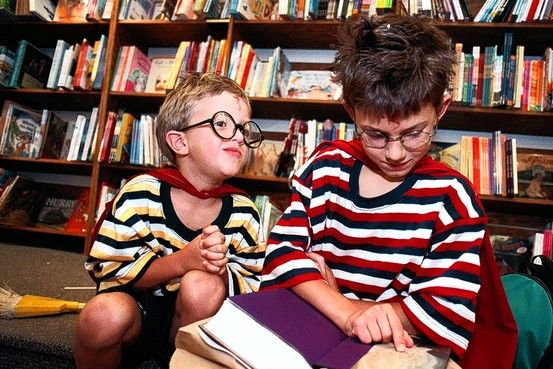
                                                                                  AP Photo/Dawn Villella
                                                                                                         Blair has
        In 2000, two brothers couldn't wait to read J.K. Rowling's latest.
                                                                                                         just
                                                                                                         become
       prime minister in Britain. Princess Diana is eyeing up an unsuitable lover. Apple is dying without Steve
       Jobs as CEO. Broadband is something people wear around their heads while playing tennis. All so long
       ago, a time before time.

       On June 30 that year, a book was published that blew apart one of the iron rules of publishing.
       Children's books, a literary agent assured me around this time, when I submitted a proposal, did not
       sell. Kids had ceased reading, full stop. Only a television tie-in could make chain stores stock a
       children's book, and even that was unlikely.

http://online.wsj.com/article/SB10001424052702304584004576419742308635716.html#printMode                                                                                Page 1 of 6
How J.K. Rowling and Harry Potter Saved Reading - WSJ.com 7/9/11 1:58 PM
Twelve London publishers turned down "Harry Potter and the Philosopher's Stone" before an
independent, Bloomsbury, offered J.K. Rowling's agent, Christopher Little, a paltry advance of £2,500.
The original edition appeared on June 30, 1997, in a run of 500 copies, most of which went to public
libraries. That's how few children were expected to read.
Sales were sluggish until two awards—one from a confectionery brand, the other an industry award as
Children's Book of the Year—put "Harry Potter" into reprint. An American publisher, Scholastic,
pitched in with $105,000—a record advance for a children's book—and amended the title to "Harry
Potter and the Sorcerer's Stone" when it brought it out in August 1998, by which time a second volume
was out in the U.K.
It is difficult to date exactly when, in the following months, Harry Potter went "viral." My family
experience traces the phenomenon to the school library. Our youngest daughter brought home a copy
around year four, when she was 9. Her elder sisters commandeered it and insisted that the parents read
as well. What Ms. Rowling achieved—long before Warner Bros. adapted her work into films, the last of
which will be released next week—was a children-led read-in that crossed all age barriers, uniting
families in a primal fireside act of sharing an unfolding story, page by page.
By the time the third volume was delivered to stores, in July 1999 in the U.K. and two months later in
the United States, publication was a news-leading event, timed for midnight, with teams of journalists
speed-reading until dawn to provide reviews for the final edition. On trains, in airport lounges, in parks
and on beaches, everywhere one went, everybody seemed to be reading Harry Potter.
The seventh and final volume, "Harry Potter and the Deathly Hallows," published on July 21, 2007, was
the fastest-selling book on record, moving 11 million copies in 24 hours, according to an estimate by the
BBC. (The second-best-selling novel of that year, Khaled Hosseini's "A Thousand Splendid Suns," made
headlines for selling a million copies in a week.) In all, Ms. Rowling is believed to have sold more than
450 million books. Her cycle has been published in 67 languages, more than any printed book apart
from the Bible.
Not since the serial novels of Charles Dickens in the middle of the 19th century had the works of a single
author excited such universal and immediate interest. The parallels with Dickens, born 200 years ago
next February, are multiple and compelling. "What happens to Little Nell?" crowds shouted in New
York harbor to incoming ships that carried the latest installment of "The Old Curiosity Shop." "Is
Hermione all right?" booksellers were asked as midnight purchasers scanned the closing pages of "Harry
Potter and the Half-Blood Prince," knowing a main character was to die.
Ms. Rowling, who rarely cites influences, has mentioned the death of Sydney Carton in "A Tale of Two
Cities" as a formative impression. She has also named Dickens, along with Shakespeare and the Bible, as
essential reading for children at school. "David Copperfield" is one of her top recommendations. A
pattern of affinities quickly emerges between two authors of very different centuries.
The common factor is hardship. Both writers were exposed to the cruelties of fate at a tender age and
embedded these experiences in their main characters. Dickens's father was jailed for debt when the boy
was 12, and he was put to work in a shoe-polish "blacking" factory. He drew on the jail memory in "Little
Dorrit" and on the child labor in "David Copperfield," "Nicholas Nickleby" and "Oliver Twist." Early
adversity turned Dickens into a formidable social reformer, a campaigner for children's rights.
Jo Rowling—she adopted "J.K." on the publishing truism that women authors did not sell—was born in
1965 and was raised in modest, rural comfort. When Ms. Rowling was 15, her mother was diagnosed
http://online.wsj.com/article/SB10001424052702304584004576419742308635716.html#printMode Page 2 of 6How J.K. Rowling and Harry Potter Saved Reading - WSJ.com 7/9/11 1:58 PM
with degenerative multiple sclerosis; she died, age 45, in December 1990. On a train to London from
Manchester earlier that year, Ms. Rowling conceived a series of novels based on a boy wizard. She
briefly went to teach English in Portugal, where she contracted a brief marriage, returning penniless
with her child to study in Edinburgh. The sickness and death of the author's mother are pivotal to her
creation.
From the opening page of the first book, the reader engages with Harry's child's-eye view of a world
ruled by imbeciles and malefactors. Harry Potter is an orphan, alone in a world of mediocrities known
as "Muggles," who do not appreciate his special gifts. Boarding a train to Scotland at platform 9¾ of
Kings Cross Station, London, he finds acceptance as a wizard, magically empowered but under mortal
threat from mysterious enemies.
Harry is a Dickensian archetype, a child of cruelty who inspires in us an urge to make a better world.
Alongside Oliver Twist, he is the most celebrated orphan in world literature. Oliver is altogether too
perfect, untouched by the evil around him. Harry, more credibly, wrestles with forces of darkness and
commands our sympathies.
Like Dickens, Ms. Rowling gives some of her secondary characters onomatopoeic names, informing us
before we read another word what kind of person they are. Just as Scrooge, Mr. Bumble, Magwitch and
Fagin reflect negative traits in Dickens's world, so do Severus Snape, Quirrell and Filch in that of Harry
Potter. Ms. Rowling goes beyond Dickens in imprinting evil into a person's name. Voldemort means
flight of death in French, Malfoy is bad faith.
In common with Dickens, Ms. Rowling knows that the reading public will not be insulted by situations
that it can recognize. In Hogwarts, she nods to the classic genre of the English school story, established
by "Tom Brown's Schooldays" in 1857. Yet she also draws deep on a well of Nordic mythology, plumbed
by J.R.R. Tolkien in "The Lord of the Rings" and by Richard Wagner in his Nibelungen tetralogy.
Hagrid, Hedwig and Hogsmeade could readily appear in any of these epics.
The force of the Harry Potter cycle lies, as with Wagner, not so much in the originality of its subject
matter as in the execution of a panoptic vision across a great span of time. Dickens, writing week to
week, never harbored such grandiose ambition. The closest any other author gets, at this level, to
creating and sustaining a fantasy/reality world is Mark Twain in the Tom Sawyer novels, of which four
were successfully published during his lifetime.
Tom is supposed to be 11 or 12 years old when the cycle begins, a year or so older than Harry, and Twain
employs him as a paradigm of lost American innocence, a nostalgic tweak at his mostly adult
readership. Harry represents no other time or place. He is what he is: an English boy who is sent off to
boarding school, where, from friends and teachers, he discovers both his own nature as a wizard and the
hair-raising hazards that he may face at any time.
It is here that Ms. Rowling achieves the double-whammy of getting child readers to emote with a
central character who is outwardly like them, inwardly not, empowered by wizardry yet otherwise
ordinary. Tom's magic is pure mischief, fooling another kid to whitewash his aunt's fence. Harry's is
existential. He pretends at normality, knowing he can shed it at will to frustrate the forces of evil.
Harry, nevertheless, arouses greater empathy because he seems to be a child liberated from the control
of dull, distracted adults, rejecting his soulless environment. No sensitive child would want to grow up
to be Harry's Muggle relatives, Mr. and Mrs. Dursley of No. 4 Privet Drive. Harry Potter allows children
of the suburbs to loathe their Little Boxes, to fly a nebulous broom, play non-televisable sports and
http://online.wsj.com/article/SB10001424052702304584004576419742308635716.html#printMode Page 3 of 6How J.K. Rowling and Harry Potter Saved Reading - WSJ.com 7/9/11 1:58 PM
aspire to a life out of the ordinary. Whether read in Seattle, Sarajevo or Soweto, Harry gives children a
license to judge the adult world—and find it wanting.
Few works of children's literature have grasped this rejectionist need so intuitively. "Little House on the
Prairie," that inexhaustible American saga, fostered civic conformity. C.S. Lewis, in the "Chronicles of
Narnia," bred good little Christians. Roald Dahl, ostensibly rebellious, invented a controllable
naughtiness in his chocolate factory. The magnetic charm of Harry is that he has no limits: He can do
anything, fly anywhere and yet remain sympathetic and real, an achievable role model. The only other
modern work of children's literature that pulls off this otherworld/our-world duality is Mark Haddon's
brilliant and disturbing "The Curious Incident of the Dog in the Night Time," in which a 15-year-old boy
with Asperger's syndrome evokes an outsider-insider dichotomy. Mr. Haddon, like Ms. Rowling,
understands that children need to express an innate difference.
Much of Harry Potter's iconoclasm disappears on film, due to Hollywood's regimented conformities of
set, sound and stereotyped character. It speaks volumes for Ms. Rowling's novels that many children will
forever imagine Harry Potter as quite different from the actor who plays him, Daniel Radcliffe. By
rekindling the urge to read, J.K. Rowling trumped the machine-tooled dream factories.
Ever since she finished "Harry Potter and the Deathly Hallows" in 2007, Ms. Rowling has given
tantalising hints of future ventures. Now Pottermore, a website that goes live on July 31, has been
announced as the sole source for electronic downloads of the Harry Potter books, as well as any
prospective future texts. Still only 45, Rowling seems ready to step up her game. From Dickens, with his
20 novels, she must know that what a writer does is write. More books, and then more. Hers may not
continue to appear as print on paper for much longer, but they will always exist to be read, one word to
the next: the word triumphant.
—Mr. Lebrecht's "Why Mahler?" will appear in paperback in September.
Copyright 2011 Dow Jones & Company, Inc. All Rights Reserved
This copy is for your personal, non-commercial use only. Distribution and use of this material are governed by our Subscriber
Agreement and by copyright law. For non-personal use or to order multiple copies, please contact Dow Jones Reprints at 1-800-
843-0008 or visit
www.djreprints.com
http://online.wsj.com/article/SB10001424052702304584004576419742308635716.html#printMode Page 4 of 6How J.K. Rowling and Harry Potter Saved Reading - WSJ.com 7/9/11 1:58 PM
www.djreprints.com
http://online.wsj.com/article/SB10001424052702304584004576419742308635716.html#printMode Page 5 of 6How J.K. Rowling and Harry Potter Saved Reading - WSJ.com 7/9/11 1:58 PM http://online.wsj.com/article/SB10001424052702304584004576419742308635716.html#printMode Page 6 of 6
You can also read


