IHDI: First International Workshop on Human-Drone Interaction
←
→
Page content transcription
If your browser does not render page correctly, please read the page content below
iHDI: First International Workshop
                                                              on Human-Drone Interaction
                                            Anke M. Brock                                                 Jessica Cauchard
                                            ENAC, Université Toulouse                                     Interdisciplinary Center (IDC) Herzliya
                                            Toulouse, France                                              Herzliya, Israel
                                            anke.brock@enac.fr                                            jcauchard@acm.org

                                            Markus Funk                                                   Jérémie Garcia
                                            Technische Universität Darmstadt                              ENAC, Université Toulouse
                                            Darmstadt, Germany                                            Toulouse, France
                                            funk@tk.tu-darmstadt.de                                       jeremie.garcia@enac.fr

Figure 1: Gestural input with drones [3].   Mohamed Khamis                                                Matjaž Kljun
                                            University of Glasgow                                         University of Primorska, HICUP Lab
                                            Glasgow, United Kingdom                                       Koper, Slovenia
                                            Mohamed.Khamis@glasgow.ac.uk                                  matjaz.kljun@upr.si

                                            ABSTRACT
                                            Commercial drones have recently been developed to encompass use cases beyond aerial photography
                                            and videography. Researchers have explored wider applications of drones including using drones as
                                            social companions, as key components in virtual environments, as assistive tools for people with dis-
                                            abilities, and even as sport companions. However the uptake of research in Human-Drone Interaction
                                            (HDI) also brought forth a plethora of challenges that are unique to this platform. While drones were
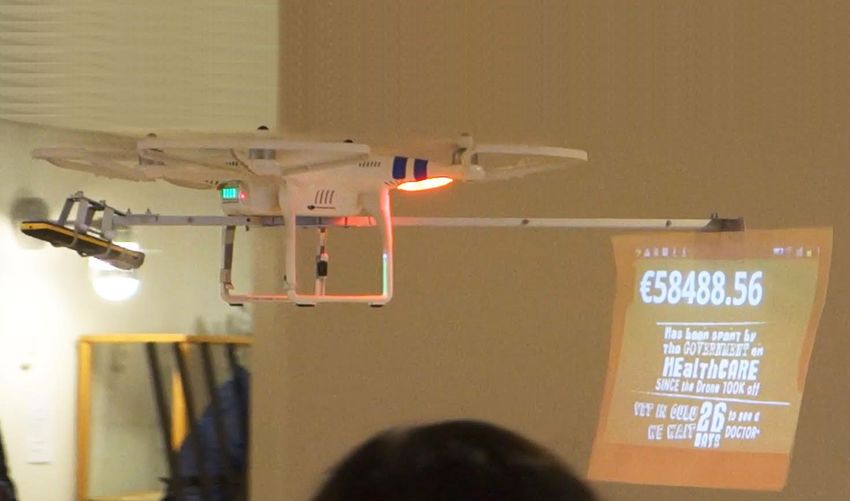
     Figure 2: Display drones [13].
                                            Permission to make digital or hard copies of part or all of this work for personal or classroom use is granted without fee
                                            provided that copies are not made or distributed for profit or commercial advantage and that copies bear this notice and the
                                            full citation on the first page. Copyrights for third-party components of this work must be honored. For all other uses, contact
                                            the owner/author(s).
                                            CHI’19 Extended Abstracts, May 4–9, 2019, Glasgow, Scotland Uk
                                            © 2019 Copyright held by the owner/author(s).
                                            ACM ISBN 978-1-4503-5971-9/19/05.
                                            https://doi.org/10.1145/3290607.3299001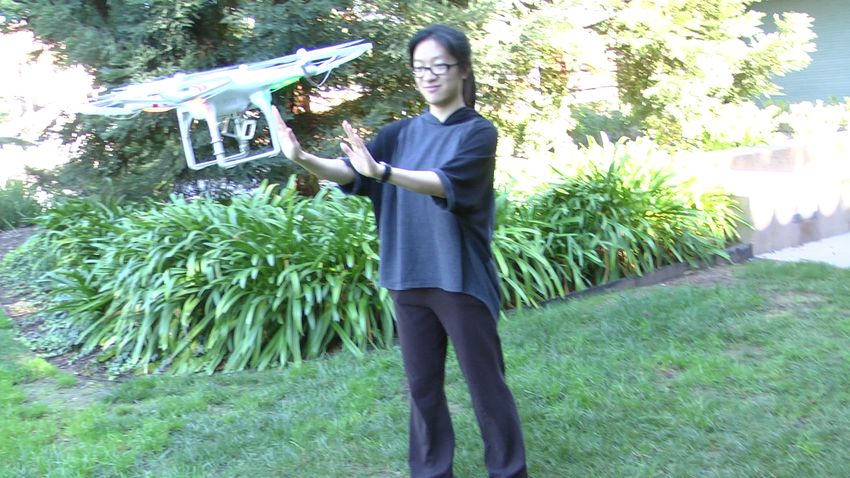
initially considered as flying robots, recent works have shown that traditional Human-Robot Interac-
tion (HRI) methodologies cannot simply be applied to HDI. For example, how do we deal with privacy
and safety concerns associated with drones in public space? What is the appropriate methodology to
evaluate HDI applications? How do the size, altitude, and speed of drones influence their perception?
The aim of this workshop is to bring together researchers and practitioners from both academia and
industry to identify: 1) novel HDI applications, and 2) key challenges in this area to drive research in
the coming decade. The long-term goal is to create a strong interdisciplinary research community that
includes researchers and practitioners from HCI, HRI, Ubiquitous Computing, Interaction Techniques,
User Privacy, and Design.

CCS CONCEPTS
• Human-centered computing → Human computer interaction (HCI);

KEYWORDS
Human-Drone Interaction, Unmanned Aerial Vehicles (UAV), Flying Robots, Quadcopters, Human-
Robot Interaction
ACM Reference Format:
Anke M. Brock, Jessica Cauchard, Markus Funk, Jérémie Garcia, Mohamed Khamis, and Matjaž Kljun. 2019. iHDI:
First International Workshop on Human-Drone Interaction. In CHI Conference on Human Factors in Computing
Systems Extended Abstracts (CHI’19 Extended Abstracts), May 4–9, 2019, Glasgow, Scotland Uk. ACM, New York,
NY, USA, 7 pages. https://doi.org/10.1145/3290607.3299001

INTRODUCTION
In the last years, the adoption rate of personal and commercial drones has exponentially increased.
This rapid growth is both exciting and frightening. On the one hand, drones are presenting new
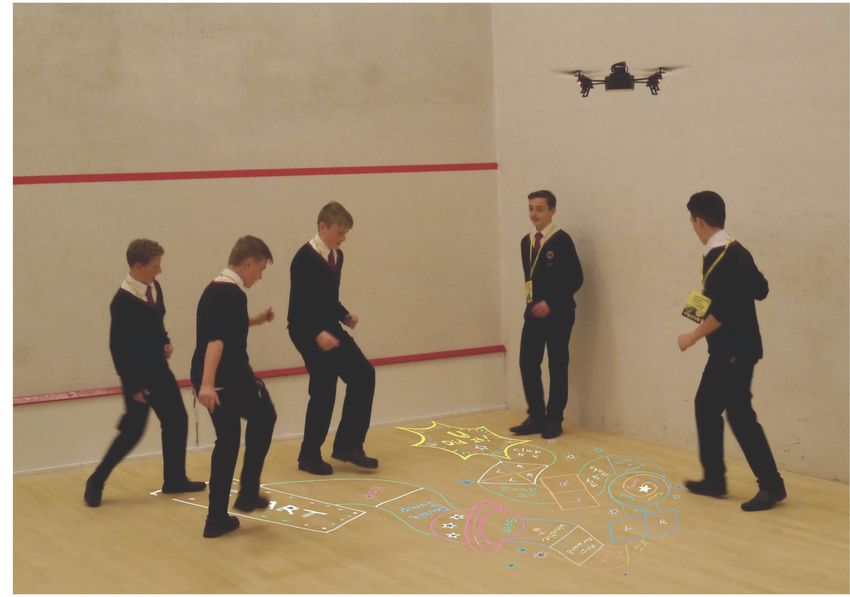
opportunities, with applications ranging from entertainment (Figures 2 and 3) to delivery, supporting
people with special needs [1] (Figure 4), sports [12], pedestrian guidance [5], agriculture, and even
search-and-rescue. On the other hand, many negative issues are arising around the adoption of drones
and what it means to have them in our environments. The success and acceptability of this technology
will depend on how well it can be used (Figure 1), integrated, and made acceptable to people. Many
of these challenges fall in the realm of research in human-computer and human-robot interaction.
   In this multidisciplinary workshop, we propose to bring together students, experienced researchers,
and practitioners from diverse areas. We expect this workshop will raise interest to researchers from
fields including, interaction techniques, autonomous vehicles, robotics, ubicomp, design, and cognitive
science. In particular, we will foster discussions around interaction techniques, design, feedback
strategies, automation, control, trust, as well as privacy and ethical issues in HDI research. These
                                            topics are relevant to ensure the successful integration of the technology.
                                               Through two hands-on sessions and group discussions with experts from both academia and
                                            industry, our goal is to address key questions around the design and methodologies, and bring a
                                            community together to develop new approaches for future human-drone interaction research. While,
                                            HRI research has been growing over the years, only few papers are presented at the CHI conferences.
                                            This workshop will give the opportunity for researchers in the HRI field to discover CHI and participate
                                            in our community.
                                               This workshop will lead to a special edition of a journal, to help bridge the gap between the HCI
                                            and HRI communities in terms of methodologies for human-drone interaction research.

Figure 3: Interactive games with drones     ORGANIZERS
[10].                                       Our interdisciplinary organization team consists of 6 diverse international researchers from France,
                                            Israel, Germany, UK, and Slovenia. In addition, an industry partner from Balmore Group’s Aerial
                                            Services division 1 confirmed their participation in the workshop.
                                               Anke Brock is an Assistant Professor at ENAC in Toulouse, France. She is interested in building
                                            drone-based navigation systems [2], and making human-drone interaction accessible to people with
                                            impairments (Fig. 4).
                                               Jessica Cauchard is an Assistant Professor at the Interdisciplinary Center (IDC) Herzliya, Israel
                                            where she heads the Ubiquitous Computing Lab. Jessica is interested in developing natural interfaces
                                            for human-drone interaction [3, 4, 7].
                                               Markus Funk is a senior researcher (area head) at the Telecooperation Lab of the TU Darmstadt,
                                            Germany. Markus is interested in human-drone interaction and flying user interfaces [8, 11].
                                               Jérémie Garcia is an Assistant Professor at ENAC in Toulouse, France. He is interested in designing
                                            interactions to author and operate automated systems such as drones or air traffic control [6].
                                               Mohamed Khamis is a Lecturer (Assistant Professor) at the University of Glasgow in the UK.
Figure 4: Making HDI accessible to people
with impairments.                           His research is at the intersection of Ubiquitous Computing and User Privacy. He is interested in
                                            understanding the privacy implications of drones, as well as developing novel input methods for
                                            human-drone interaction [9].
                                               Matjaž Kljun is an Assistant Professor at University of Primorska (UP) where he co-directs HICUP
                                            lab (Humans Interacting with Computers at UP). Within the general HCI scope, he is also interested
                                            on how drones will become our companions [10].
1 https://balmoremedia.co.uk/
                                            WEBSITE
                                            The website will promote the workshop and serve as a platform to present the findings and foster the
                                            growing community of HDI researchers. It is available at: http://hdi.famnit.upr.si/.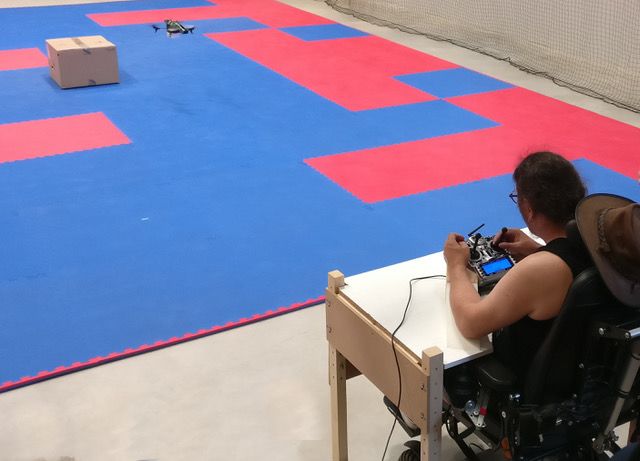
PRE-WORKSHOP PLANS
                                             Prior to the workshop, we will open a web submission form, issue a call for participation, advertise
                                             the workshop, select position papers and contact authors with relevant information.
                                                The call for participation will be broadly distributed to the different research communities addressing
                                             the subject of the workshop. This includes posting to mailing lists (e.g., chi-announcements), on social
                                             medias (e.g., Facebook and Twitter), and using the organizers’ personal networks to contact leading
                                             researchers with relevant contributions in the area.
                                                Potential participants will be asked to submit a 2 to 6-page position paper in the CHI Extended
                                             Abstract format by February 12th, 2019, along with three topics which they would like to discuss
                                             during the workshop, and with their preference of presentation format (poster or oral presentation).
                                             Papers may be submitted with organizers as authors or co-authors. We will encourage authors to
                                             consider broader implications of HDI and HCI, and where appropriate, implications for related fields
                                             such as robotics. Participants will also be encouraged to bring in new perspectives. We will seek
                                             submissions from HCI and HRI researchers already familiar with mainstream HCI, as well as cutting
                                             edge drone and robot researchers who are less familiar with HCI, but who believe their work may
                                             have wider implications for interactivity. We will also encourage submissions from researchers in any
                                             area of HCI with insights relevant to HDI.
2 https://easychair.org/conferences/?conf=      An Easychair account will be used for submitting the position papers2 . Each paper will be reviewed
hdi2019                                      by at least two of the workshop organizers. All organizers will take part in reviewing. The organizers
                                             will select around 12 position papers for presentation at the workshop, and authors will be informed
                                             of acceptance on or before March 1st, 2019. Papers will be selected based on quality and relevance to
                                             the workshop topic and goals. Accepted position papers will be uploaded to the workshop website.
                                             Participants will be asked to read all of the accepted position papers in advance of the day so that
                                             they may come to the workshop primed with relevant questions and discussion points.

                                             WORKSHOP STRUCTURE
                                             The timeline for the workshop is shown in Table 1. First, the organizers will introduce themselves and
                                             talk briefly about the aim and scope of the workshop. Participants will then introduce themselves
                                             and their research interests in 30 seconds each.
                                                Individual Presentations:
                                                The morning will start with individual presentations of the position papers in one of two proposed
                                             formats: Short oral presentations (5 min) and poster presentations. We will invite pioneering re-
                                             searchers in the field of human-drone interaction to give a short keynote, with at least one researcher
                                             coming from academia, Prof. Roel Vertegaal from Queens University, Canada, and we are aiming to
                                             invite one from industry. This session will last up to 2 hours.
Group Activity 1: After the coffee break, participants will be divided into groups. Drones of
different shapes and sizes will be brought in to stimulate the discussions. Approval to bring drones to
the venue has been obtained from the CHI 2019 general chair Prof. Stephen Brewster. Participants will
be encouraged to engage with the drone on their table. Following the observation and engagement
08:30-08:45 or 14.30-14.45 Opening stages, participants will discuss in their group the current and future research problems in Human-
08:45-09:00 or 14.45-15.00 30-second introductions Drone Interaction. They will be asked to prioritize the research problems according to their significance
09:00-11:00 or 15.00-17.00 Presentations and posters and the amount of efforts required for each problem to be solved. The results of this activity will be
11:00-11:30 or 17.00-17.30 Coffee break used as basis for the second activity.
11.30-12.15 or 17:30-18:15 Group activity 1 Group Activity 2: Participants will be split into groups. Each group will focus on one of the themes
12.15-13.30 or 18.15-19.30 Group activity 2
identified in the first group activity and will discuss the upcoming steps to address this research
13.30-14.00 or 19.30-20.00 Summary and Closing
Lunch or Dinner
problem. Each group will then be invited to present their outcome.
We will conclude by collecting feedback about the workshop and discussing the next steps the HDI
Table 1: Timeline
community should undertake. We will encourage participants to start collaborating on the discussed
themes and potentially submit new research work to the special journal issue.
POST-WORKSHOP PLANS
Interacting with drones is a topic which has recently sparked much interest in the HCI community.
Yet the HDI community is sparse and this workshop will give an opportunity for researchers in the
field to meet and discuss the future of the field. We expect this workshop to influence future research
in this area and help establish well-needed methodologies for HCI research with drones.
After the workshop, the organizers will prepare a report to be submitted to ACM Interactions
Magazine. All accepted submissions will be published on the workshop website and on HAL (https:
//hal.archives-ouvertes.fr/browse/collection) which is indexed by Google scholar. Selected position
papers’ authors will be invited to submit for review longer versions of their submissions, including
new material, together with a collaboratively produced paper. We plan to hold an open call in a special
issue of a journal. The editors-in-chief of ACM THRI have been contacted and we are in the process
of discussing the details of a human-drone interaction special issue to be published early 2020.
CALL FOR PARTICIPATION
Drones are becoming increasingly ubiquitous to our environments. Many applications have appeared
such as using drones for delivery, security, search-and-rescue, or even as companions. Such applications
led to new challenges in the design and development of drone interfaces. In this First International
Workshop on Human-Drone Interaction (HDI), through hands-on sessions and group discussions with
experts, we provide this emerging field a platform to bring together researchers and practitioners. We
seek to structure previous research efforts, identify new research directions, and define methodologies
for this novel research area.We seek high quality contributions that explore the advances and challenges in HDI, and that
suggest new ways of interacting with drones. Submissions are invited in, but not limited to, the
following topics:
• Novel applications
• Novel interaction techniques
• Manual control to autonomous applications
• Flying user interfaces
• First-person view flying
• Creating everyday interaction with drones
• Increasing safety and security
• Communicating drone interactivity
• Accessibility
Authors are invited to submit a 2 to 6-page position paper following the CHI Extended Abstracts
format, on or before February 12th, 2019 at https://easychair.org/conferences/?conf=hdi2019.
The proceedings of the workshop will be published on the website and through HAL https://hal.
archives-ouvertes.fr/, which is indexed by Google scholar. Selected authors will be invited to submit
to a special issue in the THRI journal. Further information can be found on: http://hdi.famnit.upr.si
At least one author must attend the workshop. All participants must register for the workshop and
at least one day of the conference.
REFERENCES
[1] Mauro Avila Soto, Markus Funk, Matthias Hoppe, Robin Boldt, Katrin Wolf, and Niels Henze. 2017. DroneNavigator: Using
Leashed and Free-Floating Quadcopters to Navigate Visually Impaired Travelers. In Proceedings of the 19th International
ACM SIGACCESS Conference on Computers and Accessibility (ASSETS ’17). ACM, New York, NY, USA, 300–304. https:
//doi.org/10.1145/3132525.3132556
[2] Anke M. Brock, Julia Chatain, Michelle Park, Tommy Fang, Martin Hachet, James A. Landay, and Jessica R. Cauchard.
2018. FlyMap: Interacting with Maps Projected from a Drone. In Proceedings of the 7th ACM International Symposium on
Pervasive Displays - PerDis ’18. ACM Press, New York, New York, USA, 1–9. https://doi.org/10.1145/3205873.3205877
[3] Jessica R. Cauchard, Jane L. E, Kevin Y. Zhai, and James A. Landay. 2015. Drone & Me: An Exploration into Natural
Human-drone Interaction. In Proceedings of the 2015 ACM International Joint Conference on Pervasive and Ubiquitous
Computing (UbiComp ’15). ACM, New York, NY, USA, 361–365. https://doi.org/10.1145/2750858.2805823
[4] Jessica Rebecca Cauchard, Kevin Y. Zhai, Marco Spadafora, and James A. Landay. 2016. Emotion Encoding in Human-
Drone Interaction. In The Eleventh ACM/IEEE International Conference on Human Robot Interaction (HRI ’16). IEEE Press,
Piscataway, NJ, USA, 263–270. http://dl.acm.org/citation.cfm?id=2906831.2906878
[5] Ashley Colley, Lasse Virtanen, Pascal Knierim, and Jonna Häkkilä. 2017. Investigating Drone Motion As Pedestrian
Guidance. In Proceedings of the 16th International Conference on Mobile and Ubiquitous Multimedia (MUM ’17). ACM, New
York, NY, USA, 143–150. https://doi.org/10.1145/3152832.3152837[6] Stéphane Conversy, Jérémie Garcia, Guilhem Buisan, Mathieu Cousy, Mathieu Poirier, Nicolas Saporito, Damiano Taurino,
Giuseppe Frau, and Johan Debattista. 2018. Vizir: A Domain-Specific Graphical Language for Authoring and Operating
Airport Automations. In Proceedings of the 31st ACM Symposium on User Interface Software and Technology (UIST2018).
ACM SIGCHI, Berlin, Germany. https://hal.archives-ouvertes.fr/hal-01886335
[7] Jane L. E, Ilene L. E, James A. Landay, and Jessica R. Cauchard. 2017. Drone & Wo: Cultural Influences on Human-Drone
Interaction Techniques. In Proceedings of the 2017 CHI Conference on Human Factors in Computing Systems (CHI ’17). ACM,
New York, NY, USA, 6794–6799. https://doi.org/10.1145/3025453.3025755
[8] Markus Funk. 2018. Human-drone interaction: let’s get ready for flying user interfaces! Interactions 25, 3 (2018), 78–81.
[9] Mohamed Khamis, Anna Kienle, Florian Alt, and Andreas Bulling. 2018. GazeDrone: Mobile Eye-Based Interaction in
Public Space Without Augmenting the User. In Proceedings of the 4th ACM Workshop on Micro Aerial Vehicle Networks,
Systems, and Applications (DroNet’18). ACM, New York, NY, USA, 66–71. https://doi.org/10.1145/3213526.3213539
[10] Matjaž Kljun, Klen Čopič Pucihar, Mark Lochrie, and Paul Egglestone. 2015. StreetGamez: A Moving Projector Platform
for Projected Street Games. In Proceedings of the 2015 Annual Symposium on Computer-Human Interaction in Play (CHI
PLAY ’15). ACM, New York, NY, USA, 589–594. https://doi.org/10.1145/2793107.2810305
[11] Pascal Knierim, Steffen Maurer, Katrin Wolf, and Markus Funk. 2018. Quadcopter-projected in-situ navigation cues for
improved location awareness. In Proceedings of the 2018 CHI Conference on Human Factors in Computing Systems. ACM,
433.
[12] Florian ’Floyd’ Mueller and Matthew Muirhead. 2015. Jogging with a Quadcopter. In Proceedings of the 33rd Annual
ACM Conference on Human Factors in Computing Systems (CHI ’15). ACM, New York, NY, USA, 2023–2032. https:
//doi.org/10.1145/2702123.2702472
[13] Jürgen Scheible and Markus Funk. 2016. In-situ-displaydrone: Facilitating Co-located Interactive Experiences via a Flying
Screen. In Proceedings of the 5th ACM International Symposium on Pervasive Displays (PerDis ’16). ACM, New York, NY,
USA, 251–252. https://doi.org/10.1145/2914920.2940334You can also read


