Students' Handbook, Edition 2020
←
→
Page content transcription
If your browser does not render page correctly, please read the page content below
PhD Program in Bioengineering and Robotics
 Department of Informatics, Bioengineering, Robotics, System Engineering DIBRIS - University of Genova

       Students’ Handbook, Edition 2020
                                     Revision November 2019

Introduction
The PhD program in Bioengineering and Robotics is a doctoral program of the University of
Genova (UNIGE). In this document you will find the relevant information about the educational,
training and research activities offered.

Organization
The Doctorate in Bioengineering and Robotics (Doctorate in the following) is a 3 years PhD
program where students get an in-depth training in modern engineering methodologies and
technologies and, depending on the specific curriculum, in robotics, biomedical technologies, as
well as in applied life and cognitive sciences, Education activities are offered through specific
courses, national and international (summer) schools, seminars and/or additional activities proposed
by the tutors.

At the beginning of the PhD program, each student selects a specific research area and is expected:
to develop a personal research agenda, under the supervision of a tutor, and under her/his
supervision to acquire the analytical and/or experimental abilities required to complete the PhD
research project.

Curricula
The Doctorate is organized in 6 curricula and for each curriculum there are designated Reference
Faculties that will coordinate the training and research activities in agreement and collaboration
with the Coordinator of the PhD program and the PhD Board (Collegio dei Docenti). The curricula
are listed in the following along with the Reference Faculties:

                                                                                                         1
PhD Program in Bioengineering and Robotics - 2019
Curriculum Reference Faculties E-mail
Bioengineering Prof. Paolo Massobrio Paolo.massobrio@unige.it
Robotics and Autonomous Prof. Giorgio Cannata Giorgio.cannata@unige.it
Systems Prof. Fulvio Mastrogiovanni Fulvio.mastrogiovanni@unige.it
Marine Technologies Prof. Enrico Simetti Enrico.simetti@unige.it
Advanced and Humanoid Dr. Ferdinando Cannella ferdinando.cannella@iit.it
Robotics Dr. Lorenzo Natale lorenzo.natale@iit.it
Bionanotechnologies Dr. Giuseppe Vicedomini Giuseppe.vicedomini@iit.it
Cognitive Robotics, Interaction Prof. Giulio Sandini Giulio.sandini@unige.it
and Rehabilitation Technologies
Tutors
At the beginning of the program, the PhD Board appoints for each student one or two Tutors 1, who
is(are) responsible for her/his scientific, technical as well as intellectual training.
At least one of the Tutors must be a University Professor, a University Researcher or a highly
qualified Scientist 2 at the IIT.
Tutors make sure that PhD students become active members of their research group.
Tutors support the publication of the scientific results of the students on international scientific
journals or relevant conference proceedings, as well as their active participation to scientific
conferences and schools.
Tutors are responsible for making available to their students all the resources needed to carry on
their research project. Availability of sufficient resources is checked by the PhD Board and is a
necessary condition to be appointed as Tutor.
Credit system
During the 3 years PhD students are required obtain at least 180 credits (CF) - one CF corresponds
nominally to about 25 hours of work. Credits are assigned as follows:
- Structured Training activities (40 CF)
- Research activities (120 CF, i.e. 40 CF per year)
- Thesis writing (20 CF)
1
In case of two Tutors one have to be indicated as Reference Tutor who will become a member of the PhD Board.
2
At level of Team Leader or higher.
2Structured Training activities
Structured training activities include attending PhD courses, national and/or international PhD
schools, and at least 30 Credits (CFs) have to be obtained during the first two years 3.
In general, “structured training activities” belong to the following typologies, and PhD Board will
acknowledge an amount of CFs as shown below.
(i) PhD courses, specifically offered by the PhD Program in Bioengineering and Robotics 4,5.
a. A final exam must be positively passed
b. 1 CF corresponds nominally to 3 hours of lecture 6
(ii) Courses that are part of one of the Graduate programs (Corso di Laurea Magistrale)
offered at the University of Genova 7 in agreement with the Tutor and with the approval of
the PhD Board.
a. A final exam must be positively passed
b. CFs are the credits reported for the course on the official University website
(iii) PhD Schools. International PhD Schools approved in advance by the PhD Board upon a
formal request to the Coordinator made by the Tutor 8 including the detailed program of the
School and its duration.
a. A certificate of attendance of the school must be presented for the CFs to be
assigned.
b. 1 CF can be assigned every 6 hours of lecture
(iv) On-line Courses. The attendance and CFs assignment for on-line courses must be requested
by the Tutor to the Coordinator and approved in advance by the PhD Board.
a. An official certificate of attendance (issued by the legal entity providing the course)
must be presented for the CFs to be assigned.
3
It is highly recommended, that these CFs are allocated over the three years in decreasing weight, e.g. 25-30/5-10/0-5
to have more time during the 3rd year to formalize and disseminate the research results.
4
A list of offered courses is available on the PhD web site: http://phd.dibris.unige.it/biorob/index.php/activities.
5
Or offered by other PhD programs of the University of Genova (e.g. PhD in Computer Sciences and Engineering).
6
E.g. an 18 hrs. course will give 6 CFs. However, the PhD board may assign different credits to particular courses.
7
For instance, the Graduate Programs in Bioengineering or in Robotics Engineering, or Computer Engineering, etc.
8
The Tutor of the student must send a letter
3PhD Program in Bioengineering and Robotics - 2019
b. CFs will be acknowledged by the PhD Board on the basis of:
i. course topic (basic/advanced);
ii. reputation of course provider;
iii. expected workload.
c. A maximum of 10 CFs can be acknowledged over the three years
Remark. Participation to conferences, seminars, workshops etc. does not grant CFs.
Remark. The list of the courses offered may vary over the years. In addition, others PhD programs
might offer courses in a wide range of science and engineering disciplines and they can be proposed
by the student in agreement with her/his Tutor(s) and evaluated by the PhD Board.
Remark Students with a non-engineering background, or whose research project requires the
knowledge of topics that they never addressed before during their previous career are recommended
to take some of the courses offered by the Graduate programs in engineering, science and/or
mathematics (mainly, but not exclusively, the programs of Bioengineering, Computer Science and
Engineering, Robotics and Physics).
Remark Students without fellowship are expected to obtain at least 180 credits as specified above.
Training to Scientific Research and Evaluation Procedure
At the beginning of the PhD program, PhD students formulate a research plan of activities under the
supervision of her/his tutor(s). Research is expected to be carried out in the labs which are made
available by the Departments participating in the PhD Program.
At the end of each academic year, PhD students must submit to the Reference Faculties of their
curriculum:
1) a detailed report of their research activities, including the list of publications
2) a workplan for the following year.
Students will be also required present their results in an oral presentation to a specific commission 9
for each one of the five curricula.
The Year 1 report will consist of the formulation of a thesis project identifying:
1) an assessed research workplan;
2) the themes addressed and their relevance for bioengineering and robotics;
9
The Coordinator and the Reference Faculties for the curriculum, will appoint an evaluation commission (at least two
reviewers within the PhD Board or qualified Faculties excluding the tutor(s))
43) the preliminary findings (if any).
At the end of Year 2 and 3, the students are expected to exhibit a substantial progress in their thesis
project. The report will focus on the state of advancement of the thesis work and on the results
obtained.
Each year after the presentations students will receive appropriate feedback/advice, and the
commission will formulate a written evaluation. Based on this and on recommendations of the
tutor(s) the PhD Board will approve the admission (pass/fail) to the following year, including
recommendations to the students.
Final examination and thesis defense
At the end of Year 3, based on the evaluation of the commission and the recommendation of the
tutor(s), the PhD Board will decide on admission (pass/fail) to the final examination.
The requirements for admission to the final examination are summarized as follows:
(i) Fulfilment of the training requirements (40 CFs);
(ii) Positive evaluation from their tutor(s);
(iii) Positive evaluation from the evaluation commission;
(iv) PhD board approval of Year 3 report;
(v) Being author or co-author (first name) of at least one scientific paper in a peer-reviewed
international journal (published or accepted for publication) or in a well-recognized
international conference with peer review of full papers.
The PhD candidates admitted to final examination must submit a written dissertation (in English).
In agreement with the university rules for the doctoral programs 10, the PhD Board will appoint, for
each candidate, at least two external reviewers with relevant expertise in the field of the PhD work
at international level. The reviewers will assess the quality and the scientific relevance of the thesis
work and within 30 days will provide a written evaluation report. The evaluation may propose to
either admit candidates to the final exam or (in case of major requests for modifications) to
postpone the exam for up to 6 months, during which candidates will be required to revise their
work. The reviewers will provide an updated written evaluation that accounts for the revisions.
After 6 months the thesis is admitted in any case to public defense.
The final exam consists of a public thesis defense, in front of a commission composed by three
University Professors (including university Professors of foreign institutions and with at least one
10
http://www.unige.it/regolamenti/studenti/
5PhD Program in Bioengineering and Robotics - 2019
member of the PhD Board) and up to two external experts (possibly among the reviewers that
revised the thesis works) in a field related to the specific curriculum. The PhD Board may appoint
different commissions for each candidate or groups of candidates with similar research themes.
Research Allowance
Phd students have a personal fund of 1.650,00 €/year that can be used for the sporadic mobility
(attendance at conferences, workshops, PhD Schools, short visits at other universities or
laboratories).
In order to use this funds PhD students must follow the procedure described in appendix.
Activities of Tutoring
PhD students, as an integral part of the training project, may carry out activities of tutoring for
bachelor/master students and, for a maximum forty hours each academic year, the activities of
teaching assistance.
The previous activities must be previously authorized by the PhD Board and they will not entail any
increase in the scholarship.
International dimension
The PhD Committee encourages PhD students to carry out periods of research activity in foreign
institutions as an integral part of their PhD training. During the period carried out abroad, the
scholarship is increased of 50% with respect to its nominal value.
The authorization to spend periods of research activity in foreign institutions must be requested to
the Coordinator and approved by the PhD board. The procedure is as follows:
1. The hosting institute must write a formal invitation letter for the student, clearly indicating
the period of the visit (starting and ending dates)
2. The Tutor must write a letter of authorization to visit the hosting institute indicating the
period of the visit (starting and ending dates – which must correspond to those reported in
the invitation letter). The Tutor can also request the increment up to the 50% of the
scholarship for the visiting period.
3. The letters must be sent to the Coordinator (phd.biorob@dibris.unige.it)
6PhD Structure
COORDINATOR
Prof. Giorgio Cannata, Università di Genova
giorgio.cannata@unige.it
CURRICULA AND REFERENCE FACULTIES
BIOENGINEERING
Prof. Sergio Martinoia Università di Genova sergio.martinoia@unige.it
ROBOTICS AND AUTONOMOUS SYSTEMS
Prof. Giorgio Cannata Giorgio.cannata@unige.it
Università di Genova
Prof. Fulvio Mastrogiovanni fulvio.mastrogiovanni@unige.it
MARINE TECHNOLOGIES
Prof. Enrico Simetti Università di Genova Enrico.simetti@unige.it
ADVANCED AND HUMANOID ROBOTICS
Dr. Ferdinando Cannella lorenzo.natale@iit.it
Istituto Italiano di Tecnologia
Dr. Lorenzo Natale ferdinando.cannella@iit.it
BIONANOTECHNOLOGY
Dr. Giuseppe Vicedomini Istituto Italiano di Tecnologia giuseppe.vicedomini@iit.it
COGNITIVE ROBOTICS, INTERACTION AND REHABILITATION TECHNOLOGIES
Prof. Giulio Sandini Istituto Italiano di Tecnologia giulio.sandini@iit.it
7PhD Program in Bioengineering and Robotics - 2019
ADMINISTRATIVE CONTACTS
PhD Secretariat
phd.biorob@dibris.unige.it
Valentina Scanarotti (valentina@dibris.unige.it)
BIOENGINEERING
SCANAROTTI Valentina DIBRIS Valentina.scanarotti@unige.it 010 353 2311
ROBOTICS AND AUTONOMOUS SYSTEMS
SCANAROTTI Valentina DIBRIS Valentina.scanarotti@unige.it 010 353 2311
MARINE TECHNOLOGIES
SCANAROTTI Valentina DIBRIS Valentina.scanarotti@unige.it 010 353 2311
ADVANCED AND HUMANOID ROBOTICS
BETRO Lucia IIT-iCub Grazia.Montera@iit.it 010 717 81863
BIONANOTECHNOLOGY
SALVATORI Manuela IIT – Nanophysics manuela.Salvatori@iit.it 010 717 81762
COGNITIVE ROBOTICS, INTERACTION AND REHABILITATION TECHNOLOGIES
BRUZZONE Anastasia IIT - RBCS Anastasia.Bruzzone@iit.it 010 717 81472
8PhD Board 2019-2020
35rd Cycle
Membri del collegio (Personale Docente e Ricercatori delle Università Italiane)
Cognome Nome Ateneo Dipartimento/ Struttura email
MARTINOIA Sergio GENOVA Informatica, bioingegneria,robotica e ingegneria dei sistemi (DIBRIS) Sergio.Martinoia@unige.it
CASALINO Giuseppe GENOVA Informatica, bioingegneria,robotica e ingegneria dei sistemi (DIBRIS) pino@dist.unige.it
CANNATA Giorgio GENOVA Informatica, bioingegneria,robotica e ingegneria dei sistemi (DIBRIS) giorgio.cannata@unige.it
SANDINI Giulio GENOVA Informatica, bioingegneria,robotica e ingegneria dei sistemi (DIBRIS) giulio.sandini@iit.it
BONFIGLIO Annalisa CAGLIARI Ingegneria Elettrica ed Elettronica annalisa@diee.unica.it
RAITERI Roberto GENOVA Informatica, bioingegneria,robotica e ingegneria dei sistemi (DIBRIS) roberto.raiteri@unige.it
CASADIO Maura GENOVA Informatica, bioingegneria,robotica e ingegneria dei sistemi (DIBRIS) maura.casadio@unige.it
SGORBISSA Antonio GENOVA Informatica, bioingegneria,robotica e ingegneria dei sistemi (DIBRIS) antonio.sgorbissa@unige.it
GIACOMINI Mauro GENOVA Informatica, bioingegneria,robotica e ingegneria dei sistemi (DIBRIS) mauro.giacomini@unige.it
MASTROGIOVANNI Fulvio GENOVA Informatica, bioingegneria,robotica e ingegneria dei sistemi (DIBRIS) fulvio.mastrogiovanni@unige.it
SOLARI Fabio GENOVA Informatica, bioingegneria,robotica e ingegneria dei sistemi (DIBRIS) fabio.solari@unige.it
PANI Danilo CAGLIARI Ingegneria Elettrica ed Elettronica danilo.pani@diee.unica.it
BOCCACCI Patrizia GENOVA Informatica, bioingegneria,robotica e ingegneria dei sistemi (DIBRIS) patrizia.boccacci@unige.it
ROVETTA Stefano GENOVA Informatica, bioingegneria,robotica e ingegneria dei sistemi (DIBRIS) Stefano.Rovetta@unige.it
MASSOBRIO Paolo GENOVA Informatica, bioingegneria,robotica e ingegneria dei sistemi (DIBRIS) paolo.massobrio@unige.it
PASTORINO Laura GENOVA Informatica, bioingegneria,robotica e ingegneria dei sistemi (DIBRIS) Laura.pastorino@unige.it
SIMETTI Enrico GENOVA Informatica, bioingegneria,robotica e ingegneria dei sistemi (DIBRIS) Enrico.simetti@unige.it
ARNULFO Gabriele GENOVA Informatica, bioingegneria,robotica e ingegneria dei sistemi (DIBRIS) Gabriele.arnulfo@unige.it
MESIN Luca POLITO Elettronica e Telecomunicazioni Luca.mesin@polito.it
9PhD Program in Bioengineering and Robotics - 2019 Membri del collegio (Personale non accademico dipendente di altri Enti e Personale docente di Università Straniere) Cognome Nome Tipo di ente: Ateneo/Ente di appartenenza email ATHANASIOU Athanasia ente di ricerca FONDAZIONE ISTITUTO ITALIANO DI TECNOLOGIA Athanassia.Athanassiou@iit.it DANTE Silvia ente di ricerca FONDAZIONE ISTITUTO ITALIANO DI TECNOLOGIA Silvia.dante@iit.it METTA Giorgio ente di ricerca FONDAZIONE ISTITUTO ITALIANO DI TECNOLOGIA giorgio.metta@iit.it MORASSO Pietro G. ente di ricerca FONDAZIONE ISTITUTO ITALIANO DI TECNOLOGIA Pietro.morasso@iit.it NATALE Lorenzo ente di ricerca FONDAZIONE ISTITUTO ITALIANO DI TECNOLOGIA Lorenzo.Natale@iit.it GORI Monica ente di ricerca FONDAZIONE ISTITUTO ITALIANO DI TECNOLOGIA Monic.Gori@iit.it PUCCI Daniele ente di ricerca CNR pucci.daniele@iit.it SCAGLIONE Silvia ente di ricerca CNR silvia.scaglione@ieiit.cnr.it TSAGARAKIS Nikolaos ente di ricerca FONDAZIONE ISTITUTO ITALIANO DI TECNOLOGIA Nikolaos.Tsagarakis@iit.it MUSSA-IVALDI Ferdinando Università USA NORTHWESTERN UNIVERSITY sandro@northwestern.edu CANNELLA Ferdinando ente di ricerca FONDAZIONE ISTITUTO ITALIANO DI TECNOLOGIA Ferdinando.cannella@unige.it WYKOWSKA Agnieszka ente di ricerca FONDAZIONE ISTITUTO ITALIANO DI TECNOLOGIA Agnieszka.Wykowska@iit.it CHIAPPALONE Michela ente di ricerca FONDAZIONE ISTITUTO ITALIANO DI TECNOLOGIA Michela.chiappalone@iit.it VICIDOMINI Giuseppe ente di ricerca FONDAZIONE ISTITUTO ITALIANO DI TECNOLOGIA Giuseppe.vicidomini@iit.it 10
Appendix: Travels
U_WEB Missioni
Authorization Mission Instructions:
Before travelling (no less than 2 weeks before planned travel time)
   • Go to https://unige.u-web.cineca.it/appautmis and log in using your UNIGE credentials 11
       • Please check the following link for the correct procedure to insert the mission request
https://unige.u-web.cineca.it/appautmis/resources/Manual_U_WEB_AUTMIS_Request_en.pdf

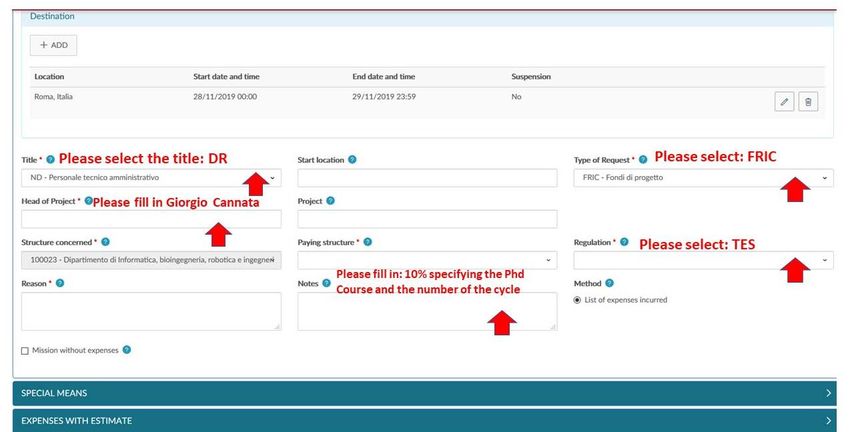
Once you have logged in, click on the “new mission” tab and fill in the form as show below:

The Department Administration will activate the procedures to authorize your travel/mission. We
warmly recommend PhD students to read carefully the University rules for travels and
reimbursements reported ad this link:

https://unige.it/sites/contenuti.unige.it/files/imported/regolamenti/finanza/documents/DR4530-
RegolamentoMissioniUnige.pdf

11
     In case of technical problem, send an e-mail to roberta.usari@unige.it or roberta.fraguglia@unige.it

                                                                                                            11
PhD Program in Bioengineering and Robotics - 2019
Phd students can travel using only the following means of transportation:
1. Train, plane, suburban bus (e.g. FlixBus), and all public urban transportations.
2. Taxi: only for transfers from and to airports-/train stations/hotel/conference or meeting
venue).
If you leave from an airports other than Genova you have to show that this option is cheaper. When
you book the flight, you must print from web the flight offers from Genoa airport and your selected
airport. The printout must be attached to the documentation at the time of the refund request.
You are authorized to leave from Genova one day before the beginning of the event to attend and to
come back one day after the end (two days before/after if the destination is out of Europe for
technical reasons, for example time zone, flights stop…). If you leave more days before and come
back more days after, you have to demonstrate that this option is not more expensive than a travel in
the right days
The Department can directly pay the registration to conference/workshop or Winter/summer
schools when the bank transfer is available as method of payment. It is exceptionally possible to ask
an advance payment of the possible expenditures for the mission when the quote is equal or higher
than € 250,00. For missions an anticipation of the 75% of the all expenses is possible (follow the
instructions in the Manual).
The PhD student has to pay in advance all of the expenses and collect all the original receipts
(train/flight tickets, meals, public transportation, certificate of attendance) therefore when you will
come back you have to deliver the original receipts to the Department Administration, Villa Bonino
Viale Causa 13, 1st floor Monday 2.00-4.00 p.m.; Tuesday 9.00- 11.00 a.m. and Friday 10.00-
12.00 a.m.
In case your travel is reimbursed by other institution, since you are UNIGE Phd students you have
to be authorized by UNIGE. The procedure is the same as above. When you came back you have to
close the procedure with the option “mission done without expenditures”.
CONTACT PERSONS Roberta Usari (roberta.usari@unige.it) and Roberta Fraguglia
(roberta.fraguglia@unige.it).
12You can also read


