Dynamic Changes in Salivary Cortisol and Protein among Dental Students - Open Journal Systems
←
→
Page content transcription
If your browser does not render page correctly, please read the page content below
1552     Indian Journal of Forensic Medicine & Toxicology, January-March 2021, Vol. 15, No. 1

       Dynamic Changes in Salivary Cortisol and Protein among
                          Dental Students

              Shaimaa Hamid Mudher1, Elham Hazeim Abdulkareem 2, Hanaa Abdul Jabbar Saleh3
   1
       Lecturer Dr., Department of Oral Medicine, 2Assistant Professor Dr., Department of Oral and Maxillofacial
        Surgery, 3Lecturer, Department of Conservative, College of Dentistry, University of Anbar. Ramadi. Iraq.

                                                              Abstract
       Background: Student assessments are the traditional methods of assessing academic success, and they are
       considered to affect one’s career. This study evaluated the levels of salivary stress biomarkers represented by
       cortisol and total salivary protein during final academic assessments of dental undergraduates.

       Methods: Saliva samples were obtained, one before the exam another afterwards. Concentrations of salivary
       stress biomarkers were obtained by enzyme-linked immunosorbent assay (ELISA).

       Results: Before the exam, the two parameters were dramatically higher than afterwards, with a substantial
       difference between the levels of salivary protein and cortisol (p=0.000, 0.000 consecutively).

       Conclusion: Stress induced by academic examinations may increase the level of salivary stress biomarkers
       in the short term.

       Keywords: Academic stress; cortisol; ELISA; saliva; salivary stress biomarkers

                        Introduction                                  stress can result in HPA activation, leading to cortisol
                                                                      release and subsequently significantly higher salivary
    Academic exams are considered to be among
                                                                      cortisol levels than resting baseline levels. The principal
the most challenging experiences for students, since
                                                                      glucocorticoid in the human adrenal cortex is cortisol,
passing or failing typically has implications for career
                                                                      which is synthesised from cholesterol. Higher levels of
development1. In particular, two primary systems
                                                                      cortisol as a response to biochemical stress contribute
or locations in the brain are involved in the stress
                                                                      to the well-characterised suppression of HPA related to
response: the sympatho-adrenomedullary and system
                                                                      health events and cognition1. Salivary cortisol is present
hypothalamus-pituitary-adrenocortical axis1. Increased
                                                                      in a stable, unbound form and is the only fraction of
secretion of cortisol in the adrenal cortex occurs due
                                                                      hormones that display metabolic activity in combination
to the activation of HPA. Therefore, salivary cortisol
                                                                      with unbound plasma cortisol in the blood. Unbound
represents the activity of HPA and is a more effective
                                                                      cortisol reaches cells through passive diffusion due to
assessment than blood collection in stress research,
                                                                      lower of molecular weight and lipophilic nature, making
which can induce spurious increases in cortisol secretion,
                                                                      it is possible to measure free cortisol in many body
representing the hyper-stress component1. A wide range
                                                                      fluids. Up to 95% of secreted cortisol attaches to large
of data has revealed that several kinds of psychological
                                                                      protein molecules, like albumin and it is transported in
Corresponding author:                                                 the blood in the body. Salivary proteins have important
Shaimaa Hamid Mudher                                                  functions, including the health of the oral cavity; the
Department of Oral Medicine, University of Anbar                      nutrition, survival and colonisation of microorganisms;
Street, Postal Address: Ta’ameem, Ramadi, Anbar                       and the adhesion and aggregation of microorganisms.
Pin Code: +964                                                        Moreover, greater concentrations of total protein in
Telephone number: 0790259559                                          response to stress lead to changes in saliva chemical
Email: den.shima.h@uoanbar.edu.iq                                     properties, including oral surface adhesion or lubrication,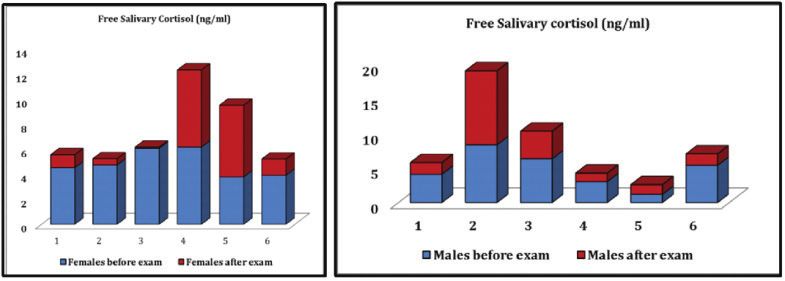
Indian Journal of Forensic Medicine & Toxicology, January-March 2021, Vol. 15, No. 1   1553

and viscosity. Stress levels vary in different areas of          males and 6 females) aged 21–23 years were randomly
education and learning, and higher stress levels could           selected and recruited from different academic years to
undermine the cognitive functions and learning abilities         study. The study’s objective and protocol were explained
of students1. Moreover, the prevalence of depression,            to all the recruited students, and their voluntary consent
anxiety and psychological distress among medical                 was obtained prior to participation. Two unstimulated
students is increasing1. To investigate this phenomenon,         saliva samples were collected from each student. In
this study used salivary cortisol as a biomarker for             order to decrease the presence of food debris and
stress assessment during academic examinations,                  consequent salivation stimulation, students were asked
with higher levels found prior to a written test and its         not to eat and drink water only about an hour prior to
anticipation. Many studies have reported a rise in stress        sample collection. The first sample was taken 30 minutes
hormones (levels of cortisol) in anticipation of stressful       before a written examination at 8:30 am, and the second
experiences, such as oral exams, cardiac surgery and             sample was taken at 12:00 pm after the examination was
dental-treatment2. Moreover, the response to physical or         complete. Each student was instructed to rinse his or her
psychological stress in the body increases the cortisol          mouth to remove debris. De-ionised water was used to
secretion. Stress can be beneficial, of course, as it can        rinse the mouth, and the participants were then asked to
boost drive and energy to get through stressful situations,      spit for 5 minutes in a special sampling container. The
such as examinations and work deadlines3,4. Students             container was labelled with a collection number (1 or 2),
face numerous academic problems in today’s highly                date and time. All salivary samples were centrifuged at
competitive world, however, including exam stress, lack          3,000 rpm for 10 min to isolate pure saliva. Total protein
of interest in a class and failure to understand a subject5.     and cortisol concentrations were calculated using a
Exam stress is the feeling of fear or anxiety over one’s         special kit (SPINREACT, Spain) with an enzyme-linked
performance in examinations6, and academic stress can            immunosorbent assay, as directed by the manufacturer.
increase students’ anxiety levels7. Interest has been
rising in identifying and using biomarkers in saliva as a                           Statistical Analyses
more evaluative way to measure stress. The investigation              The data analysis was performed using version 11.0
of stress biomarkers has achieved recognition because            of SPSS. A p-value smaller than 0.05 was determined as
saliva sample collection is standardised, non-invasive           statistically significant. To check for discrepancies in the
and easy to manage. Studies have shown that saliva               categorical variables, a Chi-square test was used.
can be used in chair-side tests for many oral and
systemic diseases8. Saliva is useful because of its many                                     Results
analytes that are affected by a variety of conditions and
                                                                      A total of 12 dental students (6 male, 6 female) from
physiological and pathological stressors9. Therefore,
                                                                 different academic years were recruited for this research
this study was designed to confirm salivary cortisol and
                                                                 to measure their levels of total free salivary cortisol
total protein levels during psychological stress9 among
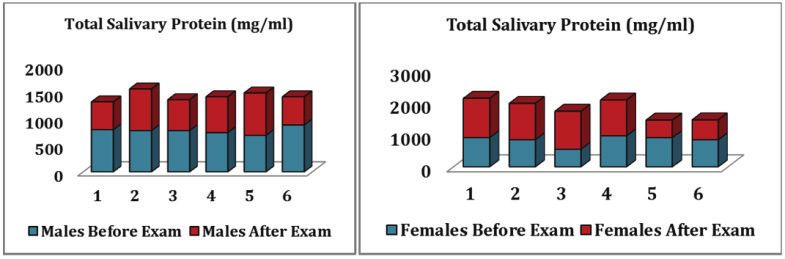
                                                                 (ng/ml) and total protein content in saliva. As shown
undergraduate students in a dental college.
                                                                 in Figures 1 and 2, both parameters were significantly
                                                                 higher before the exam than afterwards, with a substantial
              Materials and methods
                                                                 difference between salivary protein and cortisol levels
    From 2016–2017, a cross-sectional study has been             (p=0.000, 0.000 consecutively).
conducted at the College of Dentistry, University of
Anbar, Iraq. A total of 12 undergraduate students (6
1554 Indian Journal of Forensic Medicine & Toxicology, January-March 2021, Vol. 15, No. 1
Figure 1: Levels of total free salivary cortisol (ng/ml) before and after the exam.
Figure 2: Levels of total free salivary protein (mg/ml) before and after the exam.
Discussion protein secretion mainly by three salivary glands:
parotid, sublingual and submandibular. The release
Saliva plays an important role in the maintenance of
of protein from the submandibular glands and parotid
oral hygiene. Various studies have shown that salivation
is elicited by stimulating the sympathetic system, and
changes often occur due to stress. In this study, we
protein release from the sublingual gland is usually
correlated the levels of certain parameters in saliva
elicited by stimulating the parasympathetic system13.
with the stress induced by an examination in medical
students. Protein levels in saliva were significantly We also measured free salivary cortisol levels
higher before the examination than afterwards, a during a stress condition before and after the academic
finding consistent with that of Nauvoma et al., who also exam. During chronic stress, alteration in cortisol
showed a significant increase in protein concentrations levels is prominent. Cortisol is a stress hormone that
in saliva immediately after stress exposure10. Another is synthesised in the cortex of the adrenal gland14. As
study by Al-Nuaimy et al. showed similar findings discussed earlier, the measurement of cortisol in saliva
by estimating protein concentrations before an oral is superior to that in serum because a salivary assay
academic exam and after one month of holiday break11. enables the measurement of unbound cortisol.
To understand the mechanism behind this increased
protein concentration, the activation of salivary glands We observed significantly higher cortisol levels
as a sympathetic intervention during exposure to stress in saliva before the academic examination in both
to control protein secretion has also been explored10,,12. males and females than afterwards, showing a direct
The autonomic nervous system primarily controls correlation between saliva cortisol levels and stress.Indian Journal of Forensic Medicine & Toxicology, January-March 2021, Vol. 15, No. 1 1555
Other studies have reported similar findings, indicating References
that training during medical courses causes higher
1. Ng V, Koh D, Mok BYY, Chia S-E, Lim L-P.
incidences of psychological stress in students and that Salivary biomarkers associated with academic
academic examinations are major stressors for students, assessment stress among dental undergraduates.
likely because their performance affects their future J Dent Educ. 2003;67:1091–1094. doi:10.1002
careers2,15. This increased stress leads to increased /j.0022-0337.2003.67.10.tb03701.x.
levels of cortisol10,11,16. The increase in cortisol levels 2. Lacey K, Zaharia M, Griffiths J, Ravindran A,
is attributed to HPA axis activity, which is more Merali Z, Anisman H. A prospective study of
intense during stress reactions. Hypothalamus-level neuroendocrine and immune alterations associated
stressors activate the secretion of CRH and AVP, which with the stress of an oral academic examination
stimulate the frontal lobe of the pituitary gland to release among graduate students. Psychoneuroendocrinol.
adenocorticotroic hormone (ACTH). ACTH stimulates 2000;25(4):339–56. doi:10.1016/S0306-
the synthesis of cortisol and its secretion in the adrenal 4530(99)00059-1.
cells. Stress reactions are exhaustive and damaging 3. Ghatol SD. Academic stress among higher
to the body; indeed, cortisol limits and minimises the secondary school students: A review. Int J Adv Res
catabolic and immunosuppressive effects of stress Educ Technol. 2017;4(1):38–41.
reactions through a negative feedback mechanism17,18. 4. Mehfooz Q, Haider S. Effect of stress on academic
performance of undergraduate medical students.
This study therefore demonstrates that the stress of
J Community Med Health Educ. 2017;7:6.
academic examination affected important components of doi:10.4172/2161-0711.1000566.
saliva, including protein and cortisol, which decreased
5. Nikitha S, Jose TT, Valsaraj BP. Effectiveness
after the exam was over. This suggests that these levels
of academic stress management programme on
are a short-term response to stress.
academic stress and academic performance among
higher secondary students in selected schools of
Conclusion
Udupi District. Nitte Univ J Heal Sci. 2015;5(4):9–
This study has shown increased protein and cortisol 12.
concentrations in saliva before the commencement of 6. Nikitha S, Jose TT, Valsaraj BP. A correlational
an academic exam, which decreased after the exam study on academic stress and self - esteem
was over, suggesting that stress precipitates short-term among higher secondary students in selected
changes in saliva composition. Higher levels of cortisol schools of Udupi District. Nitte Univ J Heal Sci.
during an examination can reduce stress during the 2014;4(1):106–08
examination. 7. Acharya PR, Chalise HN. Self-esteem and academic
stress among nursing students. Kathmandu Univ
Conflict of Interest: All the authors declare no Med J. 2015;52(4):298–02.
conflicts of interest.
8. Prester L, Protrka N, Macan J, Katunarić M.
Funding: N/A Salivary sCD14 as a potential biomarker of dental
caries activity in adults. Arh Hig Rada Toksikol.
Acknowledgement: We thank our dental colleagues 2017;68(4):315–21. doi: 10.1515/aiht-2017-68-
at the College of Dentistry, University of Anbar, who 2974.
aided the investigation. 9. Koduru MR, Ramesh A, Adapa S, Shetty J.
Salivary albumin as a biomarker for oral squamous
Ethical Approval: The study was conducted in
cell carcinoma and chronic periodontitis. Ann Med
compliance with the Helsinki Declaration and with the Health Sci Res. 2017;7(5):337–40.
approval of the Regional Committee on Ethics, which
10. Naumova EA, Sandulescu T, Bochnig C, et al.
is represented by the Medical Ethics Committee of the
Dynamic changes in saliva after acute mental stress.
Ministry of Health in Iraq.
Sci Rep. 2015;4(1):4884. doi:10.1038/srep04884.
11. Al-Nuaimy K, Al-Hamdani I, Tawfik N. Effect of1556 Indian Journal of Forensic Medicine & Toxicology, January-March 2021, Vol. 15, No. 1
stress on the composition and flow rate of saliva. Al- medical students and its correlation with their
Rafidain Dent J. 2012;12(1):66–70. doi:10.33899/ academic performance. Indian J Occup Ther.
rden.2012.42633. 2007;39:7–10.
12. Carpenter GH. The secretion, components, 16. Singh R, Goyal M, Tiwari S, Ghildiyal A, Nattu
and properties of saliva. Annu Rev Food Sci SM, Das S. Effect of examination stress on mood,
Technol. 2013;4:267–76. doi:10.1146/annurev- performance and cortisol levels in medical students.
food-030212-182700. Indian J Physiol Pharmacol. 2012;56(1):48–55.
13. Turner RJ, Sugiya H. Understanding salivary fluid 17. Pacak K. Stressor specificity of central
and protein secretion. Oral Dis. 2002;8(1):3–11. neuroendocrine responses: Implications for stress-
doi:10.1034/j.1601-0825.2002.10815.x. related disorders. Endocr Rev. 2001;22(4):502–
14. Lee DY, Kim E, Choi MH. Technical and clinical 548. doi:10.1210/er.22.4.502.
aspects of cortisol as a biochemical marker of 18. Bozovic D, Racic M, Ivkovic N. Salivary cortisol
chronic stress. BMB Rep. 2015;48(4):209–216. levels as a biological marker of stress reaction.
doi:10.5483/BMBRep.2015.48.4.275. Med Arch. 2013;67(5):374–77. doi:10.5455/
15. Vaidya PM, Mulgaonkar KP. Prevalence of medarh.2013.67.374-377.
depression, anxiety and stress in undergraduateYou can also read


