India: taking stock of Modi's five years - Europa ...
←
→
Page content transcription
If your browser does not render page correctly, please read the page content below
BRIEFING

 India: taking stock of Modi's five years
SUMMARY
From 11 April to 18 May 2019, 900 million Indians are invited to take part in the world's biggest
democratic event: the election of the 543 members of the Lok Sabha (lower chamber). Voting will
be held across the country in seven phases and the result will be declared on 23 May.
In 2014 the Hindu nationalist Bharatiya Janata Party (BJP) obtained the absolute majority in India's
Lok Sabha, and Narendra Modi became prime minister. Enjoying a strong and undisputed mandate,
Modi has generated expectations of unleashing the country's economic potential and has adopted
many flagship initiatives in a bid to change the country.
In the last five years, India has overtaken China as the fastest growing economy, becoming the
world's sixth biggest economy and a space power. Doing business in the country has become easier.
Poverty has been reduced. The government succeeded in introducing major fiscal unification
reform and a new law on bankruptcy. It failed, however to create the necessary stock of jobs for
young people or to promote long-awaited labour reforms. The situation for farmers has worsened,
and an overnight demonetisation hindered progress among small businesses and rural
communities, while failing to bring real advances in the fight against corruption. State banks hold
large stocks of bad loans and the government has increased pressure on the central bank and on its
independence.
Hindu nationalism and religious intolerance, pressure on freedom of expression, possible state
intrusion into privacy, citizenship issues and other topics have been matters for concern in the area
of human rights, although the country remains a robust democracy governed by the rule of law.
Modi has increased the country's presence in the global arena, although the framework of India's
relations with the major powers has not changed. Following two summits in 2016 and 2017, the EU
and India have embarked on a road towards cooperation on non-trade issues. Trade has meanwhile
stagnated and little progress has been made in negotiations on a trade and investment agreement.

                                                     In this Briefing
                                                         Introduction
                                                         Economy and finance
                                                         Human rights
                                                         Foreign policy
                                                         EU-India relations
                                                         2019 India's general elections

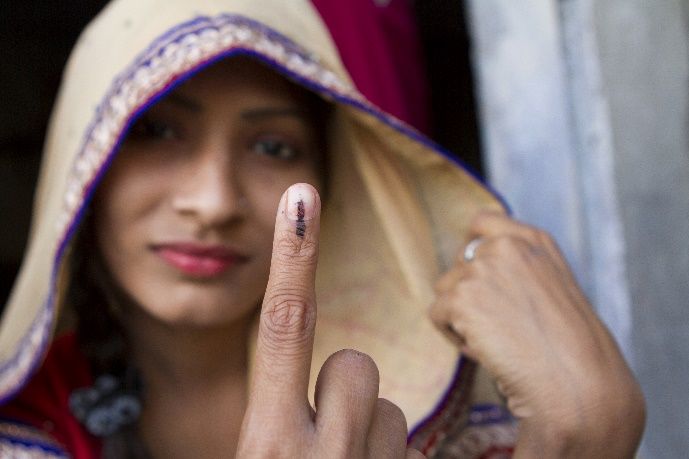
   Indian woman shows her ink-marked finger after
                 casting her vote

                   EPRS | European Parliamentary Research Service
                                   Author: Enrico d'Ambrogio
                                   Members' Research Service
                                    PE 637.921 – April 2019                                             EN
EPRS | European Parliamentary Research Service
Introduction
In 2014, India decided to turn the page on 10 years of Indian National Congress (INC) rule and gave
an absolute majority in the lower chamber (Lok Sabha) to the Hindu nationalist Bharatiya Janata
Party (BJP). With this strong mandate, prime minister Narendra Modi set out to fulfil his electoral
promise to 'build a strong, self-reliant and self-confident India'. His 'maximum governance,
minimum government' slogan, which seemed to announce a programme of liberalisation, raised
hopes that the country's economic potential would be unleashed. The programme actually focused
more on reducing bureaucracy in business, witness the slogan when launching the 'Make in India'
initiative (see box next page): 'Goodbye red tape, hello red carpet'. Modi raised expectations in the
business world having enjoyed a reputation for competent economic management during his
mandate as chief minister of north-western state of Gujarat. He was also expected to fundamentally
reboot and reorient India's foreign policy goals, content and process. Enjoying a strong and
undisputed mandate within his party, he struck a starkly different style from his predecessor
Manmohan Singh, showing a charismatic and authoritative personality, and making a direct
connection with the public opinion through orchestrated media events and wide use of social media.
Economy and finance Figure 1 – GDP % growth in India, China, the US
India has enjoyed significant growth and the EU, 2013-20
over the last five years and has overtaken 9
China as the world's fastest-growing 8
7
major economy. In 2017 it overtook
6
France as the world's sixth biggest
5
economy, slightly behind the UK; it is
4
third largest in terms of purchasing
3
power parity (PPP). Part of this growth
2
has been underpinned by factors such as
1
the low price of oil – 82 % of which is
0
imported. India has achieved a notable 2013 2014 2015 2016 2017 2018 2019 2020
improvement in ease of doing business: India China USA EU
several reforms have enabled the
country to improve its rank from 134th in Source: IMF; 2019 and 2020 are forecasts.
2014 to 77th place in 2019. During
Modi's rule, India attained the historic achievement of no longer being home to the largest number
of poor people – it now has the third largest number, after Nigeria and Congo — and at present
poor people make up 3.4 % of the Indian population (47 million, as opposed to 268 million in 2011).
India has however performed less impressively on job creation: while it needed to create some
800 000 jobs a month for young people joining the labour force, the National Sample Survey Office's
(NSSO's) periodic labour force survey found out that the unemployment rate stood at a 45-year high
of 6.1 % in the 2017-18 period (it was 2.2 % in the 2011-12 period) and the problem is particularly
acute among young people. Also, the labour force participation rate was 49.8 % in the 2017-18
period, less than in the 2011-12 period (55.9 %). The government, having failed to accelerate long-
awaited labour reforms – tried to bury the report, sparking a controversy that led to the resignation
of two members of the National Statistical Commission (NSC) and raised concern over political
interference in data estimation, also in relation to the downwards revision of growth figures under
previous administrations. According to an independent think tank, the Centre for Monitoring Indian
Economy, unemployment has been increasing steadily, reaching 7.4 % in December 2018, and India
lost 11 million jobs in 2018, with much higher losses in rural areas. One symbol of the employment
crisis were the 28 million applications for 90 000 posts at Indian Railways in the context of a long-
awaited massive modernisation programme. A 2018 International Labour Organization (ILO) report
shows that low pay and wage inequality remain serious challenges on India's path to achieving
decent working conditions and inclusive growth, in a country where the share of informal
2India: taking stock of Modi’s five years
employment is quite high (88.2 % according to a 2018 ILO
report based on 2012 data). The BJP however claims that Modi's flagship initiatives
the Modi government has created 15 million jobs a year. Narendra Modi has launched many
flagship initiatives in his bid to change
Analysts point to the November 2016 overnight India – 129 schemes, according to BJP
demonetisation, when the government suddenly President Amit Shah. The 'Make in India'
announced that 500 and 1000 rupees banknotes (€ 6.4 scheme aims at transforming India into
and € 12.8) were invalid and had to be exchanged for new a global manufacturing hub and at
ones, in a bid to curtail the shadow economy (estimated easing its business climate for both
at 20 to 25% of gross domestic product (GDP)), reduce the domestic and foreign investors. Clean
India meanwhile focuses on cleaning up
use of illicit and counterfeit cash and root out terror
the streets, roads and infrastructure of
financing. The invalidation of 86 % of the country's India, in particular by eliminating open
banknotes brought mixed results, however. It increased defecation through the construction of
tax revenues, but also harmed small businesses and rural household-owned and community-
communities, allegedly provoking 1.5 million job losses, owned toilets. Clean Cooking has
with only a modest impact on the fight against corruption provided millions of households with
and a missed the opportunity to follow up with further access to LPG as cooking fuel rather
bold reforms. than biomass fuel, dangerous to human
health. The National Mission on
Farmers' discontent has been rising. In November 2018 Financial Inclusion provides access to
tens of thousands of rural workers marched on the various financial services, such as basic
parliament in Delhi, protesting against increasing savings accounts. The National Health
operating costs and dipping produce prices. Farmers Protection Scheme, the biggest
make up 42 % of the workforce, although agriculture government-sponsored healthcare
represents only 16 % of GDP. A 2017 report by the scheme in the world, provides free
Comptroller and Auditor General (CAG) shows farm medical care for 500 million Indians. A
rural electrification programme
distress has worsened in recent years. In India 15 000
brought electricity to the 18 000
farmers commit suicide every year.
villages that were still missing it.
The historic introduction of a long-awaited goods and Analysts point at misleading numbers
services tax (GST), bringing fiscal unification to a and goals and key qualitative failures
previously complex structure of thousands of different tax compromising the outcome of several
initiatives. According to a July 2018
rates for goods and services across the country, has also
parliamentary standing committee
helped to boost tax revenues, though its six rates, several report on urban development, a major
exemptions and the ongoing possibility to carry out share of the budget allocated to six of
checks on the borders between India's 29 states were a these initiatives to improve the urban
compromise. Another major economic reform was the infrastructure and enhance the quality
adoption of the Insolvency and Bankruptcy Code, creating of life in cities has not been spent.
a legal framework for dealing with bankruptcy in line with
global standards. India has raised ceilings for foreign direct investment (FDI) in several sectors,
including defence, air transport, retail, construction, pharmaceuticals, insurance and pension,
telecoms. However, Air India has failed to attract buyers.
India's state-controlled banks – controlling 70 % of the country's credit system – are caught up in a
non–performing corporate debt crisis. Non-performing loans have reached an estimated US$ 210
billion, with India surpassing Italy as the country with the world's worst bad-loan ratio. This has
resulted in many shadow banks taking a significant market share (more than a third of all new loans)
and funding a real estate investment boom. However, disappointing returns on some key projects
resulted in defaults, even affecting triple-A institute IL&FS (Infrastructure Leasing & Financial
Services).
The government increased pressure on the Reserve Bank of India (RBI) to allow some bad-debt-
burdened public banks to lend more easily, and pushed for it to transfer part of its surplus reserves
to boost economy (and breach the fiscal targets) in the months ahead of the general elections. The
attack on the RBI's independence was evident in October 2018 when, in an unprecedented move,
3EPRS | European Parliamentary Research Service
the finance ministry invoked Section 7of the Reserve Bank of India (RBI) act, allowing the executive
to issue directions in the public interest to the central bank. In December 2018 RBI Governor Urjit
Patel resigned. His predecessor from 2013 to 2016, Raghuram Rajan, former IMF chief economist,
had also had conflicts with the government and was not offered a second mandate, as would usually
be the case. The nomination of the more malleable Shaktikanta Das in December 2018 has sparked
fears regarding RBI autonomy. The RBI has relaxed the prompt corrective action (PCA) framework,
under which 11 public banks were placed due to stressed assets, and has allowed five of them to
resume lending, prompting concerns. The government has announced the recapitalisation of some
state-controlled banks, subject to conditions. RBI has also cut the interest rate twice, ahead of the
general elections, pointing at a reduced inflation.
Human rights Hindu nationalism
Hindu nationalists represent a core part
India is a robust multicultural democracy governed by the of Narendra Modi's electoral base. Their
rule of law. It was the only country in the region to rank as goal is to shape a country inspired by
'free' in the Freedom in the world 2019 report. However, in 'Hindutva' conservative Hindu cultural
its Country Report on Human Rights Practices for 2018, the norms deploring the modern secular
US Department of State drew attention to cases of values of other parties. Some
government initiatives have indulged
extrajudicial killings of suspected criminals and insurgents,
them. In October 2018 the world's
unresolved disappearances, police torture, and life-
tallest statue – at 182 metres, twice the
threatening prison conditions. A number of government height of the Statue of Liberty – was
corruption cases were reported, though the Corruption inaugurated in Gujarat (Modi's home
Perceptions Index reported an improvement from 94th state), to celebrate independence hero
place in 2013 to 78th place in 2018. According to Human Vallabhbhai Patel. Places have been
Rights Watch (HRW), sedition and criminal defamation laws given new Hindu names – to dissociate
have sometimes been used to prosecute citizens who have them from British colonial rule. The
criticised government officials or opposed state policies. death of the first BJP prime minister Atal
Furthermore, there have been numerous reports of Bihari Vajpavee in August 2018, seemed
to symbolise the end of an idea of
journalists and members of the media being threatened or
moderate Hindu nationalism, against a
killed as a result of their reporting. The 2018 World Press
backdrop of religious tensions today. In
Freedom Index places India 138th out of 180 countries (just Uttar Pradesh, Yogi Adityanath, a hard-
before Pakistan) and denounces a growing self-censorship line Hindu monk appointed chief
in the media and among journalists. Also, on the basis of the minister in March 2017 after the BJP
2010 Foreign Contribution Regulation Act (FCRA), the won elections, supports the
government has imposed restrictions on foreign funding of construction of a Hindu temple in
some nongovernmental organisations (NGOs). The Ayodhya, on the site where a mosque
government has proposed changes to the Information was destroyed by a Hindu mob in 1992
Technology Act, in order to oblige social media operators to sparking riots across the country and
especially in Mumbai (then Bombay),
set up systems for the prompt sharing of information sought
claiming up to 2 000 casualties. Cow
by law-enforcement agencies, with a view to tracking the
defence is also an issue (cow slaughter
origins of viral fake claims that sometimes result in is banned in 18 Indian states): violent
lynchings. Mechanisms of this kind might however infringe mob attacks by cow defence squads,
users' privacy and are being resisted by WhatsApp. Also on often targeting Muslims or low-caste
the basis of the Information Technology Act, in Hindus, have multiplied. In
December 2018 the government authorised nine central October 2018, a tense situation
agencies and the Delhi police to intercept, monitor and occurred around the Hindu temple of
decrypt information transmitted by or stored in any Sabarimala in Kerala state, when
computer, raising public concern regarding individual women of reproductive age, following a
Supreme Court decision in their favour,
liberties. Limits to free speech have been evoked by
tried to access it despite strong
government members in a bid to equate dissent with a lack
resistance from devotee men.
of patriotism. According to the 2011 Census, Hindus
Aadhaar, the world's largest biometric ID system, a national made up 79.8 % of the population,
identity scheme that issues every resident in India with a Muslims 14.2 %, Christians 2.3 %, Sikhs
1.7 %, and other religions 2.0%.
4India: taking stock of Modi’s five years
unique 12-digit ID linked to biometric and demographic data, to streamline welfare services and
root out fraud, has been criticised on grounds of a potential threat to privacy and security. Although
it is not formally mandatory, it is necessary to benefit from an increasing number of welfare
programmes. The Supreme Court declared the system legitimate in December 2018. On
February 2019, the government dropped an unpopular amendment to the India Citizenship
(Amendment) Bill, aimed at offering citizenship to non-Muslim migrants from Pakistan, Bangladesh
and Afghanistan. It has been argued that the bill was designed to win over Bengali Hindus to the
BJP with the elections in sight. Another citizenship issue that shook public opinion occurred in 2018
in the Assam state, where a controversial draft National Register of Citizens (NRC) excluded four
million people, prompting concerns among some United Nations (UN) experts that the people left
out could become stateless. In 2018, the government tabled the 'Muslim Women (Protection of
Rights on Marriage) Bill' to outlaw the triple talaq, which gives Muslim men the right to instant
divorce, without reciprocity. The bill was passed by the Lok Sabha but remained stuck in the Rajya
Sabha (higher chamber) while the Supreme Court declared the triple talaq unconstitutional. The
government therefore adopted a controversial executive order to make the triple talaq a punishable
offence. The government meanwhile refused to criminalise the section of the Indian Penal code
legitimising marital rape. There is still a long way to go to achieve women's empowerment in India:
for instance, only 3.5 % of chief executives are women. The government has adopted several
schemes to promote gender equality, including the Beti Bachao Beti Padhao scheme designed to
combat sex-selective abortion (the rate of live births hit an unusually low 918 girls per 1 000 boys in
2011) and promoting education and empowerment for girls.
The Supreme Court has adopted several judgements on human rights issues. In September 2018 it
scrapped a colonial-era law criminalising gay sex. A few weeks later it repealed another colonial-era
law on adultery, allowing a husband to prosecute any man who engaged in sexual relations with his
wife but preventing a wife from prosecuting either her husband or any woman with whom he was
engaged in extramarital relations.
In June 2018 the UN High Commissioner issued a report on Kashmir criticising the excessive use of
force by Delhi's security forces in the Indian-administered part. Since 2016, hundreds of Kashmiri
protesters have been blinded by Indian shotgun pellets used as a 'non-lethal' crowd control
measure. The 1990 Armed Forces (Jammu and Kashmir) Special Powers Act and the 1978 Jammu
and Kashmir Public Safety Act give security forces virtual immunity against prosecution for any kind
of human rights violations. India's Official Spokesperson rejected the report as 'fallacious,
tendentious and motivated' and as making a 'selective compilation of largely unverified information'
and seeking 'to build a false narrative'. He underlined that the 'report violates India's sovereignty
and territorial integrity' as the 'entire state of Jammu and Kashmir is an integral part of India'.
Foreign policy
Although the BJP government has not changed the framework of India's relations with the major
powers substantially, Modi has increased the country's presence in the global arena. He has built
relations with India's southern Asian neighbours ('neighbourhood first' diplomacy), while the policy
towards southeast Asia has been rebranded Act East, with a special focus on the Association of
Southeast Asian Nations (ASEAN). Modi has also cultivated close relations with the Gulf countries.
However, India's relations with its historically antagonistic neighbour, Pakistan, have not improved.
The leadership change in Islamabad in 2018, with the election of Imran Khan as prime minister, has
not brought any significant change, partly because Pakistan does not feature high on Modi's
agenda. The South Asian Association for Regional Cooperation (SAARC) has not advanced owing to
the rivalry between India and Pakistan. Delhi looks to alternative regional groupings such as
BIMSTEC (the Bay of Bengal Initiative for Multi-sectoral Technical and Economic Cooperation) and
other frameworks in order to enhance connectivity in South Asia. India succeeded in cancelling a
SAARC summit originally scheduled for November 2016 in Pakistan in the aftermath of a militant
attack on Indian security forces in Uri – India-administered Kashmir – killing 18 soldiers and
5EPRS | European Parliamentary Research Service
prompting anger against Islamabad from Delhi and a India, a space power
military reaction against militants. India's approach was India's space programme has achieved
muscular in the aftermath of deadly attacks on its army in several successes in recent years. The
Jammu and Kashmir by Pakistan-based terrorists: in outcome is significant taking into
particular, the Pulwama suicide attack on14 February 2019 account the small size of Delhi's space
which killed 40 police officers and provoked a severe crisis in budget: up to a mere US$1.18 billion a
bilateral relations. India retaliated with an air strike on year. This is much less than those of
Balakot in Pakistani territory (the first cross-border strike in 50 most space programmes in other
years) targeting alleged training camps, and revoking countries –one sixth of China's space
budget and half the European
Pakistan's most favoured nation status. The Pakistani air
Commission's proposal for an EU 2021-
force then conducted an airstrike on Jammu and Kashmir; in 27 space programme, for instance. In
the subsequent dogfight an Indian pilot was shot down over September 2014 India became the first
Pakistan and captured, but was quickly released. Analysts country to put a satellite in orbit around
argue that the standoff may favour Modi's electoral chances. Mars at its first attempt and the first
Asian country to reach this planet. In
India is apprehensive about China's growing ties with
February 2017 India launched a world
Pakistan and the Himalayan countries, but also with some record 104 satellites from seven
countries in the Indian Ocean, traditionally within Delhi's countries on a single rocket. On
sphere of influence. Beijing is seeking to develop its Belt 15 August 2018, at the Independence
and Road Initiative (BRI), provoking a feeling of Day speech, Modi announced that India
encirclement in India. Delhi's firm stance against the is to send a manned mission into space
Chinese building a Himalayan road led to the Doklam by 2022. In December 2018 the
Plateau standoff in 2017. Despite this, relations have mostly government announced that it will be a
been constructive – Beijing is Delhi's second trading three-member crew and that the
partner – and Delhi, despite harbouring reservations programme is to cost US$1.4 billion. On
27 March 2019 India successfully
regarding the BRI, has joined the Chinese-led Asian
destroyed a low earth orbit satellite,
Infrastructure Investment Bank (AIIB). It has also joined the becoming the fourth country in the
New Development Bank (NDB) and the Contingent Reserve world to acquire anti-satellite
Arrangement (CRA), the BRICS's answer to the Western-led capability. Modi underlined that this
International Monetary Fund (IMF) and the World Bank, test (named Mission Shakti) was not
where they are underrepresented. India, alongside directed against any country.
Pakistan, has also joined the Shanghai Cooperation
Organisation (SCO), in which China is a dominant partner.
Further afield, bilateral relations with the US and Japan have blossomed under Modi's
administration, while Russia remains a key provider of security hardware to India, a country that,
according to the Stockholm International Peace Research Institute (SIPRI) database, was only
recently overtaken by Saudi Arabia as the largest importer of defence equipment in the world. India
has also started to extend its outreach to Africa, where it has to compete with China in terms of trade
and access to natural resources.
India has continued to push for permanent membership of a reformed UN Security Council and, in
his speech opening the World Economic Forum in Davos in January 2018, Modi positioned himself
as an advocate of globalisation over isolationism, in an implicit response to protectionist stances
promoted by US President Trump. Despite these good intentions, India remains fundamentally a
protectionist country: in the months following the Davos speech, India raised import duties on
hundreds of items (on textiles in particular), either to bolster the internal production of electronics,
or to protect a falling rupee. India has not signed any new trade deals under the BJP government.
Furthermore, as far as investments are concerned, in March 2016 Delhi's government announced
that it had terminated bilateral investment treaties (BITs) with 58 countries, including 22 EU member
states. India was one of the most frequently-named respondent states in BIT proceedings; the
government adopted a new Model BIT aiming to reduce India's exposure to future claims.
Nevertheless, after the US withdrawal from the Paris Agreement on climate change, the Indian
government reaffirmed its commitment; and India is also a leader in promoting renewable energy.
6India: taking stock of Modi’s five years
In March 2018 Modi, together with French President Emmanuel Macron, co-chaired the founding
conference of the International Solar Alliance (ISA).
EU-India relations
India has traditionally been keen to nurture bilateral relations with some key EU Member States,
rather than engaging with the EU. As prime minister, Modi has visited Germany four times and
France three times. France maintains a naval base at La Réunion and a further military presence in
Mayotte, Djibouti and the United Arab Emirates, all in the Indian Ocean; Paris and Delhi hold annual
bilateral naval drills named Varuna. In 2012, France's Dassault was awarded a tender to provide India
with 126 Rafale fighter jets. The BJP government withdrew the tender and negotiated a deal, signed
in September 2016, downsizing to the purchase of 36 aircraft. The deal has sparked a political storm
in India, especially around the real amount that Delhi agreed to pay to Dassault, and a much awaited
CAG report released on February 2019 failed to address questions on the topic. In his first visit to
India in March 2019 ahead of the founding conference of the ISA, French president Emmanuel
Macron expressed the wish France to replace the UK as India's gateway to Europe. The UK,
meanwhile, has several strategic interests in the region (including in Diego Garcia, Singapore, Nepal
and Bahrain), while some look at Brexit as an opportunity for a new UK-India trade deal, others
underline that the two partners' relations with the EU may overshadow bilateral ties.
Nevertheless, the EU and India are the world's two largest democracies, both with a multilevel
system of governance containing elements of federalism. The two are like-minded multicultural
entities sharing the same values of freedom, equality, tolerance and the rule of law. They share many
common challenges and therefore EU-India cooperation is a natural consequence. After a four-year
break, there have been two EU-India summits during Modi's mandate. In March 2016, EU-India
relations were reinvigorated with the 13th EU-India summit, which took place in Brussels. The
partners endorsed an EU-India agenda for action 2020. The parties adopted two joint declarations
on environmental issues: one on an 'Indo-EU Water Partnership' supporting the Indian 'Clean Ganga'
and 'Clean India' flagship projects; the other on a 'Indo-EU Clean Energy and Climate Partnership'
supporting climate dialogue with India on the wake of the Paris Agreement and reinforcing energy
cooperation, mainly on renewable energy sources. Highlighting the importance of contacts
between their citizens, they
established a common agenda on Figure 2 – EU-India trade in goods 2013 to 2018,
migration and mobility. They also € billion
adopted a joint declaration on
50
counter-terrorism. The European 45
Investment Bank (EIB) and India 40
35
formally agreed on a €450 million 30
long-term loan to finance the first 25
metro line in Lucknow, the capital of 20
15
Uttar Pradesh. The 14th summit, held 10
in Delhi in October 2017, maintained 5
the political momentum, although it 0
2013 2014 2015 2016 2017 2018
did not register any major advances. Imports Exports
The EU-India leaders adopted joint
declarations on cooperation in Source: European Commission, DG Trade
combatting terrorism; clean energy
and climate change; and a partnership for smart and sustainable urbanisation. During the summit,
other documents were agreed, such as: the Implementing Arrangement between the Science and
Engineering Research Board (SERB) and the European Research Council (ERC); a €500 million EIB loan
agreement for the Bangalore Metro Phase-II project; and a joint declaration between the Interim
Secretariat of the International Solar Alliance (ISA) and the European Investment Bank (EIB) aimed
at mobilising investments for broad-based deployment of affordable solar energy applications
across the 121 prospective member countries of the ISA.
7EPRS | European Parliamentary Research Service The two summits diversified the partnership beyond trade, but without giving the decisive boost needed to restart the negotiations for a bilateral trade and investment agreement (BTIA) that began in 2007 and stalled after 2013 following 12 rounds of negotiations. Following the 14th summit, trade negotiators met in April 2018, to discuss current gaps between differing levels of ambition. However differences remain, in particular on market access for goods, public procurement and services; on a sustainable development chapter with social and environmental clauses; on a stronger intellectual property regime; and on India being recognised by the EU as a data-secure country. As a result, growth in EU-India trade is on a slow path (see Figure 2 above), despite the EU being both India's biggest trading partner and its main foreign investor (€76.7 billion in 2017); India was the EU's ninth trading partner in 2018. Total EU-India trade in 2018 was €91.5 billion: EU imports were worth €45.8 billion and exports €45.7 billion. Trade in services amounted to €33.7 billion in 2017. Acknowledging India's growing geostrategic importance, in November 2018 the EU adopted a strategy on India in order to lend new impetus to the bilateral relations. The strategy is aimed at reinforcing the 2004 strategic partnership; cooperating more closely on global challenges; reinforcing cooperation on foreign policy, security and defence; realising the untapped potential of the trade and investment relationship; investing in talent and innovation; and building on common values. The strategy reflects the European Parliament's recommendations adopted on June 2017. 2019 India's general elections From 11 April to 18 May 2019, 900 million Indians are invited to take part in the world's biggest democratic event: the election of the 543 members of India's Lok Sabha (lower chamber). Voting will be held across the country on seven days spread over five weeks and the result will be declared on 23 May. The media focus is on a duel between incumbent BJP prime minister Modi and Indian National Congress (INC) opposition leader Rahul Gandhi. Hailing from the Nehru-Gandhi family, Rahul Gandhi is enjoying support in the key state of Uttar Pradesh from his charismatic sister Priyanka Gandhi Vadra, whose entry into active politics has been the subject of speculation for years. The election is a complex process in which states' electoral dynamics and regional parties may play an important role. In January 2019 two key parties in Uttar Pradesh, which had formerly been bitter rivals, announced an alliance, while a big rally in Kolkata (promoted by West Bengal chief minister Mamata Banerjee) marked the creation of a national electoral coalition, both challenging the BJP but not joined by the INC leadership. Modi's popularity reached its low point between 2018 and early 2019; however, after the February 2019 Balakot airstrike, his net approval rating rose to an all- time high of 62 % and satisfaction with the BJP-led NDA (National Democratic Alliance) coalition, that dipped in 2018, is now almost back to previous levels, potentially boosting its electoral chances. DISCLAIMER AND COPYRIGHT This document is prepared for, and addressed to, the Members and staff of the European Parliament as background material to assist them in their parliamentary work. The content of the document is the sole responsibility of its author(s) and any opinions expressed herein should not be taken to represent an official position of the Parliament. Reproduction and translation for non-commercial purposes are authorised, provided the source is acknowledged and the European Parliament is given prior notice and sent a copy. © European Union, 2019. Photo credits: © Kailash Kumar / Fotolia. eprs@ep.europa.eu (contact) www.eprs.ep.parl.union.eu (intranet) www.europarl.europa.eu/thinktank (internet) http://epthinktank.eu (blog) 8
You can also read


