Industry Summit: Access Planning and work-window productivity - Safer Faster Isolations
←
→
Page content transcription
If your browser does not render page correctly, please read the page content below

Industry Summit: Access Planning and
work-window productivity

      Safer Faster Isolations

Andy Wilson, Head of Programme Systems Engineering
Network Rail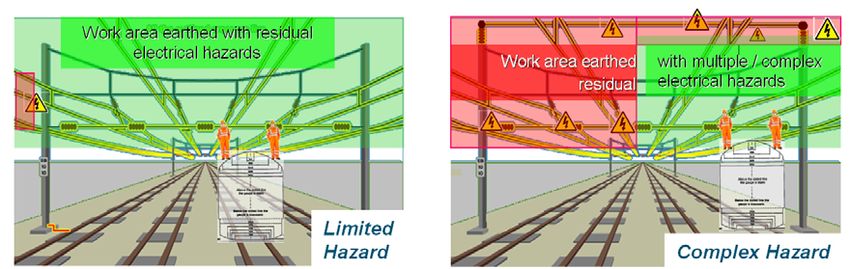
History & Drivers For Change

• The isolation process for 25kV OLE infrastructure has not changed substantially since the
  system was introduced in the 1950’s

           The process is labour intensive, involves the application of numerous
           discrete earths often placed at locations remote from line side access points

           It also involves multiple safety critical conversations between Nominated Persons and
           the Electrical Control Operator (ECO) and between the ECO and the signaller.
           Average current time to apply whole process in excess of 60 mins
• Meanwhile access to electrified routes in particular is at an even higher premium with white
  period hours being continually eroded to provide more time for what the rail infrastructure is
  there for – to run trains!

• The introduction of high output plant (generally requiring an isolation) has meant the cost of lost
  production during these remaining precious white periods has risen exponentially

• And finally safety, the heavy reliance on human behaviours even though independent checking
  is required throughout the process has resulted in an average of one serious life changing
  event per year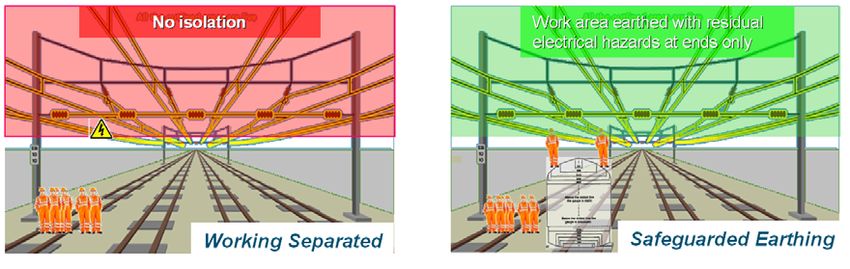
Keeping everyone safe, every day…

• Since 1998, there have been a total of 17 incidents which have
  resulted in a fatality or life-changing injury.

• The Isolation Safety Review Phase 1 was initiated by the Group
  Asset Management Director in September 2011.
• Building a network for the future means we anticipate increasing
  volumes on work on an expanding AC electrified lines. Currently,
  approx 8800 track km of Britain’s railway network is electrified using
  25 kV AC overhead line. By the end of the next control period this
  will have increased to over 12000 km

• ORR Network Availability targets require increasing adoption of
  protection arrangements - some lines remain open to traffic while
  work takes place on nearby isolated lines.

• The review makes recommendations in a number of areas to reduce
  the likelihood and severity of electrical accidents on the AC
  electrified railway.
Examples of Situations Likely to be Encountered
Isolation Review Phase 1 - areas of emphasis

• Align staff roles and competence
• Enhance safe systems of work near OLE and Permits to
  Work
• Limit possibility and consequence of attempting to work on
  live equipment
• Lead and assure railway electrical safety
• Align work and isolation planning
• Enhance Rule Book and Electrified Line Work Instructions
  29987 (NR/SP/ELP/29987)
• Early improvements to asset information
• Potential early infrastructure interventions
What are/will we be doing differently as a result…

• Methods of demarcating isolated sites

• Critical success factors were indentified as
  part of a cross industry & comparator study
    – Benchmarking with National Grid
    – Identification of key factors such as audit and
      competence

• Application of the electrical Life Saving Rules

         Always have valid permit to work where
         required

          Always test before applying earths

           Never assume equipment is isolated –
           always test before touch
What we are doing differently as a result…(2)

• Generation of a Suite of Electrical Safety Principles

  Principle No 1      Foreseeable Danger is to be avoided in all circumstances where tasks
                               are carried out on the electrified railway.

  Principle No 2      Points of Isolation can be provided and controlled by either site staff
                                  or ECR staff.

  Principle No 3      Earths will be under the control of Senior Nominated Persons or
                                            Nominated Persons on site.

  Principle No 4      Appropriately rated Circuit Main Earths will be applied between the
                                points of Inadvertent Re-energisation and the worksite which are to
                                prevent inadvertent re-energisation giving rise to Danger.

  Etc to Principle No 21 – still in draft
Isolation Review Phase 2 Work streams investigated during Phase 2 • Investigate the potential for OLE isolation switching to be done by remote control • Remote operational interface through SCADA or IEC 61850 • Minimised power supply requirement • Arrangements must be configurable for installation at ALL points of OLE isolation • Proposed solutions are to be OLE focussed. Use of facilities within associated distribution equipment will be appropriate only if the arrangements are transparent to the OLE Nominated Person • Switching must be associated with individual part sections. That is to say that where two part sections connect, there must be individual switching associated with each part section. • Remote control application of the Circuit Main Earth (duplicate earth in current practice) • Circuit Main Earth to be rated to cater for 12 kA nominal fault level (i.e. 15 kA maximum). • Circuit Main Earth to have adequate security taking into account potential damage/metal theft. • Positive earth detection mechanism by suitable method • High reliability • Low maintenance • Climate (wind, rain, ice snow and hot weather) to be taken into account • Economic and affordable at first cost and full life cost
What we will be doing differently as a result

• Introduction of Project Advice Note 083 – Design Guidance For New Electrification Systems

• Robust Operations & Maintenance Strategies agreed as early as possible in the project life cycle

• Isolation & Earthing System Development

• Suppliers engaged in the development of suitable Fixed Earthing Devices (FED’s)

• Development of the “Pink Panels”

• Proposal to have two types of isolation
                       Limit of Access process
                                  Instigated generally when no person is planned to come close
                                              (600mm) or touch OLE equipment
                       Full Permit to Work
                                  Generally invoked by a Senior Nominated Person and required
                                              for person planning to come close or to touch OLE
  equipment

• Preparation of a Roadmap detailing the proposed changes to the “Green Book” and associated
  upgrading of electrical competency for a large proportion of staff.

• Utilising developments in protection & control to reduce overall disconnection times
Q&A
You can also read


