ISSUE 1 | 2018 - Fundación Real Escuela Andaluza del Arte ...
←
→
Page content transcription
If your browser does not render page correctly, please read the page content below
ISSUE 1 | 2 018
ISSUE 1 | 2018

 D e d i c a t e d t o t h e S p a n i s h a n d Po r t u g u e s e H o rs e

                     COVER
                                                                                                                           CONTENTS
                                                                                                                           departments
ON THE

           DeDicateD to the SpaniSh anD portugueSe horSe                                             I S S U E 2 | 2 017

                   "Piaffer Bleu"
                Original watercolor
                by Beatrice Bulteau
           The PSL Commission of IALHA
            proudly supports the APSL
                 and the Lusitano

                                                                                                                            4 IALHA PRESIDENT’S LETTER       18 WHERE WE HAVE BEEN SEEN
                                                                                                                            8 CALENDAR OF EVENTS             44 SPECIALTY ~ STALLIONS
                                                                                                                            10 FPSH PRESIDENT'S LETTER

                                                      A Joint PublicAtion of
           the foundAtion for the Pure SPAniSh horSe And the internAtionAl AndAluSiAn And luSitAno horSe ASSociAtion
                                                                                                                           features
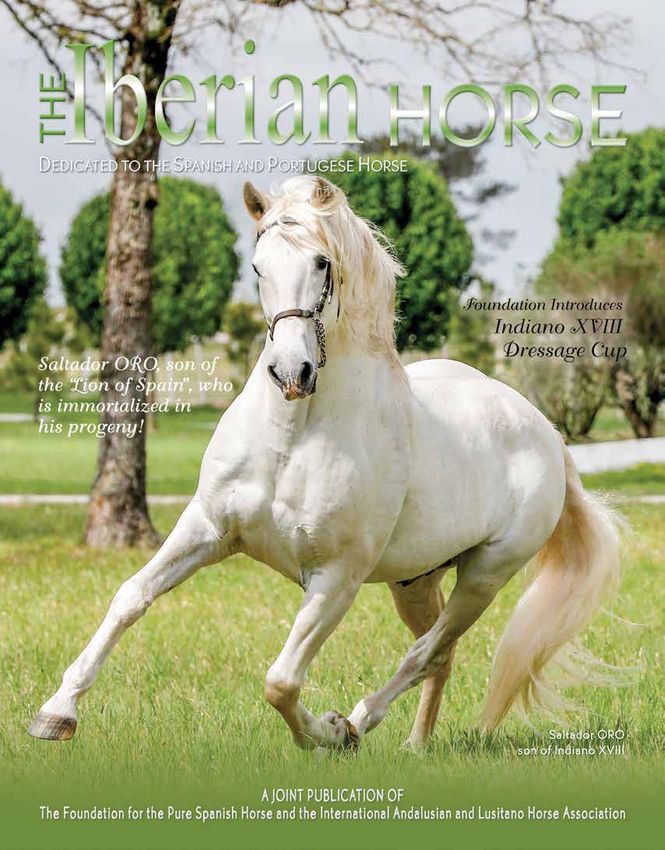
          Photographer Barbara Ponder                                                                                      12		 The Romance of Golega
          immortalizes Saltador ORO,
          highly decorated son of Indiano                                                                                                            by Keron Psillas
          XVIII, represented by "Rancho
          del Lago." In 2004, Rancho Del
                                                                                                                                                     Keron takes us on a journey through
          Lago doubled down on Indiano                                                                                                               Portugal's historical Lusitano region
          XVIII and the results were                                                                                                                 and the famed annual horse festival
          spectacular. Saltador ORO                                                                                                                  in Golegã.
          and Dardano RDL, by Indiano
          XVIII are out of Guardiola mares
          from the lines of Centella V,
          Champion of Spain.                                                                                               23 The Carriages and Driving Horses at the
          Each stallion is a USDF under                                                                                    		 Royal School of Equestrian Art in Spain
          saddle Champion and Grand
          Champion Dressage Sport                                                                                              by Diane E. Barber
          Horse in Hand; is a multiple                                                                                         An Interview with Manuel Marquez.
          USDF All Breeds Award winner,
          and carries many IALHA
          National Champion titles in
          multiple categories under both
          USEF and Spanish judges);
          holds an IALHA Life Merit Award,
          and has many championship
          awards at regional shows; and
          each stallion has in their own
          right sired multiple National
          Champions. Learn more at:
          http://ranchodellago.net
          Be sure to visit page 24 to read                                                                                 30 The Indiano XVIII Cup
          about the Fundation's Newest
          Dressage Award!                                                                                                      The FPSH announces a new Dressage Award.

  2 |    THE IBERIAN HORSE                                                                     Issue 1 | 2018                                                      www.theiberianhorse.online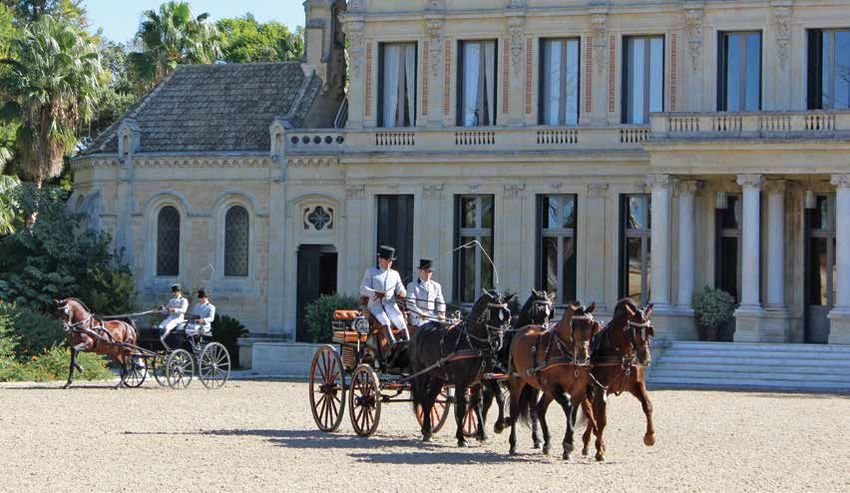
The CARRIAGES
  Driving Horses
                                                           and

        at the Royal Andalusian School of
              Equestrian Art                IN SPAIN...

23 |   THE IBERIAN HORSE   Issue 1 | 2018                       www.theiberianhorse.online
                                             Written and photographed  by Diane E. Barber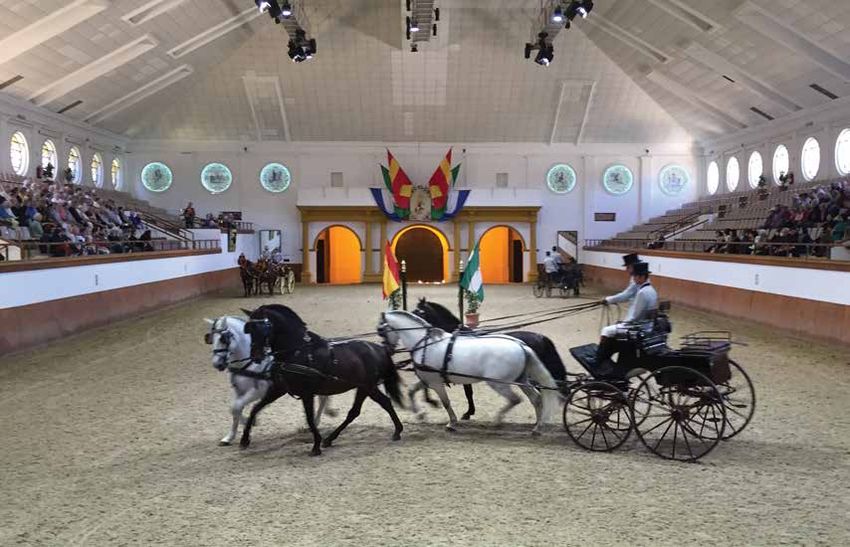
An Interview with Manuel Marquez

T
       he Royal Andalusian School of Equestrian Art in             First and foremost I learned that, as with work under
       Jerez, Spain is not only home to an exquisite P.R.E.        saddle, clear communications to establish a solid
       herd of dressage show horses. It also boasts a              trusting connection with the horse was paramount. I also
prestigious carriage museum and teams of exceptionally             quickly discovered that sensitive hands, timing, use of
trained carriage driving horses that perform in the                my voice and reward were also key, as well as engaging
school’s world-renowned performance “How the                       core muscles with great posture for balance.
Andalusian Horses Dance”.                                                The short time spent training with Manuel left me with
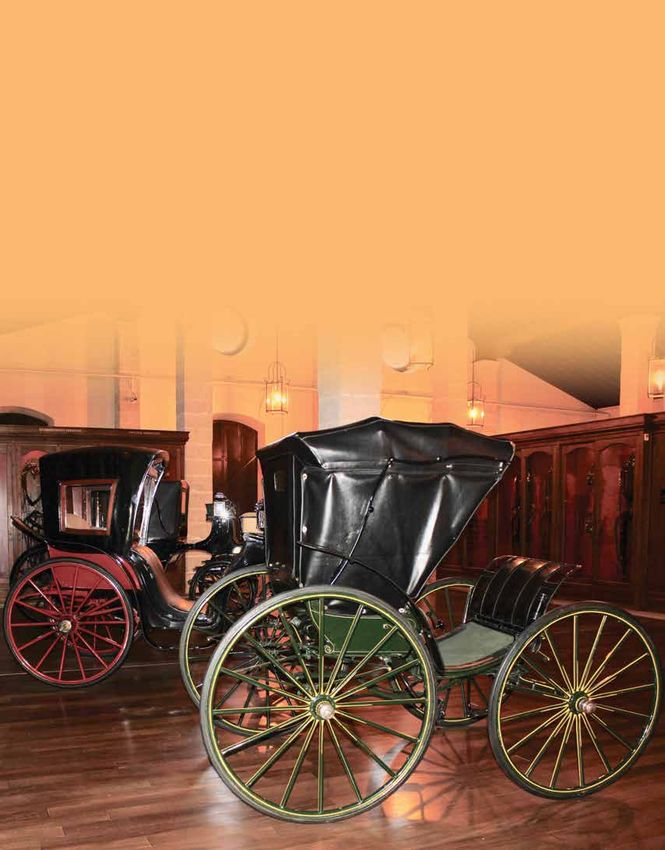
     The museum was officially established in 2002 by              a lingering fascination and respect for driving. Years later
the Junta de Andalucia (regional government) to honor              I still yearned to learn more about the behind-the-scenes
and preserve the tradition of horse-drawn carriages,               world of the carriage department at the Royal School.
which coincided with the World Equestrian Games held               When I returned to Andalucia for my annual trip last fall,
in Jerez that year. It is located in a 19th-century building       I had the good fortune of spending another day with the
that was formerly a winery across the street from the              master with a notebook and camera in hand.
main grounds of the Royal School. Twelve of the
original carriages and harnesses acquired by the
school from the Domecq family in the 1980s are on
display in the main room of the museum and are
equipped with interactive touch screens for visitors
to access information about their origin and history.
The carriage horses are stabled there among the
immaculate collection of carriages, harnesses and
costumes.
     At the helm of the day-to-day management
of the entire carriage department is Manuel
Marquez, Manager of Carriages and Coachmen,
who has meticulously overseen every detail for the
past 20 years. The museum, horse training, staff
management, teaching students, and everything
related to the shows at the school, outside exhibitions
and competitions are under his watchful eye with
tremendous pride at the heart of his passion.                    Manuel Marquez, Manager of Carriages and Coachmen, and assistant.
     Several years ago, I participated in private classes
with Manuel as a part of an intensive training program
                                                                   A CONVERSATION WITH MANUEL MARQUEZ (MM)
at the Royal School. My experience with the reins of a
                                                                   AND DIANE BARBER (DB)
single-horse carriage in my hands forever altered my
perception of horse drawn carriages and it provided a              DB: How many P.R.E.s do you currently have in the
newfound appreciation for the similarities between riding          carriage department and were they bred at the Royal
and driving. As a naive bystander, driving had always              School?
looked fairly easy to me. That certainly changed when I            MM: At the present time, we have 22 horses working
found myself in the driver’s seat for the first time. Initially,   as carriage horses. Twelve of the horses were either
having all of the horse’s energy and power in front of me          purchased or given to the school from different breeders
was disconcerting. But, with Manuel’s careful coaching,            and ten are stallions from our own FREAAE stock, which
I tapped into my riding experience and I discovered                have proven to be excellent for this discipline.
tremendous commonalities shared by both disciplines.

                                           Issue 1 | 2018     | 24 |    THE IBERIAN HORSE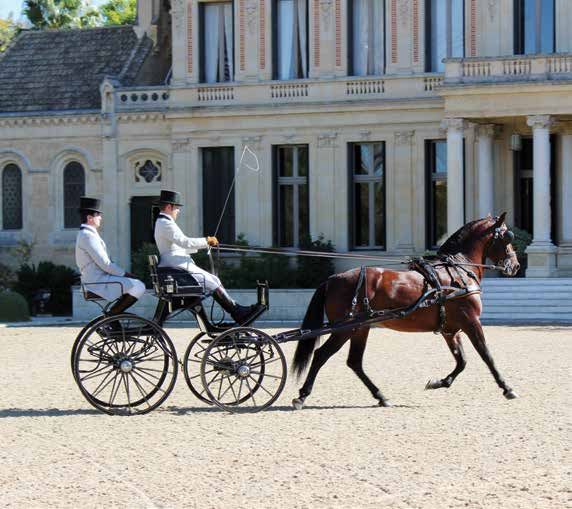
Warming up for the weekly performance of "How The Andalusian Horses' Dance".

DB: How many of them are trained to perform in the           DB: How many carriages are in the museum and how old
show “How the Andalusian Horses Dance” and how               are they?
many horses and carriages are driven in each show?           MM: The museum has approximately 40 vintage
MM: All of the horses are trained to perform. Ten or         carriages. The oldest one is the Carretela, circa 1800.
more horses usually participate in the show with up to       The most modern one is from the end of the 20th century.
four carriages.
                                                             DB: How many of the carriages do you use for training
DB: What qualities must a horse have to be good at           and for the shows? Do you use any of the vintage
pulling carriages? What is special about the horses you      carriages for special performances?
choose to lead the teams of horses?                          MM: We use seven carriages for training to teach and
MM: Carriage horses must have a good character, good         perform different types of driving. For the show we
conformation and good movement, which all of our             use an average of 10 carriages. Because it is a living
P.R.E.s have. The most expressive horses are generally       museum, every carriage can be used.
used as the carriage guides (leaders).
                                                             DB: How many people care for the horses, equipment
DB: How old are the horses when they start training and      and carriages?
how long does it typically take to train them to be ready    MM: There are six staff members under my direction –
for the performances at the school?                          a coachman, a foreman and four stable workers. There
MM: The horses are started around the age of three. For      are also six students in training.
a horse to participate in a show it needs approximately
two years of training, depending upon the evolution of       DB: Are the horse and driver costumes historical? What
the animal during the training period.                       is the significance of the bells and the tassels that are a
                                                             part of some of the horses’ costumes? Are the tassels
                                                             made at the school?

www.theiberianhorse.online                                                      Issue 1 | 2018   THE IBERIAN HORSE      | 25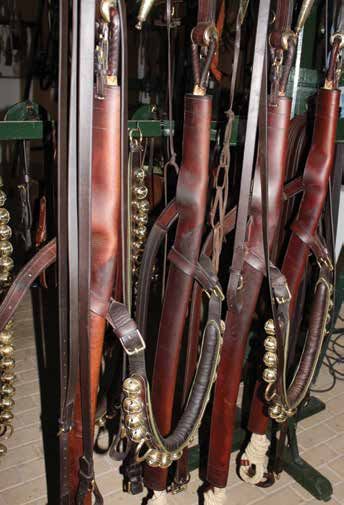
An Interview with Manuel Marquez

       MM: The dress is specific to the carriage and harness category
       that we are presenting. The bells are an element of the Calasera
       harnesses, which are traditional harnesses from our land. The
       tassels are also traditional. They are made my local artisans, not
       at the school.

       DB: Is any of the leather equipment made in the saddlery at the
       school?
       MM: Yes, our saddlery department does much of the leather
       work.

       DB: How many horses are in the largest team at the school?
       MM: The largest team is six. More than that would be difficult
       because of the size of our show arena.

       DB: How do you stop a team of horses in an emergency:
       MM: I talk to them softly, take the brake and pick up the reins
       continuously until the horses calm down.

       Performing a difficult perfect circle in the Royal School's colesium (below).

26 |    THE IBERIAN HORSE           Issue 1 | 2018                                     www.theiberianhorse.online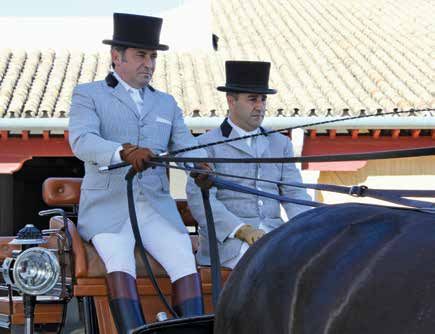
Historic costume display (above).                  Manuel Marquez students driving behind the Royal School palace.

DB: What are the most important pieces of equipment         MM: Getting the correct curvatures in a circle,
on the horses and why? Why do they wear blinders on         serpentine, backing and, of course, straightness.
their eyes? What kind of bits and shoes are used?
                                                            DB: Do you have a favorite horse?
MM: In general, all of the pieces are necessary to
                                                            MM: For me, they are all my favorites. But, I have a new
perform their functions in the hitch, without some
                                                            horse named Baluarte, which is very special. Although
of them it would be impossible. The horses wear
                                                            he has more dressage training, he has very good
blinders so they do not see the carriage behind them
                                                            movements, great character, good conformation and
and so they do not get scared. Special bits specifically
                                                            is showing a very good attitude with a lot of potential.
for carriage horses are used (not double bits like the
                                                            vTIH
dressage horses). Usually the shoes are not special
shoes, unless there are circumstances that require          Diane E. Barber lives
                                                            in Los Angeles and is a
them to avoid slipping.
                                                            lifestyle writer, interior
                                                            designer and equestrian
DB: Tell me about the carriage wheels please.               with an affinity for Spain
                                                            and P.R.E.s. She travels
MM: The wheels are made of wood or iron, depending
                                                            to Andalucia regularly to
upon the coaches. The wooden ones are made by               train with Rafael Soto and
hand and are for vintage coaches to preserve tradition      to visit her friends at the
                                                            Royal Andalusian School
and their originality. Iron wheels are used on coaches
                                                            of Equestrian Art. For
for competitions because they are lighter and capable       more information visit:
of a lot of speed and better maneuvers.                     www.realescuela.org

DB: What are the most difficult maneuvers to make
with a team of horses?
                                                                                 Issue 1 | 2018   THE IBERIAN HORSE    | 27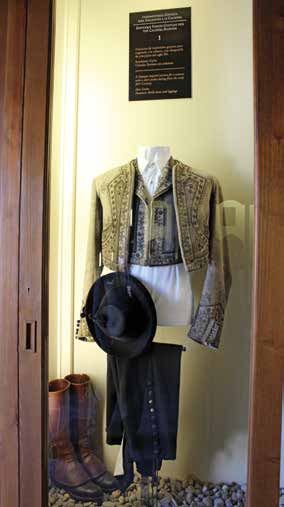
You can also read


