JAMES MCFARLANE SCHOOL - NORTH AYRSHIRE COUNCIL
←
→
Page content transcription
If your browser does not render page correctly, please read the page content below
James McFarlane School

         EDUCATION SERVICE

                            Dalry Road
                            Ardrossan
                            KA22 7DQ

Telephone          -   Ardrossan (01294) 4 6 1 3 7 0

Fax                -   Ardrossan (01294) 4 7 0 2 2 5

E-mail             -   jamesmcfarlane@ea.n-ayrshire.sch.uk

Website            -   https: blogs.glowscotland.org.uk/na/jamesmcfarlane
                       Twitter: @jamesmac_school

               Handbook 2020-2021
Contents
Head Teacher Introduction
Communities Directoraten (Education Service)
• Directorate Aims, Values and Priorities
Section 1: School Information
• School Aims, Values, Ethos
• School Contact Details (address, Telephone, Email, Fax)
• School staff
• School Calendar/Holidays
Section 2: School Procedures
• School Security
• Positive Relationships
• Playground Supervision
• Absence from School Premises at Breaks
• School Dress Code
• Dress Code for PE
• Personal Belongings
• Mobile Phones
• Information in Emergencies
• Listening and Learning
Section 3: Footwear, Clothing, Free School Meals and Transport
• Footwear and Clothing Grants
• Free School Meals
• School Transport Policy
Section 4: School Registration, Enrolment and Attendance
• Registration and Enrolment
• Attendance at School
• Structure of Classes
• Transfer to Secondary School
Section 5: Curriculum for Excellence
• Curriculum for Excellence
• The Capacities
• Extra-Curricular Activities
• Assessment and Reporting
• Homework
Section 6: School Improvement
• S&Q Report/Improvement Plan
Section 7: Support for your Child
• Additional Support for Learning
• Dispute Resolution Procedures
• Further Support
• Equality Act 2010
• Child Protection
• Inclusion
• GIRFEC
• Psychological Services
• Data Protection
2• Medical and Health Care
Section 8: Parental Involvement
• Parent Council
• Home School Links
• Reports to Parents
• Homework
• School Committees
Section 9: Pupil Data Collection and Protection Policies
Appendix 1: Important Contacts
3Head Teacher Introduction
Dear Parents/Carers
The staff and pupils of James McFarlane School extend a warm welcome to all parents.
Each person in our school is an important individual and we hope our school will be a
happy, caring and stimulating place for all. We need the assistance and co-operation of all
parents to achieve this. It is vitally important for your child’s education that good, positive
communication is established between school and home.
Our handbook is provided to familiarise you with some of the educational, organisational
and social aspects of our school. We hope you will find our handbook informative and
useful, and that it will both encourage and enhance the partnership which already exists
between home and school.
James McFarlane School meets the needs of children and young people who have severe
or complex learning difficulties, including intellectual, physical and sensory disabilities.
Our pupils come from an area stretching from Largs in the north to Irvine in the south, and
inland to Kilbirnie and Beith. At present the age range is four to eighteen years. The
capacity of the school may vary depending upon the number of pupils with specific
difficulties and the way in which classes are organised. On average two or three new
pupils join us each year. This session we have 34 pupils.
We are continually looking to improve the facilities for our pupils and to make James
McFarlane School an attractive, pleasant, working environment for both pupils and staff.
Staff at James McFarlane School are a highly qualified, caring staff who are dedicated to
ensuring that your child will develop his or her skills to their full potential. We work to
ensure that the time your child spends with us is happy and fruitful.
On behalf of everyone in James McFarlane School I extend a warm welcome to you and to
all our new pupils and to their parents.
Should any of your questions be unanswered here, please do not hesitate to contact me.
Kirsty MacPhie
Kirsty MacPhie
Acting Head Teacher
4School Day
School starts at 9.25 am for all children and finishes at 3.25 pm. All breaks and lunches
are seen as teaching time and are supervised.
School Holiday and In-Service Dates 2021/2022 (Mainland Schools)
Term Dates of Attendance Day Date Cumulative Cumulative
Holiday / Closure Working Days
Total
Term 1 Teacher (In-Service) Tuesday 17-Aug-21
Pupils Return Wednesday 18-Aug-21
Teacher (In-Service) Monday 20-Sep-21
Close Friday 08-Oct-21 39
Term 2 Pupils Return Monday 18-Oct-21 5
Teacher (In-Service) Thursday 18-Nov-21
Local Holiday Friday 19-Nov-21
Local Holiday Monday 22-Nov-21 7
Close Wednesday 22-Dec-21 85
Term 3 Re-open Thursday 06-Jan-22 17
Local Holiday Friday 11-Feb-22
Local Holiday Monday 14-Feb-22
Teacher (In-Service) Tuesday 15-Feb-22
Pupils Return Wednesday 16-Feb-22 19
Close Friday 01-Apr-22 145
Term 4 Re-open Tuesday 19-Apr-22 30
May Day Monday 02-May-22 31
Teacher (In-Service) Friday 27-May-22
Local Holiday Monday 30-May-22 32
Pupils Return Tuesday 31-May-22
Close Wednesday 29-Jun-22 66 195
22/23 Pupils Return Thursday 18-Aug-22
Pupils attendance will be 190 days after deducting 5 in-service days
5Communities Directorate
Our Overall Aim
Ensuring our children and young people experience the best start in life.
Our Priorities
• We will create the conditions for our children and young people to access the highest
quality learning experiences from ages 3-18.
• We will support our children and young people to become successful learners, confident
individuals, effective contributors and responsible citizens.
• We will offer opportunities to our young people and their families to play a more active
role in school life and encourage more participation in learning.
• We will work with all young people to build their resilience, supporting their mental health
and physical well-being.
6Section 1: School Information
James McFarlane School Vision, Values and Aims
Vision
Working together to be the best we can be.
Values
Aspiration Respect Community
We Aim to create:-
Successful learners who reach their potential inspired by us (the whole school community)
and become confident and empowered individuals
School Ethos
At James McFarlane School we believe that:
We aim to meet the individual needs of each pupil through the provision of a co-ordinated
range of professional services and a broad and balanced curriculum which reflects current
best practice and promotes curricular innovation and high quality professional development
within a safe, caring and inclusive school environment.
In partnership with parents, local agencies and the wider school community, we aim to help
all children reach their full potential by being successful learners, confident individuals,
responsible citizens and successful learners and take their rightful place in society.
The school’s philosophy of education is interpreted in its widest sense: to create a health
promoting learning environment for all members of staff and pupils.
7Promoting Positive Behaviour
It is the right of every pupil to feel safe and to have access to an appropriate curriculum. It
is the right of every member of staff to feel safe and to be supported by colleagues and
management.
In our situation, where children have complex support needs, we require to protect
vulnerable children and enable children to learn appropriate behaviour in a range of
settings. We must at all times strive to maintain the dignity of each pupil. At the heart of
our position is the belief that behaviour is a means of communication, and, where
behaviour is challenging to the services, pupils should be guided and supported towards a
more acceptable means of communication.
To this end we structure individual strategies for each pupil who exhibits ‘distressing’
behaviours. These are known to all staff and ensure an appropriate and systematic
response at all times which is aimed at eventually enabling pupils to gain control of their
own behaviour. As with all our approaches, parents are fully consulted about decisions
taken regarding promoting positive behaviour.
In the very rare event that our Behaviour Support Policy fails, exclusion would be used as a
last resort. It is our policy to recognise that challenging behaviours in our pupils are almost
always part of the particular difficulty and / disability. Thus we strive to deal with the
behaviour and still value the child or young person.
In accordance with NAC’s policy on promoting positive behaviour James McFarlane School
uses the CALM Framework (Crisis and Aggression Limitation and Management) to manage
and promote positive behaviour in the school.
This is a whole school approach in which all staff are engaged. This training is to keep both
children/young people and staff safe.
In line with council policies all incidents of aggression and violence are recorded and also
logged with councils Corporate Health and Safety Services.
School Contact Details
Basic Information
Acting Head Teacher – Kirsty MacPhie
James McFarlane School Telephone number: 01294 461370
Dalry Road Email: jamesmcfarlane@ea.n-ayrshire.sch.uk
Ardrossan
KA22 7DQ
Present Roll: 34 pupils
Non-denominational Co-educational Non Gaelic speaking
Website:
http://www.blogs.glowscotland.org.uk/na/jamesmcfarlane
8Cluster Schools:
Ardrossan Academy Dykesmains Primary School Stanley Primary School
Sorbie Road Stanley Road
Ardrossan Simpson Drive Ardrossan
KA22 8AR Saltcoats KA22 7DH
KA21 6EX
Telephone : 01294 461931 Telephone : 01294 822353 Telephone : 01294 462531
Winton Primary School West Kilbride Primary
Anderson Terrace School
Ardrossan Portencross Road
KA22 8JP West Kilbride
KA23 9ES
Telephone : 01294 464443 Telephone : 01294 822353
School Staff
Acting Head Teacher: Miss Kirsty MacPhie
Depute Head Teacher: Mrs Lesley Ward
Principal Teacher:
Secondary Department:
Teachers: Mrs Emma-Louise Caldwell
Mrs Fiona Walton (EYP)
Mrs Aileen Bannatyne
Instructors: Mrs Lorraine Brown
Early Years Practitioners: Mrs Emma Ward/Mrs Leanne Bennett
Ms Ashley Simpson
Ms Lorraine Kennedy
Miss Rebecca MacKay
Mrs Tennille Reilly
Miss Claire Dalziel
Mrs Fiona Walton
Ms Linda Findlay
Classroom Assistants: Mrs Julie Kinniburgh
Mrs Mary Smith
Mrs Sandra White
Mrs Leeann Hampton
Mrs May Moore
Mrs Claire Guiney
Mrs Linda Kinghorn
Mrs Anne Shanks (P.T.)
Mrs Deborah Weir (P.T.)
Mrs Linda Allison (P.T.)
Mrs Jackie Mason (P.T.)
Mrs Joanna Blane
Mrs Katie Narwal (P.T.)
Mrs Jennifer Flynn
9Mrs Rebecca Donnelly
Mr Frank Tennant
Mrs Ashley Anderson
Primary Department:
Teachers: Mrs Debbie Brown
Miss Kat McClure
Mrs Susan Harkin
Mrs Adele Alexander
Mrs Gillian McKenzie/Mrs Louise Allan (2 days)
Mrs Pamela Muirhead
Non-Teaching Staff:
Education Assistant Miss Lynda Lee
(Support):
Janitor: Mr Ronnie Bacon
Catering Assistant: Mrs Donna Doherty
Cleaners: Mrs Elizabeth Nixon
Ms Susan McDonald
Visiting Specialists
Educational Psychologist Mrs Lynne Ferney
Physiotherapists: Mrs J Monaghan and R Sugden
Speech Therapists: Mrs E Mair
Occupational Therapist: Susan Barr
School Chaplain: Rev Sandy Montgomerie
Community Dentist: 01294 317269
Community Dental Hygienist: June Festorazzi
School Nurse: Mrs Laura Nicol
10Section 2: School Procedures
School Security
North Ayrshire Council has introduced procedures to ensure the safety and security of
children and staff when attending or working in a school. A number of security measures
are used including the use of a visitors’ book, badges and escorts while visitors are within
the school building. Anyone parent/care or visitor at a school for any reason will be asked
to report to the school office. The school staff will then make any necessary arrangements
in connection with the visit to the school.
It is the policy of the school that any member of staff will approach a visitor and ask for
verification of identity. This measure ensures that children work in a safe and protected
environment. We appreciate you support in carry out all of the above measures
Positive Relationships
The school expects a high standard of behaviour from its pupils and aims to promote
positive behaviour. The relationship between pupil and teacher is like that between child
and parent. Both sides must respect each other and see each other’s point of view. We
use restorative practices where children and staff are encouraged to find a solution to
disagreements together.
The school has a code of conduct to ensure the safety and well-being of all and parents are
asked to support the school fully in this matter.
Some children may require additional support in relation to their behaviour and the school
will work positively with the young person and the parents to ensure positive outcomes are
achieved.
Playground Supervision
The Council meets the terms of the legal requirement that pupils be supervised in the
playground by at least one adult during the interval or lunchtime in terms of the Schools
(Safety and Supervision of Pupils) (Scotland) Regulations 1990. In addition in James
McFarlane School an adult presence is provided in any teaching base or playroom used by
the children at break times, so that no child is ever left unsupervised.
Absence from School Premises at Breaks
Our school policy is that pupils remain under the supervision of staff members at all times
of the school day, and only leave the premises on organised outings accompanied by staff
members.
It is our policy to request parental permission on an annual basis for local outings, and for
outings which are significantly different we request special parental permission for each
occasion.
11School Dress Code
It is the policy of North Ayrshire Council to support the introduction of a reasonable and
flexible dress code in schools in its area. The Council encourages each school to adopt its
own code, after consultation with parents and pupils.
The Council believes that establishing a school dress code will have many benefits.
These include, improved safety, security, discipline, school and community spirit and a
decrease in bullying and inexpense for parents.
Our school policy is that our school uniform consists of polo-shirt and sweatshirt in light
grey or red, with the school logo on them. It is recommended that comfortable, easily
washed tracksuit bottoms are worn with the polo and sweatshirts.
Soiled clothing to be sent home.
Parents are asked to name all items of clothing worn by their children in school.
The Council will support schools in encouraging and helping pupils to stick to the chosen
dress code. Some types of clothing will not be allowed at school in any circumstances, for
reasons of safety, decency or wellbeing.
Types of clothing which will not be allowed include:-
• Clothes which are a health or safety risk
• Clothes which may damage the school building
• Clothes which may provoke other pupils
• Clothes which are offensive or indecent
• Clothes which encourage the use of alcohol or tobacco
The Council will support schools taking disciplinary procedures against pupils in serious or
persistent cases.
Dress Code for PE
For health and safety reasons all children must wear suitable clothing for PE.
Personal Belongings
It is appreciated that parents and pupils are distressed over the occasional loss of pupils'
clothing and/or personal belongings. Parents are asked to assist in this area by ensuring
that valuable items of clothing or personal belongings are not brought to school. Parents
should note that the authority does not carry insurance to cover the loss of such
items.
Information in Emergencies
We make every effort to maintain a full educational service but on some occasions
circumstances arise which lead to disruption. Schools may be affected by, for example,
severe weather and temporary interruption of transport, power failures or difficulties of fuel
supply. In such cases, we shall do all we can to let you know about the details of closure or
re-opening. We will keep you in touch by using letters, texts, Seesaw (where possible),
12NAC website, notices in local shops and community centres, announcements in the press
and West FM.
Should you have doubts about deteriorating conditions during the day, it may be advisable
to contact the school. Parents should ensure that the school is aware of the emergency
arrangements made for their child and have responsibility to update us with contact
numbers.
Fire Precautions
Fire drill notices are displayed throughout the school. Fire extinguishers are checked
yearly. The janitor checks fire points and emergency lighting weekly and fire drill is
practised at least once a term.
Listening and Learning
It is the policy of North Ayrshire Council to try to encourage feedback on the education
service from parents and pupils. This is part of our overall commitment to giving the best
possible service and to working in partnership.
We are therefore very interested in feedback of all kinds, whether it be compliments,
suggestions or complaints. If you wish to register a comment of any type about the school
you can do this by writing, telephoning or making an appointment to see someone. All
feedback is welcome and helps us keep in touch.
Occasionally, in a busy school communication can be difficult. If you think that things have
gone wrong this is how the school tries to put things right:
Your child‘s teacher sees them every day and should be the first point of contact if you
have general concerns. This can be done by telephone or via the home/school
diary/Seesaw.
If, in particular, you have a complaint about the school, please let us know. It is better that
these things are shared openly and resolved fairly, rather than being allowed to damage
the home/school relationship. There will be no negative consequences arising from making
a complaint and we will deal with the issue as confidentially as possible. If we have made a
mistake we will apologise quickly and clearly and try to put things right.
There are some things which you should take note of in relation to making a complaint:
• It is helpful if complaints are made initially to the Head Teacher. This makes sure
that the school knows what is going on and has an opportunity to respond and
resolve the issue.
• We will try to respond as quickly as possible, but often issues are complex and need
time to investigate. It is therefore helpful if you can give some details of the issue
and ask for an early appointment to discuss it.
• It you are not satisfied with our response then you still have the right to take up the
matter further with the Head of Service (Schools) at Cunninghame House, Irvine,
KA12 8EE (01294 324400)
13• You should also note that you have the right to raise unresolved concerns with your
local councillor, M.S.P. or M.P.
• Parent Councils have an important role in developing links between the school and
the wider parent forum and can often be helpful in dealing with issues of general
concern. However, parents are advised that it is not appropriate to raise individual,
more personal complaints via Parent Councils due to the need for appropriate
confidentiality.
14Section 3: Footwear, Clothing, Free School Meals and
Transport
Footwear and Clothing Grants
Parents receiving Universal Credit will normally be entitled to grants for footwear and clothing
for their children. Universal Credit claimants must earn less than £610.00 per month or
£7,320 per annum. However, some parents who still receive Income Support, Income based
Job Seeker’s Allowance, any income related element of Employment and Support Allowance,
Support under part V1 of the Immigration and Asylum Act 1999, Child Tax Credit, Working
Tax Credit or Housing Benefit may also still be entitled to grants for footwear and clothing for
their children.
Parents who may be unsure whether they can apply should contact the Council on 01294
310000 for further advice.
Information and application forms may be obtained from schools.
Free School Meals
Because eating and drinking are such a vital part of our educational curriculum, all children
attending James McFarlane School are provided with a free midday meal. Special diets
are available with written confirmation of need from a dietician.
School Transport Policy
North Ayrshire Council has a policy of providing free transport to all primary pupils who live
more than two miles from their catchment area school by the recognised shortest safe
walking route or through the link attached below:
https://www.north-ayrshire.gov.uk/Forms/EducationalServices/free-school-transport.doc
These forms should be completed and returned before the end of February for those pupils
beginning school in August to enable the appropriate arrangements to be made.
Applications may be submitted at other times throughout the year but may be subject to delay
while arrangements are made. The appropriate officer has discretion in special
circumstances to grant permission for pupils to travel in transport provided by the authority,
where places are available and no additional costs are incurred.
Where free transport is provided it may be necessary for pupils to walk a certain distance to
the vehicle pick-up point. Walking distance in total, including the distance from home to the
pick-up point and from the drop-off point to the school in any one direction, will not exceed
the Council's limits (see above section). It is the parents’ responsibility to ensure that their
child arrives at the pick-up point on time. It is also the parents’ responsibility to ensure that
their child behaves in a safe and acceptable manner while boarding, travelling in and leaving
the vehicle. Misbehavior can result in children losing the right to free transport.
15Please see attached link to the Council’s School Transport Policy:
https://www.north-ayrshire.gov.uk/Documents/EducationalServices/school-transport-
policy.pdf
This year the Contractors for James McFarlane School are:
BK Minibuses Telephone: 01294 231717
Bond Cars Telephone : 07900 981986
Council Telephone: 01294 541613
Concord Taxis Telephone: 01294 465268
Largs Central Taxis Telephone: 01475 272300
Cumbrae Taxis Telephone : 07946 346737
Park Road Taxis Telephone : 01292 861352
Mercedes Telephone : 077386 37466
BJ Minibuses Telephone : 07957 949303
If a child is absent from school for any reason it is the responsibility of the parent to
inform the transport company.
On any occasion when a parent wishes to have a child collected from school other
than by the usual transport we ask that they contact the Transport Hub (Tel: 01294
541615) as well as the school.
16Section 4: School Registration, Enrolment and Attendance
Registration and Enrolment
We hope that the first thing you will do is visit our school and have a good look round all the
classrooms. We would like you to take your time to meet the Head Teacher and the other
members of the management team. If you feel, after your visit, that we will be able to meet
the needs of your child then you should speak to your Educational Psychologist who would
make the necessary approaches to Education and Youth Employment. The final decision
concerning placement rests with the Corporate Director, Education and Youth Employment.
It is the responsibility of parents to educate their child(ren); most do this by ensuring that
their child(ren) attends (attend) school regularly.
Moving from Nursery
Prior to pupils starting school the Head Teacher will attend an Inclusion Group meeting. If
the decision is made that this school is an appropriate placement arrangements are made
with parents and pre-school establishment to arrange induction and transfer of information.
As with mainstream provision, your child is entitled to 7 years in the primary stage
and 6 years in the Secondary.
Attendance at School/Lateness
It is the responsibility of parents of children of school age to educate their child(ren). Most
do this by ensuring that their child(ren) attend(s) school regularly.
Attendance is recorded twice a day, morning and afternoon.
Absence is recorded as authorised, unauthorised or temporarily excluded.
Parents should inform the school by letter or telephone, if their child is likely to be absent
for some time, and to give the child a note on his or her return to school, confirming the
reason for absence. If there is no explanation from a child’s parents, the absence will be
regarded as unauthorised.
Every effort should be made to avoid family holidays during term time as this both disrupts
the child's education and reduces learning time. Parents should inform the school by letter,
before going on holiday, of the dates. Such absence will be authorised only where certain
and very specific family circumstances exist. The majority of family holidays taken during
term time will be categorised as unauthorised absence.
Parents may request that their children be permitted to be absent from school to make an
extended visit to relatives. Only written requests detailing the destination, the duration and
the provision that will be made for their continuing education will be granted. Such
extended absences will be recorded separately from the normal attendance and absence
information.
The Pupil Welfare Officer investigates unexplained absence and the authority has the
power to write to, interview or prosecute parents, or refer pupils to the Reporter to the
Children’s Panel, if necessary.
17Section 5: Curriculum for Excellence
Curriculum for Excellence
Curriculum for Excellence (CfE) is the national curriculum for Scottish schools for learners
from age 3-18. It aims to raise standards, prepare our children for a future they do not yet
know and equip them for the jobs of tomorrow in a fast changing world.
Curriculum for Excellence enables professionals to teach subjects creatively, to work
together across the school and with other schools, to share best practice and explore learning
together. Glow, Scotland’s unique, world-leading, online network supports learners and
teachers in this and plans are already in place for parents across the country to have access
to Glow.
Teachers and practitioners will share information to plan a child’s “learning journey” from 3-
18, ensuring children continue to work at a pace they can cope with and with challenge they
can thrive on.
Curriculum for Excellence balances the importance of knowledge and skills. Every child is
entitled to a broad and deep general education where every single teacher and practitioner
will be responsible for literacy and numeracy – the language and number skills that unlock
other subjects and are vital to everyday life. There is emphasis too on health and wellbeing
– to ensure that the school is the place where children feel safe and secure.
Curriculum for Excellence develops skills for learning, life and work to help young people go
on to further study, secure work and navigate life. It brings real life into the classroom, making
learning relevant and helps young people apply lessons to their life beyond the classroom.
It links knowledge in one subject area to another helping children understand the world and
make connections. It develops skills so that children can think for themselves, make sound
judgements, challenge, enquire and find solutions, each at their own individual level.
There will be new ways of assessing progress and ensuring children achieve their potential.
Ultimately, Curriculum for Excellence aims to improve our children’s life chances, to nurture
successful learners, confident individuals, effective contributors, and responsible
citizens, building on Scotland’s reputation for great education.
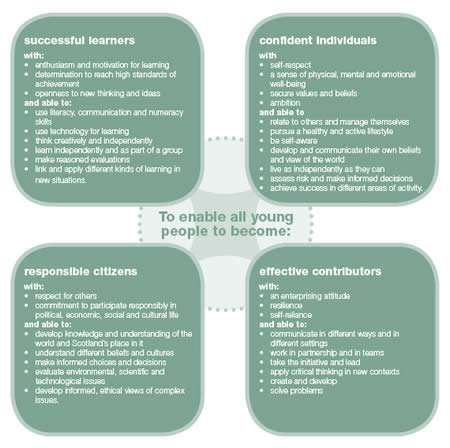
A Curriculum for Excellence aims to enable young people to meet the four capacities listed.
18Curriculum for Excellence: The Capacities
Further information about Curriculum for Excellence and the Experiences Outcomes can be
found on the Curriculum for Excellence website.
Our Curriculum
It is essential that an appropriate curriculum is provided for all pupils in James McFarlane
as this will assist them to make the fullest use of their potential for learning and will
comprise of three essential components:
• A well thought out curriculum for the class/school as a whole
• Individualised Educational Programmes
• Integration of the IEP within the curriculum of the class/school
Personalised learning targets for pupils will be achieved through participation in a set of
planned learning experiences through the following contexts for learning:
• Ethos and life of the school as a community
• Curriculum areas and subjects
• Interdisciplinary learning
• Opportunities for personal achievement
A Curriculum for Excellence is about bringing learning to life and life to learning.
19Principles
James McFarlane will provide individualised approaches to the planning and delivery of an
appropriate curriculum which reflects pupil needs.
James McFarlane will ensure that all pupils have equality of opportunity to achieve
excellence in an environment which values the achievements of individuals.
The curriculum will satisfy the principles of continuity, coherence, breadth, balance and
progression. Age appropriateness and relevance should also be considered as guiding
principles.
Parents should be actively involved in determining the main curricular priorities for their
child and in the evaluation of the effectiveness of such curricular priorities.
All children and young people should have the opportunity to participate actively in
decisions about their education and welfare.
The curriculum in James McFarlane will embody the capacities, principles, outcomes and
experiences of ‘Curriculum for Excellence’.
We will ensure that all of our pupils are:
• safe
• fulfilled and valued
• healthy
• achieving
• active
• respected and responsible
• included
We will provide a flexible and appropriate curriculum which will enable young people to
become:
• successful learners
• confident individuals
• effective contributors
• responsible citizens
We will also meet the individual needs of each learner through personalised planning of an
appropriate curriculum.
Curriculum content
The curriculum areas which comprise the whole curricular experience for our pupils are
now in line with Curriculum for Excellence.
• Languages & Literacy
• Mathematics & Numeracy
• Expressive Arts
• Health & Wellbeing
• Religious & Moral Education
• Sciences
• Social Studies
20• Technologies
Pupils will learn and develop their skills through a variety of ongoing projects such as Eco
Schools, and Enterprise and through cross curricular topics.
Methodology
Children and young people in James McFarlane are most likely to learn when they are:
• motivated by stimulating tasks which provide opportunities for positive feedback
taught in an environment which provides self-confidence and a sense of personal
worth presented with tasks and activities relevant to them
• given appropriate support in terms of adult involvement and high quality resources
• presented with programmes of study broken down into manageable steps
• encouraged, whenever possible, to be independent
• involved in group and individual activities
• able to apply knowledge, understanding and skills in practical situations
Specialist pedagogies and approaches include; Structured teaching (TEACCH), Total
Communication, Sensory approaches, MOVE (movement opportunities via education) and
Intensive Interaction to help children and young people develop the ‘fundamentals of
communication’.
It is essential that parents are fully involved in their child’s teaching/learning process and
that skills being developed in school are, where appropriate, carried over into the home.
Parents are actively involved in the determination of their child’s annual targets and receive
both regular verbal and annual written reports on pupil attainment.
Communication/Literacy
At the earliest stages of development learners will be encouraged to build fundamental
communication skills to be able to relate and interact with the world around them.
• Listening and Talking
• Pre-reading/Reading
• Pre-writing/Writing
•
All pupils are encouraged to develop their skills in communication. For some, this will
involve the use of alternative and augmentative communication systems eg concrete
signifiers (real objects), Makaton signing (which involves signing a word and speaking at
the same time), the use of symbol systems (picture or drawings which represent actions or
objects) and, for some, assistive technology involving the use of switch systems.
Some pupils may follow a programme which focuses on the development of literacy skills:
pre-writing/writing and pre-reading/reading activities, supported by computer technology.
This will form the basis of whole class and individual education programmes. Commercial
programmes currently used include the Pops Reading Programme.
21Understanding and Relating to the Environment/Mathematics and Numeracy
As learners progress they will acquire ‘Learning to Learn’ skills and develop functional
numeracy skills that will help them long-term.
• Number, Money and Measure
• Shape, Position and Movement
• Information Handling
All pupils are encouraged to develop functional mathematical skills, including using
numbers in everyday situations, finding out about the properties of shapes, using simple
measurements, using money to make purchases within real contexts.
Health and Wellbeing including Functional Movement
• Making choices
• Physical Education
• Physical activity and sport
• Food and Health
Pupils are encouraged to develop discrimination in touch, taste, smell and to develop
tracking and location in vision and hearing.
Through the development of play skills and finding out about the world around them,
children are assisted to learn about their environment and to develop appropriate patterns
of social behaviour.
The development of personal and social development is at the centre of every area of
study. Pupils are encouraged to develop appropriate levels of independence in their
personal care regimes: eating and drinking, dressing, washing and toileting.
Appropriate social behaviour and respect for self and others is encouraged in every aspect
of school life and structured programmes in health education, citizenship and enterprise
help prepare pupils to take on more personal responsibility in their own lives.
In physical education the focus is on teaching the pupils fitness and leisure skills as well as
water skills and enjoyment of water and pool activities. All children enjoy a weekly session
in our own therapy pool. We have had regular input from fitness instructors as part of the
‘Active Schools’ programme.
Functional Movement
For children who have physical disabilities great emphasis is placed on movement skills
and good positioning. Some examples of milestones in the curriculum are: head control,
sitting balance, control of involuntary movement, fixation in a good position, facilitated
standing and walking. We use the principles of M.O.V.E. (Movement Opportunities via
Education) Curriculum which is based on a top down model to teach the skills of sitting,
standing and walking. We also work on movement associated with play activities and life
skills such as running, jumping, use of large apparatus such as chute and swings and skills
for ball games.
22The use of the hand is a vital part of learning, so this is an important part of the curriculum
for all children with physical disabilities. Important skills are being able to grasp, first using
the whole hand and later on the finger and thumb, being able to place an object where
required, e.g. on a table or in a box, and being able to work with one or both hands in
midline.
For children who do not have physical impairment it is important to consolidate skills such
as running, hopping, jumping and to ensure that eye-hand co-ordination is of a high
standard.
Other curricular areas include;
Science
• Planet Earth
• Forces, Electricity and Waves
• Biological Systems
• Materials
• Through topic work and eco-awareness, pupils have many experiences and learn a
variety of skills in early science.
Technologies
• Technological developments in society
• ICT to enhance learning
• Business Contexts for developing Technological skills (through enterprise)
• Computing Science contexts for developing Technological skills and knowledge.
James McFarlane School is well equipped with the following;
Smartboards, computers and ‘Eyegaze’ supported by a wide range of software
Switches and switch operated toys
Voice output devices such as Big Macks
Cameras and video cameras
Laptops and ipads
Model making resources
Magic Carpet
Social Studies
• People: past events and societies
• People: place and environment
• People: in society
Pupils experience and learn through topic work, outings and object handling.
Expressive Arts
• Participation in Performances and Presentations
• Drama
• Art and Design
23• Music and Dance
Drama includes interacting with others through role-play activities as well as responding to
others and expressing feelings through the use of role-play. This includes games like
dressing up and playing pretend games as well as more formal activities. At Christmas the
pupils from our Primary department present the Nativity and Secondary pupils a summer
play. We video many events and make DVDs so that pupils can view themselves and
parents have a memento of their child’s participation in school events. Such activities
encourage memory and communication.
Activities in artwork involve use of crayons, paints, dough, clay, collage materials and in
fact anything that has a visual or tactile effect.
Music lessons make use of singing, percussion instruments, wooden ‘ethnic’ instruments
and both live and taped music. We teach pupils to explore sound and music, express their
feelings through music and listen and respond to sound and music. Establishing
preferences and giving pupils the opportunity to make choices is very important in
Expressive Arts.
The school participates where and when they can in art competitions locally and beyond
and have been successful with winning entries.
Religious and Moral Education
• Christianity
• Other world religions
• Development of beliefs and values
The school is non-denominational and our religious education programme is built around
the complex needs of our pupils.
Integral to the programme is the structuring of an appropriate atmosphere in school
whereby the children may be helped to achieve a sense of equanimity and appreciate
others. In religious education lessons we use simple themes, religious stories and imagery.
Different world religions are covered, particularly within the sensory curriculum, giving
pupils experience of special times and the artefacts from other countries. Different
Christian festivals are used to give focus to formal lessons throughout the year.
On a daily basis, children come together with their staff where they consider the good times
of their day and sing a prayer of thanksgiving to God. Departmental assemblies take place
fortnightly.
Our school chaplain, Rev Sandy Montgomerie visits pupils regularly in their classroom and
add an extra dimension to the life of school.
Every month Rev Sandy joins us for the Senior Assembly. At the end of each term and at
Harvest time he organises a short service for us, in which he encourages all pupils to take
as active a part as possible. Parents are invited to attend these ceremonies.
24Withdrawal
Under the terms of the Education (Scotland) Act 1980, parents have the right to ask for
their child to be withdrawn from religious observance. The school will deal with such
requests with sensitivity and understanding. The head teacher will offer to meet with any
parent wishing to withdraw their child to ensure that they are clear about the school policy
on religious observance.
In particular, parents should be reassured that the religious observance planned by the
school adopts an open and respectful approach and does not seek to compromise the
beliefs of any pupils or their families.
Where a child is withdrawn from religious observance, suitable arrangements will be made
for the pupil to participate in a worthwhile alternative activity.
Secondary Curriculum
At approximately 11-12 years our learners transition into a Secondary Class. They remain
in the Secondary department for 6 full years prior to moving onto a post-school destination.
The Secondary department is split into 2 stages: S1-S3 and the Senior Phase S4-S6.
S1-3
Learners in this stage continue to develop skills in the 3 core areas of
Communication/Literacy, Numeracy and Health & Wellbeing and through the other
curricular areas. Learners have their work formally accredited through ASDAN Transition
Challenge programmes. Learning and teaching is set within the five ASDAN Transition
Challenge modules which form the framework of the programme.
• Knowing How
• Making Choices
• Taking the Lead
• Feeling Good
• Moving Forward
Contexts for learning are real and meaningful with a focus on lifeskills and everyday living.
Learning experiences are also developed and delivered through Interdisciplinary Learning,
Enterprise and Citizenship activities, Outdoor Learning and Eco curricular work.
Curriculum S4 – S6
Senior Phase
The Senior Phase prepares learners for life beyond school and emphasis is placed on
learners taking on more responsible roles. Within the Senior phase, pupils work on National
1 Qualifications, Personal Achievement Award Framework (bronze, silver and gold
awards), ASDAN Towards Independence (where appropriate) and the John Muir Award
(Explorer and Discovery).
School/College Links
Where possible S6 learners have the opportunity to attend Ayrshire College for lifeskills or
expressive arts. This session they are participating in an art class.
James McFarlane is a partner in the Ardrossan School Cluster. Learners enjoy participating
in joint activities and expressive arts projects.
25Our learners are involved in the following inclusion programmes:
St. Matthew’s for PE/Fitness Suite and Kilwinning Campus College for Art/Mecoco
Kilwinning.
Work Experience
We aim to give our learners an experience of work both through in-house activities and on
a short supported placement within the community organised by the Developing the Young
Workforce co-ordinator. Enterprise is a good medium for this experience. Our cluster
schools facilitate supported work placements where appropriate.
Extra-Curricular Activities
We try to ensure that our pupils take part in as many different activities as possible.
We place great emphasis on outings into the community to such things as local shops,
restaurants, theatres and public parks. We also make use of indoor bowling facilities and
tubing at Newmilns Dry Ski Centre.
Each year some of our pupils enjoy a week’s stay at Arran Outdoor Educational Resource
Centre.
The staff in Arran make every effort to ensure that the pupils can participate in a range of
activities, including orienteering, sailing, canoeing, horse riding and swimming. It is always
a great success and new friendships are often forged with a primary school who are there
at the same time.
Outings have also taken place to a variety of venues in the course of the year.
Holiday Club
Parents from Haysholm and parents from James McFarlane School have set up a holiday
club called The Butterfly Club which will run throughout the summer holidays. Parents
have gained charitable status for this club and are working continuously to raise funds for
this much needed club.
Health Promoting School
Health promotion is a local and national initiative. The schools (Health Promotion and
Nutrition) (Scotland) Bill was introduced on 8th September 2006 and seeks to improve child
health by requiring schools to be ‘health promoting’.
26Pupils are at the heart of Health Promoting schools and are actively encouraged and
consulted regarding making healthy choices at snack and lunch times
Regular exercise and full participation in leisure time is also encouraged.
Rebound Therapy/Trampoline
Positive reward systems and the use of incentives are promoted to encourage positive
behaviour and raise self esteem.
Health Promotion extends beyond healthy eating and exercise within school and extends to
partnerships within the wider community to include: sports development, the use of North
Ayrshire facilities, and accessing local secondary schools for P.E. links and active schools
activities.
We aim to keep parents informed of Health Education activities within school and welcome
involvement in various initiatives that will take place throughout the school session.
The school has received Commitment and Credit awards for health promotion.
Eco-School
The school has an Eco committee comprising pupils, staff, Head Teacher, and a parent.
The committee has organised an eco-school project involving re-cycling, energy
conservation, and plant propagation. They involve the whole school in a variety of
activities. The school has gained Bronze and Silver Awards and achieving our first Green
Flag in December 2009. The school has now gained its third Green Flag.
Enterprise and Citizenship
All pupils have taken part in whole school events that promote Citizenship, for example,
raising money for Children in Need, Red Nose Day etc. Learners are also involved in
Enterprise activities, for example
• Christmas Fayre
• Garden Fayre
• North Ayrshire Foodbank
All projects provide excellent opportunities for teaching literacy and numeracy across the
curriculum and in real life settings. These events are also a means for raising funds to
donate to worthy causes.
Transitions
Transition between classes and departments in school is planned in order to make the
transfer between groups as seamless as possible. Two years before (on occasions
possibly earlier) leaving school (in S4) and moving onto adult life (at the end of S6), there is
a Transition Planning Meeting held to consider the options for meeting the young person’s
needs in the future. Thereafter at least one Transition Planning Meeting per year is held so
that adult facilities and school can work together to help the transition to adult life. We have
recently had very good contact with receiving agencies for our pupils moving into adult
services.
27Assessment & Reporting
Profiling
Development strengths and priorities of learners who are starting at James McFarlane are
assessed using appropriate baseline assessment tools, e.g. PEP 3 and Routes for
learning. The assessments, along with information gathered from partners including
parents during pre-school assessment and post placement meeting, form the basis for
drawing up an individual educational plan for each learner. Parents of Primary 1 children
are invited to an IEP meeting where the plan is fully discussed and agreed with them.
Additionally information is gathered from parents that forms the basis of the child’s
wellbeing assessment. At Secondary level, learners are profiled using Pathways to
Independence.
Individualised Educational Programme Target Setting
Annual long term targets are set and agreed with parents in June for the next school
session in the core areas of literacy, numeracy and health & wellbeing. Targets are based
on need and set in a range of functional, relevant naturally occurring contexts to ensure
learning is motivating and relevant to learners. For some learners very small progressive
targets are set as they are achieved, i.e. weekly or monthly. Individualised targets are
developed in line with the outcomes and experiences of a Curriculum for Excellence.
On a day to day basis staff communicate with parents through the home-school diary, and
they will frequently ask parents to try a particular activity with their child. If appropriate
some children will have more formal homework sheets to complete with the help of their
parents.
We recognise that, for many of our pupils and their parents, homework will consist of us
following shared aims and methods in helping our pupils master the everyday activities of
learning to feed and dress themselves, learning to sit, stand and walk and learning how to
express their needs and react appropriately to the needs and demands of others.
Assessment and Co-ordinated Support Plans
Prior to and on admission to school, children are assessed by different specialists involved
with the child, including the psychologist, physiotherapist and speech therapist as well as
educational school staff.
The Head Teacher may see parents privately to talk about their child. After a period of
approximately 6-8 weeks and from these assessments a draft individualised educational
programme/personal learning plan is devised. Parents are given a copy of their child’s
targets and asked to discuss it with staff at the first parent evening of the session, so that,
once the final programme is agreed upon, school and home are working towards common
goals.
Once a programme is under way, assessment is continuous, and re-adjustments are made
whenever necessary. Teachers track learners’ progress within the IEP.
At the annual review meeting we will consider the pupil’s progress, whether their placement
in school is still an appropriate one and whether the pupil’s Co-ordinated Support Plan
(where appropriate) is up-to-date.
28Achievement
Achievement is celebrated and evidenced through wall displays, learning journey files and
digital books or power points depicting achievements. Most learners are involved in
celebrating their learning and showcasing achievements during assemblies and annual
review meetings where appropriate.
Monitoring, Evaluating and Reporting
Achievement of individual targets and impact of the planned curriculum is evaluated and
reported on at the end of each term. Parents can expect to receive a Term 1 and Term 2
Report along with a final End of Year Report. Annual review meetings are held cyclically
involving all agencies involved with the child and parents to discuss progress made and
share concerns (if any).
During the review multi-agency input (e.g. Physiotherapist, Occupational Therapist) is taken
into account and this information is included in the updated plan for the learner. Views from
parents/carers are included and also incorporated. All information relating to the child is
updated and shared with parents/carers following the review meeting.
Where possible learners are encouraged to participate and gain an experience of peer and
self assessment of their learning. Most learners with agreement from parents attend their
annual review meetings to celebrate their learning using their preferred method of
communication. Technology supports this.
ASDAN and national 1 work is subject to rigorous and robust moderation, internally, at
Authority level and Pan-Ayrshire, to ensure a national standard is being met.
Parent’s Evening
We work closely with parents and encourage them to be involved in their child’s education.
At the start of the school session we invite parents into school to discuss learner progress
and to identify partnership/homework activities. In June, progress on current priority targets
is discussed along with the proposed focus for next session’s targets. Parental involvement
in this planning is invaluable.
Stall at the Garden Fayre Staff and Pupils at the Garden Fayre
Links with the Community
We are grateful that many local organisations, societies and businesses are involved with
fund-raising to help buy specialist equipment and support our minibus costs and outings in
the community.
29Our pupils use the minibus daily to access community facilities such as library, shops,
cafés, bowling, swimming and local parks. We have had visits from staff from local
businesses and individual friends in the community. This helps to build relationships
between our pupils and the wider community.
Students
We offer training places to students from various colleges. Our students come on varying
lengths of placement and get to know our pupils very well.
This session we have had several probationer teachers to visit.
Volunteers
We are fortunate to have the services of volunteer workers. One, in particular comes along
regularly several times every week to help in the classrooms, in the therapy pool and on
outings. They are a great asset to the school and our pupils benefit tremendously from
their help and support.
Respite Care
Many of our pupils use Muirfield Place, Kilwinning which offers short-stay care for children
with severe and complex support needs. A stay is usually for 3 to 4 days.
Every child is warmly welcomed to the house with the staff ensuring that the child’s needs
are well met. Activities are planned with the young person’s likes and dislikes taken into
account. Often children are accompanied on their stay by a school friend.
Staff from Muirfield Place liaise closely with both home and school, and some have
received informal training in our school setting.
This facility is available for children from 6 to 18 years of age.
If any parent or carer would like to know more about the service offered at Muirfield Place,
then please ‘phone on 01294 257164 where the care staff will be happy to answer any
question
Some pupils use Lisalanna, Cumnock.
Several parents make use of a shared care scheme, whereby their child spends occasional
weekends with another family. Care Partners and IMPACCT are other facilities which
some families access. Often great friendships are built up between the shared carers and
the families.
Information about other respite arrangements may be obtained from your local Social Work
Department.
30Section 6: School Improvement
Our Main Priorities for 2020/2021
We are reducing High quality learning and teaching Self-evaluation and
inequalities and delivering is taking place in all our performance improvement are
Directorate improved outcomes for establishments embedded throughout our
Priorities children and young people schools and central support
teams
School • Continuation of a culture • To continue to develop and embed • To continue to develop
based on GIRFEC and use creative, active and communication effective approaches to
Priorities of wellbeing indicators to rich approaches to teaching and moderation of BGE developing
drive improvements and learning for learners with severe staff’s understanding of
improve outcomes for our and complex additional support assessment and shared
children and young people. needs. standards.
• To continue to develop • To develop a shared understanding • To further develop and embed
practice in line with the new of what constitutes high quality processes for tracking,
High Level Children’s Act Scotland learning and teaching for children monitoring and evidencing
Objectives (2014). with severe and complex needs. progress.
• To continue to embed • To continue to embed • To pilot Education Scotland
nurturing and relationship communication rich pedagogies in pre- early level benchmarks to
based approaches to all classes ensuring consistency monitor and track progression
promoting positive across the school of learners.
behaviour. • To augment the use of digital
technology across the school and
further develop active learning
approaches (PEF funding)
• To develop a core induction
programme and mentoring for new
and less experienced staff and
increase opportunities for all staff to
access high quality CLPL
Policies
The school’s policies are currently available in hard copies from the school office. These
will be available on the school website in due course.
Authority Education policies can be found on the North Ayrshire Council website.
There are a number of National, North Ayrshire Education and Youth Employment and
School policies which will provide information on a range of issues. Further details of all of
these are available from the school. We hope to have the school policies on the school
website in the near future.
The following is a list of policies which may be most relevant to you and your child although
this is not an exhaustive list:
• Information and Communications Technology in Schools
• Protecting North Ayrshire’s Children
• Support for Children with Long-Term Absence from School
• Exclusion from School
31You can also read


