Kaupapa Māori action research in a Whānau Ora collective: An exemplar of Māori evaluative practice and the findings
←
→
Page content transcription
If your browser does not render page correctly, please read the page content below
Evaluation Matters—He Take Tō te Aromatawai 1: 2015
                                 © New Zealand Council for Educational Research 2015
                                                  http://dx.doi.org/10.18296/em.0006
                                http://www.nzcer.org.nz/nzcerpress/evaluation-matters

Kaupapa Māori action research in a Whānau
Ora collective: An exemplar of Māori
evaluative practice and the findings
Maria Baker, Kataraina Pipi, and Terri Cassidy

   Whānau Ora, introduced as a government initiative in Aotearoa New
   Zealand in 2010, was designed to support collaboration and effective
   service delivery by Māori non-government organisations. The aim of
   Whānau Ora is to improve heath and social outcomes for whānau.
   Action research was conducted to support this initiative, with action
   researchers walking alongside Whānau Ora collectives to support
   their collaborative planning, research, evaluation and reflection. This
   article examines the implementation of the evaluative component of
   kaupapa Māori (by Māori, for Māori, with Māori) action research
   with a Whānau Ora collective, Te Hau Āwhiowhio ō Otangarei.
   An integrated action-research approach based on kaupapa Māori
   principles supported methodological decisions. These decisions, in
   turn, informed the choice of evaluation methods used (e.g., wānanga,
   reflective hui, whānau interviews), and four of the methods chosen
   and the concomitant evaluative findings are described. It is concluded
   that the effectiveness of integrating action research with kaupapa
   Māori principles has provided a multi-method evaluation approach
   that works well for Māori communities.

                            © New Zealand Council for Educational Research 2015   113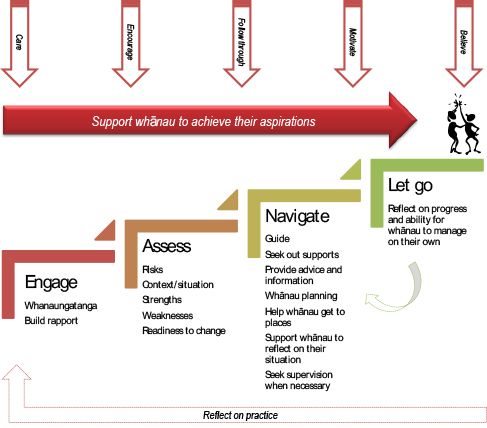
Maria Baker, Kataraina Pipi, and Terri Cassidy

    Ki te whai ao … ki te ao mārama … tihei mauri ora
    The transitional state between darkness (the unknown) and light
    (understanding) transforms to the world of light and then to a sense of
    meaning, and a way of being
In 2009 the Minister for the Community and Voluntary Sector,
the Hon Tariana Turia, established the Whānau Ora Taskforce on
whānau-centred initiatives. The Taskforce developed a framework
for a whānau-centred approach that would strengthen whānau well-
being and development, and affirmed five foundations of effective
whānau-centred service delivery: whānau, hapū and iwi leadership;
strengths-based whānau engagement and action; whānau-centred
design and delivery of services; active and responsive government; and
funding (i.e., a relational approach to contracting with funding consis-
tent with Whānau Ora) (Taskforce on Whānau-Centred Initiatives,
2010). In 2010, Whānau Ora was introduced as a government ini-
tiative designed to support Māori provider organisations and other
services to collaborate to deliver effective whānau-centred services
to individuals and whānau. Te Puni Kōkiri (the Ministry of Māori
Affairs) selected 25 Whānau Ora collectives from across the country
to participate in the first tranche of the Whānau Ora initiative. These
collectives were charged with the transformation of their services
to Māori, and the consequent implementation of a whānau-centred
approach designed to deliver whānau ora (Māori family wellness).

Te Hau Āwhiowhio ō Otangarei Whānau Ora Collective
Te Hau Āwhiowhio ō Otangarei Whānau Ora Collective (the
Collective) was one of those selected. The Collective is based in
Otangarei, Northland, part of the Ngāpuhi iwi region, and is guided
by the kawa and tikanga of Ngāpuhi. The work of the Collective is
informed by a view that there are constant changes in this world that

114 Evaluation Matters—He Take Tō Te Aromatawai 1 : 2015
Kaupapa Māori action research in a Whānau Ora collective:
An exemplar of Māori evaluative practice and the findings
influence the circumstances of whānau today. These diverse circum-
stances are shaped by life factors, a person’s growth and development,
that person’s environment (political, economic, and social), and by
that person’s whānau, hapū, and iwi.
The Collective was formed in 2010 and was initially made up of
six independent organisations: five social service providers, includ-
ing two that were Otangarei-based, and one local television station.
In 2014 the Collective consolidated its focus to “mā Otangarei mō
Otangarei—by Otangarei for Otangarei”. This resulted in the merger
of the Collective’s two Otangarei-based providers—Otangarei Trust,
a youth and social services provider, and Te Puāwaitanga ō Otangarei
Healthcare Centre—into one provider named Te Hau Āwhiowhio
ō Otangarei Trust. This merger revitalised the concept of kāinga (a
place of belonging and connection) and strengthened the Collective’s
vision and aspirations for the future for whānau in Otangarei. The
Collective’s metaphoric vision for the Otangarei community and
whānau within it is to grow a forest (ngahere)—including a strong
pūriri tree. The pūriri has a significant presence in the Otangarei
community, and is reminiscent of the Ngāpuhi whakataukī “Ka kata
ngā pūriri o Taiamai”, which extends notions of strength and hos-
pitality. In this forest each whānau is considered to be a tree, and
growth is mā Otangarei, mō Otangarei. The Collective recognised
that, to achieve and maintain whānau ora, a systemic framework was
needed which enabled the identification of clear roles, responsibili-
ties, and actions at whānau and community levels. Action researchers
were seen as being able to support the development of this framework.
Action research
Action research was implemented by Te Puni Kōkiri to support the
Whānau Ora initiative. Action researchers were tasked with walking
alongside each Whānau Ora collective to support their collaborative
© New Zealand Council for Educational Research 2015 115Maria Baker, Kataraina Pipi, and Terri Cassidy
planning, research, evaluation and reflection. There were five phases
to the action research with Whānau Ora collectives: engage, plan,
research, evaluate, and reflect. The engagement and planning phases
gave action researchers and Whānau Ora collectives an opportunity
to get to know each other and to co-design the research, evaluation,
and reflection phases. It was anticipated that the research phase would
then inform the delivery of services by Whānau Ora collectives, and
that some part of this service delivery would subsequently be eval-
uated. The final phase was to allow action researchers to support
Whānau Ora collectives to reflect on what they were learning about
whānau-centred service delivery and whānau ora (Cram, 2011).
The Collective determined criteria for engaging action researchers
that were based on previous experiences with researchers and evalu-
ators. It was important to the Collective that the action researchers:
·· had credibility in the research and evaluation sector, and with the
Collective
·· would work with the Collective to ensure the research and evalua-
tion was “done with them, not to them”
·· would be able to give critical reflection and feedback
·· were Māori, preferably with tribal affiliations to Te Tai Tokerau
·· understood the Māori worldview
·· understood and could work with the nuances of the community
and Māori organisations and
·· understood clinical and community work with whānau.
From these criteria the Collective proactively identified and recruited
two action researchers. Once these action researchers agreed in prin-
ciple to be involved, the Collective negotiated their appointment with
the funder. This process was somewhat outside the norm as most
collectives were given the opportunity to choose from a list of action
116 Evaluation Matters—He Take Tō Te Aromatawai 1 : 2015Kaupapa Māori action research in a Whānau Ora collective:
An exemplar of Māori evaluative practice and the findings
researchers identified by the funder.
During 2012–2014, a kaupapa Māori (by Māori, for Māori, with
Māori) action-research programme was conducted in partnership
with the Collective. The focus of this article is on phase 4, evaluation,
of the action research undertaken with the Collective. The following
high-level questions directed the inquiry.
·· What are the needs and aspirations of whānau?
·· What are the motivators and barriers to whānau achieving their
goals?
·· In what ways do whānau see that providers can support them to
achieve their aspirations?
·· How and in what ways are whānau better off?
·· What difference has the Collective made?
·· How has Te Rōpū Rangahau community research model increased
workforce capability and capacity?
The action researchers made methodological and method decisions
in close collaboration with the Collective. A key feature of these deci-
sions was the affirmation and validation of Māori ways of knowing
and being within a Whānau Ora context; hence the implementation
of kaupapa Māori action research.
Kaupapa Māori action research
Action research is a powerful tool for change and improvement in
services for Maori when it is utilised appropriately within a Māori
context (Kerr, Penney, Moewaka Barnes, & McCreanor, 2010). The
overarching purpose of action research within the Whānau Ora ini-
tiative was to support Whānau Ora collectives’ implementation of
successful whānau-centred service delivery, and to evidence their
facilitation of whānau ora outcomes (Cram, 2011). Action research
provided collectives with the ability to systematically reflect on
© New Zealand Council for Educational Research 2015 117Maria Baker, Kataraina Pipi, and Terri Cassidy
their work and to conduct a deep inquiry into the transformation
of services and professional practice that was expected within the
Whānau Ora initiative. As a means to evaluate whānau-centred ser-
vice delivery, action research was a community-led process with a
transformative focus (Mertens, 2009). A driving motivator was the
provision of a means to increase knowledge about the delivery of
Whānau Ora services that was responsive to the providers within the
Collective and to the whānau they served.
The recognition of a Māori worldview, or ways of being and prac-
ticing, was an important principle underpinning the action research
undertaken with the Collective. Any research or evaluation with the
Collective needed to be infused with a uniquely Māori way of look-
ing at the Collective’s world, their leadership, and their learning pro-
cesses (Smith, 1999). Engagement by the Collective and the action
researchers with kaupapa Māori action research ensured the central-
ity of Māori cultural epistemology; that is, an implicit understanding
that Māori have a distinct way of viewing and interpreting the world
(Cram, Kennedy, Paipa, Pipi, & Wehipeihana, 2015; Nepe, 1991).
Māori evaluators have combined kaupapa Māori and action research
previously to conduct bespoke assessments of the implementation
and outcomes of programmes. Such evaluations have had a deliber-
ate emphasis on empowerment and Māori development (Moewaka
Barnes, 2000).
The integration of action research with kaupapa Māori recognised
that the tikanga values of the Collective were central to its trans-
formation, and this in turn supported methodological decisions. It
was important to use tikanga Māori approaches in the engagement
activities during this action research. The action researchers followed
the tikanga as determined by the Collective, including using karakia,
mihimihi, whakawhitiwhiti whakaaro (facilitated discussion), kōrero
āwhina (affirming and validating whānau and staff approaches) and
118 Evaluation Matters—He Take Tō Te Aromatawai 1 : 2015Kaupapa Māori action research in a Whānau Ora collective:
An exemplar of Māori evaluative practice and the findings
tautohetohe (debate) as necessary. In addition, the Collective’s Māori
values of tika, pono, aroha, kotahitanga, and rangatiratanga were
used as a filter in the sense-making process throughout all research
activities. It was also imperative that any methods used were aligned
with the core foundational principles of the Collective so that any
research or evaluation conducted under the auspices of the action
research contributed to positive change for Māori (Smith, G., 2005).
Methods
The methods used in the kaupapa Māori action research included:
logic model and rubric development; documentation review; case
studies; review and analysis of whānau PATH plans (Pipi, 2010);
focus-groups; interviews; group reflective hui; participant observa-
tion; iterative discussions; and comparative coding (Pipi & Baker,
2014). There were also in-depth wānanga reflecting on the devel-
opment of the service model and framework. Using these various
methods data was gathered from 119 people, including managers,
review board members, kaiārahi (navigators), Te Rōpū Rangahau
(community research team) members, provider staff, and whānau
members.
Four of the evaluation methods used in Phase 4 of the kaupapa
Māori action research are described next: whānau interviews; logic
model and rubric development; wānanga; and reflective hui. These
methods informed the development of an emerging Whānau Ora
framework that showcases the importance of relationships, and the
transformation of the service providers as well as whānau.
Whānau interviews
Twelve face-to-face whānau interviews were held to seek feedback
using participatory and engaging approaches to support conversations.
Whānau feedback during an interview was depicted in pictorial form
© New Zealand Council for Educational Research 2015 119Maria Baker, Kataraina Pipi, and Terri Cassidy
(symbols and pictures) as they spoke and this helped them feel comfort-
able about sharing their insights (see Figure 1). Whānau could literally
see the story they were sharing as it unfolded, and used this visual
representation to make meaning of their experiences. This method
worked well in individual and group situations, as often the graphic
would prompt further insight, discussion and affirmation for whānau.
Whānau also became aware of the positive steps they had taken.
It’s not until you see what you’ve done that you realise how far you’ve
come. (Whānau)
Figure 1. Graphic depicting building of whānau capacity (Artist: Maraea Pipi-Takoko)
The whānau interviews provided good evidence that whānau engag-
ing with the Collective were achieving outcomes aligned to the
high-level Whānau Ora goals and whānau outcomes. These included:
being self-managing; creating healthier lifestyles; increasing partici-
pation in the community; having improved resilience; and improving
participation in te ao Māori. An example was the Whānau Ora
journey for Rangi1, who moved from a state of depression to being
1 Pseudonyms are used for anonymity in this article.
120 Evaluation Matters—He Take Tō Te Aromatawai 1 : 2015Kaupapa Māori action research in a Whānau Ora collective:
An exemplar of Māori evaluative practice and the findings
highly motivated to change. Rangi’s depression resulted from a series
of events including relationship separation, loss of parental rights
through Child, Youth and Family services, substance use, depression,
and isolation. Following 3 years of ongoing contact and guidance
by kaimahi, counselling, budgeting advice, assistance with gaining
access to her children, and deliberate facilitation to connect with her
Māori cultural heritage, Rangi was no longer using substances or
antidepressants, had improved cultural belonging, was highly moti-
vated, and had stronger relationships with her whānau and others.
The action researchers concluded that semistructured whānau inter-
views that focused on the most significant change for whānau proved
to be positive, and that creative approaches in an interview helped the
flow of conversation with whānau.
Whānau interviews identified nine key factors for whānau
transformation:
·· critical intervention opportunities
·· women as key influencers of whānau change
·· different engagement pathways for men
·· the importance of location of services
·· the motivational effect of sharing personal experiences
·· empowerment through financial literacy
·· family violence as an endemic issue
·· the value of Māori healing processes
·· the complexity of the whānau ora journey.
The Collective was able to reflect on each factor. This reflection sup-
ported a deeper level of understanding abut the issues impacting on
whānau and the types of services and approaches that would best
support them.
© New Zealand Council for Educational Research 2015 121Maria Baker, Kataraina Pipi, and Terri Cassidy Logic model and rubric development From the outset of this work, the action researchers detected a recurring theme that quality relationships are the key to successful whānau engagement, effective whānau-centred practice, and collabo- rative approaches to service delivery. The action researchers therefore worked alongside an external evaluator to undertake a value of rela- tionships study. A set of inquiry questions was determined, a logic model (see Figure 2) and rubric (Davidson, 2005) were developed, and an approach was designed for gathering information to inform the study. The logic model and rubric helped the action researchers investigate relationships that aid transformation when they interviewed whānau, staff, the steering group, and the review board. The logic-model development enabled reflective discussion on the various criteria that were important at each level, and for whom. Developing the rubric enabled the researchers to explore the various types and levels of rela- tionships across the Collective. Rubric development also helped to consolidate thinking around the questions to be asked in forthcom- ing interviews, and became the Collective’s framework for assessing the value of relationships (see Table 1). The inquiry questions focused both on understanding how to nurture good relationships and on what was gained from investment in relationships. The evaluation was qualitative and involved discussions with a range of Collective stakeholders, including whānau, provider staff, and governance representatives. 122 Evaluation Matters—He Take Tō Te Aromatawai 1 : 2015
Kaupapa Māori action research in a Whānau Ora collective:
                                                                           An exemplar of Māori evaluative practice and the findings

When we have good
relationships…                 that reflect these features… positive steps occur…              which leads to better results…                                          and improved whānau outcomes.

                                 Genuineness                Whānau:                            Whānau:
 Interpersonal                                              Trust in the service               Take responsibility for their own                                           Rangatiratanga

                                                                                                                                   Whānau Transformation
 relationships between                                      Have confidence in the service     future                                                                      ‐ whānau reclaim and
 staff (incl kaiārahi) &                                    Buy into the messages              Make positive decisions                                                     have confidence in their
 whānau                                                     Are motivated                      Change their behaviour                                                      own rangatiratanga
                                                            Staff:                             Build positive self belief
                                                            Understand whānau dynamics         Recognise and affirm their
                                 Reciprocity                and realities                      capabilities
                                                            Can take whānau anywhere           Strengthen cultural identity
                                                            It also:                           Self manage                                                                 Matatau ana te whānau
                                                            Speeds up the process of change    Increase health literacy                                                    – whānau are experts in
                                                            Provides quality information       Confidence in selves
                                                                                                                                                                           their own reality
                                                            Builds two way relationship        Affirmation of being Māori
                                 Tika                       Develops deeper level of sharing

Interpersonal relationships                                 Mahi ā‐whānau                      Improved access to appropriate
between provider staff                                      Responsibility                     supports                                                                    Tū pakari
                                                            Accountability                                                                                                 – whānau are thriving and
                                                            Strong foundation
                                                                                                                                                                           healthy
                                 Pono                       Reflective and deliberate

                                                                                                                                   Service & Provider Transformation
                                                            practice                           Better access to more services
                                                            Knowledge
                                                            Affirmation of cultural identity
                                                                                                                                                                           Mana motuhake
Interorganisational                                         More willingness to share                                                                                      – whānau are economically
                                                            resources & knowledge              More seamless service pathways
relationships                    Aroha                                                                                                                                     secure and contributing to
                                                            Collaboration
                                                            Pooling of resources
                                                                                                                                                                           community
                                                            Cross referrals
                                                            More integrated service
                                                            delivery                           More sustainable outcomes

                                 Empathy
Sector relationships (wider                                 Funder better understands          Appropriate levels of resourcing
system: funders, Whānau                                     operational aspects of service
Ora, health & social                                        delivery
services, Māori, iwi)                                       Speeds up contracting              Appropriate supports provided
                                                            processes
                                 Openness/honesty           Better evidence base
                                                                                               Integrated service delivery

         Assumptions: strengths‐based, non‐punitive

           Figure 2. Value of Relationships Logic Model

                                                                 © New Zealand Council for Educational Research 2015                                                                          123
Maria Baker, Kataraina Pipi, and Terri Cassidy
Table 1. Framework for assessing quality of relationships
Sector
relationships
Inter-personal
Inter-personal (wider system:
relationships Inter-
Quality of relationships funders,
between staff organisational
relationships between Whānau Ora,
(incl kaiārahi) & relationships
provider staff Health & Social
whānau
Services, Māori,
iwi)
Relationships are Relationships Relationships Relationships
reciprocal; whānau are reciprocal; are reciprocal; are reciprocal;
are responsive staff are providers are funders and
to staff, and vice responsible and responsible and sector are
versa. accountable to accountable to responsible and
The relationship each other. each other. accountable to
is conducive to Relationships Relationships each other.
whānau driving are centred on are centred on Relationships
Tino pai their own self- the interests the interests of are centred on
rawa atu actualisation. of whānau whānau wellbeing. the interests of
The relationship wellbeing. Relationships whānau/hapū/
is supportive Relationships consistently reflect iwi wellbeing.
of whānau consistently and uphold the Relationships
maintaining their reflect and kaupapa of the consistently
wellness. uphold the Collective. reflect and
kaupapa of the uphold the
Collective. kaupapa of
Whānau Ora.
Relationships are Relationships Relationships are Relationships
mana-enhancing. are mana- mana-enhancing. are mana-
They support enhancing. They They provide a enhancing.
whānau feeling support staff firm foundation for They provide a
Tino pai affirmed and feeling affirmed leaders and staff firm foundation
validated, building and validated, to create and seize for leaders and
confidence and building opportunities. staff to create
pride. confidence and and seize
pride. opportunities.
Relationships are Relationships Relationships are Relationships are
meaningful and are meaningful meaningful and meaningful and
purposeful. They and purposeful. purposeful. They purposeful. They
are also trusting, They are also are also trusting, are also trusting,
Pai
tika, pono, aroha, trusting, tika, tika, pono, aroha, tika, pono, aroha,
genuine, honest, pono, aroha, genuine, honest, genuine, honest,
open. genuine, open. open.
honest, open.
124 Evaluation Matters—He Take Tō Te Aromatawai 1 : 2015Kaupapa Māori action research in a Whānau Ora collective:
An exemplar of Māori evaluative practice and the findings
Whānau and staff/ Staff/kaiārahi Relationships Relationships are
kaiārahi have built have respectful between providers professional and
a relationship, and professional are professional respectful.
effective enough relationships and respectful,
to start identifying with one effective enough
Āhua pai te underlying issues. another, to present a
haere Relationships are effective united Collective
respectful and enough to to whānau, even
professional. provide a if some tensions
professional are being resolved
service to behind the scenes.
whānau.
Relationships that Staff/kaiārahi Providers are Relationships
just tick the box, interpersonal not on the same between funders
will get you by, but relationships wavelength in and the sector
not good enough are not good terms of kaupapa. (and/or within
to achieve real enough to They are looking the sector) are
engagement. provide a after their own unprofessional or
professional interests first, disrespectful.
Kore pai service to instead of the
whānau (for interests of
example, whānau. As a
tensions result, whānau
between staff receive mixed
are evident to or contradictory
whānau visiting messages.
the service).
The findings reiterated the importance of relationships as a key
driver for whānau and provider transformation. The features of good
relationships within the Collective’s context were: reciprocity, tika
(correct, right), pono (honesty, truth), aroha (compassion, affection),
rapport, consideration, and empathy. The Collective had invested
time, money, effort, commitment, faith, and hope in building and
maintaining good relationships. By investing in relationships, the
providers gained: extended networks; increased knowledge and
understanding of other services; more cross-agency collaboration;
affirmation and validation of the Collective’s kaupapa; better under-
standing of what works for whānau; improved capacity and capability
© New Zealand Council for Educational Research 2015 125Maria Baker, Kataraina Pipi, and Terri Cassidy
to support whānau, more streamlined service delivery; and an abil-
ity to better meet the needs of whānau. Whānau are experiencing
trusting, meaningful, and purposeful relationships, and this has
motivated them to take ownership of their own futures by planning,
setting goals, identifying aspirations, and working towards these
independently or with support from kaiārahi (Pipi & Baker, 2014).
The action researchers concluded that the use of the logic model
and rubrics in the value of relationships evaluation led to clarity
around the nature of relationships and their contribution to out-
comes. The study itself provided evidence of the recurring theme of
the quality of relationships and enabled discussion about how the
principle of whanaungatanga is embedded in Māori relationships.
In addition, the value of relationships logic model (Figure 2) and the
framework for assessing quality of relationships (Table 1) are both
resources the Collective aims to continually reflect on.
Wānanga
Wānanga were held to explore in-depth, within a Māori worldview,
key aspects of the action research. Staff and the Review Board came
together to share and learn about how they used the organisational
values in their practice. Steering group and Review Board members
came together to wānanga about Ngāpuhi leadership. Outcomes of
the wānanga included the emerging Whānau Ora framework and
the surfacing of the Collective’s kaiārahi (navigator) approach.
Emerging Whānau Ora framework
The emerging framework acknowledges that individuals, whānau
and providers move along a transformation continuum. Still in devel-
opment stage, the Collective hopes to be able to use it as a guide to
understanding their work and as a basis for making decisions about
their approach (see Table 2).
126 Evaluation Matters—He Take Tō Te Aromatawai 1 : 2015Kaupapa Māori action research in a Whānau Ora collective:
An exemplar of Māori evaluative practice and the findings
Table 2. Emerging Whānau Ora framework
Te Whai Ao Ki Te Ao Mārama Tihei Mauri Ora!
States of being To the glimmer of To the bright light of There is life
dawn day
Transaction Transition Transformation
Process An exchange of goods, Passage from one state, To change (often radically) in
services, or funds stage, place to another form, appearance, structure,
condition, nature or character
Role Storm breaker Dream maker Authenticator
Engage & Stop Chaos Advocate & Promote Nurture & Affirm actualisation
Responsibility
possibilities
Accountability Satisfy need Rejuvenate hope & Positive outcomes
possibilities
Outcomes You Vision / Me Vision Shared Vision Our Vision
The emerging Whānau Ora framework acknowledges that individu-
als, whānau, and providers move along a transformation continuum.
They transition from an initial state of working in a transactional way
(where there is an exchange of good and services in response to needs),
to a transitional stage (where there is a readiness to change with hope),
through to a transformation (where changes start to occur, and indi-
viduals and whānau action their plans, affirm their aspirations and
see positive change occurring). The Collective’s Whānau Ora frame-
work seeks to integrate understanding about different states of being,
service processes and practices, roles and responsibilities for account-
ability and the expected outcomes for whānau. The framework builds
on the assumption that, to achieve and maintain whānau ora, the
sum of the whole is greater than the individual parts.
Kaiārahi (navigator) approach
A kaiārahi (navigator) case study was developed to describe the
navigational approach being used by kaiārahi to support understand-
ing about how they worked with whānau. This case study was an
© New Zealand Council for Educational Research 2015 127Maria Baker, Kataraina Pipi, and Terri Cassidy exemplar of the navigation approach taken by one kaiārahi within the Collective and outlined the different stages of engagement when supporting whānau in their transformational journey. This also pro- vided evidence of the value of the approach to whānau. Figure 3 illustrates the navigational approach and includes factors of success as derived from kaiārahi and whānau feedback. These include: care for whānau, encourage them, follow through on promises to them, motivate them and believe in them. Figure 3. The navigational approach 128 Evaluation Matters—He Take Tō Te Aromatawai 1 : 2015
Kaupapa Māori action research in a Whānau Ora collective:
                                An exemplar of Māori evaluative practice and the findings

Identifying and mapping the navigational approach in a diagram-
matic form was useful for the kaiārahi reflecting on her practice. It
also helped inform the development of the emerging Whānau Ora
framework. It is clear that the ways in which kaiārahi invest in rela-
tionships with whānau has led to whānau transformation; that is,
successful whānau who are working together and using the resources
available to them. These gains were evidenced in three whānau case
studies that illustrated the value of relationships in the context of
the Whānau Ora journey. Overall, the action research highlighted
the important role of kaiārahi in building quality relationships with
whānau, and recognised that kaiārahi provide an important gateway
for whānau to access services.
    The action researchers concluded that wānanga supported
in-depth thinking and discussion in a Māori context about signif-
icant Whānau Ora developments. The wānanga also reaffirmed
and validated the value of being Māori and doing things in a Māori
way, and were an ideal method for learning and reflection about the
Collective’s values.

Reflective hui
A series of planned reflective hui occurred regularly throughout
Phase 3. These were deliberate in further socialising Whānau Ora
as part of the key outcomes of the Collective. Staff came together
for two one-day reflective hui to hear about and discuss the findings
from the action research. The action researchers facilitated a range of
group-based processes to encourage information sharing and oppor-
tunities for learning and reflection, and to elicit different perspectives
and analyses of the data to hand. The outcomes of these hui included:
·· whanaungatanga
·· new information and the sharing of ideas
·· clarity of purpose, mission and vision of the Collective

                           © New Zealand Council for Educational Research 2015      129
Maria Baker, Kataraina Pipi, and Terri Cassidy ·· knowledge and skills necessary to understand their roles in the scheme of the Collective ·· agreement, understanding and critical reflection about the findings of the action research ·· identification of areas for improvement ·· group ownership (e.g. the more people who understood the situa- tion and how it related to the aspirations of whānau and service delivery, the more it motivated kaimahi to invest in making changes happen) (Baker & Pipi, 2013). A reflective hui with whānau who participated in a previous project using Photovoice as an evaluation method was held to present back the findings of this project and consult with whānau on the proposed service model. The Photovoice project was completed by 10 whānau, where they took photos to represent what Whānau Ora meant to them. Whānau shared their stories of the photos with researchers. The key themes from these whānau photos and stories provided direction for the Collective to develop a proposed service model framework to achieve the aspirations of whānau. The outcomes of this reflective hui with whānau were: ·· whanaungatanga ·· validation and affirmation of whānau contribution to the Photovoice project ·· engagement with whānau and the Collective ·· confirmation of the proposed service model and its principles. The action researchers concluded that reflective hui provided regular face-to-face forums for discussions and updates on action research findings. The Kaiārahi found regular facilitated reflective discussions in hui to be valuable. In addition, reflective hui provided a forum for whānau to have a voice in the development of service models. 130 Evaluation Matters—He Take Tō Te Aromatawai 1 : 2015
Kaupapa Māori action research in a Whānau Ora collective:
                             An exemplar of Māori evaluative practice and the findings

Discussion
This article has provided a very broad description of the implemen-
tation of selected evaluation methods within the context of kaupapa
Māori action research with a Whānau Ora collective. The process
of doing this reiterated the importance of kaupapa; namely, that the
action researchers needed to understand how kaupapa developed and
influenced service delivery, workforce development, and leadership.
Two high-level key lessons included:
·· The importance of bringing to the forefront the value of being
   Māori.
·· For relationships, it was acceptable to let them go if they were
   not working; that is, to acknowledge that relationships run their
   course, where these may no longer be needed or required when the
   value of the relationship is limited or is not there any longer.
The Collective believed that Whānau Ora was a destination and a
journey and there were many unexpected things that occurred along
the way that built knowledge. Two key lessons were:
·· Moving into Whānau Ora land from provider land meant a spiri-
   tual, mental, and emotional connection with the whole kaupapa.
   “Whānau Ora was not an opportunity to put your toe in the
   water, you had to jump in and have faith” (quote from kaiwha-
   karite, 2015).
·· There was a divide between the Whānau Ora Taskforce intention
   and how this was able to be enacted by Te Puni Kōkiri and the
   Collective. Bridging this divide required an understanding of
   the policy and provider environment and of grassroots whānau
   realities.
For the Collective, kaupapa drove everything they did and it was an
expectation that they would stay on the kaupapa to achieve positive

                        © New Zealand Council for Educational Research 2015       131
Maria Baker, Kataraina Pipi, and Terri Cassidy outcomes for whānau. However this was constrained by fiscal and political restrictions. In the bigger scheme of things there was a reali- sation of what really that mattered. Two key lessons were: ·· Whānau Ora was about legacy making and legacy leaving and the Collective was operating at the intersection of these. ·· Getting high-quality sustainable outcomes for whānau requires a systemic approach. The Collective and the action researchers hoped that learning from kaupapa Māori action research would result in the following outcomes: ·· Government would be better informed about the impact of Whānau Ora policy and funding decisions. ·· Providers would be informed about service delivery, funding, and planning decisions. ·· Whānau would be able to affirm, protect, and grow what mattered to them for their whānau ora journey. ·· Evaluators and researchers would be inspired by kaupapa Māori approaches, while working to develop and build the knowledge and capacity of Māori providers. The Whānau Ora framework, the value of relationships study, and findings from the navigational approach were three of the various outcomes for this Collective. The action research found various levels of change within both the providers and the whānau as a result of the Collective’s activities. The different levels of transformation included individual, service provider, and Collective gains. In conclusion, the action research assisted the Collective to: ·· critically reflect on the value of relationships, whānau and service provider transformation ·· affirm and validate their Māori ways of knowing and being as 132 Evaluation Matters—He Take Tō Te Aromatawai 1 : 2015
Kaupapa Māori action research in a Whānau Ora collective:
                                 An exemplar of Māori evaluative practice and the findings

  significant to supporting positive whānau outcomes
·· develop tools and frameworks to support their future aspirations
   for whānau ora.
   Te piki ō te ora, tērā te tupu ō te rākau
   With improved wellbeing, the tree will grow

Glossary
ao to dawn, bright, world
Aotearoa New Zealand
aroha compassion, affection
hapū kinship group, subtribe
iwi extended kinship group, tribe—often refers to a large group of
    people descended from a common ancestor and associated with
    a distinct territory
kaiārahi navigator
kaimahi staff, worker
kaiwhakarite Whānau Ora programme manager
kaiwhakahaere operations manager
kaupapa purpose, aim, reason
kaupapa Māori Māori paradigm, ideology
kawa protocol
ki to, into, towards, on to, upon
kōrero āwhina affirming feedback
kotahitanga unity
mā by
Māori indigenous person of Aotearoa/New Zealand
mārama be clear, light (not dark), easy to understand
mō for
Ngāpuhi Northland tribe in Aotearoa/New Zealand

                            © New Zealand Council for Educational Research 2015      133
Maria Baker, Kataraina Pipi, and Terri Cassidy
ngahere forest
Pono honesty, truth
poutama the stepped pattern, symbolising various levels of learning
pūriri native tree
rākau tree
rangatahi adolescent
rangatiratanga self-determination, autonomy
takarangi shortened term for Takarangi Competency Framework—a
framework for kaimahi to validate their cultural competency level
tauparapara incantation to begin a speech
tautohetohe debate
te the
Te Rōpū Rangahau community research team
Te Tai Tokerau Northland region in Aotearoa/New Zealand
tihei mauri ora sneeze of life, call to claim the right to speak
tika moral, correct, right
tikanga correct procedure, custom, lore, practice—the customary
system of values and practices that have developed over time and
are deeply embedded in the social context
tuakana/teina older/younger—More/less experienced
wānanga learning event
whai to follow, chase, pursue, look for
whakawhitiwhiti whakaaro facilitated discussion
whānau family
whanaungatanga relationships, kinship, sense of family connection
whānau ora family wellbeing, wellness
134 Evaluation Matters—He Take Tō Te Aromatawai 1 : 2015Kaupapa Māori action research in a Whānau Ora collective:
An exemplar of Māori evaluative practice and the findings
References
Baker, M., & Pipi, K. (2013). Te Hau Āwhiowhio o Otangarei, action research
report 1. Report presented to Te Puni Kōkiri.
Baker, M., Pipi, K. (2014). Action research report 2. Report presented to Te
Puni Kōkiri.
Cram, F. (2011). Whānau Ora & action research. Paper presented to Te Puni
Kōkiri. Auckland: Katoa Ltd.
Cram, F., Kennedy, V., Paipa, K., Pipi, K., & Wehipeihana, N. (2015). Being
culturally responsive through kaupapa Māori evaluation. In S. Hood,
R. Hopson, & H. Frierson (Eds.), Continuing the journey to reposition
culture and cultural context in evaluation theory and practice (pp. 289–311).
Charlotte, NC: Information Age Publishing.
Davidson, E. J. (2005). Evaluation methodology basics: The nuts and bolts of
sound evaluation. Thousand Oaks, CA: Sage.
Kerr, S., Penney, L., Moewaka Barnes, H., & McCreanor, T. (2010).
Kaupapa Māori action research to improve heart disease services in
Aotearoa, New Zealand. Ethnicity & health, 15(1), 15–31.
http://dx.doi.org/10.1080/13557850903374476
Mertens, D. M. (2009). Transformative research and evaluation. New York:
Guilford Press.
Moewaka-Barnes, H. (2000). Kaupapa Māori: Explaining the ordinary.
Pacific Health Dialog, 7(1), 13–16.
Moss M., Smith, R., Spee, K., & King, J. (2013). Evaluation of PATH
facilitation training and PATH whānau planning. Auckland: Julian King &
Associates.
Nepe, T. M. (1991). Te toi huarewa: Kaupapa Māori, an educational
intervention system. Unpublished master’s thesis, The University of
Auckland.
Pipi, K. (2010). The PATH planning tool and its potential for whānau
research. MAI Review, 3.
© New Zealand Council for Educational Research 2015 135Maria Baker, Kataraina Pipi, and Terri Cassidy Pipi, K., & Baker., M. (2014). Action research 3 (phase 5) report. Report presented to Te Puni Kōkiri. Takitini Whānau Ora Action Research Collective. Smith, G. H. (1995). Whakaoho whānau: new formations of whānau as an innovative intervention into Māori cultural and educational crises. He Pukenga Korero, 1(1), 18–36. Smith, L. T. (1999). Decolonising methodologies: Research and indigenous peoples. Dunedin: University of Otago Press. Statistics New Zealand (2014). Quick stats—Ōtangarei. Retrieved from http://www.stats.govt.nz/Census/2013-census/ profile-and-summary-reports/quickstats-about-a-place. aspx?request_value=13132&tabname=Business Taskforce on Whānau-Centred Initiatives. (2010). Report of the Taskforce on Whānau-Centred Initiatives. Wellington: Te Pūni Kōkiri. Te Hau Āwhiowhio o Ōtangarei. (2012). Photovoice final revised report, version 4. Whangarei: Te Rōpū Rangahau. Whangarei District Council (2008). Whangarei community report. Retrieved from www.familyservices.govt.nz Corresponding author Terri Cassidy, Te Hau Āwhiowhio ō Otangarei Trust Email: terri.cassidy@tehauawhiowhio.org.nz 136 Evaluation Matters—He Take Tō Te Aromatawai 1 : 2015
You can also read


