Kindergarten Handbook 2018 - All I can be - John Paul College
←
→
Page content transcription
If your browser does not render page correctly, please read the page content below
Kindergarten Handbook 2018

                     All I can be
From the Principal

                                       Dear members of the John Paul College Family

                                       As the incoming Principal of our fine College, I warmly
                                       welcome you to 2018 at John Paul College. I look to our
                                       ongoing families to provide support to our many incoming
                                       families as we enjoy and work through the year together, in
                                       support of our students.

                                       We know that parent and broader family involvement in the life
                                       of each individual student, makes a difference to the manner in
                                       which he or she integrates into school life and also has an
                                       impact on their academic outcomes. Parents who are
                                       interested and engaged in their child’s schooling, assist in
                                       supporting that young person to get the best out of their
schooling journey. As a College, we want to partner with you to ensure that your child or children, take
full advantage of the extensive opportunities offered by the College and that they embrace the
academic life of our school, with energy, focus and commitment.

We are a College that is serious about academic outcomes for each child. We are serious about
ensuring that every student has a viable academic pathway that leads to post school study or the
workplace. We are also serious about their embracing the full and rich life of the College. Co-
curricular activities are extensive at John Paul College and offer every student an opportunity to find
his or her place.

What we are most serious about though, is assisting each young person in our care to be the best
they can be. We want each boy and girl; each young adult, to leave our College equipped with life
skills which include a care for each other and our world and with a genuine desire to make a
difference. We want them to be authentic young people who demonstrate responsibility and respect
for others.

I look forward to sharing the year with you as we progress our Mission as an holistic, connected,
dynamic and innovative learning community.

Karen Spiller OAM
Principal
Contents
Contact Details ................................................ 2          4.01       We Value your Input ..................... 17
Term Dates ...................................................... 2         4.02 Communication with Parents and
                                                                            Families ..................................................... 17
General Information ......................................... 3
                                                                            4.03 Concerns and Complaints
   1.01       Welcome.......................................... 3
                                                                            [Grievance Procedure] .............................. 18
   1.02       Governance and Management ........ 3
                                                                         Kindergarten Committee ............................... 18
   1.03       Fees ................................................. 4
                                                                            5.01       Friends of Kindy Committee ......... 18
   1.04       Kindergarten Team 2018 ................. 4
                                                                         Inclusive Services ......................................... 19
Living and Learning – Children’s Programmes5
                                                                            6.01        Inclusive Philosophy ..................... 19
   2.01       Educational Philosophy ................... 5
                                                                            6.02        Children with Additional Needs ..... 19
   2.02 Queensland Kindergarten Learning
                                                                            6.03        Cultural Diversity ........................... 19
   Guideline ..................................................... 6
                                                                            6.04        Equity ............................................ 19
   2.03       Primary Years Programme .............. 8
                                                                         Teaching Staff ............................................... 20
   2.04       Documentation ................................ 9
                                                                            7.01        Staff Positions ............................... 20
   2.05       Guiding Children’s Behaviour ........ 10
                                                                            7.02        Staff Professional Development ... 21
Our Kindergarten Day ................................... 12
   3.01          Classroom Organisation ............ 12                     7.03        Volunteers and Student Visitors ... 21

   3.02       Hours of Operation ........................ 12             Keeping Our Children Happy, Healthy and
                                                                         Safe ............................................................... 21
   3.03       Arrival and Departure .................... 12
                                                                            8.01       Protecting our greatest asset ........ 21
   3.04 Persons Authorised to Collect
                                                                            8.02       Safety at Kindergarten .................. 21
   Children ..................................................... 12
                                                                            8.03       Hygiene ......................................... 22
   3.05       What to Bring to Kindergarten ....... 12
                                                                            8.04       Injuries .......................................... 22
   3.06        Kindergarten Uniform ................... 13
                                                                            8.05       Sun Care ....................................... 23
   3.07       Kindergarten Routine .................... 14
   3.08 Settling into Kindergarten –                                        8.06       Health ............................................ 23
   Staggered Start Programme ..................... 14                       Common concerns .................................... 23
   3.09       Birthday Celebrations .................... 15                 8.07       Medication ..................................... 24
   3.10 Outside School Hours Care (OSHC)                                        The Kindergarten policy in relation to
   – Kindy....................................................... 15            puffers, spacers and nebulisers is as
   3.11       Extra Kindergarten Activities ......... 15                        follows: .................................................. 24

   3.12       Excursions ..................................... 16           8.08       Immunisation ................................. 25

   3.13       Environmental Awareness ............. 16                      Current immunisation schedule ................ 26

Family Involvement ....................................... 17               8.09        Infectious Diseases ...................... 27
                                                                            8.10        Child Protection Policy .............. 28
Contact Details
KINDERGARTEN
Address: John Paul Drive, Daisy Hill Qld 4127
Telephone Number: 3826 3450 / 3826 3300
Fax: 3808 1028
OUTSIDE SCHOOL HOURS CARE - KINDY: 3826 3508
PRIMARY SCHOOL OFFICE: 3826 3300
EARLY LEARNING CENTRE (ELC) 3826 3444
COLLEGE ADMINISTRATION: 3826 3333
HEALTH CENTRE: 3826 3323
SECURITY: 3826 3338
During the times of 8.15am – 3.15pm all calls are made to the Office – 3826 3300. Calls will be
transferred to the Kindergarten outside session times or if it is a matter of urgency. In all other
cases, messages will be taken by the Office staff and they will pass these on to the Kindergarten
staff.
Term Dates
Semester 1 Orientation: Friday 19 January 2018
Term 1: Commences: Monday 22 January 2018
Finishes: Thursday 26 March 2018
Term 2: Commences: Tuesday 17 April 2018
Finishes: Friday 22 June 2018
Semester 2
Term 3: Commences: Monday 16 July 2018
Finishes: Friday 21 September 2018
Term 4: Commences: Monday 8 October 2018
Finishes: Friday 30 November 2018 at 12pm
Pupil Free Day:
(Excluding National and State Public Holidays)
Monday 16 April 2018
Monday 22 October 2018General Information
1.01 Welcome
Welcome to John Paul College Kindergarten. Our Kindergarten is a learning environment in
which all children have the opportunity to reach their individual potential for living a
contributing and fulfilling life. Our Kindergarten community grows in an environment where
Christian ecumenism is foundational; where our values are embraced; where mutual
respect encourages us to reach out and welcome those of all cultures and faiths; and where
the children’s confidence and capabilities are acknowledged, respected and celebrated.
At John Paul College Kindergarten we aim to:
• provide a Christian environment of acceptance and understanding where children feel
respected, comfortable, happy and safe
• foster meaningful partnerships with parents and the community
• provide facilities and resources to promote possibility and investigation in the children’s
learning journey
• provide warm, professional staff who promote and maintain high quality education and
care
1.02 Governance and Management
John Paul College Ltd is the Approved Provider of John Paul College Kindergarten and
holds the legal responsibility for operating the service.
A Nominated Supervisor, approved as a suitable, fit and qualified person by the Regulatory
Authority and appointed by the Approved Provider, is in charge of the day-to-day operations
of the Service.
Staff Information and rosters are displayed near the entrance to each classroom.
(Refer Kindergarten Governance and Management Policy)
Nominated Supervisor: Leanne Zammit
The Kindergarten is regulated by The Department of Education, Training and Employment,
Early Childhood Education and Care. The department is responsible for the Service
Approval, once it is assured that standards set under the Education and Care Services
National Law Act 2010 and Regulations 2011 - are being met. The address for The Office
for Early Childhood Education and Care is:
Level 2, 6 Ewing Road, Postal: P.O. Box 250
WOODRIDGE Qld 4114 WOODRIDGE Qld 4114
Phone: 3884 7813
Fax: 388498811.03 Fees
Five Day Fortnight Programme - $4,100 per year
Five Day Programme - $8,200 per year
A term’s notice, in writing from parents, is necessary if, at any time, parents choose to remove
their child from the college. If notice of removal is not given, it is the policy of John Paul College that
parents will be charged for the subsequent term’s fees.
1.04 Kindergarten Team 2018
Leanne Zammit Bachelor of Teaching Head of Early Education
(Early Childhood)
Kelle Adams Bachelor of Education
(Kindy A Teacher) Early Childhood Monday - Friday
Lisa Lythaby Diploma Children’s
(Kindy A Services Monday - Friday
Teacher Aide)
Carolyn Wilson Bachelor of Education
(Kindy B Teacher) (Hons) Monday - Friday
Melanie Angove Diploma Children’s
(Kindy B Services Monday - Friday
Teacher Aide)
Lyn Irvine Master of Education
(Kindy C and D (Early Childhood) Kindy C – Monday, Tuesday and
Teacher) alternate Wednesday
Kindy D – Thursday, Friday and alternate
Wednesday
Penny Mackenzie
(Kindy C Certificate 3 Children’s Monday Tuesday alternate Wednesday
Teacher Aide) Services
Tahnia Barber
(Kindy D Teacher Diploma Children’s Thursday, Friday, alternate Wednesday
Aide) Services
Gail Lewis Diploma in Children’s Kindy Support
Services
Chantel Ramsay Diploma in Children’s OSHC Coordinator
Services
Claire Adams Bachelor of Early OSHC Educator
Childhood StudiesLiving and Learning – Children’s Programmes 2.01 Educational Philosophy The Italian city of Reggio Emilia is a world renowned leader in Early Childhood Education. The Reggio Emilia Educational Project, highly regarded in the EYLF, places the individual child at the centre of its approach and has influenced the principles and practices of our Kindergarten learning environment at John Paul College. Image of the Child We believe that all children have rights – a right to communicate, a right to be heard, a right to contribute and a right to learn. At John Paul College Kindergarten children are viewed as competent, curious, natural researchers who are full of knowledge, potential and interested in connecting to the world around them. Our strong image of the child ensures that their ‘voice’, their culture, their identity and their experiences are represented and reflected in the Kindergarten. We believe that children should be nurtured to collaborate and communicate with others as they explore experiment, hypothesise, take risks, create, imagine and interact in the environment. Educational Programme Our programme values the importance of building strong relationships with the children and their families; promoting collaboration and communication both with and between children, families and staff. The children’s right to experience the joy of childhood is fundamental and learning is promoted through play, and emergent and intentional experiences and interactions. We are committed to providing an environment rich in experiences where children have time, space and the opportunity to represent their knowledge of the world through the many ‘languages’ of expression. We value the children’s diverse ways of expressing themselves, and we will celebrate and document their learning to share with them, their families, and with other colleagues. We aim to provide a programme that embeds sustainable practices to develop respect and appreciation for nature and the world around us. A Community of Learners We value families as the most important people in children’s lives and engage in shared decision making where children, parents and communities have a voice. We acknowledge and value the traditional owners of the land our Kindergarten is situated on as being the Yugambeh country. We pay our respect to elders past and present by fostering learning and understanding of the Yugambeh people’s culture and traditions within our daily programme. We recognises that our Kindergarten is part of the wider community; living and learning within John Paul College and promoting children’s connectedness with the local community.
As a team of Educators, we are committed to reflective practice and continuous quality
improvement through reflection, and collaboration with all members of our ‘learning community’.

2.02    Queensland Kindergarten Learning Guideline

        The Queensland Kindergarten Learning Guideline is the basis of our programme and aims
        to enrich children’s learning in the Kindergarten year.

        The guideline is based on the Early Years Learning Framework for Australia (EYLF) and
        embraces the inclusive vision that “all children experience learning that is engaging and
        builds success for Life.” (EYLF 2009). Throughout the Kindergarten Year, children’s right to
        experience the joy of childhood is fundamental and learning is promoted through play, and
        emergent and planned learning experiences and interactions.

        The guideline acknowledges children as competent and capable learners, and the
        significant role adults play in optimising and enhancing children’s living and learning
        experiences. Adults and children share responsibility for the learning process through
        interaction, negotiation and collaboration.

        International studies have proven that children learn and thrive in a warm, caring play
        based environment that includes parents in the learning process.

        We believe that children do not learn in isolation, it is a collaborative process. The
        Kindergarten Learning Guideline acknowledges the important role adults (educators and
        parents), other children and the physical environment play in children’s learning.

        The Kindergarten Learning Guideline – The guideline at a glance

        The guideline describes a set of five learning and development areas that relate to the five
        broad learning outcomes identified in the EYLF.

        Identity

        A Kindergarten child who has a strong sense of identity:

        •   is building a sense of security and trust
        •   acts with increasing independence and perseverance
        •   is building a confident self-identity

        Related EYLF learning outcome: Children have a strong sense of identity.

        Connectedness

        A Kindergarten child who is connected with and contributes to their world:

        •   is building positive relationships with others
        •   shows increasing respect for diversity
        •   shows increasing respect for environments.

        Related EYLF learning outcome: Children are connected with and contribute to their world.
Wellbeing
A Kindergarten child who has a strong sense of wellbeing:
• is building a sense of autonomy and wellbeing
• explores ways to show care and concern and interact positively with others.
• explores ways to promote own and other’s health and safety
• explores ways to promote physical wellbeing.
Related EYLF learning outcome: Children have a strong sense of wellbeing
Active learning
A Kindergarten child who has a confident and involved learner:
• is building positive dispositions and approaches toward learning
• shows increasing confidence and involvement in learning
• engages in ways to be imaginative and creative
• explores tools, technologies and information and communication technologies (ICTs).
Related EYLF learning outcome: Children are confident and involved learners.
Communicating
A Kindergarten child who is an effective communicator:
• explores and expands ways to use language
• explores and engages with literacy in personally meaningful ways
• explores and engages with numeracy in personally meaningful ways.
Related EYLF learning outcome: Children are effective communicators.
The Importance of Play
John Paul College Kindergarten recognises the value and richness of play as a catalyst for
children’s learning and their ongoing engagement in meaningful experiences. When
children play they approach experiences with interest, ownership, empowerment and
possibility.
Through play at Kindergarten your child is:
• recognised as competent and capable.
• learning about and engaging in the community in which they live
• learning early literacy and numeracy skills and exploring the possibilities of technology
• exploring, interacting and appreciating the world around them
• actively engaged in negotiating and creating their own play environments
• building personal and emotional resilience, independence and self confidence
• building increased control of their physical skills, and learning about personal health
and hygiene
• exploring relationships and developing friendships; listening to and appreciating the
ideas and thoughts of others…….developing social competence
• building an understanding and respect for their own and others’ social and cultural
heritage• learning to share their knowledge and ideas with others through engagement and
enjoyment in the learning process, and representing their understanding and thinking in
many ways
“If we remove play from children’s lives we remove a possibility for learning.”
Carla Rinaldi
2.03 Primary Years Programme
The Primary Years Programme (PYP) is integrated into the Kindergarten programme. PYP
is an international framework that ensures our students are prepared for the GLOBAL world
we are part of today!
The PYP combines the best research and practice from a range of national systems with a
wealth of knowledge and experience from international schools to create a relevant and
engaging educational framework for all children. A driving force behind the PYP is a deeply
held philosophy about the nature of international education and the development of
international mindedness within each member of the school community.
The Learner Profile is central to the PYP definition of what it means to be internationally
minded and it guides schools towards a focus on learning. This profile is expressed in a
series of desired attributes which create the PYP learner profile to which we all aspire to be.
The Learner Profile encompasses all that we do! We are.....
Inquirers
Our natural curiosity has been nurtured. We are acquiring the skills necessary to conduct
purposeful, constructive research. We actively enjoy learning, and this love of learning will
be sustained throughout our lives.
Thinkers
We exercise initiative in applying thinking skills critically and creatively to make sound
decisions and to solve complex problems.
Communicators
We receive and express ideas and information confidently in more than one language,
including the language of mathematical symbols.
Risk-takers
We approach unfamiliar situations without anxiety and have the confidence and
independence of spirit to explore new roles, ideas and strategies. We are courageous and
articulate in defending those things in which we believe.
Knowledgeable
We have spent time in our schools exploring themes which have global relevance and
importance. In doing so, we have acquired a critical mass of significant knowledge.
Principled
We have a sound grasp of the principles of moral reasoning. We have integrity, honesty
and a sense of fairness and justice.
Caring
We show sensitivity towards the needs and feelings of others. We have a sense of personal
commitment to action and service.Open-minded
We respect the views, values and traditions of other individuals and cultures, and are
accustomed to seeking and considering a range of points of view.
Balanced
We understand the importance of physical and mental balance and personal wellbeing.
Reflective
We give thoughtful consideration to our own learning and analyse our personal strengths
and weaknesses in a constructive manner.
The Curriculum Model
PYP is carefully guided inquiry learning – it is about discovering. PYP is concept driven
focussing on the enduring understandings that children will take with them for life. PYP is
about inspiring children to WONDER and to celebrate learning. The development of
attitudes and the expectation of socially responsible behavior are also essential elements of
the programme.
The Kindergarten children in 2018 will undertake four units of inquiry, investigating their
world through the transdisciplinary themes of inquiring into.......
How We Organise Ourselves… How the World Works…… How We Express
Ourselves and Who We Are.
2.04 Documentation
Documentation is a powerful tool for viewing the learning processes of both adults and
children. By making learning, living and thinking visible it immediately becomes a shared
encounter: “A collection of traces to be used at the end of the process for reflective
purposes” (Rinaldi 2003). Documentation gives children and adults an opportunity to
revisit their thinking either together or on their own.
Individual Learning Journals
When we stop to ask children what they think, the possibilities abound. Not only are they
active seekers of knowledge but also ardent, and sometimes surprising, carriers of
knowledge. At John Paul College Kindergarten our trained and qualified staff strive to make
this knowledge visible to you by capturing your child’s learning and thinking in their learning
journals. Learning Journals are more than a memory or keepsake of your child’s time at
Kindy. Not only do they provide an insight into your child’s learning, they also make the
quality of our teaching practice visible to you. These learning journals are a collaborative
effort and will be available to families and children. They provide children with an
opportunity to revisit and reflect on past experiences; record their learning, including their
emerging literacy and numeracy skills, and provide our teachers with the knowledge they
need to ensure your child’s time with us is full of wonder and possibility.
You are encouraged to be a co-participant in three-way communication (i.e. child, parent
and educator) and contribute photos, stories, art works or any memorabilia that tells a story
about your child’s life and their learning journey.Documenting the Curriculum
As well as individual Learning Journals the Educators at our Kindergarten will reflect the
curriculum through a variety of documentation methods that could include: observations that
focus on social interactions, relationships, dispositions and learning processes; stories and
conversation transcripts; tape recordings, slide shows and CDs; writing, drawing and
painting, photographs of interactions, constructions and group projects; contributions from
families.
Through these records that incorporate the voices of children and parents, we are able to
visualise the thinking of both children and adults. The variety of documentation methods
allows us to capture all of the languages of expression of children.
Through careful observation, documentation and critical reflection, teachers gather
information to determine the ideas and potential experiences that may emerge in this
democratic learning forum. Our Kindergarten teachers adopt a reflective approach to
planning whereby planning formats are open ended, retrospective and shared; and
planning decisions tentative, flexible and open to possibility.
Planning is a continuous and collaborative process occurring within the programme as
children and adults together create opportunities for living and learning through the
spontaneous and unpredictable encounters that occur in the here and now of every context.
Our teachers will support children to become involved in what is interesting and meaningful
to them.
Parents and guardians are invited to discuss the activities and experiences provided as part
of our learning programmes and the goals to be achieved through our curriculum.
Please ask the Teacher or Head of Early Education for more detailed information about
your child’s learning and development and how we collaborate to foster your child’s learning
opportunities.
2.05 Guiding Children’s Behaviour
It is our policy that all children and staff have the right to a safe environment.
At John Paul College Kindergarten we establish an environment with the children that
supports their development in communicating and interacting with others. Our goal is to
develop the children’s self-control and responsible behaviour, and to support children in their
journey to face the challenges and obligations of living. Staff use strategies such as
directional language, guidance and behaviour teaching processes to encourage children to
understand and choose appropriate behaviour.
The concept of guidance is an important one in the area of behaviour. The goal of the
guidance process is for the adult to interact with the child in a caring and understanding way,
empowering and enabling the child to develop self-respect, self-responsibility and self-
control. For example, if physical contact occurs between one or more children, staff will
encourage the child to think about the child who has been hurt… “How do you think the child
you hurt is now feeling?” “What could you do next time to solve the problem?” Children will
be expected to take responsibility for their actions which often looks like sitting with the child
for a while to comfort them, holding ice on a bump, helping to rebuild something that was
knocked down in the incident etc.When staff observe challenging behaviours, they make notes for the child’s records so that a
clearer picture can be obtained. Staff try to establish reasons for a particular behaviour and
plan experiences which will assist the child to:
1. meet their needs in other ways
2. learn the appropriate behaviour.
Families are consulted about any issues or concerns regarding their child’s behaviour.
Families are encouraged to collaborate with teachers in promoting and guiding positive
behaviour with the child.Our Kindergarten Day
3.01 Classroom Organisation
The full time Kindergarten rooms (Kindy A and Kindy B) cater for twenty-four children, aged
three and half to five years. Each class has a qualified Early Childhood teacher and
qualified Teacher Aide to provide the educational programme.
The part time Kindergarten rooms (Kindy C and Kindy D) cater for 25 children, aged three
and half to five years. Each class has a qualified Early Childhood teacher and a qualified
Teacher Aide to provide the educational programme.
There is an additional Teacher Aide that supports the groups where it is needed.
3.02 Hours of Operation
The Kindergarten opens at 8:15am and the programme begins formally at 8.40am. Parents
can leave their children anytime from opening or may choose to play with their children until
the teacher calls the children together on the carpet. The programme finishes at 3.15pm.
Care required outside these times is available, as outlined below, in Outside School Hours
Care. Term times and attendance days are outlined on the calendar, given to each family.
3.03 Arrival and Departure
The children must be brought into the Kindergarten and signed in by a responsible adult.
The register to be signed is located on the bench inside each classroom. Again on
collection, this register must be completed. Children in Outside School Hours Care will be
cared for by the staff of this facility and handed to the teacher when Kindergarten begins.
3.04 Persons Authorised to Collect Children
Children must be collected and signed out of the Kindergarten by an adult. At the time of
enrolment, you must provide the names, addresses and telephone numbers of persons
authorised to collect your child.
It is your responsibility to notify the Kindergarten of any changes in this authorisation.
The Kindergarten requires that, all authorised persons to collect your child (other than
parents) show identification.
3.05 What to Bring to Kindergarten
The children need to bring several items with them each day to Kindergarten. Please send
these along in a named bag that your child can manage to open and close themselves.
• Morning Tea and Lunch in named, separate containers
Parents are requested to pack healthy foods for meals at Kindergarten. Please do not
send chocolate. As Early Childhood Educators we will be encouraging the children to
develop an awareness of food that is nutritious. The children’s food will be kept in the
fridge so that healthy foods will remain fresh. We will also be developing the children’s
awareness of the environment and teaching them to reuse and recycle, and would
prefer that you send a rubbish free lunch and morning tea. Please remember to supply
a spoon for yogurt and a fork for fruit if required.
We would also prefer if morning tea is packed in a bag for ease of storage in our
refrigerators. A calico bag has also been provided for you to pack morning tea in. Thiscan be washed and recycled at the end of each week. Please label and decorate your
morning tea bag so that is easily identified by your child.
Lunch may be packed in a standard lunch box.
Please Note:
- We request NO insulated lunch boxes as these cannot be stored in the fridge.
- Food that requires heating must be heated at home and stored in a small
insulated flask.
- For the wellbeing of all children and particularly those with allergies, Kindergarten
has a NUT and EGG FREE POLICY. No nuts or nut by-products, whole eggs, egg
sandwiches or quiche are to be included in the children’s lunchboxes or morning tea
bags.
- There is NO TUCKSHOP at Kindergarten.
• Named water bottle
The children will be accessing their own water bottles throughout the day. During
the first week, please check to ensure that your child’s bottle fits in the carry
container located on the kitchen bench.
• Another drink to have with lunch if desired
The children will always be provided with water at both morning tea and lunch but if
you wish to send along juice or milk, these will be kept in the fridge until lunch time.
• A change of Uniform clothes and underwear
Please store these clothes in a small cloth bag (or similar – NO PLASTIC BAGS
PLEASE) inside your child’s Kindy bag. This will keep them clean until needed.
Your child will need spare underwear and spare pair of uniform shorts.
• Hat
The John Paul College bucket hat is compulsory for all children. Please ensure that
your child’s hat is named. Hats will remain at Kindy in the children’s lockers until the
end of their week with us.
• Sheets in a named bag
The mattress size is 130 x 55 x 5cm and a fitted cot sheet covers the mattress. A
top sheet, small pillow and cuddly can be included if desired and needs to fit inside
the sheet bag also. The sheet bag usually has a drawstring so children can
independently take out their sheets. Please ensure your child’s name is marked on
both sheets, and on the outside of the sheet bag.
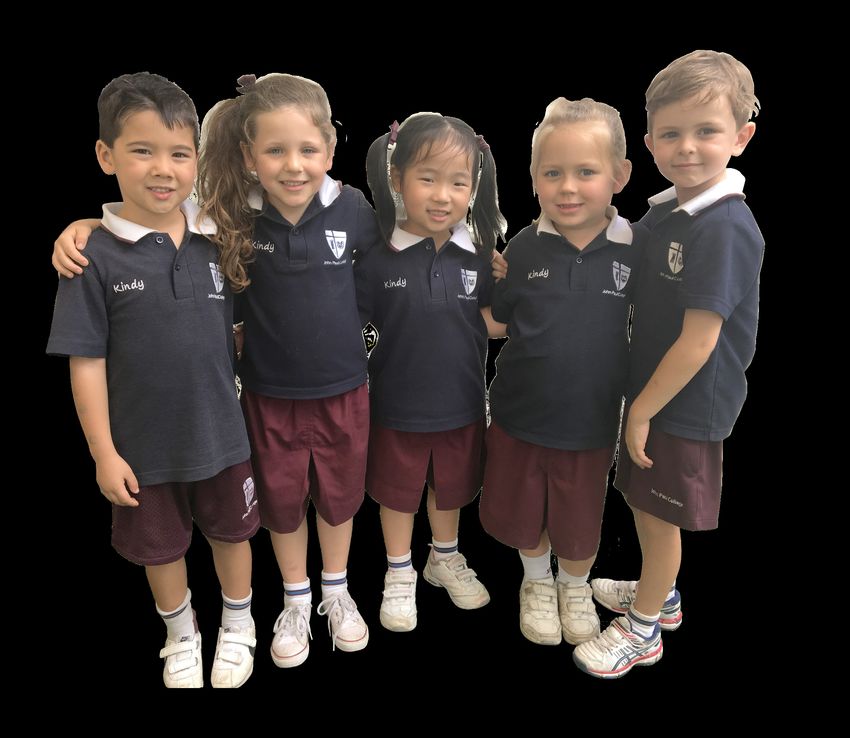
3.06 Kindergarten Uniform
The children are required to wear a compulsory Kindergarten uniform each day. This
includes:
- Navy JPC Kindergarten Shirt
- Burgundy PE Shorts (or culottes for the girls if they wish)
- JPC bucket hat- JPC sports socks accompanied by predominantly white joggers.
The Kindergarten uniform is available from the Retail Shop at John Paul College.
Please also ensure that all items are clearly labelled.
3.07 Kindergarten Routine
Parents are requested to assist their child with some basic routines each day.
• The food and drink containers for the day should be placed on the kitchen bench each
morning on arrival so they can be placed in the fridge by a staff member.
• Sheets contained in a child’s own sheet bag will need to stay at the Kindergarten for the
days of attendance and placed in the children’s lockers until rest time.
• The named hats will remain in the children’s lockers for the days of attendance so that
they are easily accessible to the children, yet remain separated to avoid cross infection.
• Parents are requested to take their child’s belongings home on the last day of the
week’s attendance so that space is available for the other groups’ requirements.
• Parents are required to sign the attendance register on arrival and departure each day.
The folders are located on the kitchen bench of each room.
An Example of a Kindy Day
8:15am – 8:40am Settling and organising belongings
8:40am – 9:00am Welcome / sharing session
9:00am – 10:30am Outdoor Experiences
10:30am – 11:00am First Break
11:00am – 12.20pm Indoor Experiences
12:30pm – 1:00pm Second Break
1:00pm – 2:00pm Rest / Relaxation
2.15pm – 3:15pm Group Experiences. Goodbye and Collection of children.
3.08 Settling into Kindergarten – Staggered Start Programme
Starting Kindergarten is a big step for a young child and for this reason we make a few
changes to the normal programme for the first week.
During the first week there is a staggered start to enable the children to settle happily in
smaller groups and become familiar with their teachers and friends. It also allows teachers
to spend more time with individual children to ensure that they feel happy and secure in
their new environment.To enable a smooth transition into Kindergarten parents are encouraged to stay with their
child in the mornings until they feel they are settled. If work commitments prevent this,
parents need to settle their child with a staff member before they leave. When parents are
ready to leave, you are asked to talk to the staff members so that your child can be
supported if necessary.
Children usually adjust to a new environment quickly, so parents can adapt their length of
stay, as their child becomes familiar with the environment.
Here are a few suggestions that may help to promote your child’s positive feelings
toward Kindergarten.
• Talk about starting Kindy as a sign of your child getting bigger, a reward for growing up
as such.
• Encourage evidence of independence so your child feels proud about doing things for
them self.
• Provide appropriate opportunities for your child to speak to other adults so that
confidence and self expression are developed.
• Be positive and excited about this new stage in your child’s life because children sense
these emotions and will develop these feelings also.
• Talk to your child about some simple scenarios so that they have some strategies ready
– e.g. What do you do when you need to go to the toilet? Who could help you at Kindy?
• Place something in the sheet bag or lunchbox that may please your child when they
find it – e.g. a funny picture, a photo, a note the teachers can read.
3.09 Birthday Celebrations
Birthdays are a very important part of a young child’s life. Please feel welcome to join us to
celebrate your child’s special day. Parents may choose to bring along cupcakes to share
with other children to mark this special occasion. We find that individual cupcakes or ice
blocks are ideal and easily organised by the staff. As a note, ice blocks are more inclusive if
there are any children with allergies in the class. No extra celebratory items – lolly bags,
balloons etc. – are able to be shared at Kindy.
Any parent who does not want their child to eat the cakes during the year must advise the
class teacher in writing, so the teacher is aware of this requirement.
3.10 Outside School Hours Care (OSHC) – Kindy
Care is provided in the Kindergarten building for the Kindy children. Care is available from
7:00 to 8.15am and 3.15 to 6.00pm each day of the term.
Care will also be available during school vacations for the Kindergarten children. This
programme will operate 7.00am to 6.00pm in the holidays.
The child /adult ratio for these care periods is 1:11 (1 adult with 11 children)
3.11 Extra Kindergarten Activities
Optional lessons are available for the children in a variety of activities. These activities are
facilitated by separate providers and parents must complete the appropriate permission
forms provided to authorise their child’s participation. Please see the notice board in the
Kindergarten foyer for further details on the following extra activities.
• Kindy Dance – Experiences in Kindy Dance foster the love of dance and movement.• Intro Tennis – During these sessions children are developing ball handling and
coordination skills as an introduction to tennis.
• Kindy Bounce - Is a sports programme incorporating the basic skills of basketball
3.12 Excursions
Visiting performances and on-campus excursions are organised throughout the year. These
are experiences designed to support and extend the children’s learning within the
classroom. Parents are invited and encouraged to attend any of these events. Information
is distributed to parents prior to these occasions and written permission for each child to
attend must be given by parents or guardians.
3.13 Environmental Awareness
The programme will also develop awareness in children for recycling and re-use.
Sustainable practices are encouraged such as rubbish free lunches, composting, recycling
of materials, use of a worm farm and water tank as well as saving power where and when
we can.Family Involvement
4.01 We Value your Input
In order to offer the best developmental programme possible to our children, it is
essential to have the valuable input from parents who are, after all, the first teachers
of our children, to support and reinforce the educational programme.
We appreciate any relevant information you can share about your child with the teacher.
This enables the staff to understand your child’s and family’s needs better.
We have an “open door policy” which means you are welcome to visit and spend time
with your child throughout the day, once the classes have settled in for the year. A
compulsory roster is not practised at our Kindergarten but the teachers will display a
timetable for requested help to provide a rich and varied programme for the children. Any
parent help is greatly appreciated and can be rostered or impromptu. Parent helpers may
be involved in a variety of tasks such as interacting with small groups playing and making
games, cooking and helping with art experiences as well as general tidying in the
classroom.
The sharing of interesting occupations, talents, traditions etc by parents and grandparents
are also wonderful additions to the programme. Please speak to the teachers if you would
like to visit and share your talents with us!
Not only does parent participation assist the teachers tremendously, but it also allows
parents to understand the developmental process and gives each child great satisfaction to
see that his/her parents are interested in what he/she is doing.
There are many other opportunities for you to participate in your child’s education
apart from regular classroom visits. In our school calendar you will see outlined such
activities as Parent/Teacher Meetings, Back to Kindy Nights, Family Fun Day, Mother’s Day
celebration, “Under-Eights” Week, Book Week, Grandparents Day etc. During the year, you
will be advised when these opportunities occur so that you will be able to participate in the
full academic and social life of the Kindergarten community.
Just as children have rights to high quality care and education, so too [do] parents
have rights to be involved in all aspects of their children’s school lives.
Gandini in Hill et al 2005
4.02 Communication with Parents and Families
Communication between the teachers and parents is an essential component in fostering
strong partnerships with our families. Teachers aim to communicate informally with parents
regularly to share stories and experiences about their child’s time with us in Kindergarten.
Regular Parent/teacher discussions are also an essential part of understanding a child’s
development. This allows the correct learning experiences to be established for each child.
Please feel free to discuss your child’s progress with his/her teacher, at a time convenient
to both teacher and parent.
In addition to these incidental contacts, arrangements are made for more formal interviews
to take place during the year. Parent /teacher discussions occur during Terms 1 and 3.Kindergarten children will also receive a written Transition Statement at the end of their
year.
We also communicate information to our parents and families through journey notes in the
children’s diaries, on our Kindergarten noticeboards and on the LCD screen in the
Kindergarten foyer. Please take the time to read these notices regularly.
4.03 Concerns and Complaints [Grievance Procedure]
If you have any concerns relating to the care of your child, a staff member, or another child
please see the Head of Early Education, Mrs Leanne Zammit.
Parents and children will not be discriminated against or suffer any repercussions if they
make a complaint. The rights of all in the Kindergarten are respected and no visitors or
parent/s may reprimand staff or other children.
We hope that all concerns of parents can be satisfactorily met. However, if you are unhappy
with the result of the complaint handling, further assistance can be received from Mr Andy
Gordon, Primary School Head at John Paul College. After discussion with the parent, the
Head of Early Education and Primary School Head will investigate the complaint, focusing
on the issue of concern, and working towards a resolution that meets the needs of
everyone involved. The Office of
Early Education and Care can also be contacted if a parent has any further issues that they
would like to discuss and resolve.
Kindergarten Committee
5.01 Friends of Kindy Committee
At John Paul College Kindergarten the ‘Friends of Kindy’ Committee (made up of parents)
works closely with the teachers to facilitate activities and projects for the children and their
families. The members of the kindergarten, being the parents of the children at the centre,
elect a small group to form the Friends of Kindy Committee. This election will take place at
our AGM which will be held on Wednesday 1st February 2017 at 6.30pm.
There are a number of roles available on our ‘Friends of Kindy’ Committee for parents dedicated to
facilitating projects at the Kindergarten:
- President
- Secretary
- Treasurer
- Events Coordinator
- Kindy Group Coordinators – we need 4 coordinators (1 for each class)
- Library CoordinatorInclusive Services
6.01 Inclusive Philosophy
John Paul College Kindergarten appreciates respects and encourages individuality and
interdependence of all children, including those from culturally and linguistically diverse
backgrounds and children with a disability or an additional need.
6.02 Children with Additional Needs
John Paul College Kindergarten provides an inclusive environment and programme to meet
the different and diverse needs of all children and their families accessing our service.
Following an interview with the parent and child, the Head of Early Education and the
Primary School Head, together with the parent/s, will collaborate to discuss possible
programme plans and modifications where appropriate. Enrolment in the programme will be
based on what programme the Kindergarten can offer that is best suited to the needs of the
child. The Head of Early Education will communicate with the Coordinator of the Learning
Enhancement Centre at John Paul College and related services in order to make an
appropriate decision regarding funding. With funding, the Kindergarten will be able to
arrange appropriate additional support and training for the staff, families and children as the
need arises. The sharing of information between the teaching team and the child’s medical
and support services is vital in order to support the child’s total inclusion.
6.03 Cultural Diversity
John Paul College Kindergarten recognises and celebrates the multicultural nature of our
community and aim to provide an environment and curriculum of acceptance towards all
people. We value each child and family’s culture and beliefs. All parents are encouraged to
communicate any concerns or considerations with staff upon enrolment and on a daily
basis.
6.04 Equity
The Kindergarten is committed to and firmly believes that experiences in the early
childhood period have a significant impact on later childhood and adult life. John Paul
College Kindergarten is a learning environment in which all children are encouraged to
engage in a range of experiences which will promote their optimal development, and the
opportunity to reach their individual potential for living a contributing and fulfilling life.Teaching Staff
7.01 Staff Positions
All staff directly working with children at John Paul College Kindergarten are qualified with
an appropriate early childhood qualification. It is an Office of Early Education and Care
requirement that all permanent staff have a current Senior First Aid and CPR certificate.
Staff are all trained in Child Protection, Asthma and Anaphylaxis. All staff working in the
Kindergarten will also have a positive notice for working with young children, more
commonly referred to as a Blue Card.
Head of Early Education
• To ensure quality service delivery which provides young children with a secure and
nurturing environment and serves to meet the needs of the community
• To be an advocate for children and children’s rights
• To oversee the overall operation of the centre
• To oversee the formulation of educational programmes which are aimed at promoting
the development of individual children, are developed in co-operation with parents and
reflect the multi-cultural nature of our community
• To ensure a safe and healthy work environment for everyone
• To promote the Kindergarten to the local community
Early Childhood Teacher
• To facilitate a high quality, inclusive and educational programme incorporating a play-
based curriculum, which will provide children with a secure nurturing environment for
their play and learning
• To document and share information with families about their child’s learning and
engagement in the programme
• To develop positive connections with children and families and to support parents with
their involvement in the programme
• To develop an environment which is relaxed, home-like, aesthetically pleasing and safe
for children and staff to live and work in
Teacher Aides
• To assist the Teacher in the delivery of a high quality, inclusive and educational
programme which will provide the children with a secure nurturing environment
• To develop positive connections with children and families and to support parents with
their involvement in the programme
• To maintain the environment and equipment in a safe, hygienic and aesthetically
pleasing state7.02 Staff Professional Development
Our Kindergarten believes that ongoing staff professional development is essential for high
quality practice. Professional development provides staff with the opportunity to learn new
skills and to challenge current practice. We actively promote and support the ongoing
professional development of all staff members by encouraging their attendance at courses,
seminars, workshops and conferences. Staff are also encouraged to develop an ongoing
approach to their own professional development.
7.03 Volunteers and Student Visitors
Occasionally, there will be new faces in the Kindergarten when volunteers and students
visit to gain experience in the education field. These new faces will also include relief staff
who will sometimes be present at the Kindergarten.
Every visitor is interviewed by the Head of Early Education and provided with guidelines to
ensure that there is no disruption to the children’s daily routine. All volunteers must hold a
blue card. These visitors will be under the supervision of regular staff members and parents
will be informed about visitors attending the Kindergarten.
Keeping Our Children Happy, Healthy and Safe
8.01 Protecting our greatest asset
As most parents are well aware, a healthy child is a happy child and at John Paul College
Kindergarten, we do everything we can to make sure children are happy, healthy and most
of all, safe. Whether this is helping them cope when mum or dad drop them off in the
morning, making sure they have their hat on during outdoor sessions, or knowing what to
do if they have an allergic reaction. Don’t hesitate to tell us about anything that will make
your child’s day happy and safe.
8.02 Safety at Kindergarten
To enable the Kindergarten to maintain the highest standards of safety, we ask parents to
ensure gates and doors are closed behind them and that our ‘No Smoking’ policy is strictly
adhered to.
Fire and other emergency evacuations are practised once a month by staff and children at
the Kindergarten. Evacuation procedures are outlined in all rooms with diagrams and steps
to follow. Parents are encouraged to familiarise themselves with this information. At the
time of an emergency evacuation drill we ask all people in the Kindergarten to join in the
drill with the children and staff members. It is important that all parents and visitors
cooperate with staff and follow the necessary directions to ensure a quick and safe
evacuation.Workplace Health and Safety
The safety of your child is of paramount concern to us. On a daily basis staff carry out
routine procedures to ensure an optimal level of safety is maintained. Such procedures
include: raking sandpits to check for foreign objects, covering sandpits after use, emptying
water trays when not in use, and checking equipment and the environment for wear and
tear. Other safety procedures include:
• ensuring all poisons and dangerous items are kept in locked cupboards
• filling out incident report forms to document injury
• training staff on accident and emergency procedures
• ensuring that safety devices are installed
• requiring all permanent staff to hold a current senior first aid certificate.
Should you have a concern about any safety issue please see the Head of Early
Education.
8.03 Hygiene
To minimise cross infection at the Kindergarten, several procedures are followed for the
well being of the children. Parents and children are requested to wash their hands on
arrival and departure of the building. All children are required to wash their hands after
toileting and before meals. Staff members wear disposable gloves when attending to a sick
child or changing soiled clothing. Toys and equipment are disinfected regularly. Sunscreen
is applied by each child under the supervision of a staff member. A disposable cloth is used
by the staff member to assist the child if required.
8.04 Injuries
If a child sustains an injury at Kindergarten, first aid is delivered immediately and the
Director is informed of the incident.
If a child is ill or has a minor accident, contact will be made with the parent and further
instructions obtained. If the accident is serious, an ambulance will be called immediately
and parents advised accordingly.
It is essential that parents leave all emergency telephone numbers with the
Kindergarten, including the family doctor, and ensure that an up-to-date record is
available at all times.
All incidents are recorded and parents are asked to sign these forms when the staff
members have informed them of the incident. If the incident is serious and/or requires
parent or medical assistance, a parent will be notified as soon as possible after the incident.
Small knocks and scrapes will be reported to parents at collection time in the afternoon.
In the event of a child requiring transportation by ambulance to hospital, a staff member will
accompany the child in the absence of a parent.8.05 Sun Care
The outdoor programme is an important part of Kindergarten and consideration of sun
safety is paramount. Despite avoiding exposure to the sun in the hottest part of the day,
children are still required to wear sunscreen and a hat when outside.
The John Paul College Kindergarten Sun Care Policy provided to parents, outlines the
detailed procedures for sun safety at Kindy. Parents are required to implement the
measures outlined in this policy and to complete the form either granting or denying
permission for staff to apply sun screen.
The Kindergarten provides a SPF 30+ Sunscreen for the children’s use. Parents who
choose not to use the provided sunscreen are required to supply alternative sun screen for
their child. Children are required to wear the John Paul College bucket hat and the
Kindergarten shirt is designed to provide adequate protection from the sun with the close
weave, collar and sleeves.
8.06 Health
The Kindergarten is committed to protecting the general health and wellbeing of children
and staff by minimising the risk of the spread of infections with the Kindergarten. Dealing
with sickness and infectious diseases is very serious, especially when so many children are
in contact with each other. Preventing the spread of infectious diseases is an important part
of our commitment to protecting everyone’s health and wellbeing.
By limiting the attendance of sick and unwell children from the Kindergarten we can reduce
the risk of infecting other children.
Children should not be brought to Kindergarten unless they are able to cope
adequately with the normal daily routines and experiences within the programme.
Usually, if you are in doubt, then he/she is not well enough to attend. It would be
appreciated if children, who are ill at home or appear to be ill, are kept at home to
recuperate.
Children who become ill during the day will be removed from the class to rest. The
staff or School Nurse will contact the parent / guardian immediately to come and
collect the child from Kindergarten. Infection can move swiftly through a group,
therefore, we ask that parents come to Kindergarten within the hour to collect their
child.
Common concerns
If children are showing any of the following signs, parents are well advised to keep them at
home.
• Vomiting - If your child is suffering from vomiting, regardless of the cause, they must
be kept at home for 48 hours from the completion of the vomiting attack.
• Diarrhoea - Regardless of the cause, children must be kept away from the
Kindergarten for 48 hours, from the last attack, and have a normal bowel motion before
they return.
• Conjunctivitis - Children must be kept away from Kindergarten from the time medical
treatment has started and until the discharge has stopped.• Ear Infections - If there is a discharge, the child will need to be excluded
• Colds - If children have any of the following symptoms, they need to be kept away for a
minimum of 24 hours or until well enough to cope with a normal Kindy day:
- thick green discharge
- persistent or deep cough
- wheezing
- fever
- listlessness or lack of appetite
8.07 Medication
In the event that a child is required to take prescriptive medication during his/her
attendance at Kindergarten, instructions from the child’s Medical Practitioner or the
attached pharmaceutical label must contain the following information: name of the child,
name of the medication, dosage to be taken, frequency of dosage, prescribing doctor’s
name, and date issued. If this information is not on the label we will not administer the
medication.
Prescribed Medication
Parents are asked to enter the details of medication to be given on the ‘Authority to
Administer Medication Form’ located inside the sign-on folder. The name of the medication
as it appears on the bottle, dosage and time to be given, must be entered on the form by
the parent. Staff will not administer medication unless specific time/dosage is indicated by
the parent. The medication must be given to a staff member on arrival. The staff member
will check the form and Medication with the parent to ensure all details are correct. Staff will
place the medication in a locked storage bag that is inaccessible to all children or in a
locked bag in the fridge.
Non-prescribed Medication (including alternative therapies)
Non-prescribed medication (i.e. over the counter medications and alternative therapies) will
not be given to any child unless prior written permission and instructions from your child’s
doctor have been received by the Director or teacher.
Administering Puffers, Spacers and Nebulisers
The Kindergarten policy in relation to puffers, spacers and nebulisers is as follows:
• All asthma medication is to be administered as per the requirements of Prescribed
Medication in the Giving of Medication policy. A letter from the doctor or instructions as
per pharmacy label is required.
• Parents must provide an asthma management plan for the child, which has been
developed in consultation with the child’s doctor, advising staff of the child’s triggers,
symptoms and appropriate management techniques.
• A spacer must be used with a puffer for all children.
• Nebulisers will not be administered more often than four-hourly. If more frequent use is
required the child should not be attending the centre.
• The doctor’s letter must be renewed every three months if ongoing use is required.
• In the case of the child having an acute asthma attack or showing no improvement after
the use of the nebuliser/puffer, the parent will be contacted or the child will be taken to
hospital.
• You are required to show the staff member the procedure for using the nebuliser so that
both staff member and child feel secure in using the machine.You can also read


