Minds We Meet Music an Ablest Mess - Council Connection - The Voice Magazine
←
→
Page content transcription
If your browser does not render page correctly, please read the page content below
Mi
 ndsWeMeet

Mus
  icanAbl
        estMes
             s

Counci
     lConnect
            ion
March 19, 2021                                                                                                    Volume 29, Issue 11   1

                                                                             The Voice’s interactive Table of Contents

   CONTENTS
                                                                             allows you to click a story title to jump to an
                                                                             article. Clicking the bottom right corner of any
                                                                             page returns you here.         Some ads and
                                                                             graphics are also links.

                 Features
                 Minds We Meet: Josh Dela Peña Galarido ......................................... 4

                 Articles
                 Editorial: Contest Closing .................................................................... 3
                 Sia’s New Movie Music is an Ableist Train Wreck .............................. 8
                 He is in Danger: Celebrating World Poetry Day ................................ 11
                 Six Traits of Highly Successful Women ............................................ 16
                 Japanese vs. Korean BBQ: What’s the Difference? .......................... 20

                 Columns
                 Course Exam:Math 266(Introduction to Calculus II) .......................... 9
                 Council Connection: February 17, 2021 Meeting.............................. 12
                 Fly on the Wall: Being Cold and the Being of our Being ................... 15
                 Homemade is Better: S’Mores .......................................................... 18
                 Dear Barb: Dysfunction Junction ...................................................... 22

                 News and Events
                 AU-Thentic Events ............................................................................... 6
                 Scholarship of the Week...................................................................... 7
                 Vintage Voice ..................................................................................... 11
                 Student Sizzle .................................................................................... 19
                 AUSU Updates ................................................................................... 24

                 Comics
                 Poet Maeve: Loving the Royals ......................................................... 23
2    The Voice Magazine                                                                                    March 19, 2021

      The Voice Magazine
      www.voicemagazine.org
        301 Energy Square               LETTERS TO
       10109 – 106 ST NW
          Edmonton AB
             T5J 3L7
                                        THE EDITOR
             Email
     voice@voicemagazine.org

            Publisher
        AU Students’ Union

         Editor-In-Chief
          Jodi Campbell

        Managing Editor
           Karl Low

      Regular Contributors
    Barb Godin, Natalia Iwanek,
    Barbara Lehtiniemi, Angela                       We love to hear from you!
       Pappas, Jason Sullivan,        Send your questions and comments to voicemagazine.org,
     Wanda Waterman, Xine
          Xu, and others
                                          and please indicate if we may publish your letter!

         Views and articles
     presented here are those
    of the contributors and do
    not represent the views of
      AUSU Student Council.
       The Voice is published
      almost every Friday in
      HTML and PDF format.
    For weekly email reminders
     as each issue is posted, fill
     out the subscription form
                here.
    The Voice does not share its
    subscriber list with anyone.
     Even I don't look at it, it's
            all on auto.
        Volume 29, Issue 11
       © 2021 by The Voice
            Magazine
          ISSN 2561-3634
                                     Hey! Did you know the Voice Magazine has a Facebook page?
                                     No kidding! We also do the twitter thing once in a while if you're into that.
March 19, 2021                                                              Volume 29, Issue 11    3

Editorial                                                                           Karl Low
Contest Closing
                                   If you’re reading this on Friday, March 19th, there’s still a
                                   few hours to get your entry in for the Voice Writing
                                   contest. We’ve got a good number of entries for the
                                   fiction category, and a few for the non-fiction category,
                                   so the next step is for me to remove all identifying
                                   information from the entries and send them off to our
                                   judging panels. Then we wait. And I’m as anxious about
                                   it as you are.
                                   In the meantime, this week’s The Voice Magazine, gives us
                                   an interview with student Josh Dela Peña Galarido. It’s a
                                   fun interview and a read that will definitely help you get
                                   to know this student who’s working toward his Bachelor
                                   of Professional Arts degree.
                                  Also this week is the report on February’s AUSU Council
                                  meeting. It’s taken a while to get this one out as I was
                                  waiting on some extra information from AUSU, but it’s
                                  here now, and the report for the March Meeting will
                                  hopefully be out in the next couple of weeks. But
                                  speaking of that, if you’re a person who’s interested in
what’s going on at AUSU Council, can spare a few hours on a Wednesday evening each
month, and are able to write a thorough report on what you hear at the meeting, please get
in touch with me at voice@voicemagazine.org. You’ll even get paid for the work.
You’ll also want to take a look at Jessica Young’s review of the movie Music by chart-topping
singer-songwriter Sia. Let’s just say Jessica has some strong feelings about this movie, and
they’re not pleasant ones.
Plus, Sunday is World Poetry Day, so in honour of that, we’ve got a poem from Barb
Lehtiniemi. I don’t usually like putting poetry in The Voice Magazine unless it’s got a solid
AU hook in it. This is in part because I know I’m not a great judge of it—I tend to feel
limericks are the pinnacle of poetic expression, after all. However, this particular poem was
longlisted as a finalist for the 2020 Nick Blatchford Occasional Verse Contest, in New
Quarterly Magazine. That seems like a reasonable certification of quality. So I hope you
enjoy!
We’ve also got a comparison between Japanese and Korean barbeque, and if that’s not enough
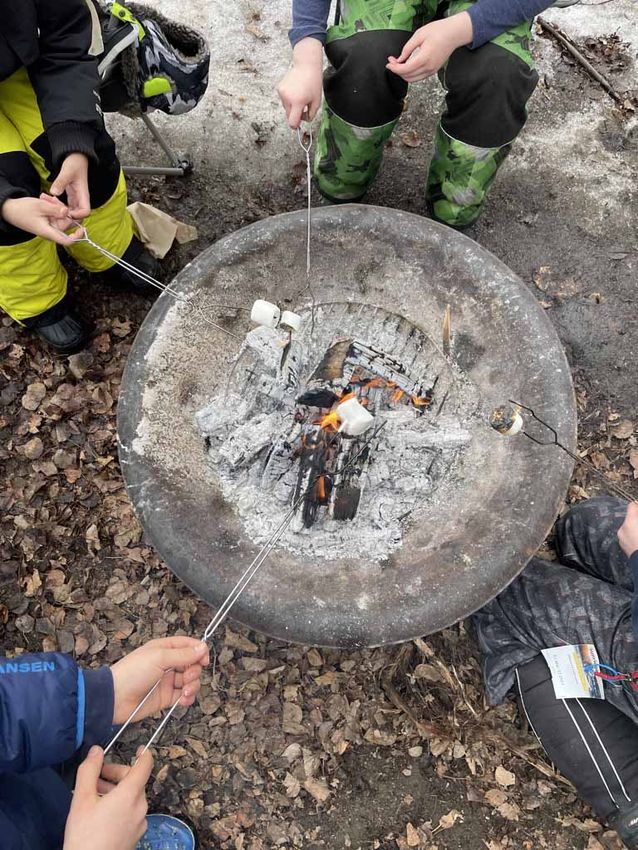
to make you hungry, Chef Corey comes with a look at an old favorite, s’mores. Even better,
he gives some tips for how to make the perfect marshmallow for them. In addition to his
tips, one that I’ll point out is that, should you happen to set your marshmallow on fire, the
recommended course of action is most definitely NOT to start waving the stick back and
forth in a panic hoping to put out the fire. Do that, and what really happens is that you end
up firing a fireball of flaming sugary goo across the campfire, usually directly at the person
you were most hoping to impress—because Murphy.
Other than that, our normal selection of reviews, events, scholarships, advice
and more! Enjoy the read!
4    The Voice Magazine                                                                  March 19, 2021

                                          Who are your fellow students? It can feel like you are all
                                          alone in your studies, but across the nation, around the
                                          globe, students like you are also pursuing their AU
                                          education, and The Voice Magazine wants to bring their
                                          stories to you. If you would like to be featured next, do not
                                          hesitate to get in touch!
                                          The Voice Magazine recently had the chance to chat with Josh
                                          Dela Peña Galarido from Edmonton, Alberta, located on
                                          Treaty 6 territory and a traditional meeting ground and
                                          home for many Indigenous Peoples, including the Cree,
                                          Saulteaux, Niitsitapi (Blackfoot), Métis, and Nakota Sioux
                                          Peoples.
                                          Josh is a 24-year old AU student currently enrolled in his
                                          third year of the Bachelor of Professional Arts in Human
                                          Services (BPA HSRV) program. Before coming to AU, Josh
                                          completed a Therapy Assistant Diploma with a focus on
                                          four areas of rehabilitation, including Occupational,
                                          Physical, Speech-Language and Recreation Therapy. He
                                          stated, “After finishing my diploma program, I got a chance
                                          to work         in a long-term          care facility   as  an
                                          Occupational/Physical Therapy Assistant. I worked there
                                          for two years, and during my first year working as a Therapy
                                          Assistant I fell in loved in the field of Occupational Therapy
    and how impactful it is, how it empowers people, and how promotes inclusivity. From that
    moment I decided to continue my study.” He continued, “Luckily, I found Athabasca University,
    which is a perfect school for me since I am working full time. My initial plan was to use this
    degree as a stepping-stone to get into Master of Science in Occupational Therapy. But as I
    progress with this degree, I am starting to fall in loved in the field of Human Service. One of the
    core courses of the program is HSRV 201: Social Work and Human Services. The course is an
    eye opener as it details what a social and human services worker does: empowering people and
    making a difference in individuals’ lives, which resonates so much to my personal values. The
    program opened my eyes to see other future careers that I see myself doing, [a] career that is very
    impactful and uplifting. Social Worker, Mental Health Therapist and Emotional/Behavioural
    Specialist are my three other options that I see myself working other than being an Occupational
    Therapist. Overall, the flexibility of the program helps students curate and plan what suits to
    their chosen career in the future which is the best part of BPA HSRV program and what makes
    this program so unique amongst all.”
    Josh was born and raised in Manila, the Philippines before moving “to Canada to seek better life
    opportunities” with his family. He stated, “I was 16 when I moved to Edmonton along with my
    four siblings (yes, you read it right! There are five of us living in a one household, actually six,
March 19, 2021                                                                   Volume 29, Issue 11    5

including my mom, so imagine how chaotic and fun is that). I am the third child, middle child,
odd child; name it. I have two older brothers and two younger sisters. Most people describe me
as people person, friendly and warm but also, I am very stubborn, loves to sleep, read, plants and
most importantly his coffee (that’s because I’m a Taurus). I enjoy strolling around downtown and
take pictures, look for new coffee shops and brunch places. I’m not the sportiest guy, but I enjoy
going for jog, or brisk walking (during winter or summer time). Other than English, I speak two
different languages, Tagalog and Español.”
Josh continued, “This year I started a new job as Therapeutic Assistant Behavioural Therapy at
Edmonton Catholic Schools District where I work with kids with learning disabilities, challenging
behaviours, and exceptionalities. A big jump from where I was but change is good, as older folks
would say. I was working as an Occupational/Physical Therapy Assistant on a long-term care
facility for two years before landing in my new job, working there and being introduced in the
field of Occupational Therapy interest me to pursue Master of Science in Occupational Therapy
once I finished my undergrad and become an Occupational Therapist in the future.”
When he is not studying, Josh stated that while it may sound a bit boring, above all, he is an “avid
fan of reading.” He continued, “I am not most sporty person you will ever meet but I’m always
down to try things (as long as it’s safe and within my realm of interest). I also enjoy researching
for ways how to level up my coffee (just so you know I looooove coffee). I love hanging out with
my friends and family and having that sense of ‘bonding’ soothes my soul because I’m a people
person. In a nutshell, I am boring and crazy at the same time. Lastly, I love to cook! It is honestly
the best way to get into everyone’s hearts (besides my lovely smile and dimples, yes with an ‘s’
because I have two).”
As for the one person that has had the greatest influence on his desire to learn, Josh chose his
mother, stating that “her life was never easy when she was [his] age.” He explained, “She used to
tell me that she had to work for eight hours during the day and do night classes as her family
didn’t have enough money to support her studying and her three other siblings. Therefore, her
and her older brother worked so hard to support their younger siblings’ education. She always
emphasized that hardship, perseverance, and taking risks are the formula for great success and
learning in life. Also, learning doesn’t always happen inside the classroom, the outside world will
teach you more life learning experiences. And with this, it pushes me to strive harder and do well
in learning and pursue higher education.” He continued, “By the way, my mom finished a degree
in Accounting (Bachelor of Science in Business Administration in Accounting) and her older
brother finished Bachelor of Science in Electrical Engineering and their two other siblings
finished Bachelor of Science in Midwifery and Bachelor of Science in Business Administration in
Management.”
His initial impressions of online learning were “pretty overwhelming,” stating that the “hardest
part of it is how would you manage your time because you basically have all the control whether
you choose to slack off” or complete “smaller steps (tasks) each day.” However, he quickly
became confident. “My experience was definitely a rollercoaster ride, but what I realized when
this pandemic hit us was … oh, maybe God put me on this training ground, because he knows
something is coming that will shake the entire learning experience. Fast forward to now where
everything is doing online. I learned to manage my time, do smaller tasks, appreciate small
achievements, and have study breaks versus when I started where I literally crammed 5-6
chapters in one sitting. Do I like it? Hmm, yes and no.” While online learning makes Josh
accountable for his failures and successes, he also misses interacting with “classmates and having
that physical sense of connectedness.”
6    The Voice Magazine                                                                      March 19, 2021

    Josh did waver about continuing his school once,
    stating, that when he obtained his first job he was
    excited about his quite professional career and                       AU-thentic Events
    slowly became comfortable in the role.             He             Upcoming AU Related Events
    explained, “This feeling of being comfortable makes
    me second-guess if I should pursue or continue my
    studies. The person who really helped me realized             Bannock and a Movie March Edition:
                                                                  Wahkohtowin: Cree Natural Law
    my full potential was my acting supervisor, the
                                                                  Mar 1 to Mar 31
    occupational therapist. She would tell me and asked
                                                                  Online
    me every day, ‘Are you satisfied with this position?          Hosted by AU Nukskahtowin
    I’m saying this with all love; you’re very young, and         www.athabascau.ca/indigenous/bannock-and-
    I could see you becoming a therapist one day. I see           a-movie/index.html
    a strong potential in you Josh. You should go for it.’        Access through above link
    Besides my mom, she is one of the people that
    influenced me to continue my schooling. She guided            Learning to Learn Online MOOC
    me and saw a potential in me, she shared lots of ways         Mar 21 to Apr 24
                                                                  Online
    and skills needed to become one and that’s why I fell
                                                                  Hosted by AU and Contact North
    in love with the profession so much, because of her
                                                                  news.athabascau.ca/events/learning-to-learn-
    and its purpose.”
                                                                  online-athabasca-universitys-massive-open-
    Choosing one memorable course was difficult, as “all          online-course-spring-2021/
    of them are very impactful,” however, he chose                Register through above link
    HSRV201 discussed earlier, stating, “It helped see            Keeping Organized as You Search
    how I could help people beyond the philosophical              Tues, Mar 23, 12:00 to 1:00 pm MDT
    meaning of ‘helping.’ It instilled skills that I could        Online via Microsoft Teams
    use in everyday life and not just for professional use.       Hosted by AU Library
    I’m also looking forward taking [Educational                  library.athabascau.ca/orientations.html
    Psychology] EDPY courses because it aligns to where           Register through above link
    I am at right now career wise. I am working as
                                                                  Business Undergrad Program Orientation for
    Therapeutic Assistant Behavioural Therapy in                  New Students
    school, so those courses are very beneficial.”                Wed, Mar 24, 12:00 to 1:00 pm MDT
    As for communication with his course tutors, Josh             Online
                                                                  Hosted by AU Faculty of Business
    stated that they are “superb and very helpful.” He
                                                                  news.athabascau.ca/events/faculty-of-
    continued, “I want to emphasize how beneficial it is
                                                                  business-undergraduate-program-
    to communicate with a tutor as they will guide you
                                                                  orientation-for-new-students-20210324/
    toward success. It would not make you less of a
                                                                  RSVP through above link
    person or student if you ask things you solely don’t
    know or even if you’re just uncertain about it. If the        The Grad Lounge
    situation tickles your stomach, ask for help. As              Fri, Mar 26, 5:00 to 6:00 pm MDT
    Professor Dumbledore once said, ‘Help is given to             Online via Microsoft Teams
    those who ask.’ I cannot emphasize that enough.”              Hosted by AU Faculty of Graduate Studies
                                                                  fgs.athabascau.ca/news/events/index.php
    If he were the new president of AU, Josh would focus          No pre-registration necessary; access through
    of three areas, mainly developing “more internship            above link
    programs as it promotes networking skills and
    strengthen students’ skills in their chosen field or    All events are free unless otherwise noted.
    future careers,” adding “more courses focusing on
    mental health,” and developing “an integrated
    Indigenous focused course or possibly make it a part
    of each programs’ core course to advocate people about the Indigenous People of Canada.”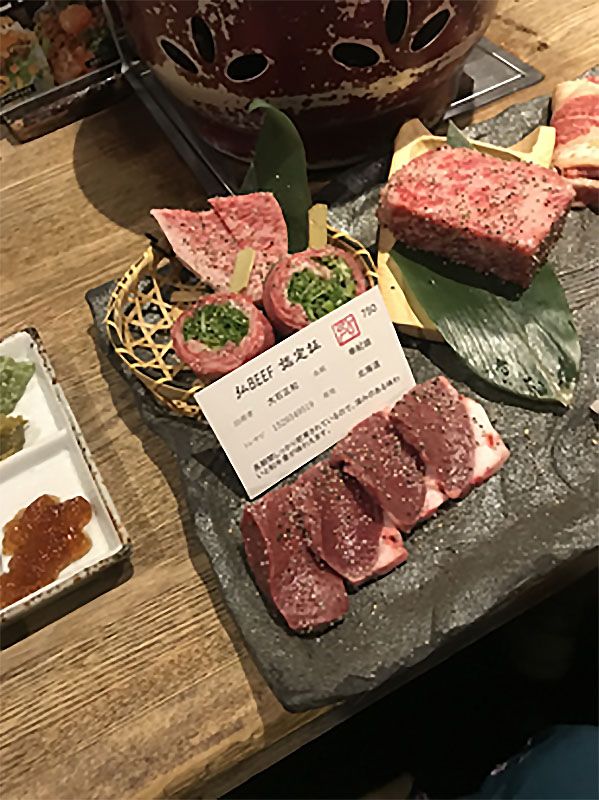
March 19, 2021                                                                                                      Volume 29, Issue 11           7

If he were to meet a famous person, past or present, to have lunch with Josh chose Vice President
Kamala Harris. And the lunch would probably be “probably a mixture of my culture’s food
(Filipino-Spanish) and hers (Indian-Black). Why? Simply because of her personality, her values,
her stance aligns to mine and the way she sees good in every people.” Specifically, the lunch
would be “Tandoori Chicken, Dosa and potato curry, Caldereta and Paella.”
Although Josh admits that at only 24-years old, he has “not experienced life fully,” he has “learned
that life will never be easy.” He has also learned to “face challenges, take risks, put God in your
centre, [and] accept failures because it’s necessary.”
As for his proudest moment? He stated, “I’m very proud of myself how I recognize, reflect, and
learn from my mistakes. Also, mastering my time management skills as I juggle life, school, and
my full-time work. Those two are my proudest moment in my life.”
The one thing that distinguishes Josh from other people is that he is a “multi-faceted person,”
who enjoys “learning new skills, discovering new things, and [using] these skills.” He continued,
“Also, people would describe me as very warm-hearted and hardworking person.”
As for a non-AU book that he is currently reading, Josh chose three in the field of neuroscience
and neuropsychology, including “My Stroke of Insight by Jill Bolte Taylor, a neurobiologist who
experienced a rare type of stroke.” He stated that it is “truly fascinating and inspiring.” In
addition, he is also reading “Why We Sleep by Matthew Walker, a neuroscientist,” stating that “this
is not your typical book about sleeping; it details about how lack of sleep correlates with
developing Alzheimer’s Disease.” Finally, Josh is also reading “Kids These Days by Jody
Carrington, a clinical psychologist who believes that the main cause of child’s challenging
behaviours is how disconnected everyone is.” Best of luck Josh!
Natalia Iwanek is currently completing her Bachelor of Arts in English at AU and is also a freelance editor and writer. She can be contacted at
https://www.nataliaiwanekediting.com

Scholarship of the Week
Digging up scholarship treasure for AU students.
Scholarship name: Shear Comfort Automotive Scholarship
Sponsored by: Shear Comfort
Deadline: April 15, 2021
Potential payout: $1500
Eligibility restriction: Applicants must be legal residents of
Canada or the U.S. or hold a valid student visa, and be enrolled at
an accredited university or college in Canada or the U.S. in an undergraduate
program related to engineering or automotive technology.
What's required: An email with contact and academic info, along with a 300-600 word essay
about future technological developments in the automotive industry.
Tips: Check out previous scholarship winners for inspiration.
Where to get info: www.shearcomfort.com/scholarship.asp
8    The Voice Magazine                                                                   March 19, 2021

    Sia’s New Movie Music is an Ableist Train Wreck                                     Jessica Young

                                           You may have heard of the new movie Music directed by
                                           singer-songwriter Sia, known for her chart-topping hits
                                           such as “Chandelier” and “Cheap Thrills”. Her prodigy and
                                           goddaughter, Maddie Ziegler, stars in the movie. Ziegler
                                           plays a non-verbal, autistic girl named Music. After the
                                           sudden death of her grandmother, Music is left in the care
                                           of her recovering addict and drug-dealer sister, Zu, played
                                           by Kristen Hudson. We get a glimpse of how Music
                                           supposedly sees the world when she puts on her
                                           headphones and we are transported to what looks like the
                                           set of Yo Gabba Gabba, where Music performs
                                           choreographed dance routines to Sia’s songs. . The trailer
                                           for Music is available on YouTube
                                           As the mom of an autistic five-year-old who is also non-
                                           verbal, I was excited when I first heard about Music. I want
                                           my son to be represented in the media.               I want
                                           misconceptions about autism to be addressed. I want to
                                           start conversations about prejudice towards people with
                                           disabilities because this is the only way to create a more
                                           inclusive world for my son. Unfortunately, Music is a slap
                                           in the face to the autism community and anyone who loves
                                           someone with a disability, and I was horrified when I
    watched the trailer.
    Let’s begin by defining ableism. Ableism is the discrimination against people with disabilities. It
    is rooted in the belief that people with disabilities are inferior, need “fixing”, and are defined by
    their disability. The casting of Zeigler—who is neurotypical—to represent a neurodiverse person
    is the definition of ableism: it says that autistic people aren’t even good enough to represent their
    own experiences.
    The portrayal of the character Music is a caricature of autism, with no depth or development to
    Music’s personality throughout the movie. Zeigler’s facial expressions, movements, and voice
    are grossly exaggerated to the point that it looks like she’s doing an impression of Simple Jack
    from Tropic Thunder. There is no way to describe the performance other than it looks like she
    is mocking a disabled person. Although, yes, some autistic people do have similar traits (including
    my son), watching a neurotypical person behaving that way feels, well, icky. It is also quite clear
    that Music’s character is nothing more than a prop for Zu’s personal development. The focus of
    the movie is not on its namesake, but on how Music effects Zu’s life. “Music” is essentially “Marley
    and Me”, except Marley was given more of a personality. Sia, like many others, seems to see
    people with disabilities as pets. It seems she’ll pat them on the head with a condescending coo of
    “You’re so cute!” but lacks the ability to see them as real people deserving of respect.
    Overall, this movie came across as Sia’s vanity-piece, designed to show the world just how woke
    she is. She doesn’t seem to see how harmful this is to the autism community nor care enough to
    try. The laundry list of controversies surrounding how Sia has handled this movie is a mile long;
    including dismissing the criticisms of autistic people on Twitter and partnering with Autism
    Speaks, an organization widely regarded as ableist. If that wasn’t enough, a video has surfaced of
March 19, 2021                                                                                                 Volume 29, Issue 11      9

an interview with Sia, where the interviewer says that non-verbal people “might as well be an
inanimate object—like a wig” while Sia nods her head enthusiastically.
Music and Sia’s behaviour in the aftermath hurts my heart. I look at my beautiful little boy and
think, how could someone compare him to an inanimate object? How could someone think he is
inferior or undeserving? When I describe my son, I say he is the sweetest guy you will ever meet.
He’s affectionate and kind. He loves hugs and tickles. His laugh is infectious. He’s silly and
charming and determined. He loves dinosaurs. His sister is his best friend. His autism is such a
small, insignificant part of who he is. But I know that so many people in this world will look at
him and only see autism. Music is a stark reminder of that.
Jessica is completing her Bachelor of Human Resources and Labour Relations degree while pursuing her passion for writing and drinking
coffee.

Course Exam                                                                                                             Karen Lam
MATH 266 (Introduction to Calculus II)
If you have a course that you would like to see a Course Exam article written for or you recently took a course
that you would like to recommend to other AU students, please feel free to reach out with the course name and
number, and any questions or feedback you may have. We’ll be happy to write about it in our next Course Exam
article.

MATH 266 is the second three-credit introductory calculus course that further expands on topics
that were taught in MATH 265. MATH 266 “focuses on definite integrals, which allow exact
calculation of surface areas, volumes, the length of curves, and solutions of practical and
theoretical problems.” MATH 266 does have a pre-requisite of MATH 265 and is also available
for challenge for credit option.

For those interested in taking MATH 265, I recommend reading the MATH 265 course exam
article that was written by another Voice Magazine writer!

Who and Why You Should take this Course
This course is designed for Math majors, however, many other majors including Sciences,
Engineering and Computer Science typically are also required to take one or two university level
calculus courses. With that said, this course is not limited to those in a Math major or studying a
science or engineering program. If you enjoy mathematics or would like to expand your calculus
knowledge, this course is also for you.
10    The Voice Magazine                                                                                                  March 19, 2021

     When I completed my Biology degree a few years ago, it was mandatory for me to complete two
     calculus courses as part of my program. Many times, I wondered if this course would ever come
     in handy, although most of the knowledge will not be used, I did find that after taking this calculus
     course, my general mathematics skills had improved significantly. It was most useful when I
     started working as I spent a lot of time working with our budget—financial reconciliation and all
     that fun stuff. Therefore, I recommend this course to everyone as it will improve your existing
     knowledge of calculus and improve your general mathematics skills in the long term.
     Course, Assignment, Midterm and Final Exam Details
     The course itself is six units starting with Unit 1: Inverse Functions, Unit 2: Inverse Trigonometric
     and Hyperbolic Functions, L’Hopital’s Rule, Unit 3: Techniques of Integration, Unit 4:
     Applications of Integration, Unit 5: Differential Equations and finally, Unit 6: Sequences and
     Series.
     The course activity includes eight quizzes that are worth a total of 12% along with four assignments
     each worth 10%, 6%, 8% and 10% respectively. There is a midterm and final exam for the course
     with the midterm being worth 26% and the final exam worth 28%. The midterm covers the first
     four units, and the final exam covers the final two units of the course.
                                                How to Be Successful in the Course
     Student Tips
     Throughout my schooling, mathematics and calculus have always been one of the courses that I
     find students either do well in or struggle through. The primary reason I’ve found is because,
     unlike many other classes, math courses require heavy practice. Unlike some other subjects,
     where understanding the concepts really well may get you a good grade or memorizing is key,
     math courses require lots of practice to be successful.
     As someone who has taken a linear algebra course and a statistics course, I can confidently tell
     you that if you would like to excel in any mathematics course, practice is key. First, make sure
     you understand the concepts and then make sure you practice all the practice problems provided.
     This could be practice questions from the textbook, assignment questions or quiz questions. The
     more practice you do, you will become more confident and find that the course is actually quite
     easy.
     For assignments and quizzes, when you are stuck, I find that we often try to troubleshoot, which
     is perfectly fine and a good strategy, however, if you are stuck for hours or just need a hand, also
     remember that Moodle Discussions and your Course Tutor exists for a reason. Do not hesitate
     to reach out to them if you have any questions!
     Students may think that cramming is possible for math courses, and although, it has been done
     many times and some students get away with it, I strongly recommend against it. Practice takes
     time and I recommend spreading out your studying and do a little bit of practice each day, and
     that will come a long way, and you will feel confident with minimal stress for the exams.

     Questions?
     If you have any further questions regarding the course, please do not hesitate to contact the
     Course Coordinator at Fst_success@athabascau.ca. Happy practicing!
     Karen's taking her Computing Science degree at AU, learning French and Korean, and is into K-pop, SF, and politics
March 19, 2021 Volume 29, Issue 11 11
He is in danger Barb Lehtiniemi
Celebrating World Poetry Day March 21
He is in danger when at prayer
He is in danger everywhere
He is in danger in his car
He is in danger from the law
He is in danger in the skies
He is in danger when he flies
He is in danger at the store
He is in danger in a war
He is in danger after school
He is in danger shooting pool
He is in danger from his boss
He is in danger when there's a loss
He is in danger at the park
He is in danger after dark
He is in danger around the town
He is in danger—he is brown
("He is in danger" was longlisted (though not published) in the 2020 Nick Blatchford Occasional Verse
Contest in The New Quarterly magazine.)
Unearthing classic articles from previous issues of
The Voice Magazine
World Poetry Day is March 21. Poetry is integral to life (not just in song lyrics)
and The Voice's contributors have mused on the many facets of poetry.
Verses to Fight by. Writer Wanda Waterman St. Louis traces how controversy
over a poetry reading fuelled a rebellion. "Other insurrections have reportedly
been inspired and fuelled by poetry, but I can think of no others fought in its
defence." Maghreb Voices — Power, Poetry, and Popular Dissent in Algeria, Part I,
February 11, 2011.
Looking Beyond the Words. Another entry by Wanda Waterman St. Louis continues some views
on Canadian poetry and its relationship with culture and ethnicity. "But we need to stop seeing
our literature as either a set of ethnic solitudes or an elitist, exclusionary hierarchy; we need to
recognize literature as a network of consciousnesses that are all, in their way, significant to the
culture at large." The Mindful Bard — On Canadian Poetry, Part II, October 15, 201012 The Voice Magazine March 19, 2021
Council Connection Karl Low
February 17, 2021 Meeting
The meeting started with ten of the eleven
remaining councillors present. Councillor Regan
Johnson unfortunately was absent due to an
illness.
With the acknowledgement of working on the
traditional lands of various indigenous people’s
President Stacey Hutchings called for others to
indicate which lands they were on in the chat, and
several councillors and staff members did. I do
have to give some props for the Council finding
ways to ensure that what would normally become
a part of the meeting simply done by rote instead
manages to maintain some relevance, and people
putting thought into it.
The agenda was quickly passed, and, after a
friendly amendment prompted by Councillor
Monique Durette to correct what was referred to
as a special meeting of council but was not, the
meeting minutes were passed as well.
Scholarships, Awards, & Bursaries, and Others
The first order of new business for AUSU this meeting was to look at policy revisions to the
Scholarships, Awards and Bursaries policy. The notable changes to this policy included reducing
the minimum requirements for many scholarships from twelve credits to only six credits, and
increasing the minimum GPA for the Academic Achievement Scholarship to 3.85 from 3.7,
thereby aligning it with AU’s criteria for Great Distinction.
As a side note, I was present when these awards policies were first created and the reasoning for
the twelve credits was to ensure that AUSU awards be primarily accessed by program students.
However, it was noted in the meeting that there are many newer students at AU seeking assistance
from AUSU that Council would like to be able to provide, and this is one way of making it more
accessible to them.
Councillor Durette noted that she was disappointed that this policy did not include a change to
point 7.02.05 relating to what happens to leftover funds if not all of the awards funds are
distributed, stating that Council had approved the policy in September incorrectly as the wrong
version had been included in the meeting package.
President Hutchings noted that this motion was about what the awards committee approved for
changes to the awards policy as it stood, and further changes needed should go to the awards
committee for review. She also pointed out that Council did not approve the policy incorrectly,
as that was the policy brought forward and that was what Council then voted on and approved.
The vote was called and passed with 8 in favor, none opposed, and Councillor Durette and
Councillor Devon Romanick abstaining.March 19, 2021 Volume 29, Issue 11 13 With some discussion on referencing technicalities, Council moved forward with approving a new policy on Equity, Diversity, and Inclusion, and instituting a standing committee for the policy as well. AUSU Survey The next item on the agenda was a review of the AUSU survey results. While there were fewer responses than usual, Executive Director Jodi Campbell noted that they were still pleased with the number of responses received, especially given COVID-19. The public report on the 2020 AUSU Survey results is now available on the AUSU website, and will be used to direct where AUSU focuses it’s advocacy efforts with the university. It was also noted that, as usual, some students are confused with the differences between AUSU and AU programs, and this is something that still needs to be worked on. New Executive The next item on the agenda, and probably the most consequential one, was AUSU’s decision to add a fourth executive member to the Executive Committee. For those who don’t know, it is the AUSU Executive Committee that is responsible not only for setting the direction of AUSU (with the rest of Council overseeing them to be sure that they’re not heading the wrong way) but also that does a good portion of the work involved, especially on drafting new policies and figuring out ways to develop new ideas and programs, in consultation with the staff as to what’s possible. Once designed, AUSU staff then takes on the actual implementation and making those plans happen. The Executive roles are full time and paid accordingly, and AUSU now feels that, with the expansion both in AUSU activities and the membership of AUSU, this fourth executive is needed to ensure full service to members. The new executive position is titled “Vice-President Community and Wellness”, and will split off from the “Vice-President External and Student Affairs”, allowing the former to concentrate more on developing AUSU’s relations and programs and policies dealing with other organizations (such as the provincial governments) for the benefit of AU students, while the new executive position will concentrate on making sure that AU students have the programs and supports internally that they need to succeed. This motion passed unanimously, though there was some brief discussion about what happens if a person who is not a member of the LGBTQ+ community gains this executive role, as it is expected to take a position of leadership for the community in spearheading their concerns to AU and AUSU. It was noted that there is certainly room in the community for those who are not part of it to still be able to provide some leadership, and also that it is expected that there will be further refinement of the role by the first executive to hold it. Emergency Relief Fund This meeting also saw Council unanimously approve giving $10,000 from the AUSU surplus to AU, where it would become part of the AU Emergency Relief Bursary. Councillor Amber McDuffe asked why AUSU simply didn’t run its own emergency relief bursary with the money, noting that it might look like it was only AU who was helping the students. President Hutchings noted that AU has already developed the infrastructure and policies to handle getting the money out to students in an efficient manner, and also that AUSU made sure that it’s name was listed as being partners with AU in providing the bursary. Given that the total bursary is slated to be about $270,000, that $10,000 for a listing alongside may actually make AUSU look more generous than it was.
14    The Voice Magazine                                                                  March 19, 2021

     Mediation & Human Resources Services
     This meeting also contained a motion for an unbudgeted expenditure of $9,000 for human
     resource services including about $3,000 for mediation services.
     Looking at the proposal, I noted that it was “to provide mediation services for the Executive
     Director and an Employee working for the Athabasca University Students’ Union.” And that the
     objective was “to provide coaching and mediation for the participants to support them in …
     dealing with the aftermath of the investigation, and to begin the journey of rebuilding trust.”
     So I asked Executive Director Campbell what additional details he could provide to me about the
     incident that caused there to be an investigation, and if the money spent was worth the expense.
     He responded “Throughout the past number of months, AUSU has sought out professional HR-
     related services, to not only address our needs as an organization during COVID-19 but also
     address the evolving HR needs of AUSU in general. As an organization, we sought our
     professional advice throughout this process and mediation was suggested as an effective way to
     assist with working through the many facets of our experience. We have been pleased with the
     results we have received thus far and look forward to continuing to foster a positive and
     supportive culture within our staff, executive team, and our council.”
     It’s a safe response--in that it doesn’t say very much at all. However, having been on past Councils
     I understand how sometimes people just don’t get along very well. How what initially seems like
     a minor argument can blow up, and the drama that can happen can be completely disruptive to
     the group for months on end. With a Council that has lost several members since the last full
     election, I can certainly understand wanting to avoid further disruption that leaving these kinds
     of issues unresolved might create.
     The motion passed unanimously.
     Reports and Final Words
     While previously, the Executives and Committee Chairs would tend to expand on their reports
     during the meeting, this newer Council under President Hutchings seems to be going the
     opposite route, generally leaving their reports as written, without comment. While this makes
     for shorter meetings, it also means that there’s less to report on, and that if you want to know
     what Council is doing, you’ll need to attend the meeting to get a copy of the reports, or write
     directly to AUSU and ask.
     AUSU has added a Recognitions and Acknowledgements to its regular agenda as a way to try to
     highlight to each other what they’re doing and how AUSU is making a difference. It was noted
     during this section that the AUSUNights initiative is attracting a lot of people each week and
     starting to attract some repeats and form a little community. Also, new staff member Tim
     Hansen, responsible for AUSU’s social media, was welcomed.
     The next Council Meeting was scheduled for March 17th, and the report on it should be out in the
     next couple of weeks. In related news, I’m currently looking for a new AUSU Council Meeting
     reporter. If you have an interest in AUSU Council, attending a meeting once a month and writing
     up a solid review of what happened in the meeting, please contact me at
     voice@voicemagazine.org. You can even be paid for your work.
     So the next AUSU Council Meeting that you can attend will be on April 21, 2021 at 6:30 pm.
     Contact governance@ausu.org for more information.
March 19, 2021 Volume 29, Issue 11 15
Fly on the Wall Jason Sullivan
Being Cold and the Being of our Being
As temperature depends on our local micro-
climate, so too do the feelings of our personal life
remain irreducible to a series of facts. Nowhere is
this clearer than our lives as AU students, which,
for the most part, appears to others in the abstract.
We might be feeling the heat of a deadline, or the
chill of a disappointing grade, but to outward
appearances we’re the same friend or family
member that we were all along.
Social theorist Gayatri Chakravorty Spivak
suggests that we tend to misplace our location
within lived reality by forgetting that it’s our
personal dilemmas and experiences that forge our
sense of presence in the world. She wrote that
“before one can even say there is being, there must
be a decision that being can be proper to itself to
the extent of being part of that proposition” (Spivak, 141). Thus, being cold or warm is a matter
of perspective and comes down to our own point of view. After a vigorous trek through deep
snow we’ll all be warm and maybe right through to our metaphysical bones!
Yet, there’s more to saying how we feel than drawing a line between ourselves and our feelings;
invariably, to take a perspective is to splinter, like an icicle, ourselves into a self doing the feeling
and a self commenting upon it. And our being is not the same as being in itself, if such a thing as
equality among consciousness exists and we share a collective sense of our world.
To share a human world and understand one another feels natural because we seem to have more
in common, both language and emotions, than in difference. Or so the story goes. Likewise, to
the extent that we see ourselves as active and powerful in the face of whatever elements we
encounter, be they social or meteorological, invokes seeing beyond simple categories of what is
and choosing to prescribe for ourselves what ought to be. At AU we know that the tough toil of
scholastic success is no mere metaphor, no TED talks lecture to pacify some childlike curiosity.
Temperature, then, would seem to be something we experience with our whole being and with
the reflexive nature of our consciousness. To separate our being cold from the social
circumstances and conscious/unconscious tangle of choices that got us there suggests that we are
never a holistic self so much as a pastiche of versions and interpretations. In fact, if therapists
(whose job, as such, is to therapize) could teach only one thing to their clients it would be just how
labile our state of being truly is. Kids learn this in a jiffy: “if you’re cold, put your darn socks back
on!”
The Tightly Wound Illusion of a Self
Winter is what it is, and that tautology illustrates both our agency and our potential. In distance
education we’re not constrained by anyone more than ourselves if we choose to look at our study
opportunities that way. At AU we have little to fear, procrastination-wise, but that we will forget
to take charge of ourself and our studies. And if we get snowed under there’s no stormy skies to
blame; it’s on us.
Drifting intuitively down daydreamy study streams, untrammeled by ice, is to this Fly on the Wall,
a portage to disaster. The cold of winter can teach us something: the best excuses, such as not16 The Voice Magazine March 19, 2021
studying because it’s a sunny day outside, founder when we realize that motivation is about
placing our future selves, all of them and all of their goals, squarely into our present being. And
from there, it’s merely a matter of realizing that we’ll be happier later and now if we do what has
to be done first. Our studies, forsooth!
Whether we’re whining about being cold or the cold is affecting our being at an unconscious level,
the key to remember is that we make of temperature what we make of all our life: a mission, a
misery, or a triumph depending upon our perspective. Objective measurements provide a
baseline for creative action in the world; as Jacques Derrida put it, “objectivity takes the form of
representation, of the idea as the modification of a self-present substance, conscious and certain
of itself at the moment of its relationship to itself” (Derrida, 106).
We make of the temperature what we will as soon as we refuse to allow the temperature to have
its way with us. So too with academic adversity, tendencies for procrastination are an opportunity
to feel a greater sense of success in each moment that we overcome them. After all,
accomplishment is about realizing that when our studies leave us cold that’s when the fire of our
ambition has to get going. So next time winter temperatures get us down, let’s remember that
we’re among the lucky few who have something intellectually productive to do on an intemperate
winters’ afternoon!
References
Derrida, J. (1967/2016). Of Grammatology. Baltimore: Johns Hopkins University Press.
Spivak, G.C. (1993/2009). Spivak: Outside in the Teaching Machine. New York: Routledge.
Jason Hazel-rah Sullivan is a Masters of Integrated Studies student who loves engaging in discourse while working in the sunny orchards and
forests of the Okanagan.
Six Traits of Highly Successful Women Marie Well
I love hearing about women's successes, especially from
those most unlikely to succeed. Some women are rocket
ships. They excel at work, become Chief Executive
Officers, and lead hundreds of employees to unbeatable
success. And some of these women come from very
humble beginnings, some of which may be shocking.
So, how can we become more successful, especially as it
concerns our study life and careers? Here’s what I think
it takes.
Successful women reward themselves for their effort
and achievements. They may spend weekends on skills
development, a new wardrobe, an exercise routine, a
seminar in the Bahamas, and other rewards that
simultaneously advance their careers. Go ahead, my
lovely, and indulge in such rewards.
Top performing women don’t waste time, either.
Instead, they work consistently. Working evenings and weekends for the sheer pleasure signals
that ambitious women tapped into their passions. They love the feeling of getting ahead andMarch 19, 2021 Volume 29, Issue 11 17 over delivering. They love using free time to acquire missing skills. Work becomes a tempo, a continual effort that becomes less of a habit and more of an addiction. Women living the dream tap into their passions, too. They take note of all the careers they ever wished they could pursue and bundle them into one dream job. For instance, the woman who loves networking, marketing, acting, and teaching, may work well wearing many hats, for instance, within a company that provides online courses. Blend your desires into one career to pique your passions. Women who achieve success tend to invest in themselves. When they run into roadblocks, especially if the women are inexperienced, they seek multiple solutions. They pay for courses, buy hours of consulting, pay for checklists, seminars, conferences, and books—anything to take them to the next level. They may reinvest half their salaries into bettering their job skills. They may also go out of pocket to purchase performance enhancing software tools. They seek every edge. The more women invest in themselves, the faster they reach the goal. Women who tend to succeed work well with others. They encourage others and strive to boost others’ career prospects. A friend once said she'd never end up in an executive role because she’s a misanthrope—she dislikes people. In other words, the women who truly achieve the heights know how to charm others, make others feel valued, and boost others' self-esteem. One successful woman I know advised, “Believe in others until they believe in themselves.” And I once saw an interview with Walmart's CEO. What a lovable, caring, down-to-earth soul. I believe even the most cynical women can become beloved leaders by simply caring about others. Lastly, successful women never quit. They stay fixed on the goal. Should one door close, they work steadfastly to open another. Success doesn't just come to perfect people either. We could be severely disabled, filled with addictions, living in a homeless shelter—and still have the ability to reach the top. When my editor posted a photo of a chess board pawn with the shadow of a king, he spoke to the core of me: we truly have no limits, every one of us, no matter our backgrounds. Not from my point of view.
18    The Voice Magazine                                                                   March 19, 2021

     Homemade is Better                                                                     Chef Corey
     S’mores
                                             There is something about a campfire that is captivating.
                                             The way that flames move, the crackling sound of wood,
                                             smell of the smoke—ok, maybe the smoke isn’t as
                                             captivating, but cooking over a fire sure is! This past
                                             weekend, our twins and I got together with our cub scout
                                             pack and enjoyed a day of outdoor activities. I got to show
                                             some youth how to cross-country ski, curl, and what a
                                             chucksled is. Google that one; it is a neat scouting activity!
                                             We also roasted hot dogs over a fire and made the elusive
                                             s’more! I call it elusive because it seemed like none of the
                                             Cubs I was with could get that perfectly golden colour on
                                             their marshmallow. It was so foreign to them all. A few
                                             tried but ended with the inevitable taste of defeat, a
                                             blackened sweet! I also lead a group of Beaver Scouts (age
                                             5-8), watching them make s’mores is a treat all to itself!!
     The s’more has always been popular with scouting groups. I say scouting
     groups because the same people started the Girl Guides and the former Boy
     Scouts (now called Scouts Canada). Scouts Canada officially became duel
     gendered in the early 1990s. But groups were allowing females to join
     before that. Rewind to the early 1900s and Lord Robert Baden-Powell, his
     sister Agnes, and his wife, Lady Bing, were responsible for creating the scout
     movement, including the Girl Guides.
     In the 1920’s the first recipes for s’mores started to appear in cookbooks as
     a graham cracker sandwich. Its name was changed in later editions,
     presumably because you want some more after the first! It is traditionally
     made with three ingredients: 2 graham crackers, 1 large marshmallow, and
     a piece of chocolate (something flat that you have enjoyed previously). But
                            there are infinite variations that one could use to create
                            a s’more still!    I have tried using a Reese’s Peanut
                            Butter Cup, changing the crackers for some that have a chocolate topping,
                            using flavoured marshmallows, and also homemade marshmallows! You
                            could also use different chocolate types and add in a salty item like bacon if
                            you’re using dark chocolate. Be cautious with this, though, as some flavours
                            overpower others, and you lose the balance.
                           The key to a golden marshmallow is not to pick the hottest part of the fire
                           but rather the coals. Let your fire die down a little bit, so you have a nice
                           hot bed of coals. If you’re using a gas stove or propane firepit, this obviously
                           changes. Movement is the second tip. Keep rotating the roasting stick over
                           the heat source, but give it a good six inches or more. If you keep turning
                           the marshmallow and have a decent gap between the flame and the
                           marshmallow, you’ll quickly get that golden look. Don’t turn it too fast,
                           though, just nice and easy, a little like a rotisserie on a BBQ.
     Once you get that beautiful golden-brown and delicious marshmallow, carefully transfer it to one
     of your graham crackers. I like to use the cracker to pull the marshmallow off the roasting stick.
     Then I add on the chocolate and the top layer of cracker. Lastly, I admire the creation I’ve just
March 19, 2021 Volume 29, Issue 11 19
given myself and eat it, savouring every bite! Roasting marshmallows and making s’mores is still
a reminder of my childhood simpler days.
But what if you can’t get to a campfire or you don’t have
a gas stove? Well you can still make s’mores. Crank
your oven to 350F. Get out a sheet pan and cover it with
parchment or spray it with pan spray at the very least.
But really, parchment makes clean up much more
manageable. Go to a dollar store and look for some;
your local grocer likely carries it as well. Once your
oven is ready, place some graham crackers on the pan,
add your marshmallow and roast until the
marshmallow is just starting to melt or turns golden
brown. Remove the sheet pan, and carefully add your
chocolate and top layer. Let it cook for a minute, then
get ready to buckle up cause you’re taking the Graham
Cracker Express to Flavourville!
I hope to get out and enjoy some more of these treats, I
know our scouting sections will have many more days
of this!
Chef Corey is a student in business management who first graduated from NAIT’s Culinary Arts Program in 2007
Student Sizzle — AU's Hot Social Media Topics
Following What's Hot around AU's Social Media Sites.
AthaU Facebook Group
Oh, look! A real live student! A student who began studying at AU last year
posts a link to a video describing AU from a new student's perspective.
Sixteen minutes of a real AU student talking, right here folks:
youtu.be/a9jFTFmHaDQ.
Discord
Half the stress is just booking an exam: queries in the #General discussion
reveal many students get stressed navigating the dual-stage exam booking
process (with AU and an invigilator like ProctorU.)
reddit
Motivation from beyond the finish line: A student who has just completed their BGS shares some
wisdom from the other side of the parchment.
Twitter
@AthabascaU tweets: "Congratulations to #AthabascaU Writer In Residence Joshua Whitehead
(@JWhitehead204)! 2018's novel #JonnyAppleseed has won the @cbcbooks 2021 #CanadaReads
competition!!"20 The Voice Magazine March 19, 2021
Japanese versus Korean Barbeques Xine Xu
What’s the Difference?
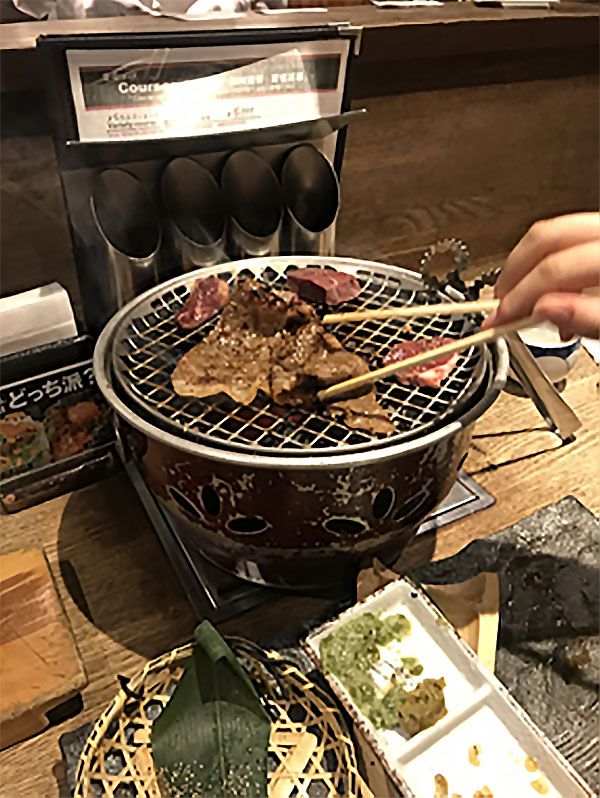
One of my favorite meals at restaurants are Japanese barbeques
(JBBQs) and Korean barbeques (KBBQs). They showcase some
incredibly complex flavors mixed with the charred taste of
protein that makes the perfect combination for a hearty,
satisfying meal. Recently Alberta opened in-person dining and
I had an opportunity to celebrate my roommate’s birthday at a
Japanese barbeque restaurant. While many JBBQs and KBBQs
are all-you-can-eat, this particular one was not. I personally
found that the a la carte options provided better cuts of protein,
great variety, and were more enjoyable when you don’t over-
eat because of the restricted portion sizes.
So what are the similarities and differences between these two
highly popular dining options?
Similarities
● Both JBBQ and KBBQ allow guests to cook their food
themselves. This adds a lot of fun and excitement to the eating
experience. I found that these dining styles truly enable individuals to custom the degree
to which the protein is grilled.
● Side dishes are often available for both and add some changes to the palate especially after
having multiple cuts of the same meat dipped in the same sauce, the side dishes are a
refreshing change.
Differences
KBBQ:
● KBBQ typically has meat marinated in a
variety of sauces adding a lot of flavor to the
meat. Even after the meat is grilled, a variety
of sauces can be added to the meat to enhance
the flavor further.
● The grill used for KBBQ is a charcoal or gas
grill.
● Oftentimes the meat is wrapped in veggies
such as lettuce leaves.
● Typically, KBBQs offer unlimited sides,
called banchan dishes, including things like
potato salad, fishcakes, kimchi, and pickled
vegetables.
● The cuts of meat include beef short ribs (kalbi), pork belly, boneless chicken, and brisket
steaksMarch 19, 2021 Volume 29, Issue 11 21
JBBQ:
● JBBQ typically offers high quality cuts of meat that are
not marinated to preserve the natural flavors of the protein.
However, following the grilling, dipping sauces can be used
to add flavor including mirin, garlic and soy sauce.
● The barbecue grill used is a charcoal or gas grill,
however, Teppanyaki (which is another subcategory of
JBBQ) uses a cast iron grill.
● Side dishes are often raw vegetables or salads.
● The cuts of meat often include beef, pork, and chicken.
For beef, I’ve tried wagyu cuts and other marbled cuts of
beef that almost melt on your tongue with their high fat
content. Pork and chicken are often extremely tender and
reminiscent of the yakitori or skewered meats in Japanese
street-food.
Overall, both KBBQ and JBBQ are incredibly enjoyable
experiences and can be DIY or experiences in a restaurant
setting. Prior to the opening of local restaurants for in-
person dining, I’ve attempted my own KBBQ at home
using a backyard charcoal grill and laying the different cuts
of meat marinated with a KBBQ marinade—which you can find in most Asian supermarkets.
Xin Xu is a post-graduate health-science AU student, aspiring clinician, globe-trotter, parrot breeder and tea-connoisseur.You can also read


