Myanmar's media from an audience perspective - Myanmar audience study 2018 - International ...
←
→
Page content transcription
If your browser does not render page correctly, please read the page content below
Myanmar audience study 2018

Myanmar's media
from an audience
perspective
2 / Myanmar's media from an audience perspective

Myanmar's media from an audience perspective– Myanmar audience study 2018
Published in Myanmar by IMS-Fojo in September 2018

Author
Emilie Lehmann-Jacobsen

ISBN
978-87-92209-96-2

With contributions from:
Ellie Swindon, Lars Thunø, Pernille Kristensen, and Enlightened Myanmar Research
Foundation

Design
IMS and Inspiral

Photos
Chris Peken

© 2018 IMS
The content of this publication is copyright protected. International Media Support
is happy to share the text in the publication with you under the Creative Commons
Attribution-ShareAlike 4.0 International License. To view a summary of this license,
please visit http://creative commons.org/licenses/by-sa/4.0.

Join the global work for press freedom and stay up to date on media issues worldwide

    forfreemedia
    InternationalMediaSupport

IMS is a non-profit organisation working to support local media in countries affected by
armed conflict, human insecurity and political transition.
www.mediasupport.org
Myanmar's media from an audience perspective / 3

Contents

4    Executive summary

5    Introduction

6    Methodology
     Data collections

9    Findings
     TV triumphs
     Issues with access
	   Sharing is caring
     T hat's news to me
      Trusting it tough
      The Facebook factor

21   Conclusion

22   Recommendations
     For media houses and journalists
     For media development organisations and learning institutions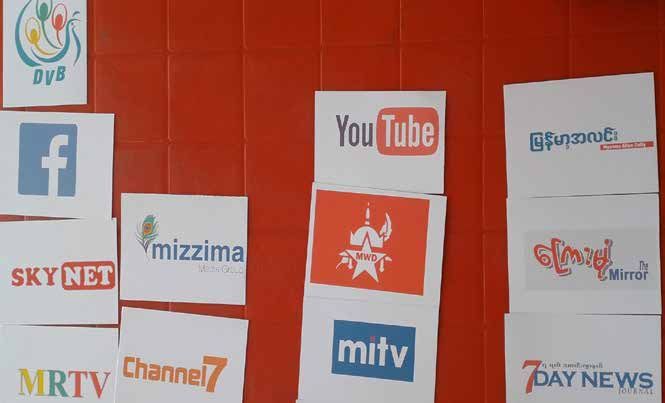
4 / Myanmar's media from an audience perspective

Executive summary
This publication presents the findings from an audience study carried out by International Media
Support (IMS), its partner institution Fojo Media Institute and Enlightened Myanmar Research
Foundation (EMRef) in May 2018. The report provides indications of the media habits of the
population of Myanmar as well as people’s understanding of news and information flows.

The study found that there is a widespread preference towards local media as people feel that
these media outlets provide them with information relevant to their local communities and daily
lives. Television is a preferred medium for consuming news but social media, and Facebook in
particular, is catching up. A culture of sharing news and information ensures that even people
without access to Facebook know of the platform and get updates through friends and family.

People’s trust in media differs but with many preferring state-owned media to deliver trustwor-
thy and reliable news and information. Some news consumers showcase a natural skepticism
towards news and information, but limited access to reliable information makes it difficult for
them to verify what they read, see or hear. Despite some people’s ability to critically reflect on
the information they encounter, the level of media literacy in Myanmar remains low with many
finding it difficult to decipher media content and grasp the role and purpose of media and news.

Based on the findings, the report ends with 12 recommendations. Six are directed towards the
Myanmar media industry, journalists and other content producers while the remaining six are
targeted at media development organizations and learning institutions. IMS-Fojo hopes that
these recommendations can serve as inspiration for the continuous development and profes-
sionalization of the media in Myanmar.

IMS-Fojo would like to express gratitude towards the men and women who participated in the
study. Without their willingness to share their views and media habits, this study could not have
been carried out. IMS-Fojo is equally appreciative of EMReF’s professional approach and read-
iness to carry out an audience study in Myanmar without prior experience.
Myanmar's media from an audience perspective / 5

Introduction
Within the last five years, Myanmar’s media landscape has undergone significant changes. Prior to 2013,
prepublication censorship and the existence of very few independent media made access to reliable
information difficult and for the main part people had to rely on state propaganda. Although the internet
and mobile technologies had reached the country, few had access. The price of a sim card was up to 300
USD and Myanmar had one of the world’s lowest mobile penetrations, just above of North Korea1. In
2018 the picture has changed dramatically. With the abolition of prepublication censorship, new and better
media reforms making it easier for independent media to operate and heavy investments in infra-
structure, Myanmar’s media landscape is far more diverse, and the population has access to an
ever-growing number of media on a variety of platforms.

Today approximately 34 percent of the population has access to the Internet (up from 26 percent in 2017)
and are active social media users2. Facebook is by far the most popular social media – and for many
Facebook is the Internet3. This poses some serious issues in terms of the quality of information people
have access to, as well as people’s ability to distinguish between reliable information and mis-
information. Unfortunately, very little is known about the public’s understanding of news and
information flows in Myanmar, including their trust in mainstream media versus social media.
The conflict in Rakhine has further highlighted the lack of knowledge of people’s media habits
and their ability to critically reflect on digital content, with large amounts of disinformation and
hate speech dominating Facebook feeds and spilling into the mainstream media’s narratives4.

Thus, in an effort to understand people’s media repertoires as well as their level of media liter-
acy, IMS-Fojo decided to carry out an audience study in Myanmar in 2018. It is the hope that
the findings from the study may not only inform future media development efforts in Myan-
mar but may also help improve content production and distribution through better understand-
ing of the audiences the Myanmar media is trying to reach and engage.

In the interest of getting in-depth information and not merely overviews of people’s media habits, a qualitative
approach was determined to be best suited. Furthermore, experiences from BBC Media Action show that
quantitative studies on media habits in Myanmar result in poor results with participants being unwilling or
hesitant to provide opinions5. In comparison, qualitative studies have proven much better suited in the
local context. Thus, it was decided to use a combination of focus groups discussions and in-depth inter-
views with participants from four different states/regions: Yangon, Mandalay, Rakhine and Kachin.
Whereas the in-depth interviews were designed to focus on the interviewee’s media/information
repertoires, news habits and media literacy level, the focus groups delved into issues of trust and
discussed perceptions of media and news.

The data collection for this study was undertaken in May 2018 by a research team from EMReF
with guidance and support from IMS-Fojo. A total of 168 participants took part in the study
from the regions of Yangon, Mandalay, Rakhine and Kachin.

1   Myanmar Times, “Waiting for the sim card price drop”, published on February 11, 2013.
    www.mmtimes.com/special-features/159-digital-communications/4087-waiting-for-the-sim-card-price-drop.html
2   We Are Social, Digital Yearbook 2018, published January 29, 2018 on:
    www.wearesocial.com/blog/2018/01/global-digital-report-2018
3   New York Times, “A war of words puts Facebook at the center of Myanmar’s Rohingya crisis”, published on October 27, 2017.
    www.nytimes.com/2017/10/27/world/asia/myanmar-government-facebook-rohingya.html
4   See for instance the report “Fake news on Facebook fans the flames of hate against the Rohingya in Burma”, from the Washington
    Post, December 8, 2017.
5   BBC Media Action, Strengthening accountability through media in Myanmar – final evaluation, published in June 2017, dataportal.
    bbcmediaaction.org/site/assets/uploads/2016/07/Myanmar-Country-Report-2017.pdf
6 / Myanmar's media from an audience perspective Methodology Doing an audience study with a qualitative approach naturally sets some limitations in terms of the number of participants and the representability of the study. It is therefore important to emphasize that the research effort does not claim to provide statistically representative results reflecting the media habits and media literacy levels of the entire Myanmar population. The research is designed to give indicative insights into these topics and generalize on more broad levels. In qualitative studies, the research participants play an important role. Given that qualitative research typically focuses on fewer cases than quantitative research, cases and/or research participants are commonly selected purposefully. Whereas the logic and power of sampling in quantitative research lies in randomization and representativeness, the logic and power of purposeful sampling “lies in selecting information-rich cases for study in-depth”6. Thus, to ensure a high level of generalizability, participants in the research were therefore selected based on a stratified purposive sampling strategy to make sure that they reflected different media habit types (heavy, medium and light as well as social media users versus non-social media users7) and that the sample was stratified according to location (urban/rural), gender and age. With such a sampling approach, the research strived to include several different stereotypical media consumers in Myanmar without having a full representative sample. This provided indications of media use and media understandings across different groups in Myanmar and used to identify trends and phenomena among Myanmar media audiences. As described in the introduction, four states/regions were selected for the research: Yangon, Mandalay, Rakhine and Kachin. Six focus groups and six in-depth interviews took place in each state/region. Of the 24 focus group discussions, 10 were female-only and 10 were male- only. The four remaining were mixed. The gender disaggregated groups ensured participating women were able to voice their opinions without any constraints due to male presence. As focus group discussions are all about equal participation and debate, it was a natural choice to carry out the research in this way. For the 24 in-depth interviews, the gender distribution was 50/50 with 12 interviews with women and 12 with men. In each state/region, focus groups and in-depth interviews were evenly distributed according to rural and urban locations as well as being stratified according to gender, age and other demo- graphic parameters. Although it was not possible in all cases, most focus group discussions reflected various levels of diversity. 6 Patton, Michael Q. 1990. Qualitative Evaluation and Research Methods. London; New York: Sage Publications. 7 When it comes to media user types, the literature typically distinguishes between light, medium and heavy media users. What con- stitute a light, medium and heavy media user will depend on context and culture. As very little is known about the news and media habits of people in Myanmar, the study worked with the assumption that light media users rarely seek news and information on their own initia- tive, medium media users seek out news and information at least once a week and heavy media users seek out news and information on a daily basis or several times a day. The study also distin- guished between social media users and non-social media users.
Myanmar's media from an audience perspective / 7

                  took part in our
                  qualitative audience study
                  from four different states/regions:

                  KACHIN

                  MANDALAY

                  RAKHINE

                  YANGON
8 / Myanmar's media from an audience perspective
Table 1: Overview of research participants
Yangon Mandalay Rakhine Kachin Total
Total number 42 45 45 36 168
of participants
Gender 22 men 25 men 23 men 19 men 89 men
distribution 20 women 20 women 22 women 17 women 79 women
Age distribution a 16-24: 16 16-24: 8 16-24: 19 16-24: 7 16-24: 50
25-34: 6 25-34: 5 25-34: 9 25-34: 6 25-34: 26
35-44: 5 35-44: 12 35-44: 8 35-44: 8 45-44: 33
45-54: 6 45-54: 13 45-54: 4 45-54: 8 45-54: 31
Above 55: 9 Above 55: 7 Above 55: 3 Above 55: 7 Above 55: 26
Ethnicities b Bamar: 41 Bamar: 35 Bamar: 5 Bamar: 1 Bamar: 82
Other: 1 Other: 9 Rakhine: 40 Kachin: Kachin: 32
32 Shan: 1 Shan: 1
Other: 2 Rakhine: 40
Other: 12
a Two persons (both in Rakhine state) declined from revealing their age.
b One person (from Mandalay) declined from revealing his/her ethnicitiy.
Data collection
In preparation of the study, different materials and manuals informed by similar studies and
past experiences from across the globe were developed. For the focus groups, a moderator guide
was developed with instructions for the moderator as well as questions and assignments for the
participants. For the in-depth interviews, an interview guide was developed. The guide included
instructions for the interviewer as well as questions for the interviewee. All materials were designed in a
flexible way to accommodate for different levels of media literacy and media habits. Prior to data
collection, the materials were translated into Burmese, the research team was trained in using
the guides and a trial of both guides were undertaken.
All participants in the study were required to fill out 1) a background questionnaire with questions on
demography and media habits and 2) an informed consent form. In some cases, participants chose
to give oral consent instead of signing a consent form. If no consent was given, the participant
was excluded from the research. The research team made sure that all participants understood the
purposes of the research and informed them of the use of the collected data. All participants
have been anonymized throughout this report.
Despite minor obstacles8, the data collection was carried out successfully. The research team
reported high interest from participants and good participation in most focus groups and in-depth
interviews. Focus groups typically lasted 1.5 to 2 hours and in-depth interviews took between 45
minutes to 1 hour. Focus groups and interviews were undertaken in participants’ native languages
– sometimes with the help of an interpreter to translate into local dialects and ethnic languages.
For more on the methodology, please contact IMS.
8 Such as difficulties with getting permissions from local authorities; finding proper venues; and participants having to leave
before the focus groups ended.Myanmar's media from an audience perspective / 9
Findings
Careful analysis of the in-depth interviews
and focus group discussions reveals patterns
“News is really important. For of media consumption, preferences and trust
example, everyone needs to know in Myanmar. This section lays out the find-
ings from the study under six different themes.
the weather reports and the The themes display the most significant trends
political changes because it can and insights that emerged from analysis of
the data collected – the background question-
impact us .” naire, the focus group discussions and the
in-depth interviews. To respect the privacy of the
(26-year-old woman from urban Yangon) research participants, everyone is anonymized
in the accounts and will only be presented with
gender, age and geographical location.
People Have Highest Trust The Facebook Factor
Where Media Have Facebook is big. Most people get
A Local Presence information from Facebook, either
directly or second-hand.
Sharing Is Caring Fact Checking Made Difficult
When access to reliable news is limited, When people have limited access to
news become a social engagement. information, fact checking becomes
difficult.10 / Myanmar's media from an audience perspective TV triumphs Television is clearly one of the most popular mediums in Myanmar. More than half of “I used to read newspapers and the people who participated in the study watch television, but I cannot read watch television every day. Women in par- ticular seem to be favoring television over anymore as I have some problems other mediums with 6 out of 10 watching with my eyes. [...] Radio is the television every day. The internet and radio come in second and third place with a main source to get information or little over a third using the internet and news for me. [...] I ask my friends little below a third of the participants using to confirm the news to see radio every day. However, there are big variances depending on the age of the user. whether the things I have heard Whereas the younger participants favor the on the radio has also been internet (about 6 out of 10 between the ages of 16 and 34 use the internet everyday), the older broadcasted on the television.” generations favor the radio (4 out of 10 above 44 years old listen to radio daily). (50-year-old woman from urban Mandalay) As in many other countries, the use of newspapers is low compared to other media. Newspapers in Myanmar have reported drops in print “I prefer to watch news on circulations over the last couple of years television because I have to give and the findings from the audience study ref lect this trend. Less than 2 out of 10 time to read a printed participants stated that they read a printed newspaper. I can watch news on newspaper every day – and almost half of the participants say that they “rarely” or television and work at the same “never” read printed newspapers. Men, time. So, I prefer to watch news on particularly those between the ages of 45 television.” and 55, seem to consume print news to a higher degree than others. But on an overall level, printed newspapers are not a heavily (41-year-old man from urban Kachin) consumed medium. Interestingly, when looking at preferred news sources, the image somewhat changes. People’s media repertoires slightly change when it comes to seeking out news and information. While television continues to be an all-time favorite, radio comes in a clear second place followed by social media (third place), the internet (fourth place), friends and relatives (fifth place), printed newspapers (sixth place) and online newspapers (seventh place). However, for many participants other past times are often preferred to news watching, as a 28-year-old woman from rural Rakhine explains: “I can only watch TV at 7 pm when the power [electricity] is available, but mostly we watch movies at that time from DVD too. So, the news watching time is not that much.”
Myanmar's media from an audience perspective / 11

                              Issues with access
                                                                                          “We don’t buy and read
                                                                                          newspapers in this village.
                                                                                          We get the news only
                                                                                          from radio and television.”
                                                                                          (29-years-old woman from rural Rakhine)

                              Whether or not people have access to the necessary technologies and distributionchannels has,
                              perhaps not surprisingly, a big influence on people’s media habits. Television relies on tv-sets
                              and electricity; radio relies on transmitters and electricity; online and social media rely on either
                              computer and internet access or smartphone and 3G connections; and, printed newspapers rely
                              on sales points and physical roads for distribution. People living in more remote areas have a
                              much more limited palette of choices when it comes to available media. Even if they wanted to
                              read a printed newspaper more frequently or use social media it might not be an option.

                              People therefore end up using the media that they have access to – as well as media that they
                              know. With the media landscape having evolved so rapidly, people may not be aware of the
                              media they actually have access to. This finding was highlighted by an exercise from the focus
                              group discussions where participants were asked to sort cards with the names and logos of a
                              wide variety of available media in Myanmar printed on them. The cards were to be sorted based
                              on different questions such as preferences and trust.

                              Observing the exercise, it was evident that the recognition of the available media in Myanmar is low.
                              Particularly in rural areas, people have limited knowledge of the country’s media landscape and only
                              knew a handful of the media they were presented with – despite some of them being quite local in
                              scope and thereby within reach of the participants. In some focus groups, participants even
                              ended up thanking the research team for introducing them to so many new media that they had
                              never heard of.

Cards presenting different media were sorted according to trust and relevance in all focus group discussions. The image above presents the results
from a discussion on the most relevant media by the female-only focus group in rural Rakhine. Photo by EMReF.
12 / Myanmar's media from an audience perspective
Sharing is caring
With limited access to information, Myanmar
people have become accustomed to sharing news
and information with each other. “Those who go to the town also
share the news.”
This culture of sharing is best illustrated with an
account of a scene taking place during one of the
focus group discussions. The participants were (18-year-old woman from rural Rakhine).
asked to read three articles with the purposes of
discussing them afterwards. People quietly began reading the distributed articles when the silence was
suddenly broken by one of the participants. “You need to hear this,” she yelled out, addressing a group of
fellow villagers standing not far from where the focus group was taking place. The news, which
happened to be about education enrollment, was immediately shared. When asked about why
she shared the news, she just stated, “I knew they would be interested in it. It would be impor-
tant to them”.
From both the interviews and the focus group discussions, it is clear that this informal sharing
culture plays a big role in the way people receive information. Some people rely almost solely on this type of
secondhand information as they have either limited access to media themselves or no obvious
interest in or habit of accessing information. As a 39-year-old woman from rural Yangon says
when asked about her use of Facebook: “I cannot use it as I am busy. I have to take care of my
children. If I want to know something, I look at my husband’s account. I don’t have my own
account.”
9
As other studies have also pointed out , it is particularly women who are restricted in their access
to information. In some cases, their husbands function as gatekeepers to the sort of news and
information they receive – or they rely on the information that they can get through interaction
with others e.g. at the local market.
Despite the positive aspects of the sharing culture,
it is not without consequences. Not least in terms
of the quality of information that people are “My husband does not allow
exposed to. All new messengers in an information me to use Facebook. He shares
chain will add new filters and interpretations
to the original message, potentially altering facts only the news he wants to tell me.”
and vital nuances. Although some people appear
to be aware of the way information can become (28-year-old woman from rural Rakhine).
tainted by word-of-mouth transmissions, most do
not have any other means of obtaining information
or verifying the information that they receive. For
many people second hand information is all
that they get.
9 Fojo Media Institute, 2016, Gender in the Myanmar Media Landscape, fojo.se/images/pdf/publications/EN_MM_Gender_2016.pdfMyanmar's media from an audience perspective / 13
That’s news to me
What people understand to be news differs
across regions and gender. What constitutes “Weather reports about cyclones
“news” is closely connected to the specific and health-related news are news.
interests, problems and concerns of the indi-
vidual. A highly educated young man from I always listen to such kind of
Yangon has different worries and interests to reports because a cyclone may
a poorly educated elderly woman living in an
IDP-camp in Kachin, which in turn influences come, and for health related news,
their distinct perception of news. as my mom is suffering from
paralysis.”
Looking at the understanding of news from
a gender perspective, in comparison to men,
women tend to place higher emphasis on (8-year-old woman from rural Rakhine).
health-related news and news about education
– two topics that concern the well-being and
prospects of the family.
In contrast, men tend to place higher emphasis on political news and sports. Both place empha-
sis on the weather and the economy – with the latter being more about commodity prices than
national economic concerns.
From a regional perspective, the understanding of news is closely connected to the specific challenges
of the region in question. In the more conflict-prone areas such as Rakhine and Kachin, people are more
concerned about the impacts of the ongoing conflicts on their daily lives. Is the conflict moving closer to
them? Are any of their friends or relatives in any kind of danger? Although the ongoing conflicts of the
country are also on people’s minds in other regions, they are not mentioned as frequently by the participants
from Yangon and Mandalay. What is happening locally is far more important to the individual than
concerns of a more national scope. In short, the sense of national identity is evidently not as
strong when it comes to what news people are most interested in.14 / Myanmar's media from an audience perspective
Below is an overview of the most mentioned topics associated with news by people from both
the focus group discussions and in-depth interviews in the four regions.
Table 2: Overview of topics associated with news according to regions
Rahkine Kachin Mandalay Yangon
Conflict (in particular Conflict/war Weather/ Politics
related to the Rohingya) natural disasters
Weather Politics Politics Economy
Health Sports Conflict/civil war Weather
Politics Crime Economy Education
News events Health Culture/ entertainment
Culture/ entertainment Health
Some people are quite frank about the way that they prioritize and consume news that are relevant to
their particular life. As a 36-year-old man from urban Kachin puts it: “I do not watch the news about land
grabbing in lower part of Myanmar because it is not relevant to us and not interesting as well.”
Differences between rural and urban areas can naturally also be detected in the study. In rural
areas for instance, people are far more inclined to follow news about the weather. Bad weather
may have serious consequences for their crops, their estates and their abilities to protect their
families. In urban Yangon and urban Mandalay, people are more interested in more broad news
topics related to politics and the economy as well as culture and entertainment. Particularly the
younger research participants in the urban areas place emphasis on these softer news topics
and are more inclined to associate stories on celebrities with news than the older participants.
In conclusion, local conditions and individual priorities highly frame the perception of news. Local
news is clearly preferred over more general national news. It is difficult for people to concern themselves
with events happening far from their homeland unless they see a distinct connection to their daily lives.
Relevance is the news criterium most important to people when prioritizing information flows and
selecting news to engage with.Myanmar's media from an audience perspective / 15
Trusting is tough
With limited access to information and few
news sources to choose from, people strug- “I don’t believe news once I hear
gle with trusting the media. The findings from it. If the same news comes from
the focus group discussions and the in-depth
interviews show that people in Myanmar have three news media, it is believable.
a natural skepticism towards not only the estab- Because even if I ask someone, he
lished media but also news and information
coming from other sources – including friends or she may exaggerate the news.”
and family.
(19-year-old man from rural Kachin).
Many do however highlight state-owned media as being most trustworthy and reliable. Like one
man from rural Yangon puts it: “MWD is military-owned and the MRTV is government-owned
media. We trust in those media. They share the news which are possible [to believe]” (43-year-
old man from rural Yangon).
Those trusting the state-owned or military-owned media seem to believe that these media are more
capable of providing accurate information because they have direct access to news and informa-
tion sources. Particularly when it comes to factual topics such as official wage levels or enrollment
criteria for higher education. Even those who do not fully trust the state-owned or military-owned
media mention that they rely on them for these kinds of information. The more critical respondents will
even say that they use these information channels to see how the state and/or military view different
topics. These participants displayed strong abilities in sourcing different media for different purposes,
using the different strengths of the media for their own benefit. While the state-owned media might
provide them with some type of news, the independent media could provide them with
another kind and the international media with yet another kind. As a heavy media user
from urban Kachin explains: “VOA, MRTV and BBC are always good. Some of them write
news in both Burmese and English which is interesting to read. They are also very good
sources to read. 7days and MWD seem biased in favor of the government. They write good
things about the government. But DVB is a little bit different from them. [...] New Light of
Myanmar writes a lot of news about the government and seems to be giving favor to the
government side. I do not trust them that much, there are many lies. The news sources from
The Mirror are true but it is also the military backed media10 [sic]. RVA broadcast news for only
Christians.” (61-year-old man from urban Kachin).
10 Although the respondent believes that The Mirror is a military-owned newspaper, it is in fact published by the Ministry of
Information and therefore it would be more correct to say that it is government-owned.16 / Myanmar's media from an audience perspective
However, the majority of the research participants
did not showcase these abilities to interpret the “Seeing is believing. So, if we
differences in the media they consume. Either cannot go and check by ourselves
because they did not reflect upon the media’s
reliability or different media’s political alle- on the ground, we should check
giances, or because they did not have the with someone who is living there.”
luxury of access to more than a couple of
different news sources. (46-year-old Woman from rural Kachin).
“Although I like information or
But if they cannot see it with their own eyes or news sourced on Facebook, I do
hear the incident accounted by an eyewitness
then they will need to see other forms of proof. not trust some of them because
Some do however realize that you cannot trust there can be fake news with fake
all images. Especially when it comes to online
content. But as pointed out by many research photos. People fake them and post
participants it can be difficult for them to them on Facebook, so they
verify whether a story or an image is false or not. cannot be trusted. [...] So, we need
to think carefully before we
believe them.”
(25-year-old man from rural Kachin).
Looking at trust from a regional perspective,
it is again apparent that local news outlets “DVB is good. [...] In Myitkyina,
carrying local news have a better position among there is a DVB reporter. When he
the local population than the Yangon-based
media. People tend to trust media that have is sick or not available, our news is
a local presence and can report directly from missing.”
the neighborhood. If they know the journalists
covering their local community, trust is even
higher. (51-year-old woman from rural Kachin).
The exercise mentioned above where the focus group participants were asked to sort cards with
the names and logos of different news outlets further underlines people’s tendency to place
higher trust on local media outlets or media outlets with a – for them – known local presence.
As is visible from the table below which lists the media that were most frequently mentioned
in each region, media with a known local presence have a clear advantage over media that are
not recognized as having a local presence.Myanmar's media from an audience perspective / 17
Table 3: Overview of mentioned media according to regions and topics
Yangon Mandalay Rakhine Kachin
Preferred news DVB Myitkyina News DVB BBC
sources Facebook Journal MNTV MRTV
YouTube Kachin News BBC MRTV Myanmar A Linn
Local market DVB The mirror The Mirror
MNTV 7 Days VOA Facebook
Channel 9 VOA Facebook
MRTV MRTV Padamyar FM (rural)
Narinjara Facebook
Trusted news (BBC) a DVB DVB State-owned media
sources Friends and family Kachin News State-owned media MRTV
Myitkyina News Eye-witnesses DVB
Journal (BBC) a
Friends and family
News sources (BBC) a (BBC) a (BBC) a (BBC) a
with least trust Facebook Facebook Facebook
YouTube
Myawaddy Daily b
a BBC are placed in brackets throughout the table as people were somewhat conflicted about whether the media could be trusted or
not.As explained in the text below, people used to consider BBC as one of the most trustworthy news outlets but BBC’s recent
coverage of the conflicts in country had disappointed many. They felt that BBC did not provide a correct image of the conflicts.
Yet, due to the past reputation of BBC people are not ready to fully disregard the news outlet.
b Trust in Myawaddy Daily had been tainted due to a recent scandal where the newspaper misappropriated an image showing IDPs
crossing a river into safety to illustrate a story with the headline “Increased number of tourists in Ngwe Saung Elephant Camp”.
Yangon-based media are for many people living outside of the bigger cities not relevant
news sources. People feel that these media do not present them with news or informa-
tion that pertains to their daily lives and challenges and that they are often too elitist in
their reporting. One media outlet did, however, seem to carry itself well among respond-
ents across the different states. DVB was highlighted by several people in both Rakhine,
Kachin and Mandalay as being very good at reporting from the local areas. In Kachin, Myit-
kyina News Journal and Kachin News received similar praise. People felt that they were
represented fairly by these media outlets and could therefore trust them more. Proximity to
events is clearly something that is being appreciated by audiences and elevates trust.
“DVB comes as soon as possible “We rely on DVB for news. As the
to the area to get news in a case of news is presented with an
something happening,” eyewitness account, they cannot
lie.”
(46-year-old woman from rural Mandalay).
(44-year-old woman and 33-year-old woman from
urban Rakhine).18 / Myanmar's media from an audience perspective
“BBC is not reliable. They are
Interestingly, the trust in international news really biased and make news as they
outlets such as BBC, VOA and RFA seems some-
what contested – regardless of the region. Many like. They cannot reflect the truth.
people expressed appreciation of the reporting And their reports are always
these outlets had done in the past under the
military regime when information was scarce. different from other channels’
However, people are not sure that they can be reports. For example, when they
trusted any longer, particularly after having reported about the death tolls in a
observed the outlets coverage of the conflict in
Rakhine and the Rohingya minority. Several communal conflict in Yangon, they
of the respondents explained that they did not mentioned a low number of killed
feel that the international outlets were telling
the truth or that the full story was being told Rakhine people and a much higher
in their reports. number of killed Muslim people.”
(63-year-old woman from urban Rakhine).
Despite the decaying trust in the international outlets, people did nonetheless still respect the media, and many
continue to seek them out – albeit with greater apprehension.Myanmar's media from an audience perspective / 19
The Facebook factor
“I get more knowledge as if I got
a window to the world. Before, I
could only watch TV and
read the newspaper.”
(16-year-old woman from urban Yangon).
One of the most surprising findings from the audience study was the role and impact of Facebook. Although
official figures state that only about one out of three in Myanmar are active Facebook users, most people that
participated in the audience study knew of Facebook and had gotten information from Face-
book in one way or another. Facebook has clearly become a big factor in Myanmar’s news and
information flows and the reach of the social networking site is far bigger than the official fiure
of 34 percent. The sharing culture of Myanmar has ensured that information from the social
net working platform is spread outside of the online realm and reaches people by word of mouth in
traditional ways. As one research participant explains: “I look at Facebook every day. I joined the
GAB group [a group with information relevant for farmers] because I want to get updates on bean
prices. As we cannot easily get news from outside in our village I share the price information I
have with others.” (44-year-old man from rural Yangon).
One of the things that people particularly
appreciate about Facebook is the platform’s “Recently, one ward caught on fire.
ability to present them with news and infor- But before the fire fighters came,
mation at a speed that cannot be matched by
any other media. They can get updates almost the news was already posted on
in real time. For people living in conflict-prone the Facebook.”
areas or regions that are likely to suffer from
natural disasters it can be a matter of life and (63-year-old woman from urban Rakhine).
death to get accurate and up-to-date information.
People are, however, aware that they cannot necessarily fully trust the information that they
get online. They know that they are sometimes misled and that some people use the platform to
spread hate speech and disinformation. As a 47-year-old man from urban Mandalay says: “Not
every post on Facebook is reliable. Some posts are biased based on personal opinions. Some-
times we can also see hate speech and rumors such as ‘Muslims have too big of an influence’
and ‘Buddhism will disappear under the NLD government’. Sometimes, people post personal
attacks. So, we need to rely on our rational thinking to judge the news.”20 / Myanmar's media from an audience perspective Some have developed their own ways of deal- ing with the issue and found ways to try to fact-check the information that they encoun- ter. As a 44-year-old woman from urban Rakhine explains: “As soon as I read a post, I don’t decide whether it is true or fake. I con- tinue reading the comments. Based on the comments, I can decide whether the post is reli- able or not. Sometimes, I even chase a person’s account who made comment in order to check what type of person he/she is.” But far from everyone has the capabilities to do this type of fact-checking. And despite the skepticism towards Facebook, it seems as if most people would rather rely on information from the social media than live in the dark. In the absence of better information channels, Facebook can give them the updates that they so desperately need – in addition to the other functions of the networking platform. Face- book is acknowledged to be far more than just a news and information sharing tool. For many people, the youth in particular, the main purpose of the platform is social networking and keeping track of friends and family. Not surprisingly, the older generations seem somewhat more apprehensive of the social net- working site. Not only due to the fact that the platform is being exploited by some to spread false information and induce hatred among different groups in society, but also because people are concerned about what impact the platform may have on cultural traditions and social norms. Many recounted stories of young women being seduced online and snared into sexual relationships with elderly men. This had led some to refuse their wives and/or daughters to use the platform out of fear of what could happen to them. Regardless of these concerns, Facebook has in a very short time gotten a dominant role in Myanmar society. A role that needs to be acknowledged by not only the media but also by learning institutions and development organizations. No other social media comes near the popularity and reach of the platform and with no other alternatives that match the immediacy of the platform, and no ways of fact-checking information, people often have to settle for what they read, see and watch on Facebook. Even with the natural skepticism seemingly present with many people, there is a clear need for media literacy efforts to enhance the understanding of online news and informa- tion consumption.
Myanmar's media from an audience perspective / 21

Conclusion
It is a difficult time for media in Myanmar. With rapid developments, the media and journalists operating
within the industry have had to continuously adjust their approaches and positions. And the
transformations and adjustments are far from over, making it difficult for the media to find the right
course. However, one of the keys to success in these uncertain times are the audiences – those who
should be the targets and recipients of the content produced by the media. As is evident from the audience
study presented in this report, the people of Myanmar hunger for reliable information relevant to their
everyday lives. They want accurate news about their local communities, presented in an easy and
decipherable manner with solid documentation and delivered as quickly as possible. In short, they
emphasize accuracy, proximity, transparency and immediacy.

Although the population to some extent is able to voice what they want in terms of news and information,
the media literacy levels of the country remain low; particularly among people living in rural areas
and among women who are often limited in their access to both the necessary technologies and media
outlets. With little experience with independent media and limited access to information, people lack
basic skills to critically analyze news content. A natural skepticism leads them part of the way but with
few opportunities and inadequate skills to fact-check information, their inquisitiveness is often left
unsatisfied and put aside. Trust in the media is low with people struggling to understand what
the media may do for them. For many, the media is elitist and mainly concerns itself with Yan-
gon-related matters leaving little space for and acknowledgement of the realities of the popula-
tion living outside of the bigger cities.

Facebook has to some extent been able to fill the void and give people the ability to seek out information
in something close to real time. Yet, navigating the social media is tricky and not everybody understands
that it can be abused by people with ill intentions. Though official figures may state that only 34
percent of the population are active Facebook users, the reach of the platform goes far beyond number and
the media has become a force to be reckoned with when looking at Myanmar’s media environment – for
better or for worse.
22 / Myanmar's media from an audience perspective

Recommendations
As described in the introduction, the purpose of the audience study went beyond merely
uncovering the media habits of the people in Myanmar. Not only does IMS-Fojo hope that
the study may inform future media development efforts in Myanmar, but we also believe
that the findings can help improve news content production and distribution in the country.
In an attempt to elevate the findings of the audience study into practical advice, this section
therefore presents six recommendations for the consideration of media houses and journalists
and six for the consideration of media development organizations and learning institutions.

For media houses and journalists
In short, media, journalists and other content producers are recommended to:

• Go local: Be present in the local communities and report directly from where the action is
taking place;

• Connect with audiences: Build rapport with audiences and meet them in their local
communities to establish and increase trust;

• Be transparent and include documentation: People have a natural skepticism towards in
formation they encounter and need to be convinced with facts and strong documentation;

• Think in images and creative ways of story-telling, particularly on social media platforms:
Images elevate trust and creative story-telling captures audiences in a competitive market;

• Avoid making reporting too academic or heavy for readers: Elitist reporting alienates readers
and keeps them from moving beyond the headline;

• Consider means of distribution: Infrastructure affects news consumption and careful
consideration of how contentis distributed is paramount for the success and survival of a news
outlet.
Myanmar's media from an audience perspective / 23

For media development organizations and learning
institutions
With low levels of media literacy and people’s limited access to information in Myanmar,
media development organizations and learning institutions should, among other things, seek
to:

• Establish mechanisms for fact-checking: Provide people with the necessary tools to fact-
check information, particularly from online sources;

• Ensure better access to information: Better access to information will foster better informed
news stories and greater possibilities for people to seek out information on their own;

• Raise people’s media literacy and their abilities to find information: Production and distribution
of quality content only has an impact if it reaches and engages audiences. Attention to audiences’
abilities to engage with news and information f lows is paramount for the success of media
development efforts;

• Prioritize women and other marginalized groups: Women, ethnic minorities and people
living in rural areas have lesser access to information than other groups as well as lower lev-
els of media and digital literacy. Special attention to these groups is important to ensure that
they are not left behind;

• Capacitate journalists in connecting and engaging with audiences: Assist journalists with
understanding the potential that lies in engaging more actively with their audiences to enhance
the quality and reach of their content;

• Promote creative storytelling, particularly on social media platforms: With increased compe-
tition for people’s attention, journalists’ abilities to deliver quality content in compelling ways
are even more important.
This publication has been made possible with      International Media Support and Fojo Media Institute are working to
support from the Ministry of Foreign Affairs of   support Myanmar media partners in their efforts to develop independent
Denmark.                                          and accountable media as a driver of positive social and political change.
You can also read


