New Technology Expands Applications for Cochlear Implants - Head and Neck Surgery ...
←
→
Page content transcription
If your browser does not render page correctly, please read the page content below
2018 • Issue 2

                    ADVANCES IN OTOLARYNGOLOGY -
                       HEAD AND NECK SURGERY
                                      New Technology Expands Applications for Cochlear Implants
Lawrence R. Lustig, MD
Chief, Otolaryngology -               Technology breakthroughs in cochlear implants
Head and Neck Surgery                 are allowing doctors to help more patients with
NewYork-Presbyterian/
Columbia University Medical Center
                                      residual hearing than ever before, a vast improve-
lrl2125@cumc.columbia.edu
                                      ment over the early days of implants, according to
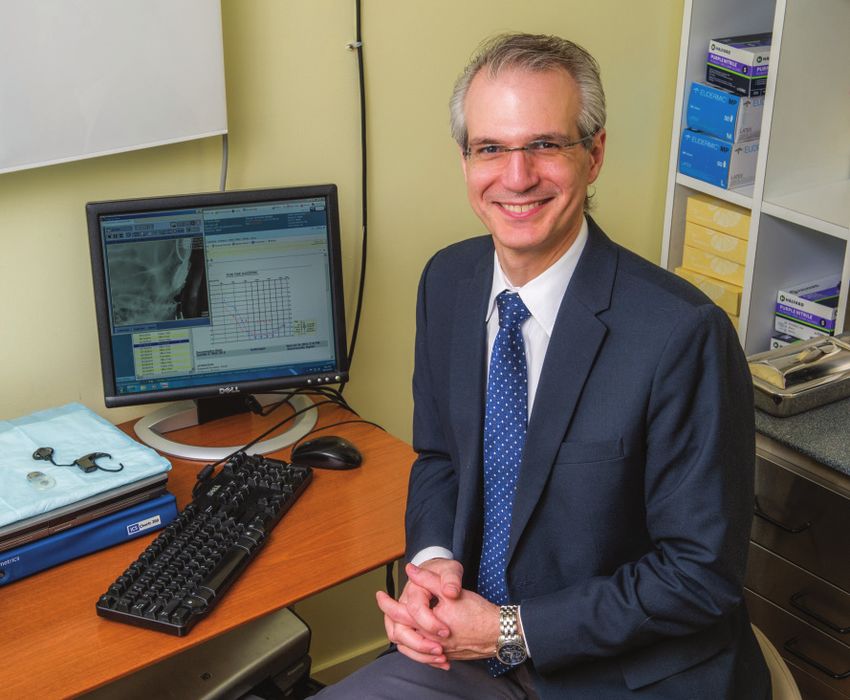
                                      George Alexiades, MD, an otologist/neurotologist
Michael G. Stewart, MD, MPH           and Director of the Cochlear Implant Center at
Chief, Otolaryngology -               NewYork-Presbyterian/Weill Cornell Medical Center.
Head and Neck Surgery
NewYork-Presbyterian/                 “When we first began performing cochlear implants
Weill Cornell Medical Center          we would tell our patients that their residual hearing
mgs2002@med.cornell.edu               would be gone after surgery,” he says. “However, over
                                      time we have refined surgical techniques and the
                                      implants have become more delicate and advanced.
                                      Today, we are much more consistent in preserving
SAVE THE DATE                         residual hearing even with patients who have very
                                      little. We try to save as much of their residual low-    Dr. George Alexiades
12th Annual Otolaryngology Update
in New York City                      frequency acoustic hearing as possible so that they
October 18-19, 2018                   still have some sound awareness when they take           Cochlear Implant Center have expanded their patient
Location                              their cochlear implants off.”                            selection criteria and widened their pool of potential
New York Marriott Marquis                                                                      implant candidates. “Cochlear implants initially
1535 Broadway
Liberty Room, 8th Floor
                                      Extending Criteria for Cochlear Implants                 were relegated to patients with severe-to-profound
New York, NY 10036                    The cochlear implant has seen marked improve-            sensorineural hearing loss in both ears who were not
For More Information                  ments in its more than 35-year history. In recent        getting enough benefit from traditional hearing
(212) 305-3334                        years, Dr. Alexiades and his colleagues at the           aids,” says Dr. Alexiades.            (continued on page 2)
cme@columbia.edu

                                      On the Frontlines of Cochlear Implant Research
AMAZING ADVANCES IN                   The Department of Otolaryngology – Head and              scientists, genetics specialists, neuroradiologists,
RESEARCH, TECHNOLOGY,                 Neck Surgery at NewYork-Presbyterian/Columbia            speech therapists, and a dedicated cochlear implant
AND PATIENT CARE                      University Irving Medical Center is advancing the        coordinator.
NewYork-Presbyterian’s new clinical   field of cochlear implantation through a dynamic            A vibrant research agenda is also a top priority of
innovations site for professionals    and expanding clinical and research program.             the Cochlear Implant Program. “We are involved in
nyp.org/amazingadvances               “Our Cochlear Implantation Program has grown             many areas of cochlear implant research, ranging
                                      tremendously in the last four years,” says Lawrence      from outcome measures, genetic causes of hearing
                                      R. Lustig, MD, Otolaryngologist-in-Chief. “In            loss, and quality-of-life changes, including the
                                      2014, we were doing under 15 cochlear implants a         effect on cognitive function, to sound and music
                                      year, and this year we are approaching 100.”             appreciation,” says Dr. Lustig. “We also have devised
                                          Combining the experience of leading experts in       methods for inserting implants without damaging
                                      hearing loss with access to the latest technological     the cochlear tissue and are working with colleagues
                                      breakthroughs, the comprehensive program                 at Columbia Engineering and at Harvard to develop
                                      includes a multidisciplinary team of subspecialty-       a fully implantable cochlear implant.”
                                      trained surgeons in otology/neurotology and                 Following are a just a few of the investigations
                                      pediatric otolaryngology, audiologists, hearing          underway.                              (continued on page 3)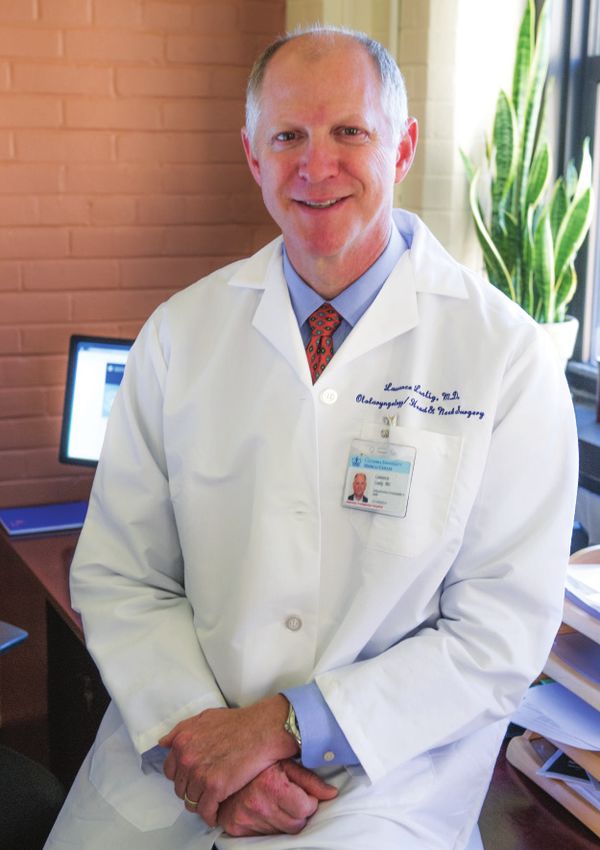
ADVANCES IN OTOLARYNGOLOGY - HEAD AND NECK SURGERY

New Technology Expands Applications for Cochlear Implants                                              (continued from page 1)

   In recent years, FDA guidelines have broadened to include anyone                        Of the 67 patients, 79 percent experienced less than a 30 dB HL
with moderate-to-profound hearing loss in both ears who are not                         low-frequency pure-tone average (250-1000 Hz) shift, and 97 percent
getting sufficient benefit with a traditional hearing aid. “The big                     were able to use the acoustic unit at 12 months post-activation;
change more recently is that we have been inching towards including                     94 percent of patients performed similarly to or better than
more people with residual hearing loss because we’ve seen the benefit                   their preoperative performance on City University of New York
of implants outweighing traditional hearing aids,” says Dr. Alexiades.                  sentences in noise at 12 months post-activation, with 85 percent
“We are now offering implants to people with unilateral hearing loss                    demonstrating improvement; and 97 percent of subjects performed
and children younger than one year of age.”                                             similarly or better on consonant-nucleus-consonant words in quiet,
   Electro-acoustic stimulation, or hybrid devices, received FDA                        with 84 percent demonstrating improvement.
approval two years ago. This can be the solution for those who hear
too well to receive a conventional cochlear implant, but who cannot                     Addressing Unilateral Hearing Loss
use a traditional hearing aid. The combination of acoustic hearing                      The loss of hearing in one ear – unilateral hearing loss or single-sided
for the low frequencies and electric stimulation for the mid-to-high                    deafness – is more common and more bothersome than many people
frequencies has been life-changing for patients, notes Dr. Alexiades.                   realize. In these patients, one ear has normal or near normal hearing,
With bimodal fitting, in contrast to the hybrid situation, one ear is                   while the other has profound-to-severe hearing loss. The symptoms
stimulated acoustically with a hearing aid and the opposite ear is                      of unilateral hearing loss vary. In addition to impaired hearing on
stimulated electrically with a cochlear implant to supply the mid-to-                   one side, some people may have difficulty determining the direction
high frequency sounds.                                                                  of sounds making it dangerous to cross a street or navigate in traffic.
                                                                                        Others may be unable to hear sounds from a particular direction,
                                                                                        with the most common symptom being an inability to separate
                                                                                        background noise from sounds the individual wants to hear.
                                                                                           “Previously, we could only offer these patients special types
                                                                                        of hearing aids that could shunt the signal from one side to the
                                                                                        other but never really restored hearing in the ear that had lost
                                                                                        hearing,” says Dr. Alexiades. “With only one ear you can’t localize
                                                                                        sound. In certain circumstances, however, patients with unilateral
                                                                                        hearing loss will do very well with a cochlear implant. We can
                                                                                        implant the one ear that has severe-to-profound hearing loss and
                                                                                        over time the patient is able to fuse the signal coming in from the
                                                                                        cochlear implant with the normal ear. Using both together, they
X-ray image of a patient with bilateral cochlear implants; arrows indicate electrodes   can actually have restored hearing in the ear that had lost hearing.
in the cochlea.
                                                                                        However, this approach only works well in someone who has
                                                                                        recently lost hearing on one side; it can’t be many years later.”
    “We have found that patients with hybrid devices do significantly                      While the average age of Dr. Alexiades’ patient population
better than patients with a hearing aid alone, and better than patients                 varies, the majority fall at either end of the spectrum – the elderly
with a full cochlear implant,” says Dr. Alexiades. “Again, this approach                or the very young. “Many of our patients are either children under
is for patients who could have normal hearing in low frequencies                        two years old or older adults, but there is still a great number of
but by the middle frequencies – usually 1000 Hz and above – their                       patients with hearing loss in their 40s and 50s,” he says. “Some
hearing is in the severe-to-profound range. They just don’t get enough                  patients have their original device implanted in the 1980s, but in
information with their hearing aids to function very well. The cochlear                 all likelihood, most people, especially young patients, will have to
implant helps give them high frequency information and the hearing                      have at least one revision in their lifetime.”
aid helps give them the low frequencies.”                                                  Among children, studies have shown that outcomes are more
    “Outcomes have been very good,” continues Dr. Alexiades, who                        successful with early intervention, and Dr. Alexiades believes that
has performed some 20 hybrid cochlear implants at the Center.                           the nationwide universal screening policy at birth is crucial to help
“The advantage of combining a hearing aid and a cochlear implant                        identify children with hearing loss.
is that patients tend to hear better with background noise and                             “Patient selection is an evolving process,” adds Dr. Alexiades.
in music appreciation than individuals who have just a cochlear                         “Patients who were not deemed a cochlear implant candidate five
implant with no acoustic component.”                                                    years ago may very well be an implant candidate today.”
    Dr. Alexiades and his Weill Cornell colleagues recently took part
in a multicenter clinical trial to test an electric-acoustic stimulation                  Reference Article
system for adults with residual low-frequency hearing and severe-to-                      Pillsbury HC 3rd, Dillon MT, Buchman CA, Staecker H, Prentiss SM,
profound hearing loss in the mid-to-high frequencies. The study,                          Ruckenstein MJ, Bigelow DC, Telischi FF, Martinez DM, Runge CL,
the results of which were published in Otology & Neurotology in March                     Friedland DR, Blevins NH, Larky JB, Alexiades G, et al. Multicenter U.S.
2018, focused on 67 of 73 patients who completed outcome measures                         clinical trial with an electric-acoustic stimulation (EAS) system in adults:
                                                                                          Final outcomes. Otology & Neurotology. 2018 Mar;39(3):299-305.
for all study intervals. Speech perception was assessed using City
University of New York sentences in noise and consonant-nucleus-                          For More Information
consonant words in quiet.                                                                 Dr. George Alexiades • gea9039@med.cornell.edu

2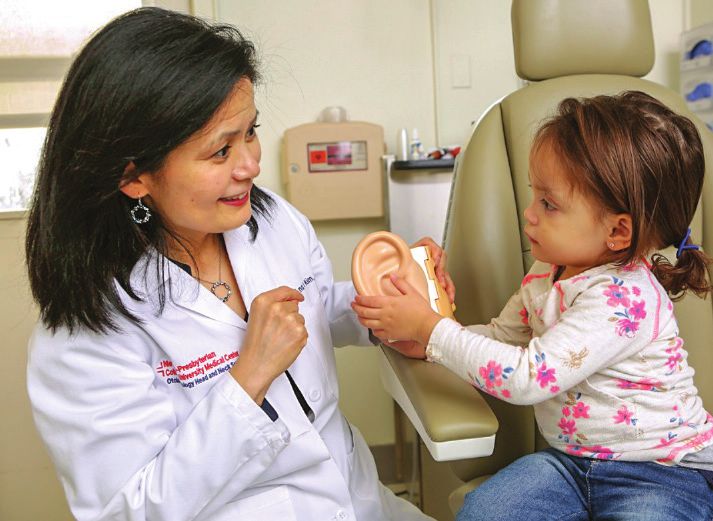
ADVANCES IN OTOLARYNGOLOGY - HEAD AND NECK SURGERY

On the Frontlines of Cochlear Implant Research                              (continued from page 1)

Sound Investigations                                                              Genetic Factors in Hearing Loss
Clinician-scientist Ana H. Kim, MD, is Director of the Cochlear                   Dr. Lustig and his Columbia
Implantation Program and Director of Otologic Research at Columbia.               colleagues are currently estab-
In her practice, she cares for a growing population of children and               lishing a protocol to perform
adults who can benefit from cochlear implants. She has implanted                  next-generation sequencing on
the device in patients from 9 months to 93 years old. “As long as                 all of the program’s cochlear
the infant physically weighs enough to undergo a 1½-hour general                  implant patients aimed at
anesthesia procedure,                                                             identifying genetic factors that
we will implant                                                                   cause hearing loss. “About 100
them because the                                                                  different single gene mutations
sooner they get the                                                               have been identified that will
cochlear implant                                                                  lead to hearing loss, and we
the better they do,”                                                              think there may even be 150 to
says Dr. Kim. “My                                                                 200,” says Dr. Lustig. “There
older patients are                                                                are still many genes to be
generally in their                                                                identified. Add to this the need
60s, but as long as                                                               to understand the subtle differ-
they can undergo                                                                  ences between multiple genes      Dr. Lawrence R. Lustig
general anesthesia,       Dr. Ana H. Kim                                          or duplications or deletions.
are mentally able                                                                 Traditional genetic screening might miss these. To address this chal-
to understand and use this technology, there really are no exclusion              lenge, we are partnering with Dr. David Goldstein and Columbia’s
criteria per se. It’s determined on a person-by-person basis.”                    Institute for Genomic Medicine to perform whole-exome sequencing
   “When we implant patients with profound hearing loss, some will                on all of our implant patients who have agreed to be sequenced.”
do really well and there are those who do not,” notes Dr. Kim. While
the clinical outcomes of cochlear procedures generally bring Dr. Kim
great satisfaction, she knows that much more can be done, which has                  “We are at a stage where we have a number of different
led her to pursue several avenues of inquiry in her basic research lab.                animal models for testing genetic forms of hearing loss –
   Many of Dr. Kim’s investigations are focused on prolonged
                                                                                       some of which we can treat.”
hearing loss and what occurs in the brain’s auditory center, which
is responsible for sound and speech processing. “We want to have a                                                         — Dr. Lawrence R. Lustig
better understanding at the molecular level,” says Dr. Kim, who is
studying the central auditory pathway using a mouse model. “We
want to identify the neurons and cells responsible for ultimately                    Dr. Lustig notes that data suggest that certain genetic mutations
interpreting the electrical signals the brain uses to process sounds,             are associated with better outcomes in patients with cochlear
and determine what kind of mediators are killing them versus                      implants. “If someone has a genetic mutation that we think will
those that are important to sustain their survival?”                              negatively impact implant performance, we can at least have
   Dr. Kim and her research team are also collaborating with physicians           that discussion with the family at the time of implant or even
in the Division of Nuclear Medicine at Columbia looking at the pos-               beforehand,” he says.
sible restructuring of the brain and the cells that are being activated.             To date, the researchers have sequenced some 50 patients and are
“Our work involves a nuclear medicine tracer,” says Dr. Kim. “So far,             preparing to sequence the next 50 patients. “When we reach about 150
the mouse model is showing that this tracer is being picked up in the             we believe we will have enough of an aggregate body of data to do a
auditory centers for hearing. We need sufficient mouse data before we             deep dive and draw some conclusions,” he says. “Ultimately, this should
can go on to a clinical trial. This is a perfect example of basic science         be a consideration for all cochlear implant candidates so we will be
translating into clinical applications.”                                          able to identify who is going to need some more support. When we do
    “Along the same lines,” continues Dr. Kim, “not only are we                   develop treatments in the future for genetic forms of hearing loss with
looking at functional imaging with the nuclear medicine team, but                 gene therapy, I believe sequencing is going to be mandatory.”
we’re also working with the Neuroscience Department studying                         Dr. Lustig is encouraged by the wealth of research underway today
single cell RNA analysis to see what genes are being turned on or                 in the field of genetics and hearing loss. “We are at a stage where we
turned off with prolonged hearing loss or noise-induced hearing                   have a number of different animal models for testing genetic forms of
loss. If we know what’s happening at the RNA level, or at the                     hearing loss – some of which we can treat. These early phase studies
cellular-molecular level, are we going to be able to finesse why                  will help get us where we need to be. Also, a number of new biotech
some people with prolonged hearing loss don’t do as well. If we                   startup companies focusing on hearing loss are entering the hearing
can somehow switch certain genes or molecules that are needed to                  space. The field is on their radar, where just 10 years ago it was not. In
enhance the auditory pathway, perhaps we can open the door for                    fact, we’ve just started an international society that focuses specifically
those who’ve had hearing loss for five or 10 years.”                              on molecular treatments for hearing loss. A lot is happening now.”
                                                                                                                                           (continued on page 4)

                                                                                                                                                             3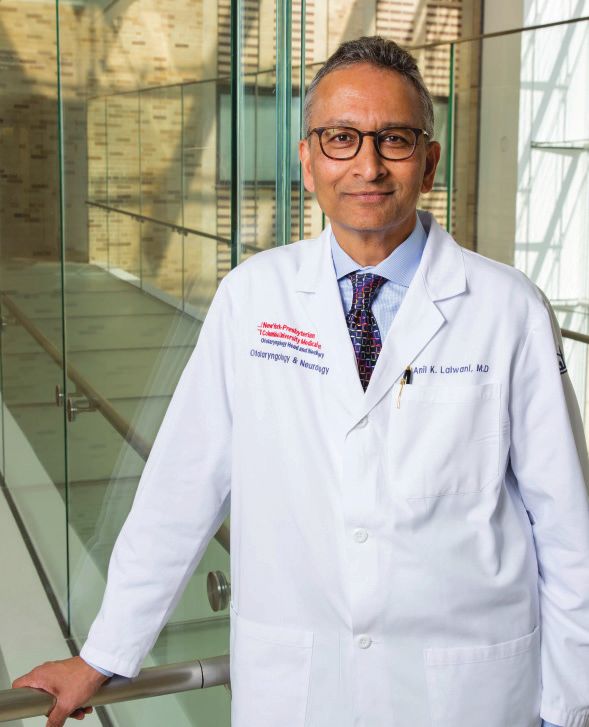
New York’s #1 Hospital
18 Years in a Row
ADVANCES IN OTOLARYNGOLOGY - HEAD AND NECK SURGERY
NewYork-Presbyterian Hospital
NON-PROFIT ORG.
525 East 68th Street US POSTAGE
New York, NY 10065 PAID
NEW BRUNSWICK, N.J. 08901
www.nyp.org PERMIT NO. 1
On the Frontlines of Cochlear Implant Research (continued from page 3)
Enhancing the Enjoyment of Music
Despite excellent performance in speech generate a more enjoyable listening experience for
discrimination, appreciation of music among the cochlear implant user. “Focusing on vocals,
cochlear implant listeners remains poor. “Before instruments, musical complexity, reverberation,
an implant, patients might get zero percent of and harmonics, we are seeking to identify what
the words right and after receiving the implant, aspect of musical input is important,” he says.
they might get 80 percent right,” says Anil K. “Our hypothesis is that re-engineering the
Lalwani, MD, Co-Director of the Cochlear original piece of music to better reflect the aspect
Implant Program and Chief of Otology, Neuro that the listener likes or dislikes will lead to
logy, and Skull Base Surgery. “However, in a heightened musical enjoyment.”
similar music perception test, which may include To aid in their investigation, the American
identifying a note, an instrument, or a piece of Academy of Otolaryngology – Head and Neck
music, they may get zero to 15 percent correct.” Surgery awarded a grant to resident Tiffany
According to Dr. Lalwani, diminished music Peng, MD, and the Columbia team to conduct
appreciation has been attributed to low resolution a study with a sound/audio engineer and a
and skewed mapping of transmitted frequencies web developer to create a novel web-based
through the cochlear implant. “A person needs Dr. Anil K. Lalwani application that enables a cochlear implant
only five or six electrodes – distinct points of listener to adjust and tweak the music to
stimulation within the cochlea – to understand speech,” he says. enhance their enjoyment of it. The researchers recruited cochlear
“You probably need hundreds to do the same for music. The fine implant listeners to mix the audio for a song, adjusting treble and
temporal information needed is missing and I believe there are bass frequencies, percussion emphasis, and reverberation. The
several possible reasons why.” team concluded that the user-directed modifications were more
Dr. Lalwani suggests there may not be enough receivers to enjoyable than preset modifications and that music re-engineering
handle all the information that cochlear devices are able to provides the flexibility to further optimize music enjoyment.
communicate, or perhaps the speech processing strategies aren’t “Our long-term goal is to design an app that will allow one to
suited for music. “The third possibility, and my assumption, is stream music through it with those adjustments,” says Dr. Lalwani.
that it is unrealistic to expect a deaf individual with a cochlear “It would have the potential of helping every cochlear implantee in
implant to perceive music in the same way as a normal-hearing the world enjoy music – and that’s about a quarter million people now.”
person. The normal-hearing person has 100 percent of neurons,
whereas the deaf individual with the cochlear implant may only For More Information
have 20 to 30 percent.” Dr. Ana H. Kim • ahk2166@cumc.columbia.edu
Dr. Anil K. Lalwani • akl2144@cumc.columbia.edu
Over the last six years, Dr. Lalwani and his colleagues have sought
Dr. Lawrence R. Lustig • lrl2125@cumc.columbia.edu
to identify how the complexity level of music can be altered in order to
4You can also read


