Ontario Autism Program: Caregiver-mediated early years programs Call for applications December 11, 2020
←
→
Page content transcription
If your browser does not render page correctly, please read the page content below
MINISTRY OF CHILDREN, COMMUNITY AND SOCIAL SERVICES

Ontario Autism Program:
Caregiver-mediated early years programs
Call for applications
December 11, 2020

 Ministry of Children, Community and Social Services
 Call for applications: OAP Caregiver-mediated early years programs   Page 1 of 39
Application submission instructions
   Your completed application must be emailed by January 29, 2021 at 5:00pm Toronto Time to
   OAP_CFA@ontario.ca. Applications may be submitted in English or French. Submissions in
   French will be translated into English by MCCSS.

   Questions and answers about this call for applications:
   Please address questions to the Ministry at OAP_CFA@ontario.ca between December 16, 2020
   to January 8, 2021 at 5:00pm Toronto Time.

   Disclaimer
   It is the applicant’s responsibility to ensure that all information provided by the applicant is up-
   to-date and correct to the best knowledge of the applicant.

   It is the applicant’s responsibility to ensure that the application reaches the ministry on, or prior
   to, the application closing deadline. The ministry is not responsible for applications that are lost,
   delayed, misplaced or misdirected.

   By submitting an application, applicants acknowledge that this is not a competitive
   procurement/tender process and that determination of the successful candidates for funding
   shall be made at the ministry’s sole and absolute discretion.

Ministry of Children, Community and Social Services
Call for applications: OAP Caregiver-mediated early years programs                      Page 2 of 39
Table of contents
   Section 1: Introduction and context ............................................................................................................. 4
   Section 2: Submission and review process ................................................................................................... 5
      a) Submission process ............................................................................................................................... 5
      b) Review process ..................................................................................................................................... 6
      c) Partnership expectations for organizations .......................................................................................... 6
   Section 3: Timelines ...................................................................................................................................... 8
   Section 4: OAP caregiver-mediated early years programs ........................................................................... 9
      A. Description of Caregiver-Mediated Early Years programs ................................................................... 9
      B. Key elements of caregiver-mediated early years programs: ................................................................ 9
      C. Key objectives and desired outcomes of caregiver-mediated early years programs: ........................ 12
      D. Criteria for eligible caregiver-mediated early years programs........................................................... 13
      E. Roles and responsibilities of organizations in the caregiver-mediated early years programs ........... 15
      F. Evaluation of caregiver-mediated early years program applications ................................................. 15
   Section 5: Application form for caregiver-mediated early years programs ............................................... 20
      Part 1 - Applicant and community information ...................................................................................... 20
      Part 2 – Preliminary application criteria ................................................................................................. 22
      Part 3 - Rated application components (220 points) .............................................................................. 25
   Appendix A -Service delivery areas ............................................................................................................. 39

Ministry of Children, Community and Social Services
Call for applications: OAP Caregiver-mediated early years programs                                                                      Page 3 of 39
Section 1: Introduction and context
In December 2019, the Ministry of Children, Community and Social Services (MCCSS) announced
key elements of the new needs-based, sustainable and family-centred Ontario Autism Program
(OAP), including a broad range of services that will offer families more supports for their child’s
specific needs. The new program will recognize that every family’s experience and needs are
different, and that children and youth on the autism spectrum have different levels of need at
different points in their lives.
In the new needs-based OAP, all children/youth up to age 18 with a written diagnosis of Autism
Spectrum Disorder (ASD) from a qualified professional will be eligible to register for the
OAP.Families will have access to the following service pathways and program supports in the
new program:
Core clinical services that include Applied Behaviour Analysis, speech language pathology,
occupational therapy and mental health services;
Foundational family services for all families in the program, to build their capacity to support
their child’s learning and development;
Early years supports and entry to school services to help young children access critical
services when they will benefit most, and to prepare them to enter school;
Urgent response services to support children and youth who are in service, or are waiting for
service, and have significant and immediate needs; and
Care Coordinators to support families throughout their journey by providing orientation to the
program, service planning and navigation, and help with managing transitions.
Two types of early years services will be available in the needs-based Ontario Autism Program:
caregiver-mediated early years programs; and
entry to school services.
The focus on this Call for Applications (CFA) is on the delivery of the caregiver-mediated early
years programs, which are described in detail in Section 4. The CFA to deliver entry to school
services is expected to be issued in March 2021. Interested applicants may choose to also submit
an application to deliver entry to school services at that time.
Ministry of Children, Community and Social Services
Call for applications: OAP Caregiver-mediated early years programs Page 4 of 39Section 2: Submission and review process
To support a new sustainable and needs-based OAP, MCCSS is releasing this CFA to invite
organizations to express their interest and apply to deliver caregiver-mediated early years
programs in their communities. The application form for the delivery of caregiver-mediated
early years programs can be found in Section 5 of this CFA.
This CFA is being distributed to publicly-funded providers and private providers.
The CFA process will identify initial organizations to implement a caregiver-mediated early years
program over a period of two years (2021/2022 and 2022/2023). As these initial programs are
implemented, services will be evaluated and adjusted as needed. Once an Independent Intake
Organization (IIO) becomes operational, they will assess the need and capacity for additional
providers in the respective regions.
Funding allocations for each organization will be determined by the ministry and outlined in a
service agreement between the ministry and recipient. Selected organizations will receive
funding from the ministry via a transfer payment service agreement.
Organizations must direct the majority of funds provided to direct service delivery. A maximum
of 10% of the funding can be directed to administrative support, project management and
overhead. Northern communities may direct a maximum of 10.5% of the funding to
administrative support, project management and overhead.
a) Submission process
1. Documents must be submitted in electronic form.
2. Applicants are encouraged to answer each of the questions clearly, completely and
concisely. The application must be typed in point or paragraph form.
3. Applicants are strongly encouraged to provide any supporting documentation in clearly
defined appendices at the end of the submission.
4. Applications must be submitted with the subject line: “Caregiver-Mediated Early Years
Program Application – [Name of Organization]”.
5. Completed applications must be received by MCCSS by no later than 5:00 pm on January
29, 2021.
6. Submissions must be submitted electronically to MCCSS at OAP_CFA@ontario.ca.
7. Applicants will be sent an electronic confirmation of receipt of their application.
Ministry of Children, Community and Social Services
Call for applications: OAP Caregiver-mediated early years programs Page 5 of 398. Questions about the CFA may be submitted to MCCSS at OAP_CFA@ontario.ca between
December 16, 2020 to January 8, 2021 at 5:00 pm.
Organizations/partnerships interested in submitting an application for the caregiver-mediated
early years programs should carefully review the program criteria, implementation timelines,
and CFA evaluation criteria outlined below, and submit a completed application form to MCCSS
by January 29, 2021. Please note that additional time has been factored into the submission
deadlines in acknowledgement of the holiday period.
The ministry will be holding information sessions for interested organizations regarding the CFA
on December 16 and 17, 2020. Please see the attached memo for more information regarding
these sessions, including how to register for a session. In addition to the information sessions,
questions about the CFA may be submitted to the ministry between December 16 to January 8 at
5:00pm Toronto Time. Application submission instructions are on the cover page of this CFA.
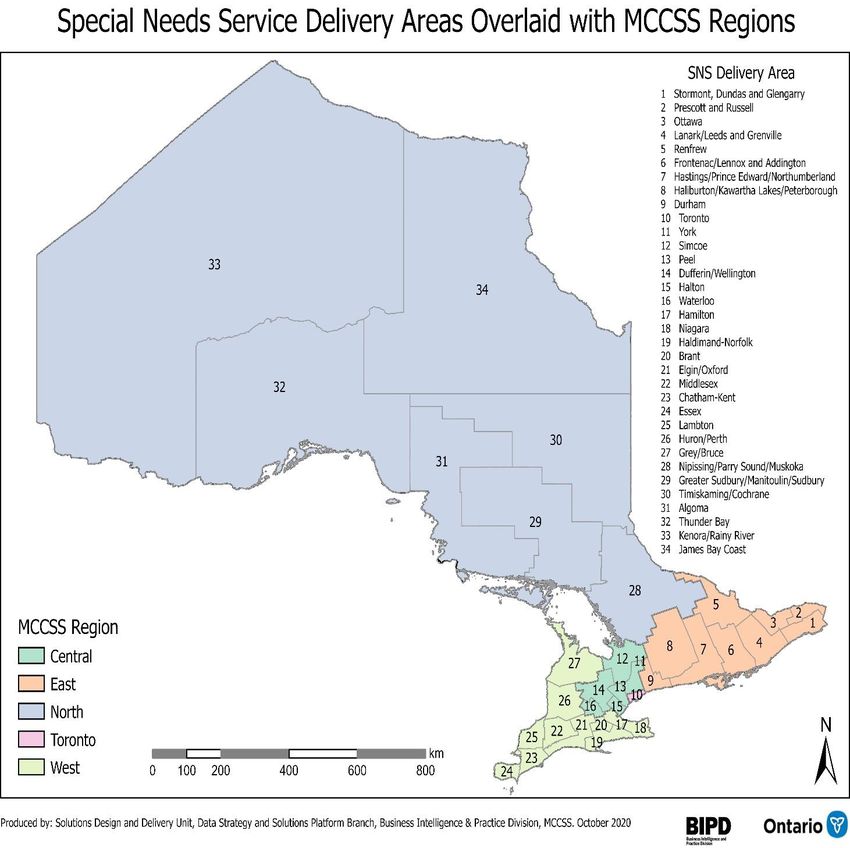
Organizations/partnerships must identify which MCCSS region they will serve, including which
service delivery areas they will serve within the region (See Appendix A for a list and map of
service delivery areas within each region). Organizations are encouraged to develop partnerships
in order to cover as many service delivery areas within the region as possible. When the
Independent Intake Organization for the OAP is implemented, it will establish an integrated and
coordinated regional network of service providers within each of the five MCCSS regions,
including organizations delivering caregiver-mediated early years services.
Organizations should propose their service capacity based on anticipated local demand for these
services. Please refer to Section 4B of this document for the estimated number of children
eligible for caregiver-mediated early years programs by region.
b) Review process
MCCSS will evaluate applications based on the demonstration of how the program design will
meet the objectives and expectations identified in the CFA document. If required, MCCSS may
ask applicants to clarify specific aspects of their application. MCCSS will notify both successful
and unsuccessful applicants in writing.
c) Partnership expectations for organizations
Organizations will be expected to build on or initiate innovative and collaborative local
partnerships with both publicly-funded and private providers to implement a caregiver-mediated
early years program within their communities.
Ministry of Children, Community and Social Services
Call for applications: OAP Caregiver-mediated early years programs Page 6 of 39In their application, organizations must demonstrate how they will partner and collaborate with community social service providers to support coordination and implementation, including how the program would be integrated into the community/region’s existing service system. Strong partnerships between local service providers will help to facilitate efficient delivery of programs across the region, including supporting the various cultural, linguistic and geographic needs of children, youth and families within the region. A group of organizations within a region may wish to submit a joint application. Joint applications will be expected to outline how organizations that form the partnership will work together to determine locally what type of service delivery model they anticipate would work best within their community’s existing service system. In the case of joint applications, criteria will be applied to the collective capacity of the partnership. However, a single organization should be identified by the partnership as the applicant and the organization that will lead the implementation of the program in their community and sign a transfer payment service agreement with MCCSS. If an organization within the partnership has an existing transfer payment agreement with the ministry, then this organization would be considered the lead organization, or “applicant”. It is expected that the lead organization will enter into sub-contractor agreements or Memoranda of Understanding with the other organizations within the partnership. Ministry of Children, Community and Social Services Call for applications: OAP Caregiver-mediated early years programs Page 7 of 39
Section 3: Timelines
   Below are the timelines for organizations interested in submitting an application for the delivery
   of a caregiver-mediated early years supports program:

     CFA issued                                       December 11, 2020

     Information sessions                             Session 1: December 16, 2020, 2:00-3:00pm

                                                      Session 2: December 17, 2020, 10:00-11:00am

     Deadline for questions                           5:00pm on January 8, 2021

     Application deadline                             5:00pm on January 29, 2021

     Evaluation of CFA submissions and follow
     up questions for applicants as required  February 2021

     Selected Organizations Notified                  February 2021

     Transfer Payment Agreement
     Development                                      March 2021

     Organization Implementation Planning             March 2021

     Program Launch (may include
     recruitment and staff training, ramp up
     activities, and communication to
     caregivers about the program)                    Beginning April 1, 2021*

   * Note: Selected providers will begin to implement their caregiver-mediated early years program
   on April 1, 2021. If selected providers have existing staff trained to deliver their program, they
   may be ready to begin to deliver services to families in April 2021. New providers may need
   additional time to complete staff training before delivery of services can begin. It is expected
   that all providers will begin delivering services to families by late spring/early summer 2021.

Ministry of Children, Community and Social Services
Call for applications: OAP Caregiver-mediated early years programs                     Page 8 of 39
Section 4: OAP caregiver-mediated early years
programs
A. Description of Caregiver-Mediated Early Years programs
Caregiver-mediated early years programs will be time-limited services for young children based
on their individual needs. In parent/caregiver-mediated services, parents/caregivers learn
therapeutic strategies from professionals and are supported to use these strategies with their
child.
These programs will be available to children who are registered with the OAP, with a confirmed
diagnosis of autism, and are between the ages of 12 to 48 months.
Caregiver-mediated early years programs will be, play-based and child-led developmentally
appropriate programs to help young children (12 to 48 months of age) learn new skills and meet
individualized goals in the areas of social communication and play and build caregiver capacity to
support their children. These programs are intended to be offered for up to six months.
B. Key elements of caregiver-mediated early years programs:
Program
Description
element
Program focus Focused on building caregiver capacity to support their child’s skill
development in one or more of the following areas:
o Social Interaction
o Play
o Communication
o Emotional Development
o Adaptive Development and Self-Help Skills
Duration and Services will be time-limited and available for up to six months.
intensity Intensity may vary based on specific eligible programs.
Eligibility Children who are 1 to 3 years of age (12-48 months) with a diagnosis of
autism spectrum disorder, and who are registered in the OAP, will be
eligible.
Ministry of Children, Community and Social Services
Call for applications: OAP Caregiver-mediated early years programs Page 9 of 39Program
Description
element
o Children on the waitlist, and those receiving Childhood Budgets or
Interim One-Time Funding will be eligible.
o Children with an active OAP behaviour plan and children receiving core
services are not eligible to access these programs.
o Children can receive other OAP, special needs and/or community-based
early years programs concurrently (other than core services within the
OAP).
o Families cannot participate in more than one caregiver-mediated early
years program at the same time.
Eligible families will be referred to providers by the OAP (i.e., initially by the
Central Intake and Registration Team and in future by the Independent
Intake Organization once it is operational) once families have registered for
the OAP.
Delivery Parents/caregivers will learn therapeutic strategies from professionals and
are supported to use these strategies with their child.
Therapists teach caregivers specific techniques to support their child’s
development, and do not deliver the intervention directly to the child. This
may or may not include the therapist demonstrating implementation of a
technique or strategy with the child while the parent/caregiver observes, in
order to learn specific techniques.
Organizations should build on or initiate innovative and collaborative local
partnerships with other providers to implement a caregiver-mediated early
years program. Within these partnerships, a lead organization should be
identified.
o The lead should work with partners to ensure the proposed program is
accessible to the entire region and addresses the unique local needs of
their area, including supporting various cultural and linguistic
populations, as well as rural and remote service delivery.
Organizations may choose to include a proposal to deliver one or more
caregiver-mediated programs.
Depending on the proposals submitted, the ministry may fund multiple
organizations within each region to deliver caregiver-mediated programs
across the entire region.
Caregiver-mediated early years programs can be delivered in community
and home-based settings, and/or delivered through virtual service delivery.
Given current restrictions to in-person services during the COVID-19
Ministry of Children, Community and Social Services
Call for applications: OAP Caregiver-mediated early years programs Page 10 of 39Program
Description
element
pandemic, please include options for interim virtual/telepractice service
delivery within your proposal.
Organizations/partnerships must identify which MCCSS region they will
serve, including what service delivery areas will be covered within the region
(See Appendix A for a list and map of service delivery areas within each
region). Organizations are encouraged to develop partnerships in order to
cover as many service delivery areas within the region as possible. The five
regions align with the five MCCSS regions, and are:
o North Region
o East Region
o Central Region
o West Region
o Toronto Region.
Estimated number of children eligible for caregiver-mediated early years programs by region:
Region 2021-22 2022-23 2023-24
Central 1,548 772 772
East 691 333 333
North 84 48 48
Toronto 945 429 429
West 438 223 223
Total 3,706 1,805 1,805
Note that these numbers are estimates based on current OAP registrations and are subject to
change. It is also expected that uptake will be lower in year one (2021-22) due to the time it will
take selected providers to implement the program.
Ministry of Children, Community and Social Services
Call for applications: OAP Caregiver-mediated early years programs Page 11 of 39C. Key objectives and desired outcomes of caregiver-mediated
early years programs:
Objectives
1. Support families and children as soon as possible after diagnosis.
2. Help young children develop/acquire core foundational skills in the areas of communication,
socialization and play to facilitate participation in activities with their families and peers.
3. Help young children develop independence in activities of daily living (hygiene and grooming,
bathing, dressing and toileting, etc.).
4. Provide parents/caregivers with specific strategies to support their child’s development while
working towards meeting identified developmental milestones.
5. Increase parent/caregiver confidence in their ability to support their child in both home and
community settings.
6. Support families in identifying and accessing next steps for their children upon completion of
early years programs.
Outcomes
1. Children will learn new skills to help them participate in activities with family and peers.
2. Children will show measurable improvement in skills/abilities related to their individualized
goals.
3. Families and children will feel more connected with one another.
4. Parents/Caregivers will have a better understanding of their child’s strengths and interests, and
how to use them in skill building.
5. Parents/Caregivers will learn new strategies to support their child’s development.
6. Parents/Caregivers will feel more confident in their abilities to support and facilitate their
child’s development.
7. Parents/Caregivers will feel engaged and better supported in interacting with their child and
addressing their child’s challenging needs.
8. Parents/Caregivers will feel confident in understanding their child’s needs and the services
available upon transition from early years programs. They will be supported in identifying what
to do and where to go next.
Ministry of Children, Community and Social Services
Call for applications: OAP Caregiver-mediated early years programs Page 12 of 39D. Criteria for eligible caregiver-mediated early years programs
Organizations can propose a caregiver-mediated program that meets all of the program
expectations outlined in Section 4B. In addition to meeting the program requirements in Section
4B, in order to be eligible for funding, the proposed caregiver-mediated program must also meet
all of the criteria below:
Caregiver-mediated: The intervention is caregiver-mediated. Caregivers learn therapeutic
strategies from professionals and are supported to use these strategies with their child to
support their child’s development.
Note: In caregiver-mediated interventions, therapists teach caregivers specific techniques to
support their child’s development rather than delivering the intervention directly to the
child. This may or may not include the therapist demonstrating implementation of a
technique or strategy with the child while the parent/caregiver observes, in order to learn
specific techniques. Therapist-delivered early years programs (where therapists are
delivering services directly to a child), or programs with a hybrid model including a
combination of therapist-delivered intervention and parent/caregiver-mediated
intervention, are not eligible within the early years supports stream. Note that therapist-
delivered and hybrid models may be eligible through other service streams.
Individualized and responsive: Program is developmentally appropriate and responsive to
families’ needs.
Effective:
o Program must have demonstrated effectiveness for young children with autism
spectrum disorder or showing signs of autism spectrum disorder.
o Program has demonstrated ability to show measurable change in a child’s outcomes,
over a specific time period.
Ministry of Children, Community and Social Services
Call for applications: OAP Caregiver-mediated early years programs Page 13 of 39 Evidence-informed:
o Program has a strong research base demonstrating positive child outcomes. Research
base includes high quality, published peer-reviewed group design studies1, or several
peer-reviewed single subject design studies2.
o Program has not demonstrated any evidence of harm.
Timeframe: Program is intended to be delivered for up to six months.
Evaluation: Program will be delivered with fidelity, target outcomes will be measured, and an
evaluation of outcome data will be implemented to monitor program effectiveness.
Based on these criteria, some examples of caregiver-mediated early years programs that would
be eligible to be included in the OAP for 2021/2022 and 2022/2023 include:
1. ESI/SCERTS (Early Social Interaction / Social Communication Emotional Regulation and
Transactional Supports)
2. Joint Attention, Symbolic Play, Engagement & Regulation (JASPER)
3. Pivotal Response Treatment (PRT)
4. PLAY Project
5. Project ImPACT
6. Social ABCs
If an organization wishes to apply to deliver another caregiver-mediated program, they are
responsible for outlining the research evidence for their desired program, and clearly
demonstrating in their application that the program meets all of the criteria outlined above. The
first stage of the evaluation process will be a review of Part 2 of each applicant’s form, where
they demonstrate how they meet the criteria above.
1 *Adequate group designs could include randomized control trials (RCT), sequential multiple
assignment randomized trials (SMART design), quasi-experimental designs (QED), or regression
discontinuity designs (RDD) that compare an experimental/intervention group receiving the
intervention to at least one other control or comparison group that did not receive the
intervention or received another intervention.
2 **Single case research designs (SCRDs) must demonstrate the functional relationships
between the intervention (or independent variable) and the autistic child outcomes. Acceptable
SCDs could include withdrawal of treatment (ABAB), concurrent multiple baseline, multiple
probe, alternating treatment, and changing criterion designs, as well as SCDs that included
hybrid designs.
Ministry of Children, Community and Social Services
Call for applications: OAP Caregiver-mediated early years programs Page 14 of 39For applicants whose proposed program is not included in the list of programs above, the
ministry may seek confidential clinical and research expertise to review and assess the submitted
research evidence and advise on whether it meets the criteria. Any clinical or research expert
asked to review submitted research evidence will not have access to or review any part of an
applicant’s application form (i.e., Parts 1, 2 and 3 of the form).
E. Roles and responsibilities of organizations in the caregiver-
mediated early years programs
The role of the lead organization will be to:
Lead the development of the CFA proposal and implementation plan;
Coordinate the input of the partnering organizations;
Deliver the caregiver-mediated program, if applicable;
Manage implementation timelines, reporting, budgets and all other aspects of service
implementation and delivery; and
Work with the supporting organization(s) to ensure successful service implementation,
delivery, and reporting requirements.
The role of the partnering organization(s) will be to:
Support the development of the CFA proposal and implementation plan; and
Work with the lead organization to ensure successful service implementation, delivery, and
reporting requirements.
F. Evaluation of caregiver-mediated early years program
applications
Applications will be reviewed in a two-stage process. In the first stage of evaluation, applicants
must demonstrate their proposed program meets all of the criteria outlined in Sections 4B and
4D to be eligible for consideration (Part 2 of application form, Preliminary Evaluation Criteria).
In the second stage, applications that meet all of the preliminary evaluation criteria in Part 2 of
the form will then be evaluated based on the rated criteria in Part 3 of the form. Applications
that do not meet the criteria in Part 2 will be disqualified and will not be evaluated in stage two.
The following criteria and scoring will be used to evaluate applications to deliver a caregiver-
mediated early years program:
Ministry of Children, Community and Social Services
Call for applications: OAP Caregiver-mediated early years programs Page 15 of 39Rated criteria Points*
Community Leadership in Early Years Services 35
Well-Established Partnerships in the Early Years and Community Social 30
Service Sectors
Staff Knowledge, Skills, Expertise, and Experience 30
Organizational Capacity to Successfully Lead Program 35
Implementation Plan 40
Evaluation Plan 30
Budget 20
TOTAL: 220
Community leadership in early years services (35 points)
The organization/partnership:
Provides various types of early years services, such as speech and language pathology
services, developmentally appropriate, play-based early years services, and Applied
Behaviour Analysis services.
Is a well-established community leader in the provision of high quality, family-centered,
evidence-based early years services for infants and toddlers with developmental
concerns/delays.
Effectively uses and promotes best practices in providing supports and services to children
with special needs and involves families in treatment/service decisions.
Has the ability to meet service targets, including established intake processes.
Well-established partnerships in the early years and community social
services sectors (30 points)
The organization/partnership:
Has strong partnerships and is part of a well-established network of service providers to
support the establishment, coordination and integration of the early years program within
its community. Organizations and/or partnerships are able to seamlessly incorporate a
caregiver-mediated early years program into their community’s existing network of early
identification and early years services for infants and toddlers with autism spectrum
disorder;
Ministry of Children, Community and Social Services
Call for applications: OAP Caregiver-mediated early years programs Page 16 of 39 Has demonstrated experience working with other service providers to address the diversity
and geography of their region, including supporting the various cultural and linguistic
populations, including Indigenous and Francophone communities, of children and youth
within the organization’s/partnership’s region, including rural and remote areas.
Is well-positioned to take an interdisciplinary and collaborative approach when working
with other service providers to implement the program.
Has demonstrated ability to develop and maintain relationships with children’s service
providers in the service delivery area in order to efficiently deliver caregiver-mediated
early years programs across the region.
Staff knowledge, skills, expertise, and experience (30 points)
The organization/partnership employs, or has the capacity/ability to employ (if gaps are
identified) staff that:
Have a strong foundation in autism spectrum disorder; early child development (infant and
toddler); ABA-based (behaviourally-based) services and Speech and Language Pathology
services and their approaches;
Have experience working directly with children; and want to fully engage/play with
children to deliver the program;
Are comfortable working with and coaching caregivers (e.g., parents, grandparents)
including in their own homes or via virtual service delivery and/or telepractice;
Are interdisciplinary in how they approach their work with children and others providing
services to the child/family; and
Have experience delivering services to diverse cultural and linguistic populations.
The organization/partnership should also have demonstrated a commitment to and
experience in consulting and collaborating with other clinicians (within organization and
with clinicians employed by other community agencies) as part of an interdisciplinary
approach.
Organizational Capacity to Successfully Implement, Lead, and Evaluate
a Program (35 points)
The organization identified to lead a program (i.e., the applicant) has the capacity to:
Successfully implement, lead, and coordinate the program within established MCCSS
timelines, working effectively and efficiently with its partners, and MCCSS. The
organization can successfully implement the program in a relatively short timeframe and
can be flexible in adapting service delivery of caregiver-mediated early years programs in
both in-person and virtual modes.
Ministry of Children, Community and Social Services
Call for applications: OAP Caregiver-mediated early years programs Page 17 of 39 Document and share its experience with other communities including implementation
processes, lessons learned and successes to improve outcomes for children and their
families;
Implement and maintain clear processes and protocols for collaboration and information
sharing among relevant providers in the children’s services, education, and health sectors
through such methods as up-to-date agreements and/or memoranda of understanding
(MOUs) that address, at a minimum, how and when to refer families, share information
and roles and responsibilities in contributing to early years services. Demonstrated
commitment in principle of proposed partners to collaborate to successfully implement
program. Letters of support will be encouraged;
Outline proposed intake processes for families of children and youth who may be seeking
early years services;
Will collect and analyze a range of data (e.g., to measure implementation processes,
treatment fidelity, child and family outcomes) and lead a program evaluation;
Facilitate consistent information sharing by promoting the program, both amongst service
providers and with families of children and youth receiving services, regarding the delivery
of caregiver-mediated early years services;
Has effective governance and financial policies and procedures in place and the support of
senior management, and if applicable, a Board of Directors, to successfully manage the
implementation and evaluation of a program; and
Take a leadership role in the management of any conflicts with service partners across
sectors.
Implementation plan (40 points)
The organization/partnership:
Includes a detailed workplan that provides a timeframe for each of the key activities to be
completed to launch an early years program beginning in April 2021.
Evaluation plan (30 points)
The organization/partnership:
Provides a brief description of the evaluation approach that will be used to measure the
effectiveness, efficiency and feasibility of the program on an annual basis, including
qualitative and quantitative data about the program. This should include how the
organization/partnership plans to evaluate measurable change in a child’s outcomes, over
a specific period of time.
Budget (20 points)
The organization/partnership includes a proposed budget that:
Ministry of Children, Community and Social Services
Call for applications: OAP Caregiver-mediated early years programs Page 18 of 39 Shows clear linkages to the workplan and the organization’s capacity to meet the
requirements outlined in the CFA within established timeframes;
Provides cost estimates that are reasonable from the Ministry’s point of view based on its
knowledge and experience funding similar services; and
Allocates no more than 10% of the proposed budget towards administrative costs (or
10.5% for services delivered to Northern communities).
Ministry of Children, Community and Social Services
Call for applications: OAP Caregiver-mediated early years programs Page 19 of 39Section 5: Application form for caregiver-
mediated early years programs
Instructions:
Review all sections of this CFA before completing this form.
Enter your answers to all questions directly on this form and attach any additional material
required as appendices, as well as letters of support.
Additional instructions are on the cover page of this CFA.
Part 1 - Applicant and community information
Legal Name of Applicant
Operating name (if different from above)
Street address Mailing address (if different from street
address)
City/Town City/Town
Province Postal code Province Postal code
Name of president/Chair of the Title Telephone/E-mail address
Board (if applicable)
Name of Executive Director or Title Telephone/E-mail address
Chief Executive Officer
Website Address
Contact person for application Position/Title Name of organization
Telephone E-mail
Ministry of Children, Community and Social Services
Call for applications: OAP Caregiver-mediated early years programs Page 20 of 39If this is a joint application from more than one organization, please identify the other partner(s) that would be implementing the program. The “Applicant” identified above should be the organization that will provide overall project leadership and that would be the signatory of a Transfer Payment agreement with MCCSS. Please estimate the number of children and youth your organization/partnership would serve per year in 2021/22 and 2022/23. Please include how you arrived at these estimates. Does your organization/partnership provide services in French and/or in other languages outside of English? Is the applicant in a designated area under the French Language Services Act? Ministry of Children, Community and Social Services Call for applications: OAP Caregiver-mediated early years programs Page 21 of 39
Identify the caregiver-mediated early years program(s) that your organization would deliver.

   Part 2 – Preliminary application criteria
   Refer to Section 4D “Criteria for Eligible Caregiver-Mediated Early Years Programs” in preparing
   your responses.

    1. Caregiver-mediated: Is the program that your organization/partnership is planning to
       deliver caregiver-mediated? Do caregivers learn therapeutic strategies from professionals
       and are they supported to use these strategies with their child to support their child’s
       development?

    2. Individualized and responsive: Describe how the program that your
       organization/partnership is planning to deliver is developmentally appropriate and
       responsive to families’ needs.

Ministry of Children, Community and Social Services
Call for applications: OAP Caregiver-mediated early years programs                   Page 22 of 39
3. Effective: If your proposed program is not included in the list of examples of eligible
programs in Section 4D, please provide evidence that the program your
organization/partnership is planning to deliver has demonstrated effectiveness for young
children with autism spectrum disorder or showing signs of autism spectrum disorder, and
has demonstrated the ability to show measurable change in a child’s outcomes over a
specific time period. (Not required for programs identified as eligible examples in Section
4D).
Ministry of Children, Community and Social Services
Call for applications: OAP Caregiver-mediated early years programs Page 23 of 394. Evidence-informed: If your proposed program is not included in the list of examples of
eligible programs in Section 4D, please provide evidence of a strong research base
demonstrating that the program your organization/partnership is planning to deliver has
positive child outcomes and has not demonstrated any evidence of harm, including
submitting links to relevant research. (Not required for programs identified as eligible
examples in Section 4D).
5. Timeframe: What is the length of the program your organization/partnership intends to
deliver? (i.e. number of months and number of hours of service delivery)
6. Evaluation: Programs must be delivered with fidelity. Briefly describe how your
organization/partnership will monitor program effectiveness by measuring target outcomes
and evaluating outcome data.
Ministry of Children, Community and Social Services
Call for applications: OAP Caregiver-mediated early years programs Page 24 of 39Part 3 - Rated application components (220 points)
Refer to Section 4F “Evaluation of Applications” in preparing. your responses.
A. Community leadership in early years services (35 points)
1. Describe the current early years services delivered by your organization/partnership and
the population you serve. (15 points)
2. Describe your role in your community’s early years and early years services sector(s) in
providing and promoting high-quality, family-centered, evidence-based early years
services, including caregiver-mediated early years programs. (20 points)
B. Well-established partnerships in the early years and early years
services sector (30 points)
3. Describe the existing partnerships and network of programs/services that you will be
leveraging to implement the program. What is your plan to communicate the new services
to families in your community, as well as to service providers to facilitate awareness of the
program (e.g., early years sector, child care providers, etc.). (5 points)
Ministry of Children, Community and Social Services
Call for applications: OAP Caregiver-mediated early years programs Page 25 of 394. Provide a recent and relevant example of a successful partnership with other service
providers in your community, noting lessons learned that would apply to the
implementation of an early years program. (5 points)
5. Please outline your strategy to address the needs of the various cultural and linguistic
populations of children/youth and their families within your region, including, but not
limited to:
a. First Nations, Inuit and Métis children and families; and
b. Francophone or other linguistic populations. (10 points)
Ministry of Children, Community and Social Services
Call for applications: OAP Caregiver-mediated early years programs Page 26 of 396. Please outline your strategy to address the needs of children and families across the various
geographic areas within your region (i.e. rural and remote areas). Does your organization
have the capacity to deliver virtual services in remote communities? If so, please explain.
Please also describe any travel costs and/or partnerships that may be involved in serving
your region. (10 points)
C. staff knowledge, skills, expertise, and experience (30 points)
7. Describe the knowledge, skills, qualifications and experience of the staff within your
organization/partnership that may be employed to deliver one of the caregiver-mediated
early years programs. If there are any gaps in your staffing capacity to implement a
caregiver-mediated early years program, please describe how you would address them. (15
points)
Ministry of Children, Community and Social Services
Call for applications: OAP Caregiver-mediated early years programs Page 27 of 398. Describe your organization’s/partnership’s experience in and commitment to consulting and
collaborating with other clinicians (either within the same organization or clinicians
employed by other service providers) as part of an interdisciplinary approach, as well as your
experience working collaboratively with families to identify children’s strengths and needs
to support the development of individualized goals. (15 points)
D. Organizational capacity to successfully implement a caregiver-
mediated early years program (35 points)
9. Provide a brief description of the approach your organization will take related to
developing and implementing the caregiver-mediated early years program based on the
key elements outlined in Section 4 and within established timelines (section 3), including
how this program will be developed and integrated within your community’s/region’s
existing service system (e.g. various provincially and municipally-funded programs,
Ministry of Children, Community and Social Services
Call for applications: OAP Caregiver-mediated early years programs Page 28 of 39programs delivered by private providers etc.). (15 points)
10. Describe your current intake and/or screening processes and tools, and how these will
support your organization/partnership to determine which children referred from the OAP
are eligible for the caregiver-mediated early years program. Include how this would address
the specific needs of families in rural and remote areas in your region, as well as Indigenous
and Francophone communities. (10 points)
11. Describe how your organization/partnership will implement and maintain clear processes
and protocols for collaboration and information sharing among relevant providers and
communities including implementation processes, lessons learned and successes to improve
outcomes for children and their families (10 points).
Ministry of Children, Community and Social Services
Call for applications: OAP Caregiver-mediated early years programs Page 29 of 39E. Implementation plan (40 points) The ministry will notify selected organizations in February 2021, and organizations are expected to prepare for the implementation of services in Q4 of 2020/21 and begin delivering services in Q1 of 2021/22. Identify and describe all steps that will be taken/required to implement and begin to deliver caregiver-mediated early years programs in your community in Q1 of 2021/22. Identify resources available for all steps and key milestones. The work plan must outline all of the activities to be undertaken from the point of signing a contract with the ministry to full implementation. The work plan should also provide a timeframe for each of the key activities and the resources available to support implementation (i.e., staff resources). Please include a Timeline/Critical Path (see template below) which specifies all start and end dates for each of the key activities from development to implementation. Ministry of Children, Community and Social Services Call for applications: OAP Caregiver-mediated early years programs Page 30 of 39
Start Date/End        Key          Resources   Anticipated
       Activities/Milestone
                                       Date            Roles         Available   Outcomes

   Service delivery
   a) Please describe your approach to implementing the early years program within your existing
      organizational structure and with your proposed partner organizations, including:
      What services will be delivered;
      The intensity and duration of the program per child;
      The setting(s) in which the program will be delivered;
      Any plans for virtual service delivery; and
      Whether services will be delivered individually and/or in a group setting. (20 points)

Ministry of Children, Community and Social Services
Call for applications: OAP Caregiver-mediated early years programs                    Page 31 of 39
Caregiver/Parent Involvement
a) Please describe the role of parent/caregivers in the delivery and evaluation of the program.
How do you plan to train caregivers/parents in the program? (10 points)
b) Please describe your plan to ensure that all caregivers/parents are able to participate in the
program and how you will facilitate their involvement (i.e., language barriers, childcare
needs, delivering caregiver/parent training during family-friendly hours, etc.). Do you have
any mitigation strategies if your approach is not successful? (5 points)
Ministry of Children, Community and Social Services
Call for applications: OAP Caregiver-mediated early years programs Page 32 of 39Staff training and development
a) Please describe your plan for training new and existing staff to deliver the model. In this
section, please include:
How many hours of staff training will be required per person;
Training methods and tools (e.g., online, in-person, workshops, checklists, certification, etc.);
and
Any ongoing staff training requirements. (5 points)
F. Evaluation plan (30 points)
This section is for lead service providers to briefly describe the evaluation approach that will be
used to measure the effectiveness and efficiency of the program on an annual basis. Further
information and direction on data to be collected will be provided as part of the Service Contract.
The evaluation plan should also examine both the ongoing implementation and outcomes of the
program. These measures should include child, family, and system outcomes, such as:
Child Outcomes (as reported by parents/caregivers and providers, and based on a
standardized measure), which may include but are not limited to:
o Improved functioning in key skill areas which are associated with a diagnosis of ASD.
o Generalization and maintenance of skills beyond the context where and people with
which they were learned.
o Attainment of skills to support long-term success and good outcomes across
developmental stages.
Family Outcomes (as reported by parents/caregivers), which may include but are not limited
to:
Ministry of Children, Community and Social Services
Call for applications: OAP Caregiver-mediated early years programs Page 33 of 39o Enhanced capacity to support the child’s development.
o Enhanced capacity to manage/cope with the child’s challenging behaviours.
o Being better equipped to address the needs of the child in order to reduce family stress as
parents/caregivers.
System/Program Outcomes, which may include but are not limited to:
o Achieving and maintaining fidelity (how many staff were trained to fidelity, what was the
process, how many hours of training were required, etc.)
o Enhancing capacity and improving coordination within the regional service system to
better meet the needs of children with ASD (how were the needs of underserved
communities met, average wait times to access caregiver-mediated programs, etc.)
a) Please describe your approach to evaluation. (20 points)
b) Describe your organization’s capacity to evaluate the implementation of the program and
to share results with other communities, including the ability to collect and analyze a range
of data. Briefly describe your staffing resources and/or outside resources you anticipate
recruiting, if applicable, to evaluate and share results. If you are the lead organization
within a broader partnership, how will your organization support partner organizations to
evaluate the program? (10 points)
Ministry of Children, Community and Social Services
Call for applications: OAP Caregiver-mediated early years programs Page 34 of 39G. Budget (20 points)
MCCSS will determine funding allocations for selected organizations, which will be outlined in
the respective service contracts.
Service providers must direct the majority of funds provided to service delivery. A maximum of
10% of the funding may be directed to administrative support, project management and
overhead. Northern communities may direct a maximum of 10.5% of the funding to
administrative support, project management and overhead.
Please outline your organization’s/partnership’s budget estimate below, with a corresponding
scalable estimate of the number of children that could be served.
Note: Final budgets will be specified in the transfer payment agreements between MCCSS and
selected providers.
2020/2021 2021/2022 2022/23
(Start Up Costs) (Start Up and (Program
Program Delivery Delivery Costs)
Costs)
Estimated # of Clients to be
Served
# of Total # of Total # of Total
FTEs Cost FTEs Cost FTEs Cost
Staffing Expenses
Please Specify Job Titles
Total Staffing Expenses
Benefits Expenses
Please Specify Job Titles
Total Benefits Expenses
Program Expenses
Transportation (Travel and
Communication)
Services (Advertising, Staff
Training, etc.)
Supplies/Equipment (IT,
Supplies, Program Materials)
Ministry of Children, Community and Social Services
Call for applications: OAP Caregiver-mediated early years programs Page 35 of 39Other (Please specify)
Total Program Expenses
Total Staffing, Benefits, and
Program Expenses
Central Administration Cost
(not to exceed 10% of total
budget)
Total Program Expenses
* Where applicable, Ontario will fund up to the most practical and economical means of travel.
The most practical and economical arrangements must be made while traveling on government
business. The Ministry is not responsible for any travel or accommodation expenses incurred
that are not pre-approved in writing by the Ministry and charged in accordance with the
Management Board of Cabinet’s Travel, Meal and Hospitality Expenses Directive. Socially-distant
alternative means of transportation and delivery should be used wherever possible.
Ministry of Children, Community and Social Services
Call for applications: OAP Caregiver-mediated early years programs Page 36 of 39H. Letters of support
Attach evidence of support from your community partners who have worked with you in the
past and/or will work with you to implement the program. Letters should provide support for the
selection of the applicant that will lead the program and the anticipated roles and
responsibilities of community partners.
Statement by applicant
On behalf of, and with the authority of the Applicant, I certify that:
a) the information given in support of this Application is true, correct and complete in
every respect;
b) I am aware that the information contained herein can be used for the assessment of
funding eligibility, evaluation and for statistical reporting;
c) I understand that the information contained in this Application, or submitted to the
Ministry of Children, Community and Social Services at any time, is subject to
disclosure under the provincial Freedom of Information and Protection of Privacy Act;
d) I understand that, as a condition of and prior to receiving any funding pursuant to this
Application, I will be required to negotiate in good faith and enter into a Service
Contract containing the terms and conditions related to any funding and the program
to be delivered;
e) Notwithstanding that the applicant has submitted a complete application and may
have met all the eligibility and selection criteria, I acknowledge and agree that the
applicant may not be selected to receive funding or may not receive the amount of
funding identified in the proposed budget;
f) I understand that the Ministry may cancel this Call for Applications at any time, may
change any terms or criteria set out in this Call for Applications and/or may select
providers based on a process other than this Call for Applications, and;
g) To the best of my knowledge and belief, no actual or potential Conflict of Interest
exists with respect to the preparation and submission of this Application.
"Conflict of Interest" includes, but is not limited to, any situation or circumstance where:
a) in relation to the Call for Applications process, the Applicant has an unfair advantage
or engages in conduct, directly or indirectly, that may give it an unfair advantage,
including (i) having, or having access to, information in the preparation of its
submission that is confidential to the Ontario government and not available to other
organizations; (ii) communicating with any person with a view to influencing preferred
Ministry of Children, Community and Social Services
Call for applications: OAP Caregiver-mediated early years programs Page 37 of 39treatment in the Call for Applications process; or (iii) engaging in conduct that
compromises, or could be seen to compromise, the integrity or competitiveness of the
Call for Applications process and render that process non-competitive and unfair.
Name of Authorized Signing Position/Title Signature Date (mm/dd/yy)
Officer for the Applicant
Ministry of Children, Community and Social Services
Call for applications: OAP Caregiver-mediated early years programs Page 38 of 39Appendix A -Service delivery areas Ministry of Children, Community and Social Services Call for applications: OAP Caregiver-mediated early years programs Page 39 of 39
You can also read


