ORGANIZERS Collaborators - ESACH
←
→
Page content transcription
If your browser does not render page correctly, please read the page content below
ORGANIZERS Collaborators
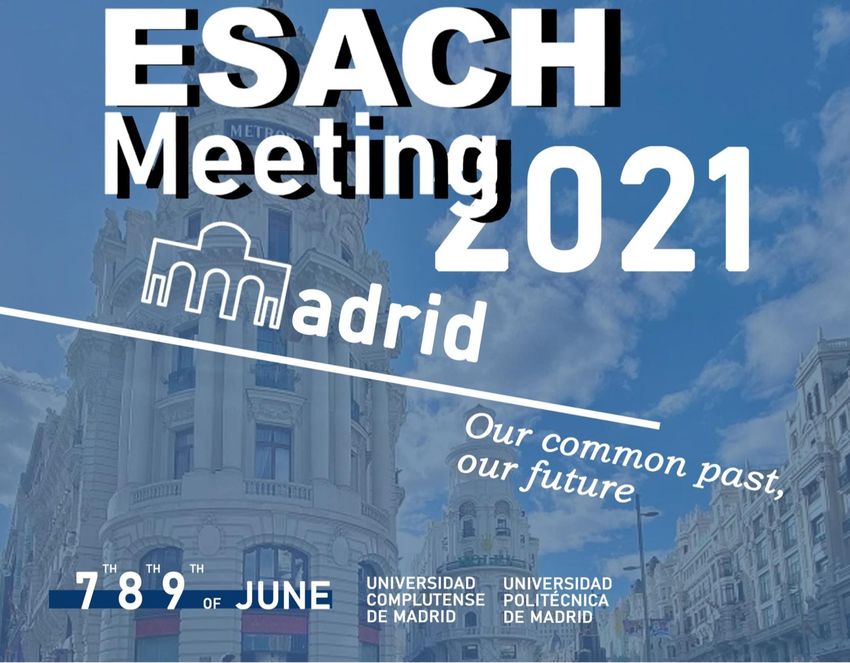
III ESACH MEETING 2021 MADRID PROGRAM

MONDAY 7
  Facultad de Geografía e Historia - Universidad Complutense de Madrid

Morning

       08:30 - 09:00            Handing-out of accreditations and documents

      09:00 - 09:15             Welcoming words by ESACH Madrid and ESACH

       09:15 - 09:45            Institutional Welcoming

      10:00 - 11:30             Cultural Heritage and the New European Bauhaus: Mobilising Youth and Hearing their
                                Voices by by Europa Nostra, ESACH, UNESCO, ICOMOS, Hispania Nostra, Europeana.

       Coffee break (30 min.)

       12:00 - 12:20            Museality and Musealization: Museum Theory and Management by Ivan Vaz,
                                Universidade do Porto

      12:20 - 12:40             Silent monuments of Adriatic Sea: The untold (hi)story by Tea Tomkic, Politecnico di
                                Milano

      12:40 - 13:00             Cultural Tourism and its impact as power of transnational peace by Athanasios Vlitas,
                                University of Brussels

      13:00 - 13:30             Questions and discussion

      Lunch Break

Afternoon

      15:00 - 16:00             Roundtable discussion: Exploring digital careers in the cultural heritage sector by
                                Europeana

      16:00 - 18:00             Workshop: Facing your work challenges. A workshop for emerging professionals by
                                Europeana

                                                          1
TUESDAY 8
Facultad de Geografía e Historia- Universidad Complutense de Madrid
Morning
09:00 - 09:20 Can we envision a common heritage management policy for EU? by Argyri Platsa,
University of Campania
09:20 - 09:40 The role of communities in the international safeguarding mechanism for the
intangible cultural heritage by Aliki Gkana, University of Athens
09:40 - 10:00 Free, Prior and Informed Consent: How Human Rights Contribute to Sustainable
Heritage Management by Loredana Scuto, Deakin University
10:00 - 10:30 Questions and discussion
Coffee break (30 min.)
11:00 - 11:20 Cultural Heritage, People, Creativity and Sustainability – The applicability of the Faro
Convention in ‘Loulé Criativo’ Project by Tiago Candeias, Universidade do Algarve
11:20 - 11:40 Assessment of Values as a tool to protect heritage: the case of San Antonio (Texas) by
Andrea Martínez, Tehnical University of Brandenburg
11:40 - 12:00 Questions-discussion
12:00 - 12:30 El Grupo de Profesionales Emergentes de ICOMOS by Dña. Clara Villalba Montaner,
ICOMOS España
12:30 - 13:00 Agenda 2030, ODS y Cambio Climático by D. José Alberto Alonso, ICOMOS-España
13:00 - 13:30 Questions and discussion
Lunch Break
Afternoon
15:00 - 17:00 Workshop Cultural Heritage and the New European Bauhaus: Perspectives from the
European Heritage Youth Ambassadors by Europa Nostra, Europeana, ESACH
Europe, Esach Ambassadors
.
17:00 - 18:00 Workshop: The Cuatro Caminos historical Metro Depot in Madrid: the lost dimension
of Heritage by Madrid, Ciudadanía y Patrimonio.
2WEDNESDAY 9
Escuela Superior de Arquitectura de Madrid - Universidad Politécnica de Madrid
Morning
09:00 - 09:20 Atlas of rites. Festivity, occupation and movement in the public space of Seville by
Javier Navarro, Universidad de Sevilla
09:20 - 09:40 Building the spanish landscape during industrialization, 1939-1959 by Isabel
Rodríguez de la Rosa, Universidad Politécnica de Madrid
09:40 - 10:00 Questions and discussion
Coffee break (30 min.)
10:30 – 10:40 Cultural trauma and heritage education by Athanasios Vlitas, University of Brussels
10:40 – 10:50 International day for monuments and sites in local communities: Pinto and Getafe
by Ekiñe Delgado, Nora El Rhazi, Diego García, Alba Hernández, Manuel Ruiz Rosana
Soriano, Grupo de Gestión del Patrimonio Cultural
10:50 – 11:00 Study of the commercial signing of the late-nineteenth - Neneteenth century in the
Raval (Barcelona) by Raquel Castillo, Universidad de Barcelona.
11:00 – 11:10 The vision of the cultural manager in Cultural Heritage rehabilitaon projects by
Chintia Giménez A., Universidad Privada de Santa Cruz de la Sierra
11:10 - 11:20 Re-imagining Melnik through a Local Tourism Ambassador Program by Marija
Konjević and Yanka Milusheva, Brandenburg Technical University Cottbus-
Senftenberg
11:20 – 11:45 Questions and discussion
11:45 – 12:30 Fundación Santa María La Real (FSMLR): Actions in Cultural Heritage, Development
of Territories and Cultural Tourism by Héctor Arriaga, Fundación Santa María la Real
12:30 - 12:45 Closing Ceremony
Lunch Break
Afternoon
15:00 - 18:00 Cultural outing Real Monasterio de San Lorenzo del Escoria
3III ESACH MEETING 2021 MADRID - EXTENDED PROGRAM
MONDAY 7
08:30 - 09:00 Handing-out of accreditations and documents
09:00 - 09:15 Welcoming words by ESACH MADRID and ESACH
09:15 - 09:45 Institutional Welcoming
10:00 - 11:30 Panel discussion: Cultural Heritage and the New European Bauhaus: Mobilising Youth and
Hearing their Voices
Europa Nostra, ESACH, UNESCO, ICOMOS, Hispania Nostra, Europeana
Moderator
Hana Kohout
Introductory remarks
Sneška Quaedvlieg - Mihailovic
Marcos Ros Sempere
Panel discussion
Héctor Manuel Aliaga de Miguel, ESACH and Europa Nostra
Pravali Vangeti, UNESCO and Cultural Heritage News agency
Ilaria Rosetti, ICOMOS Emerging Professional
Jasna Popovic, Hispania Nostra
Georgia Evans or Killian Downing, Europeana
412:00 - 12:20 Communication: Museality and Musealization: Museum Theory and Management
Ivan Vaz, Universidade do Porto
Museality, although widely used, is an imprecise and undefined term in museological theory.
Accordingly to Stransky, the author that creates this concept, "museality is the quality of
musealized things".Therefore, as a factor of activation and qualification of musealization,
museality can be considered one of the elements of the museological operating chain,
influencing the actions not only of selection and documentation of cultural heritage, but, at
the same time, of its management. How this concept can be used and absorbed in the daily
work of museological practices, its limits and potential are issues that it is proposed to explore
in this presentation. Starting from other related concepts such as
musealization/patrimonialization, object/collections, preservation/communication, we will
search an approach that points out ways for an intersection between museological theory and
the practical field of application and management of cultural heritage.
12:20 - 12:40 Communication: Silent monuments of Adriatic Sea: The untold (hi)story
Tea Tomkic, Politecnico di Milano
Introduction - Not until recent was neither scientific, nor local community interested in
preservation of monuments that were reminiscent of an 'unwanted' political system. Left to
decay, only occasional curious passengers were dedicating attention to this monuments of
exceptional historical and architectonic values. Their restoration is not only matter of ensuring
a secure construction and putting them into conditions of use, but what might be even more
challenging, recreating meaning for the ones who chose to abandon it.
Topics involved - Through transdisciplinary approach starting from examining a specific socio-
cultural context, and political conditions that determined the fertile ground for such strong
architectonic statements with its ambition surpassing local tendentions of that time, analysis
of urban environment and sociological meanings, and proposal of a long-term self-sustainable
investement and business plan that would enable them to be placed on the never as
demanding and diversified tourism market, through examination of real-estate conditions and
predicting possible responses to hospitality demands. 3 examples will be examined,
originating from the same socio-cultural context and positioned along the historical road
‘Jadranska magistrala': 1.Children's Maritime Sanatorium, Rikard Marasovic, 1964; 2. Motel
Soline, Ivo Vitic, 1965; 3. Hotel Complex Haludovo, Boris Magas, 1970. All three with an urgent
need for greater investment and utter care preventing their further deterioration through
novelty use. Next to purely engineer intervention, additional challenge is creating a satisfying
solution for numerous stakeholders, from governmental bodies and investors, to tourists and
local community. Putting them under the same label would create a more efficient marketing-
strategy and greater recongizability among the possible users, as well as enable a common
investment and management.
Main goals - To revalorize socialist heritage layer, reestablish and recreate meaning for ones
who refused to inherit it, and emphasize them as attractors in space for regional touristic
development under a common market placement and story-telling.
512:40 - 13:00 Communication: Cultural Tourism and its impact as power of transnational peace
Athanasios Vlitas, University of Brussels
Tourism is an omnipresent and defining feature of our modern societies. The evolution of
cultural and other alternative forms of tourism based on organization and planning comes
into conflict with the long-term effect mass tourism has on tradition, culture and people.
Cultural tourism, in specific, provides to the visitors with the opportunity to establish a
conscious and complete itinerary over time across the respective field, protecting thus all
cultural goods from being over-exploited. This presentation demonstrates how the
importance of cultural tourism goes much further than the splendor of humanity's tangible
creation and the expressions of our intangible legacy. Cultural tourism is presented in relation
to politics and justice and as a concept intertwined with the notions of human rights,
economic rights and identity.
The key question of the current proposal is the role of culture in terms of interstate relations
and also the organization, implementation and objective of cultural tourism as a means of
communication. Central government as opposed to local authorities is unable to see prompt
implementation of such studies and immediate results that mostly deal with decision making-
related process and foreign policy. However, if we are to investigate international relations in
view of their long-term prospective, it becomes clear that cultural interactions are some of
the most penetrating and intense traits of the human history. In this context, we will address
the particularly neglected facet of cultural tourism -and culture in general- more cautiously in
transnational relations.
The current study I am working on is fixed on investigating and analyzing certain phenomena
via the empirical control of project theoretical assumptions. In order to ensure the best
accessibility and analysis possible, the method of qualitative research was selected. This
methodological approach eliminates approaches of a statistical or descriptive nature and
focuses on the investigation of a specific case studies. The proposed case study is about the
Aegean Sea and the Greek-Turkish cultural, touristic and diplomatic relations.
13:00 - 13:30 Questions and discussion
615:00 - 16:00 Roundtable discussion: Exploring digital careers in the cultural heritage sector
Coordinated by Europeana and Europa Nostra
Moderator:
Raul Gomez Hernandez, ESACH-Madrid member and European Network Association member
Participants:
Federico Varela Mazzantini, architect and ESACH member.
Giovanni Pescarmona, museum professional and European Heritage Youth Ambassador
Lorenza Stanziano, marketing specialist in ICOMOS España and Europeana Network
Association member.
Killian Downing, Archivist at Dublin City University and Chair of the New Professionals Task
Force in Europeana.
The digital transformation of the cultural heritage sector has seen the emergence of new
professional opportunities and challenges for new professionals.
In this virtual roundtable discussion, five professionals will share their own experiences and
thoughts on this moment.
16:00 - 18:00 Workshop: Facing your work challenges. A workshop for emerging professionals
Coordinated by Europeana
Coordinator
Raul Gomez Hernandez, ESACH-Madrid member and European Network Association member
This workshop is an opportunity to network with peers in the cultural heritage sector and to
gather opinions and suggestions to deal with work issues and challenges in topics like
internships, training, skills, and social values.
7TUESDAY 8
09:00 - 09:20 Communication: Can we envision a common heritage management policy for EU?
Argyri Platsa, University of Campania
Introduction - EU supports various actions in order to promote the idea of common European
cultural heritage. European Year of Cultural Heritage 2018, European Heritage Days, the EU
Prize for Cultural Heritage and are such examples. However, the EU has limited powers in
cultural policy and care for cultural heritage since they are responsibilities of each member
state. It seems that some EU states have recognised the importance of cultural heritage
management and move towards this direction. Others possibly due to administrative
structure seem to have fallen behind. This argument is presented through the case studies of
Italy and Greece and the actions taken for the management of World Heritage Sites. Could
common cultural policy increase the implementation of integrated heritage management
approach and promote common European heritage? Can civil societies and local communities
participate meaningfully in this process?
Topics involved - First topic presented is the diversity of heritage laws across EU member
states that defines the cultural policy of each country. Linked to that, the topic of integrated
cultural heritage management approach and its difference to centralistic management models
is tackled. The main topic discussed is the cultural policy in the EU and whether promotion of
common European heritage could lead to common heritage management approaches
including possible involvement of local communities.
Main Goals - The presentation aims to bring attention the differences in the approach to
cultural heritage management between member states in EU. Through the comparative
approach (Italy, Greece) the presentation wants to promote the idea of interstate
collaboration for cultural heritage management. Another goal is to stress the need of
meaningful participation of local communities in those procedures. Finally, it also targets to
tackle conversation with other participants of the meeting over whether similar or different
policies in other states exist and whether tools for cooperation and common approach can be
developed through ESACH network.
809:20 - 09:40 Communication: The role of communities in the international safeguarding mechanism for
the intangible cultural heritage
Aliki Gkana, University of Athens
The paper examines the role of communities in the mechanism for the safeguarding of the
intangible cultural heritage (ICH) under international law. Communities, along with groups
and in some cases individuals -bearers of ICH- are recognized as playing an important role to
its production, safeguarding, maintenance and re-creation, by the UNESCO 2003 Convention
for the Safeguarding of ICH. However, despite the States’ obligation to ensure the bearers’
widest possible participation in their safeguarding activities, this participation is neither
always respected nor necessarily guaranteed by the existent legal framework. On the
contrary, the States’ “management” and instrumentalization of ICH through their applied
safeguarding policies at the national and international level may even negatively affect
communities’ interests over their heritage. By outlining the existent safeguarding mechanism,
the paper highlights the emerging need for the reinforcement of communities’ active
involvement in ICH “management”, in view of the absense of specific legal guarantees. In this
context, it also touches upon the debate of communities’ rights over their ICH, as reflected
already within the UNESCO system, often adopting a human rights-based approach to cultural
heritage, but also beyond it, discussing the utilization of the international human rights
protection framework for the realization of those rights. The writer argues that today,
following a decennial application of the UNESCO 2003 Convention and having learnt from the
primary rights and wrongs, it becomes crucial to re-pose some fundamental questions in two
directions. On the one hand, looking towards the past, by “reminding” the core principles
leading to the Convention’s adoption, one of which is certainly the recognized central role
that communities should have in ICH safeguarding. On the other hand, looking towards the
future, by pointing out the new developments in the current evolution phase of the
Convention’s life demanding a truly effective say of communities over their heritage
management.
909:40 - 10:00 Communication: Free, Prior and Informed Consent: How Human Rights Contribute to
Sustainable Heritage Management
Loredana Scuto, Deakin University
Free, Prior and Informed Consent (FPIC) has become increasingly prominent in international
and legal debates since the second half of the 20th century. Considered one of the
fundamental rights of indigenous peoples, FPIC fosters their full participation and informed
consent concerning projects, activities, and policies carried out in ancestral lands or affecting
indigenous livelihoods.
In the past two decades, civil society and indigenous organisations have denounced a failure
in the implementation of this right in the context of World Heritage. A large number of World
Heritage sites in indigenous territories is inscribed every year on the World Heritage List
without the consent of indigenous communities, who can face eviction, forced relocation,
mass tourism and restrictions on traditional activities such as fishing, hunting or performing
ceremonies. During the last World Heritage Committee meeting held in Baku, Azerbaijan
(2019), FPIC was incorporated into the Operational Guidelines and became a requirement for
the inscription of new World Heritage sites.
The presentation will show how the application and implementation of human rights can
contribute to the sustainable management of cultural heritage. Following a brief legal
definition and context around the concept of FPIC, the presenter will highlight the advantages
of incorporating FPIC and human rights in Management Plans. The examples of good practice
in heritage sites around the globe will be selected from the World Heritage List, which
represents an inventory of best practices in environmental and cultural conservation.
The last part of the presentation will connect indigenous and human rights with the
Sustainable Development Goals and will emphasise the opportunities and positive aspects
derived by a greater inclusion in decision-making processes not only of indigenous peoples
but also of civil society in general. The presenter will also attempt to provide a short overview
of the presence of indigenous communities in Europe, as they are not always properly
included in heritage discourses in our Continent.
10:00 - 10:30 Questions and discussion
1011:00 - 11:20 Communication: Cultural Heritage, People, Creativity and Sustainability – The applicability
of the Faro Convention in ‘Loulé Criativo’ Project
Tiago Candeias, Universidade do Algarve
According to the Council of Europe Framework Convention on the Value of Cultural Heritage
for Society (2005), contemporary creation and new generations must assume a crucial role in
the heritage appreciation, enhancing access, participation, involvement and the consequent
understanding of cultural heritage, in which creativity and sustainability projects are essential.
This research focuses on assessing the contribution of these projects to the enhancement of
Cultural Heritage, analyzing the results of the ‘Loulé Criativo’ project, which, in line with the
Faro Convention, aims to encourage the active involvement of various heritage communities
in the heritage management and sustainable development processes of the territory, using
contemporary creativity in favor of traditional arts and crafts.
The research addresses topics such as: community participation; access; contemporary
creation and new generations as an added value to the heritage reality; traditional arts and
crafts; and the sustainable development of territories.
The main goals are: to understand the impact that Creativity projects have on the valorization
of cultural heritage; how heritage can be part of the sustainable development of territories;
how society's involvement contributes to participation, access and the consequent
valorization of heritage; to enhance the understanding of contemporary creation and
creativity as an integral part of cultural heritage.
1111:20 - 11:40 Communication: Assessment of Values as a tool to protect heritage: the case of San Antonio
(Texas)
Andrea Martínez, Technical University of Brandenburg
The San Antonio Missions have been declared as a World Heritage Site in 2015, which implies
that there has been a narrative constructed around the site focused on the global values.
When addressing global values, it is important to also understand the local values of that site
and that they are properly addressed. When we talk about global values, we understand and
take for granted that they are already implicit in such a site. For being inscribed in the World
Heritage List, the authorities in charge of managing the Missions had to prove that the site
was worth be preserved in an international scale and has values that represent global society.
This is, in terms of the UNESCO, the Outstanding Universal Value (OUV). Local communities
are one of the main stakeholders when it comes to creating an statement of Outstanding
Universal Value. Local values are the ones that should transcend and become universal. We
cannot limit our view of the San Antonio Missions to the physical part. These buildings are not
only material remains from a past time, but they are still alive. Locals interact with them on a
daily basis; this daily interaction generates intangible values that the people perceive and that
are worth being OUV. A community-based management system can improve the values of the
site in a variety of ways. A World Heritage site that is valuable for its community will preserve
its significance for longer, as the locals are the first ones who should be interacting with it.
But, on the other side, a disconnection between the site and the community eventually leads
to an enormous problem when it comes to the management of the site, as it affects the
conservation and the decision-making process, not mentioning the unethical basis. Sites such
as the San Antonio Missions, still are present in the lives of many people and how they interact
with the historic structures. In order to create a fair management system of the Missions, we
need to take accountability on the perception of the local community about the different
values of the site.
An accurate perspective on the needs and expectations of the local community is necessary
to create more understanding and an ethical approach to heritage conservation and
management. In this presentation, I aim to show the methodology followed for the creation
of a community participation survey in the framework of the US/ICOMOS IEP 2019. I will also
discuss the theoretical framework and the outcome of it. From a materialistic point of view,
I’ve created a survey that revolves around the interaction between different sectors of the
local community and the material remains of an uncomfortable past, challenging the current
narratives and promoting new notions and values over the sites.
11:40 - 12:00 Questions and discussion
1212:00 - 12:30 El Grupo de Profesionales Emergentes de ICOMOS.
Clara Villalba Montaner, vocal de la Junta Directiva de ICOMOS-España y coordinadora de la
Comisión Estratégica “Profesionales Emergentes” en España.
12:30 - 13:00 Cambio Climático y Patrimonio: La Agenda 2030 y los ODS
José Alberto Alonso Campanero, vocal de la Junta Directiva de ICOMOS-España y coordinador
de la Comisión Estratégica “Agenda 2030, ODS y Cambio Climático” en España.
13:00 - 13:30 Questions and discussion
15:00 - 17:00 Workshop: Cultural Heritage and the New European Bauhaus: Perspectives from the
European Heritage Youth Ambassadors
Europa Nostra, ESACH Europe, Esach Ambassadors
Facilitators
Shari Bone and Sorina Neacsu, Europa Nostra and ESACH Representatives
Hana Kohout, Jen Wenzler, Antigoni Michael, Pravali Vangeti, Héctor Manuel Aliaga de Miguel,
Elena Cautis, European Heritage Youth Ambassadors
17:00 - 18:00 Workshop: The Cuatro Caminos historical Metro Depot in Madrid: the lost dimension of
Heritage
Coordinated by Madrid, Ciudadanía y Patrimonio
Coordinator
Álvaro Bonet López, architect and Vice-president of Madrid Ciudadanía y Patrimonio
The Cuatro Caminos historical Metro Depot is one of the best examples of the industrial
heritage of the city of Madrid. It is now a cultural heritage site in danger under intense
pressure from urban development.
This workshop is an opportunity to know more about the industrial heritage of Madrid
through this case study and to use your management skills for the safeguarding and valuing
of this cultural heritage site.
13WEDNESDAY 9
09:00 - 09:20 Communication: Atlas of rites. Festivity, occupation and movement in the public space of
Seville
Javier Navarro, Universidad de Sevilla
Introduction - This research seeks to delve into the dynamics of the occupation of public space
through rituals, festivals, events and happenings in the city of Seville. Although they are
phenomena belonging to other fields of study such as anthropology or sociology, they depend
fundamentally on the space in which they take place.
Formalised through processions, ephemeral constructions and mobile objects, they lack
functional and formal meaning without buildings, thresholds, doors, streets and squares. In
addition to the popular mythology they generate, they are great exercises in architecture and
urban planning that allow, following the rules and indications of a cyclical and collective
project, the appearance of a series of "ephemeral cities" that coexist within the "permanent
city". This process of project and construction requires an important movement of matter, of
bodies and masses which, with ritual repetition, end up leaving certain marks and traces in
the urban fabric. Ritual, therefore, is not only an instrument of social cohesion but a tool
linked, since the creation of the first cities, to the urban an architectural fact.
Goals - On the basis of this hypothesis, the aim of the project is threefold: firstly, the
construction of an atlas of events, rites and happenings which, on the same plane, outline this
"transitory Seville"; based on the atlas, the definition of "spaces and forms of the rite" is
proposed through the study of the relationship between urban form and occupation
dynamics, specifying the project strategies that are put into practice during its execution;
finally, it explores the capacity of the rite, the festival or the popular event to inspire
contemporary projects—through the figures of Aldo Rossi, Constant Niewenhuys and John
Cage, incorporating a timeless and universal reading of its forms and formulas.
Despite the profusion of studies on the ephemeral city, the baroque urban scenario of Seville
and its cycle of festivals and traditions, there are few studies that deal with transitory form
and space, those that use cartography as an instrument of expression of movement or those
that start from an understanding of these rites as an integral system. In this sense, the
research seeks to complement them by interpreting each procession, occupation or transition
as part of a whole, of an absolute architecture (Aureli, 2011); a whole in which the city, the
fragments that make it up and the events that traverse and transform it respond to the same
logic and to a single collective project; a whole that constructs multiple Sevilles within Seville.
1409:20 - 09:40 Communication: Building the spanish landscape during industrialization, 1939-1959
Isabel Rodríguez de la Rosa, Universidad Politécnica de Madrid
The research focuses on the landscapes designed by engineers and architects in Spain during
the Francoist autarchic period (1939-1959). By this time an industrialization process was
planned in order to exploit the territory. Autarky was conceived as a political and economic
model looking for economic self-sufficiency as a crucial step to achieve political independence.
It drove significant industrialization projects all over the Spanish country. As Lino Camprubí
(2017) has proved this period cannot be understood without the specific role of engineering,
science and technology on the transformation of Spanish landscapes in both the aesthetic and
economic sense.
During industrialization the Spanish landscape was subject to a series of radical
transformations in order to make the national territory into a huge energy factory. The
industrial complexes did not only consist of the installation of large factories or infrastructure,
but also they generally involved the exploitation of the specific natural resources of an area
and the associated constructions and services for both the development of industrial activity
and its workers. Therefore, these complexes defined territorial structures and configured
functional and social environments. The landscape turned into an infrastructure of vast
territories for the individual and collective memory and identity, generating links between
society and territory.
The main goal of this research is to explore this process seeing it as the result of a spatial
design experience that has current heritage consequences. The principal hypothesis is that
the autarkic actions not only contributed interesting industrial objects, but that they are a
significant part in Spanish environmental history and also crucial to understanding most of the
current territorial and industrial situation. For this reason, it is intended to increase the
existing knowledge about these landscapes through their identification, documentation and
characterization in order to reveal their cultural meaning and their impact on physical,
environmental and social levels.
09:40 - 10:00 Questions and discussion
1510:30 – 10:40 Poster: Cultural trauma and heritage education
Athanasios Vlitas, University of Brussels
10:40 – 10:50 Poster: International day for monuments and sites in local communities: Pinto and Getafe
Ekiñe Delgado, Nora El Rhazi, Diego García, Alba Hernández, Manuel Ruiz, Soriano Manuel,
Rosana Soriano, Grupo de Gestión del Patrimonio Cultural
10:50 - 11:00 Poster: Study of the commercial signing of the late-nineteenth - Neneteenth century in the
Raval (Barcelona)
Raquel Castillo, Universidad de Barcelona
11:00 – 11:10 Poster: The vision of the cultural manager in Cultural Heritage rehabilitaon projects
Chintia Giménez, Universidad Privada de Santa Cruz de la Sierra
11:10 - 11:20 Poster: Re-imagining Melnik through a Local Tourism Ambassador Program
Marija Konjević and Yanka Milusheva, Brandenburg Technical University Cottbus-Senftenberg
11:20 – 11:45 Questions and discussion
11:45 - 12:30 Fundación Santa María La Real (FSMLR): Actions in Cultural Heritage, Development of
Territories and Cultural Tourism
Héctor Arriaga, Fundación Santa María La Real
12:30 - 12:45 Closing Ceremony
15:00 - 18:00 Cultural outing Real Monasterio de San Lorenzo del Escorial
16You can also read


