Our commitment to human rights - Modern Slavery Statement of CRH plc For the year ending 31 December 2020
←
→
Page content transcription
If your browser does not render page correctly, please read the page content below

Our commitment to human rights
Modern Slavery Statement of CRH plc
For the year ending 31 December 2020
CRH Commitment to Human Rights   B

Contents                                                                                                                                   Introduction

2020 achievements                                                                                   1                                      This statement is made in compliance with Section 54(1)
Goals and targets for 2021 and beyond                                                               1                                      of the UK Modern Slavery Act 2015 and other applicable
Governance                                                                                          2                                      legislation*, and sets out the measures CRH and its
Our policies                                                                                        3
                                                                                                                                           subsidiaries (collectively “CRH” or the “Group”) have
                                                                                                                                           taken during the financial year ending 31st December
Our supply chain risks                                                                              4
                                                                                                                                           2020 to ensure that slavery or human trafficking is not
Assessing and managing risk                                                                         5
                                                                                                                                           taking place within its own business or in any of its
Internal due diligence                                                                              7                                      supply chains.
External due diligence                                                                              8
                                                                                                                                           CRH believes that slavery, in all its forms, is unacceptable
Global direct sourcing audit summary                                                                9
                                                                                                                                           and that all CRH companies must do everything they
Conflict minerals                                                                                10                                        can to prevent any form of slavery, human trafficking or
Training                                                                                          12                                       any other unethical behaviour in their businesses and
Speak Up process                                                                                  12                                       supply chains.

This Statement was approved by the Board of Directors of CRH plc on
xx xxxx xxxx and signed on behalf of the Board by Jim Mintern, Finance                                                                     At CRH we do what we say
Director.
                                                                                                                                           and our values unite us in the
                                                                                                                                           way we work, every day, all
By: ___________________________________________________________________                                                                    over the world. This means
                                                                                     Jim Mintern,                                          we have a clear zero tolerance
                                                                                 Finance Director.
                                                                                                                                           approach to all forms of
                                                                                                                                           modern slavery.”
All statements are available on our corporate website here
* The California Transparency in Supply Chains Act 2010, The Australian Commonwealth Modern Slavery Act 2018 and Loi de Vigilance 2017.
CRH Commitment to Human Rights   1

2020 achievements                                                                     Goals and targets for 2021 and beyond

    Training and raising awareness                                                        Expand coverage of our due diligence process and explore new ways of
    Our Modern Slavery e-Learning module was introduced to key colleagues.                gaining intelligence and performance insights.
    The module sets out to provide a summary of what modern slavery is and the
    risk modern slavery poses to our business. It summarises the key indicators
    of modern slavery and how to spot them. It also provides an overview of our
    policies, systems and processes and outlines how to flag any issues and
    concerns to the appropriate people.

                                                                                          Expand the coverage of our Modern Slavery e-Learning module to more
                                                                                          colleagues across our business.

    Know Your Supplier
    Following the update of our Supplier Code of Conduct (SCoC) in 2019, we
    have developed our core due diligence processes to increase the visibility and
    insights we get into our suppliers. This process captures a digital Supplier
    Code of Conduct acknowledgment, and automated data points on financial
    health, sanctions screening and adverse media report of suppliers in areas            Continue to use this annual statement to demonstrate progress and ensure
    such as discrimination/workforce rights, human rights, workforce disputes             we are fully transparent in our actions in the areas of human and labour
    and workforce health/safety issues. Focusing on our key suppliers in the first        rights (see page 5 for further details).
    instance we plan to scale this insight across all spend.

    Code of Business Conduct
    The CRH Code of Business Conduct (CoBC) was updated in 2020 for                       Our ambition is to have a culture of safety and wellness working towards
    launch in 2021.                                                                       zero harm. Our target of zero fatalities extends beyond our own employees
                                                                                          to include contractors.

    Defining salient human rights issues
    The risk to people’s human rights can occur throughout the value chain.
    Through our Enterprise Human Rights Impact Assessment, which was
    completed in 2020, we identified the salient human rights issues in relation to       Continue to review human rights and modern slavery risks through our
    our own operations, acquisitions and supply chain, communicating these to             Enterprise Risk Management processes (see pages 26-29 in the CRH 2020
    our stakeholders in a transparent and open way.                                       Annual Report, available on our corporate website here).
CRH Commitment to Human Rights   2

Governance                                                                                            Three
                                                                                                      Divisions
The CRH Board is responsible for the leadership, oversight, control, development and
long-term success of the Group. The Safety, Environment & Social Responsibility (SESR)                Americas Materials               Europe Materials               Building Products
Board Committee monitors developments in all areas of safety and sustainability. The CRH              SALES   $11.3 billion            SALES   $9.1 billion           SALES   $7.2 billion
Group Procurement Council oversees all aspects of purchasing strategy, policy, targets
and objectives. We have a dedicated Legal & Compliance team and a Procurement Head
of Sustainability, Innovation & Risk who supports our global procurement team. In addition,
the Group Sustainability team facilitates all Group sustainability reporting.

Expectations
Stakeholder expectations of businesses to uphold human rights have never been higher.
At CRH, we understand the role of business in the protecting and upholding of human rights              -3% 2019: $11.6 billion          -4% 2019: $9.5 billion        +3% 2019: $7.0 billion
across our operations. We continue to develop and refine our approach to human rights due             c. 27,400 employees              c. 26,800 employees            c. 22,900 employees
diligence to better understand our potential impacts.                                                 c. 1,475 operating locations     c. 1,155 operating locations   c. 480 operating locations
                                                                                                      46 US states, six Canadian       21 Countries                   19 Countries
We are committed to respecting internationally recognised human rights as set out in the              Provinces and Southeast Brazil
International Bill of Human Rights and the International Labour Organisation’s Core Labour
                                                                                                      Products & Services              Products & Services             Products & Services
Principles, across our operations and extended supply chain. We are committed to building
knowledge and awareness on human rights across our entire value chain and to operate in a
manner consistent with the UN Guiding Principles on Business and Human Rights.

CRH plc
At the end of 2020, our global footprint spanned 30 countries and over 3,100 operating
locations, serving customers across the breadth of the building materials spectrum.
Our operating companies manufacture and supply a range of integrated building materials,
products and innovative solutions which can be found throughout the built environment.
We procure a wide range of goods and services and have an annual procurement spend
of c.$16 billion, with 118,000 suppliers worldwide. Our core business lines each have a
specific supply chain footprint with different characteristics, challenges and opportunities.
For further details of our global footprint refer to pages 3, 54 and 55 of our Sustainability
Report here.

Products & Services Index

                                                                    Readymixed
        Aggregates           Cement                 Lime                                    Asphalt
                                                                    Concrete

           Infrastructural      Paving & Construction        Infrastructure          Architectural
           Concrete             Services                     Products                Products

                                  Construction
        Building Envelope
                                  Accessories
CRH Commitment to Human Rights   3

Our policies
There are a number of key codes and policies that demonstrate our                              Social Policy
commitment to our values. These include:                                                       The Social Policy is outlined in our Sustainability Report on page 67 (available on our
                                                                                               corporate website here) and requires all our Group companies to:
        CRH Code of Business Conduct
Our CoBC sets out our commitment to doing the right things in the right way, complying
                                                                                                              Comply at a minimum with all applicable legislation and continuously
with the law, and working responsibly. It is essentially the manual for how we can stay true
                                                                                                              improve our social stewardship, aiming all the time to meet or exceed
to one of our core Group values - ‘Do what we say and lead with integrity’. The CoBC
                                                                                                              industry best practice standards.
is available in 21 languages on our corporate website here.

Supplier Code of Conduct                                                                                      Support freedom of association and recognise the right to
                                                                                                              collective bargaining.
Our SCoC sets out how our suppliers must support and commit to our requirements in
relation to safety and health, people and the community, environment, climate change,
governance and compliance (available on our corporate website here). It applies the
                                                                                                              Apply the principle of equal opportunity, valuing diversity regardless
concepts, principles and recommendations of the OECD Guidelines for Multinational
                                                                                                              of age, gender, disability, creed, ethnic origin or sexual orientation,
Enterprises and other applicable legislation. We integrate the SCoC requirements and
                                                                                                              while insisting that merit is the ultimate basis for recruitment and
acceptance into our standard contract clauses and terms and conditions of purchase.
                                                                                                              selection decisions.
Our suppliers must specifically undertake the following in relation to modern slavery:

                                                                                                              Manage our businesses in a fair and equitable manner, meeting all our
                     Support and respect the protection of human rights within their areas                    social responsibilities including working conditions, as both a direct
                     of influence.                                                                            and indirect employer.

                                                                                                              Ensure that we deal responsibly with our suppliers and customers in
                                                                                                              accordance with our Code of Business Conduct, Supplier Code of
                     Prohibit all forms of modern slavery including forced labour, bonded                     Conduct and proper business practice.
                     labour, compulsory labour and child labour.

                                                                                                              Prohibit forced, compulsory and child labour in all forms, including
                                                                                                              modern slavery.
                     Support the principles of Equality, Fairness, Inclusion and Respect
                     when dealing with the recruitment and selection of employees.

                     Respect freedom of association and the effective recognition of the
                     right to collective bargaining by employees.

Other Policies are included on page 67 of the Sustainability Report here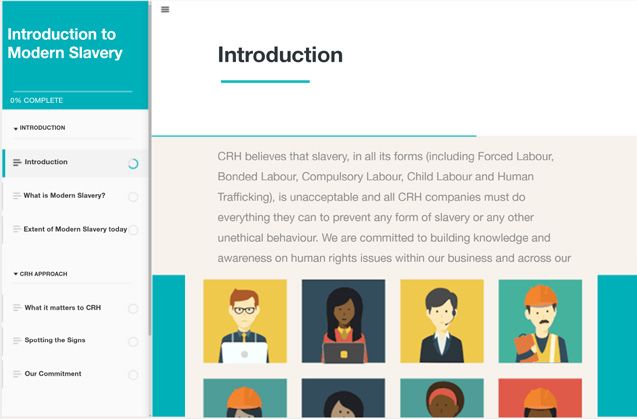
CRH Commitment to Human Rights   4

Our supply chain risks
We assess risk at the category level, in line with ISO 20400 - Sustainable                       All suppliers must show high ethical and corporate social responsibility standards and
                                                                                                 compliance with relevant laws.
Procurement best practice. We use 12 assessment criteria covering areas
such as health and safety, human and labour rights, environment, climate                         By managing risk and opportunity at a category level, we are able to obtain a greater insight
                                                                                                 into supply chains and ensure that the required improvements are integrated into category
change and governance.                                                                           strategy plans and linked to our procurement decisions.
Based on the risks identified and the outcomes of an accompanying opportunity
assessment, we enhance our Category Strategy Plans to drive improvement actions at the
point where we have most influence with our suppliers.                                                                                             Logistics
Country risk is a significant part of this assessment and the vast majority of our suppliers                                                       20%
replicate our operational footprint with over 91% of our spend in North America and Europe.                                                                                                      Raw materials
We are continually improving our spend visibility platforms to enhance country and location                                                                                                      18%
insights into suppliers in regions with a higher prevalence of modern slavery. This allows

                                                                                                  Increasing external spend %
us to focus our resources on supplier activities that prevent any potential issues with                                                            Maintenance and
modern slavery.                                                                                                                                    production services
                                                                                                                                                   14%
Our criteria covering Human Rights and Labour practices includes modern slavery and
other human rights issues and our procurement teams assess their projects and spend
areas against this aspect.

Sustainable procurement approach
                                                                                                                                              Energy                     General         Building components and
Our sustainable procurement approach is to ensure our businesses are well-equipped to                                                         9%                         services        manufacturing materials
understand and manage responsible supply chains through:                                                                                                                 8%              8%

  • Our CRH Group Procurement Council overseeing all aspects of purchasing                                                                          Mobile equipment
    governance including strategy, policy, targets and objectives.                                                                                  6%                    Chemicals      Production equipment
  • Engagement with suppliers, governments, businesses and other partners to find new                                                                                     5%             5%
    ways to innovate and create positive change to transition towards more responsible                                                                                                             Facilities management
    supply chains across the entire industry.                                                                                                                                                      & estates
                                                                                                                                    Packaging                                                      4%
  • Assessing risk at a category level, in line with ISO 20400 – Sustainable Procurement                                            2%      IT and telecoms
    best practice. Our procurement teams undertake a specific ESG risk assessment for                                                         1%
    all spend, of which labour practices is a core aspect.
  • Identification of critical suppliers, in particular sustainability issues through the heat                                           Increasing modern slavery potential impact
    mapping process.
  • Assurance procedures in place to ensure that all CRH companies are actively
                                                                                                                                Building components and manufacturing materials - Sometimes sourced in low-cost
    implementing the requirements of our SCoC.                                                                                  countries through our Global Direct Sourcing team. See page 9 to see how we manage
                                                                                                                                this risk.
Non-compliance by a supplier of the SCoC can have a number of consequences including
exclusion from any tendering process or termination of contract. However, our preference
is to work with our suppliers to develop remediation plans for those affected, and build the                                    Raw materials - we continue to engage in industry partnership schemes to understand and lead
capacity of suppliers to ensure these issues are properly managed on an ongoing basis.                                          standards in this area – please see page 11 for details.
CRH Commitment to Human Rights   5

Assessing and managing risk
Enterprise Risk Management plays a critical role in how we respond to a world of increasing uncertainty and globalisation. Effectively managing our risks
and challenges facilitates better decision making, thereby driving performance, creating growth opportunities and generating sustainable shareholder value.

          We conduct an annual review of social performance across our operations. Through this review and our due diligence work we have highlighted four human rights impact
          areas including:

   Health and safety of those working on our sites                                                                            Employment conditions of employees
   There are multiple safety hazards associated with our industry.                                                            and contractors working on our sites
   We manage safety across our operations, working towards our                                                                Through our Annual Review, we assess the working
   ambition of zero harm.                                                                                                     conditions of our employees and contractors.
   Our actions                                                                                                                Our actions
   • Implement the CRH Life Saving Rules                                                                                     • F
                                                                                                                                 ocus on Inclusion & Diversity (I&D) by SESR
   • Employee and contractor engagement                                                                                        Committee & I&D Council
   • COVID-19 mitigation plans                                                                                                • Fair remuneration and equal opportunity
   • Safety audits ongoing                                                                                                    • Group-wide organisational health survey
   •	Health & Safety Policy with the right to stop unsafe work                        Salient
                                                                                       Human
                                                                                       Rights
                                                                                       Issues
   Health of the communities living                                                                                           Labour rights of those working in
   close to our materials activities sites                                                                                    our extended supply chain
   We continue to apply best practice across our operations.                                                                  We source our materials and products from suppliers
                                                                                                                              worldwide. We work with our suppliers and stakeholders
   Our actions                                                                                                                to promote human rights.
   •	All relevant materials activities have a Community
                                                                                                                              Our actions
       Engagement Plan in place at their sites
                                                                                                                              • Category level assessments in line with ISO 20400
   •H
     osted over 3,500 stakeholder engagements
    over the last 3 years                                                                                                     • R
                                                                                                                                 eview labour practices annually
   • Invest in community relations and development                                                                           • CRH Hotline available
                                                                                                                              See page 4 for further information on supply chain risks.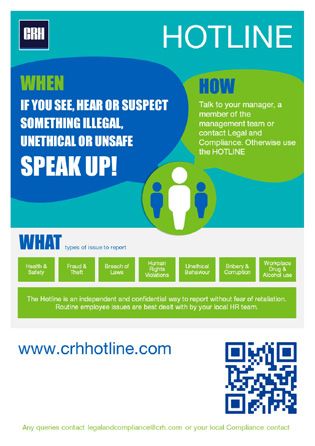
CRH Commitment to Human Rights   6

  Case study                              Case study

Collaborating for                      Managing the risks and
a safer world                          impacts of COVID-19
Across the world, 1.35 million         Over the last year, the COVID-19 pandemic has posed
people die as the result of road       enormous challenges around the world. The awareness
traffic accidents annually, with 93%   of public health, safety and protection issues has greatly
of these fatalities occurring in low   increased, as has the recognition of the connection
to middle income countries (data       between environmental changes and disease.
from the World Health Organisation).   The vulnerability of certain groups has been exacerbated
The United Nations has set specific    by the pandemic – in particular migrant workers, women
targets as part of the Sustainable     working in the supply chain, and young workers.
Development Goals to provide
access to sustainable transport        At CRH, we are acutely aware of the impact of COVID-19
systems for all and to halve the       on those working in global supply chains, such as
number of global deaths and injuries   potential challenges of increasing unemployment
from road traffic accidents.           and pressures on environmental management.
                                       Our procurement teams work in partnership with our
At CRH, we collaborate with other
                                       suppliers to find solutions to potential issues. In response
leading companies at the Global
                                       to the COVID-19 pandemic, we have undertaken specific
Cement and Concrete Association
                                       resilience discussions with suppliers.
(GCCA) to improve health and safety
across the building materials value
                                       Our ‘Know Your Supplier’ programme is designed to
chain. As part of this collaboration
                                       highlight suppliers that are undergoing a change in their
we have joined forces to produce a
                                       financial health, so we can be more targeted in our
“Road Safety Handbook”, using our
                                       approach. In addition, our procurement teams continue
experience and scale in practical
                                       to work closely with our operating companies to address
ways to promote better transport
                                       the issues that have arisen from the pandemic.
standards with our partners across
the transport industry.
                                       Our site assessment programmes have been impacted
                                       by the pandemic. We will return to a normal practice
                                       as soon as we can safely do so and continue to
                                       manage our critical supplier relationships virtually for the
                                       time being.
CRH Commitment to Human Rights   7

Internal due diligence
We carry out a comprehensive annual Social Review of all our operating                               Labour practices
companies, as well as, where possible, associates and joint ventures.                                At CRH, we embrace and comply with local wage and working time laws. Our operating
A key objective of this Social Review is to verify the implementation of the                         companies offer entry-level wages at or above the minimum wage, with many companies
CRH Social Policy and to review performance against our salient human                                having policies in place to ensure a living wage. Policies or procedures are in place at our
                                                                                                     operating companies to prevent excessive working hours.
rights issues.
                                                                                                     Due diligence processes
Measuring effectiveness and year-on-year progress
Our annual Social Review covers our operating companies’ performance relating to 50 human
rights criteria. These cover areas such as policy implementation, discrimination, diversity,              Extensive due diligence processes are completed for all
safety, forced labour, freedom of association and fair payment. Performance data is also                  CRH acquisitions. Where deficiencies are identified in health
collected on training for various employee categories and types.                                          and safety standards, improvement plans are put in place
                                                                                                          together with the relevant capex needed to ensure the safety
An enterprise-wide human rights risk assessment is completed annually with results included               of employees, contractors and the communities where
in the report to the SESR Committee. In addition, our operating companies also complete                   we operate.
individual human rights assessments and have systems in place to ensure compliance with
human rights best practices. Where issues are identified, mitigation plans are put in place               Across the Group in 2020 there were 17 bolt-on acquisitions.
to ensure steps are taken to bring these companies up to CRH best practices within a                      Through our due diligence and health and safety audit
specific timeframe.                                                                                       programmes, specific plans were put in place to improve
                                                                                                          health and safety standards as required. Issues identified
                                                                                                          included aligning processes to the CRH Life Saving Rules,
   In 2020 we found zero cases of forced or compulsory labour                                             installation and updating machine guarding, access to heights
   and no employees or contractors under the relevant legal age                                           and pedestrian vehicle segregation. These remediation plans
   working at any location among our businesses (zero cases                                               help progress our ambition to have a culture of safety and
   reported in 2019). The Social Review also found that all migrant                                       wellness working towards zero harm across all companies
   workers have similar legal protection to other employees and all                                       at CRH. The performance of these companies is tracked
   companies permit trade unions, with 22% of CRH employees                                               through the Annual Review process with 100% of these
   being members of trade unions (22% in 2019).                                                           acquisitions reporting performance in 2020.

       Case study

   Tarmac                                Tarmac, a CRH company, is the
                                         UK’s leading building materials and
                                                                                  The ELS standard aims to verify
                                                                                  companies that are applying due
                                                                                                                              BRE’s ethical sourcing standard
                                                                                                                              assesses organisations across 12 areas,

   Ethical Labour                        construction solutions business and
                                         has been verified under BES 6002,
                                                                                  diligence around human rights and
                                                                                  ethical concerns when sourcing
                                                                                                                              including management structure and
                                                                                                                              systems, learning and development,
                                         the Ethical Labour Sourcing (ELS)        materials, products and services            bribery and corruption, procurement and
   Standard (ELS)                        standard, which was developed by
                                         the Building Research Establishment
                                                                                  including labour, and which are
                                                                                  actively identifying and working
                                                                                                                              supply chain management.

                                         (BRE) in response to the 2015 Modern     towards eradicating the exploitation of
                                         Slavery Act.                             vulnerable workers.
CRH Commitment to Human Rights   8

External due diligence
Measuring effectiveness and year on year progress
We monitor compliance with our human and labour rights policies in relation to issues such as modern slavery across all CRH companies, and review labour practices annually.
Within our supply chain, we increase our assurance and due diligence response in accordance to the risk we identify for the spend area. Methods we prescribe in our SCoC include:

     Category risk profile

        Industry partnership schemes                 3rd party onsite audit                       3rd party desktop audit                           Know Your Supplier
        For specific commodities we partner          Partners providing audit and                 Independent review of data                  Acknowledgement of CRH SCoC
        and collaborate with organisations           improvement plans as part of                 submissions from suppliers to an            and Application Programming
        dedicated to improving standards             supplier site visits.                        industry standard.                          Interface (API) links to key external
        across industry sectors.                                                                                                              data points to identify any sanctions
                                                                                                                                              implications, financial health, adverse
                                                                                                                                              media or prosecutions of companies.

                                                                                      Increasing risk
CRH Commitment to Human Rights 9
Global direct sourcing audit summary
Increasingly, we are sourcing goods and materials from best value In 2020, we undertook 24, 3rd party onsite assessments, which is less than in 2019
countries. Our Global Direct Sourcing (GDS) team is based in because of the impact of the pandemic. However, we have maintained our supplier
relationships and interactions virtually during this time and look forward to returning to
Shanghai and looks to source key components and products for all normal procedures when it is safe to do so. We grade the results to help our teams and
our businesses. suppliers understand their performance better. We do not work with suppliers until they
The key categories of spend that utilize GDS are manufacturing materials, building close any critical gaps identified.
components and production equipment. Often this spend occurs in countries that pose
a higher risk profile in terms of modern slavery and human rights issues. Audit performance
Good standard
Following initial CRH site visits to set out Base standard
our expectations and codes of conduct, 2020
we work with our audit partner TÜV 24 Audits
Critical gaps
Rheinland who carries out an onsite
assessment of supplier operations and
factories. Only on successful completion Unsuccessful
of this audit and the closure of any critical
gaps do we enter contracts and place any
orders with suppliers.
Critical gap trends
46% 47% 2019 2018
We have seen several issues raised in these assessments. Although we believe that
modern slavery is not in place, we have identified some concerns that if left unchecked 2019 2020
46% 29%
42%
could create the opportunity for modern slavery to occur. For any critical gaps we identify, 23%
we ensure that a corrective action plan is delivered and implemented and re-checked 16% 17%
through secondary visits or spot checks. 10%
23% 26% 7% 5%
Common issues that we have had to manage in the past include discrepancies in wage 16% 15%
12% 10%
records and processes being in place to demonstrate that people are being paid fairly
Health & Safety Working Hours Others Including Wages & Bene 5% Labour
5% Practices
for their work and potential indicator issues such as deposits being held by employers for Environmental
onsite accommodation.
Health and safety Working hours Others including Wages and benefits Labour practices
We intervene in all of these cases and we recognise the need to continue this environmental
engagement to build and improve supplier capabilities and processes, as well as our
own understanding. We believe that using the commercial incentive of our future orders
provides us with the best leverage to make an impact.CRH Commitment to Human Rights 10
Spotlight
Conflict minerals
CRH is committed to responsibly sourcing all its products and
raw materials as outlined in the SCoC and in line with applicable
legislation*. Our objective is to ensure that our direct suppliers are
not using tin, tungsten, tantalum and gold (3TG) minerals from
sources that directly or indirectly finance or benefit armed groups
in Conflict-Affected and High-Risk Areas (CAHRAs).
In line with the SCoC and our Sustainable Procurement processes, we consider
this aspect in the purchase of float glass, as tin is involved in its manufacture.
For example, our Oldcastle BuildingEnvelope® business is a leading integrated
supplier of products specified to close the building envelope, including architectural
glass, storefront systems, custom engineered curtain and window walls,
architectural glazing systems and related hardware. Float glass is used in the
manufacture of some of these glazing products.
Assessment of conflict minerals in our supply chain
Due diligence and mitigation measures we have in place to develop a conflict-free
supply chain include:
• Continuous inquiries across our business to ensure we have appropriately
identified and assessed the risk relating to the use of 3TG in the
Group’s products.
• Following on from our inquiries, we have identified three direct glass suppliers
and they have provided the country of origin details of their smelters. We have
procedures in place to assess our suppliers’ responses to our queries and these *Section 1502 of U.S. Dodd Frank Act requires U.S. publicly-listed companies to check
together with smelter listings remain under review. their supply chains for tin, tungsten, tantalum and gold, if they might originate in Congo
or its neighbours, take steps to address any risks they find, and to report on their efforts
• Engaging with our direct glass suppliers to confirm that a conflict minerals policy every year to the U.S. Securities and Exchange Commission (SEC).
is in place and they undertake due diligence in their upstream supply chain.
Suppliers must also confirm corrective action management processes are
in place. *The EU Conflict Minerals Regulations require importers to: establish strong
company management systems, identify and assess risk in their supply chains,
Of the information provided to CRH, it is estimated that there are 32 smelters and
design and implement a strategy to respond to identified risks, carry out an
refiners in our supply chain. All of these smelters and refiners have successfully independent third-party audit of supply chain due diligence and report annually on
completed an assessment against the applicable RMAP (Responsible Minerals supply chain due diligence.
Assurance Process) standard or an equivalent cross-recognised assessment.CRH Commitment to Human Rights 11
Case study
Demonstrating performance
throughout the value chain
Concrete is the world’s most widely used building material. We continue
to demonstrate the sustainability credentials of our products to our
clients and customers by achieving responsible sourcing certification of
our products.
CRH is a founding member of the Concrete Sustainability Council (CSC).
This organisation brings together major players and stakeholders across
the industry to develop a global responsible sourcing certification system
for concrete and its direct industry supply chain. BES 6001 is a dominant
standard in many markets.
Ethical labour and business practices are a key element of both schemes.
CSC and BES 6001 are aligned and provide credits to the major building
sustainability certification schemes BREAMM® and LEED®.
Very Good
Excellent
Very GoodCRH Commitment to Human Rights 12
Training Speak Up process
All policies are available online for employees and the CoBC and SCoC can be downloaded As part of the Group’s Speak Up! culture, we provide formal, confidential ways to report
from crh.com. All in-scope employees are trained annually in the CoBC and the training is concerns through a “Hotline” facility, an independent, multi-lingual reporting service
available in 21 languages. that is accessible 24/7. The CRH Hotline allows employees, customers, suppliers and
other external stakeholders to raise any good faith concerns they may have relevant to
Procurement teams are continuously trained in responsible sourcing issues, tools and
CoBC, inappropriate or illegal behaviour or violations of any CRH policies or local laws.
techniques. In 2020, Modern Slavery eLearning was developed with a planned rollout
This global provider is able to manage our multinational, multilingual workforce and
across the Group in 2021. This training was developed to increase employee awareness of
supply chains and is a 24/7 service. All concerns and grievances raised are handled
the potential of modern slavery to occur and the steps to take to report any issues that can
discreetly, assessed, fully investigated and prioritised and escalated where necessary.
help stop modern slavery.
In 2020, a total of 309 concerns were raised globally and 21 proven incidents resulted
At CRH, we take a holistic approach to training, our frontline leadership and senior in disciplinary action.
management development programmes include strategic modules across the
spectrum of human rights including health and safety, developing an inclusive CRH does not tolerate retaliation and is committed to ensuring that anyone reporting
workplace and leading with integrity. We are working to ensure our commitment to a reasonably-held concern will not be negatively treated. In addition, an employee
human rights is integrated into all levels of the business. suspected of retaliation against a person who has reported a concern will be
investigated in accordance with disciplinary procedures.
During 2020
no hotline calls
relating to human
rights were receivedCRH plc
Stonemason’s Way
Rathfarnham
Dublin 16
D16 KH51
Ireland
www.crh.com
Registered Office
42 Fitzwilliam Square
Dublin 2
D02 R279
Ireland
CRH® is a registered trade
mark of CRH plc.You can also read


