JACOB BLAUSTEIN INSTITUTE FOR THE ADVANCEMENT OF HUMAN RIGHTS - CELEBRATING 40 YEARS OF INTERNATIONAL ADVOCACY - AMERICAN JEWISH COMMITTEE
←
→
Page content transcription
If your browser does not render page correctly, please read the page content below
Jacob Blaustein Institute
                          for the Advancement of Human Rights
                    Celebrating 40 Years of International Advocacy

                                                 jbi Fortieth anniversary   1
contents

          FROM our chair
             1

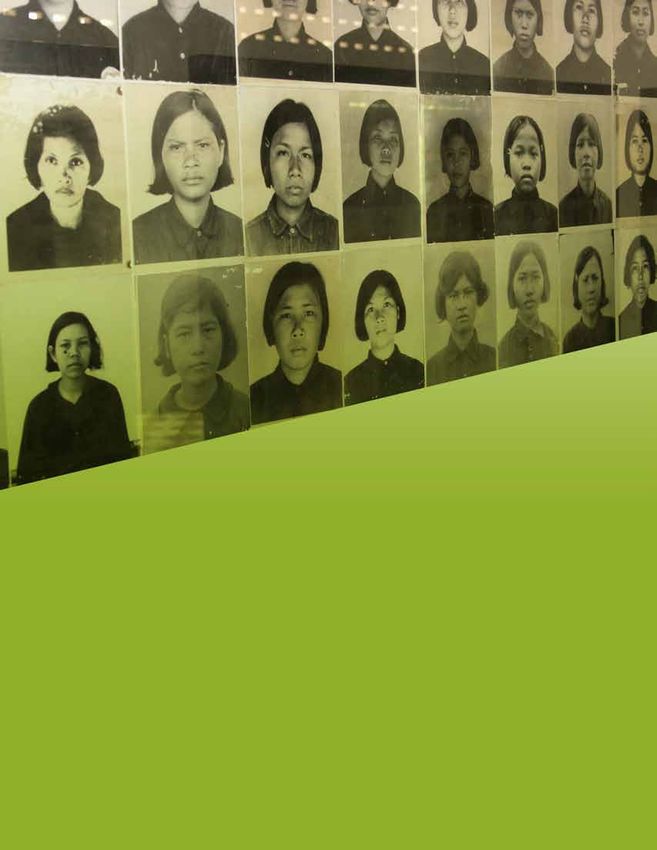
          G E N O CI D E A N D T O R T U R E
                2

          h u m a n r i g h t s defender s
               4

          re l i g i o u s freedom
               6

          WO M E N ’ S R I G H TS
              7

          J ew i s h ISSU E S
             10

          P O S T SC R I P T
               11

          JBI 40TH ANNIVERSARY REPORT: WRITTEN BY GARY SPRUCH
          GRAPHIC DESIGN BY LINDA KRIEG

2   jbi Fortieth anniversary
from our chairman
Dear Friend,

There’s no excuse for silence.

And as JBI celebrates our 40th anniversary of global advocacy, it is our
commitment to breaking the silence that we celebrate.

For four decades—as you’ll see in the pages that follow—we’ve made our
voice heard. For four decades, we’ve spoken out forthrightly on behalf of
human rights, human dignity, and human solidarity.

Indeed, in the past forty years, the concept and reality of human rights
has made impressive progress in the world arena. I’m glad to report to
you that at every turn, JBI has been part of that progress—often, right in
the very thick of it.

It’s been said that American Jews who care passionately about human
rights must assume a difficult task: dancing at three weddings at the same
time. That is, they need to simultaneously stand up for American, Jewish,
and universal concerns.

As JBI Chair, I can tell you that at JBI, we’d simply have it no other way.
For us to cease “dancing” at any one of these weddings would be to be-
tray the vision we hold most dear.

In the pages that follow, you will read brief sketches describing a small
portion of the work we’ve done and continue to do.

I believe that as you read, you’ll see clearly how all our efforts reflect our
profound, unceasing dedication—to the moral ideals of Judaism, and to
the universal standards and abiding values of humanity.

Let’s make sure that in the years to come, whenever justice and freedom
are under attack, JBI’s voice continues boldly to break the silence.

Best regards,

E. Robert Goodkind

Chairman, JBI

                                             jbi Fortieth anniversary            3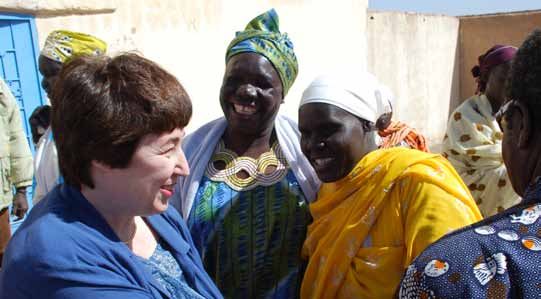
Genocide
                    and torture
    Primo Levi once asked: “How much of the concentration camp world is
    dead and will not return?”

  	Striving to avert the return of such a monstrosity, Jacob Blaustein
    (1892-1970), in the Holocaust’s aftermath, launched a successful campaign
    for fundamental human rights protections in the new UN Charter.

  	In NGOs and the Universal Declaration of Human Rights, William Korey
    tells the tale of the central role Blaustein played. But, of course, the Univer-
    sal Declaration was just a start.

    For four decades, JBI has carried the work forward on
    every front. And, indeed, despite terrible challenges,
    we have seen vital growth. In both the mainstreaming
    of human rights and the prevention and punishment of
    genocide.
                                        Jacob Blaustein, serving as a
                                         member of the U.S. Delega-
                                         tion to the UN. JBI is named
                                           in honor of this pioneering
                                                 human rights leader.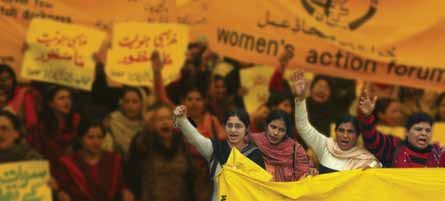
To Aid Humanity’s Cause
                                                                                               Prevention of
“I salute JBI for your leadership on holding the perpetrators of war
                                                                            Genocide
crimes accountable, and for all you have done to aid humanity’s
cause,” proclaimed Secretary of State Madeleine Albright.
     War crimes in Bosnia, mass killings in Kosovo, ethnic slaugh-
                                                                             Compilation of Risk Factors
ter in Rwanda, atrocities in the Congo, the range of threats em-
                                                                             and Legal Norms for the
anating from Iran—in all these cases and so many more, JBI has
made our voice clearly heard.                                                 Preventionof
     We’ve also made a unique effort to study and identify the risk
factors and strengthen the legal means of preventing genocide. In
                                                                                    Genocide
fact, a JBI-produced compilation on exactly these themes earned
                                                                                                                   A JBI publication
the admiration of Frances Deng, the UN Secretary General’s Special Representa-                                     on genocide
tive on the Prevention of Genocide.                                                                                prevention.
                                                                                                                  Jacob Blaustein Institute
                                                                                                     for the Advancement of Human Rights
     “I consider your publication an invaluable contribution to my office’s efforts
                                                                          In Cooperation with the Office of the Special Adviser on the Prevention of Genocide, United Nations

to address the legal ambiguities in the Genocide Convention,” remarked Deng.

The Question of Waterboarding
In opposing torture, JBI has never flinched. We have actively sought to alert the
world to state-sponsored torture in China, Cambodia, Iran, and Saudi Arabia,
among other nations.
     Our range of efforts on the issue include cosponsoring a major New York City
Law Review symposium and subsequent publication on preventing torture. And
we assisted efforts by CUNY Law School’s Women’s Rights Clinic to lodge cases
against torturers—including the only successfull case against Bosnian Serb leader
Radovan Karadzic.
     Closer to home, JBI’s early, vociferous rejection of military tribunals and the
use of torture at Guantanamo won wide praise. As president of the American Jew-
ish Committee and, later, as JBI chair, E. Robert Goodkind has proved an ardent
opponent of torture and inhumanity.
     In 2005, for example, he spearheaded AJC’s support of legislation banning
the use, by U.S. personnel, of degrading treatment of detainees. And, in 2007,
when the question of waterboarding came to the fore, Goodkind declared, and
AJC’s Board affirmed, that “waterboarding is unquestionably torture.”

One Group that Stood Firmly
“JBI is one group that stood firmly and never considered justifying violations of in-
ternational law in the name of national security,” declared Phillipe Sands, Profes-
sor of Law at University College London and author of Torture Team: Rumsfeld’s
Memo and the Betrayal of American Values.
     The election of our director, Felice Gaer—as the first American on the UN
Committee Against Torture—points also to our tenacious struggle against cruel,
inhuman, or degrading punishment.

                                                               jbi Fortieth anniversary                                                                  5
Human Rights
                           defenders
  “ The grammar of totalitarianism has only two persons: us and them,”
   writes Tzvetan Todorov in Hope and Memory: Lessons From the
   Twentieth Century. And for them, of course, what too often awaits is
   a world of torture, forced confessions, secret detentions, or worse.

  	Indeed, among the bravest heroes of our time are human rights
   defenders. These are men and women who put themselves at grave
   personal risk by promoting, protecting, and defending human rights—
   in places where these rights are trampled.
A publication of the Iran Human Rights
Documentation Center
JBI takes great pride in our across-the-board participation in the
drafting and adoption of the UN’s 1998 Declaration on Human
Rights Defenders. We were deeply involved, in fact, in the very
conception of this historic declaration. And we later convened the
first-ever NGO meeting with the UN’s Special Representative on
Human Rights Defenders.
We strive to take action on every level. When the Chinese
delegation came before the UN Committee Against Torture, for in-
stance, committee member and JBI director Felice Gaer repeated-
ly raised the names of individual Chinese human rights defenders. These champi-
ons of freedom had faced harassment, intimidation, and sometimes brutal violence
at the hands of the government or its agents.
Taken by Surprise
Gaer’s specificity took the delegation members by surprise. They were furious,
and leveled a host of charges against the defenders cited. They no doubt dis-
liked the pointed departure from their usual UN experience—an all-too-comfort-
able conversation about human rights concepts and generalities.
Without question, calling persecutors to account is an indispensable aspect
of defending human rights defenders.
And JBI consistently extends its own efforts in this arena by assisting others.
For example, JBI has worked to strengthen Human Rights in China (hric.org), a
Famed Soviet dissident
highly respected advocacy group dedicated to Chinese human rights issues. Andrei Sakharov receives
a Russian version of the
The Iran Human Rights Documentation Center (iranhrdc.org), also assisted
Universal Declaration of
by JBI, does similar groundbreaking work exposing the appalling human rights Human Rights from JBI
Director Felice Gaer.
abuses and persecution of human rights defenders, taking place in Iran.
The Promise of “Never Again”
Roya Hakakian, human rights activist and author of Journey from the
Land of No, said of JBI: “You stand as a pillar—for all people every-
where—in making sure that ‘Never Again’ is not an empty promise.”
Our work on behalf of human rights defenders—including our ef-
forts in Russia today—reflects a long tradition.
“In the early 70’s, JBI was unique in its deep concern not only with
Jewish dissidents and Jewish emigration, but with the general state of human
rights in the Soviet Union,” explained Elena Bonner, wife of famed Soviet physicist
and Nobel Peace Prize recipient Andrei Sakharov.
“Your endeavors,” she added, “lent authority to the Soviet movement for
democratic change.”
jbi Fortieth anniversary 7Religious
freedom
It seems pulled from the pages of George Orwell’s 1984.
The movement at the UN—introduced by the Organization of the Islamic
Conference—to ban the “defamation of religions” seeks to transform international
human rights law into a tool for attacking religious freedom.
It would turn on its head a basic human rights idea: that it is people—and not
abstract concepts or belief systems—that warrant special rights and privileges.
A series of General Assembly “defamation” resolutions has already met suc-
cess. While discrimination against Muslims is a problem, the “defamation” move-
ment takes an entirely wrong-headed approach, concluded a JBI expert panel.
“A Dangerous Precedent”
No doubt, these resolutions “set a dangerous precedent,” asserts a JBI petition
on the issue prepared by attorney Christen Broecker, JBI’s International Human
Rights Officer. JBI lodged the petition to the UN Committee monitoring compli-
ance with the International Covenant on Civil and Political Rights.
Nazila Ghanea, Oxford University professor and editor-in-chief of the Journal
of Religion and Human Rights, chaired two recent JBI seminars—one in New York
and one in Geneva—on current threats to religious freedom. Each drew more than
twenty key UN diplomats.
The Last Utopia
In his acclaimed The Last Utopia: Human Rights in History, Columbia University
professor Samuel Moyn discusses the WW-II era “entry of human rights into the
ideological and rhetorical arsenal of world politics.”
Moyn recently commented: “The various
freedoms that crystallized in the broad anti-to-
talitarian movement of that time—including reli-
gious freedom—have had a responsible, reliable,
and relentless defender in JBI.”
Indeed, our longtime efforts led to JBI Direc-
tor Felice Gaer’s appointment to the U.S. Com-
mission on International Religious Freedom, and
to her service, three times, as Commission chair.
Secretary of State Hillary
Rodham Clinton meets with Ringing the Alarm Bell
JBI Director Felice Gaer, in
Gaer’s capacity as Chair, U.S. The Jewish Forward, praising her work on religious freedom, named Gaer one
Commission on International
of the 50 most influential Jewish leaders in America. She’s “the American Jewish
Religious Freedom.
community’s in-house international human rights expert,” the Forward noted.
“She delves into human rights issues long before they bubble to the surface.”
It was Gaer, for instance, who “started alarm bells ringing” regarding the troubling
character of Afghanistan’s constitution.“Women’s rights are human rights.” The statement may seem obvious today.
And yet, it was a bold conceptual breakthrough when declared in Beijing at
the 1995 UN World Conference on Women.
JBI’s longstanding quest to put women’s
rights into the framework of human rights led,
no doubt, to the appointment of our director,
Felice Gaer, to the official U.S. government del-
egation to Beijing.
Gaer additionally served as staff director
of an AJC/JBI delegation accredited both to
the official Beijing conference and the parallel
NGO forum.
“Ms. Gaer’s work in Beijing made a real difference,” declared Melanne Verveer,
U.S. Ambassador-at-Large for Global Women’s Issues. “Under her leadership, JBI
continues to contribute in significant ways to advancing women’s rights and inter-
national law.”
No Room for Retreat Women’s
Certainly, there’s no room for retreat in the urgent work of defending women’s rights
equality and security. A major JBI focus right now: the effort to win U.S. ratifica-
tion of CEDAW—the Convention on the Elimination of All Forms of Discrimination
against Women.
Sadly, in not yet joining this vital international treaty—so far ratified by 186
out of 193 countries—the U.S. stands together with some unsavory company in
terms of human rights: the likes of Iran, Somalia, and Sudan.
In addition to CEDAW, there’s another key front in JBI’s pioneering work on
women’s issues. And that is the inclusion, in international law, of rape and sexual
violence as a crime against humanity, when used as a weapon of war.
The Rights of Women and Girls
Equality Now (equalitynow.org)—an advocacy group aided by JBI—contributes in
extraordinary ways to the worldwide struggle for the human rights of women and
girls.
Rape, domestic violence, reproductive rights, trafficking, female genital muti-
lation, political participation, and gender discrimination—these are the urgent con-
cerns that occupy Equality Now every day.
In its entry on Gaer, the Encylopaedia Judaica describes her as “the architect
of many initiatives linking women’s rights to human rights.”
“We count on JBI’s Felice Gaer,” said Susan Rice, U.S. Ambassador to the UN,
“to speak out on behalf of the vulnerable and oppressed, who need our help.”
jbi Fortieth anniversary 9Jewish
It’s a fact so often forgotten: there’s no country in the world with origins more issues
deeply embedded in international law than the State of Israel.
On the 60th anniversary of UN Resolution 181, partitioning Palestine into two
states, one Jewish and one Arab, JBI published Mandate of Destiny.
Produced in honor of Bob Rifkind’s JBI chairmanship, the book extensively
documents the development and emergence of the UN partition plan.
And it leaves no doubt about the seriousness with which the newly-created
UN worked to reach a fair and equitable solution. Quoted in the book is Trygve
Lie, the first UN Secretary General, who described the May 1948 invasion of Israel
as “armed defiance of the UN.”
Israel’s Place Among the Nations
In the face of mounting delegitimization campaigns against Israel, Mandate of
Destiny underscores Israel’s uncommonly legitimate place among the nations.
Indeed, time and again, JBI stands up for international law and for the human
rights of all, including the Jewish people. As told in Michael Galchinsky’s Jews and
Human Rights, JBI helped launch Israel’s most respected human rights organiza-
tion, the Association for Civil Rights in Israel (acri.org.il/en).
Rebuking Antisemitism
JBI has worked to free Soviet Jewry, overturn the
UN’s “Zionism=Racism” resolution, and gain passage
of the UN’s first explicit rebuke of antisemitism. Sim-
ilarly, we played a pioneering role—as only JBI could
have—in ensuring that the 56 member states in the
OSCE commit to combating antisemitism.
And we demanded, in countless influential fo-
rums, that the two UN Durban conferences turn
away from the demonization of Israel and toward the issues they were called to UN Secretary-General
Ban Ki-Moon (r.) discusses
address—racism, discrimination, and intolerance. issues with JBI leaders.
On left (l. to r.): Former
“Inside the Game” JBI Chair Bob Rifkind;
JBI Chair E. Robert Goodkind;
and JBI Director Felice Gaer.
While playing fully “inside the game,” JBI has never stood outside the most vital
struggles confronting the Jewish people today.
Praising Gaer for her historic work on the 1998 UN resolution condemning
antisemitism, Dore Gold, Israel’s Ambassador to the UN, pointed with clarity to
JBI’s enduring uniqueness:
“While all too many despaired over the treatment of Jewish issues at the UN,
you rose to action. Your work,” he continued, “amounts to a monumental step in
the direction of fairness and justice for Israel.”
10 jbi Fortieth anniversaryif we wish for a life of freedom . . .
The greatest achievement of the Hebrew prophets? In his 1951 classic on Jewish
social ethics, Judaism and Modern Man, Will Herberg explained that they “vindi-
cated the uniqueness and significance of the individual.”
As we launch our fifth decade of global advocacy, the earth-shaking insights of
the ancient Jewish prophets stand at the core of JBI’s work. Upon the joyful cel-
ebration of our anniversary, we affirm yet again our core mission:
In Herberg’s terms, it is, indeed, to vindicate—that is to clear of any blame, fear,
or suspicion—the notion that every man and woman, everywhere on earth, de-
serves a life of freedom and dignity.
And it is likewise to encourage perceptive scholarship, build coalitions, support
effective projects and programs, and press for laws and actions, nationally and
internationally, that will bridge the gap between human rights ideals and human
rights realities.
At JBI, we feel keenly obliged. We know that if we ourselves wish for a life of
freedom, then we have no choice but to take action.
We must stand up for those who face down their oppressors. And we must chart
a course of progress for those who are beaten, battered, trapped, tortured, or
forgotten.
As you have read in these pages, JBI has contributed meaningfully to the great
advances made in the post-war world. But the work, of course, goes on.
And we are pledged to carry forward into the future our determined battle—
against abuse and persecution and for the fundamental freedoms of the individ-
ual and the solidarity of all humankind.
jbi Fortieth anniversary 11Administrative Council
E. Robert Goodkind, Chair
Marion Bergman
Susan Morton Blaustein
Thomas Buergenthal
Roberta Cohen
Irwin Cotler
Lori F. Damrosch
Edith B. Everett
Lois Frank
David Harris
Barbara Blaustein Hirschhorn
Michael Hirschhorn
Charlotte Holstein
Suzanne Jaffe
Harris L. Kempner Jr.
Edward Luck
Jesse Margolin
Carol Nelkin
Louis Perlmutter
Robert S. Rifkind
Arthur Roswell
Elizabeth Blaustein Roswell
Bruce Rubin
Stephen Schwebel
Jerome Shestack
David F. Squire
Daniel Terris
Felice D. Gaer, Director
Christen Broecker, International Human Rights Officer
Jennifer Izelle, Administrative Assistant
Remembering our Leaders and Friends
Selma Hirsch
A JBI Founder and Associate Executive Director
David Hirschhorn
A JBI Founder and longtime Steering Committee Member
William Korey
Author, advocate, and JBI Administrative Council Member
Leo Nevas
Attorney and Former JBI Chair
Oscar Schachter
Professor of Law, Columbia University
12 jbi Fortieth anniversaryYou can also read


