Packaging and labelling guide for cannabis products - Requirements under the Cannabis Act and the Cannabis Regulations
←
→
Page content transcription
If your browser does not render page correctly, please read the page content below
Packaging and labelling guide for
cannabis products

Requirements under the Cannabis Act and the
Cannabis Regulations
Health Canada is the federal department responsible for helping the people of Canada
maintain and improve their health. Health Canada is committed to improving the lives of all
of Canada's people and to making this country's population among the healthiest in the
world as measured by longevity, lifestyle and effective use of the public health care system.
Disclaimer: This document does not constitute part of the Cannabis Act or its regulations. It
should be read in conjunction with the relevant sections of the Act and its regulations. The
information in this document is not intended to substitute for, supersede or limit the
requirements under the legislation. In the event of discrepancy between the legislation and
this document, the legislation shall prevail.
The reader is advised to consult other legislation that may apply to them or their activities,
such as applicable provincial or territorial legislation.
This document may be updated from time to time so the reader is encouraged to check back
periodically.                                             DRAFT

Également disponible en français sous le titre :
Guide sur l’emballage et l’étiquetage des produits de cannabis
To obtain additional information, please contact:
Health Canada
Address Locator 0900C2
Ottawa, ON K1A 0K9
Tel.: 613-957-2991
Toll free: 1-866-225-0709
Fax: 613-941-5366
TTY: 1-800-465-7735
E-mail: hc.publications-publications.sc@canada.ca
© Her Majesty the Queen in Right of Canada, 2019
Publication date: August 30, 2019
This publication may be reproduced without permission provided the source is fully
acknowledged.
Cat.: H134-8/2019E-PDF
ISBN: 978-0-660-32189-9
Pub.: 190293

1   Packaging and labelling guide for cannabis products
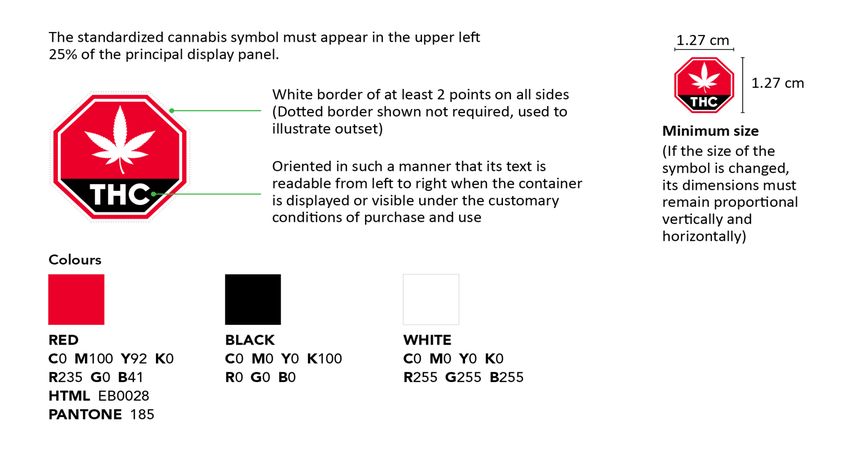
Table of Contents
1.0     Purpose ...................................................................................................................................... 4
2.0     Background ................................................................................................................................ 4
3.0     Scope .......................................................................................................................................... 4
4.0     Definitions and abbreviations ................................................................................................... 5
        4.1        Definitions....................................................................................................................... 5
        4.2        Abbreviations ................................................................................................................. 6
        4.3        Icons ................................................................................................................................ 7
5.0     Prohibitions on packaging and labelling of cannabis ............................................................... 7
        5.1        General prohibitions ...................................................................................................... 7
        5.2        Other prohibited representations ................................................................................. 7
        5.3        False, misleading or deceptive information.................................................................. 8
6.0     General packaging and labelling requirements ....................................................................... 9
7.0     Packaging requirements ..........................................................................................................11
        7.1        Immediate container requirements ............................................................................11
        7.2        Outermost container requirements ............................................................................12
        7.3        Food grade packaging requirements ..........................................................................13
        7.4        Co-packaging edible cannabis .....................................................................................13
8.0     Labelling requirements............................................................................................................14
        8.1        Required information on the principal display panel of the label .............................15
            8.1.1         Standardized cannabis symbol ............................................................................15
            8.1.2         Health warning messages ....................................................................................16
            8.1.3         THC and CBD content ...........................................................................................18
            8.1.4         Brand name...........................................................................................................20
            8.1.5         An additional brand element (optional) ..............................................................20
            8.1.6         International radiation symbol (if applicable) .....................................................20
        8.2        Required information about the cannabis product ...................................................21
            8.2.1         Displaying the list of ingredients on the label .....................................................26
            8.2.2         Naming ingredients ..............................................................................................26
            8.2.3         Order of ingredients .............................................................................................27

2     Packaging and labelling guide for cannabis products
8.2.4 Order and grouping of constituents ....................................................................27
8.2.5 Order and grouping of sugars-based ingredients ...............................................28
8.2.6 Declaring food allergens, gluten and added sulphites .......................................29
8.2.7 Declaring a risk of cross-contamination ..............................................................31
8.2.8 Nutrition facts table for edible cannabis .............................................................32
8.3 Required information on small immediate containers ..............................................32
8.4 Other information about the cannabis product .........................................................33
8.5 Labelling cannabis other than a cannabis product.....................................................34
9.0 Transition period for packaging and labelling ........................................................................35
10.0 Contact us ................................................................................................................................36
11.0 Feedback—Help us improve ...................................................................................................36
Appendix A: A cannabis product that meets the packaging and labelling requirements ...............37
3 Packaging and labelling guide for cannabis products1.0 Purpose This guide provides guidance and information about the packaging and labelling requirements for cannabis products under the Cannabis Act (also referred to in this guide as “the Act” and abbreviated to CA for references) and the Cannabis Regulations (also referred to in this guide as “the Regulations”, and abbreviated to CR for references). 2.0 Background The Cannabis Regulations sets out requirements pertaining to how cannabis and cannabis products must be packaged and labelled prior to sale, distribution or export. Specifically, the Regulations require plain packaging and labelling for all cannabis products with restrictions on logos, colours, and branding. Cannabis products must be in packaged in a child-resistant container and be labelled with the standardized cannabis symbol, the mandatory health warning message, and include specific product information (e.g., brand name of the cannabis product, class of cannabis, delta-9-tetrahydrocannabinol (THC) and cannabidiol (CBD) information, licence holder information). These measures aim to reduce the risks of accidental consumption and overconsumption as well as reduce the appeal of cannabis products to young persons while providing consumers with the information they need to make informed decisions before using cannabis. Licence holders are responsible for complying with the Act and Regulations, and other legislation that may apply to them or their activities. Health Canada does not review or pre-approve packages and labels of cannabis products. Health Canada applies a risk-based approach to compliance and enforcement whereby risk pertains to health, safety and the credibility of the regulatory system, among other factors. The Compliance and enforcement policy for the Cannabis Act can be found on Health Canada’s website. 3.0 Scope This guide applies to cannabis products that are sold or distributed in Canada. Cannabis products do not include cannabis or a cannabis accessory that contains cannabis that is intended for an animal, or a drug containing cannabis. This guide does not apply to industrial hemp or hemp seed derivatives. This guide does not apply to shipping containers such as outer wrappings or boxes used to transport cannabis products, or a crate in a transport truck. The information in this guide is based on the Cannabis Regulations, as amended by the Regulations Amending the Cannabis Regulations (New Classes of Cannabis) which were published in the Canada Gazette, Part II, on June 26, 2019 and will come into force on October 4 Packaging and labelling guide for cannabis products
17, 2019. The amended Regulations include transitional provisions related to packaging and
labelling. More information is outlined in section 9.0 of this guide.
On its website, Health Canada publishes other guidance documents and information that may be
used in conjunction with this guide to support compliance with the Act and Regulations. For
consistency and transparency, this guide and other guidance documents and information are
updated as required to reflect changes to policies and/or operations.
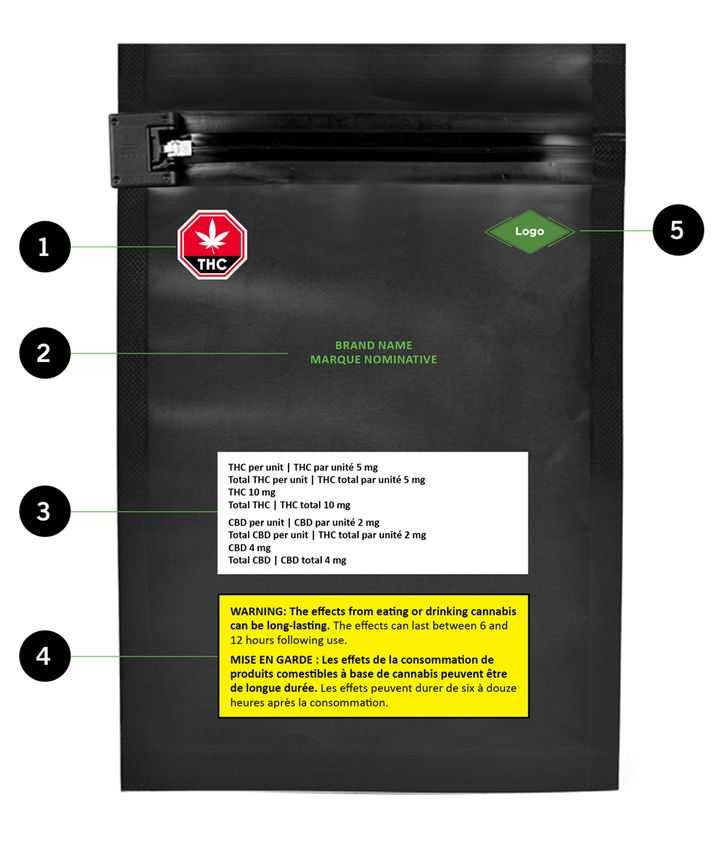
The examples and figures in this guide are for illustrative purposes only and do not represent
actual cannabis products.

4.0 Definitions and abbreviations
4.1 Definitions
The Cannabis Act and the Cannabis Regulations should be referred to for definitions. The
definitions in this section are provided for ease of reference.
Brand element: As defined in the Cannabis Act, includes a brand name, trademark, tradename,
distinguishing guise, logo, graphic arrangement, design or slogan that is reasonably associated
with, or that evokes,
        (a) cannabis, a cannabis accessory or a service related to cannabis; or
        (b) a brand of any cannabis, cannabis accessory or service related to cannabis.
Cannabis accessory: As defined in the Cannabis Act, means
      (a) a thing, including rolling papers or wraps, holders, pipes, water pipes, bongs and
      vaporizers, that is represented to be used in the consumption of cannabis; or
      (b) a thing that is deemed under subsection 2(3) of the Act to be represented to be used
      in the consumption of cannabis.
Cannabis product: As defined in the Cannabis Regulations, means cannabis of only one of the
classes that are set out in Schedule 4 to the Cannabis Act—or a cannabis accessory that contains
such cannabis—after it has been packaged and labelled for sale to a consumer at the retail level.
It does not include cannabis that is intended for an animal or a cannabis accessory that contains
cannabis that is intended for an animal, or a drug containing cannabis.
Common name: As defined in the Cannabis Regulations for the purposes of its Part 7, in respect
to edible cannabis, has the same meaning as in subsection B.01.001(1) of the Food and Drug
Regulations.
Exterior display surface: As defined in the Cannabis Regulations for the purposes of its Part 7,
means the area on the exterior surface of an immediate container to which a label is applied and
that is visible under customary conditions of purchase or use.
Immediate container: As defined in the Cannabis Regulations, means a container that is in direct
contact with cannabis or a cannabis accessory that is a cannabis product or, if a wrapper is in
direct contact with the cannabis or the cannabis accessory, with the wrapper.

 5   Packaging and labelling guide for cannabis products
Label: As defined in the Cannabis Act, includes a legend, word or mark that is, or is to be applied
or attached to or included in, or that accompanies or is to accompany, cannabis or a cannabis
accessory or a package.
Package: As defined in the Cannabis Act, means any inner or outer container or covering.
Point: As defined in the Cannabis Regulations, means the unit of measurement for type size that
is known as a PostScript point and is equal to 0.3527777778 millimetres.
Principal display panel: As defined in the Cannabis Regulations for the purposes of its Part 7, has
the same meaning as in subsection 2(2) of the Consumer Packaging and Labelling Regulations.
Specifically it means:
(a) in the case of a container that is mounted on a display card, that part of the label
applied to all or part of the principal display surface of the container or to all or part of
the side of the display card that is displayed or visible under normal or customary
conditions of sale or use or to both such parts of the container and the display card,
(b) in the case of an ornamental container, that part of the label applied to all or part of
the bottom of the container or to all or part of the principal display surface or to all or
part of a tag that is attached to the container, and
(c) in the case of all other containers, that part of the label applied to all or part of the
principal display surface
4.2 Abbreviations
CA Cannabis Act
CBD cannabidiol
CFIA Canadian Food Inspection Agency
CR Cannabis Regulations
EU European Union
FDA Food and Drug Act
FDR Food and Drugs Regulations
g gram
INCI International Nomenclature of Cosmetic Ingredients
mg milligram
ml millilitre
PDP principal display panel
ppm parts per million
SFCR Safe Food for Canadians Regulations
THC delta-9-tetrahydrocannabinol
6 Packaging and labelling guide for cannabis productsTHCA delta-9-tetrahydrocannabinolic acid
TVPA Tobacco Vaping Products Act
μg/g microgram per gram
4.3 Icons
The following icons are used in this guide to highlight information of interest.
Important: Key or cautionary information.
Tip: Supplementary information that could be helpful, including references to
external documents.
5.0 Prohibitions on packaging and labelling of cannabis
The Cannabis Act and Cannabis Regulations outline a number of prohibitions related to the
packaging and labelling of cannabis and cannabis products. Unless authorized under the Act, the
prohibitions listed in this subsection apply to all cannabis and cannabis products.
5.1 General prohibitions
Under the Cannabis Act, it is prohibited for a person that is authorized to sell cannabis (or for a
person that sells a cannabis accessory) to sell it in a package or with a label:
• That does not meet the requirements of the Regulations [25, CA]
• If there are reasonable grounds to believe that a package or label could be appealing to
young persons [26(a), 27(a), CA]
• That sets out a testimonial or endorsement, however displayed or communicated [26(b),
27(b), CA]
• That sets out a depiction of a person, character or animal, whether real or fictional [26(c),
27(c), CA]
• That associates it or any one of its brand elements with, or evokes a positive or negative
emotion about or image of, a way of life such as one that includes glamour, recreation,
excitement, vitality, risk or daring [26(d), 27(d), CA]
5.2 Other prohibited representations
The prohibitions listed in this subsection apply to all cannabis products including the package,
label or panel of a container.
7 Packaging and labelling guide for cannabis productsUnder the Regulations, it is prohibited to make an express or implied representation, including
by way of a brand element, if there are reasonable grounds to believe that the representation
could:
• Associate the cannabis product with a tobacco product as defined in section 2 of the
Tobacco Vaping Products Act (TVPA), or a vaping product to which that Act applies
[132.32, CR].
• Associate the cannabis product with an alcoholic beverage [132.31, CR].
• Create the impression that health or cosmetic benefits may be derived from the use of
the cannabis product This prohibition does not apply to drugs containing cannabis that
are health products (i.e. prescription drugs containing cannabis or medical devices which
are approved under the Food and Drug Act (FDA) [104.12(2), 132.28, CR]). For more
information, refer to the FDA and its regulations as well as the Guidance on health
products containing cannabis or for use with cannabis: Guidance for the Cannabis Act,
the Food and Drugs Act, and related Regulations.
Additionally, for edible cannabis, it is prohibited to make an express or implied representation,
including by way of a brand element that would:
• Concern the energy value referred to in item 2 of the table to 132.22 of the Regulations
or the amount of nutrient referred to in items 3 to 15 of that table or in items 5 to 37 of
the table to section B.01.402 of the Food and Drugs Regulations (FDR) [132.29(1), CR].
• Cause reasonable grounds to believe that the representation could create the impression
that the cannabis product is intended to meet the particular dietary requirements of an
individual who has a physical or psychological condition as a result of a disease, disorder
or injury, or for whom a particular effect, including weight loss, is to be obtained by a
controlled intake of food, or of individuals who are under 18 years of age [132.3, CR].
Additionally, for cannabis extracts, it is prohibited to display an indication or illustration, including
a brand element that could:
• Cause a person to believe that the cannabis product has a flavour set out in column 1 of
the Schedule 3 to the TVPA, other than the flavour of cannabis, such as confectionary,
dessert, soft drink and energy drink flavours [132.13, CR].
5.3 False, misleading or deceptive information
It is prohibited for a person that is authorized to sell cannabis (or for a person who sells a
cannabis accessory) to sell it in a package or with a label that contains any information that is
false, misleading or deceptive or that is likely to create an erroneous impression about the:
• Characteristics, value, quantity, composition, strength, concentration, potency, purity,
quality, merit, safety, health effects or health risks of the cannabis [26(e), CA].
• Design, construction, performance, intended use, characteristics, value, composition,
merit, safety, health effects or health risks of a cannabis accessory [27(e), CA].
8 Packaging and labelling guide for cannabis productsThe Act and Regulations set out a series of comprehensive provisions that prohibit
certain activities (e.g., packaging and labelling, promotion and sale) with cannabis or
a cannabis accessory if there are reasonable grounds to believe the cannabis,
cannabis accessory, cannabis product, or service related to cannabis could appeal to
young persons. The Policy statement on Cannabis Act prohibitions referring to
appeal to young persons provides more information.
6.0 General packaging and labelling requirements
The requirements of the Regulations result in plain packaging and labelling for all cannabis
products. This includes restrictions on logos, colours, and branding as well as specific display
formats about how product information must appear on the label (e.g., type style, size, and
spacing). These measures are designed to:
• Reduce the attractiveness and appeal of cannabis products, particularly to young persons
• Make the standardized cannabis symbol and health warning messages more prominent
and noticeable
• Provide consumers with accurate information about the content and use of the cannabis
product
Plain packaging and labelling applies to all surfaces, including labels and the various types and
parts of the package such as containers, wrappers, and coverings (e.g., shrink wrap). Table 1
summarizes the general packaging and labelling requirements.
Table 1: General packaging and labelling requirements
Cannabis
Regulations Requirement Notes
reference
Single uniform colour¹
• No fluorescent colours for containers or Colour may be different for each surface
wrappers, or metallic colours on containers (e.g., exterior, interior) and panel. The
113 • Colour of containers must create a contrast exterior of any container and the
120 with yellow colour of the health warning interior surface of immediate containers
123.1(1)(c) message and the red colour of the standardized may be a metallic colour if that surface
cannabis symbol is made of metal, excluding the label or
• Coverings of containers must be transparent image.
and colourless
9 Packaging and labelling guide for cannabis productsTable 1: General packaging and labelling requirements
Cannabis
Regulations Requirement Notes
reference
Smooth texture¹
• No raised features for containers and coverings Does not apply to features necessary to
115 • No embossing or decorative ridges for facilitate opening and closing of the
123.1(1)(e) wrappers container and those to assist persons
• No other irregularities (e.g., engravings, who are visually impaired.
etchings) for containers and coverings
No hidden features including
• Heat-activated ink
116(1) • Feature that is visible only through
123.1(1)(f) technological means unless, in the case of
containers or coverings, it is used to prevent
counterfeiting
No features that can change surface area including
• Tags
116(2) • Fold-out panels except in the case of a peel- Does not apply to wrappers.
back or accordion panel for a small immediate
container. See section 8.3 of this guide.
117
Not emit scent or sound
123.1(1)(g)
121 Does not apply to coverings or
No cut-out windows
wrappers.
111 Subject to specific provisions of the
118 No brand element Regulations. See sections 8.1.4 and 8.1.5
123.1(1)(a) of this guide.
No image and/or information¹ A container may display a bar code but it
112 • No image on any container (interior or must only appear once. It must be in a
119 exterior surface and panel) in which a rectangle that is black and white without
122 cannabis product is packaged any other images or designs. A wrapper
123.1(1)(b) • No image or information on the covering must display the standardized cannabis
123.1(2) • No image or information on a wrapper symbol. See section 8.1.1 of this guide
for more information about the symbol.
Cannabis products may be accompanied
by the document entitled Consumer
18 Information – Cannabis. There is an
107 No inserts or leaflets¹ exception that allows additional
132 information to be included with any
shipment, including shipments sent to
registered patients.
1
Unless provided under the Cannabis Act, any other Act of Parliament, or any provincial Act.
10 Packaging and labelling guide for cannabis productsColours that have the lustre of metal or metallic properties include Pantone
Metallics or Pantone Premium Metallics. Fluorescent properties include pigments
that absorb ultraviolet energy and transmit it as a longer wavelength, such as the
Pantone 800 series.
7.0 Packaging requirements
All cannabis products must be packaged in an immediate container. Some products may also
have an outer container in addition to the immediate container, while other products may have
shrink wraps or wrappers (e.g., foil wrappers around chocolate).
Where a cannabis product has multilayered packaging, all elements must be packaged and
labelled according to the regulatory requirements.
In addition to the general packaging and labelling requirements outlined in section 6.0 of this
guide, the Regulations also outline specific requirements related to the different parts of a
package.
7.1 Immediate container requirements
As mentioned, all cannabis products must be packaged in an immediate container. This
container is the part of the package that is in direct contact with the cannabis or the cannabis
accessory. The immediate container may also be in direct contact with the wrapper. Table 2
summarizes the immediate container requirements.
Table 2: Immediate container requirements
Cannabis
Regulations Requirement Notes
reference
1(2) Cannot contain more than one class of cannabis Applies to the outermost container
122.4(1)(b) • As set out in Schedule 4 to the Act as well.
Prevent contamination of the cannabis
108(b),(c)
• The container must keep dried cannabis and Does not apply to cannabis plants.
110(a)
cannabis seeds dry
Does not apply to cannabis plants
108(a) Be opaque or translucent
and seeds.
Be child resistant
Does not apply to cannabis plants
108(e) • Meet the requirements set out in C.01.001(2) to
and seeds.
(4) of the FDR
11 Packaging and labelling guide for cannabis productsTable 2: Immediate container requirements
Cannabis
Regulations Requirement Notes
reference
Have a security feature
• Provides reasonable assurance to consumers that Does not apply to cannabis plants
108(d)
the package has not been opened prior to and seeds.
purchase (e.g., security seal)
Not exceed the maximum amount of cannabis
• Cannot contain more than the equivalent of 30 g With the exception of cannabis
108(f)
of dried cannabis plants, refer to Schedule 3 to the Act
109
• The container holding cannabis plants cannot be for equivalency values for different
110(b)
flowering or budding at time of packaging and cannabis classes.
contain more than four plants
Not exceed the maximum THC quantity
• The container holding cannabis topicals or
cannabis extracts cannot have a quantity of THC
96(1) that exceeds 1,000 mg
97(1) • Subject to the variability limits, the container The quantity of THC mentioned here
97(2) holding edible cannabis cannot have a quantity of takes into account the potential to
101.2 THC that exceeds 10 mg convert THCA into THC.
102.7 • Subject to the variability limits, each discrete unit
of cannabis intended for ingestion, nasal, rectal,
or vaginal use cannot have a quantity of THC that
exceeds 10 mg
Control measures for cannabis extracts not in discrete
units
• The container must not permit the extract to be
easily poured or drunk The quantity of THC mentioned here
• If the container contains liquid cannabis extract, takes into account the potential to
122.3 it cannot contain more than 90 ml convert THCA into THC. Cannabis
122.5 • If the container contains liquid cannabis extract extract in liquid form mentioned here
with greater than 10 mg THC not intended for must be at a temperature of 22 ±
inhalation, it must have an integrated dispensing 2°C.
mechanism (e.g., pump or metered spray for a
bottle) that does not dispense more than 10 mg
of THC per activation
7.2 Outermost container requirements
The outermost container in which a cannabis product is packaged must not contain:
• Food;
12 Packaging and labelling guide for cannabis products• More than one class of cannabis set out in Schedule 4 to the Act; or
• More than one immediate container [122.4(1), CR].
There are some exceptions to multiple immediate containers for edible cannabis that are further
detailed in section 7.4 of this guide.
7.3 Food grade packaging requirements
There are food grade packaging requirements for:
• The immediate container in which the edible cannabis, or a cannabis accessory that
contains edible cannabis is packaged;
• Any wrapper that is direct contact with the edible cannabis, or a cannabis accessory
that contains edible cannabis; and
• Any wrapper that is in direct contact with a cannabis extract intended for ingestion,
or a cannabis accessory that contains cannabis extract intended for ingestion.
Division 23 of Part B of the FDR, among other things, prohibits the sale of foods in packages that
may impart any substance to the contents which may be harmful to the consumer of the food.
Section 186(a)(i),(ii), and (v) to (vii) of the Safe Food for Canadians Regulations (SFCR) outline
requirements for a package including to be clean, suitable for its intended use, and free from
odours that might affect the food [122.2, CR].
Wrappers may only be used if they are required to maintain the quality or stability
of the cannabis product.
In these cases, the wrapper must be in direct contact with the cannabis (or the
cannabis accessory) and with one or both of the following:
• The immediate container of the cannabis product
• A wrapper that in direct contact with the cannabis (or the cannabis
accessory) [122.1, CR]
7.4 Co-packaging edible cannabis
The use of multiple immediate containers in an outermost container for edible cannabis is
allowed provided that all requirements related to how these containers are packaged and
labelled are met [122.4, CR].
Each immediate container must:
• Meet the immediate container requirements outlined in section 7.1 this guide (e.g.,
single uniform colour, child resistant, security feature) [122.4(2)(a), CR]
• Contain edible cannabis with consistent properties including size [122.4(2)(f), CR]
• Be labelled in accordance with the requirements for discrete units or non-discrete units
as applicable [122.4(2)(b), CR]
13 Packaging and labelling guide for cannabis productsThe outermost container must:
• Meet the requirements for discrete units and the word “unit” must be interpreted as the
immediate container. As such, for instances, the outermost container must be labelled
with the quantity of THC and CBD in each immediate container, rather than the quantity
for each discrete unit in each container [132.18, 122.4(3), CR]
• Not contain, in total, a quantity of THC that exceeds 10 mg in the immediate containers,
taking into account the potential to convert THCA into THC [122.4(2)(c), CR]
• Not contain, in total, a quantity of cannabis in the immediate containers that exceeds the
equivalent of 30 g of dried cannabis as determined in accordance with Schedule 3 to the
Act [122.4(2)(d), CR]
• Be labelled with the statement “Contains the equivalent of ## g of dried cannabis” where
## is the equivalent quantity of dried cannabis, in grams, as determined in accordance
with Schedule 3 to the Act [122.4(2)(e), CR]
There may be requirements pertaining to the use of certain containers (e.g., hazard
symbol on pressurized containers). The Consumer Chemicals and Containers
Regulations, for instances, should be referred to for more information.
The Government of Canada recognizes that plastic pollution is a growing problem in
Canada and around the world.
To help reduce the amount of waste created by cannabis product packaging, the
Regulations permit wrappers and peel back-type labels as well as flexibility for
packaging materials other than plastics (e.g., cardboard).
Health Canada encourages the use of innovative and environmentally sound
packaging approaches, provided the requirements in the Regulations are satisfied.
8.0 Labelling requirements
The Regulations prescribe what, where and how information must appear on the label of all
cannabis products. This includes strict requirements on the presentation of information such as
type style and size, colours, and spacing.
All information on the label must be:
• In English and French, except for International Nomenclature of Cosmetic Ingredients
(INCI) names and European Union (EU) trivial names [130(1), CR]
• Clear, prominently displayed and legible under normal conditions of purchase and use
[130(2), CR]
14 Packaging and labelling guide for cannabis productsA label should be either printed on, or securely applied to a package (e.g., as a sticker). It should
not fall off or be easily removed during transportation or normal use of the product.
8.1 Required information on the principal display panel of the
label
Every label must have a principal display panel (PDP) that must appear on the principal display
surface of the container. This is the surface that is displayed or is visible under normal or
customary conditions of purchase or use. As defined in section 2 of the Consumer Packaging and
Labelling Regulations, the PDP of the label may be all or part of the principal display surface.
Table 3: Principal display panel
Part of container that is visible under
Area of principal display surface
normal conditions of purchase or use
Side or surface Total area of such side or surface (excluding the top)
Any 40% of the total surface area that can be
No side or surface
displayed (excluding the top and bottom)
Lid Total area of the top surface of the lid
Bag with sides of equal dimensions Total area of one of the sides
Bag with sides of more than one size Total area of one of the largest sides
If there are separate PDPs to display English and French information, each PDP of
the label must be properly labelled.
The subsections below outline the requirements of the PDP of a label:
8.1.1 Standardized cannabis symbol
The standardized cannabis symbol must be displayed on the PDP of the label and is used to
inform and warn consumers that the cannabis product contains THC. It is incorporated by
reference as part of the Regulations and must appear on the label of all cannabis products
containing THC in a concentration greater than 10 μg/g, taking into account the potential to
convert THCA into THC [123(1)(f), 130(5), CR]. A high-resolution format of the standardized
cannabis symbol must be downloaded from Health Canada’s website: Standardized cannabis
symbol
Documents "Incorporated by reference" are documents not in the text of the
regulations that are made part of the regulations. Documents incorporated by
reference have the force of law and can be updated from time to time.
15 Packaging and labelling guide for cannabis productsFigure 1 – Standardized cannabis symbol
If the size of the symbol is changed, its dimensions must remain proportional
vertically and horizontally [130(5)(e), CR].
It is prohibited to display on the label a representation such as an image, sign, mark
or symbol that resembles or can be mistaken for the standardized cannabis symbol
[131, CR].
8.1.2 Health warning messages
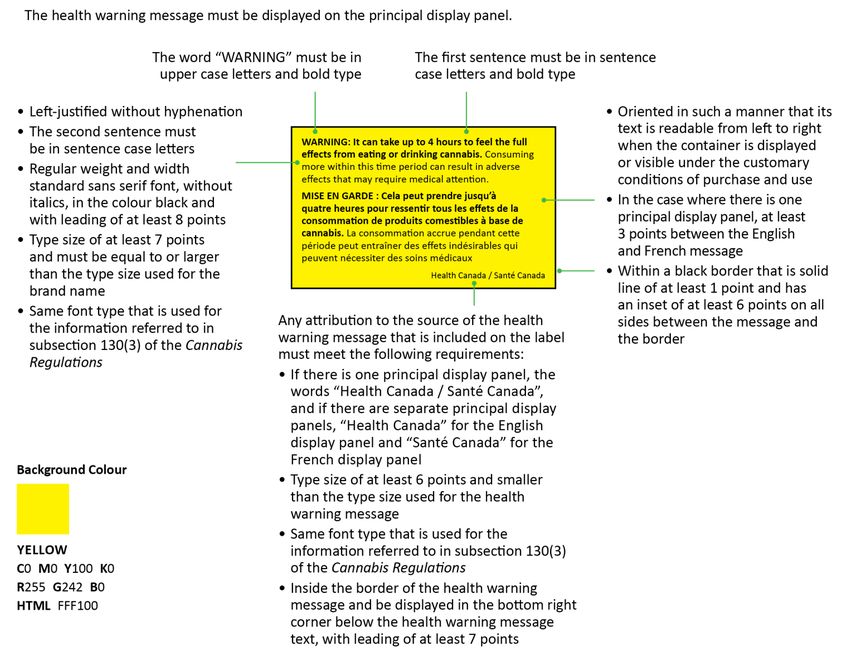
The health warning message must be displayed on the PDP of the label and is comprised of a
primary and secondary message in a yellow box to inform and warn consumers of the potential
health risks and effects of using cannabis [123(1)(e), 130(6)-(7), CR]. These messages are
incorporated by reference as part of the Regulations and can be obtained from Health Canada’s
website: Cannabis health warning messages
16 Packaging and labelling guide for cannabis productsFigure 2 – Health warning message with attribution (bilingual example)
An updated list of health warning messages will take effect when the amended
Regulations come into force on October 17, 2019.
The health warning messages must be displayed in rotation on each type of
container of each brand name of the cannabis product that is packaged in a year, so
that each message is displayed, to the extent possible, on equal numbers of
containers of that product [123(4), CR]. Cannabis topicals are exempted from this
requirement as they have a single health warning message.
17 Packaging and labelling guide for cannabis products8.1.3 THC and CBD content
The unit of measure and whether the THC and CBD content is represented by quantity (mg) or
concentration (mg/g) can vary depending on the class of cannabis in the immediate container,
whether the cannabis product is in discrete units or not and the intended use of the cannabis
product [130(3)(e), CR]. Table 3 summarizes how this information must be displayed on the PDP
of the label:
Table 4: Displaying the THC and CBD content
Note: ## used as a placeholder for numerical values
Cannabis
Class of
Regulations In discrete units Not in discrete units
cannabis
reference
124 Dried or
124.1 fresh Not intended for Intended for
125 cannabis inhalation inhalation THC ## mg/g
THC per unit ## mg THC ## mg/g Total THC ## mg/g
Total THC per unit ## mg Total THC ## mg/g CBD ## mg/g
CBD per unit ## mg CBD ## mg/g Total CBD ## mg/g
Total CBD per unit ## mg Total CBD ## mg/g
132.1 Cannabis
THC ## mg/g
132.11 extract
Total THC ## mg/g
132.12
CBD ## mg/g
Not intended for Intended for
Total CBD ## mg/g
inhalation inhalation
Additionally, if using a cannabis
THC per unit ## mg THC ## mg/g
extract intended for ingestion
Total THC per unit ## mg Total THC ## mg/g
or rectal or vaginal use, or that
CBD per unit ## mg CBD ## mg/g
is packaged with and is
Total CBD per unit ## mg Total CBD ## mg/g
intended to dispense extract:
Total THC per activation ## mg
Total CBD per activation ## mg
132.15 Cannabis
THC per unit ## mg or mg/g THC ## mg or mg/g
132.16 topical
Total THC per unit ## mg or mg/g Total THC ## mg or mg/g
CBD per unit ## mg or mg/g CBD ## mg or mg/g
Total CBD per unit ## mg or mg/g Total CBD ## mg or mg/g
18 Packaging and labelling guide for cannabis productsTable 4: Displaying the THC and CBD content
Note: ## used as a placeholder for numerical values
Cannabis
Class of
Regulations In discrete units Not in discrete units
cannabis
reference
132.18
THC per unit ## mg
132.19
Total THC per unit ## mg
THC ## mg
THC ## mg
Total THC ## mg
Edible Total THC ## mg
CBD ## mg
cannabis CBD per unit ## mg
Total CBD ## mg
Total CBD per unit ## mg
CBD ## mg
Total CBD ## mg
Figure 3 – THC and CBD content for topical cannabis not in discrete units (bilingual example)
19 Packaging and labelling guide for cannabis productsTable 2 in section 7.1 of this guide lists the maximum THC quantities allowed in an
immediate container by class of cannabis. Additionally, the label of a cannabis
product cannot include a total quantity of THC taking into account the potential to
convert THCA into THC that exceeds:
• 10 mg per unit for dried or fresh cannabis or cannabis extract (in discrete units
and not intended for inhalation) [124(2), 132.1(2), CR]
• 10 mg per activation for cannabis extracts in non-discrete units with an
integrated dispensing device [132.12(2), CR]
• 10 mg for edible cannabis [132.18(2), 132.19(2), CR]
The THC and CBD content values displayed on the label must be the values
calculated when testing for the levels of cannabinoids. Further requirements related
to composition testing are found in sections 90 and 92 of the Regulations as well as
the Good production practices guide for cannabis.
8.1.4 Brand name
The brand name of the cannabis product must be displayed on the PDP of the label; however it
must not be in metallic or fluorescent colours. It can be in any type style but the type size must
be smaller than or equal to the type size used for the health warning message that appears on
the label [130(4), CR].
8.1.5 An additional brand element (optional)
Only one other brand element (in addition to the brand name) may be displayed on the PDP of
the label. This element could include, for example, a slogan or logo. It must not be in metallic or
fluorescent colours.
If the brand element is an image or graphic, the surface area must be smaller than or equal to
the surface area of the standardized cannabis symbol that appears on the label.
If the brand element is text only, the type size must be smaller than or equal to the type size
used for the health warning message that appears on the label.
For cannabis products containing less than 10 μg/g THC which are not required to display the
standardized cannabis symbol, the brand element, if an image, must be smaller than or equal to
25% of the PDP of the label, and smaller than or equal to the surface area of the health warning
message that appears on the label [130(9), CR].
8.1.6 International radiation symbol (if applicable)
If edible cannabis is irradiated, the international radiation symbol set out in subsection
B.01.035(5) of the FDR with a statement such as “irradiated”, “treated with radiation” or
“treated by irradiation” must be displayed on the PDP of the label [102.6, 130(11), CR]. The
symbol can be found on the Canadian Food Inspection Agency’s (CFIA) website: Food Irradiation
20 Packaging and labelling guide for cannabis products8.2 Required information about the cannabis product
The Regulations require that all cannabis products be labelled with specific product information,
and this information must be displayed on either the PDP or the area of the label that is visible
under customary conditions of purchase and use (i.e., the exterior display surface). Table 4
summarizes the required information by class of cannabis.
The information must be presented in both English and French in the following format
[130(3)(a)-(d), CR]:
• Background: white
• Type colour: black
• Type style: regular weight and width standard sans serif without italics
• Type size: at least 6 points and must be smaller than the type size used for the health
warning message that appears on the label
• Outset: at least 6 points from the white background on all sides
• Leading: at least 7 points
Table 5: Required information about the cannabis product
Cannabis Class of cannabis
Regulations
Cannabis Dried or Cannabis Cannabis Edible
Reference Requirement plants or fresh extract topical cannabis
plant cannabis
seeds
Contact information of the Required Required Required Required Required
licence holder: name,
123(1)(a) telephone number, email
address
Class of cannabis: one of
Required Required Required Required Required
the classes that are set out
123(1)(b) in Schedule 4 to the
Cannabis Act
Lot number: information Required Required Required Required Required
related to the
manufacturing stage of the
123(1)(c)(ii) product; must be preceded
by Lot number, Lot no.,
Lot, or (L) (e.g., Lot 12345)
21 Packaging and labelling guide for cannabis productsTable 5: Required information about the cannabis product
Cannabis Class of cannabis
Regulations
Cannabis Dried or Cannabis Cannabis Edible
Reference Requirement plants or fresh extract topical cannabis
plant cannabis
seeds
Recommended storage Required Required Required Required Required
conditions: may refer to
elements of temperature,
123(1)(c)(iii)
light conditions or humidity
(e.g., store in a dry place,
avoid direct light)
Packaging date: the date Required Required Required Required Required
the cannabis product was
packaged on. It should be
the same date as required
123(1)(c)(iv)
in the record document
[224(2)(b), 225(2)(b), CR].
(e.g., Packaged on 2019 AL
21)
Expiry date: the end date of Not Required Required Required Not
the stability period of the required required
105(1)
cannabis product, if any,
123(1)(c)(v)
must include at least a
123(2)
month and year (e.g.,
123(2.1)
Expiry date 2019 AL) or a
123(3)
statement that no expiry
date has been determined.
Net weight of the cannabis: Required Required Required Required Required
124(1)(a) the net weight of cannabis
124.1(a) expressed in numerical
125(a) values followed by grams.
132.1(1)(a) (e.g., Net weight 100 g).
132.11(a) The net weight must be in
132.12(a) the tolerance limits set out
132.15(a) in the document entitled
132.16(a) Tolerance Limits for the Net
132.18(1)(a) Weight and Volume
132.19(1)(a) Declared on Cannabis
Product Labelling.
22 Packaging and labelling guide for cannabis productsTable 5: Required information about the cannabis product
Cannabis Class of cannabis
Regulations
Cannabis Dried or Cannabis Cannabis Edible
Reference Requirement plants or fresh extract topical cannabis
plant cannabis
seeds
Net volume of the edible Not Not Not Not Required
cannabis: the net volume required required required required
(The net
of the edible cannabis not
volume
in solid form expressed in
only if
numerical values followed
product is
by millilitres. May be
not in
expressed in ml, mL or mℓ.
132.18(1)(a) solid
(e.g., Net volume 100 ml).
132.19(1)(a) form; net
The net volume must be in
weight in
the tolerance limits set out
all other
in the document entitled
cases)
Tolerance Limits for the Net
Weight and Volume
Declared on Cannabis
Product Labelling.
124(1)(b)
Required Required Required Required Required
124.1(b)
Number of discrete units, if
132.1(1)(b)
applicable: (e.g., 10
132.11(b)
capsules, 10 chocolates)
132.15(b)
132.18(1)(b)
Required Required Required Required Not
required
(The net
weight
100 per
Net weight per discrete discrete
124(1)(c)
unit, if applicable: the net for dried
124.1(c)
weight of cannabis (in cannabis
132.1(1)(c)
grams) per discrete unit intended
132.11(c)
(e.g., 10 g per capsule) for
132.15(c)
inhalation
cannot
exceed
1.0 g)
23 Packaging and labelling guide for cannabis productsTable 5: Required information about the cannabis product
Cannabis Class of cannabis
Regulations
Cannabis Dried or Cannabis Cannabis Edible
Reference Requirement plants or fresh extract topical cannabis
plant cannabis
seeds
123(1)(g) Cannabis possession
Required Required Required Required Required
statement: “Contains the
for for fresh
equivalent of ## g of dried
cannabis cannabis
cannabis” where ## is the
plant but not
equivalent quantity of
seeds but required
dried cannabis, in grams,
not for dried
as determined in
required cannabis
accordance with Schedule
for
3 to the Act.
cannabis
plants
123(d) The warning statement:
Required Required Required Required Required
“KEEP OUT OF REACH OF
CHILDREN / TENIR HORS
DE LA PORTÉE DES
ENFANTS” in upper case
font
132.1(1)(j) Identity by common name Not Not Required Required Required
132.11(j) of product or its function: required required
132.12(1)(i) generic name of product;
132.15(i) may be the name of the
132.16(g) cannabis product form
132.18(1)(o) (e.g., cream, drops,
132.19(1)(j) capsule, chocolate)
124(1)(h)
Not Required Required Required Not
124.1(h)
Intended use of cannabis required required
132.1(1)(k)
product: intended uses
132.11(k)
such as for inhalation,
132.12(1)(j)
ingestion, for use on skin
132.15(j)
132.16(h)
24 Packaging and labelling guide for cannabis productsTable 5: Required information about the cannabis product
Cannabis Class of cannabis
Regulations
Cannabis Dried or Cannabis Cannabis Edible
Reference Requirement plants or fresh extract topical cannabis
plant cannabis
seeds
132.2 Durable life date: required
Not Not Not Not Required
for edible cannabis that
required required required required
has a durable life date of
90 days or less, or may be
on the label if date is more
than 90 days; must include
the words "Best before" in
the format year-month-day
where the year is optional
(e.g., Best before 19 JN 28)
132.1(1)(h) List of ingredients (and
Not Not Required Required Required
132.11(h) constituents): must show,
required required
132.12(1)(g) fully and accurately all of
132.15(h) the ingredients in the
132.16(f) cannabis product. See
132.18(1)(k) sections 8.2.1 to 8.2.5 of
132.19(1)(f) this guide.
132.1(1)(i) Sources of food allergen or
Not Not Required Not Required
132.11(i) gluten, and added
required required for required
132.12(1)(h) sulphites: must be
allergens
132.18(1)(l) identified in the list of
only
132.19(1)(g) ingredients or in a
statement. This includes
any cross-contamination
statements, if applicable.
See sections 8.2.6 and
8.2.7 of this guide.
132.18(1)(n) Nutrition facts table: must
Not Not Not Not Required
132.19(1)(i) be displayed in the format
required required required required
132.22(3) set out in the document
entitled Directory of
Nutrition Facts Table
Formats for Edible
Cannabis. See section 8.2.2
of this guide.
25 Packaging and labelling guide for cannabis productsThe durable life date must use the following bilingual symbols to display months
[132.2(2), CR]. These symbols may be used to display the month in the expiry date
and packaging date.
JA: January JL: July
FE: February AU: August
MR: March SE: September
AL: April OC: October
MA: May NO: November
JN: June DE: December
8.2.1 Displaying the list of ingredients on the label
The Regulations prescribe how the list of ingredients must be displayed on the label [130(3)(a)-
(d), CR].
• Wording: show the words “Ingredients” at the beginning of the list without any
intervening written, printed or graphic material [132.14(1)(a)-(b), 132.17(1)(a)-(b),
132.21(1)(a)-(b), CR]
• Background: white
• Type colour: black
• Type style: regular weight and width standard sans serif without italics
• Type size: at least 6 points and must be smaller than the type size used for the health
warning message that appears on the label
• Outset: at least 6 points on all sides
8.2.2 Naming ingredients
Cannabis extracts: Ingredients must be listed by their common or chemical name, except for
vitamins which must be referred to by their chemical name [132.14(1)(c)(ii)-(iii), CR].
Cannabis topicals: Ingredients must be listed by their INCI names, or if none exists, by their
chemical names, or by their EU trivial name set out in the schedule of the Cosmetic Regulations.
In the case of a botanical ingredient, it must be specified at least by the genus and species
portions of its INCI name, or if none exists, by its chemical name [132.17(1)(c), CR]. For more
information on the INCI system, refer to Health Canada’s Guide to Cosmetic Ingredient Labelling.
Edible cannabis: Ingredients and their constituents must be listed by their common names, which
means the applicable name listed in column II of the table referred to in B.01.010(3)(a) of the
FDR. If not listed, for standardized foods, the name printed in boldface type in the FDR; the name
prescribed by any other Regulations (e.g., SFCR); or in all other cases, the name by which the
food is generally known [132.21(1)(c)(iii), CR].
Common names, chemical names of ingredients and their constituents should not be
abbreviated.
26 Packaging and labelling guide for cannabis products8.2.3 Order of ingredients
Ingredients must be separated by a comma and shown in descending order of their proportion
by weight before the ingredients are combined to form the final cannabis [132.14(1)(c)(i),
132.17(1)(c), 132.21(1)(c)(i), CR]. For cannabis extracts and cannabis topicals, any ingredient in
proportion by weight less of 1% or less may be listed in any order after the ingredients that are
present in a proportion of more than 1% [132.14(2), 132.17(2), CR]. Additionally, the following
ingredients may be displayed at the end of the ingredients list in any order:
Cannabis extracts: Flavouring agent(s) [132.14(3), CR]
Cannabis topicals: Fragrance or flavours listed by the term parfum or aroma [132.17(3), CR]
Edible cannabis: Ingredients referred to in B.01.008.2(4) of the FDR such as spices, seasonings,
herbs (except salt), sulphites and all of their applicable common names [132.21(3), CR]
There are some ingredients that may be shown collectively in the list such as those set out in
column I of B.01.010(3)(b) of the FDR, unless one of the ingredients referred to the table is
shown separately in the list of ingredients by its common name [132.21, CR].
Depending on the class of cannabis, there are a number of restricted ingredients
for edible cannabis (e.g., meat products, poultry products and fish ingredients),
and prohibited ingredients for cannabis extracts (e.g., added caffeine, probiotics,
sugars, sweeteners) [101.3(2), CR].
8.2.4 Order and grouping of constituents
Constituents in edible cannabis must be shown in descending order of their proportion of the
ingredient by weight before the constituents are combined to form the edible cannabis.
Constituents must be shown together after the ingredient’s common name in parentheses and
be separated by a comma unless the constituents are listed as an ingredient [132.21(1)(c)(i)-(ii),
132.21(1)(d), CR].
Constituents that are required to be shown on the label include:
• Those listed in subsection B.01.009(4) of the FDR (e.g., peanut oil)
• Certain food preparation and mixtures added to a food that has one or more specific
constituents listed in subsection B.01.009(3) of the FDR (e.g., salt, aspartame) [132.26(3),
CR]
Constituents that are not required to be shown on the label include:
• Those listed in table B.01.009(1) of the FDR (e.g., butter, rice) [132.26(1), CR]
• Certain food preparation and mixtures added to a food listed in the table under
B.01.009(2) of the FDR (e.g., food colour preparation, spice mixtures) [132.26(2), CR]
unless the ingredients or constituents are listed under B.01.009(3), than those must be
shown by their common names in the list of ingredients [132.26(3), CR].
27 Packaging and labelling guide for cannabis productsConstituents that may be shown collectively in the list of ingredients on a label include:
• Those listed in column I of B.01.010(3)(b) of the FDR, unless one of the constituents
referred to the table is shown separately in the list of ingredients by its common name
[132.21, CR]
Example 1 – Ordering and grouping of constituents
Ingredients: Tomato paste (tomatoes, salt, benzoic acid), Sugar, Modified corn starch, Lemon
juice from concentrate (water, concentrated lemon juice, sugar, benzoic acid), Water, Spices,
Salt, Allura red
The constituents "tomatoes," "salt" and "benzoic acid" are shown in descending order of
proportion by weight after the ingredient "Tomato paste". They are grouped together in
parentheses and are separated by a comma. This ordering and grouping of constituents was also
applied to the constituents of the ingredient “Lemon juice from concentrate”.
The Regulations reference a number of tables in the FDR with respect to edible
cannabis. While the Regulations use the term “constituent”, and not “component”
as per the FDR, the meaning is the same. Specifically, where the Regulations refer
to FDR tables, “component” in the FDR tables is to be read as “constituent”
[132.21, 132.23, 132.26, CR].
8.2.5 Order and grouping of sugars-based ingredients
Sugars-based ingredients in edible cannabis must be shown in descending order of their
proportion by weight. Sugars-based ingredients must be shown together after the term "Sugars”
in parentheses and be separated by a comma [132.21(1)(g), CR].
Example 2 – Displaying sugars-based ingredients
Ingredients: Sugars (fancy molasses, brown sugar, sugar), Flour, Vegetable oil shortening, Liquid
whole egg, Salt, Sodium bicarbonate, Spices, Allura Red
The sugars-based ingredients "fancy molasses,” "brown sugar" and "sugar" are grouped together
in descending order of proportion by weight. They are shown after the term "Sugars" in
parentheses and each sugars-based ingredient is separated by a comma.
Sugars-based ingredients has the same meaning as in subsection B.01.001(1) of the
FDR. The requirement to group sugars-based ingredients under the FDR is intended
to help consumers understand their relative proportion in the food compared to
other ingredients as well as identify unfamiliar sources of sugars in their foods. For
more information on sugars-based ingredients, see CFIA’s website: Grouping sugars-
28 Packaging and labelling guide for cannabis productsbased ingredients.
8.2.6 Declaring food allergens, gluten and added sulphites
Food allergens, gluten and added sulphites at levels of 10 parts per million (ppm) that is present
in edible cannabis must be declared by their prescribed source name or common name [132.23,
132.21(1)(f), CR]. They must be shown in one of two ways:
1. In the list of ingredients (see example 3 and 4 below)
2. In a food allergen source, gluten source and added sulphites statement [132.23(1) and
(2), CR] (see example 5 below)
1. List of ingredients
The source of food allergens and gluten must be shown after the ingredient in parentheses, if
the source:
• Is the ingredient; or
• Is present in the ingredient, but is not a constituent of or present in a constituent of that
ingredient; or
• Is, or is present in, a constituent of the ingredient and the constituent is not shown in the
list of ingredients [132.21(1)(e)(ii)(A)-(C), CR]
However, if the source of allergen or gluten is that constituent, or is present in that constituent,
then the source must be shown after the constituent, in parentheses and be separated by a
comma [132.21(1)(e)(iii) CR].
Example 3 – Displaying food allergens and gluten in the list of ingredients
Ingredients: Flour (wheat), Liquid albumin (egg), Vegetable oil, Sugar, Chocolate chips (milk)
(sugar, chocolate liquor, cocoa butter, milk ingredients, soy lecithin, salt, natural flavour).
Wheat protein is an inherent part of flour but is not a constituent. Since wheat is both a food
allergen and gluten source, it must be declared. Liquid albumin is an egg protein, and, as egg is a
food allergen, it must be declared. The constituents of “Chocolate chips” are declared in
parentheses after the allergen source milk.
Ingredients: Pastry pieces [flour (wheat), butter (milk), liquid albumin (egg), canola oil], Sugar,
Natural flavour.
The constituents of "Pastry pieces" must be declared. Furthermore, the food allergen and gluten
prescribed source names wheat, milk and egg are declared in parentheses after the constituent.
Added sulphites must be shown in parentheses after the ingredient, of which the sulphites are a
constituent; or at the end of the list where they may be shown in any order with the other
ingredients that are shown at the end of the list [132.21(1)(f)(iii), CR].
29 Packaging and labelling guide for cannabis productsYou can also read


