Partner Agency Membership Manual 2021 - Food Bank of ...
←
→
Page content transcription
If your browser does not render page correctly, please read the page content below
Partner Agency
Membership Manual
       2021

       2021
Contents:
General Work Principles                              3

Introductions                                        4

Vision, Mission, & Values                            5

Partner Agency Categories & Training                 6

Food Bank Membership and Accounting Rules            7

Understanding Your Invoice                           8

Understanding Your Statement                         9

Safety Rules for All Warehouses                      10

Dress Code                                           10

Agencies Do’s and Don’t                              11

Appointment Shopping                                 12

Donated & Purchased Products                         12

Case Items                                           13

Deliveries                                           13

Record Keeping                                       14

Instructions for Online Reporting                    17

Instructions for Online Ordering                     17

Agency Shared Maintenance Donations                  19

Shopping Categories                                  20

General Food Storage                                 21

Agency Monitoring                                    21

Transporting Guidelines                              22

Pest Control                                         22

Good Samaritan Act                                   23

Probation, Suspension, Termination Policies          24

Staff Directory                                      26

                                              2021        2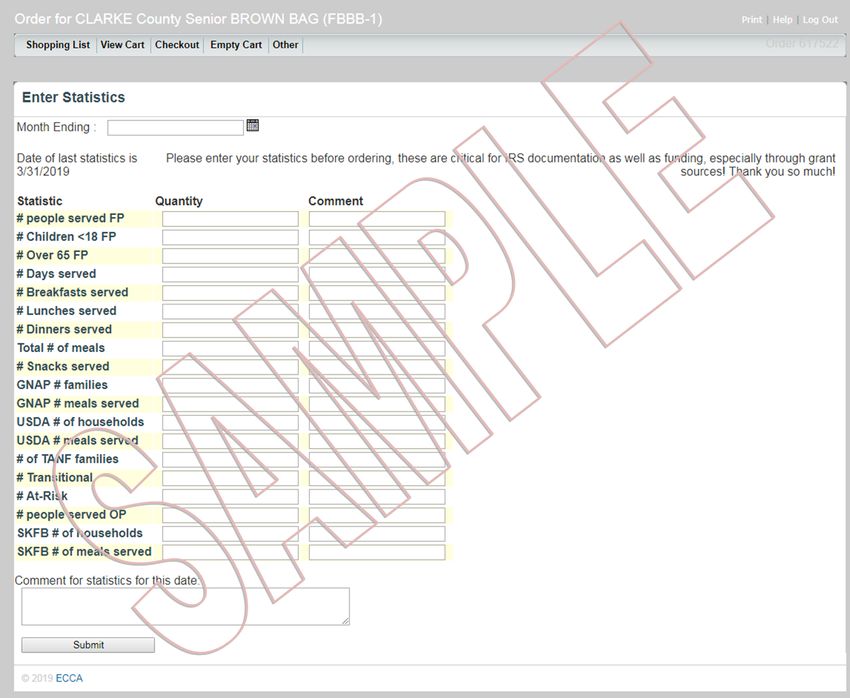
General Work Principles

The following general inter-relational principles will guide this outreach and those in-
volved in this outreach. We all will:
•   Do the right thing the right way
•   Do unto others as we would have them do unto us

Further, we will abide by the four way test of the things we think, say, and do:
   1. Is it the truth?
   2. Is it fair to all concerned?
   3. Will it build good will and better friendships?
   4. Will it be beneficial to all concerned?

The following will be considered with our business decisions:

Does it balance our options?
   Does the decision at hand tend to balance our business or make it less balanced
   with respect to resources including time, manpower, and others. Strategically we
   want to achieve a balanced state such that the alteration of input or output of any
   one portion of our business would not result in catastrophic loss.
Community-wide support?
   Does the decision at hand tend to build community wide support, or does it tend to
   isolate support into the hands of a few? Due to the concept of human equality, we
   are all benefitted by outreach and should therefore promote its extension so as to
   avail as many people as possible of these benefits.
Relative impact? (CBA)
   What is the relative impact of this decision? Will it be an efficient and effective use
   of our time? If not, is it so critical for us to do that we should expend relatively
   more resources to perform this activity than another to achieve a similar result. In
   essence, what is the Cost Benefit Analysis?
Will it help us end hunger?
   Our ultimate goal is to end hunger. What does this decision do to affect this end
   goal? Have we achieved this state? Will this decision help us maintain a condition
   where those who need and cannot afford food have access to fill their needs?

                                           2021                                            3
Introduction
The Food Bank partners with many different members of the communities
that it serves in its work to alleviate hunger. The Food Bank procures food
through National Level (Feeding America) donations, government grants, and
local donations. It works with trucking companies, distribution and storage
warehouses, manufacturers, wholesalers, and retailers to collect food which
would not typically be sold and store it in one of our several warehouses. This
food may be excess food from a product roll-out, it may be mislabeled, it may
have damaged packaging, it may be an incorrect and refused product for a
business, or it may be an item which is reaching its sell-by date. All food is
good product that anyone would appreciate. If enough food is not donated,
the Food Bank purchases salvage at a very low price.

The Food Bank distributes this food through Mobile Pantries, Targeted
Programs, and Agencies. These agencies distribute this food as groceries or
meals to families and individuals in need. For some, this need is on-going. For
others, this need may be temporary. Either way, the Food Bank works with
many different organizations and people to make sure all of their needs are
met. We work to house a large quantity of different products. We aid each
Partner-Agency in its mission by constantly striving to reduce costs, expand
services, and help with outreach initiatives.

The Food Bank is financially supported through a balanced combination of
private gifts, grants and government funding, and agency contributions. The
Food Bank receives state support in the form of GNAP funding used to
purchase food for families with children. We are accountable to all of you for
making sure your investment in the community is managed wisely.

                                      2021                                 4
VISION

           Creating a community where no neighbor experiences hunger.

                                      MISSION

    Empowering our community to target the root causes of hunger by providing
      healthy food, nutrition education, and innovative distribution methods.

                                       VALUES
•    Dignity
     Dignity- Honoring the humanity of all people.

•    Generosity
      Generosity – Caring for and supporting the needs of our community.

•    Stewardship
     Stewardship-Managing our resources responsibly and efficiently.

•    Accessibility
     Accessibility- Making food, education, and resources available to all.

•    Diversity
     Diversity-Welcoming everyone to our places and programs.

•    Integrity
     Integrity- Committed to doing the right things the right way.

                                          2021                                5
Partner Agency Categories
An agency that distributes non-prepared foods and other grocery products to the
ill, needy, or infants, who then prepare and use these items where they live. Food
Food Pantry
is distributed on a short-term or emergency basis until clients are able to meet
their food needs.
A program that provides prepared meals on-site to clients in need who do not
Soup Kitchen
reside at the agency’s premises.
(Emergency Shelter, Homeless Shelter) A charitable program whose primary
Shelter purpose is to provide shelter or housing on a short-term or temporary basis to
needy clients and typically serves one or more meals a day.
On-site programs specializing in a specific area in regard to client needs.
Rehabilitation Center Examples are substance abuse recovery houses, homes for people with mental
disabilities, and facilities for troubled youth. Clients live on-site.
After-School Program A program where children are given hot meals and/or snacks after school.
These agencies do not fall into the above categories. Whether these agencies
Other become Food Bank partners will be handled on an individual basis according to
the guidelines set forth by Feeding America and GHFB.
Training
We are here to help! Food Bank of Northeast Georgia is committed to assisting and supporting our
Partner Agencies in their mission to feed the hungry in any manner that we can, on an ongoing basis.
As your food program grows and you are faced with challenges, we are here to help! Your Agency
Monitoring Specialist is available to provide ongoing support and training to assist you in the mission of
ending hunger.
New Agency Training:
This training is for new agencies and current agencies that have internal changes in leadership and or
key volunteer roles. All agencies that have changes within their food pantry administration are
encouraged to attend this training for a refresher course.
One on One Training:
Perhaps your agency is in need of individual training and a large setting is intimidating. We will be happy
to sit down with you and provide you with any training that is needed. However, this training is not
designed to take the place of the required annual training.
Required Annual Training:
All Partner Agencies are required to attend training at least once a year. We generally offer these
trainings in the fall. These trainings include, but are not limited to:
• Food Safety – Focuses on safe handling standards of the FDA, CDC, and the food service industry
and is implemented by the National Restaurant Association
• USDA – Civil Rights Training
At least one representative from your agency will need to attend the required annual trainings.
2021 6Food Bank Membership and Accounting Rules
Membership
Once your agency becomes a member of the Food Bank, it will remain a member unless
a) Your agency decides to terminate membership or not to renew it, or b) you violate your
agreement with the Food Bank (Sections II and V in membership application). If you are found to be
in violation of your agreement with the Food Bank, your agency may be placed on
probation or your agency Food Bank account may be closed permanently.
All agencies pay an annual membership of $75.00 and maintenance fee of $25. This fee is paid when
an agency joins and then each December thereafter. In the event that an application is received
during any period which is less than the full twelve months of the current calendar year, the
membership fee will be prorated. New ID cards are issued annually after an agency pays its
membership fee.
AGENCY ACCOUNTING RULES AND GUIDELINES
• Be sure that Shoppers deliver invoices to the person at the agency responsible for paying the
bills. An example of an invoice is attached.
• Payments must be on an Agency check only. There is a “Returned Check Fee” of $35.
• Payments should reference both the agency number and the invoice number(s) being paid.
• Statements will be mailed out at the end of each month and any outstanding invoices will be
reflected on that statement. An example of a monthly statement is attached.
Any invoices not paid after 60 days will result in the suspension of shopping privileges.
Any invoices not paid after 120 days will result in the termination of shopping privileges.
Should you have any questions about your account or balance, please contact Tiffany McClain.
Her phone number is 706-354-8191
Her email address is tmcclain@foodbanknega.org.
2021 7Understanding Your Invoice
2021 8Understanding Your Statement
2021 9Food Bank Information
Safety Rules for All Warehouses
1. Please park your vehicle in the loading area only while loading your product. Do not
leave your vehicle in the loading area while you are shopping or while you are checking
out. Please turn your engine off while loading your product. Please return shopping
carts to the cart area after loading your products into your vehicle.
2. Only 1 cart per agency at any one time. We have a limited number of carts and want
to make them available for everyone.
3. No children under 12 are allowed on the shopping floor. They must stay seated in the
waiting area.
4. Staff and volunteers are not responsible for damage to vehicles or products after pur-
chases.
5. No smoking, tobacco products, eating or drinking in the warehouse. This is not only
our rule; it’s the FDA’s and ADA’s. Please step outdoors to enjoy your snacks and dis-
pose of your trash in the proper containers.
Dress Code
As a member of the Food Bank of Northeast Georgia, shoppers are expected to exhibit a neat,
well-groomed appearance. Some general guidelines apply:
1. Shoppers are not to dress in a manner which may be provocative.
2. Clothing with reference to or advertising of tobacco products, alcohol products, or
other inappropriate items is prohibited.
3. Due to Safety requirements, open toed shoes or shoes with raised heels are
prohibited in warehouse.
The Food Bank will not be liable for damage to clothing
or accessories while shopping.
2021 10Agencies Do’s and Don’t
Agencies
• Must be open to the public
• Must schedule shopping appointments to shop at the Warehouse
• Must have their current agency ID card when shopping at the Food Bank; orders
cannot be picked up or items purchased off of the shopping floor without this
card or picture ID
• Must properly transport, refrigerate and store Food Bank food and products;
and,
• Must distribute product received from the Food Bank to low income individuals
or families.
Agencies
• May use products for cleaning agency sites;
• May determine how client eligibility will be determined and monitored; and,
• May have up to five registered shoppers. All shoppers must attend orientation.
• May have two authorized shoppers per agency may shop at one time. Individu-
als that are not authorized to shop, but are here as helpers, should assist with
shopping and loading.
Agencies
• May NOT exchange or barter Food Bank products for money, property, or ser-
vices;
• May NOT permit Agency ID card use by anyone other than the intended person;
• May NOT hide higher shared maintenance donation product beneath lower
shared maintenance donation product. This will result in termination of partner-
ship.
• May NOT allow employees or volunteers to make private use of food;
• May NOT allow employees or volunteers to take product to individual residenc-
es (don’t order more than you can store at your site);
• May NOT violate any applicable local, state, or federal code, regulation, statute,
or ordinance; or
• May NOT compensate employees or volunteers with food products.
• May NOT give gifts to Food Bank Staff
2021 11Appointment Shopping
• Agencies need to call to schedule their shopping appointments
• Appointments will be in 1-hour blocks, from 8:00 to 12:00 and from 12:30 to 4:30.
• Please tie in your order pickups with your shopping appointments.
• Agencies that pick up orders without a shopping appointment will not be allowed on the
shopping floor.
• Call as far in advance as possible to schedule your appointments.
• We cannot guarantee appointment availability.
• If you cannot make your scheduled appointment, please give us a 24-
hour notice as we will keep a waiting list and will notify another agency if
there is availability.
General Products
Donated Product
. While the Food Bank works hard to ensure that our Partner-Agencies have a variety of goods
from which to choose, please recognize that we do not always have control over the food we
receive. Examples of food an agency will typically find in our warehouses include fresh pro-
duce, shelf-stable goods in cans or boxes, eggs, bread, frozen meats, snack foods and various
non-food products. These items are not on the inventory list. Availability will vary.
“Shopping Goods” do not need to be pre-ordered. They are in the warehouse where check-
out is located and online. These items will either be on shelves or in boxes. When shopping,
please keep like-items together. Dry goods, dairy products, frozen items, fresh produce, etc.
need to be weighed in categories at check-out. Such organization will help check-out take
place more quickly. Please bring your own boxes or bags for shopping and transport. Also,
please bring your own help. A driver who is not an authorized shopper can pick up food when
accompanied by a letter from the agency director. The driver may not shop or add product to
the order.
Purchased Products
Purchased Product Case items can be found on-line. Cases must be purchased by the case and
may not be broken open. These case items are still cheaper than your grocery store.
Purchase Product case items do not have the same standard shared maintenance fee as gen-
eral shopping goods as these products are purchased by the Food Bank of Northeast Georgia.
Costs will vary based on the cost the food bank has incurred. In order to keep these items
stocked it is imperative that you pay for these items immediately.
2021 12Ordering
Case Items
These items are available online. If you need assistance with online ordering please contact
the Agency Monitoring Specialist.
Case items are stored in the Athens and Rabun Warehouses. They must be pre-ordered in
advance for pick up. When you arrive to pick up case items, you must first check in. You will
receive two invoices from check-out. Please sign both copies. The Food Bank will retain a copy.
The other one is your bill. Please use this to check your items off your order and to keep on
file at your site. It is your responsibility to check the items you have ordered against the in-
voice to make sure you have your entire order before you leave the Food Bank. Please retain a
copy of all invoices for your record. We need at least Two Business Days to process your or-
der, no exceptions.
Deliveries
For delivery orders, please order in as much in advance as possible. Only items which are
online can be ordered for delivery. Please check with the warehouse manager regarding avail-
ability, times, and delivery costs for your area. You will need volunteers to help you unload the
order. You will be given an invoice at the time of delivery. This invoice is your bill.
2021 13Record Keeping
All agencies are required to submit a report online by the 1st of each month for the previ-
ous month’s operations. In the event the 1st falls on a weekend or holiday, agencies may sub-
mit their reports the next business day, as long as the reports are received by the 4th of the
month. All records must be kept onsite for a period of 4 years.
Reminder for all agencies distributing USDA products. Agencies must have every client fill out
the current The Emergency Food Assistance Program (TEFAP) Household Eligibility Criteria
Form every time you distribute food. Please file with TEFAP Commodity Distribution Record on
top.
Your reports are extremely important to the Food Bank. Your information is used for re-
porting to the State and Federal Government, as well as to Feeding America and our donors.
It is essential that we have accurate information on your work to feed the hungry. We also
greatly appreciate personal accounts of how GNAP and USDA food has helped a family or
individual.
• Pantries: Those agencies which give out groceries, are required to keep track of the num-
ber of families served each month, how many had children under 18 years of age, and how
many had people over 65 years.
• Kitchens: Those agencies which prepare meals are required to keep track of the number of
unduplicated clients, the number of days meals are provided each month, the number of
each type of meal served, and the number of snacks provided during the month.
• Agencies distributing GNAP must also keep track of either the number of meals which used
GNAP foods each month or the number of TANF, Transitional TANF, and At-Risk families
receiving GNAP foods each month.
• Agencies receiving USDA food must keep track of the number of households receiving
USDA food or the number of meals served with USDA food.
2021 1415
Emergency Food Pantry Daily Distribution Log
Date Name (please print) Phone # Adults Children Seniors 65+ Client Signature
under the
age 18
2021Meal Count Calendar
16
Month __________ Year: _______
Indicate the number of meals on each date in which USDA foods were used.
Sunday Monday Tuesday Wednesday Thursday Friday Saturday
B B B B B B B
L L L L L L L
D D D D D D D
S S S S S S S
B B B B B B B
L L L L L L L
D D D D D D D
2021
S S S S S S S
B B B B B B B
L L L L L L L
D D D D D D D
S S S S S S S
B B B B B B B
L L L L L L L
D D D D D D D
S S S S S S S
B B B B B B B
L L L L L L L
D D D D D D D
S S S S S S SInstructions for Online Reporting
1. Go to the Food Bank website—www.foodbanknega.org
2. Click on “AGENCIES” in the top right hand corner
3. Click “AGENCY LOG-IN”
4. Enter your agency code and password.
5. At the top of the next page, this will be the shopping page, click on “OTHER.” This will take
you to the proper page to enter your numbers for the month.
All agencies must submit this information by the 1st of each month.
1. In the space for the date enter the last day of the month for which you are reporting. For
example, you must enter 2019 for the year——it will not accept “19.” (e.g., 6/30/2019).
2. After this, enter the numbers in all of the spaces provided. If you did not serve your com-
munity for a month, you are still required to report your monthly numbers even if those
numbers are zero.
3. It is recommended to print this screen before you submit your reports; as you will not have
access to do so after you have submitted your monthly report.
4. When you are finished entering your numbers, scroll down to the bottom of the page and
click on “submit.” Contact the Agency Monitoring Specialist if you need assistance.
Instructions for Online Ordering
Important: Please help conserve everyone’s funding by closely adhering to the procedures
listed. We strive to be efficient and effective for all involved.
1. Please allow two business days between ordering and pick up.
2. All orders must be placed online and submitted to the Food Bank. Orders should include
desired pick-up date/time and location for pick up.
3. Orders are filled on a first-come, first served basis and require two business days to pro-
cess, no exceptions.
4. Agency shoppers should be prepared to load their own vehicles. Don’t forget that you can
bring one helper to assist you with loading.
5. Please check off items from your invoice as you load them.
6. A $.03 per pound restocking fee will be charged to your agency if your agency does not
show up or if your agency cancels an order once it has been pulled. If you need to post-
pone your pick-up date, we are happy to work with you. Just call us to let us know your
desired date and we will note this on your form.
2021 172021 18
Agency Shared Maintenance Donations
The Food Bank is able to conduct its mission because of three distinct and critical funding
sources. These are:

•   Private source donations;
•   Government grants and funds; and
•   Agency Shared Maintenance Donations.

Essentially, the first two sources of funds are insufficient to cover all the costs incurred in con-
ducting this outreach. Therefore, upon signing our contract, our agencies acknowledge that
the Food Bank needs their financial assistance to perform this outreach and that they will sup-
port us at the per pound rates and other fees as we request.

As one of our agencies, you should know that we run one of the most efficient and effective
food banks in the United States. For instance, at the time of this writing we have been able to
maintain constant rates for our mobile pantries regardless of the fact that fuel prices have
doubled since the date these first went into effect. Our commitment to you is that we will
keep Agency Shared Maintenance Donations and other “fees” as low as possible while ensur-
ing adequate funding for our needs.

1. Agency Share is used for shipping, handling and similar costs.
2. Agency Share amounts for shopping goods vary between .02 and .18 cents, but are an av-
   erage of 10 cents per pound. An agency’s individual average may be higher or lower de-
   pending on the type of food received. Some food has no Agency Share fee attached, while
   other food has a VAP, Value Added Packaging/Processing Fee, of .03 cents added to the
   base charge.
3. Agency Share amounts for Purchased Product, case items, are determined at check out.
4. Agencies will receive an invoice to sign at checkout. This invoice may be paid by agency
   check at the time of checkout. Please pay invoices as quickly as possible because this helps
   assure an adequate food supply to our agencies.
5. Please keep a copy of all invoices on file for Food Bank review.

                                                2021                                              19
SHOPPING
Please have your food items separated
by the following categories when you
are ready to check out:
SHOPPING CATEGORIES
Snacks Chili/Beef Stew freezer
Raisins Box/Single Serve section
Crackers Dinners
Fruit Snacks Soup
Granola Bars Pasta/Mac-n-Cheese Dairy
Chips/Cookies Rice/Instant Potatoes Eggs
Nuts/Pudding Cups Dried/Canned Beans Milk
Snack Cakes Vegetables Yogurt
Candy/Popcorn Fruit/Fruit Cups Cheese
Pop Tarts Cereal Hummus
Fruit Breakfast Bars Sandwiches
Drinks Non Food
Water Cleaning Supplies
Soda Paper Products
Capri Sun Personal Hygiene
Bottled/Canned Juice Items
Dry Milk Holiday Items
Coffee Pet Supplies
Tea Anything else that is
Juice Boxes not edible
Grocery Freezer
Peanut Butter Anything found in the
*Warehouse hours are 8:00am—4:30pm by Appointment only
2021 20General Food Storage
Some critical considerations are listed below.
For further information concerning food safety please refer to the following
websites www.foodsafety.gov or www.usda.gov.
1. Food must be stored 4 to 6” off the floor and out of cardboard storage boxes.
2. Cleaning products should never be stored next to or above food items.
3. Check food items regularly for freshness and damage.
4. Food received from Food Bank of Northeast Georgia may NEVER be stored at a private
residence and can only be kept at a FBNEGA approved location
5. All freezers, coolers, and refrigerators must contain a thermometer.
6. Temperatures should be checked and logged at least 3 times a week. This includes
refrigerators, freezers and dry storage.
7. Refrigerators should run at 40 degrees or below, and freezers should run at 0 degrees or
below
8. Baby food and infant formula cannot be distributed after the expiration date
9. Distribute food on a first in, first out (FIFO) basis. Refer to Code Date Extension Guidelines
for more info. about expiration dates.
10. Separate GNAP, USDA, and Shopping Goods.
Agency Monitoring
The Food Bank helps our agencies maintain the highest safety and distribution standards
through monitoring. Partner Agencies will be monitored when they first become a member of
the Food Bank and annually thereafter. Refer to your food safety/standards manual for further
instructions. Some critical concerns are listed below.
1. Posted Hours of Operation
2. Proper food storage
3. Clean and functional freezers and/or refrigerators
4. Safe and edible products
5. Reports
6. Temperature and Pest Control Logs
7. Record storage
8. How agencies distribute and determine eligibility
2021 21Transporting Guidelines
For the health & safety of your client families, FBNEGA will ensure that all items are being transported
in a method that will maintain proper food temperatures year round.
Refrigerated and frozen food items must be transported in coolers with ice or cold packs to prevent
thawing or spoilage.
Another option is to cover refrigerated and frozen items with a freezer blanket. The freezer blanket will
keep your cold items at safe temperatures if used properly.
All truck and trailer beds must be fully covered and secured with tarps.
When picking up Warehouse Orders or Utilizing the Agency Shopping Floor, our staff/volunteers will
look for one of the following:
• Insulated coolers
• Freezer Blankets
• Agencies may also use a refrigerated vehicle to transport refrigerated or frozen items.
• Tarps on all truck and trailer beds.
Please keep these guidelines in mind when acquiring and transporting items from the Food Bank of
Northeast Georgia. If FBNEGA staff members determine the vehicles and/or equipment does not
provide a safe and secure transport of food products, your agency order will not be received.
Below is a list of retailers that supply freezer blankets, coolers, and tarps:
• Legion Safety http://www.legionsafety.com/insulated-covers-and-blankets.html
• Freezer Wearhttp://www.freezerwear.com/eShop/10Browse.asp
• Coleman http://www.coleman.com/Products/8500/coolers
• Rubbermaid http://www.rubbermaid.com/en-US/coolers
Pest Control
This should be administered at your agency at least twice a year. Pest control can be administered by
the agency or by an outside vendor. Recording of when the service was administered needs to be kept
at the facility and will be reviewed during FBNEGA visits to the agency.
Food Handling Guidelines
• Always wash your hands before, during and after handling food
• Use disposable gloves when appropriate. Change gloves when they get soiled or contaminated.
Cover all cuts and use gloves
• If you are sick, please do not work with food
• No smoking, eating, or drinking in food storage and or prep area
• Returns are not accepted for unwanted or excess products. If you have questions about a
particular product, ask before you order it. Please only order what you can store on site.
• If you find damaged or spoiled food, please alert FBNEGA immediately. We are happy to give you
credit on your agency share account for items you receive that are damaged.
• If you have food loss (due to refrigerator/freezer failure, etc.) that exceeds 1 case of food or more,
please contact the Food Bank immediately and submit the “Product Issue Report” within three
days of loss.
2021 22Food Keeper
Food Keeper is a database provided by the Food Marketing Institute and gives users
information on how long products can be kept before it is discarded: http://www.fmi.org/
consumer/foodkeeper/
Recalls:
Your agency should be prepared to handle a food recall or food safety issue. FBNEGA will
notify our Partner Agencies via email of recalls. Please check your inventory for products
that are listed on the recall notice(s), post recall notice in an area visible to clients, and
notify clients that may have received the product(s).
Good Samaritan Act
The Federal Bill Emerson Good Samaritan Food Donation Act
On October 1, 1996, President
Clinton signed this act to encourage
donation of food and grocery
products to non-profit organizations
for distribution to individuals in need.
The Good Samaritan law protects
citizens, businesses, volunteers, and
nonprofit organizations that proceed
in good faith to donate, recover, and
distribute excess food. It limits liability
to acts of gross negligence or
intentional misconduct and, absent
these, donors and others shall not be subject to civil and criminal liability arising from the
nature, age, packaging, or condition of the seemingly wholesome food of the apparently fit
grocery products received as a donation.
The Good Samaritan Act is designed to encourage donations of food and grocery products
by providing a uniform, national standard of liability for donations. In order to maintain
compliance with this act, please contact the Food Bank immediately if food does not
appear wholesome or fit for consumption due to age, freshness or if it shows signs of
infestation.
2021 23Compliance Tools
The Food Bank employs a variety of compliance tools to help ensure integrity and confidence
in our outreach. These compliance tools include probation, suspension, and termination.
Probation
1. The purpose of the probationary period is to guide an agency toward compliance through
use of training and advice. A member agency may be placed on written probation.
Compliance must be attained before an agency is removed from probation. Probation does
not typically exceed two months.
2. Member agencies placed on probation will retain rights and privileges, including shopping
privileges.
Suspension
1. A member agency may be placed on suspension without notification.
2. Length of suspension will be determined by the Food Bank.
3. Suspension of an agency will result in that agency losing shopping privileges and all other
rights and privileges of a member agency until conditions leading to suspension are
corrected.
4. Partner Agency may be suspended for any of the following:
• Missed or late monthly reports
• Unfavorable monitoring review
• Non-payment or Returned Checks
• Breach of the Partner Agency agreement
If you are not sure of your agency’s status, you may speak to the Office Manager or Agency
Monitoring Specialist to see if you are able to receive product.
Termination
1. A member agency may be terminated without first being suspended if found in violation of
circumstances including, but not limited to, sale of food and violation of ordinances.
2. A member agency that is on probation or has been suspended, may be terminated at the
discretion of the Food Bank.
3. If a member agency is inactive (no purchases or zero clients served) for one year, it may
be “Honorably Terminated.” To become a member agency again, the agency must
reapply.
Appeal
An agency may appeal its suspension or termination in writing to the Executive Director. A
written answer will be given within 30 days after receipt
of written appeal.
2021 24THINGS TO KNOW
TO GET THE MOST OUT OF THE FOOD BANK
When Shopping
• Bring your Shopper ID and Picture ID
• Bring your own boxes.
• Make sure that your items are sorted by category before checking out.
• Keep the shopping floor neat and orderly.
To Best Help us Help You
• Keep us updated with your current phone number and email address.
• Read all emails from the Food Bank.
• Please know that if you unsubscribe to our mailings, you will need to provide us with a
new email address to receive future correspondences.
• Order 48 hours in advance (if ordering after 4:30pm, please do not ask for 8:00am pick-
up).
• If you need a delivery scheduled, call first to confirm availability.
• Come on the day of your scheduled pick-up. Bring help if it is a large order. Call if you
cannot make your scheduled pick up.
Items to Keep in Mind
• We are PARTNERS!
• Food is distributed FREE of charge. We do NOT sell food to our Agencies.
• Agencies contribute about $.06, or roughly one-third of the total cost to us.
• We bring food in from all over the country to distribute here at the Food Bank of North-
east Georgia.
• If the POL is not working, wait 30 minutes and try again.
2021 25Agency Staff:
NAME JOB TITLE CONTACT INFO
Tonya Bolton Programs Manager 706-354-8191
programs@foodbanknega.org
LaTasha James Agency Monitoring 706-354-8191
Based out of the Specialist ljames@foodbanknega.org
Athens
office
Additional Staff Contact:
NAME JOB TITLE CONTACT INFO
Richard Boone Executive Director 706-354-8191
Tiffany McClain Accountant 706-354-8191
tmcclain@foodbanknega.org
Jim Heider Operations Manager 706-354-8191 opera-
Based out of the Athens tions@foodbanknega.org
office
2021 26You can also read


