Photo Credit: UC Davis West Village California Public Utilities Commission
←
→
Page content transcription
If your browser does not render page correctly, please read the page content below
New Residential Zero Net Energy
Action Plan 2015-2020
Executive Summary

                                                           Photo Credit: UC Davis West Village

    California Public Utilities Commission   California Energy Commission
                Energy Division                    Efficiency Division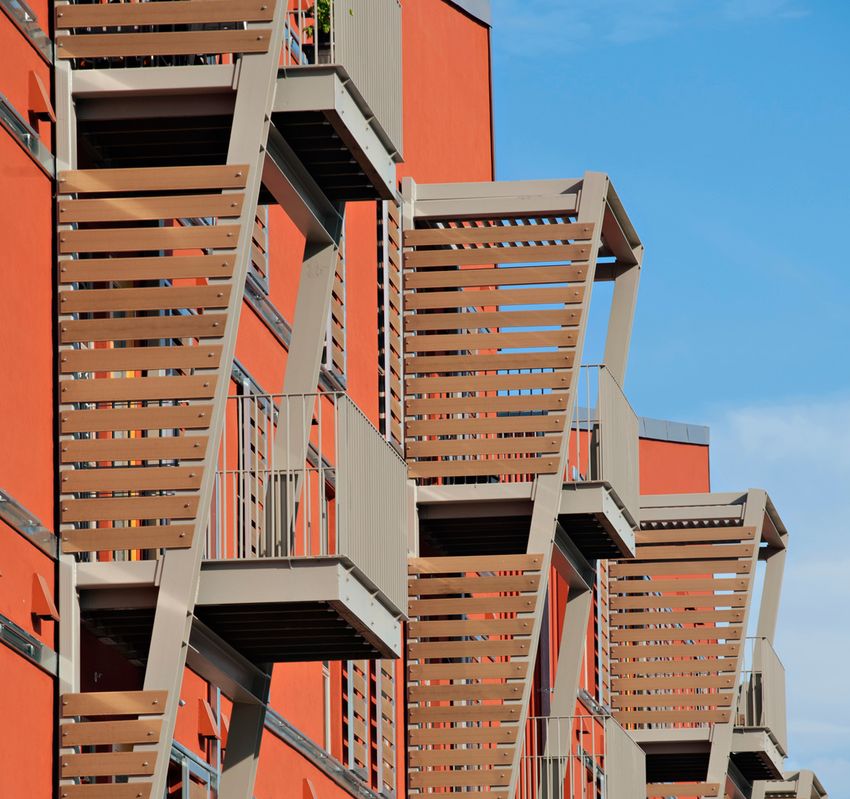
100% of all new homes will be
zero net energy beginning in 2020. Approach
For this Action Plan to be successful it is critical participate and leverage the action taken by state
that the strategies and tactics identified are respon- agencies and utilities to achieve the 2020 goal.
sive to the needs, interests, and ideas of industry
This Action Plan provides both immediate term
leaders, key actors, partner agencies, and utilities.
strategies, as well as some strategies that are more
This means that the Plan is focused on achieving
high level and provide a solid foundation for the
milestones and being as feasible as possible in the
future. A three-year work plan is being developed
breadth and depth of the proposed strategies and
separately to direct Plan implementation, identify
tactics. The “ZNE Action Plan: Commercial Building
resources, and enable a more dynamic and stream-
Sector” focuses on activating champions for imple-
lined process for updating the specific actions.
mentation. However, this Plan has been developed
with an expectation that the state agencies, specifi- Finally, this Action Plan is focused on new resi-
cally the CPUC and Energy Commission, or the utili- dential construction, including single-family and
Introduction
ties, will initiate or lead a majority of the strategies. low-rise multifamily (3 stories or less) buildings, as
At the same time, this realistic approach is designed well as low and moderate income housing within
to encourage and inspire other market actors to these categories. Multifamily projects
Photo Credit: Lawrence Berkeley Labs, Energy Technologies Area have a number of unique requirements
that differ to some extent from single-
The Residential New Construction Zero Net Energy The following are the key stakeholder activities: family construction. The Action Plan
(ZNE) Action Plan (Action Plan or the Plan) is has devoted Chapter 4 to outline and
• In Fall 2012, a stakeholder survey was conducted
designed to operationalize the California Long-term focus on the key multifamily building
to better understand the market, key actors,
Energy Efficiency Strategic Plan’s (CEESP) goal to areas that are not covered within the
potential issues, and gaps and opportunities.
have 100% of new homes achieve ZNE beginning main goals section in Chapter 3. It is
in 2020. The Action Plan provides a foundation for • From Fall 2012 to Fall 2013, four public stake- anticipated that many of the differ-
the development of a robust and self-sustaining holder workshops were held; three in San ences in the markets will be addressed
ZNE market for new homes over the next five years, Francisco at the CPUC and one at the Energy in specific implementation activities.
supports future codes and standards for ZNE, Commission in Sacramento. Each workshop built For example, a key strategy is to launch
and inspires voluntary actions to meet California’s on the information of the previous meeting. The ZNE awareness and outreach activities.
goal. Further, the Action Plan will be a living docu- process began with goal setting and visioning This strategy applies to both housing
ment subject to ongoing updates and refinements and progressed to the development of strategies types, but will look different and address
to help address the changing environment, tech- and metrics. different audiences for single-family and
nology advances, and the State’s needs. In order low-rise multifamily.
to do this, the Plan must be supported by multiple • Two rounds of five separate subcommittee
market actors; act as a guide for state agencies, local meetings were conducted and organized by the
government, and the utilities; and motivate industry. six Action Plan goals. Each meeting was used to
refine and develop the Plan.
To develop the Action Plan, a comprehensive stake-
holder outreach process was employed. While a • Additional stakeholder engagement included
benefit of this process will be increasing activity meeting with builders at the Pacific Coast
and potential advocates to implement the Plan, Builders Conference (PCBC) and in Sacramento
the purpose of the stakeholder engagement was and conducting a local government statewide
to ensure that strategies and metrics are feasible webcast.
and that the overall plan will stimulate independent
A planning website was launched to share informa-
action and provide a higher level of certainty and
tion about the plan, solicit case studies, and share
understanding for the market to build their own path
documents and information about relevant events:
to ZNE.
www.CaliforniaZNEhomes.com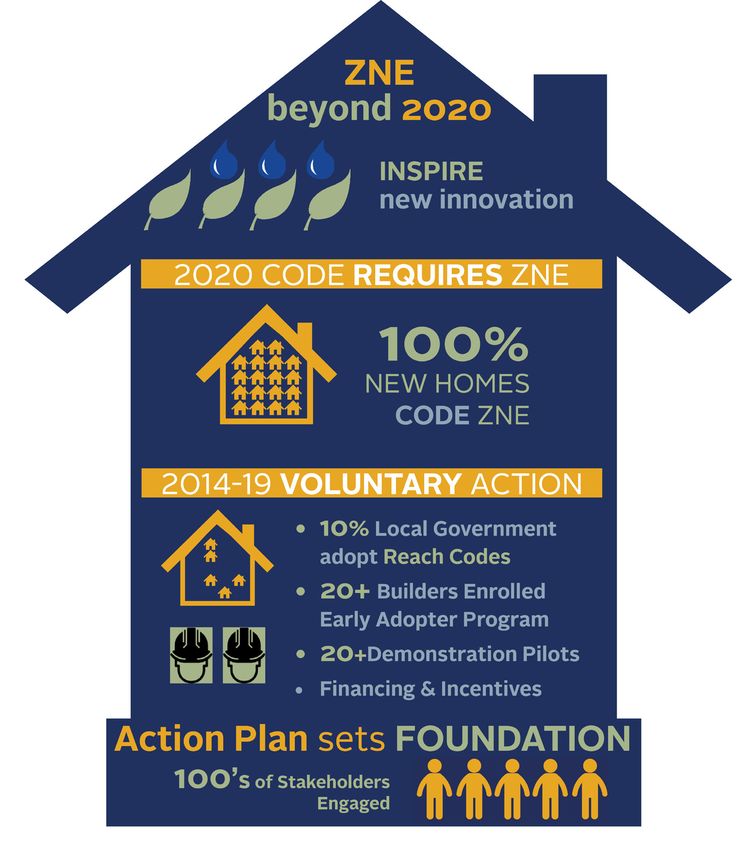
Action Plan Framework VISION
The Action Plan Vision Framework on the facing page is a guiding structure for the Plan to achieve the State’s
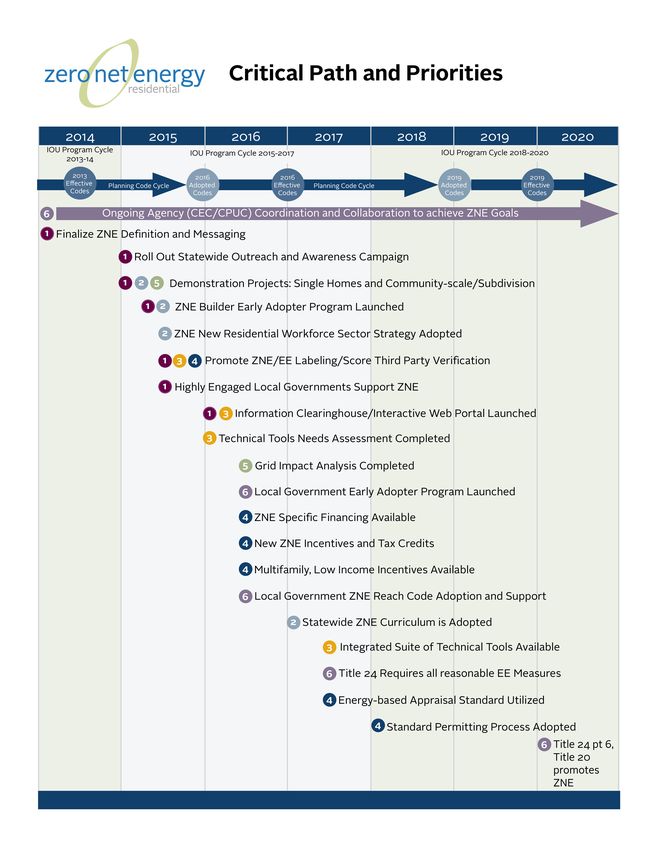
2020 goal and key objectives. Additional details on the Plan Goals, Principles and Critical Path Timeline are 100% of all New Homes in California will be Zero Net Energy starting in 2020
provided on the following pages.
GUIDING PRINCIPLES
Action Plan Goals
Each goal area was identified in collaboration with
stakeholders and verified through the planning
Financing, Affordability & Value
Develop specific approaches and standards to
process as a key area for action and focus. Each goal
quantify the value of ZNE homes, support a robust Leverage Consistency
is critical to ultimate success of reaching the 2020
financing market and ensure that ZNE homes are
goal, and priorities for implementing each goal are
affordable. To reach scale, it is important to ensure
Flexible Measurable
reflected in the Overall Critical Path diagram on
there are mechanisms to appropriately value ZNE
page 7. Following is a brief summary of the purpose Market Multiple Paths
homes and to ensure long-term affordability of
for each goal.
ZNE. This goal incorporates the need for a labeling Driven
Demand and Awareness system for built homes, as well as efforts to develop
an acceptable appraisal standard that will remove a
G OA L S & G OA L R E S U LT S
Demand and awareness is one of the key goals for
major barrier to market adoption. Finally, this goal
this plan, particularly over the next few years as a
informs the creation of various financing and incen-
foundation for ZNE is developed. It is recognized
tive products that will support the market. Builders and homeowners 1. Create 4. Quantify By 2017, create a systematic
that there is a lack of understanding of the benefits are inspired to voluntarily way to value ZNE homes
awareness of value of ZNE,
of zero net energy among potential homeowners adopt ZNE through a to enable underwriters,
and critical sectors of the housing industry, including
the value and support robust
market driven process appraisers and financial
real estate professionals, the financial community Future Infrastructure starting in 2014 and
benefits of ZNE
and build
financing
and ensure
institutions to support
(most notably underwriters and loan officers), devel- An underlying need for mainstream ZNE is a grid and increasing steadily financing and a strong and
opers, and building trades organizations. infrastructure that can effectively manage distrib- until 2020. demand affordability affordable ZNE housing
uted generation energy. This goal informs research market.
Technical Training & Education and the direction for utilities and state agencies to
This goal focuses on creating a robust and well- update policies and programs to meet this need.
trained industry that is able to implement and adapt Industry workforce and By 2017, investor owned
to the technological innovations and integrated professionals (existing and utility distribution resources
business strategies that are required to effectively 2. Increase 5. Drive future
meet the ZNE goals. In addition, this goal seeks to Alignment entering) are equipped to
create quality ZNE homes participation and grid infrastructure
plans to evaluate locational
benefits and costs of distri-
develop a well-informed support industry including Aligning and coordinating all of the agencies, at a production scale improve the quality and technological bution resources are adopt-
building inspectors, financial and real estate profes- municipalities, and market actors that are involved starting in 2015 and of ZNE education improvements ed, as directed in Assembly
sionals, and other industries central to the advance- in achieving the ZNE goal is critical to the success increasing steadily and training Bill 327. These plans support
ment of ZNE. of this Plan and is a constant throughout the Plan’s to 2020. the goal that ZNE buildings
implementation. In addition, the goal for ZNE to connect and integrate with
Technical Tools be regulated by Codes and Standards beginning in
2020 provides the coordination and steps to reach
the grid effectively.
While there are a number of design and modeling
technical tools available on the market, it is critical that important step. Finally, this goal encourages
to develop an integrated suite of tools specific to the alignment of state goals with local policies and By mid-2016, designers, 3. Ensure By 2015, California has a
builders and developers 6. Align consistent, integrated and
ZNE that provides consistent data, informs all steps planning. availability,
have access to an inte- regulations, clear ZNE policy framework
of the design and construction of ZNE homes, and effectiveness and
grated suite of technical policies, (regulations, incentives and
translates that data into homeowner feedback tools efficiency
tools that facilitates their incentives codes) due to continuous
to improve performance of the ZNE homes.
ability to bring ZNE homes
of technical multi-agency coordination
and codes
to market successfully. tools and collaboration efforts.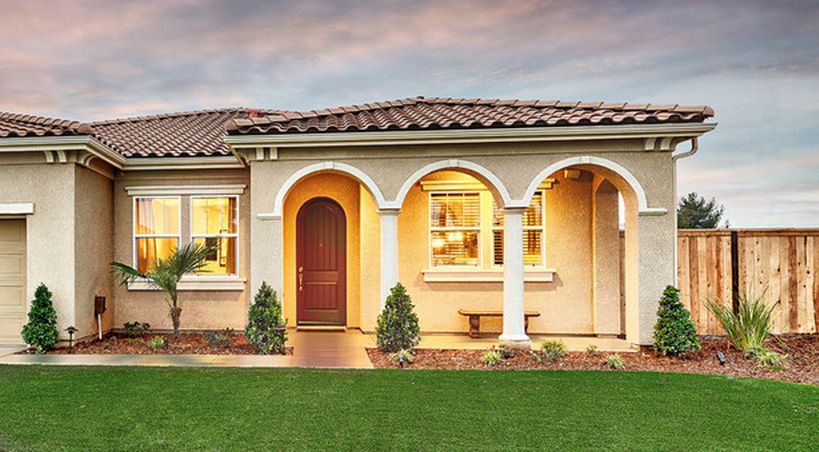
Guiding Principles                                                    Photo Credit: DeYoung Properties - Zero Net Energy Home

To reach the Plan’s vision, the following guiding       Consistent
principles are important crosscutting concepts          The number of state and local agencies involved
reflected in all of the plan’s strategies that stake-   in implementation, and the diversity and number
holders and policy makers identified during this        of private industry and utility companies engaged,
process to ensure the Plan’s feasibility and broad      complicates the path to ZNE. The Action Plan
adoption.                                               supports strategies that achieve the highest level
                                                        of consistency possible in policy, regulations, and
                                                        incentives to reach the State’s goals.
Market Driven
To achieve a mainstream ZNE Building Future,            Measureable
support a robust industry by empowering key             Quantifying the impacts, costs and value of ZNE is
market actors through appropriate policies, regula-     essential to its long-term support by consumers,
tion, incentives and effective program design. This     legislators, utilities, the financial market, and the
will drive innovation, new projects, workforce devel-   industry as a whole. The Plan should inform the
opment, marketing and awareness.                        development of transparent and broadly accepted
                                                        mechanisms for measuring the value of ZNE.
Flexible
Technology, policy and understanding about ZNE          Multiple Paths
buildings are evolving at a rapid pace. The Action      The diversity of housing stock in California and
Plan will be a “living document” that will allow for    trends for more compact land use scenarios, multi-
the evolution in business models, rate structures,      family housing and community-scale renewables,
construction techniques, demand and consumer            requires that future ZNE building policies and
needs over the coming years.                            programs support multiple paths and approaches.

Leverage
Existing programs, projects and information on
techniques, training, incentives and industry prod-
ucts related to zero net energy are recognized as
important resources, and should be leveraged to
achieve the Action Plan’s goals.
Benchmarks

To measure the effectiveness and provide clear bench-    •   Between 2013 and 2017, California sees a 5 to
marks for progress of the Action Plan, the following         10% decrease in the cost of implementing ZNE on
overarching benchmarks have been developed.                  production homes.

•   By 2020, all new homes are ZNE Code or ZNE           •   By 2017, a nationally recognized appraisal standard,
    Ready homes (single-family and low-rise multi-           accepted by underwriters and funders for ZNE
    family).                                                 homes is in place and utilized in California.

•   By early 2016, utility new construction activities   •   An adequate pool of trained and educated profes-
    include fully subscribed ZNE Builder Early Adopter       sionals in design, engineering and construction to
    Programs that address incentives, training, market       support ZNE demand in California is in place by
    adoption, and demonstration projects, etc.               2018.

•   An Updated California Residential Building Rating
    and/or Labeling System (Updated HERS or equiva-
    lent) is in place by 2016.

     To download the full plan, to get involved or find out more information,
        go to: www. CaliforniaZNEhomes.com or the www.CPUC.ca.gov

You can also read


