Plant Breeders' Rights in the European Union - Francesco Mattina, CPVO Vice President - IP Key
←
→
Page content transcription
If your browser does not render page correctly, please read the page content below
Plant Breeders’ Rights in
   the European Union
                 Francesco Mattina, CPVO Vice President
IPKey SEA - Webinar series on Plant Variety Protection and UPOV 1991 10.06.2021
Outline
•   Introduction of the EU PBR System
•   Application process
•   International cooperation in DUS testing
•   Benefits of a regional system

PBR protection in the EU:
   Legal Framework
       UPOV ACT
      1991,1978,1961    EU Reg.
          UPOV
          Art.20        2100/94
       Convention
                         Basic
          91 Act
                       Regulation

                        EU Reg.
         EU MS          874/2009
       legislations    Proceedings
                        Regulation
PBR Protection in the EU
•   The EU implemented a sui generis system of PVP in line with the
    TRIPS Agreement requirements (Art. 27(3)b);

•   The EU PVP system is based on the International Convention for
    the Protection of New Varieties of Plants of the Union For The
    Protection of New Varieties Of Plants (UPOV) (1991 Act);

•   The protection under the EU system has a uniform effect
    throughout all Member States (Art. 2 BR).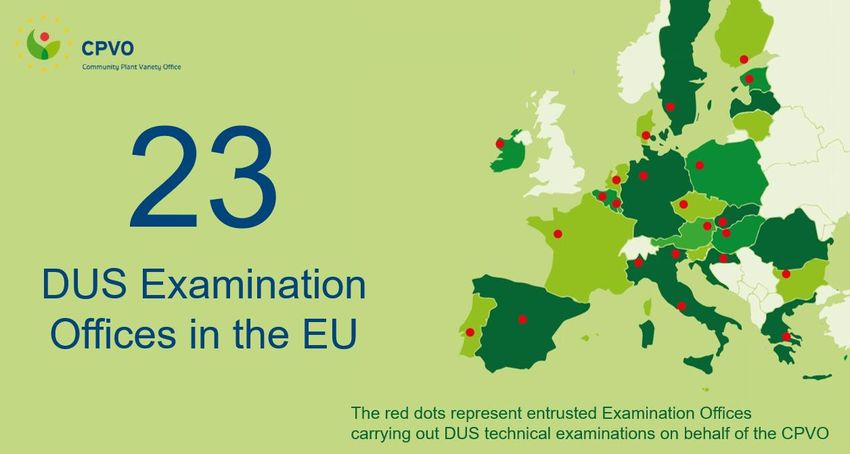
PBR Protection in the EU
•       Varieties of all botanical genera and species may be protected

•       The CPVO has received applications for more than 2000 different plant
        species

•       Duration of the right:

    •      25 years
    •      30 years for vines, trees and potato varieties
The CPVO is an agency of the EU
operational since 1995 and currently based in
               Angers, France.

                                              Mission Statement:
                               ‘To deliver and promote an efficient Intellectual
                             Property Rights system that supports the creation of
                                 new plant varieties for the benefit of Society’
The Application procedure
One
Application
Everybody One
can apply Procedure
CPVRs
27 Member
States of One Technical
the EU Examination
One
DecisionApplications from outside the EU
Entitlement to file an application for a CPVR (Article 12 BR)
• Any natural or legal person can file an application
• Persons without a:
• Domicile
• Seat
• An establishment
In the territory of the EU, shall designate a procedural representative within
the EU.Technical examination
Examination Offices (EOs)
• When the EU PBR system was created it has been decided to use
the testing facilities already existing in the MS, for the assessment
of the DUS criteria of candidate varieties
• Where no examination office within the EU is available for testing
a particular species, the Office may collaborate with offices
outside the EUTake-over of examination reports
Legal Basis
• UPOV convention (1991 Act):
• Art. 12 (Examination of the Application): ”… the authority may grow the
variety or … take into account the results of growing tests … which have
already been carried out. …“
• At the CPVO- Art. 27 Proceedings Regulation (Other examination
reports):
• Report take-over from EU Member states
• Entrustment required
• Report take over from non-EU authorities
• UPOV members or party to the TRIPs Agreement
• Special written agreement requiredTake-over of examination reports
• Conditions to take over reports
• Equivalent plant material requirements
• CPVO test protocol or equivalent applied
• Opportunity to visit the growing trial
• Technical examination has already been carried out or is in the process
of being carried out
• For tests not yet started: only if there is no testing competence in a EU Member
state
• Adequate experience in DUS testing of the crop in question
• Written Agreement with the testing authority
• Defining technical and administrative detailsCooperation with non-EU EOs
The CPVO may under certain circumstances make use of DUS reports
established by a non EU EO after having received the consent of the
Administrative Council (AC). This applies to cases where:
• There is no EO available to perform DUS test for the species in question in the EU
• An EO in the EU is entrusted for the species in question, but the candidate variety
has already undergone, or is in the process to undergo, a DUS examination at a non
EU EOTechnical examination from non-EU
Legal Basis
Article 27.5 PR - Request to carry out the Technical Examination:
• No possibility to carry out the TE in the EU
• Report not available/not meeting the conditions in the PR
• UPOV Member or party to the TRIPs Agreement
• Written agreement approved by the Administrative CouncilBenefits of a Regional System
Administrative Economic
Development of common
Harmonisation of practices
tools
Access to information Additional income for
national authorities
Less administrative burdens
Training
for national authoritiesCommunity Plant Variety Office
3 Boulevard Maréchal Foch
49000 ANGERS – FR
Contacts
Tel: (+33) (0) 2-41.25.64.00
E-mail: communication@cpvo.europa.eu
Francesco Mattina: mattina@cpvo.europa.eu
Join us on…
@CPVOTweets
…and subscribe to our new
Digital NewsletterYou can also read


