Pragmatics Transfer on Compliment and Compliment Responses to English Learners at The Faculty of Adab and Humanities Uin Alauddin Makassar ...
←
→
Page content transcription
If your browser does not render page correctly, please read the page content below
International Journal of Research and Innovation in Social Science (IJRISS) |Volume V, Issue VI, June 2021|ISSN 2454-6186

   Pragmatics Transfer on Compliment and Compliment
     Responses to English Learners at The Faculty of
      Adab and Humanities Uin Alauddin Makassar
                                             Nurasia Natsir, Lukman, Manda, Kamsinah
                                      Cultural sciences Faculty, Hasanuddin University, Indonesia

  Abstract: This study aims to describe (1) the form of compliment     pronunciation option that corresponds to the context of the
  strategies and compliment responses of English learners at the       speech applicable to the target language
  Adab and Humanities Faculty of UIN Alauddin Makassar, (2)
  the factors related to the pragmatics of the transfer of English     Over the previous three decades, researchers whose research
  learners at the Adab and Humanities Faculty of UIN Alauddin          focuses on second language acquisition had switched to
  Makassar. The population in this study is all students of semester   researching communicative competencies whose initial focus
  6 of the Class of 2017 English Language and Literature Faculty       of their researches was linguistic competence. Some of them
  of Adab and Humanities UIN Alauddin Makassar, with a total of        are Canale & Swain (1980) and Hymes (1972), which show
  70 respondents as a representative selected research sample, is      that grammar and lexicon structures are not adequate tools to
  considered as the representation of the entire research
  population. The data collection methods are conducted using
                                                                       understand the meaning behind a speech; it is not enough to
  DCT, interviews, and direct observations. The data obtained is       understand the message that the speaker wants to convey.
  analyzed with quantitative and qualitative techniques.               Then comes the perspective that proposes that speakers who
  Specifically, the quantitative data is processed with statistics     are fluent in a particular language need to master
  using R analytics software, while the qualitative data is analyzed   communicative competencies that fit the cultural context in
  using pragmatic transfer analysis. The results showed that (1)       which they are located. The ability to use correct grammar
  The form of compliment strategy used by English learners at the      sentences in the right context involves two types of
  UIN Alauddin Makassar faculty consists of 18 forms of                competencies, namely linguistics and pragmatic (Bachman,
  compliment strategies and 13 forms of compliment response            1990). Related to the concept, speakers should be aware of the
  strategies, the most commonly used forms are surprise and
  congratulations strategies while the form of compliment response
                                                                       importance of language functions and pragmatics functions so
  that is most often done is the appreciation and appreciation         that they can use appropriate linguistic norms in the situation
  strategy receive compliments. (2) There are 3 factors related to     or context in which the language is spoken.
  the pragmatic transfer of English learners that affect the
                                                                                Mutual understanding of speech between speakers
  negative transfer that occurs when performing compliments
  speech acts and compliment responses, including sociopragmatic,
                                                                       and interlocutors is crucial in communicating because
  pragmalinguistic and psychopragmatic factors.                        communication will occur as long as there is a similar
                                                                       meaning to what is being discussed. Therefore, a speaker
  Keywords: pragmatic transfer, speech act, compliment and             should be able to choose and use the language or speech
  complement response                                                  appropriately, so the meaning of the speech can be understood
                         I. INTRODUCTION                               by the speech partner. In this case, the accuracy in choosing
                                                                       the variety of languages greatly affects the smoothness of

  E    ach language in the world is governed by a set of
       linguistic and socio-cultural norms, each of which has a
  unique and varied system. Speakers of a language
                                                                       communication. Good communication will certainly occur if
                                                                       participants who are involved in communication can
                                                                       understand each other the language used, but in some cases of
  subconsciously develop communication competency skills               acquiring a second language, a speech produced by a speaker,
  that allow them to interpret and produce easy-to-understand          in this case, second language learners, cannot always be
  and precise speech in the communicating process. It is               immediately understood by partners.
  likewise the students of Indonesia who are learning English as
  a foreign language. The target language learners need to know                  The above conditions fail in communication
  the cultural norms underlying the language to produce                objectives, resulting in failure or bottleneck in the process of
  appropriate speech that can be understood by the speaker. It's       delivering messages. Failure of communication between
  not just a matter of mastering all the grammar rules but also        speakers and speech partners to understand what is meant by
  gaining knowledge of how language is pragmatically used in           what is said in pragmatic studies is known as a pragmatics
  the target culture (Leech, 1983). Thus, linguistic accuracy          failure. The term pragmatics failure was first introduced by
  cannot be achieved unless the speaker considers the                  Jenny Thomas (1983). Thomas said that the condition of
                                                                       pragmatics failure is when the informant cannot understand
                                                                       what message the speaker is intended to convey. This is not

  www.rsisinternational.org                                                                                                Page 514
International Journal of Research and Innovation in Social Science (IJRISS) |Volume V, Issue VI, June 2021|ISSN 2454-6186
about a right or wrong speech but conveyed or not the as evidence of pragmatics diversity and social culture between
meaning of the speech. The process of pragmatics failure is languages. On the other hand, pragmatics transfer is viewed
due to the occurrence of negative pragmatic transfer which is negatively when it indicates a transfer that occurs based on
more dominantly used by the target language speakers in sociolinguistic norms or provisions of the first language
communicating (Indonesian), which are not properly applied to the target
language.
II. LITERATURE REVIEW
Negative pragmatic transfer as described by Rizk
Pragmatic studies focus more on illocution and perlocution (2003), occurs when an utterance/phrase about an expression
than on locution, because in the illocution there is a speech of various speech acts in the first language, is unable to be
power (meaning and function of speech), perlocution means properly expressed through the utterance or phrase in the
that action occurs as a result of the power of speech. target language. The cause could be the effect of pragmatic
Meanwhile, in the locution has not seen the function of transfer and the learner's wrong perception of what is called
speech, there is only the meaning of the word/sentence language-specific or universal topics.
spoken.
A transfer is considered responsible for the
Various speech act that occurs in the society, both occurrence of errors in cross-cultural and inter-language
representative, directives, expressive, commissive, and studies (Lado, 1957: 43). As a result, researchers began to
declarative speech acts, direct and indirect speech actions, as investigate linguistic differences and variations that exist
well as literal and non-literal acts of speech, or a combination across languages to find out the causes of the negative transfer
of two /more speech acts, is a material as well as a very that occur in the first language. And it will be easily identified
interesting phenomenon to be studied pragmatically. through the specific factors that are related and influence it.
In pragmatics, several things are important parts of Based on the phenomena that have been stated in the
pragmatic studies. Among them: pragmatics transfer. The background above, several problems arise that can be
phenomenon of transfer in the theory of foreign language explained through questions, namely (1) What are the forms
learning is related to hypotheses about contrastive analysis of compliment and complement response strategies used by
voiced by behaviourists. This hypothesis believes that the first English learners at the Faculty of Adab and Humanities at
language has a huge role in the acquisition of the second UIN Alauddin Makassar, and (2) What factors are related to
language. They believe that the magnitude of the similarities the pragmatic transfer that affects the speech acts of
or differences between the first language and the target compliment and compliment responses used by English
language will determine the success of a language learner. learners at the Faculty of Adab and Humanities at UIN
However, at that time, the only known terms of negative and Alauddin Makassar.
positive transfer from the first language to the target language
were based on the degree of difference between the two III. METHODOLOGY
languages. The pragmatic transfer was first mentioned in the
This research is a descriptive-analytical study (Saleh et al.,
1980s when some researchers found that foreign language
2021; Hasyim et al., 2021). Pragmatic transfer data and
learners did not only transfer processes at the word level or
information on compliment speech acts and compliment
grammar rules but also the pragmatics level.
responses are presented based on 12 scenarios that have been
As mentioned earlier in the transfer theory that first made and tested previously in the initial data collection before
emerged, there were positive and negative types of transfer the research was carried out. Data collection was carried out
that can be seen from how big the difference between the first using survey techniques, observation, questioner/ DCT, and
language and the target language. However, the form of online interviews. This research is an analytical survey, which
negative pragmatic transfer gives more harm or negative seeks to obtain information and explore how and why this
influence to the communication process. Negative transfer is phenomenon occurs (Mustar et al., 2021).
considered as one of the primary causes of misunderstanding
This research uses descriptive and inferential
in intercultural communication. This is because the
statistics (Patmawati et al., 2020; Hasyim et al., 2021).
intercultural communication, communication participants use
Descriptive statistics presented in tables and graphs to
patterns or communication norms based on different cultures
describe the form and pragmatic transfer strategies in
even though they use the same language, for example, English
compliment speech act and compliment responses to English
as an international language.
learners at the Faculty of Adab and Humanities, UIN
Rizk (2003) defines pragmatic transfer as an Alauddin Makassar. The inferential statistics through the
influence of the learner's pragmatics knowledge on the association rule show that the data on the form of compliment
language and culture itself, in this case, the Indonesian and complement response strategies are more dominant, and
language, in understanding, applying, and receiving the chi-square test (dependency test) is used to measure the
pragmatics information from the target language. Pragmatics relationships and factors that affect the pragmatic transfer of
transfer can be viewed both positively or negatively. compliment speech acts and compliment responses to English
Pragmatics transfer is viewed positively when it is considered
www.rsisinternational.org Page 515International Journal of Research and Innovation in Social Science (IJRISS) |Volume V, Issue VI, June 2021|ISSN 2454-6186
learners in English. Faculty of Adab and Humanities, UIN form of silence and encouragement, 4 respondents used the
Alauddin Makassar. compliment strategy which was conveyed in the form of
expectations, 2 respondents each used the compliment
This research was conducted at the Faculty of Adab
strategy in the form of comparison and metaphor. The
and Humaniora, Alauddin State Islamic University (UIN)
respondents who did not use the complement strategy in the 6
Makassar, located in Samata, Gowa. The researcher chose
compliments scenarios prepared were a strategy of gratitude
UIN Alauddin as the research location based on the fact that
to God and prayer.
UIN Alauddin Makassar The data sources in this study were
70 English learners represented by 51 female students and 19 b. Forms of Compliment Response Strategies for English
male students. Learners.
IV. RESULT AND DISCUSSION
Forms of Compliment Strategies and Compliment Responses
to English Learners
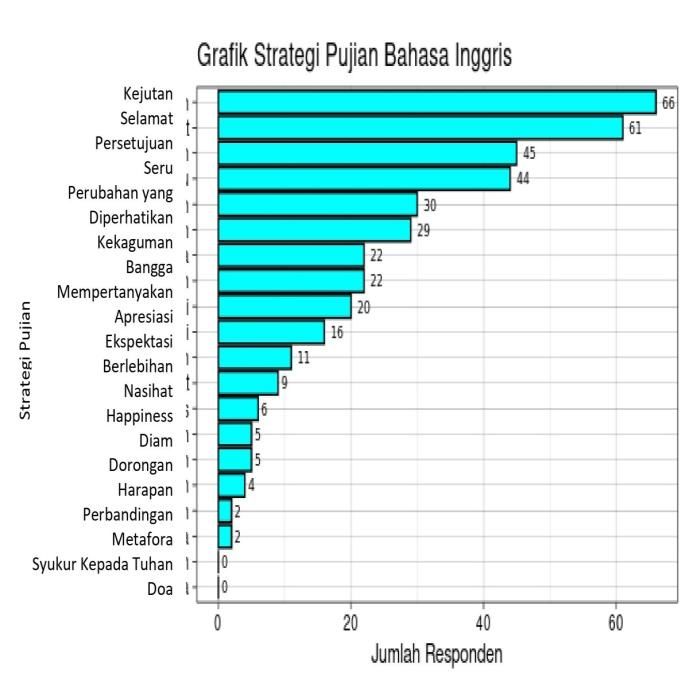
a. Forms of Compliment Strategies for English Learners
Figure 2. Compliment Response Strategies for English Learners
The graph above shows that in English learners the
compliment response strategy used is dominated by
appreciation/appreciation as many as 68 respondents.
Furthermore, 34 responses from respondents used a
compliment response strategy that was delivered in the form
Figure 1. Compliment Strategies for English Learners of returning praise, 22 responses from respondents used a
compliment response strategy that was delivered in the form
The graph above shows that in English learners the of disagree, 19 responses from respondents used a compliment
compliment strategy used was dominated by surprises as response strategy that was delivered in the form of good
many as 66 respondents used it. Furthermore, 61 respondents expressions, 16 responses from respondents using a
used the compliment strategy which was delivered in the form compliment response strategy that was delivered in the form
of congratulations, 45 respondents used the compliment of self-deprecation, 13 responses from respondents used a
strategy which was conveyed in the form of approval, 44 compliment response strategy that was delivered in the form
respondents used the compliment strategy which was of a promise, 10 responses from respondents used a
conveyed in the form of exclamation, 30 respondents used the compliment response strategy that was delivered in the form
compliment strategy which was conveyed in the form of of distracting praise, Each of the 8 responses from the
changes that were considered, 29 The responses from the respondents used a compliment response strategy that was
respondents used the compliment strategy which was delivered in the form of questions and received praise, 6
conveyed in the form of admiration, 22 respondents each used responses from the respondents used a compliment response
the compliment strategy which was conveyed in the form of strategy that was delivered in the form of qualifications, 2
pride and questioning, 20 respondents used the compliment responses from the respondents used a compliment response
strategy which was conveyed in the form of appreciation, 16 strategy that was delivered in the form of a comment history
respondents used the compliment strategy which was and 1 response from respondents using a compliment response
conveyed in the form of expectations, 11 respondents used the strategy in the form of gratitude to God and no recognition.
compliment strategy which was conveyed in the form of The respondents did not use the compliment response strategy
exaggeration, 9 respondents used the compliment strategy in the 6 compliment response scenarios that were prepared,
which was conveyed in the form of advice, 6 respondents used namely the strategy of hope, fear, offer, prayer, and request
the compliment strategy which was conveyed in the form of for interpretation.
happiness or happiness, 5 respondents respectively each of
them used the compliment strategy which was conveyed in the
www.rsisinternational.org Page 516International Journal of Research and Innovation in Social Science (IJRISS) |Volume V, Issue VI, June 2021|ISSN 2454-6186
In line with the analyzed data, it can be concluded - Aunty, where you bought the jacket, I like it very
that English learners use the surprise strategy as the most much(aunty, where did you buy that jacket I like it)
dominant strategy. This proves that in English the function of 3. Nephew interaction with Uncle / Uncle
complement is to encourage the interlocutor. - Uncel, I like your jacket. Maybe, it will look better if I
wear it.(Uncle, I like your jacket, maybe it would be
Factors Affecting Pragmatic Transfer of Compliment and
great if I put it on.)
Compliment Response on English Learners
- Uncle, is it the new one? It must be expensive right?
Based on the research conducted by Leech (1983) on (uncle, is this new, it must be expensive)
the scope of pragmatics, Kasper (1992) classifies pragmatic 4. Student and teacher interactions
transfer into two aspects, namely sociopragmatic transfer, and - Sir, Where you buy this jacket, this is good!
pragmalinguistic transfer. A sociopragmatic transfer is the (Sir, where did you buy this jacket, the jacket is very
social perception of language users that underlies the nice)
interpretation and performance of linguistic actions on the 5. Interaction between friends pr
target language which is influenced by their subjective - Cool, you just bought it first. And you don't even tell
assessment of the native language context. On the other hand, me. How dare you :) You know exactly that I want it at
pragmalinguistic transfer refers to the process in which the the first place "
power of speech acts or the value of politeness is used for (good, you bought it first, and didn't tell me, you're bad,
certain linguistic material in the first language whether it even though you know very well. I wanted it from the
affects students' perceptions in the production of mapping first time).
forms or functions in the second language, especially in - Can i have it? (can it be for me?)
aspects of linguistic structures such as morphosyntax in the - Can i have that one babe, pls (can for me one say?
communication process, 1992). please)
- reall it's that your jacket. How much money that you
Based on the theory put forward by Kasper (1992)
have to pay this jacket?(Is this really your jacket? How
with the classification of pragmatic transfers, In this study, we
much money did you spend on this jacket?)
found several related aspects that affect the pragmatic transfer
of compliment speech acts and compliment responses to In the data above, the speech that appears tends to experience
English learners. negative transfer on the sociopragmatic aspect in every
interaction. All speeches that appear are influenced by the first
In the sociopragmatic aspect, based on the chi-square
language, which causes the production of the target language
test of English learners, the findings from the data studied did
to not match the context in the culture of the target language,
not find a link between social relations and pragmatic transfer.
namely English. This is due to the tendency of English
These data indicate that negative transfers occur in almost
learners at the Faculty of Adab and Humanities at UIN
every social relationship whose frequency has no significance
Alauddin Makassar to transfer the method commonly used in
between student and teacher interactions, nieces and uncles,
Makassar culture and their first language, Indonesian into
nieces and aunts, between male friends, and between female
English, which is used as speech.
friends.
The negative transfer also occurs in English learners
As illustrated in the data in scenario 1 on the topic of
who are influenced by pragmalinguistic aspects such as the
complimenting appearance with a picture of the social context
following data.
of meeting in a public place complimenting the jacket with a
famous brand worn. Respondents were asked to compliment Negative transfer on pragmalinguistic aspects
male friends, female friends, uncles, aunts, and teachers. Data that should
English respondent data Information
be spoken
As illustrated in the following data there is a negative transfer: The tense used is not
Thank you, I appropriate, the
1. Interaction between male friends and male friendsWhere Thank you, I am working
worked really hard respondent should use
did you get it? I am looking for this suit jacket.(where really hard on this
for this the past tense because
did you get this? I'm also looking for a jacket like this) Thank you for working hard
the incident has
- Wow, where did you buy that jacket? That is quite Thank you for already taken place,
on this
working hard on but the respondent
expensive. this uses the continuous
(wow where did you buy this jacket? it's so expensive) tense.
- That is so cool. Can you also buy me one? (very good, thank you sir, will work more thank you sir, i
The word better
want to buy me one) already means better,
better will work better
so the respondent
2. The interaction between niece and aunt should no longer use
- It's cute, Aunty. You look younger. I hope I could also Thank you sir, I will do Thank you sir, I
the word More to
better will do better
wear it soon. indicate the word
(This is beautiful aunt, you look younger I hope I can more.
Thank you, same with you, Thank you, you The expression same
wear it soon too)
you look gorgerous look great with you experiences
www.rsisinternational.org Page 517International Journal of Research and Innovation in Social Science (IJRISS) |Volume V, Issue VI, June 2021|ISSN 2454-6186
a negative transfer have 13 forms, namely, the Appreciation/Appreciation
Thank you for looking Thank you for from the expression strategy, Returning Praise, Disagree, Good Expressions,
charming too looking charming commonly used in
too Indonesia, however it Humble oneself, Promises, Divert Praise, Questions, Receive
is not commonly used Praise, Qualifications, History of Comments, Thank God,
in English. None Recognition.
Table 1. Negative transfer on pragmalinguistic aspects The pragmatic transfer of compliment and compliment
The data above is a concrete example that English learners at responses to English learners at UIN Alauddin Makassar is
the Adab and Humanities faculty at UIN Alauddin Makassar influenced by the sociopragmatic aspect with indicators of
found negative transfers when performing compliment speech social relations. The results showed that there was no linkage
acts which led to pragmatic failure in the pragmalinguistic of social relation among English learners because there was a
aspect. negative and positive transfer found in almost every social
relationship. In the pragmalinguistic aspect, it is studied
The psychopragmatic aspects of English learners are through language form indicators. In English learners, it was
illustrated in the table 2: found that there was no relationship between language forms
Data that and transfer pragmatics which caused each learner to have
English respondent data should be Description negative transfers in language forms as much as 74% of
spoken English learners. In these two aspects, it was found that
That jacket is so Respondent data
That is so cool. Can you also
cool experienced negative
another aspect that influences pragmatic transfer is the
buy me one? psychopragmatic aspect.
transfer seen through
constructivism
That jacket is so cool. Can REFERENCES
That jacket is so approach, respondent
you buy one for me?
cool speech is influenced [1] Barker,Chris&Dariusz Galasinski. (2001). Cultural Studies and
psychologically Discourse Analysis. London: SAGE Publications Ltd.
through the way they [2] Bachman,L.F.(1990). Fundamental considerations in language
express feelings when testing. Oxford: Oxford University Press.
performing speech [3] Briska,S.(2013).Apragmatic analysis of compliments in Hausa
acts. A feeling to have socialcontexts.Unpublisheddoctoraldissertation.Ahmadu Bello
I think ur jacket is more something expressed University. Nigeria
I love your
suitable for me through the target [4] Brown, P & Levinson ,S. (1987). Universals in Language usage:
jacket
language using their Politeness phenomena. Cambridge: Cambridge University Press.
I think your jacket suits me habitual first [5] Canale, M. (1983). From communicative competence to language
I love your
better. language. pedagogy.InJ.Richards&J.Schmitt (Eds.), language
jacket
This expression communication. London: Longman.
causes negative [6] Enssaif,Z.A.(2005).Complimentbehavior:Strategies and
transfer to occur and realizations in English and Arabic. Unpublished Master's
has the potential to dissertation. King Saud University. Kingdom of Saudi Arabia.
cause pragmatic [7] Golato, A. (2003). Studying Compliment responses; A comparison
failure. of DCTs and recording of naturally accuring talk. Applied
Table 2. The psychopragmatic aspects of English learners linguistic, 24 (1), 9-121.
[8] Hasyim, M., Latjuba, A.Y., Akhmar, A.M., Kaharuddin, Saleh,
Based on the results of the analysis on the psychopragmatic N.J. (2021). Human-Robots And Google Translate: A Case Study
aspect, the researcher found that English language learners at Of Translation Accuracy In Translating French-Indonesian
Culinary Texts. Turkish Journal of Computer and Mathematics
the Faculty of Adab and Humanities at UIN Alauddin Education, 12 (4), 1194- 1202.
Makassar tended to express their feelings and mentality in [9] Hasyim, M., Arafah, B., Fatimah, Saleh, F. (2021). Female
doing speech acts praising or responding to compliment Sexuality For Male: The Power Relation Of Womenin The
strengthened by positive or negative feedback on the language Intimacy Relationship Of The Partner On Tv Advertisements, A
Semiotic Analysis. Turkish Journal of Physiotherapy and
behaviour shown by respondents at the interview. Rehabilitation, 32 (3), 79-87.
[10] Herbert, R. K. (1989). The Ethnography of English compliment
In conclusion, the pragmatic transfer of compliment and and complimentresponses:AConstructivesketch. Contrastive
compliment responses to English learners at the Faculty of Pragmatics, ed. By W. Oleksy, 3-36. Amsterdam: Jhon Benjamins
Adab and Humanities at UIN Alauddin Makassar is Publishing Company.
influenced by three aspects, namely sociopragmatic, [11] Hymes,D. (1972). On communicative competence. In J.B. Pride
and J. Holmes (Eds.). Sociolinguistics. Harmondsworth, England:
pragmalinguistic and psychopragmatic factors. Penguin Books.
[12] Holmes, J. (1989). Compliment and Compliments Responses in
V. CONCLUSION New Zealand English. Anthropological Linguistic. 28, 485-508.
There are 18 strategies used by English learners, namely the [13] Holmes, J. (1988). Paying Compliments; A sex –preferential
positive politeness strategy. Journal of pragmatics, 12, 445-465.
strategy of Admiration, Exclamation, Happiness, Expectation, [14] Katsuta Hiroko. (2012). The role of Compliment Topics in
Congratulations, Questioning, Exaggeration, Proud, Changes Compliment Response, Portland StateUniversity.
in Attention, Expectations, Approval, Metaphor, Advice, [15] Lado,R. (1957). Linguistics across culture. Ann Arbor, MI: The
Appreciation, Comparison, Surprise, Encouragement, and University of Michigan Press.
[16] Leech, G. (1983). Principles of Pragmatics. New York: Longman.
Exaggeration. While the strategies used by English learners
www.rsisinternational.org Page 518International Journal of Research and Innovation in Social Science (IJRISS) |Volume V, Issue VI, June 2021|ISSN 2454-6186
[17] Levinson, S.1 983 Pragmatics. Cambridge: Cambridge University Sulawesi. International Journal of Arts and Social Science, 4 (1),
Press. 312-318.
[18] Mustar, A.S., Latjuba, A.Y., Hasyim, M. (2021). Pesan Dan [22] Sugiyono. (2013). Metode Peneitian Kuantitatif Kualitatif dan
Makna Karikatur Brexit Patric Chappatté. Jurnal Ilmu Budaya, 9 R&D. CV.ALFABETA. Bandung.
(1), 165-176. [23] Rizk, S. 2003. Why say NO! when you refuse? TESOL Arabia
[19] Patmawati, P., Nurhayati, N., Latjuba, A.Y. (2020). Internalisasi 2002 Conference Proceedings, 7, 401-431.
Aplikasi Mind Map Pada Media Pembelajaran Guru Untuk [24] Thomas, J.(1983). Cross-cultural pragmatic failure. Applied
Meningkatkan Kompetensi Siswa Dalam Memproduksi Teks Linguistics, 4, 91-112.
Prosedur. Jurnal Ilmu Budaya, 8 (2), 302-312 [25] Wolfson, N. (1981). Compliments in cross-culture perpective.
[20] Pomerantz, A. (1978). Compliment responses: Notes on the co- TESOL Quarterly, 15 (2), 117-124.
operation of multiple constraints.In J,Schenkein (Eds.), Studies in [26] Yu,M-c.(2005)SocialinguisticCompetenceinThe
Organization of Conversational Interaction, 79-112, New York: Complimenting Act of Native Chinese and American English
Academic Press. Speakers.
[21] Saleh, F., Lukman, Rahman, F., Hasyim, M. (2021). Metaphor in
the Bugis Language Expression of the Sidenreng Dialectin South
www.rsisinternational.org Page 519You can also read


