Public Perception on Healthcare Services: Evidence from Social Media Platforms in China - MDPI
←
→
Page content transcription
If your browser does not render page correctly, please read the page content below
International Journal of
           Environmental Research
           and Public Health

Article
Public Perception on Healthcare Services:
Evidence from Social Media Platforms in China
Guangyu Hu , Xueyan Han, Huixuan Zhou and Yuanli Liu *
 School of Public Health, Chinese Academy of Medical Sciences and Peking Union Medical College,
 Beijing 100730, China; hugy@sph.pumc.edu.cn (G.H.); hanxueyan611@163.com (X.H.);
 chouhuixuan@live.cn (H.Z.)
 * Correspondence: liuyl_fpo@126.com; Tel.: +86-010-5232-8735

 Received: 27 February 2019; Accepted: 8 April 2019; Published: 10 April 2019

 Abstract: Social media has been used as data resource in a growing number of health-related research.
 The objectives of this study were to identify content volume and sentiment polarity of social media
 records relevant to healthcare services in China. A list of the key words of healthcare services were
 used to extract data from WeChat and Qzone, between June 2017 and September 2017. The data were
 put into a corpus, where content analyses were performed using Tencent natural language processing
 (NLP). The final corpus contained approximately 29 million records. Records on patient safety were
 the most frequently mentioned topic (approximately 8.73 million, 30.1% of the corpus), with the
 contents on humanistic care having received the least social media references (0.43 Million, 1.5%).
 Sentiment analyses showed 36.1%, 16.4%, and 47.4% of positive, neutral, and negative emotions,
 respectively. The doctor-patient relationship category had the highest proportion of negative contents
 (74.9%), followed by service efficiency (59.5%), and nursing service (53.0%). Neutral disposition was
 found to be the highest (30.4%) in the contents on appointment-booking services. This study added
 evidence to the magnitude and direction of public perceptions on healthcare services in China’s
 hospital and pointed to the possibility of monitoring healthcare service improvement, using readily
 available data in social media.

 Keywords: healthcare; social media; China; WeChat; Qzone; natural language processing

1. Introduction
     Investigating public perception of healthcare services from different perspectives may generate
inconsistent results. For example, patient-initiated violence against health workers [1–6], and the
tension between doctors and patients for their dissatisfaction with the quality of healthcare [7,8],
were wildly covered in the Chinese media. While patient experience surveys on the national level
showed that patients were generally satisfied with both in-patient and out-patient services [9].
Such differences may result from biases rooted in the survey and media coverage; however,
the inconsistency also pointed to the need for additional data sources to monitor public opinions on
Chinese healthcare services.
     It has been suggested that social media might be such a data source. Rozenblum et al. pointed
out that when patient-centered healthcare, the internet, and social media were combined, the current
relationship between healthcare providers and consumers might face major changes—thus creating
a “perfect storm” [10]. Users’ posts on the social media platforms would generate a large volume
of real-time data regarding public or private issues, among which healthcare related information
scatters. Therefore, the utilization of social media data for healthcare research becomes a dramatically
growing field and already covered various medical and healthcare research fields [11,12]. Sinnenberg
and colleagues proposed four ways in which social media data were used in healthcare studies:

Int. J. Environ. Res. Public Health 2019, 16, 1273; doi:10.3390/ijerph16071273   www.mdpi.com/journal/ijerph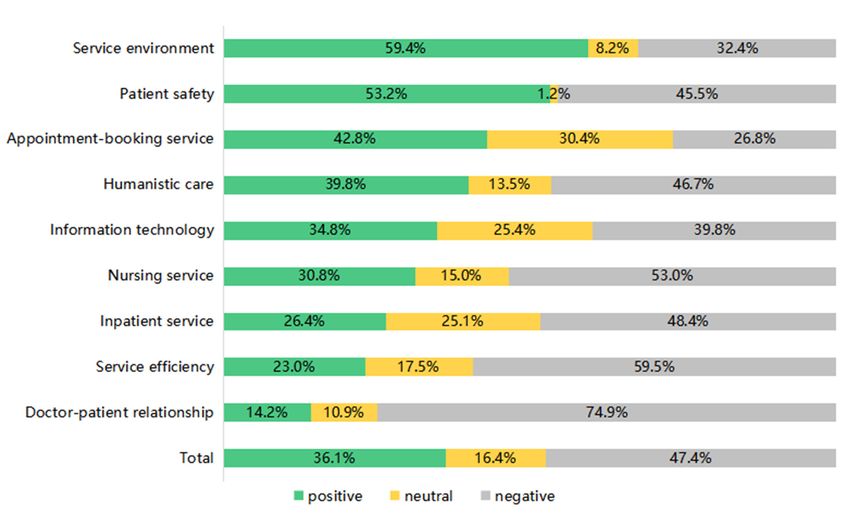
Int. J. Environ. Res. Public Health 2019, 16, 1273                                                 2 of 10

(1) content analysis, (2) volume surveillance of contents on specific topics, (3) engagement of users
with others, and (4) network analysis of users [12]. For the content analysis, most studies focused on
measuring public discussion on specific diseases [13–15], sentiment analysis for medical interventions
(e.g., cancer screening) [16,17], identifying safety concerns among health consumers [18], detecting
adverse events of health products [19,20]. Several researchers studied patient experience, based on the
comments posted by patients from online health communities in China [21,22], but few studies have
been conducted to gather information on healthcare services related topics using social media data.
Meanwhile, although sentiment analysis has been wildly applied to process user sentiments associated
with health-related text [23], the lexical resource and tools designed for doing health-related sentiment
analysis in Chinese language are few and far between. Fast-advancing in technology and economy,
social media users and their activities spiked in China, which made social media a promising source
for healthcare service monitoring. In China, the internet penetration rate reached 55.8% at the end of
2017 [24], with local providers dominating the market, rather than Facebook and Twitter, which are not
accessible in China. Chinese social media sites have a unique landscape, and it may not only be used
as a communication software but also as an entry point for information. As subsidiaries of Tencent
Holdings Limited, Shenzhen, China, WeChat and Qzone are two leading social media and networking
services platforms. Each of them reached more than 938 million and 632 million monthly active user
accounts in the first quarter of 2017 [25]. According to the 2016 WeChat Data Report, typical users
of WeChat were born in the 80s or 90s [26], representing a wide breadth of demographic group in
China. Besides providing multimedia communication and supporting social networking, WeChat also
has “Official Accounts”, which serve as channels for publishing articles to the public. Any individual
or organization can apply for having their own official account to broadcast their ideas and believes.
As for Qzone, it is a platform bundled with QQ, a popular online messaging application in China.
Qzone allows users to create their own personal page to write blogs and post updates. And users
could be able to express their individual opinions and attitudes freely and instantly on the social media
platforms. Subject to the platforms’ terms of service and privacy policy agreed upon by users [27,28],
three kinds of information were collected, stored, and used by the platforms: (1) Personal information;
(2) non-personal information; and (3) shared information. The shared information refers to information
that is voluntarily shared on the platforms by users freely and instantly, thus providing a valuable
perspective and opportunity to gather public opinions on healthcare services.
      As such, we selected WeChat and Qzone as the social media platforms to conduct this exploratory
study. The objectives of this study are to conduct volume and sentiment analyses base on the extracted
social media contents on hospital healthcare services. The study could demonstrate the social media
users’ perceptions of hospitals healthcare and may shed light on the further utilization of social media
as a data source for healthcare research in China.

2. Materials and Methods

2.1. Study Design
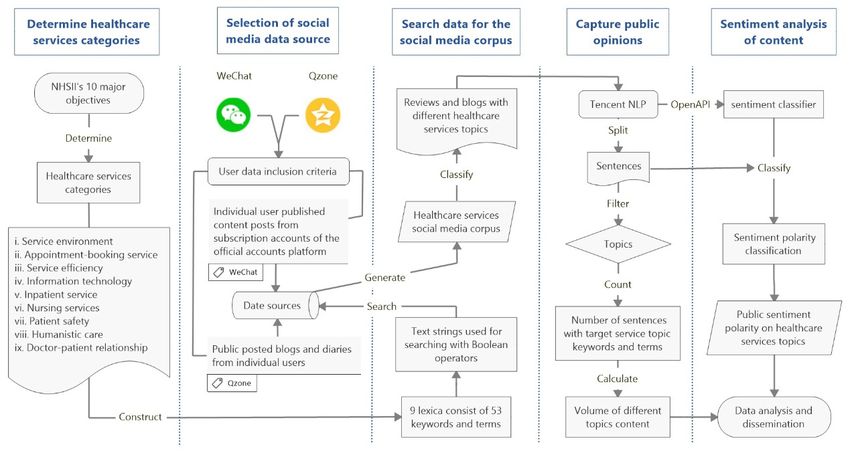
     This study consisted of three phases. Firstly, we utilized a predefined list of healthcare services
categories to devise key words and search strategies accordingly. The data searching strategy would
then be used to extract contents from a raw database, which contained publicized posts of WeChat and
Qzone. The extracted materials were then put into a corpus. Secondly, we applied natural language
processing (NLP) techniques from Tencent NLP platform to the corpus and calculated the volume
of content concerning different healthcare services topics. Thirdly, we conducted sentiment analysis
to explore the sentiment polarity of Chinese social media users on different healthcare service topics.
The detailed process of data collection and analysis is presented in Figure 1. The study protocol
was approved by the Ethics Committee of School of Public Health, Peking Union Medical College
(71532014) and conducted under the academic collaborative project between Peking Union Medical
College and Tencent.
s. Public Health 2019, 16, x Res. Public Health 2019, 16, 1273
Int. J. Environ. 3 of 11 3 of 10
Figure 1. Flowchart of data collection and analysis. Note: NLP, natural language processing; API, application programming interface.
Figure 1. Flowchart of data collection and analysis. Note: NLP, natural language processing; API, application programming interface.Int. J. Environ. Res. Public Health 2019, 16, 1273 4 of 10
2.2. Data Source
The raw databases used for this study come from WeChat and Qzone of the version only operated
in mainland China. The user volumes and data inclusion criteria of the platforms were showed in
Table 1. Publicly available posted information such as: posted blogs, reviews and articles that are
voluntarily shared by individual users from June 2017 to September 2017 were collected from the two
platforms. The data collection followed the privacy policy for users of Tencent and was subject to the
confidentiality and security measures that implemented by the platforms. And the data analyses were
supported by technicians in the Tencent.
Table 1. Data sources.
Monthly Active User
Platform Launch Time User Data Inclusion Criteria
Accounts (2017Q1)
Posts from subscription accounts of the official
WeChat 2011 938 million
accounts published by users
Qzone 2005 632 million Public posted blogs and diaries of individual users
2.3. Healthcare Services Categories
The nine healthcare service categories, used in this study, were derived from the objectives of the
National Healthcare Service Improvement Initiative (2015–2017), which was dedicated to improving
patient-centered healthcare and patient experience nationwide by the former National Health and
Family Planning Commission of P.R. China (NHFPC) [29]. The initiative operated under the leadership
of the Bureau of Medical Administration of NHFPC [30], which suggested that we used nine predefined
categories to reflect the healthcare services in hospital (see Table 2).
Table 2. Healthcare services categories and corresponding descriptions in the National Healthcare
Service Improvement Initiative 2015–2017 (NHSII).
Healthcare Services Categories Objectives of NHSII
Service environment Optimize the layout of the facility and build a friendly service environment
Appointment-booking service Promote utilization of clinical appointment services and guide patient flow
Service efficiency Improve service efficiency and effectiveness by rational allocation of resources
Information technology Take advantage of information technology to improve patient experience
Inpatient service Promote inpatient service process reengineering and provide integrated healthcare service
Nursing service Continuously improve quality of nursing care and enhance nursing workforce
Patient safety Ensure patient safety by promoting adoption of standard operating procedures
Humanistic care Strengthen humanistic care and provide medical social worker service
Doctor-patient relationship Harmonize the doctor-patient relationship and reduce medical disputes
2.4. Searching Strategy and Corpus Construction
In this study, we constructed a healthcare services corpus, in the Chinese language from the social
media data source, to enable further analyses. First, we constructed lexica of keywords and terms in
accordance with the predefined service topics. For example, the lexicon for “Information technology”,
used in this study indicate new information dissemination channels, based on information technology
provided by hospital to improve patient experience of service information acquisition. And this lexicon
contains six information technology service-related terms, namely, “Weibo”, “WeChat”, “website”,
as well as “Self-service machine”. Second, we developed a set of searching strategy to extract the
relevant data from the two sources based on the corresponding lexicon of topics. The entire list of search
terms for each category and its corresponding searching strategy were provided in Supplementary
Table S1. Finally, we applied the search strategies to the database of publicly posted materials to screen
for posts related to the healthcare service categories to construct the corpus. The search and screening
process were performed by Qcloud.Int. J. Environ. Res. Public Health 2019, 16, 1273 5 of 10
2.5. Analyze the Social Media Content of Healthcare Services
Based on the healthcare services corpus, we classified the content to different healthcare services
topics that predefined and measured the content volume of the topic. Specifically, we used the
open application programming interface (OpenAPI) services provided by Tencent NLP to analyze
the retrieved contents. It is an open platform for Chinese natural language processing (based on
parallel computing and distributed crawling system) [31]. Such services enable us to split reviews
and blogs into sentences, and each sentence was filtered to classify whether it contained target service
topic keywords and terms. If the sentences, containing certain keywords and terms, belonged to the
corresponding topic of healthcare services categories as listed in Table S1, then they would be divided
into a certain category. By counting the appearances of each service topic keywords in terms of the
number of sentences in the corpus, we can aggregate the counts at the topic level and calculate the
proportion of different topics from the social media corpus. For the sentiment analysis tool in Chinese,
we also select Tencent NLP, as its algorithm was trained by hundreds of billions of entries of internet
corpus data in Chinese and with successful application in other Tencent products (https://nlp.qq.com).
OpenAPI with function of Chinese batch texts automatic summarization and sentiment analysis of
Tencent NLP enable us to categorize the sentences on certain topic in the social media corpus into
a sentiment polarity classification (i.e., neutral, positive, and negative). Finally, each sentence was
tagged and classified into different sentiment polarity.
3. Results
3.1. Content Volume
The social media corpus contained approximately 29 million records from WeChat and Qzone,
spanning the 9 pre-defined categories, related to hospital healthcare services.
Table 3 presents the content volume of each healthcare services topic by social media channel.
Among the social media content on healthcare services topics, patient safety was the most commonly
encountered topic, both in WeChat and Qzone. The majority of the content related to patient safety
issue, its approximately 8.73 million records and covered 30.1% of the entire corpus. The proportion of
contents related to other topics varied in the corpus: Information technology (22.2%), service efficiency
(17.9%), service environment (10.3%), inpatient service (9.6%), appointment-booking service (3.4%),
nursing service (2.5%), doctor-patient relationship (2.5%), and humanistic care (1.5%).
Table 3. Distribution of each topic content volume (count and proportion), 15 June 2017 to
15 September 2017.
WeChat (N = 15,172,421) Qzone (N = 13,844,634) Total (N = 29,017,055)
Healthcare Services Topic
Count % Count % Count %
Patient safety 4,020,928 26.5% 4,704,284 34.0% 8,725,212 30.1%
Information technology 3,598,566 23.7% 2,857,266 20.6% 6,455,832 22.2%
Service efficiency 2,491,950 16.4% 2,703,352 19.5% 5,195,302 17.9%
Service environment 1,902,727 12.5% 1,075,697 7.8% 2,978,424 10.3%
Inpatient service 1,392,611 9.2% 1,396,209 10.1% 2,788,820 9.6%
Appointment-booking service 641,865 4.2% 353,856 2.6% 995,721 3.4%
Nursing service 424,229 2.8% 303,034 2.2% 727,263 2.5%
Doctor-patient relationship 438,823 2.9% 276,865 2.0% 715,688 2.5%
Humanistic care 260,722 1.7% 174,071 1.3% 434,793 1.5%
3.2. Sentiment Analysis
The results of the sentiment analysis of contents from the corpus found that, in all nine healthcare
services topics, 36.1% of the contents in the corpus have been recognized to reveal a positive disposition,
16.4% neutral and 47.4% negative. We found that topic comprising most positive contents was service
environment (59.6%), followed by patient safety (53.2%). With regard to the topics that containedInt. J. Environ. Res. Public Health 2019, 16, 1273 6 of 10
more negative contents than positive, the most one was doctor-patient relationship (74.9%), followed
by service efficiency (59.5%), and nursing service (53.0%). Notably, over one third of contents in the
appointment-booking service (30.4%) revealed a neutral disposition.
Additionally, in contrast to the content volume distribution for the nine topics, the sentiment
disposition of contents in corresponding healthcare services topics shows differences. For instance,
Table 3 shows that the nursing service and doctor-patient relationship share an equal proportion (2.5%)
of
Int.contents
J. Environ.in the
Res. corpus,
Public Healthhowever,
2019, 16, x we observed the disposition of contents from social media users
7 of to
11
the two topics varied in Figure 2.
Figure 2. Comparison of sentiment expressed towards the healthcare services topics at overall level.
Figure 2. Comparison of sentiment expressed towards the healthcare services topics at overall level.
4. Discussion
4. Discussion
To our knowledge, this is the first study that has attempted to explore the public perceptions of
healthcare
To ourservices, usingthis
knowledge, publicly
is theposted materials,
first study of two
that has Chinesetosocial
attempted media
explore theplatforms. Our results
public perceptions of
showed
healthcarethatservices,
patient safety
using was the most
publicly postedsignificant topic
materials, of for
twousers of Chinese
Chinese social social
mediamedia platforms,
platforms. Our
results showed
followed that patient
by information safety was
technology and the most
service significant
efficiency. topicenvironment
Service for users of was
Chinese
foundsocial media
to have the
platforms,
highest followedof by
proportion information
positive comments. technology and service efficiency. Service environment was
found to research
The have the assessed
highest proportion
the applicationof positive comments.
of content volume calculation and sentiment analyses on
Thesocial
Chinese research assessed
media the application
data. The of content
study is a crucial step tovolume calculation
discovering and sentiment
the methodology onanalyses
harnessing on
Chinese
the socialsocial
mediamedia
data indata. Theand
China studyan is a crucial
early steptototrack
attempt discovering the methodology
the perceptions on harnessing
of healthcare services in
social media
the public data in aChina
by analyzing unique and an source.
data early attempt to track the perceptions of healthcare services in
the public by analyzing
This study found a alargeunique
numberdata of
source.
information technology and service efficiency, which might
This
reflect thestudy
seriesfound a large
of efforts made number
by both of the
information
government technology
and the and service
hospital efficiency, which
in integrating might
information
reflect the series
technology of efforts
in healthcare made by
services both the
in China. government
Several and the
researchers have hospital in integrating
identified that health information
in healthcare
technology services were used services in China.
to enhance patientSeveral
experience researchers haveasidentified
[32–34], and a potentialthat health
solution to
information
shorten technology
the lengthy services
waiting time were used to
in China’s enhance
public patient
hospital experience [32–34], and as a potential
[22,35–37].
solution to shorten
Humanistic thewas
care lengthy waiting
the least time in China’s
mentioned topic inpublic hospital
the corpus [22,35–37].
complied by this study. It may
Humanistic
suggest caresocial
that Chinese was the
media least mentioned
users topicfamiliar
are not very in the corpus
with thecomplied by this study.
idea of humanistic care. ItThose
may
suggest
who thatabout
posted Chinese social media
it basically users are
expressed not very
a positive familiarAn
attitude. with the idea explanation
alternative of humanistic care.be
might Those
this
who of
type posted about
care has yetittobasically
reach theexpressed
public only a positive attitude.
experienced by aAnfewalternative explanation
people. Further might
empirical be this
studies or
type of care
controlled has yet
studies mayto reach the public
be conducted to only
provideexperienced by a few people. Further empirical studies
further insights.
or controlled studies may be conducted to provide further insights.
Our research also explored the sentiment disposition of social media content on healthcare
services: 47.4% provided negative feedback. Although this was only the initial results, it could be
quite alarming to healthcare administrations and policymakers. Despite the fact that patient surveys
generally had favorable results in China [9], there was still a significant amount of negative commentsInt. J. Environ. Res. Public Health 2019, 16, 1273 7 of 10
Our research also explored the sentiment disposition of social media content on healthcare services:
47.4% provided negative feedback. Although this was only the initial results, it could be quite alarming
to healthcare administrations and policymakers. Despite the fact that patient surveys generally had
favorable results in China [9], there was still a significant amount of negative comments on the social
media platforms. Further and more detailed methodology is necessary to further understand the
negative comments.
In the 9 topics investigated in this study, we found huge variations in the negative feedback as
well as content volumes across topics. For instance, the contents related to doctor-patient relationship
only take percentage of 2.5% in the corpus, however 74.9% of the content revealed negative feedback.
The varied sentiment polarity distribution of the topics may have important policy implications for
healthcare reform in China. For example, 30.4% of the social media references to appointment-booking
service reflected neutral feedback, which may suggest that the unsureness of the public on this novel
service. Patients have yet to be familiar with the services—even though it certainly aims to improve the
convenience for patients as well as hospital efficiency. Such feedback could be essential for hospitals
to improve their service quality by enhancing patient education. Further research might focus on
what exactly were discussed in those negative posts so that targeted measures can be employed by the
hospitals and responsible administrators to improve the services.
In line with previous evidence [11,12], our results show that social media could be a useful tool for
health research in China, as well as English, and could be used to capture the public’s perspective of
healthcare [23,38]. However, it appeared that the most concerned issue of healthcare in social media is
different from what has been found in patient surveys. Findings from a recent qualitative study found
that patients cared about the environment and facilities in hospital the most [39], whereas in our study
patient safety issues had the greatest volume. Another research examined the online doctor reviews in
China revealed that most posts expressed positive attitudes towards the physicians [21]. Although the
evidence on these issues are still not conclusive, it might suggest the perception difference between
general public and patients.
5. Strengths and Limitations
Our research extends application of the natural language processing techniques to analysis of
healthcare services related contents in China’s social medial platforms and offers a new perspective of
healthcare services in China’s hospital. The results would be of benefit to healthcare providers and
regulators benchmarking their performance on patient-centered healthcare delivery. This is important
because the social media has been considered as a portal of health information acquisition for Chinese
netizens [40], the perspective of social media would be supplementary in understanding how consumer
views the healthcare services in hospital besides the results from traditional paper-based surveys.
This study has the following limitations. First, because the raw material was user-generated
data, selection bias may have affected the data. For example, it was observed that most social
media users were born in the 80 s or 90 s [26], however we were unable to characterize the users
social-demographic information in detail, since the user privacy policy of Tencent currently prohibit
such practice. Moreover, considering the exploratory nature of the study, our study focused only on
WeChat and Qzone as data sources, whereas other social media platforms in China may have the
potential to conduct such analyses as well.
Second, since we derived the healthcare services categories and lexica based on the government
document on NHSII and expert consultation, thus the corpus in this study may have failed to include
certain amount of healthcare services related data. As a result, we may have underestimated the
content volume of healthcare services from the two social media platforms. Furthermore, although
all the material in the databases are in Chinese, and therefore most likely be generated by users
from China, we are currently not able to determine whether the posts, containing the key terms on
healthcare, were describing the Chinese healthcare system or discussing foreign healthcare systemsInt. J. Environ. Res. Public Health 2019, 16, 1273 8 of 10
in Chinese language. Further research may strive to develop searching strategies that enable such
distinction and increase the specificity of the results.
Third, although the consumer health vocabulary (CHV) is the gold standard reference for
retrieving the target data, it has been used in previous researches [13,38], such open source of
vocabulary list and its corresponding lexica are not available in Chinese language. The accuracy
and credibility of the sentiment analysis of this study also await further validation; however, it would
require an alternative method to conduct sentiment analyses for Chinese language and the possibility
to apply such methods on the Tencent data, which were publicly posted material but still under strict
terms of utilization. Another limitation concerned that we have no ability to confirm that the data
supplied by Tencent completely represent all users’ data as there could be undocumented keyword
filter on the platforms. These would inflict potential bias and limit the generalizability of our findings.
6. Further Research
Weibo is another popular Chinese social media platform considered to be the counterpart of
Twitter in China. Future research could consider extend the analysis process to contents from Weibo,
to further explore users, and their views, that have not been covered in this study.
Both the quantitative approach, as shown in our research, and the qualitative approach, such as
the face-to-face individual interview method, would be useful to better understand consumer care in
healthcare services. There is a scarcity of empirical research exploring the latter issue at present. It has
been proposed to complement public perspectives on healthcare services [39].
Furthermore, the popularity of consumers’ unsolicited comments on healthcare providers in
social media, prompts an important avenue for understanding patient experience, and has been
demonstrated by previous researches [38,41–44]. Future research for measuring patient experience
based on social media data at hospital level would be help to better understand the landscape of
healthcare quality in China.
7. Conclusions
By analyzing shared information from WeChat and Qzone, this study showed that patient safety
was the most concerned topic for users of Chinese social media platform, followed by information
technology and service efficiency, while the doctor-patient relationship was found to have the highest
proportion of negative comments. This study explored the possibility of utilizing social media to
monitor public perceptions on healthcare services. The findings provide an overview of public
opinion on healthcare services, which could help regulators to set up the benchmark, on a national or
regional level, to monitor the progress of healthcare improvements between comparator districts and
services domains. It is also a necessary complement to the traditional paper-based consumer survey.
The potential differences between social media perception and traditional consumer survey results
would help regulators better understand the gap in quality of care services from various perspectives.
Further studies could also focus on extending the NLP method to a more content-based resource and
to expand our understanding of mass opinion on healthcare services.
Supplementary Materials: The following are available online at http://www.mdpi.com/1660-4601/16/7/1273/s1,
Table S1: List of keywords, terms, and text strings used for data searching.
Author Contributions: Conceptualization, G.H. and Y.L.; data curation, G.H.; funding acquisition, Y.L.;
methodology, G.H.; writing—original draft, G.H.; writing—review and editing, X.H., H.Z., and Y.L.
Funding: This research was funded by the National Natural Science Foundation of China, grant number 71532014
and the National Health Commission of China.
Acknowledgments: We would like to acknowledge Dalu Wang and Hongda Wu from Tencent for their technical
support in data analysis.
Conflicts of Interest: The authors declare no conflict of interest.Int. J. Environ. Res. Public Health 2019, 16, 1273 9 of 10
References
1. Yu, D.; Li, T. Facing up to the threat in China. Lancet 2010, 376, 1823–1824. [CrossRef]
2. Sun, S.; Wang, W. Violence against Chinese health-care workers. Lancet 2011, 377, 1747. [CrossRef]
3. Li, P.; Qin, C. The danger of being a doctor in China. Int. J. Cardiol. 2014, 177, 489. [CrossRef]
4. Shi, J.; Wang, S.; Zhou, P.; Shi, L.; Zhang, Y.; Bai, F.; Xue, D.; Zhang, X. The frequency of patient-initiated
violence and its psychological impact on physicians in china: A cross-sectional study. PLoS ONE 2015, 10,
e128394. [CrossRef]
5. Wang, Y.; Fang, M.; Wang, Y. How to decrease violence against doctors in China? Int. J. Cardiol. 2016, 211.
[CrossRef]
6. Li, Z.; Yan, C.M.; Shi, L.; Mu, H.T.; Li, X.; Li, A.Q.; Zhao, C.S.; Sun, T.; Gao, L.; Fan, L.H.; et al. Workplace
violence against medical staff of Chinese children’s hospitals: A cross-sectional study. PLoS ONE 2017, 12,
e179373. [CrossRef]
7. Wu, D.; Hesketh, T.; Zhou, X. Media contribution to violence against health workers in China: A content
analysis study of 124 online media reports. Lancet 2015, 386. [CrossRef]
8. Zhou, M.; Zhao, L.; Campy, K.S.; Wang, S. Changing of China’s health policy and Doctor—Patient
relationship: 1949–2016. Health Policy Technol. 2017, 6, 358–367. [CrossRef]
9. Sun, J.; Hu, G.; Ma, J.; Chen, Y.; Wu, L.; Liu, Q.; Hu, J.; Livoti, C.; Jiang, Y.; Liu, Y. Consumer satisfaction with
tertiary healthcare in China: Findings from the 2015 China National Patient Survey. Int. J. Qual. Health Care
2017, 29, 213–221. [CrossRef] [PubMed]
10. Rozenblum, R.; Bates, D.W. Patient-centred healthcare, social media and the internet: The perfect storm?
BMJ Qual. Saf. 2013, 22, 183–186. [CrossRef]
11. Kamel Boulos, M.; Giustini, D.; Wheeler, S. Instagram and WhatsApp in Health and Healthcare: An Overview.
Future Internet 2016, 8, 37. [CrossRef]
12. Sinnenberg, L.; Buttenheim, A.M.; Padrez, K.; Mancheno, C.; Ungar, L.; Merchant, R.M. Twitter as a Tool for
Health Research: A Systematic Review. Am. J. Public Health 2017, 107, E1–E8. [CrossRef]
13. Weeg, C.; Schwartz, H.A.; Hill, S.; Merchant, R.M.; Arango, C.; Ungar, L. Using Twitter to Measure Public
Discussion of Diseases: A Case Study. JMIR Public Health Surveill. 2015, 1, e6. [CrossRef]
14. Song, J.; Song, T.M.; Seo, D.C.; Jin, D.L.; Kim, J.S. Social Big Data Analysis of Information Spread and
Perceived Infection Risk During the 2015 Middle East Respiratory Syndrome Outbreak in South Korea.
Cyberpsychol. Behav. Soc. Netw. 2017, 20, 22–29. [CrossRef]
15. Tian, X.; Batterham, P.; Song, S.; Yao, X.; Yu, G. Characterizing Depression Issues on Sina Weibo. Int. J.
Environ. Res. Public Health 2018, 15, 764. [CrossRef]
16. Wong, K.O.; Davis, F.G.; Zaïane, O.R.; Yasui, Y.; Dietz, J.; Aveiro, D.; Filipe, J.; Filipe, J.; Liu, K.; Bernardino, J.;
et al. Sentiment analysis of breast cancer screening in the United States using twitter. In Proceedings of
the 8th International Joint Conference on Knowledge Discovery, Knowledge Engineering and Knowledge
Management, Porto, Portugal, 9–11 November 2016.
17. Metwally, O.; Blumberg, S.; Ladabaum, U.; Sinha, S.R. Using Social Media to Characterize Public Sentiment
Toward Medical Interventions Commonly Used for Cancer Screening: An Observational Study. J. Med.
Internet Res. 2017, 19, e200. [CrossRef]
18. Lau, A.Y.S.; Gabarron, E.; Fernandez-Luque, L.; Armayones, M. Social Media in Health—What are the Safety
Concerns for Health Consumers? Health Inf. Manag. J. 2012, 41, 30–35. [CrossRef]
19. Tricco, A.C.; Zarin, W.; Lillie, E.; Pham, B.; Straus, S.E. Utility of social media and crowd-sourced data for
pharmacovigilance: A scoping review protocol. BMJ Open 2017, 7, e13474. [CrossRef]
20. Kazemi, D.M.; Borsari, B.; Levine, M.J.; Dooley, B. Systematic review of surveillance by social media platforms
for illicit drug use. J. Public Health UK 2017, 39, 763–776. [CrossRef]
21. Hao, H. The development of online doctor reviews in China: An analysis of the largest online doctor review
website in China. J. Med. Internet Res. 2015, 17, e134. [CrossRef]
22. Zhang, W.; Deng, Z.; Hong, Z.; Evans, R.; Ma, J.; Zhang, H. Unhappy Patients Are Not Alike: Content
Analysis of the Negative Comments from China’s Good Doctor Website. J. Med. Internet Res. 2018, 20, e35.
[CrossRef]
23. Gonzalez-Hernandez, G.; Sarker, A.; O’Connor, K.; Savova, G. Capturing the Patient’s Perspective: A Review
of Advances in Natural Language Processing of Health-Related Text. Yearb. Med Inform. 2017, 26, 214.
[CrossRef]Int. J. Environ. Res. Public Health 2019, 16, 1273 10 of 10
24. China Internet Network Information Center The 41st China Statistical Report on Internet Development.
Available online: http://www.cnnic.net.cn/hlwfzyj/hlwxzbg/hlwtjbg/201803/P020180305409870339136.
pdf (accessed on 15 January 2018).
25. Tencent Products & Services. Available online: https://www.tencent.com/en-us/system.html (accessed on
15 January 2018).
26. Tencent the 2016 WeChat Data Report. Available online: http://blog.wechat.com/2016/12/29/the-2016-
wechat-data-report (accessed on 15 January 2018).
27. Tencent Privacy Policy. Available online: https://www.tencent.com/en-us/zc/privacypolicy.shtml
(accessed on 15 January 2018).
28. Tencent Terms of Service. Available online: https://www.tencent.com/en-us/zc/termsofservice.shtml
(accessed on 15 January 2018).
29. National Health and Family Planning Commission Announcement of Implementing the Healthcare
Services Improvement Initiative. Available online: http://www.nhfpc.gov.cn/yzygj/s3593g/201501/
5584853cfa254d1aa4e38de0700891fa.shtml (accessed on 15 January 2018).
30. National Health and Family Planning Commission the Implementation Strategy of the Healthcare Services
Improvement Initiative (2015–2017). Available online: http://www.nhfpc.gov.cn/yzygj/s3593g/201506/
cbe5494282d24e97a001e81e0325e1b1.shtml (accessed on 15 January 2018).
31. Tencent Tencent NLP. Available online: http://nlp.qq.com (accessed on 15 January 2018).
32. Zhang, W.; Deng, Z.; Evans, R.; Xiang, F.; Ye, Q.; Zeng, R. Social Media Landscape of the Tertiary Referral
Hospitals in China: Observational Descriptive Study. J. Med. Internet Res. 2018, 20, e249. [CrossRef]
33. Mao, H.; Sun, Y. A Way to Understand Inpatients Based on the Electronic Medical Records in the Big Data
Environment. Int. J. Telemed. Appl. 2017, 2017. [CrossRef]
34. Deng, Z.; Hong, Z.; Ren, C.; Zhang, W.; Xiang, F. What Predicts Patients’ Adoption Intention Toward mHealth
Services in China: Empirical Study. JMIR mHealth uHealth 2018, 6, e172. [CrossRef]
35. Bao, Y.; Fan, G.; Zou, D.; Wang, T.; Xue, D. Patient experience with outpatient encounters at public hospitals
in Shanghai: Examining different aspects of physician services and implications of overcrowding. PLoS ONE
2017, 12, e0171684. [CrossRef]
36. Luo, L.; Liu, H.; Liao, H.; Tang, S.; Shi, Y.; Guo, H. Discrete Event Simulation Models for CT Examination
Queuing in West China Hospital. Comput. Math. Methods Med. 2016, 2016, 2731675. [CrossRef]
37. Zhang, M.; Zhang, C.; Sun, Q.; Cai, Q.; Yang, H.; Zhang, Y. Questionnaire survey about use of an online
appointment booking system in one large tertiary public hospital outpatient service center in China. BMC
Med. Inform. Decis. Mak. 2014, 14. [CrossRef]
38. Rastegar-Mojarad, M.; Ye, Z.; Wall, D.; Murali, N.; Lin, S. Collecting and Analyzing Patient Experiences of
Health Care from Social Media. JMIR Res. Protoc. 2015, 4, e78. [CrossRef]
39. Wang, X.; Jiang, R.; Li, J.; Chen, J.; Burström, B.; Burström, K. What do patients care most about in China’s
public hospitals? Interviews with patients in Jiangsu Province. BMC Health Serv. Res. 2018, 18. [CrossRef]
40. Zhang, X.; Wen, D.; Liang, J.; Lei, J. How the public uses social media wechat to obtain health information in
china: A survey study. BMC Med. Inform. Decis. Mak. 2017, 17. [CrossRef]
41. Huppertz, J.W.; Otto, P. Predicting HCAHPS scores from hospitals’ social media pages: A sentiment analysis.
Health Care Manag. Rev. 2018, 43, 359–367. [CrossRef]
42. Maramba, I.D.; Davey, A.; Elliott, M.N.; Roberts, M.; Roland, M.; Brown, F.; Burt, J.; Boiko, O.; Campbell, J.
Web-Based Textual Analysis of Free-Text Patient Experience Comments from a Survey in Primary Care. JMIR
Med. Inform. 2015, 3, e20. [CrossRef]
43. Greaves, F.; Ramirez-Cano, D.; Millett, C.; Darzi, A.; Donaldson, L. Use of Sentiment Analysis for Capturing
Patient Experience from Free-Text Comments Posted Online. J. Med. Internet Res. 2013, 15, e239. [CrossRef]
44. Greaves, F.; Ramirez-Cano, D.; Millett, C.; Darzi, A.; Donaldson, L. Harnessing the cloud of patient experience:
Using social media to detect poor quality healthcare. BMJ Qual. Saf. 2013, 22, 251–255. [CrossRef]
© 2019 by the authors. Licensee MDPI, Basel, Switzerland. This article is an open access
article distributed under the terms and conditions of the Creative Commons Attribution
(CC BY) license (http://creativecommons.org/licenses/by/4.0/).You can also read


