PUMPKIN GUIDE 2018 - HM Clause
←
→
Page content transcription
If your browser does not render page correctly, please read the page content below
PUMPKIN GUIDE 2018
Choosing and caring for your
  HARRIS MORAN pumpkins
The right variety for you
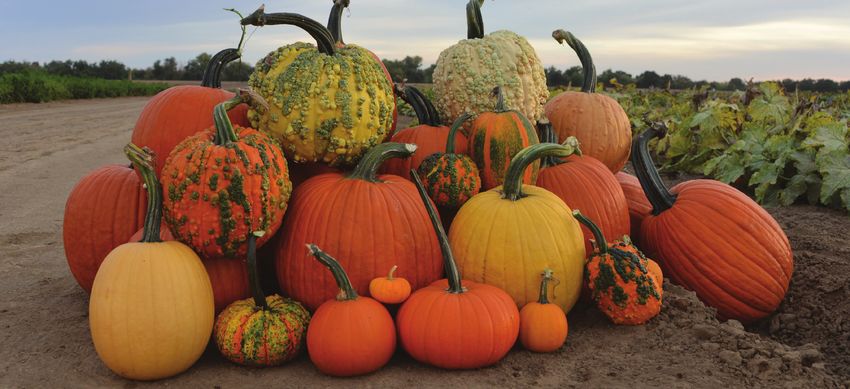
HARRIS MORAN offers many features of pumpkins to fill all market slots. In addition to having
various shapes and sizes, HARRIS MORAN varieties feature pumpkins with the dark rich color,
strong handles and disease resistances that enhance the appearance and value of the pumpkin.

Fertility
Before planting, we recommend that you sample the soil. An ideal pH ranges from 6.0 to 7.0.
You may need to amend your soil to achieve this level with high calcium and low magnesium
limestone, as your soil test warrants. Once you have the appropriate pH, you should apply the
major and minor soil nutrients (NPK) at the proper levels.

Pollination
Pumpkins sport both male and female flowers. The
plants must be insect pollinated – honeybees being
the main pollinators. Multiple visits to each flower are
necessary for pollination – about 15 visits per flower.
Place beehives in the field when flowers begin opening,
usually when the third node forms on the plant. Leave
beehives in the field for only 35 days. Location and
timing of pollination is key because research shows
honeybees prefer other types of plants from which they
get more nectar and pollen. Keep the bees interested in
pollinating the pumpkin patch by placing the hives in
the proper area at the proper time.

     Credit for information used: Maryland Cooperative Extension, Fact Sheet 454 • Bob Rouse – University of Maryland Regional Fruit and
     Vegetable Specialist • Charles McClurg – Extension Vegetable Specialist University of Maryland • Alan McNab – Penn State Univ. Extension
                       Plant Pathologist • Ron Morse – Virginia Polytechnic Institute and University, Vegetable Crop Specialist
Planting and spacing
Proper soil depth at planting, along with spacing intervals, can also make or break a
crop. Recommended planting dates usually run from late May to early July, depending
on your location. You may want to consider multiple planting dates to provide pumpkins
for an extended harvest period. Seeds are most often planted at a depth of 1 to 2 inches
depending upon the soil moisture at the time of planting. Remember, you need good
seed-to-soil contact for optimum germination. Seeding rates per acre, as well as spacing,
should be selected based upon the variety of pumpkin. Each variety has an ideal spacing
for optimum performance. A heavy stand can stress your plant and restrict growth thus
influencing the size and set of your pumpkins. In work done by Ron Morse, Virginia
Polytechnic Institute and University, optimum yield was achieved by using a semi-bush
plant such as Magic Lantern and equilateral spacing (4ft x 4ft). This type of spacing
produced 25% more marketable pumpkins than other spacings with the same number
of square feet (8ft x 2ft).

Managing pests in your production field
 Weeds can prevent bees from pollinating flowers. They also serve as hosts for insects
   which can spread harmful viruses.
 Insects can introduce viruses to a field. These infestations lead to restriction of size,
   greening and lumpiness of the pumpkin fruit.
 Diseases can jeopardize your pumpkin crop. Phytophthora Blight, Black Rot, Mosaic
   Viruses and Powdery Mildew are just some of the major diseases that can do harm.
   Each of these pests can be controlled by numerous methods including: good crop
   rotation, soil drainage, varietal resistance, proper planting time, seeding rate, and
   regular use of pesticides.

Harvest, handling, and storing pumpkins
If you want maximum tonnage from your pumpkin crop, it is imperative you harvest
your fruit at its optimum maturity. If pumpkins are left on the vine past maturity they
will actually decrease in weight as each day passes. This can reduce the final tonnage
of your field. When harvesting for wholesale be sure to harvest and stack the pumpkins
carefully in the bins so you don’t injure the fruit. Injured fruit offer the perfect points of
entry for post-harvest disease.

The USDA Agriculture Handbook suggests the following steps be taken for proper
pumpkin storage:
   Ideal storage temp should be between 50 to 55 degrees F
   Relative humidity should be no more than 70% and no less than 50%
   The harvested pumpkins should be placed on racks, in bins or in baskets
CRUNCHKIN                          MUNCHKIN
Excellent choice for the           Miniature ornamental for
decorative pumpkin class.          speciality markets.
 Ornamental scalloped type          Early maturity
 Concentrated high yield            Full vine with good yield
 Speckled, hard shell exterior      Excellent bright orange color
   that darkens as it ages            Trim stems for easy packing
 Weight: 0.5lb                      Weight: 0.5lb

APPRENTICE                         LIL’ PUMP-KE-MON
Mini pumpkin with a giant          Unique white ornamental mini
personality.                       pumpkin with orange stripes.
   Hard shell                       Large, stocky plant
   High yielding variety            Very uniform fruit
   Very uniform fruit               Concentrated set
   Irresistible in the market       Weight: 1-2lb
   Weight: 1lb

CANNON BALL                        MISCHIEF
A superb pie pumpkin, perfect      Perfect size for both chain
for painting.                      stores and roadside stands.
   Vigorous plant                 Can be carved or painted
   Excellent orange color         High yields of uniform fruit
   Large, firmly rooted handle    Dark orange with a dark,
   Heavy fruits                     strongly attached handle
   Weight: 3-5lb                  Weight: 3-5lb

FIELD TRIP                         MYSTIC PLUS
Perfect for school pumpkin         Traditional pie filling pumpkin
patches!                           with production potential.
   Distinctive long handle          Great tasting pie filler
   Flat and ribby                   Top yields, excellent producer
   Very uniform in shape/size       Minimal handle breakage
   Weight: 5-7lb                    Ideal for children to carry
                                      Weight: 5-7lb

WARTY GOBLIN                       ORANGE SUNRISE
Frighteningly cool!                A precocious medium
                                   pumpkin with great color!
 Heavily warted pumpkins
   with a very high yield           Early-maturing variety
 Excellent pumpkin for            Enticing deep orange color
   patches and roadside stores      Excellent round shape
 Hard shell for durability          and size
 Weight: 8-20lb                   Weight: 15-20lb
MAGIC LANTERN                         MAGIC WAND
The high standard by which all        High yielding even during hot
other varieties are judged.           seasons.
   Attractive, classy appearance     Attractive, uniform round to
   Upright shape, classic look         slightly flat shape
   High yield potential              Large, firmly rooted handle
   Easy harvest management           Smooth and lightly-ribbed
   Weight: 15-25lb                   Weight: 15-25lb

ZEUS                                  GLADIATOR
Olympic quality pumpkin.              A proven performer in many
                                      environments.
   Large, firmly-attached handle
   Good yield on a strong vine         Vigorous plant
   Attractive, medium-sized fruit      Consistent high yield
   Consistent size for shipping        Excellent color
   Weight: 16-20lb                     Weight: 20-30lb

RHEA                                  ARES
A beautiful pumpkin that has          Tall, strong, warrior pumpkin.
a handle to match!
                                         Large, firmly-attached handle
   Consistent yielding                 Unique, upright shape
   Large vigorous vine                 Excellent yield potential
   Dark orange color                   Uniform shape and size
   For roadside and shipping           22-28lb
   Weight: 20-30lb

APOLLO                                KRATOS
Exciting large size pumpkin to        Strong, powerful pumpkin.
compliment Aladdin.
                                       Large, firmly-attached handle
 Medium dark orange color            Strong vine
 Medium ribbing                      Good yield, grower friendly
 Improved handle size &              Large, flat-round, medium-
   handle attachment                     ribbed fruit
 Weight: 18-32lb                     Weight: 20-30lb

ALADDIN                               CRONUS
Beautiful large-sized pumpkin.        Extra-large pumpkin. A must
                                      have for every patch!
   Uniform size and yield
   Firmly rooted handle                Excellent yields
   Dark orange color                   Exceptionally vigorous vine
   Weight: 25-35lb                     Dark orange color
                                         Large, firmly attached handle
                                         Weight: 25-60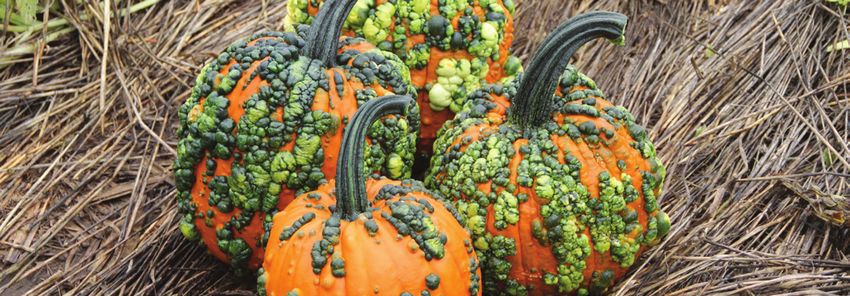
Pumpkins
Commercial Varieties Comparative Table
Hard Weight Between In-row Square
Variety Size Shape Color Px ZYMV
Shell (lbs) row feet feet feet
Flattened/
Crunchkin Mini Bright orange 0.5 4-6 1-2 4-12
scalloped
Flattened/
Munchkin Mini Bright orange 0.5 4-6 1-2 4-12
scalloped
Round to
Apprentice Mini Orange 1 4-6 1-2 4-12
flat round
Flattened/ White with
Lil Pump-Ke-Mon Mini 1-2 4-6 1-2 4-12
scalloped distinct stripes
Round to Orange to
Cannon Ball Small 3-5 5-6 2-3 10-18 IR
upright dark orange
Mischief Small Tall round Orange 3-5 5-6 2-3 10-18 IR
Orange to
Field Trip Small Flattened 5-7 5-6 2-3 10-18 IR
dark orange
Orange to
Mystic Plus Small Round 5-7 5-6 2-3 10-18 IR
dark orange
Orange with
Warty Goblin Medium Flat round 8-20 3-4 4-5 12-20 IR
green warts
Orange Sunrise Medium Round Orange 15-20 3-4 4-5 12-20 IR
Slightly
Magic Lantern Medium Dark orange 15-25 3-4 4-5 12-20 IR
upright
Round,
Magic Wand Medium Dark orange 15-25 3-4 4-5 12-20 IR
slightly flat
Medium dark
Zeus Medium Round 16-20 4-6 4-6 18-36 IR IR
orange
Deep Orange to
Gladiator Medium 20-30 8-12 3-4 24-48 IR
round deep orange
Rhea Medium Flat round Dark orange 20-30 8-12 3-4 24-48 IR
Medium dark
Ares Medium Upright 22-28 8-12 3-4 24-48 IR
orange
Round to
Apollo Large Dark orange 18-32 8-12 3-4 24-48 IR
tall
Medium dark
Kratos Large Flat-round 20-30 8-12 3-4 24-48 IR
orange
Round to Orange to
Aladdin Large 25-35 8-12 3-4 24-48 IR
tall deep orange
Cronus Large Round-flat Dark orange 25-60 8-12 4-6 48-75 IR
Data and Disease Ratings are an average of results from various test locations. It is not
Common name Abbreviation Pathogen/Causal agent a prediction of future performance, but a summary of past results. Your performance will
vary depending on the actual environment, pathogen strain and management conditions
Powdery mildew Px Podosphaera xanthii (ex Sphaerotheca fuliginea) in your field. The HM.CLAUSE, Inc. Limitation of Warranty and Liability and Use Restriction
is a condition of purchase of all Harris Moran and HM.CLAUSE seed. To preview the
Zucchini yellows ZYMV Zucchini Yellow Mosaic Virus Limitation of Warranty and Liability and Use Restriction, please visit the HM.CLAUSE, Inc.
website found at www.hmclause.com or call HM.CLAUSE, Inc. for more information.
Quick Reference Guide

                                                             Mini
Crunchkin        Munchkin     Apprentice   Lil Pump-ke-mon

Cannon Ball

                                                             Small
Mischief         Field Trip                Mystic Plus

Warty Goblin                               Rhea

                                                             Medium
Orange Sunrise                Zeus

Magic Lantern    Magic Wand   Gladiator    Ares
                                                             Large

Apollo           Kratos       Aladdin      Cronus
COMMUNICATIONS DIVISION | US6439 | 1117

260 Cousteau Place, Suite 210, Davis CA 95618 USA
Tel: 1.800.320.4672 • www.hmclause.com
You can also read


