Q2 Quarterly Market Review - Second Quarter 2020 - Potomac Financial
←
→
Page content transcription
If your browser does not render page correctly, please read the page content below
Q2
Quarterly Market Review
         Second Quarter 2020
Quarterly Market Review
Second Quarter 2020
This report features world capital market performance and a Overview:
timeline of events for the past quarter. It begins with a global
overview, then features the returns of stock and bond asset Market Summary
classes in the US and international markets.
World Stock Market Performance
The report also illustrates the impact of globally diversified
portfolios and features a quarterly topic. World Asset Classes
US Stocks
International Developed Stocks
Emerging Markets Stocks
Select Market Performance
Select Currency Performance vs. US Dollar
Real Estate Investment Trusts (REITs)
Commodities
Fixed Income
Global Fixed Income
Impact of Diversification
Quarterly Topic: Long-Term Investors, Don’t Let a
Recession Faze You
Michael R. Kalas, CFP®, AIF® is a financial advisor at Potomac Financial Private Client Group, LLC. He offers securities and advisory services as a Registered Representative and an Investment Adviser Representative of
Commonwealth Financial Network®, Member FINRA/SIPC, a Registered Investment Adviser. He maintains an office at 11130 Sunrise Valley Dr., Suite 130, Reston, VA 20191 and can be reached at 703-891-9960 or at
mike@potomacfinancialpcg.com. This e-mail is an advertisement and you may opt out of receiving further e-mails. To opt out, please respond to this e-mail with 'Opt Out' in the subject field.
2Quarterly Market Summary
Index Returns
Global
International Emerging Global Bond
US Stock Developed Markets Real US Bond Market
Market Stocks Stocks Estate Market ex US
2Q 2020 STOCKS BONDS
22.03% 15.34% 18.08% 11.17% 2.90% 1.76%
Since Jan. 2001
Avg. Quarterly Return 2.1% 1.4% 2.7% 2.3% 1.2% 1.1%
Best 22.0% 25.9% 34.7% 32.3% 4.6% 4.6%
Quarter
2020 Q2 2009 Q2 2009 Q2 2009 Q3 2001 Q3 2008 Q4
Worst -22.8% -23.3% -27.6% -36.1% -3.0% -2.7%
Quarter
2008 Q4 2020 Q1 2008 Q4 2008 Q4 2016 Q4 2015 Q2
Past performance is not a guarantee of future results. Indices are not available for direct investment. Index performance does not reflect the expenses associated with the management of an actual portfolio.
Market segment (index representation) as follows: US Stock Market (Russell 3000 Index), International Developed Stocks (MSCI World ex USA Index [net div.]), Emerging Markets (MSCI Emerging Markets Index [net div.]),
Global Real Estate (S&P Global REIT Index [net div.]), US Bond Market (Bloomberg Barclays US Aggregate Bond Index), and Global Bond Market ex US (Bloomberg Barclays Global Aggregate ex-USD Bond Index [hedged to
USD]). S&P data © 2020 S&P Dow Jones Indices LLC, a division of S&P Global. All rights reserved. Frank Russell Company is the source and owner of the trademarks, service marks, and copyrights related to the Russell
Indexes. MSCI data © MSCI 2020, all rights reserved. Bloomberg Barclays data provided by Bloomberg. 3Long-Term Market Summary
Index Returns
Global
International Emerging Global Bond
US Stock Developed Markets Real US Bond Market
Market Stocks Stocks Estate Market ex US
1 Year STOCKS BONDS
6.53% -5.42% -3.39% -15.91% 8.74% 4.00%
5 Years
10.03% 2.01% 2.86% 1.62% 4.30% 4.49%
10 Years
13.72% 5.43% 3.27% 6.97% 3.82% 4.20%
Past performance is not a guarantee of future results. Indices are not available for direct investment. Index performance does not reflect the expenses associated with the management of an actual portfolio.
Market segment (index representation) as follows: US Stock Market (Russell 3000 Index), International Developed Stocks (MSCI World ex USA Index [net div.]), Emerging Markets (MSCI Emerging Markets Index [net div.]),
Global Real Estate (S&P Global REIT Index [net div.]), US Bond Market (Bloomberg Barclays US Aggregate Bond Index), and Global Bond Market ex US (Bloomberg Barclays Global Aggregate ex-USD Bond Index [hedged to
USD]). S&P data © 2020 S&P Dow Jones Indices LLC, a division of S&P Global. All rights reserved. Frank Russell Company is the source and owner of the trademarks, service marks, and copyrights related to the Russell
Indexes. MSCI data © MSCI 2020, all rights reserved. Bloomberg Barclays data provided by Bloomberg. 4World Stock Market Performance
MSCI All Country World Index with selected headlines from Q2 2020
300
280
260
240
220
200
180
Mar 31 Apr 30 May 31 Jun 30
“China GDP Falls “Argentina Defaults on “IMF Says
“Eurozone “Recession in
6.8%, First Drop Its Sovereign Debt” Global
Economy US Began in
on Record” February, Economy
Sees Largest “US Stocks
Ending Will Shrink
Contraction Close Out
“Industrial Production in 128-month 4.9% This
on Record” Best Quarter
US Fell 11.2% in April” Expansion” Year”
“At Least a Fourth of US “Decade of Job Since 1998”
Economy Goes Idle from Gains Erased “Fed Holds Rates
“Virus Shrinks in April” Steady, Hints at
Lockdown” “Consumer Prices Post Biggest “S&P 500 Up Nearly
Economy by 4.8%; Future Cuts if Outlook
Drop Since Last Recession 40% in Past 50
Fastest Fall Since Doesn't Improve”
During April Lockdowns” Trading Days”
2008 Crisis”
“UK Economy Shrank “Fed Stress Test Finds
“Russell 2000 Rallies, a Record 20% in April US Banks Healthy
Outperforming S&P 500” as Lockdown Hit” Enough to Withstand
Coronavirus Crisis”
These headlines are not offered to explain market returns. Instead, they serve as a reminder that investors should view daily events from a long-term perspective and avoid making
investment decisions based solely on the news.
Graph Source: MSCI ACWI Index [net div.]. MSCI data © MSCI 2020, all rights reserved.
It is not possible to invest directly in an index. Performance does not reflect the expenses associated with management of an actual portfolio. Past performance is not a guarantee of future results. 5World Stock Market Performance
MSCI All Country World Index with selected headlines from past 12 months
LONG TERM (2000–Q2 2020)
300
200
SHORT TERM (Q3 2019–Q2 2020) Last 12
100
months
300 0
2000 2005 2010 2015
280
260
240
220
200
180
Jun 30 Sep 30 Dec 31 Mar 31 Jun 30
“Dow Closes at “Record Rise in “Eurozone
“China Growth at Its “ECB Launches Unemployment Economy Sees
“US Stocks Close Record as “US Stocks
Slowest Since 1992 Major Stimulus “Manufacturing Claims Halts Largest
Out Decade with Worries Abate” Close Out
as Beijing Struggles Package, Cuts Sputters as Broader Historic Run of Contraction on
190% Gain” Best Quarter
to Juice Economy” Key Rate” US Economy Slows” Job Growth” Record”
“Dow, S&P, Nasdaq Since 1998”
All Drop More than
“Dow Sheds 800 “New Virus Discovered “Fed Cuts Rates
“China’s Consumer 4% in Largest One- “Recession in US
in Biggest Drop by Chinese Scientists to Near Zero and
Inflation Soars to Day Point Declines Began in February,
of Year” Investigating Will Relaunch
Highest Level in Years” on Record” “At Least a Fourth Ending 128-month
Pneumonia Outbreak” Bond-Buying
“Fed Cuts Rates by of US Economy Expansion”
Program”
Quarter Point but Goes Idle from
Faces Growing Split” “Oil Prices Collapse After Saudi Lockdown”
Pledge to Boost Output”
These headlines are not offered to explain market returns. Instead, they serve as a reminder that investors should view daily events from a long-term perspective and avoid making
investment decisions based solely on the news.
Graph Source: MSCI ACWI Index [net div.]. MSCI data © MSCI 2020, all rights reserved.
It is not possible to invest directly in an index. Performance does not reflect the expenses associated with management of an actual portfolio. Past performance is not a guarantee of future results. 6World Asset Classes
Second Quarter 2020 Index Returns (%)
Equity markets around the globe posted positive returns in the second quarter. Looking at broad market indices, US equities outperformed non-US
developed markets and emerging markets.
Value stocks underperformed growth stocks, and small caps outperformed large caps.
REIT indices underperformed equity market indices in both the US and non-US developed markets.
MSCI Emerging Markets Small Cap Index (net div.) 27.14
Russell 2000 Index 25.42
Russell 3000 Index 22.03
Russell 1000 Index 21.82
MSCI World ex USA Small Cap Index (net div.) 21.66
S&P 500 Index 20.54
Russell 2000 Value Index 18.91
MSCI Emerging Markets Index (net div.) 18.08
MSCI All Country World ex USA Index (net div.) 16.12
MSCI World ex USA Index (net div.) 15.34
Russell 1000 Value Index 14.29
MSCI Emerging Markets Value Index (net div.) 13.83
MSCI World ex USA Value Index (net div.) 12.35
S&P Global ex US REIT Index (net div.) 10.75
Dow Jones US Select REIT Index 9.11
Bloomberg Barclays US Aggregate Bond Index 2.90
One-Month US Treasury Bills 0.02
Past performance is not a guarantee of future results. Indices are not available for direct investment. Index performance does not reflect the expenses associated with the management of an actual portfolio. The
S&P data is provided by Standard & Poor's Index Services Group. Frank Russell Company is the source and owner of the trademarks, service marks, and copyrights related to the Russell Indexes. MSCI data © MSCI 2020, all
rights reserved. Dow Jones data © 2020 S&P Dow Jones Indices LLC, a division of S&P Global. All rights reserved. S&P data © 2020 S&P Dow Jones Indices LLC, a division of S&P Global. All rights reserved. Bloomberg
Barclays data provided by Bloomberg. Treasury bills © Stocks, Bonds, Bills, and Inflation Yearbook™, Ibbotson Associates, Chicago (annually updated work by Roger G. Ibbotson and Rex A. Sinquefield). 7US Stocks
Second Quarter 2020 Index Returns
The US equity market posted positive returns for the quarter, Ranked Returns (%)
outperforming non-US developed markets and emerging
markets. Small Growth 30.58
Value underperformed growth in the US across large and small Large Growth 27.84
cap stocks.
Small Cap 25.42
Small caps outperformed large caps in the US. Marketwide 22.03
REIT indices underperformed equity market indices. Large Cap 21.82
Small Value 18.91
Large Value 14.29
World Market Capitalization—US Period Returns (%) * Annualized
Asset Class YTD 1 Year 3 Years** 5 Years** 10 Years**
Large Growth 9.81 23.28 18.99 15.89 17.23
Large Cap -2.81 7.48 10.64 10.47 13.97
57%
Small Growth -3.06 3.48 7.86 6.86 12.92
Marketwide -3.48 6.53 10.04 10.03 13.72
US Market Small Cap -12.98 -6.63 2.01 4.29 10.50
$30.5 trillion Large Value -16.26 -8.84 1.82 4.64 10.41
Small Value -23.50 -17.48 -4.35 1.26 7.82
Past performance is not a guarantee of future results. Indices are not available for direct investment. Index performance does not reflect the expenses associated with the management of an actual portfolio.
Market segment (index representation) as follows: Marketwide (Russell 3000 Index), Large Cap (Russell 1000 Index), Large Cap Value (Russell 1000 Value Index), Large Cap Growth (Russell 1000 Growth Index), Small Cap
(Russell 2000 Index), Small Cap Value (Russell 2000 Value Index), and Small Cap Growth (Russell 2000 Growth Index). World Market Cap represented by Russell 3000 Index, MSCI World ex USA IMI Index, and MSCI
Emerging Markets IMI Index. Russell 3000 Index is used as the proxy for the US market. Dow Jones US Select REIT Index used as proxy for the US REIT market. Frank Russell Company is the source and owner of the
trademarks, service marks, and copyrights related to the Russell Indexes. MSCI data © MSCI 2020, all rights reserved. 8International Developed Stocks
Second Quarter 2020 Index Returns
Developed markets outside the US underperformed both the Ranked Returns (%) Local currency US currency
US equity market and emerging markets equities for the
quarter.
Small Cap 18.73
Small caps outperformed large caps in non-US developed 21.66
markets.
Growth 15.20
Value underperformed growth across large and small cap 17.89
stocks. 12.81
Large Cap
15.34
Value 10.01
12.35
World Market Capitalization—International Developed Period Returns (%) * Annualized
Asset Class YTD 1 Year 3 Years** 5 Years** 10 Years**
Growth -3.11 4.25 5.93 5.29 7.36
31%
International
Large Cap
Small Cap
-11.49
-12.87
-5.42
-3.20
0.84
0.53
2.01
3.56
5.43
7.26
Value -19.96 -15.14 -4.42 -1.46 3.36
Developed Market
$16.7 trillion
Past performance is not a guarantee of future results. Indices are not available for direct investment. Index performance does not reflect the expenses associated with the management of an actual portfolio.
Market segment (index representation) as follows: Large Cap (MSCI World ex USA Index), Small Cap (MSCI World ex USA Small Cap Index), Value (MSCI World ex USA Value Index), and Growth (MSCI World ex USA
Growth Index). All index returns are net of withholding tax on dividends. World Market Cap represented by Russell 3000 Index, MSCI World ex USA IMI Index, and MSCI Emerging Markets IMI Index. MSCI World ex USA IMI
Index is used as the proxy for the International Developed market. MSCI data © MSCI 2020, all rights reserved. Frank Russell Company is the source and owner of the trademarks, service marks, and copyrights related to the
Russell Indexes. 9Emerging Markets Stocks
Second Quarter 2020 Index Returns
Emerging markets underperformed the US equity market but Ranked Returns (%) Local currency US currency
outperformed developed ex US equities for the quarter.
Value stocks underperformed growth stocks.
Small Cap 25.63
Small caps outperformed large caps. 27.14
Growth 20.81
22.09
Large Cap 16.74
18.08
Value 12.42
13.83
World Market Capitalization—Emerging Markets Period Returns (%) * Annualized
Asset Class YTD 1 Year 3 Years** 5 Years** 10 Years**
Growth -1.52 9.67 6.19 6.35 5.76
12%
Large Cap -9.78 -3.39 1.90 2.86 3.27
Small Cap -12.74 -8.82 -2.95 -1.38 1.78
Value -18.05 -15.74 -2.64 -0.80 0.66
Emerging Markets
$6.4 trillion
Past performance is not a guarantee of future results. Indices are not available for direct investment. Index performance does not reflect the expenses associated with the management of an actual portfolio.
Market segment (index representation) as follows: Large Cap (MSCI Emerging Markets Index), Small Cap (MSCI Emerging Markets Small Cap Index), Value (MSCI Emerging Markets Value Index), and Growth (MSCI
Emerging Markets Growth Index). All index returns are net of withholding tax on dividends. World Market Cap represented by Russell 3000 Index, MSCI World ex USA IMI Index, and MSCI Emerging Markets IMI Index. MSCI
Emerging Markets IMI Index used as the proxy for the emerging market portion of the market. MSCI data © MSCI 2020, all rights reserved. Frank Russell Company is the source and owner of the trademarks, service marks,
and copyrights related to the Russell Indexes. 10Select Market Performance
Second Quarter 2020 Index Returns
In US dollar terms, Australia and New Zealand recorded the highest country performance in developed markets, while the UK and Hong Kong posted the
lowest returns for the quarter. In emerging markets, Argentina and Thailand recorded the highest country performance, while Qatar and Colombia posted
the lowest performance.
Ranked Developed Markets Returns (%) Ranked Emerging Markets Returns (%)
Australia 31.70 Argentina 35.81
New Zealand 27.03 Thailand 26.97
Germany 26.75 South Africa 26.78
Netherlands 25.30 Indonesia 25.12
Brazil 23.83
Sweden 23.48
Taiwan 23.38
Canada 22.98
Czech Republic 23.28
USA 22.03 Poland 22.91
Finland 21.81 Turkey 22.39
Norway 20.82 India 21.52
Denmark 19.86 Korea 20.60
Ireland 19.66 Philippines 19.34
Italy 16.94 Russia 19.09
France 16.41 Chile 17.12
Israel 15.01 UAE 16.67
Greece 16.39
Austria 14.41
Malaysia 16.03
Belgium 14.19
China 15.22
Portugal 12.61 Pakistan 14.70
Japan 11.82 Hungary 14.60
Switzerland 11.65 Saudi Arabia 13.89
Singapore 11.55 Mexico 11.81
Spain 10.57 Egypt 10.70
Hong Kong 9.61 Peru 10.34
UK 8.77 Colombia 9.88
Qatar 8.53
Past performance is not a guarantee of future results. Indices are not available for direct investment. Index performance does not reflect the expenses associated with the management of an actual portfolio.
MSCI Index returns are in USD net of dividend withholding taxes. Country returns are the country component indices of the MSCI World ex USA IMI for all countries except the United States, where the Russell 3000 index is
used instead. Frank Russell Company is the source and owner of the trademarks, service marks and copyrights related to the Russell Indexes. MSCI data © MSCI 2020, all rights reserved. Indices are not available for direct
investment. Their performance does not reflect the expenses associated with the management of an actual portfolio. Past performance is not a guarantee of future results. 11Select Currency Performance vs. US Dollar
Second Quarter 2020
In developed markets, most currencies appreciated vs. the US dollar except for the British pound. In emerging markets, currency performance vs. the US
dollar was mixed. Most currencies generally appreciated vs. the US dollar, but others, notably the Argentinian peso and Brazilian real, depreciated.
Ranked Developed Markets (%) Ranked Emerging Markets (%)
Australian dollar (AUD) Indonesian rupiah (IDR) 14.18
12.49
Russian ruble (RUB) 9.65
Norwegian krone (NOK) 8.85 Colombian peso (COP) 8.58
Thai baht (THB) 6.18
New Zealand dollar (NZD) 8.59 Czech koruna (CZK) 5.26
Swedish krona (SEK) Polish zloty (PLN) 5.00
6.34
Hungarian forint (HUF) 4.17
Canadian dollar (CAD) 4.50 Chilean peso (CLP) 3.87
South African rand (ZAR) 2.79
Danish krone (DKK) 2.48 New Taiwan dollar (TWD) 2.50
Euro (EUR) Philippine peso (PHP) 2.08
2.36
Mexican peso (MXN) 1.52
Israeli New shekel (ILS) 2.21 Korean won (KRW) 1.21
Malaysian ringgit (MYR) 0.82
Swiss franc (CHF) 2.11 Chinese renminbi (CNY) 0.27
Singapore dollar (SGD) Indian rupee (INR) 0.20
2.06
Saudi Arabian riyal (SAR) 0.16
Japanese yen (JPY) 0.06 Pakistani rupee (PKR) -1.07
Egyptian pound (EGP) -2.48
Hong Kong dollar (HKD) 0.01 Peruvian sol (PEN) -2.74
British pound (GBP) -0.35 Turkish lira (TRY) -3.86
Brazilian real (BRL) -5.54
Argentinian peso (ARS) -8.61
Past performance is not a guarantee of future results. Indices are not available for direct investment. Index performance does not reflect the expenses associated with the management of an actual portfolio.
MSCI data © MSCI 2020, all rights reserved. 12Real Estate Investment Trusts (REITs)
Second Quarter 2020 Index Returns
US real estate investment trusts underperformed non-US Ranked Returns (%)
REITs in US dollar terms during the quarter.
Global ex US REITS 10.75
US REITS 9.11
Total Value of REIT Stocks Period Returns (%) * Annualized
Asset Class YTD 1 Year 3 Years** 5 Years** 10 Years**
US REITS -22.01 -17.71 -1.99 2.45 8.27
37% 63% Global ex US REITS -25.25 -19.44 -2.37 -0.11 5.73
US
World ex US
$683 billion
$409 billion
116 REITs
259 REITs
(23 other
countries)
Past performance is not a guarantee of future results. Indices are not available for direct investment. Index performance does not reflect the expenses associated with the management of an actual portfolio.
Number of REIT stocks and total value based on the two indices. All index returns are net of withholding tax on dividends. Total value of REIT stocks represented by Dow Jones US Select REIT Index and the S&P Global ex US
REIT Index. Dow Jones US Select REIT Index used as proxy for the US market, and S&P Global ex US REIT Index used as proxy for the World ex US market. Dow Jones and S&P data © 2020 S&P Dow Jones Indices LLC, a
division of S&P Global. All rights reserved. 13Commodities
Second Quarter 2020 Index Returns
The Bloomberg Commodity Index Total Return returned 5.08% Ranked Returns (%)
for the second quarter.
Unleaded gas 69.46
Unleaded gas and Brent crude oil were the best performers, Brent crude oil 31.26
returning 69.46% and 31.26%, respectively. Silver 29.12
WTI crude oil 23.53
Lean hogs and coffee were the worst performers, declining Copper 21.12
23.90% and 17.78%, respectively. Cotton 19.43
Sugar 12.71
Gold 12.03
Nickel 10.76
Zinc 6.75
Low sulphur gas oil 6.44
Heating oil 6.35
Aluminum 3.94
Soybean oil 1.91
Period Returns (%) * Annualized
Live cattle -0.67
Asset Class QTR YTD 1 Year 3 Years** 5 Years** 10 Years** Soybean -2.65
Commodities 5.08 -19.40 -17.38 -6.14 -7.69 -5.82 Corn -2.88
Soybean meal -12.49
Kansas wheat -13.65
Natural gas -14.26
Wheat -14.54
Coffee -17.78
Lean hogs -23.90
Past performance is not a guarantee of future results. Index is not available for direct investment. Index performance does not reflect the expenses associated with the management of an actual portfolio.
Commodities returns represent the return of the Bloomberg Commodity Total Return Index. Individual commodities are sub-index values of the Bloomberg Commodity Total Return Index. Data provided by Bloomberg. 14Fixed Income
Second Quarter 2020 Index Returns
Interest rate changes were mixed in US Treasury Yield Curve (%) Bond Yield across Issuers (%)
the US Treasury fixed income market
in the second quarter. The yield on the 4.00
2.52
5-Year US Treasury Note decreased 2.33
by 8 basis points (bps), ending at 3.00
0.29%. The yield on the 10-year note 6/30/2019 1.61
decreased by 4 bps to 0.66%. The 30- 2.00
6/30/2020
Year US Treasury Bond yield 3/31/2020 0.66
1.00
increased by 6 bps to 1.41%.
On the short end of the curve, the 1- 0.00
10-Year US State and AAA-AA A-BBB
Month T-bill yield rose by 8 bps to 1 5 10 30 Treasury Local Corporates Corporates
0.13%, while the 1-year T-bill yield fell Yr Yr Yr Yr Municipals
by 1 bp to 0.16%. The 2-year note
finished at 0.16% after a yield Period Returns (%) *Annualized
decrease of 7 bps.
Asset Class QTR YTD 1 Year 3 Years** 5 Years**10 Years**
In terms of total returns, short-term Bloomberg Barclays US High Yield Corporate Bond Index 10.18 -3.80 0.03 3.33 4.79 6.68
corporate bonds returned 5.59% for the Bloomberg Barclays US TIPS Index 4.24 6.01 8.28 5.05 3.75 3.52
quarter. Intermediate corporates Bloomberg Barclays US Aggregate Bond Index 2.90 6.14 8.74 5.32 4.30 3.82
returned 7.63%. The total return for Bloomberg Barclays Municipal Bond Index 2.72 2.08 4.45 4.22 3.93 4.22
FTSE World Government Bond Index 1-5 Years 1.41 2.11 2.27 1.86 1.68 0.62
short-term municipal bonds was
FTSE World Government Bond Index 1-5 Years (hedged to USD) 0.53 2.79 3.96 3.09 2.38 1.96
2.38%, while intermediate-term muni
Bloomberg Barclays US Government Bond Index Long 0.28 20.97 25.14 11.96 9.21 7.71
bonds returned 3.19%. General
ICE BofA US 3-Month Treasury Bill Index 0.02 0.60 1.63 1.77 1.19 0.64
obligation bonds outperformed revenue
ICE BofA 1-Year US Treasury Note Index -0.03 1.69 2.86 2.25 1.54 0.95
bonds.
One basis point (bps) equals 0.01%. Past performance is not a guarantee of future results. Indices are not available for direct investment. Index performance does not reflect the expenses associated with the
management of an actual portfolio. Yield curve data from Federal Reserve. State and local bonds are from the S&P National AMT-Free Municipal Bond Index. AAA-AA Corporates represent the Bank of America Merrill Lynch
US Corporates, AA-AAA rated. A-BBB Corporates represent the ICE BofA Corporates, BBB-A rated. Bloomberg Barclays data provided by Bloomberg. US long-term bonds, bills, inflation, and fixed income factor data © Stocks,
Bonds, Bills, and Inflation (SBBI) Yearbook™, Ibbotson Associates, Chicago (annually updated work by Roger G. Ibbotson and Rex A. Sinquefield). FTSE fixed income indices © 2020 FTSE Fixed Income LLC, all rights
reserved. ICE BofA index data © 2020 ICE Data Indices, LLC. S&P data © 2020 S&P Dow Jones Indices LLC, a division of S&P Global. All rights reserved. 15Global Fixed Income
Second Quarter 2020 Yield Curves
US UK
Changes in government bond interest 4.0 4.0
rates in the global developed markets 3.0 3.0
were mixed for the quarter. 2.0 2.0
6/30/2020
Yield (%)
Yield (%)
1.0 3/31/2020 1.0 3/31/2020
6/30/2020
Longer-term bonds generally 0.0 0.0
outperformed shorter-term bonds in -1.0 -1.0
global developed markets. 1Y 5Y 10Y 20Y 30Y 1Y 5Y 10Y 20Y 30Y
Years to Maturity Years to Maturity
Short- and intermediate-term nominal
interest rates were negative in Japan, Germany Japan
while all maturities finished the quarter 4.0 4.0
negative in Germany.
3.0 3.0
2.0 2.0
Yield (%)
Yield (%)
1.0 1.0 6/30/2020
3/31/2020
3/31/2020
0.0 6/30/2020 0.0
-1.0 -1.0
1Y 5Y 10Y 20Y 30Y 1Y 5Y 10Y 20Y 30Y
Years to Maturity Years to Maturity
Changes in Yields (bps) since 3/31/2020 Canada Australia
1Y 5Y 10Y 20Y 30Y
4.0 4.0
US 5.7 -9.9 -6.9 4.6 3.1
UK -13.5 -18.9 -17.1 -20.2 -16.9 3.0 3.0
Germany 1.2 -4.0 -1.5 -3.2 -3.3 2.0 2.0 6/30/2020
Japan -3.0 2.2 0.0 8.9 16.1 3/31/2020
Yield (%)
Yield (%)
3/31/2020
1.0 6/30/2020 1.0
Canada -21.0 -24.6 -24.5 -33.1 -32.6
Australia 1.4 6.1 10.7 7.0 8.9 0.0 0.0
-1.0 -1.0
1Y 5Y 10Y 20Y 30Y 1Y 5Y 10Y 20Y 30Y
Years to Maturity Years to Maturity
One basis point (bps) equals 0.01%. Source: ICE BofA government yield. ICE BofA index data © 2020 ICE Data Indices, LLC. 16Impact of Diversification
Second Quarter 2020
These portfolios illustrate the performance of different global Ranked Returns (%)
stock/bond mixes and highlight the benefits of diversification.
100% Stocks 19.39
Mixes with larger allocations to stocks are considered riskier
but have higher expected returns over time. 75/25 14.36
50/50 9.46
25/75 4.68
100% Treasury Bills 0.02
Growth of Wealth: The Relationship between Risk and Return
Stock/Bond Mix
$120,000
100% Stocks
$100,000
Period Returns (%) * Annualized
10-Year $80,000 75/25
Asset Class YTD 1 Year 3 Years** 5 Years** 10 Years** STDEV¹
100% Treasury Bills 0.39 1.35 1.62 1.07 0.55 0.23 $60,000
50/50
25/75 -0.86 2.10 3.12 2.73 2.97 3.49
$40,000 25/75
50/50 -2.34 2.57 4.48 4.29 5.31 7.00
100% Treasury
75/25 -4.05 2.75 5.67 5.72 7.57 10.51 $20,000 Bills
100% Stocks -5.99 2.64 6.70 7.03 9.74 14.02
$0
12/1988 12/1993 12/1998 12/2003 12/2008 12/2013 12/2018
1. STDEV (standard deviation) is a measure of the variation or dispersion of a set of data points. Standard deviations are often used to quantify the historical return volatility of a security or portfolio.
Diversification does not eliminate the risk of market loss. Past performance is not a guarantee of future results. Indices are not available for direct investment. Index performance does not reflect expenses associated
with the management of an actual portfolio. Asset allocations and the hypothetical index portfolio returns are for illustrative purposes only and do not represent actual performance. Global Stocks represented by MSCI All
Country World Index (gross div.) and Treasury Bills represented by US One-Month Treasury Bills. Globally diversified allocations rebalanced monthly, no withdrawals. Data © MSCI 2020, all rights reserved. Treasury bills ©
Stocks, Bonds, Bills, and Inflation Yearbook™, Ibbotson Associates, Chicago (annually updated work by Roger G. Ibbotson and Rex A. Sinquefield). 17Long-Term Investors, Don’t Let a Recession
Faze You
Second Quarter 2020
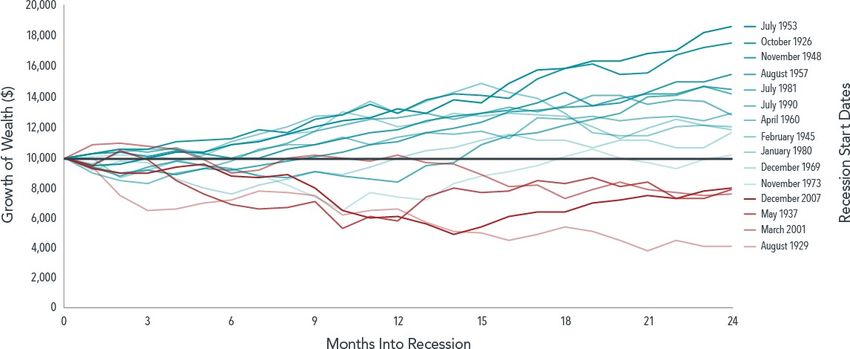
With activity in many industries sharply curtailed in an effort to reduce the Exhibit 1. Downturns, Then Upturns
chances of spreading the coronavirus, some economists say a recession is Growth of wealth for the Fama/French Total US Market Research Index
inevitable, if one hasn’t already begun.1 From a markets perspective, we have
already experienced a drop in stocks, as prices have likely incorporated the
growing chance of recession. Investors may be tempted to abandon equities
and go to cash because of perceptions of recessions and their impact. But
across the two years that follow a recession’s onset, equities have a history of
positive performance.
Data covering the past century’s 15 US recessions show that investors tended
to be rewarded for sticking with stocks. Exhibit 1 shows that in 11 of the 15
instances, or 73% of the time, returns on stocks were positive two years after a
recession began. The annualized market return for the two years following a
recession’s start averaged 7.8%.
Recessions understandably trigger worries over how markets might perform.
But history can be a comfort for investors wondering whether now may be the
time to move out of stocks.
Past performance, including hypothetical performance, is not a guarantee of future
results.
In USD. Performance includes reinvestment of dividends and capital gains. Indices are not available for
direct investment; therefore, their performance does not reflect the expenses associated with the
management of an actual portfolio.
Growth of wealth shows the growth of a hypothetical investment of $10,000 in the securities in the
Fama/French US Total Market Research Index over the 24 months starting the month after the relevant
Recession Start Date. Sample includes 15 recessions as identified by the National Bureau of Economic
Research (NBER) from October 1926 to December 2007.
NBER defines recessions as starting at the peak of a business cycle.
1. Nelson D. Schwartz, “Coronavirus Recession Looms, Its Course ‘Unrecognizable,’” New York Times, March 21, 2020; Peter Coy, “The U.S. May Already Be in a Recession,” Bloomberg Businessweek, March 6, 2020. 18Long-Term Investors, Don’t Let a Recession Faze You (continued from page 18) GLOSSARY Fama/French Total US Market Research Index: The value-weighed US market index is constructed every month, using all issues listed on the NYSE, AMEX, or Nasdaq with available outstanding shares and valid prices for that month and the month before. Exclusions: American Depositary Receipts. Sources: CRSP for value-weighted US market return. Rebalancing: Monthly. Dividends: Reinvested in the paying company until the portfolio is rebalanced. The information in this document is provided in good faith without any warranty and is intended for the recipient’s background information only. It does not constitute investment advice, recommendation, or an offer of any services or products for sale and is not intended to provide a sufficient basis on which to make an investment decision. It is the responsibility of any persons wishing to make a purchase to inform themselves of and observe all applicable laws and regulations. Unauthorized copying, reproducing, duplicating, or transmitting of this document are strictly prohibited. Dimensional accepts no responsibility for loss arising from the use of the information contained herein. “Dimensional” refers to the Dimensional separate but affiliated entities generally, rather than to one particular entity. These entities are Dimensional Fund Advisors LP, Dimensional Fund Advisors Ltd., Dimensional Ireland Limited, DFA Australia Limited, Dimensional Fund Advisors Canada ULC, Dimensional Fund Advisors Pte. Ltd, Dimensional Japan Ltd., and Dimensional Hong Kong Limited. Dimensional Hong Kong Limited is licensed by the Securities and Futures Commission to conduct Type 1 (dealing in securities) regulated activities only and does not provide asset management services. 19
You can also read


