Qualification adaptations for 2021 - For summer 2021 | February 2021 - Ysgol Dyffryn ...
←
→
Page content transcription
If your browser does not render page correctly, please read the page content below
Qual
   ificat
       ionadapt
              ati
                onsf
                   or2021

Fors
   ummer2021|Febr
                uar
                  y2021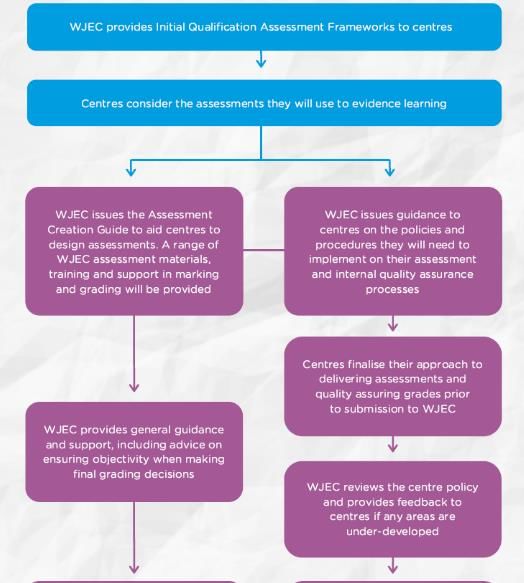
WJEC GCSE, AS and A level
                              Qualification Adaptations for 2021
                        (for units usually assessed by examination)

Contents                                                              Page

1. Introduction                                                        1

2. GCSE Qualifications                                                 2

3. GCE Qualifications                                                 19
1. Introduction
The Minister for Education announced on 10th November 2020 that end of year examinations
will not go ahead in Wales in summer 2021. Furthermore, in a statement made on 20th
January 2021, the Minister for Education confirmed that:
‘learners undertaking GCSE, AS and A levels approved by Qualifications Wales will have
their qualifications awarded through a Centre-Determined Grade model.’
The Minister went on to say that:
‘Qualifications Wales will work with WJEC, supported by the Design and Delivery Advisory
Group (DDAG), to provide an assessment framework to support schools and colleges in
developing their assessment plans, which should demonstrate sufficient coverage of key
concepts to allow learners to progress, and detail for how the centre has determined a
learner’s grade.’
On 9th February 2021 Qualifications Wales released its Guidance for Alternative
Arrangements for Approved GCSEs, AS and A levels in Summer 2021. On 22nd February
WJEC released an individual Qualification Assessment Frameworks for every Qualifications
Wales approved WJEC GCSE, AS and A Level. These frameworks provide teachers with
information to enable them to award fair and reliable grades based on suitable assessment
evidence learners will produce for each qualification. The frameworks are available for
teachers on our secure website. We have provided a learner version of each framework on
the summer 2021 adaptations section on the relevant qualification page of our public
website. The individual frameworks for each qualification complement the subject
adaptations we released in July 2020 (GCSE) and August 2020 (GCE) in consultation with
Qualifications Wales1. There is no expectation that learners should study the content
previously removed from assessment in 2021. This content is outlined in this booklet in
sections 3 and 4 and focuses only on units that would normally be assessed by examination.
Adaptations to NEA also remain in place, further details of which can be found in our Guide
to NEA for summer 2021. In order to understand the full suite of adaptations for our
qualifications, we strongly recommend that you read both booklets, particularly when the
qualification includes NEA, in conjunction with the relevant Qualification Assessment
Framework.
2. Process for awarding centre determined grades
The diagram below provides an overview of how centres will determine grades to award to
their learners for each qualification, including internal and external quality assurance
processes. Further information will be provided to centres as outlined in the Timeline for
Centres published on WJEC’s website.
1
When making adaptations to qualifications for delivery in summer 2021, WJEC followed the
principles set out by Qualifications Wales in its regulatory document Requirements for
adapting Assessments for GQ Qualifications in Wales in 2021, published in July 2020 and
updated in August 2020.
12
2. GCSE Qualifications

There are no adaptations to the assessed content (for units usually assessed by exam) in
the following WJEC GCSE qualifications as these qualifications already have significant
adaptations to their NEA units. Those with adaptations to NEA only are out of scope of this
publication, as are all WJEC Eduqas GCSE (9-1) qualifications (some of which are
designated for use in Wales). For further information on adaptations to Eduqas
qualifications, please see the relevant subject page of our website www.eduqas.co.uk

 WJEC GCSE Qualifications with no adaptations to content             Eduqas GCSE (9-1)
 usually assessed by exam                                            Qualifications designated
                                                                     for use in Wales
 Computer Science                                                    Electronics
 Drama                                                               Film Studies
 Food and Nutrition                                                  Geology
 Health and Social Care and Child Care (Single Award)                Sociology
 Health and Social Care and Child Care (Double Award)
 Music
 PE (Full and Short Course)
 Welsh Second Language

Art and Design is 100% NEA and therefore out of scope of this booklet.

In the following GCSE qualifications, adaptations have been made to assessed content in
units that would normally be assessed by exam.

                                GCSE Qualification
            with adaptations to units normally assessed by examination
 Applied Science (Double Award)        History
 Applied Science (Single Award)        ICT (Single Award)
 Biology                               Mathematics and Mathematics Numeracy
 Business                              Media Studies
 Chemistry                             Physics
 Design and Technology                 Religious Studies
 English Language                      Science (Double Award)
 English Literature                    Spanish
 French                                Welsh Language
 German                                Welsh Literature
 Geography

Past papers provided by WJEC for summer 2021 will not include the content outlined in the
table below. The use of these past papers is optional. The information in the table below
is correct at time of publication and is subject to confirmation of the final assessment
framework.

                                              3
GCSE Subject Unit Mitigation
Applied Science Units 1-3 We recommend the use of teacher demonstrations, video clips and simulations in place of hands-on
(Double Award) practical work.
Applied Science Units 1-2 We recommend the use of teacher demonstrations, video clips and simulations in place of hands-on
(Single Award) practical work.
Biology/Chemistry/Physics Units 1 - 2 We recommend the use of teacher demonstrations, video clips and simulations in place of hands-on
practical work.
Business All units The following content areas will not appear in the past papers provided for 2021:
Business Activity Franchising
The advantages and disadvantages of operating as a franchisor and
franchisee
Influences on Business The European Union and the European single market
The impact of membership and non-membership of the European Union to
businesses and their stakeholders
Business Operations Supply chain
The various stages of the movement of goods and services from their
source to the end customer:
The relationship between the functional areas of a business and its supply
chain
The impact of supply and logistical decisions on businesses and their
stakeholders
Finance What is meant by a cash-flow forecast, construct, calculate and interpret
cash-flow forecasts
The impact of cash-flow forecasts on a business and its stakeholders
Recommend and justify what can be done to improve cash-flow problems
4GCSE Subject Unit Mitigation
Marketing he different pricing strategies used by businesses
The use of different pricing strategies for different businesses in different
contexts and scenarios
Human Resources The importance of having an effective recruitment process to employ the
right people with the right job skills
The recruitment process and how this will differ for different businesses in
different contexts
The different methods of recruitment used by different businesses in
different contexts
The advantages and disadvantages of the different methods of recruitment
The most appropriate recruitment process and methods for different
businesses in different contexts and scenarios
The benefits of a motivated workforce
The methods which businesses use to motivate its workforce
The most appropriate method a business can use to motivate
employees in different contexts and scenarios
Design and Technology Unit 1: Design and The following amplification points currently in the Design and Technology specifications will not appear in
Technology in the the past papers provided for 2021. Learners may still choose to use any amplification point removed as
Engineering Design 21st Century part of their NEA studies.
Fashion and Textiles
Product Design Engineering Design
Content Amplification bullet points that are not subject to assessment
a Ferrous Metals
• Strengths and weaknesses.
• Cast iron, mild steel, medium carbon steel and high carbon steel.
• Stainless steel, high-speed steel and high-tensile steel.
• Physical properties including melting point, thermal and electrical conductivity.
b Nil
c Nil
5GCSE Subject Unit Mitigation
Engineering Design (Cont.)
Content Amplification bullet points that are not subject to assessment
d • Quantum Tunnelling Composite (QTC) – when used in circuits the resistance
changes under compression.
e • Pulley systems, for example curtain rails, sewing machine.
• Levers and linkages, for example scissors.
f • The function of AND, OR, EOR, NOT, and NAND logic gates.
• Combining logic gates to form control systems.
• Levers
g Nil
h • Manufactured boards are commonly available in sheet form and in standard sizes and
various thicknesses.
i Nil
j Under: Deforming/Reforming
• Bending plastics.
• Laser cutter.
• 3D printing.
Under: Assembly and components
• Components for a particular purpose, including nuts, bolts, washers, screws, rivets.
The main stages in the following joining processes:
Temporary: machine bolt and nut, self-tapping bolts, cutting threads for appropriate fixing
bolt.
6GCSE Subject Unit Mitigation
Fashion and Textiles
Content Amplification bullet points that are not subject to assessment
a • Regenerated: Viscose, rayon, acetate, lyocell (Tencel®)
b Under technical textiles remove reference to:
• Geo textiles for landscaping and agricultural textiles
• Bonding breathable waterproof membranes to outer fabrics for all-weather wear:
Gore-tex, Permatex, Sympatex
• Nomex
c • The differences between a thermoforming (thermoplastic) and thermosetting material
d • Microfibres in clothing manufacture
• Phase changing materials: breathable materials, pro-active heat and moisture
management
e • Blending and mixing fibres to improve the properties and uses of yarns and materials
• Blends for example: polyester and cotton, silk and viscose, hemp and cotton or silk.
• Mixture for example: cotton and wool, lycra with wool or nylon.
• Bonding breathable waterproof membranes to outer fabrics for all weather wear
(Gore-tex, Permatex)
f • To enhance aesthetic quality:
Colouring, surface decoration, glazing, stiffening, increasing lustre, (calendaring,
mercerising), brushing, stain resistance (Scotch guard, Teflon).
g Nil
h • How manufacturing systems are organised: line production, progressive bundle
system and production.
i • Hot notch marking in industry
j • Painting: felt tip, dimensional, fabric paint, silk paints
7GCSE Subject Unit Mitigation
Product Design
Content Amplification bullet points that are not subject to assessment
a • The aesthetic and functional properties of common papers, cards and boards
including cartridge paper, photocopy paper, bleed proof paper, mounting board,
foam board, solid white board, corrugated board and duplex board.
b • The aesthetic and functional properties of hardwoods and softwoods including beech,
oak, balsa, jelutong, scots pine, western red cedar and parana pine.
• Natural timber is protected using different finishes and these finishes are sometimes
used to improve aesthetic appeal.
c Nil
d Nil
e • Quantum Tunnelling Composite (QTC) ‐ when used in circuits the resistance changes
under compression.
• Polymorph
• Thermochromic polymers or dyes
f Natural and Manufactured timber
• The difference between a hardwood and softwood.
Papers and boards
• The basic sources of paper and boards.
• Recycled boards.
• The use of microns to measure thickness of paper and boards.
• The physical and working properties of paper and board including: texture, weight,
thickness, strength, surface finish, transparency, folding ability and absorbency.
8GCSE Subject Unit Mitigation
g Nil
h • Natural timber is available in different sectional forms, various standard sizes and can
have a different finish (sawn or planed).
• Plastic polymers are available in a wide range of forms including: powders, granules,
pellets, liquids, films, sheets and extruded shapes.
• Standard sizes of papers and boards. i.e. rolls, A5, A4, A3. and measured in grams
per square metre.
i • On‐press and the finishing processes used by commercial printers to produce
products in batches or mass/high volume.
j Nil
9GCSE Subject Unit Mitigation
English Language Unit 2: Description, Learners may choose to study either description writing or exposition writing.
Narration and Exposition
Narration writing will not appear in the past papers provided for 2021.
Unit 3: Argumentation, In the past papers provided for 2021, learners may choose either the argumentation task or the
Persuasion and persuasion task.
Instructional
English Literature Unit 1: Prose (different Learners may choose to study the content of:
cultures) and Poetry
(contemporary) and • either Unit 1 content: Prose (different cultures) and Poetry (contemporary)
Unit 2: Unit 2a content: • or Unit 2a content: Literary Heritage Drama and Contemporary Prose
Literary Heritage Drama
and Contemporary Prose • or Unit 2b content: Contemporary Drama and Literary Heritage Prose
Unit 2b content:
Contemporary Drama and
Literary Heritage Prose
10GCSE Subject Unit Mitigation
French Unit 1: Speaking Task 2 (photo card discussion) was removed from assessment in 2021. Past paper assessments
German will be made available to assist centres in delivering this unit.
Spanish
The recommended length of the assessment has been reduced by two minutes (currently 7-9
minutes) on the foundation tier and three minutes (currently 10-12 minutes) on the higher tier to
take into account the removal of task 2. This assessment length is now advisory and teachers are
permitted to relax this control if this would help support learners to complete their NEA. Teachers
should also ensure that learners are given adequate time to prepare. We recommend that each
learner has 12 minutes uninterrupted preparation time immediately beforehand.
Learners may select their own sub-sub-theme for Part 1 of the Conversation. We recommend that
the choice of sub-sub-theme is agreed between the learner and the teacher no later than two
weeks before the assessment takes place.
The following five sub-sub-themes have been removed from assessment in the Role Play task
and Part 2 of the Conversation in 2021:
• Theme 1: i) Technology and social media; ii) Festivals and celebrations
• Theme 2: iii) Local and regional features and characteristics of France/Germany/Spain and
French-/German-/Spanish-speaking countries; iv) Social issues
Theme 3: v) Post-16 study.
French Unit 4: Writing Translation from English/Welsh into French/German/Spanish will not appear in the past papers
German provided for 2021.
Spanish
The following five sub-sub-themes will also not appear in the past papers provided for 2021:
i) Technology and social media (Theme 1)
ii) Festivals and celebrations (Theme 1)
iii) Local and regional features and characteristics of France/Germany/Spain and French-
/German-/Spanish-speaking countries (Theme 2)
iv) Social issues (Theme 2)
v) Post-16 study (Theme 3).
11GCSE Subject Unit Mitigation
Geography Unit 1: Changing Physical The following content will not appear in the past papers provided for 2021.
and Human Landscapes
Theme 1: Landscapes and Physical Processes
1.1.2 How are physical landscapes in Wales affected by human activity?
The environmental challenges created by human activity in one distinctive landscape
to include the positive and negative impacts of visitor pressure and changing rural
economies and societies. The concepts of honey pot sites and carrying capacity.
1.1.3 How can landscapes in Wales be managed?
Strategies to manage the landscape, to include management of visitors, and to repair
damage to landscapes or environments under pressure (for example, footpath
maintenance).
Theme 2: Rural-Urban Links
2.3.2 What are the consequences of urbanisation in two global cities?
Ways of life in two global cities. One city must be located in either a low-income
country (LIC) or newly industrialised country (NIC). The other city must be located in a
high-income country (HIC). For each city, learners must set their studies within the
regional, national and global context of that city.
For each city:
(a) The reasons for its growth to include natural population change and
migration. How each city is connected to its wider city-region and to
other parts of the world by migration. Push and pull factors for rural to
urban migration at the regional/national scale and reasons for historic or
recent international migration.
(b) Ways of life to include social and cultural patterns within each city.
The contribution of the informal economy in the LIC/NIC city.
(c) Current urban challenges to include reducing poverty/ deprivation
and providing housing.
12GCSE Subject Unit Mitigation
Geography Unit 2: Environmental and The following content will not appear in the past papers provided for 2021.
Development Issues
Theme 5: Weather, Climate and Ecosystems
5.2.1 What are the causes and consequences of two weather hazards?
An overview of global circulation of the atmosphere. How global circulation creates
areas of low and high pressure. How these different pressure systems each lead to
weather hazards.
Low pressure: The global distribution of areas affected by hurricanes/cyclones. Their
changing patterns over time to include annual seasonality and longer-term changes to
frequency and magnitude. Detailed study of a least one located low-pressure hazard
to include its causes and consequences for people, environment and economy.
High pressure: The global distribution of areas affected by heatwaves and drought.
Their changing patterns over time to include longer term changes to frequency and
magnitude (for example, changing patterns of drought in Australia or Sahel countries
over the last 50-100 years). Detailed study of a least one located high-pressure
hazard to include its causes and consequences for people, environment and
economy.
Theme 6: Development and Resource Issues
6.3.2 Are water resources being managed sustainably?
How and why people manage water supply through the construction of
reservoirs for water supply/irrigation and HEP projects, water transfer schemes
and the abstraction of groundwater.
The social, economic and environmental consequences of water
management in each of the following situations:
1. The management of water resources at an international scale, where
rivers cross national boundaries
2. Small scale water management project where appropriate levels of
technology are used (for example, rainwater harvesting).
3. One location where over-abstraction of groundwater is an issue and
where alternate geographical futures are considered.
13GCSE Subject Unit Mitigation
History Unit 1: Wales and the Learners may choose to study the content from:
Wider Perspective,
• Either Unit 1: Wales and the Wider Perspective and Unit 2: History with a European/World
Unit 2: History with a Focus
European/World Focus • Or Unit 1: Wales and the Wider Perspective and Unit 3: Thematic Studies from a Broad
and Historical Perspective
• Or Unit 2: History with a European/World Focus and Unit 3: Thematic Studies from a Broad
Unit 3: Thematic Studies Historical Perspective.
from a Broad Historical
Perspective
ICT (Single Award and Unit 1 and 3 Unit 1 has been removed from assessment of the Single Award in 2021. There are no changes to
Short Course) the content of this unit.
Please note that Unit 1 will be assessed if candidates are following the short course.
There are no changes to the content of unit 3.
Mathematics/Mathematics All units For GCSE Mathematics/Mathematics-Numeracy, the following topics will not appear in the past
Numeracy papers provided for 2021.
Foundation tier topics are in standard text.
Intermediate tier topics that are in addition to foundation tier topics are in underlined text.
Higher tier topics that are in addition to intermediate tier topics are in bold text.
Mathematics-
Topics that will not appear in the past Numeracy and
Additional Comments
papers for 2021. Mathematics OR
Mathematics only
Number
1 Understanding annual rates, e.g. AER, Mathematics-
APR. Numeracy and
Mathematics
2 Understanding and using Venn diagrams to Mathematics-
solve problems. Numeracy and
Mathematics
14Algebra
3 Finding the nth term of a sequence where the Mathematics only The following could be
rule is quadratic. assessed:
Finding the nth term of a
sequence where the rule is
linear.
4 Drawing, interpretation, recognition and Mathematics only Drawing, interpretation,
sketching the graphs of y = a , recognition and sketching of
x graphs of linear and quadratic
y = ax3. functions could be assessed.
Drawing and interpretation of graphs of
y = ax3 + b.
Drawing and interpretation of graphs of
a
y = ax + b + with x not equal to 0,
x
y = ax3 + bx2 + cx + d,
y = kx for integer values of x and simple
positive values of k.
Drawing and interpreting graphs when y is
given implicitly in terms of x.
5 The use of straight-line graphs to locate Mathematics only
regions given by linear inequalities.
6 Distinguishing in meaning between Mathematics only It is only identities that will not
equations, formulae, identities and be assessed. The following
expressions. could be assessed:
Distinguishing in meaning
between equations, formulae
and expressions.
Mathematics-
Topics that will not appear in the past Numeracy and
Additional Comments
papers for 2021. Mathematics OR
Mathematics only
Geometry and Measure
157 Interpretation and drawing of nets. Mathematics-
Numeracy and
Mathematics
8 Drawing 2-D representations of 3-D shapes, Mathematics- The following could be
including the use of isometric paper. Numeracy and assessed:
Mathematics Using 2-D representations of 3-
D shapes (but not ones drawn
on isometric paper).
9 Bisecting a given line, bisecting a given Mathematics- The following could be
angle. Numeracy and assessed (but not in questions
Constructing the perpendicular from a point to Mathematics assessing constructions):
a line. Accurate use of ruler, pair of
compasses and protractor.
10 Constructing 2-D shapes from given Mathematics-
information and drawing plans and elevations Numeracy and
of any 3-D solid. Mathematics
11 Use of ruler and pair of compasses to do Mathematics only
constructions.
Construction of triangles, quadrilaterals and
circles.
Constructing angles of 60°, 30°, 90° and 45°.
12 The identification of congruent shapes. Mathematics only
Understanding and using SSS, SAS, ASA
and RHS conditions to prove the
congruence of triangles using formal
arguments.
Reasons may be required in the solution
of problems involving congruent triangles.
13 Using angle and tangent properties of circles. Mathematics only
Understanding that the tangent at any point
on a circle is perpendicular to the radius at
that point.
Using the facts that the angle subtended by
an arc at the centre of a circle is twice the
16angle subtended at any point on the
circumference, that the angle subtended at
the circumference by a semicircle is a right
angle, that angles in the same segment are
equal, and that opposite angles of a cyclic
quadrilateral sum to 180°.
Using the alternate segment theorem.
Understanding and using the fact that
tangents from an external point are equal in
length.
Understanding and constructing
geometrical proofs using circle theorems.
Mathematics-
Topics that will not appear in the past Numeracy and
Additional Comments
papers for 2021. Mathematics OR
Mathematics only
14 Location determined by distance from a given Mathematics only
point and angle made with a given line.
15 Solving problems in the context of tiling Mathematics-
patterns and tessellation. Numeracy and
Mathematics
16 Constructing the locus of a point which Mathematics-
moves such that it satisfies certain conditions, Numeracy and
for example, Mathematics
(i) a given distance from a fixed point or line,
(ii) equidistant from two fixed points or lines.
Solving problems involving intersecting loci in
two dimensions.
Questions on loci may involve inequalities.
17 Distinguishing between formulae for length, Mathematics-
area and volume by considering dimensions. Numeracy and
Mathematics
1718 Using the compound measures: density and Mathematics- All compound measures that
population density. Numeracy and are not density-related, e.g.
Using compound measures that relate to Mathematics speed, could be assessed.
density, such as kg/m3, g/cm3, population per
km2
Statistics
19 Specifying the data needed and considering Mathematics- The following could be
potential sampling methods. Numeracy and assessed:
Sampling systematically. Mathematics Considering the effect of
Working with stratified sampling sample size and other factors
techniques and defining a random that affect the reliability of
sample. conclusions drawn.
20 Designing and criticising questions for a Mathematics- Learners will need to
questionnaire, including notions of fairness Numeracy and understand the notion of
and bias. Mathematics fairness and bias, but not in the
context of questionnaires.
21 Estimating the probability of an event as the Mathematics only The following could be
proportion of times it has occurred. assessed:
Calculating theoretical
Relative frequency. probabilities based on equally
likely outcomes.
Understanding the long-term stability of
relative frequency.
Graphical representation of relative frequency
against the number of trials.
Estimating probabilities based on
experimental evidence.
Comparing an estimated probability from
experimental results with a theoretical
probability.
22 Identifying all the outcomes of a combination Mathematics only Identifying outcomes using all
of two experiments using Venn diagrams. other methods could be
assessed.
18GCSE Subject Unit Mitigation
Media Studies Unit 2: Understanding TV Learners may choose to study either Section A: Wales on Television or Section B:
and Film Contemporary Hollywood Film.
A choice will be indicated in past paper assessments provided for 2021.
Religious Studies Unit 1: Religious We recommend that Learners cover three out of the four topic areas in Unit 1.
Responses to Philosophical
Themes Non-religious beliefs will not appear in the past paper questions provided for the Unit 1 Life and
Death topic in 2021. However, we recommend that non-religious beliefs should be studied
within the wider context of the topic.
The C. Questions on the Philosophical and Ethical Themes will be from the perspective of TWO
religions (Christianity PLUS the second religion) on the past papers provided for 2021.
Units 2/3: Religious We recommend that Learners cover three out of the four topic areas in Units 2/3.
Responses to Ethical
Themes The C. Questions on the Philosophical and Ethical Themes will be from the perspective of TWO
religions (Christianity PLUS the second religion) on the past papers provided for 2021.
Science (Double Award) Units 1-6 We recommend the use of teacher demonstrations, video clips and simulations in place of
hands-on practical work.
Welsh Language Unit 2: Reading and Writing: Learners may choose to study either description writing or exposition writing. Narration writing
Describing, Narrative and will not appear in the past papers provided for 2021.
Exposition
Welsh Language Unit 3: Reading and Writing: In the past papers provided for 2021, learners may choose either the argumentation task or the
Argumentation, Persuasion persuasion task.
and Instructional
Welsh Literature Unit 1: Poetry and Learners may choose to study the content of either Unit 1: Poetry or Unit 2: Novel.
Unit 2: Novel.
193. GCE Qualifications
There are no adaptations to the assessed content (for units usually assessed by exam) in
the following WJEC GCE qualifications as these qualifications already have significant
adaptations to NEA. Those with adaptations to NEA only are out of scope of this publication,
as are all WJEC Eduqas GCE A level and AS qualifications (some of which are designated
for use in Wales). For further information on adaptations to Eduqas qualifications, please see
the relevant subject page of our website www.eduqas.co.uk
WJEC GCE Qualifications with no adaptations Eduqas GCE A level Qualifications
to content usually assessed by exam designated for use in Wales
Applied ICT Electronics
Design and Technology Film Studies
Drama and Theatre Geology
English Language
English Language and Literature Eduqas GCE AS Qualifications
English Literature designated for use in Wales
Health and Social Care and Childcare (AS only) Electronics
Health and Social Care (Legacy)* Film Studies
Media Studies Geology
Music
Physical Education
*Although Health and Social Care (Legacy) Single Award, Unit 7 is an NEA unit, we will still
provide past assessment materials for this unit and not release a new assessment as we
normally would.
Art and Design is 100% NEA and therefore out of scope of the booklet.
For GCE AS and A level English Language, English Literature, and English Language and
Literature, content continues in 2021 as prescribed in the relevant specification. We did not
adapt these subjects earlier this year because the nature or structure of those assessments
meant that all adaptations considered introduced as many issues or risks as they aimed to
mitigate.
20
© WJEC CBAC Ltd.In the following GCE qualifications, adaptations have been made to assessed content in
units that are usually assessed by exam.
GCE Qualifications
with adaptations to units normally assessed by examination
Biology ICT
Business Law
Chemistry Mathematics
Computer Science Further Mathematics
Economics Physics
French Psychology
Geography Religious Studies
German Spanish
Geography Sociology
Government and Politics Welsh First Language
History Welsh Second Language
Past papers provided by WJEC for summer 2021 will not include the content outlined in the
table below. The use of these past papers is optional. The information in the table below
is correct at time of publication and is subject to confirmation of the final assessment
framework.
21
© WJEC CBAC Ltd.GCE Subject Unit Mitigation
Biology AS Units 1 + 2 We recommend the use of teacher demonstrations, video clips and simulations in place of hands-on
Chemistry practical work.
Physics
A2 Units 3 + 4 Synoptic element – AS content that is not developed or required for Units 3 and 4 will not appear in the
past papers provided for 2021.
We recommend the use of teacher demonstrations, video clips and simulations in place of hands-on
practical work.
Business Unit 3: Business The following 6 topic content areas will not appear in the past papers provided for 2021:
Analysis and Strategy
• Price and income elasticity of demand
• Budget variances
• Porters Five Forces framework
• Rationalisation
• Decision trees
• Investment appraisal.
Computer Science Unit 3: Programming The following distinct topic content areas (subheadings in the left-hand column of the specification) will
and System not appear in the past papers provided for 2021:
Development
• 6. System design
• 8. Program construction.
Unit 4 Computer The following distinct topic content areas (subheadings in the left-hand column of the specification) will
Architecture, Data, not appear in the past papers provided for 2021:
Communication and
Applications • 1. Hardware and communication - Input / output, networking
• 6. The operating system – Memory management and buffering, Scheduling
• 7. The need for different types of software systems and their attributes – Safety related systems,
Control systems, Expert systems
22
© WJEC CBAC Ltd.GCE Subject Unit Mitigation
Economics Unit 3: Exploring The following 3 topic content areas will not appear in the past papers provided for 2021:
Economic Behaviour
• Competition Policy and Privatisation
Unit 4: Evaluating
Economic Models and • Financial Stability
Policies • European Union.
French A2 Unit 4 Listening, The following subthemes will not appear in the past papers provided for 2021. Learners may still choose to
German Reading and draw on these themes in their answers to more open-ended questions.
Spanish Translation
• French – Repercussions for modern-day France (Theme 4)
• German – Social cohesion in present-day Germany (Theme 4)
• Spanish – Cultural Enrichment and Celebrating Difference (Theme 3).
Geography Unit 2: Changing Section B: Physical and Human Fieldwork Investigation
Places
We recommend that learners undertake a minimum of one fieldwork experience in preparation for
assessment where it is safe and practicable to do so. This experience may be within the context of
physical or human geography (or may be within the context of people-environment questions and issues).
This fieldwork experience should equip learners with the required knowledge and understanding applied to
the six stages of the enquiry process as outlined in Section 2a. of the specification.
Past Paper assessments provided for 2021 will allow learners to respond to questions 4 and 5 in Section B
on a single fieldwork experience, where necessary.
Unit 4: Contemporary Section B: Contemporary Themes in Geography
Themes in Geography
On past paper assessments provided for 2021, learners will be able to respond to questions on one
optional theme only from Section B.
23
© WJEC CBAC Ltd.GCE Subject Unit Mitigation
Government and Unit 3 Political The following content will not appear in the past papers provided for 2021. Consequently, learners will only be
Politics concepts and asked to answer one question in section B.
theories
In 3.1.2 Liberal views, * The impact of liberal ideas on global politics.
In 3.2.2 Conservative views, * The impact of conservative ideas on global politics.
In 3.3.2 Socialist views, * The impact of socialist ideas on global politics.
In 3.4.2 Nationalist views, * The impact of nationalist ideas on global politics.
Unit 4 Government The following content will not appear in the past papers provided for 2021. Consequently, learners will only be
and politics of the asked to answer one question in section B.
USA
In 4.1.3 The Bill of Rights, remove ‘death penalty’ from * Contemporary debates about civil rights and civil
liberties in the USA: gun ownership; death penalty and privacy. So, this bullet point would read *
Contemporary debates about civil rights and civil liberties in the USA: gun ownership and privacy.
In 4.2.2 The US President home and abroad, * Debates concerning the relative power and influence of the
Cabinet and the Executive Office of President.
In 4.2.3 The US Supreme Court, * The impact of the landmark cases of Marbury vs Madison (1803) and
McCulloch vs Maryland (1819).
In 4.3.3 Political parties in the US, * Reasons for two-party dominance; the significance of third parties and
independent candidates.
24
© WJEC CBAC Ltd.GCE Subject Unit Mitigation
History Unit 3: Breadth The narrow timeframe questions have been removed from assessment in 2021. However, centres may
study choose to offer these questions if they wish. For this reason, the past papers have not been adapted and we
recommend that centres choose one of the following routes.
Either Route One:
Complete two Section B questions from two past papers, ensuring that the questions in the past papers
selected assess both Theme 1 and Theme 2
Or Route Two:
Complete one past paper, utilising one of the Section A questions in addition to the Section B question
ICT Unit 1: Information Section B content will not appear in the past papers provided for 2021.
Systems This removes the need to produce a spreadsheet.
Unit 3: Use and The following topic content areas will not appear in the past papers provided for 2021:
Impact of ICT
• 4.3.1 Networks – Choosing a network for a company, Network topologies, Wireless networking
• 4.3.5 ICT Security Policies – Prevention of accidental misuse, Prevention of deliberate crimes or misuse
• 4.3.9 Management Information Systems (MIS) – Features of an effective MIS, Understand the flow of
information between external and internal components of an MIS, Features of good MIS
• 4.3.10 Systems Development Life Cycle (SDLC) – System Design, System Implementation, System
Maintenance, System Evaluation.
Law Unit 3: The The following topics will not appear in the past papers provided for 2021:
Practice of
Substantive Law • Human rights option - from 3.3 - breach of confidence, obscenity and torts of trespass and harassment.
• Contract law option - from 3.7 - Privity of contract and from 3.9 - Economic duress.
Unit 4: Substantive • Criminal law - from 3.15 - Property offences, including theft and robbery and from 3.17 - preliminary
Law Perspectives offences of attempts
25
© WJEC CBAC Ltd.GCE Subject Unit Mitigation
Mathematics Unit 3 The content detailed below will not appear in the past papers provided for 2021.
Content that will NOT be included on the past papers provided for summer 2021
A2 Unit 3 – Pure Mathematics B
2.3.1 Proof
Proof by contradiction (including proof of the irrationality of 2 and the infinity of primes,
and application to unfamiliar proofs).
2.3.8 Numerical Methods
Locate roots of f (x) = 0 by considering changes in sign of f (x) in an interval of x in which
f(x) is sufficiently well-behaved.
Understand how change of sign methods can fail.
Solve equations approximately using simple iterative methods; be able to draw associated
cobweb and staircase diagrams.
Solve equations using the Newton-Raphson method and other recurrence relations of the
form xn + 1 = g (xn).
Understand how such methods can fail.
Understand and use numerical integration of functions, including the use of the trapezium
rule and estimating the approximate area under a curve and limits that it must lie between.
Use numerical methods to solve problems in context.
Further Mathematics Units 4-6 The content detailed below will not be included on the past papers provided for summer 2021. We
recommend that learners study Unit 4 and either Unit 5 or Unit 6.
26
© WJEC CBAC Ltd.Content that will NOT be included on the past papers
Additional Comments
provided for summer 2021
A2 Unit 4 – Further Pure Mathematics B
2.4.4 Further Algebra and Functions
Find the Maclaurin series of a function (including the ONLY the Maclaurin series in
general term). section 2.4.4 will not be
included.
Recognise and use the Maclaurin series for e x ,
and (1 + x) ,
n The following, from section
ln( 1 + x ) , sin x , cos x 2.4.4, could be included:
and be aware of the range of values of x for which they Understand and use partial
are valid. fractions with denominators of
the form (ax + b)(cx + d) .
2
Content that will NOT be included on the past papers
Additional Comments
provided for summer 2021
A2 Unit 5 – Further Statistics B (optional unit)
2.5.3 Hypothesis Testing
ONLY Understand and use tests for
(b) difference of two means for two independent normal None
distributions with known variances.
2.5.4 Estimation
ONLY Understand and use confidence limits for
(a) the mean of a normal distribution with None
(ii) unknown variance.
A2 Unit 6 – Further Mechanics B (optional unit)
2.6.3 Moments and Centre of Mass
Understand and use the centre of mass of uniform
None
rigid bodies and composite bodies.
27
© WJEC CBAC Ltd.GCE Subject Unit Mitigation
Psychology Unit 3: Psychology: Section B: We recommend that learners study four controversies, rather than the usual five controversies.
Implications in the
Real World The following content will not be included on the past papers provided for summer 2021:
Cultural Bias
• cross cultural studies
• difference or bias
• ethnocentrism
• historical and social context
As questions about Cultural Bias have been removed, this may mean that adapted past papers may only have
one question available for learners to attempt, rather than the usual two questions.
Unit 4: Psychology: Section A: Personal Investigations – we recommend that learners study just one of the personal investigations,
Applied Research specifically ‘A questionnaire study of perceived wellbeing after exercise’.
Methods
Learners need not undertake 'A correlational study of time spent revising and scores on a test'.
The following Unit 2 Section B content in Unit 4 will not appear in the past papers provided for summer
2021:
• Milgram, S. (1963). Behavioral study of Obedience. Journal of Abnormal and Social
Psychology, 67, 371-8
• Kohlberg, L. (1968). The child as a moral philosopher. Psychology Today, 2, 25-30
The ‘Section A: Personal Investigations’ in past papers does not apply to the personal investigation titles for
2021. Therefore, the Section A of the adapted past papers includes questions relevant to this year’s
investigation, ‘A questionnaire study of perceived wellbeing after exercise’.
28
© WJEC CBAC Ltd.GCE Subject Unit Mitigation
Religious Studies Unit 5: A Study of Theme 4 will not appear in the past papers provided for summer 2021.
the Philosophy of
Religion Theme 4 consists of:
Theme 4 Subtheme 4A: Religious language as non-cognitive and symbolic
Theme 4 Subtheme 4B: Religious language as non-cognitive and mythical
Theme 4 Subtheme 4C: Religious language as a language game
and their accompanying AO2 issues for evaluation:
• The effectiveness of the terms non-cognitive, analogical and mythical as solutions to the problems of
religious language.
• The relevance of religious language issues in the 21st Century.
• The extent to which language games provide a suitable way of resolving the problems of religious
language.
• Whether symbolic language can be agreed as having adequate meaning as a form of language.
• How far the works of Randall and Tillich provide a suitable counter-challenge to logical positivism.
• Whether the strengths of language games outweigh the weaknesses.
Sociology Unit 3 Power and On past papers provided for 2021, questions 1b and c; 2b and c; 3b and c; 4b and c will only cover the
Control following:
Crime and deviance - theories and explanations of crime and deviance: functionalist, Marxist, neo-Marxist,
interactionist, right and left realism, postmodernist, feminist, sub-cultural.
Health and disability - theories and explanations of health and disability: functionalist, Marxist, interactionist,
feminist, postmodernist, biomedical model.
Politics - theories and explanations of power and politics: functionalist, Marxist, neo-Marxist, postmodernist,
Weberian, pluralist, elite theories.
World Sociology - theories and explanations of development: Marxist, modernisation, dependency, world
systems theory.
29
© WJEC CBAC Ltd.GCE Subject Unit Mitigation
Welsh First Language Unit 5: Medieval Prose, Section B – Early and Medieval Poetry
Early and Medieval
Poetry The number of set poems by one of the poets has been reduced - Dafydd ap Gwilym from 3 to 2. Total
number of poems has reduced from 7 to 6.
The set poem which will NOT appear on past paper assessments for 2021 is ‘Yr Wylan’.
Unit 6: Appreciation of Section B – Welsh Language in Context
Literature, Welsh
Language in Context The number of writing forms to be studied has been reduced from 7 to 5.
The writing forms which will NOT appear on past paper assessments for 2021 are:
• minutes of a meeting
• address.
Welsh Second Unit 5: The Language Section A – The Language in Society
Language in Society and
Translanguaging The period of study of the Welsh language in society has been reduced from the middle of the 20th
century to the present day to the 1980s to the present day.
Unit 6: The Use of Section B – The Short Story
Language and the
Short Story The number of short stories to be studied has been reduced from 4 to 3.
The set text which will NOT appear on past paper assessments for 2021 is ‘Trŵ lyf’ (Cariad Pur?:
Marlyn Samuel).
30
© WJEC CBAC Ltd.You can also read


